Penile Lymphocele: Hard Vein or Lump After Sex Explained
In short
- A penile lymphocele is a firm, rope-like or bubbly swelling under the skin of the penis, often just behind the head, that appears after vigorous sex or masturbation.
- It's a blocked or swollen lymph vessel, sometimes called lymphangiosclerosis or sclerosing lymphangitis.
- It's harmless and usually goes away on its own within a few weeks if you give your penis a rest.
A penile lymphocele is a firm, rope-like or bubbly swelling under the skin of the penis, usually just behind the head, that appears a day or two after vigorous sex or masturbation. It can feel like a hard vein or a cord that wraps part of the way around the shaft.
It's a swollen or blocked lymph vessel, not a vein, and it's harmless. Doctors also call it lymphangiosclerosis or sclerosing lymphangitis. It usually goes away on its own within a few weeks if you give your penis a rest. This page explains what it looks like, why it happens, how to tell it from other lumps, and when to see a doctor.
By the numbers: of the 6,026 men who shared their experiences with hard flaccid syndrome, 2,661 described their symptoms, and 194 of them described prominent or bulging veins.
Key facts
- A penile lymphocele is a firm, rope-like or beaded swelling under the skin, most often in the groove just behind the head of the penis.
- It's caused by a lymph vessel that has become blocked or swollen, usually after vigorous or long sex or masturbation.
- It's usually painless or only a little tender, and you can often move the skin over it.
- It isn't a sexually transmitted infection and isn't dangerous.
- It usually goes away on its own within a few weeks. A break from sexual activity helps.
What is a penile lymphocele?
Lymph is a clear fluid that drains from your body's tissues through thin vessels, like a second set of veins. The skin of the penis has a network of these lymph vessels just under the surface.
A lymphocele forms when one of these vessels becomes swollen with fluid or blocked, for example after a lot of friction or pressure. When the vessel wall also hardens for a while, doctors call it lymphangiosclerosis or sclerosing lymphangitis. Some researchers prefer the name benign transient lymphangiectasis, which simply means a harmless, short-lived widening of a lymph vessel.
Related: Death Grip Syndrome: Is It Real? What 125 Men Say »
What does a penile lymphocele look like?
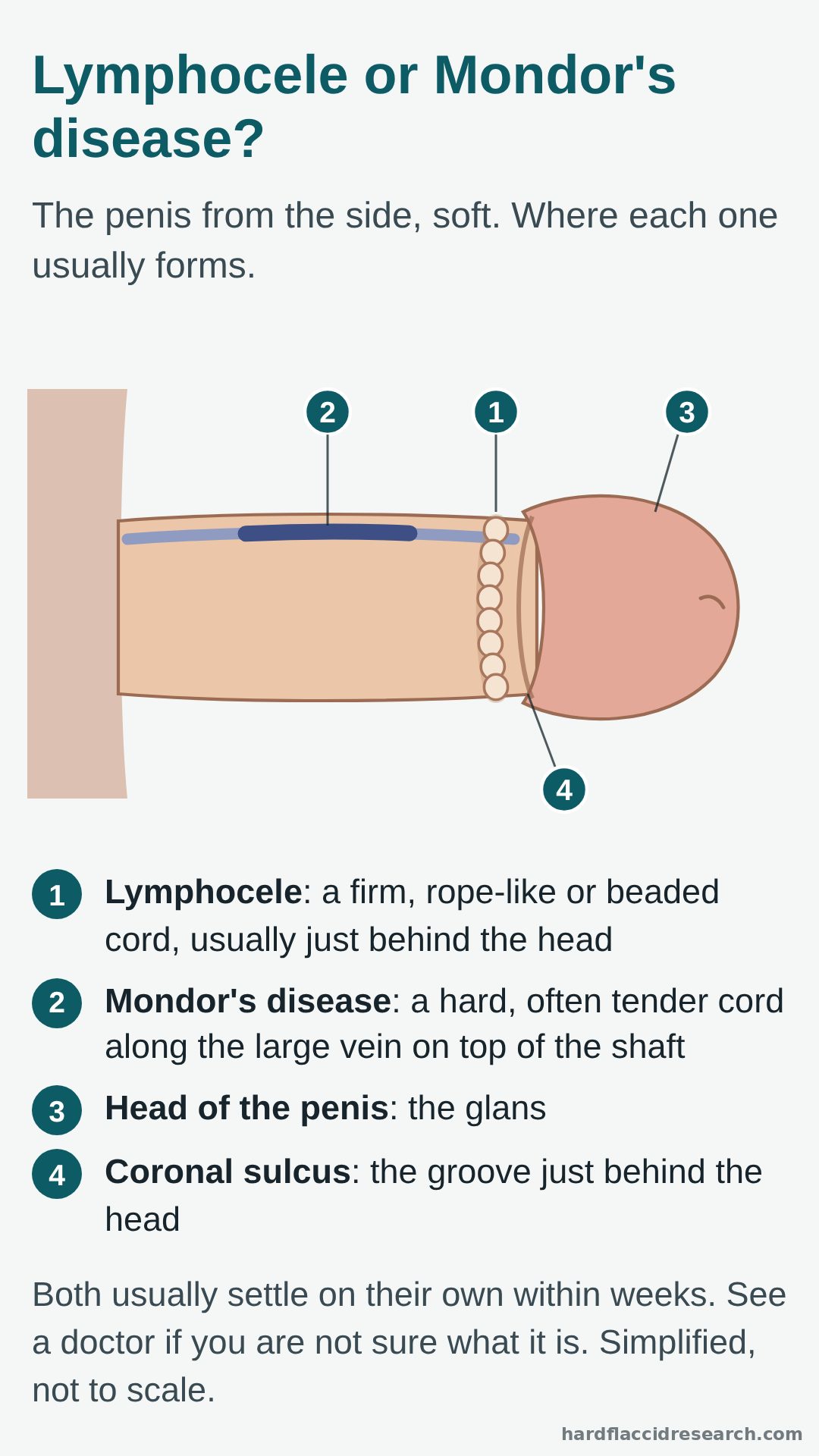
- A firm, smooth cord, like a piece of string or a cooked spaghetti noodle, under the skin.
- Most often in the coronal sulcus, the groove just behind the head of the penis, running part or all of the way around.
- Sometimes a short cord or a bubbly, beaded swelling along the shaft.
- Skin-colored or a little translucent, not red or dark.
- More noticeable when the penis is soft, and often more prominent during an erection.
- Painless or only mildly tender, with no discharge or sore.
What causes a penile lymphocele?
It nearly always follows a lot of friction or pressure on the penis, such as:
- Vigorous or long sex or masturbation, or several sessions close together.
- A tight grip, or masturbation without lubrication.
- Pressure from a tight ring, band or clothing.
- Less often, after surgery such as circumcision.
Researchers have looked for an infection as a cause but found little support for one. The condition seems to come from the friction itself.
Related: Gabapentin for Hard Flaccid: Worth the Side Effects? »
Is it a lymphocele, a vein or Mondor's disease?
Several things can feel like a hard vein on the penis. Here's how they usually differ:
Normal veins
The veins on the shaft can look bigger and bluer after sex, exercise or heat, and they're often more visible during an erection. They're soft, you can press them flat, and they follow the length of the shaft rather than wrapping around it.
Penile Mondor's disease
Mondor's disease is a blood clot in the large vein along the top of the shaft (the superficial dorsal vein). It can also follow vigorous sex. It feels like a hard, often tender cord along the top of the penis, sometimes with an ache or bruising. Like a lymphocele, it usually settles on its own within weeks, but it's worth seeing a doctor to confirm it. A Doppler ultrasound scan can show the clot.
Peyronie's disease
Peyronie's disease causes a firm patch of scar tissue (a plaque) deeper inside the penis, which can cause a curve or a dent during erection. It doesn't sit under the skin like a cord. A new curve is worth getting checked early.
Other lumps
Pearly penile papules (small, harmless bumps around the rim of the head), cysts, genital warts and sores from infections look different from a smooth cord. Anything with a sore, a discharge, rapid growth or a rash needs a doctor's check.
Penile lymphocele and hard flaccid syndrome
Hard flaccid syndrome is a firm, shrunken penis at rest, often with numbness, weaker erections and pelvic pain. Many men with hard flaccid check their penis closely and notice veins and cords they hadn't seen before.
Of the 2,661 men who described their symptoms, 7% described prominent or bulging veins (194 men). A description can't tell a vein from a swollen lymph vessel. In separate counts, 125 men blamed aggressive masturbation and 34 blamed rough sex or an injury to the penis for their symptoms, the same kinds of friction that can cause a lymphocele.
A lymphocele isn't hard flaccid syndrome and doesn't cause it. But if you also notice a firm, shrunken penis at rest, numbness or weaker erections, our free self-check can help you make sense of it. If you're also worried about shrinkage or numbness, our members' guide, Numbness and Shrinkage With Hard Flaccid: What Men Try, covers what men tried.
How is a penile lymphocele diagnosed?
A doctor can usually tell what it is by looking at it and gently feeling it. They'll ask when it appeared, what you were doing beforehand, and whether it hurts. Most of the time no tests are needed.
If the doctor isn't sure, they may suggest:
- An ultrasound scan, which can show whether the cord is a lymph vessel or a vein with a clot.
- Tests for sexually transmitted infections, from a urine sample or a swab, if you've had a new partner or there's a sore or discharge.
- Rarely, a small sample of tissue (a biopsy), if the lump looks unusual or doesn't go away.
It helps to take a photo when it first appears, since it may have shrunk by the time of your appointment.
How is a penile lymphocele treated?
Most lymphoceles go away without treatment. These steps can help it settle and stop it coming back:
- Take a break from sex and masturbation until the swelling has gone, usually a couple of weeks.
- Don't squeeze, pinch or massage the lump, which can irritate the vessel more.
- When you start again, use plenty of lubricant, a lighter grip and gentler, shorter sessions.
- Avoid tight rings, bands or clothing.
- Wear loose, soft underwear.
If it lasts longer than about six weeks, keeps coming back, or bothers you, a doctor may check it again. Rarely, a lymphocele that doesn't settle is removed with a small operation.
When should I see a doctor?
See a primary care provider, a dermatologist or a urologist (a doctor for urinary and sexual health) if:
- You're not sure what the lump is, or it doesn't match the description above.
- It hasn't gone after about six weeks, or it keeps coming back.
- It's painful, red, warm or hard along the top of the shaft, which could be Mondor's disease.
- You have a sore, a discharge, a rash, swollen glands in the groin or a fever.
- You've had a new sexual partner, so a check for sexually transmitted infections makes sense.
- You notice a new curve or a dent during erection.
Get urgent care straight away (call 911 or go to the emergency room) if you have:
- A popping or cracking sound during sex or masturbation, followed by sudden pain, a quick loss of erection, or rapid swelling or dark bruising.
- An erection lasting more than 4 hours.
- Sudden, severe pain in the penis, testicles or pelvis.
Frequently asked questions
How long does a penile lymphocele last?
Usually a few days to a few weeks. Giving your penis a rest from sexual activity is the most helpful thing you can do.
Is a penile lymphocele an STD?
No. It's caused by friction, not infection. But if you've had a new partner, it's still sensible to get tested, since some infections can sit alongside it.
Can I have sex with a lymphocele?
It's best to wait until it has gone. Sex or masturbation can irritate it and make it last longer.
Will a lymphocele leave damage?
No. It doesn't damage the penis or affect erections, and it usually disappears completely.
Why do I keep getting a hard vein after masturbating?
If it keeps coming back, it's usually a sign of too much friction or pressure. Try more lubricant, a lighter grip and shorter sessions. If it still keeps happening, have it checked.
Takeaway
A penile lymphocele is a firm cord or bubbly swelling, usually just behind the head of the penis, caused by a swollen lymph vessel after vigorous sex or masturbation. It's harmless and usually goes away within weeks.
Give your penis a rest, then go gentler with more lubricant. See a doctor if it lasts, hurts, sits along the top of the shaft or comes with a sore or discharge.
This article is for general information and isn't a substitute for advice from your own doctor. Hard Flaccid Research doesn't diagnose or treat. If you have new or worsening symptoms, see a qualified clinician. In an emergency, call 911.
Free tools that can help
- Self-check: do I have hard flaccid?Compare your symptoms with what 6,026 men report.
- Doctor visit kitA one-page summary to take to your appointment.
- Habit trackerCount your days without porn or masturbation, and get through urges.
- Diaphragm breathing toolBreathe with a moving picture of your diaphragm and pelvic floor.
- Add your experienceTell us what you tried and how it went. No name needed.
- Hard Flaccid Syndrome CensusWhat men answered in 818 polls.
- Symptom trackerLog your symptoms and see what helps you.
- Ask us a questionThe questions men ask most become new articles.
The numbers behind this article
Every number in this article comes from what men with hard flaccid syndrome shared between December 2020 and October 2026, counted once per person, or from their polls. These are self-selected reports, not a clinical study. See hard flaccid syndrome statistics, the Hard Flaccid Syndrome Census and how we count.
7% of men who described their symptoms described prominent or bulging veins
Share of the 2,661 men who described their symptoms. Each man is counted once.These are self-selected reports, not a clinical study. A description can't tell a vein from a swollen lymph vessel.
Source: Hard Flaccid Research, hardflaccidresearch.com
125 men blamed aggressive masturbation for their symptoms
Men who named each cause, counted once each from what men wrote.This is what men believed caused their hard flaccid symptoms, not a diagnosis.
Source: Hard Flaccid Research, hardflaccidresearch.com
Every number in this article, with its source
| In this article | Source |
|---|---|
| 7% of the men who described their symptoms described prominent or bulging veins (194 of 2,661) | 194 of 2,661 men, counted |
| 6,026 men shared their experiences, and 2,661 of them described their symptoms | 2,661 of 6,026 men, counted |
| 34 men blamed rough sex or an injury to the penis for their symptoms | 34 men who blamed rough sex or an injury to the penis, counted from what men wrote |
| 125 men blamed aggressive masturbation for their symptoms | 125 men who blamed aggressive masturbation, counted from what men wrote |
Medical sources
What this article says about medical research, guidelines and urgent care comes from these sources.
- Babu AK, Krishnan P, Andezuth DD. Sclerosing lymphangitis of penis: literature review and report of 2 cases. Dermatol Online J. 2014;20(7). https://escholarship.org/uc/item/7gq9h1v9
- Benign transient lymphangiectasis (sclerosing lymphangitis) of the penis. Br J Vener Dis. 1977;53(6):379-385. https://doi.org/10.1136/sti.53.6.379
- Walsh JC, Poimboeuf S, Garvin DS. A common presentation to an uncommon disease. Penile Mondor's disease: a case report and literature review. Int Med Case Rep J. 2014;7:155-157. https://pmc.ncbi.nlm.nih.gov/articles/PMC4222714/
- Nazir SS, Khan M. Thrombosis of the dorsal vein of the penis (Mondor's disease): a case report and review of the literature. Indian J Urol. 2010;26(3):431-433. https://doi.org/10.4103/0970-1591.70588
- Anatomy, Abdomen and Pelvis, Penis. In: StatPearls. Treasure Island (FL): StatPearls Publishing. https://www.ncbi.nlm.nih.gov/books/NBK482236/
How we made this article
We started from the question many men asked. Every number was checked against our data. Our editorial team edited it and Dr. Julian Reyes reviewed it medically. Read our editorial policy.
Read next
See more of us on Google
Add Hard Flaccid Research as a preferred source, and Google shows you our pages more often when you search.
Add as a preferred sourceDon't see your question? Ask us. We answer the most-asked ones in new articles.
Cite and share this article
You're welcome to quote this article. Please name Hard Flaccid Research and link to this page, so others can find the full answer and the data behind it. To cite this page, use its link.
Citation
Hard Flaccid Research. (2026). Penile Lymphocele: Hard Vein or Lump After Sex Explained. Written by the Editorial Team, medically reviewed by Dr. Julian Reyes. https://hardflaccidresearch.com/articles/penile-lymphocele
Credit link for your article
Source: <a href="https://hardflaccidresearch.com/articles/penile-lymphocele">Hard Flaccid Research</a>
Wikipedia reference
<ref>{{cite web |url=https://hardflaccidresearch.com/articles/penile-lymphocele |title=Penile Lymphocele: Hard Vein or Lump After Sex Explained |website=Hard Flaccid Research |date=2026 |access-date=22 November 2026}}</ref>
How the data was collected: our methodology. Journalists and researchers: key numbers, data and contact.