Perineum Pain With Hard Flaccid: Why It Hurts, What Helps
In short
- Perineum pain is an ache, burning or pressure between the scrotum and the back passage.
- In hard flaccid syndrome it is often linked to a tight pelvic floor or an irritated nerve, though this isn't proven, and many men say sitting or straining makes it worse; 267 men with hard flaccid syndrome described pelvic, perineal or tailbone pain (10% of 2,661).
- Prostatitis, infections, piles and other conditions can cause the same pain, so a doctor's check comes first, and sudden severe pain, or pain with a fever, needs urgent care.
232 men with hard flaccid asked this question.
Perineum pain is an ache, burning or pressure between the scrotum and the back passage (anus), sometimes called the taint. In hard flaccid syndrome, where the penis stays firm, rubbery or shrunken when it should be soft, it is often linked to a tight pelvic floor or an irritated nerve, though this isn't proven. 267 men with hard flaccid described pelvic, perineal or tailbone pain.
Many other conditions cause the same pain, so see a doctor first if yours hasn't been checked, and get urgent care for sudden severe pain or pain with a fever (see below).
By the numbers: of the 6,026 men with hard flaccid who shared their experiences between December 2020 and October 2026, 2,661 described their symptoms, and 10% of them described pelvic, perineal or tailbone pain (267 of 2,661). These are self-selected reports, not a clinical study.
Where is the perineum?
The perineum is the area between the scrotum and the anus: the part you sit on when you lean forward on a bike saddle. Under the skin are the pelvic floor muscles, the root of the penis and the pudendal nerve, the main nerve of the genitals and pelvic floor. The pelvic floor is a hammock of muscles between your legs that holds up the bladder and bowel and helps keep erections firm.
Pain here can spread. Men describe it reaching the base of the penis, the testicles, the tailbone, the inner thighs or the lower belly.
Hard Flaccid Explorerby Hard Flaccid Research
Why the perineum may hurt
A 7-minute animated explainer of this article. Press play, or skip between chapters. The first minute is free for everyone.
A picture to explain, not a diagnosis. Pain isn't drawn: the picture shows the pelvic floor, the pudendal nerve, blood flow and the penis.
What perineum pain feels like
Men describe it in different ways:
- A deep ache or pressure, as if sitting on a ball or a golf ball.
- Burning, stinging or a raw feeling, sometimes with tingling or numbness (new numbness between your legs needs urgent care; see below).
- Sharp twinges or stabbing pain that comes and goes.
- A sore, bruised feeling, or pain when the area is touched.
- Pain during or after ejaculation, or after a bowel movement.
It can come and go, build through the day, or flare and then settle. Pain clearly worse when sitting, and easing when standing or lying down, can point more towards an irritated pudendal nerve. A short cramp in the back passage has its own names, which our page on pelvic floor twitching explains.
Of the 267 men with this pain, 72% also described the firm flaccid state and 56% numbness. Men who described one symptom tended to describe more of every kind, so this doesn't show that one causes another.
Related: Gabapentin for Hard Flaccid: Worth the Side Effects? »
How many men with hard flaccid syndrome have pain?
In what men with hard flaccid syndrome wrote, pain came up less often than some other symptoms: of the 2,661 men who described their symptoms, 10% described pelvic, perineal or tailbone pain (267 men), 8% pain or burning in the penis (206) and 4% testicle pain or a tight or high scrotum (102), against 58% for the firm flaccid state (1,553). The chart below shows more. Counts from what men wrote run lower than poll answers, because men weren't asked.
In one May 2023 poll of men with hard flaccid asking which one symptom they would fix first, 7% chose pain or discomfort (7 of 104 men). Separately, 232 men with hard flaccid asked why there is pain.
Why does the perineum hurt with hard flaccid syndrome?
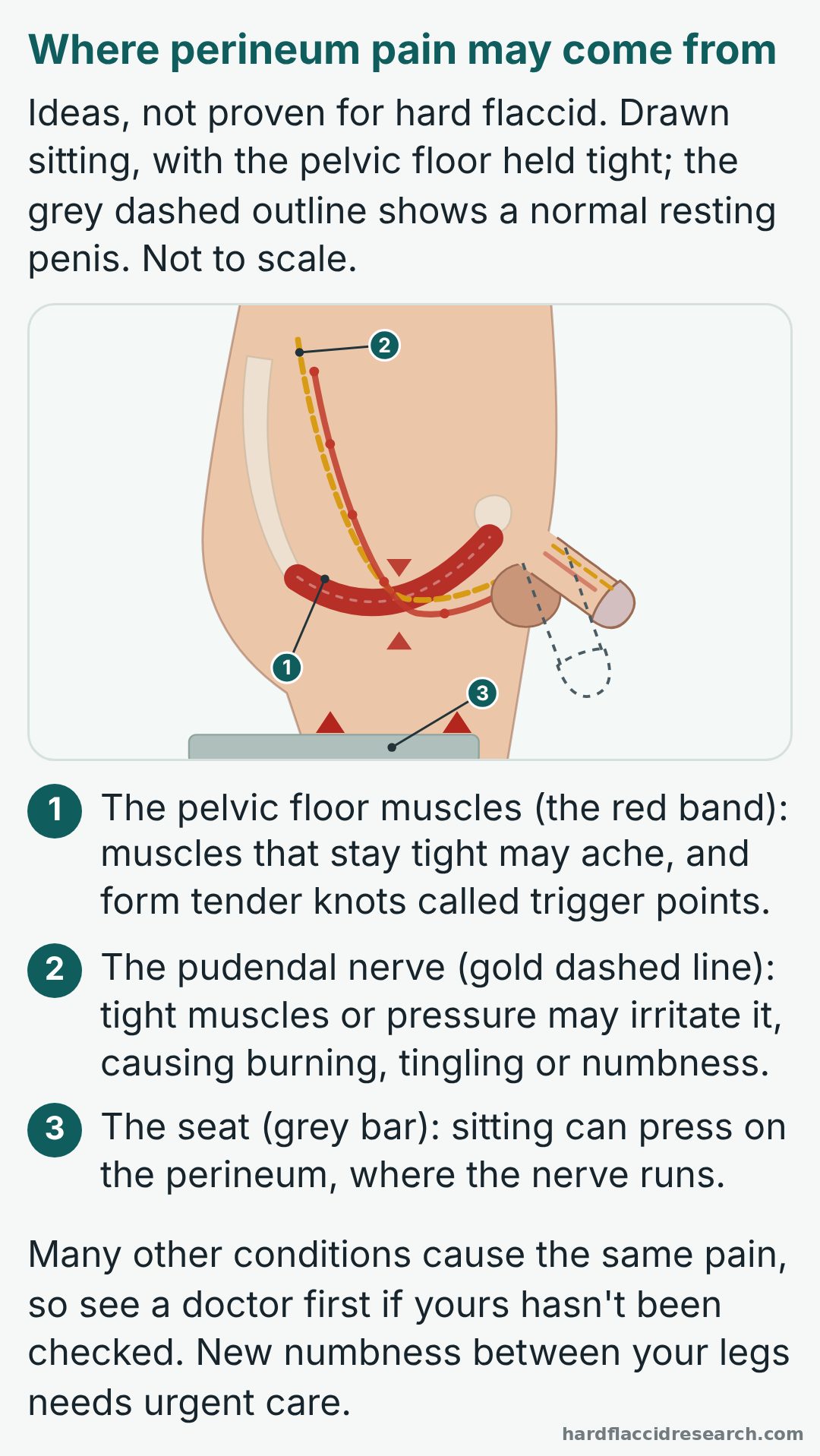
There is no proven answer yet. These are the ideas doctors and pelvic health physios discuss. None is confirmed for hard flaccid syndrome:
- Tight pelvic floor muscles. Muscles that stay partly clenched may ache, like a tense neck or jaw, and may have tender spots, often called trigger points, that some physios think send pain to nearby areas such as the penis, testicles or tailbone.
- An irritated pudendal nerve. Tight muscles, or long spells of pressure, may irritate the nerve, which can cause burning, aching, tingling or numbness along its path.
- Sitting. Sitting, especially leaning forward or on a hard or narrow seat, presses on the perineum, where the pudendal nerve runs. Separately, 45 men with hard flaccid asked whether sitting makes it worse.
- Straining. Straining on the toilet pushes down on the pelvic floor and may leave it sore and guarded. Separately, 90 men with hard flaccid asked why it is worse around bowel movements.
- Tight hips and lower back. Muscles there attach close to the pelvis, and tightness may add to pelvic tension.
- Stress and pain feeding each other. Pain can make you brace, and bracing can feed the pain. That doesn't mean the pain is imagined. In one January 2023 poll of men with hard flaccid asking whether the cause of hard flaccid is psychological, 84% said no (88 of 105 men). It asked nothing about pain, and a poll can't settle what causes hard flaccid.
Related: Hard Flaccid Pudendal Surgery: 82 Men, 0 Recovery Stories »
Other causes of perineum pain
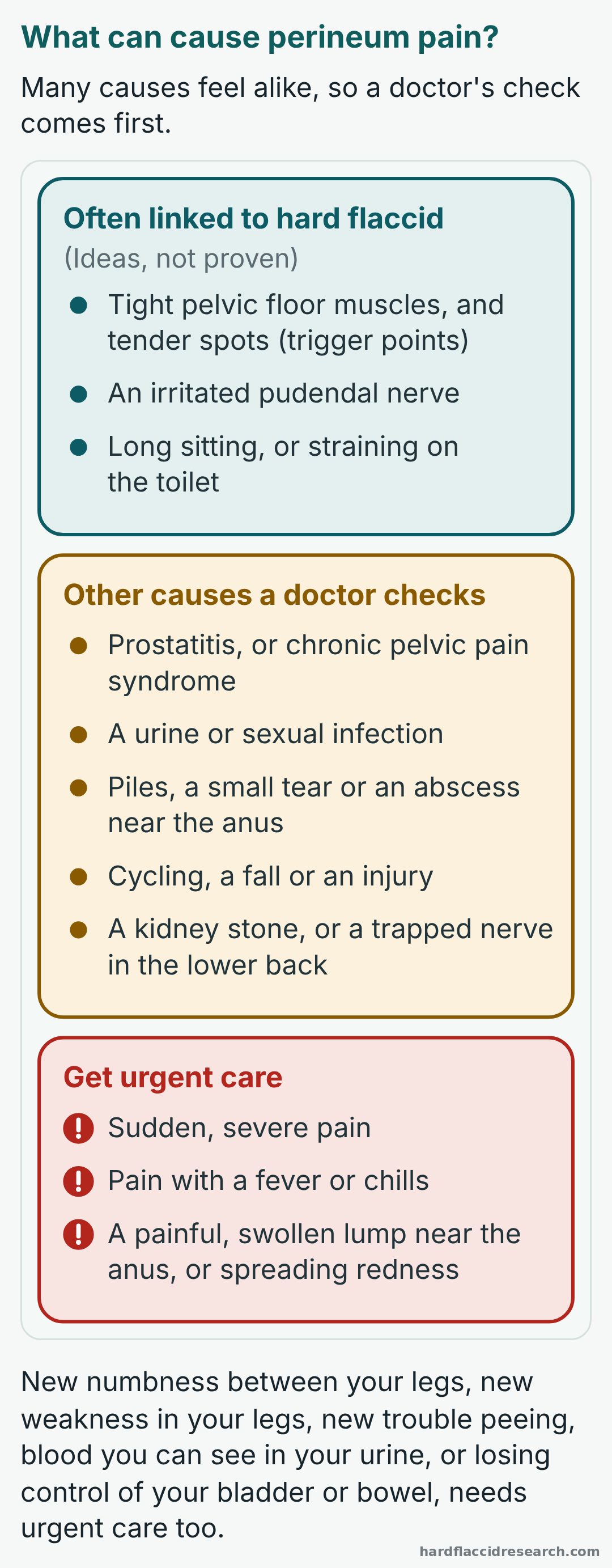
Other conditions cause very similar pain, and several need their own treatment:
- Prostatitis, an infection or inflammation of the prostate, and chronic pelvic pain syndrome (CPPS).
- A urine infection or a sexually transmitted infection, which can also cause burning when you pee or a discharge.
- Piles, a small tear near the anus (an anal fissure) or an abscess.
- Long bike rides, a hard seat, or a fall or kick to the area.
- Pudendal neuralgia, where the pudendal nerve itself is the main problem, usually worse when sitting.
- Pain passed on from somewhere else, such as a kidney stone, a hernia, or a trapped nerve in the lower back.
Perineum pain on its own is rarely a sign of prostate cancer, which often causes no symptoms early on. Peeing more often or a weaker flow, or blood in your semen, needs a doctor's check soon; blood in your urine that you can see, or new trouble starting or controlling your pee, needs urgent care (see the list below).
How doctors check perineum pain
A GP will usually ask about the pain, peeing, bowels, sex and any injury, then may:
- Test your urine, and check for sexually transmitted infections if that could be the cause.
- Feel the prostate and the pelvic floor muscles with a gloved finger in the back passage. It takes a few minutes and can be uncomfortable, more so if the muscles are tender; you can ask for a chaperone, and ask them to stop.
- Sometimes suggest a blood test, such as PSA for the prostate, or a scan, depending on what they find.
- Refer you to a urologist, a pelvic health physio, who can check the muscles for tightness and tender spots, or a pelvic pain or nerve specialist.
Separately, 26 men with hard flaccid syndrome asked which doctor to see and what tests to ask for. Our doctor visit kit helps you take your symptoms and questions with you.
What makes perineum pain worse
Many men say these make it worse, though not every man has every trigger:
- Sitting for long spells, above all on a hard seat, a bike saddle or a long drive.
- Constipation, diarrhoea or pushing hard on the toilet.
- Lifting heavy weights with a held breath, or hard squats and core work.
- Sex or ejaculation, for some men.
- Cold weather, stress or a bad night's sleep.
In one February 2023 poll, 78% of men with hard flaccid syndrome said their hard flaccid was worse after masturbation or sex (92 of 118 men); it asked nothing about pain.
Perineum pain treatment
There is no proven treatment for hard flaccid syndrome pain yet. For chronic pelvic pain in men, US urology guidelines suggest combining treatments to fit each man's symptoms:
- See a doctor first, to find and treat other causes such as an infection.
- Pelvic floor physio, to help tight muscles relax rather than strengthen them. A physio should explain each step and ask before any hands-on or internal work. US urology guidelines say doctors may offer it to men whose pelvic floor muscles are tender (a weaker recommendation). If your muscles feel tight, ask a physio before doing Kegels, and let go fully between squeezes.
- Painkillers. Anti-inflammatory painkillers, such as ibuprofen, may take the edge off a flare. They can upset the stomach and affect the kidneys and heart, so don't take them for long, or with a blood thinner, without advice.
- Nerve pain medicines, such as gabapentin, pregabalin or amitriptyline, which a doctor may suggest for burning or shooting pain (a weaker recommendation, and off-label for hard flaccid). They can cause drowsiness and dizziness, gabapentin and pregabalin can cause dependence, amitriptyline can affect heart rhythm, and none should be stopped suddenly.
- Muscle relaxants act all over the body, can cause drowsiness and dependence, are dangerous with alcohol or opioid painkillers, and have little research behind them in pelvic pain.
- Nerve blocks or Botox injections, offered by some pain specialists. US urology guidelines don't recommend them for pelvic pain in men, and they can cause soreness, infection, and for a while numbness, weakness or leaks.
- Talking therapy, such as CBT, which may help you cope with long-term pain (a weaker recommendation).
- Acupuncture (a weaker recommendation) and low-intensity shockwave therapy, which the guidelines say doctors should discuss. Neither has been tested in hard flaccid, and both can cause soreness or bruising.
In one November 2022 poll of men with hard flaccid who had seen a pelvic floor physio, 36% said it helped quite a bit or cured them (17 of 47 men). It asked nothing about pain, and these are self-selected reports, not a clinical study.
Separately, men with hard flaccid discussed many approaches, from stretching (1,288 men) and pelvic floor physio (656) to nerve blocks (246); the chart shows more. Discussing something is not the same as it working.
Talk to a doctor first. Anti-inflammatory painkillers, such as ibuprofen, can upset the stomach and affect the kidneys and heart, so don't take them for long, or with a blood thinner, without advice. Nerve pain medicines (gabapentin, pregabalin, amitriptyline) can cause drowsiness and dizziness, gabapentin and pregabalin can cause dependence, and with alcohol, opioid painkillers or other calming medicines they can slow your breathing dangerously; amitriptyline can affect heart rhythm and is dangerous in overdose; none should be stopped suddenly. Muscle relaxants can cause drowsiness and dependence, are dangerous with alcohol or opioid painkillers, and some must not be stopped suddenly. Nerve blocks and Botox injections can cause soreness, bruising or infection where the needle goes in, and for a while numbness, weakness or leaks of pee or stool. Shockwave therapy and acupuncture can cause soreness or bruising. Antibiotics treat bacterial infections; if tests find no infection, US urology guidelines advise against repeated courses, and like any medicine they can have side effects. Tell your doctor or pharmacist about every medicine and supplement you take, and never buy prescription medicines online. Never start, stop or change a medicine on your own.
Easing perineum pain day to day
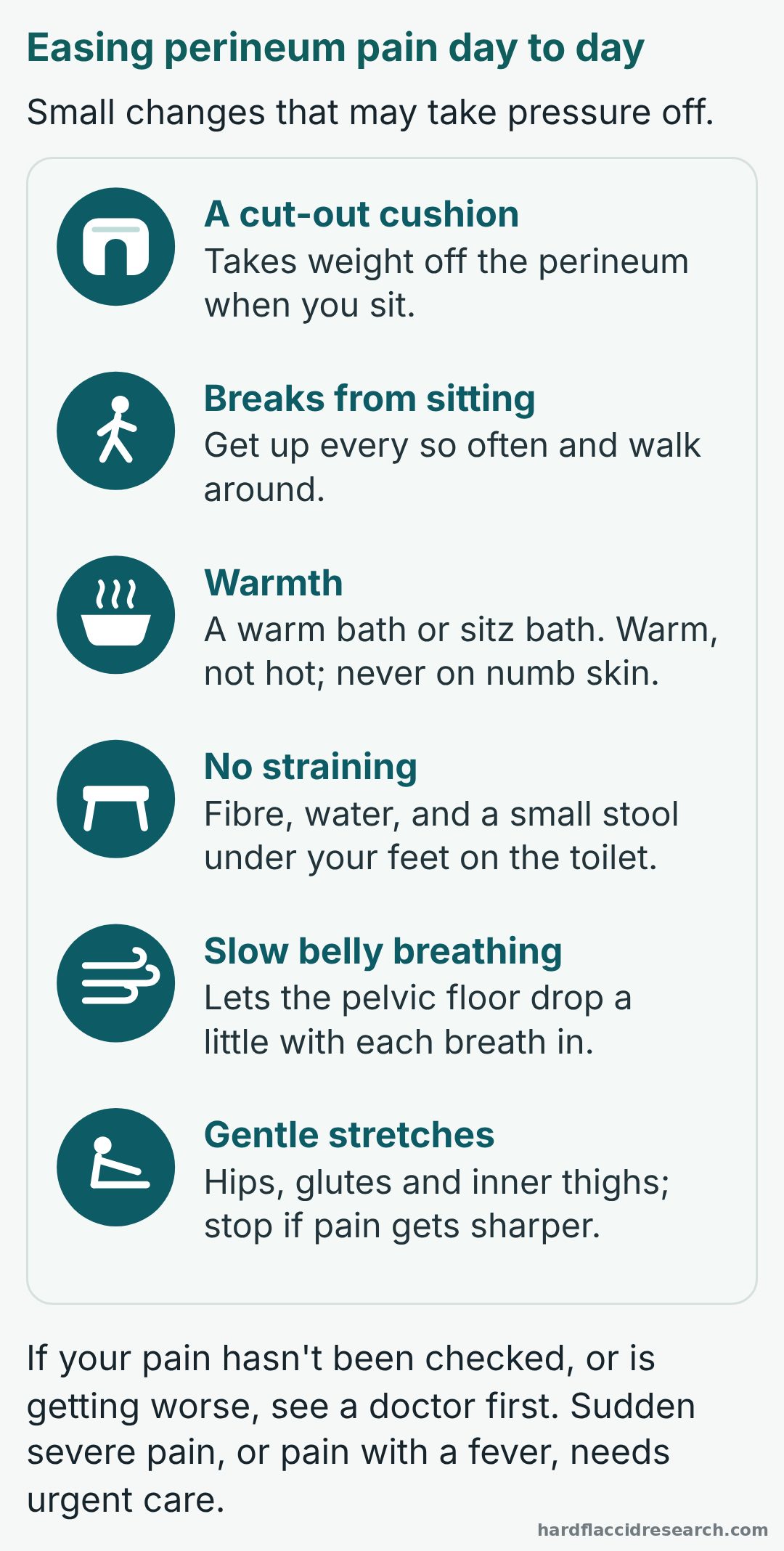
- Take the pressure off: a cushion with a cut-out under the perineum, and getting up every so often to walk around.
- Warmth: a warm bath, a heat pack or a sitz bath (a shallow bowl of warm water you sit in). Keep it warm, not hot, and never use heat on numb skin or while you sleep.
- No straining: fibre, water, and a small stool under your feet on the toilet.
- Slow belly breathing lets the pelvic floor drop a little with each breath in.
- Gentle stretches for the hips, glutes and inner thighs, stopping if anything makes the pain sharper.
- If you cycle, ride shorter and stand on the pedals now and then, or try a saddle with a cut-out and padded shorts. Numbness after a ride that doesn't go away, or that comes with leg weakness or bladder or bowel changes, needs urgent care.
Our members' guide, Hard Flaccid Pain and Flare-Ups: How to Calm Them, covers a flare-up plan step by step.
Pain and your mood
Living with pain wears you down, and low mood, worry and poor sleep can make it feel worse. In one January 2023 poll, 67% of men with hard flaccid syndrome said hard flaccid affects their life dramatically (83 of 124 men); it asked nothing about pain. Talk to someone you trust and tell your doctor how you feel; talking therapy may help.
If you are feeling hopeless or having thoughts of ending your life, please visit our Support page now. It lists crisis lines you can call or text today.
Common questions about perineum pain
Is perineum pain serious? Often it isn't dangerous, but it can be hard to live with and has many causes, so get it checked. Sudden severe pain, pain with a fever, or a painful swelling needs urgent care.
Why does my perineum hurt when I sit? Sitting can press on the pelvic floor muscles and the pudendal nerve, so tight muscles or an irritated nerve may hurt more. If you've had burning or numbness there for a while, ask a doctor to check the nerves; new numbness between your legs needs urgent care.
Why does my perineum hurt after ejaculating? Ejaculation makes the pelvic floor muscles squeeze hard, so tight or tender muscles may ache afterwards. Prostatitis and infections can cause it too, so see a doctor.
Can cycling cause perineum pain? It can. Long rides press on the perineum and the pudendal nerve. Numbness after a ride that doesn't go away, or that comes with leg weakness or bladder or bowel changes, needs urgent care.
Does perineum pain go away? It depends on the cause. An infection can clear with treatment. Pain from tight muscles or chronic pelvic pain often comes and goes; with the right mix of treatments many men get some relief, though not always complete relief.
When to see a doctor
See a doctor soon about any new pain in your perineum, penis, testicles or pelvis, especially if you haven't had a check-up yet, or if pain comes with burning when you pee, a discharge, blood in your semen, a lump in your scrotum or near your anus, or bleeding from your back passage. If you've had numbness between your legs for a while, or pain that is clearly worse when sitting, ask a doctor to check the nerves, including the pudendal nerve; new numbness there needs urgent care.
Get urgent care straight away if you have:
- A painful, swollen lump near the anus.
- A painful swelling in your groin or scrotum.
- Spreading redness or swelling on your genitals or between your legs with severe pain or a fever, or skin there turning dark, purple or grey.
- Blood in your urine that you can see.
- Sudden, severe pain in the penis, testicles or pelvis.
- New numbness around your back passage, genitals or inner thighs, or new weakness in your legs.
- New trouble starting or controlling your pee, not being able to pee, or not feeling when your bladder is full.
- Loss of control of your bladder or bowel.
- A fever or chills with pelvic pain or pain when peeing.
Sudden, severe testicle pain can mean a twisted testicle (testicular torsion). It needs treatment within hours, so go to an emergency department.
What to do next
- If your pain hasn't been checked, see a doctor first, because it can have other causes.
- Keep a short pain diary for a week or two, and take it to your appointment.
- Try a cut-out cushion, regular breaks from sitting and no straining on the toilet.
- Ask for a referral to a pelvic health physiotherapist.
- Don't start or stop any medicine without talking to your doctor.
- Add your experience, so the next man has better numbers than we do.
Free tools that can help
- Self-check: do I have hard flaccid?Compare your symptoms with what 6,026 men report.
- Doctor visit kitA one-page summary to take to your appointment.
- Habit trackerCount your days without porn or masturbation, and get through urges.
- Diaphragm breathing toolBreathe with a moving picture of your diaphragm and pelvic floor.
- Add your experienceTell us what you tried and how it went. No name needed.
- Hard Flaccid Syndrome CensusWhat men answered in 818 polls.
- Symptom trackerLog your symptoms and see what helps you.
- Ask us a questionThe questions men ask most become new articles.
The numbers behind this article
Every number in this article comes from what men with hard flaccid syndrome shared between December 2020 and October 2026, counted once per person, or from their polls. These are self-selected reports, not a clinical study. See hard flaccid syndrome statistics, the Hard Flaccid Syndrome Census and how we count.
In what men with hard flaccid syndrome wrote, 10% described pelvic, perineal or tailbone pain
Share of the 2,661 men with hard flaccid syndrome who described their symptoms. Each man is counted once in each bar.Counts from what men wrote run lower than poll answers, because men weren't asked.
Source: Hard Flaccid Research, hardflaccidresearch.com
Of the 267 men with hard flaccid syndrome who described pelvic, perineal or tailbone pain, 72% also described the firm flaccid state
Share of the 267 men who also described each symptom (first five bars) or discussed each approach (last five bars). Each man is counted once in each bar.Men who described one symptom tended to describe more of every kind, so this doesn't show that one causes another. Other approaches came up too, and discussing something is not the same as it working. If your pelvic floor feels tight, ask a physio before doing Kegels, and let go fully between squeezes.
Source: Hard Flaccid Research, hardflaccidresearch.com
In one poll, 7% of men with hard flaccid syndrome said pain is the one symptom they would fix first (7 of 104 men)
Each bar is a different poll of men with hard flaccid syndrome, with its own number of men.Only the first poll asked about pain. A poll can't settle what causes hard flaccid syndrome. Anti-inflammatories can upset the stomach and affect the kidneys and heart. These are self-selected reports, not a clinical study.
Source: Hard Flaccid Research, hardflaccidresearch.com
In one poll, 36% of men with hard flaccid syndrome who had seen a pelvic floor physio said it helped quite a bit or cured them (17 of 47 men)
Two separate polls of men with hard flaccid syndrome who had seen a pelvic floor physio, each with its own number of men.Neither poll asked about pain. These are self-selected reports, not a clinical study.
Source: Hard Flaccid Research, hardflaccidresearch.com
1,288 men with hard flaccid syndrome discussed stretching, and 656 pelvic floor physio
Number of men with hard flaccid syndrome who discussed each, counted once per person. These are for hard flaccid syndrome in general, not pain.The groups overlap, other approaches came up too, and discussing something is not the same as it working. Nerve pain medicines and muscle relaxants can cause drowsiness and dependence; injections can cause soreness, infection and, for a while, weakness or leaks; reverse Kegels are a gentle letting go, never a push; never start, stop or change a medicine on your own.
Source: Hard Flaccid Research, hardflaccidresearch.com
232 men with hard flaccid syndrome asked why there is pain
Number of men with hard flaccid syndrome who asked each question, counted once per person.The groups overlap: one man can ask more than one question.
Source: Hard Flaccid Research, hardflaccidresearch.com
916 men with hard flaccid syndrome wrote about anxiety, and 550 about low mood or depression
Number of men with hard flaccid syndrome in each group, counted once per person. The last two bars are men who blamed it for their hard flaccid syndrome.These are men with hard flaccid syndrome in general, not only men with pain. Blaming something isn't proof that it caused hard flaccid syndrome, and men who wrote about a cause tended to describe more symptoms of every kind.
Source: Hard Flaccid Research, hardflaccidresearch.com
Every number in this article, with its source
| In this article | Source |
|---|---|
| 2,661 of the 6,026 men who shared their experiences described their symptoms | Research data, December 2020 to October 2026 |
| 10% described pelvic, perineal or tailbone pain (267 of 2,661) | 267 of 2,661 men, counted from what men wrote, once per person |
| 9% described lower back, hip or hamstring tightness (233 of 2,661) | 233 of 2,661 men, counted from what men wrote, once per person |
| 8% described pain or burning in the penis (206 of 2,661) | 206 of 2,661 men, counted from what men wrote, once per person |
| 8% described a weak or painful orgasm or ejaculation problems (202 of 2,661) | 202 of 2,661 men, counted from what men wrote, once per person |
| 4% described testicle pain or a tight or high scrotum (102 of 2,661) | 102 of 2,661 men, counted from what men wrote, once per person |
| 58% described the firm flaccid state (1,553 of 2,661) | 1,553 of 2,661 men, counted from what men wrote, once per person |
| 23% described pelvic floor tightness, spasm or twitching (601 of 2,661) | 601 of 2,661 men, counted from what men wrote, once per person |
| 15% described bowel symptoms (391 of 2,661) | 391 of 2,661 men, counted from what men wrote, once per person |
| Of the 267 men with pelvic, perineal or tailbone pain: 72% firm flaccid state, 56% numbness, 55% weaker erections, 46% shrinkage, 45% pelvic floor tightness, spasm or twitching | 267 men with pelvic, perineal or tailbone pain, counted from what men wrote, once per person |
| Of the 267 men with pelvic, perineal or tailbone pain: 63% discussed stretching, 45% rest or abstinence, 45% pelvic floor physio, 44% Kegels, 41% talking therapy, CBT, mindfulness or meditation | 267 men with pelvic, perineal or tailbone pain, counted from what men wrote, once per person |
| 7% would fix pain or discomfort first (7 of 104 men) | 7 of 104 men, poll, May 2023 |
| 78% worse after masturbation or sex (92 of 118 men) | 92 of 118 men, poll, Feb 2023 |
| 86% harder when standing than lying down (54 of 63 men) | 54 of 63 men, poll, Mar 2023 |
| 84% said the cause of hard flaccid syndrome is not psychological (88 of 105 men) | 88 of 105 men, poll, Jan 2023 |
| 67% said hard flaccid affects their life dramatically (83 of 124 men) | 83 of 124 men, poll, Jan 2023 |
| 36% said physio helped quite a bit or cured them (17 of 47 men) | 17 of 47 men, poll, Nov 2022 |
| 38% said physio dramatically helped (24 of 64 men) | 24 of 64 men, poll, Feb 2023 |
| 56% noticed at least a small improvement with anti-inflammatories (18 of 32 men) | 18 of 32 men, poll, Feb 2023 |
| 1,288 men discussed stretching | 1,288 men, counted from what men wrote, once per person |
| 704 men discussed reverse Kegels and pelvic floor relaxation | 704 men, counted from what men wrote, once per person |
| 656 men discussed pelvic floor physio | 656 men, counted from what men wrote, once per person |
| 603 men discussed talking therapy, CBT, mindfulness or meditation | 603 men, counted from what men wrote, once per person |
| 481 men discussed massage, myofascial release or trigger point work | 481 men, counted from what men wrote, once per person |
| 425 men discussed breathing exercises | 425 men, counted from what men wrote, once per person |
| 246 men discussed nerve blocks | 246 men, counted from what men wrote, once per person |
| 230 men discussed heat or warm baths | 230 men, counted from what men wrote, once per person |
| 174 men discussed muscle relaxants | 174 men, counted from what men wrote, once per person |
| 137 men discussed Botox injections | 137 men, counted from what men wrote, once per person |
| 122 men discussed nerve pain medicines | 122 men, counted from what men wrote, once per person |
| 303 men discussed shockwave therapy | 303 men, counted from what men wrote, once per person |
| 105 men discussed acupuncture or dry needling | 105 men, counted from what men wrote, once per person |
| 916 men wrote about anxiety | 916 men who wrote about anxiety, research data |
| 550 men wrote about low mood or depression | 550 men who wrote about low mood or depression, research data |
| 24 men blamed long hours sitting for their hard flaccid | 24 men, counted from what men wrote, once per person |
| 23 men blamed straining or constipation for their hard flaccid | 23 men, counted from what men wrote, once per person |
| 82 men asked how to cope mentally | Question group, 82 men, research data |
| 41 men asked whether pelvic floor physio helps | Question group, 41 men, research data |
| 232 men asked why there is pain | Question group, 232 men, research data |
| 216 men asked which stretches or exercises help | Question group, 216 men, research data |
| 100 men asked whether their hard flaccid is a nerve problem, such as the pudendal nerve | Question group, 100 men, research data |
| 90 men asked why it is worse around bowel movements | Question group, 90 men, research data |
| 50 men asked why symptoms flare up | Question group, 50 men, research data |
| 45 men asked whether sitting makes it worse | Question group, 45 men, research data |
| 42 men asked whether nerve blocks or Botox help | Question group, 42 men, research data |
| 26 men asked which doctor to see and what tests | Question group, 26 men, research data |
How we made this article
We started from the question 232 men asked. Every number was checked against our data. Our editorial team edited it and Dr. Julian Reyes reviewed it medically. Read our editorial policy.
Read next
- Gabapentin for Hard Flaccid: Worth the Side Effects?Article
- Hard Flaccid Pudendal Surgery: 82 Men, 0 Recovery StoriesArticle
- Nerve Blocks or Botox for Hard Flaccid? Read This FirstArticle
- Long hours sittingCause
- Straining and constipationCause
- Tight hips, back and hamstringsSymptom
- Pelvic floor tensionSymptom
See more of us on Google
Add Hard Flaccid Research as a preferred source, and Google shows you our pages more often when you search.
Add as a preferred sourceDon't see your question? Ask us. We answer the most-asked ones in new articles.
Cite and share this article
You're welcome to quote this article. Please name Hard Flaccid Research and link to this page, so others can find the full answer and the data behind it. To cite this page, use its link.
Citation
Hard Flaccid Research. (2026). Perineum Pain With Hard Flaccid: Why It Hurts, What Helps. Written by the Editorial Team, medically reviewed by Dr. Julian Reyes. https://hardflaccidresearch.com/articles/hard-flaccid-pain
Credit link for your article
Source: <a href="https://hardflaccidresearch.com/articles/hard-flaccid-pain">Hard Flaccid Research</a>
Wikipedia reference
<ref>{{cite web |url=https://hardflaccidresearch.com/articles/hard-flaccid-pain |title=Perineum Pain With Hard Flaccid: Why It Hurts, What Helps |website=Hard Flaccid Research |date=2026 |access-date=28 October 2026}}</ref>
How the data was collected: our methodology. Journalists and researchers: key numbers, data and contact.