Pudendal Nerve Entrapment: Symptoms, Causes & Treatment
In short
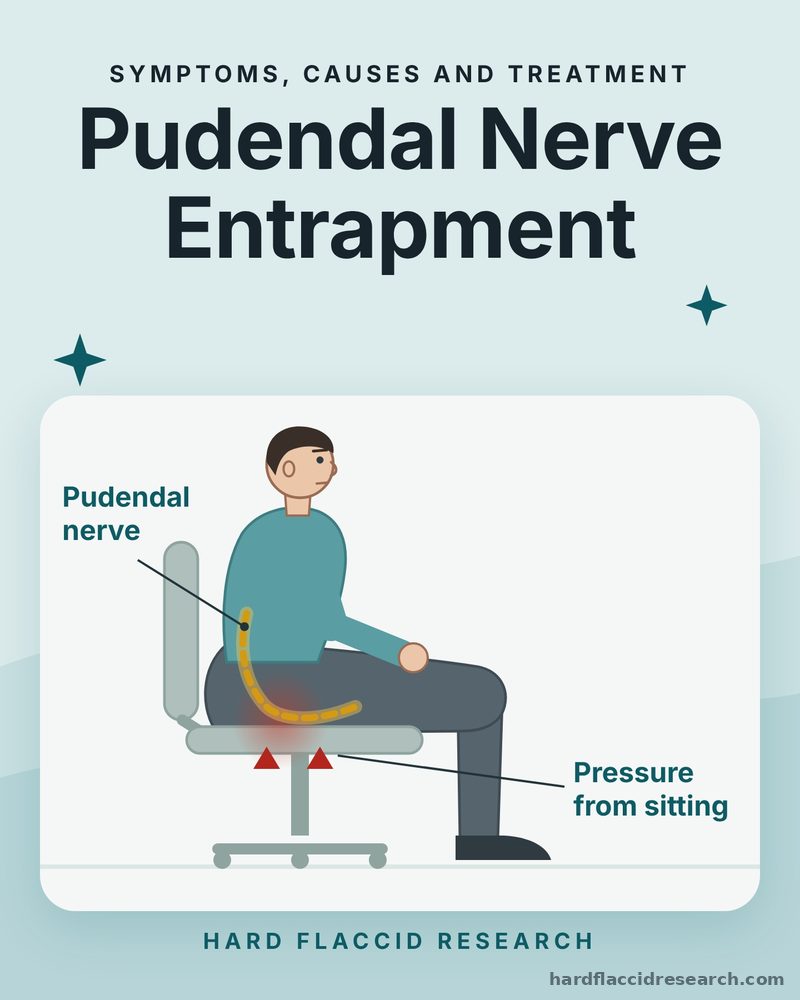
- Pudendal nerve entrapment is when the main nerve of the genitals and pelvic floor is squeezed or irritated, causing burning pain, numbness or tingling between the legs that is usually worse when sitting.
- Treatment usually goes step by step, starting with less pressure from sitting and pelvic floor physio.
- Hard flaccid shares some of this, especially numbness, which 34% of men who described their symptoms mention, but in one poll most men with hard flaccid syndrome said it is harder when standing than lying down.
100 men with hard flaccid asked this question.
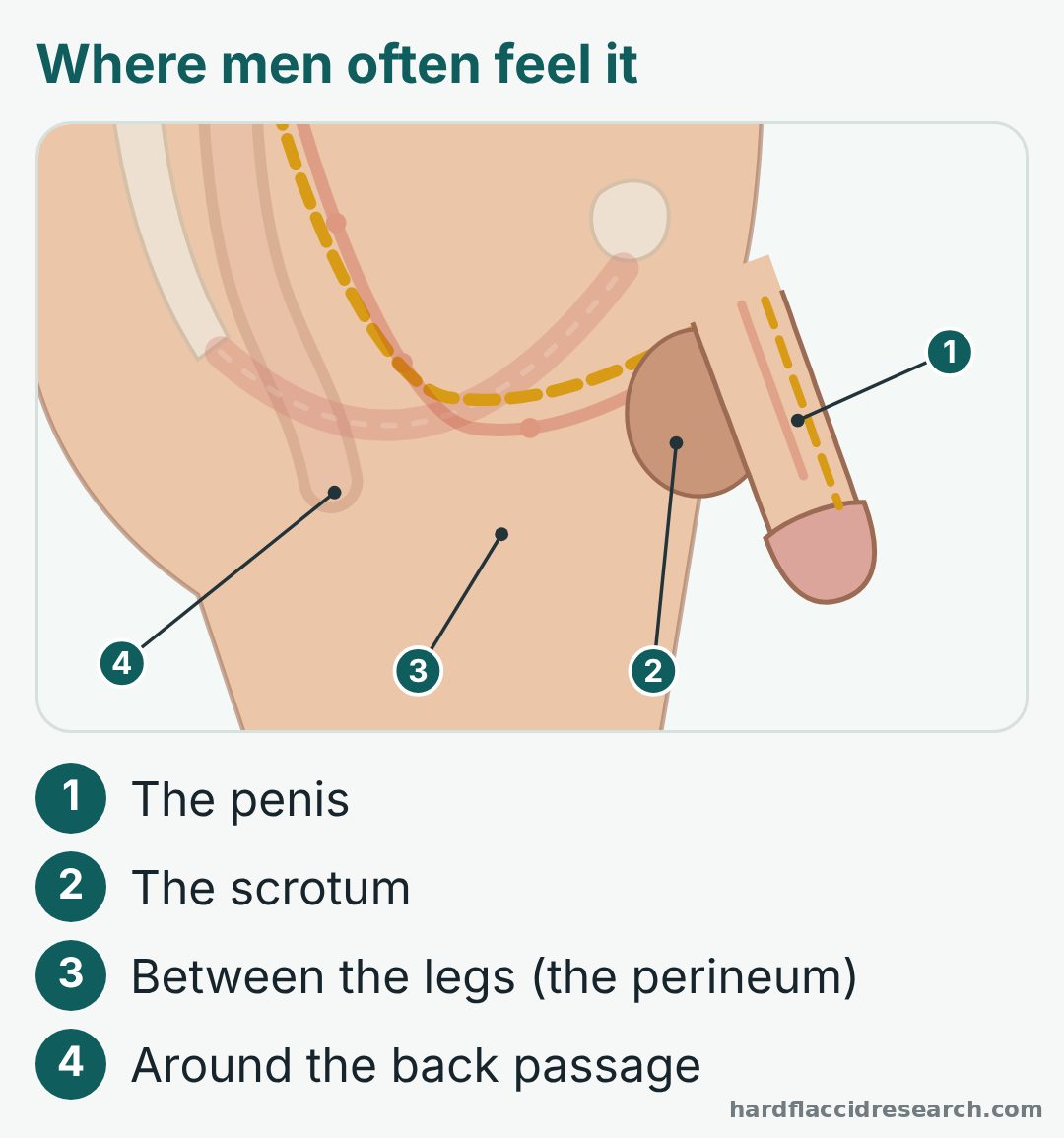
Pudendal nerve entrapment is when the pudendal nerve, the main nerve of the genitals and pelvic floor, is squeezed or irritated along its path. In men it can cause burning, stabbing or aching pain, numbness or tingling in the penis, scrotum, the area between the legs or around the back passage, and it is usually worse when sitting.
It is more common in women, but men get it too, and this page is written for men. It covers the symptoms, the causes, how doctors check, how it is treated step by step, and how to tell it apart from hard flaccid syndrome, which shares some of the same symptoms. 100 men asked whether their hard flaccid is a nerve problem.
By the numbers: between December 2020 and October 2026, 2,661 of the 6,026 men who shared their experiences described their symptoms, and 914 of them mentioned numbness. Separately, 24 men blamed long hours sitting for their hard flaccid, and 100 men asked whether their hard flaccid is a nerve problem.
What is the pudendal nerve?
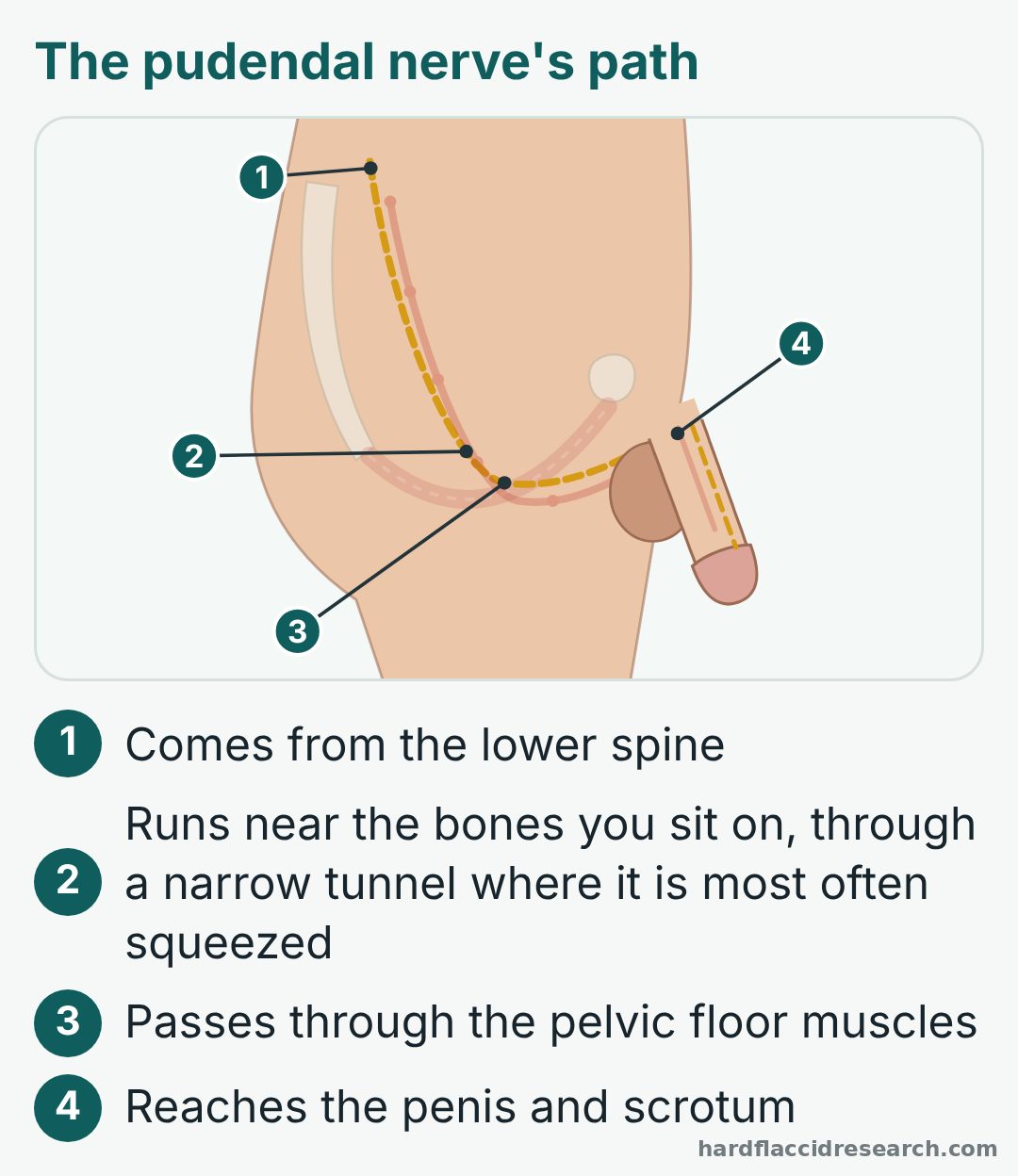
The pudendal nerve is the main nerve of the genitals and pelvic floor. It carries feeling and helps trigger erections. It runs from the lower spine, around the bones you sit on, and through a narrow tunnel along the side of the pelvis to the penis, scrotum, perineum and back passage.
Because it passes through the pelvic floor and sits right where you put your weight when you sit, it can be pressed on in several places. The pelvic floor is the sling of muscles between your legs that supports your bladder and bowel and helps control erections.
Hard Flaccid Explorerby Hard Flaccid Research
Pudendal nerve entrapment, step by step
A 7-minute animated explainer of this article. Press play, or skip between chapters. The first minute is free for everyone.
A picture to explain, not a diagnosis. The two can overlap.
What is pudendal nerve entrapment?
Entrapment means the nerve is squeezed or rubbed somewhere along its path. Doctors find this most often where it passes between two tough ligaments near the bones you sit on, or in the narrow tunnel beside them, called Alcock's canal. A squeezed or irritated nerve can send burning or stabbing pain, or stop sending feeling properly.
Pudendal neuralgia means pain from the pudendal nerve. Entrapment is one cause of it, and many doctors use the two names for the same problem. It is uncommon, and it doesn't shorten life, but long-lasting pain can be hard to live with.
Related: Hard Flaccid Pudendal Surgery: 82 Men, 0 Recovery Stories »
Pudendal nerve entrapment symptoms
The main sign is pain between the legs that is worse when sitting and eases when standing, lying down or sitting on a toilet seat. Symptoms men describe include:
- Burning, stabbing, electric or aching pain in the penis, scrotum, the area between the legs (the perineum) or around the back passage.
- Pain that is worse sitting, often builds through the day, and is often worse on one side.
- Pins and needles, numbness, or a feeling of something stuck in the back passage.
- Pain when peeing, needing to pee often or urgently, or pain when you ejaculate.
- Sexual problems, such as weaker erections or trouble reaching orgasm.
- Pain during or after a bowel movement, or constipation.
Pain from the nerve usually doesn't wake you at night, though it can make it hard to fall asleep. Numbness you feel yourself can be part of it. But if a doctor examining you finds a clear loss of feeling, that makes entrapment less likely, and doctors look for other causes too, such as a nerve root in the lower back. If numbness between your legs is new, get urgent care now (see the list below).
What causes pudendal nerve entrapment?
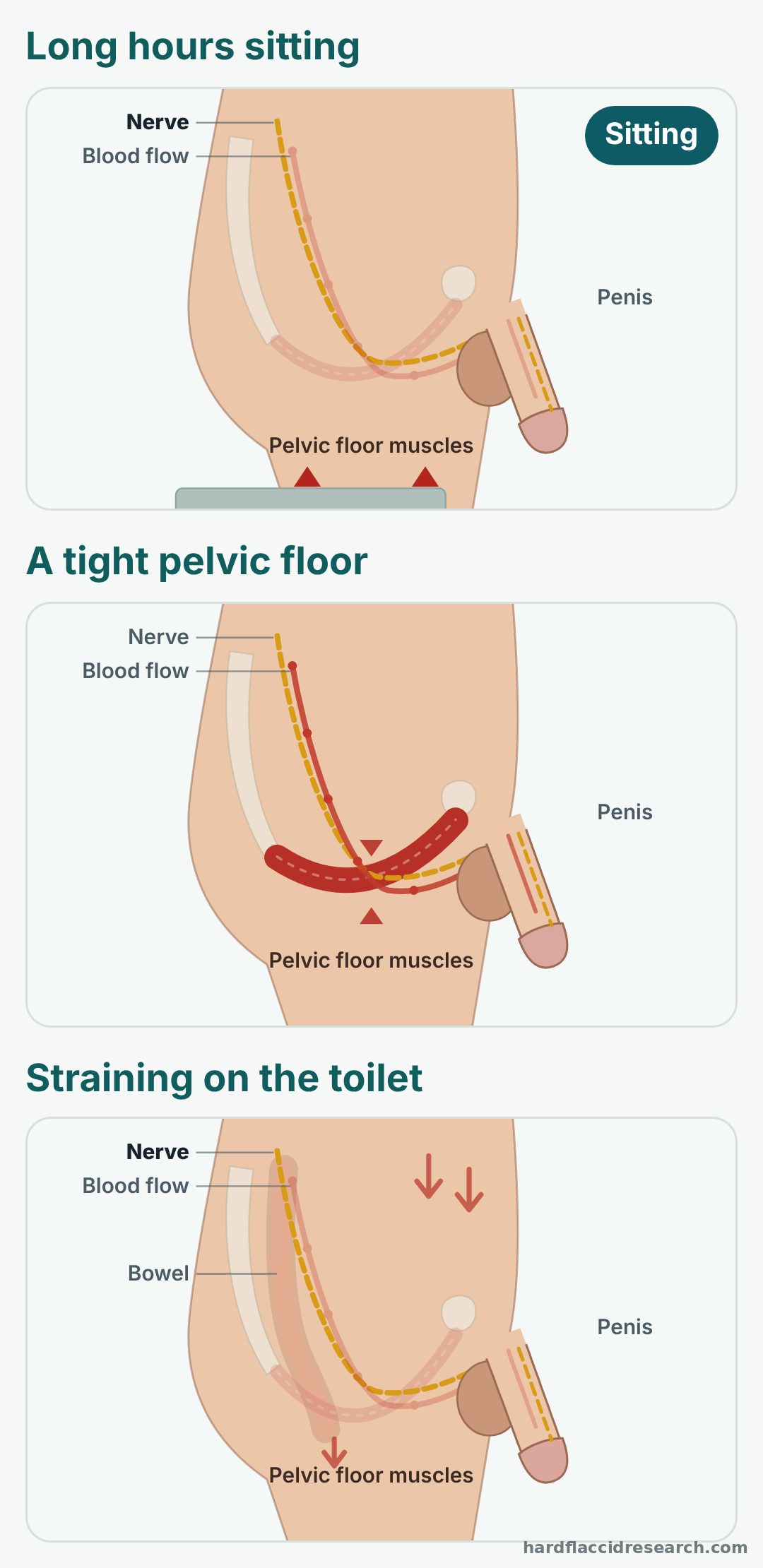
Anything that presses on, stretches or rubs the nerve along its path can irritate it. The causes doctors describe most are:
- Long hours sitting, especially on hard seats.
- Cycling, and other activities that put weight on the area between the legs, such as horse riding.
- Tight pelvic floor muscles, which may press on the nerve where it passes through them.
- Straining on the toilet, or long-term constipation.
- Heavy squats or other hard exercise that loads the pelvis.
- A fall onto the buttocks, a broken pelvis, or surgery in the pelvis, such as prostate surgery.
- Less often, an infection such as shingles, diabetes, or a growth pressing on the nerve.
Among men who shared their experiences, 24 blamed long hours sitting for their hard flaccid syndrome, 23 straining or constipation, and 14 the gym, heavy lifting or sport. These are men linking their own hard flaccid to something, not men diagnosed with a trapped nerve. 45 men asked whether sitting makes hard flaccid worse. These are self-selected reports, not a clinical study.
Related: Gabapentin for Hard Flaccid: Worth the Side Effects? »
Pudendal nerve entrapment or hard flaccid?
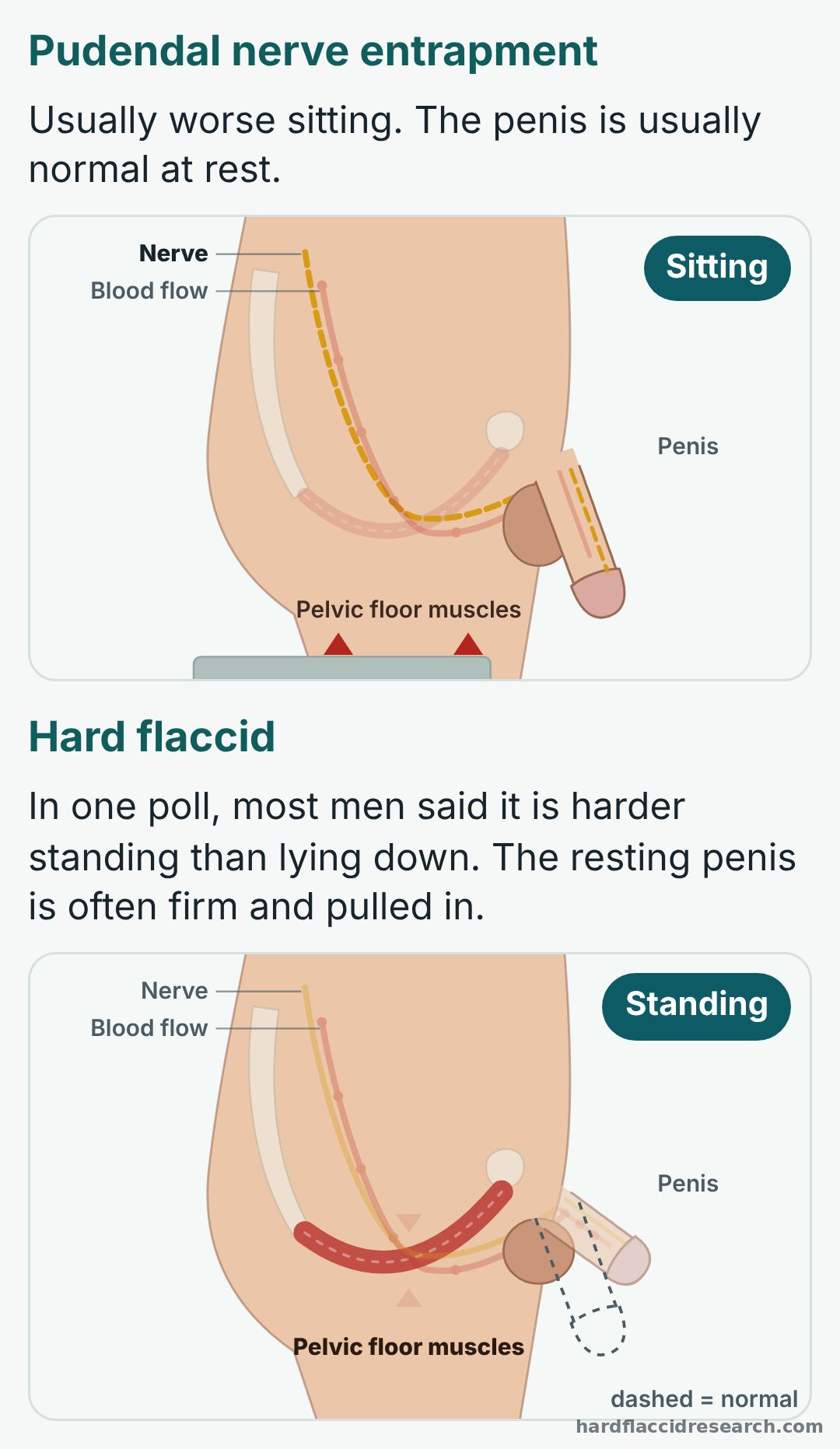
The two overlap, and a tight pelvic floor may irritate the nerve, so you can have features of both. These differences can help:
- Position: pudendal nerve pain is usually worse sitting. Most men with hard flaccid syndrome say it is worse standing: in a March 2023 poll, 86% said it is harder when standing than lying down (54 of 63 men).
- The resting penis: pudendal nerve entrapment doesn't usually make it firm. In hard flaccid, 58% describe the firm flaccid state (1,553 of 2,661).
- Pain: it is the main symptom of pudendal nerve entrapment. In hard flaccid, 267 men describe pelvic or perineal pain and 206 penile pain or burning, out of 2,661 who described their symptoms.
- Numbness: men with either can describe it. In hard flaccid, 34% describe numbness or loss of feeling (914 of 2,661). A clear loss of feeling that a doctor finds on examination usually makes entrapment less likely, so tell your doctor about any numbness, and get urgent care if it is new.
Numbness in hard flaccid syndrome: what men describe
In an April 2023 poll of 108 men with hard flaccid syndrome, 79% said they had lost some sensation (85 of 108 men):
- 21% said the whole penis feels numb (23 of 108 men).
- 18% said the glans has feeling but the shaft is numb (19 of 108 men).
- 18% said the shaft has feeling but the glans is numb (19 of 108 men).
- 22% said both have about half their feeling (24 of 108 men).
- 21% said they had lost no sensation (23 of 108 men).
Among the 914 men who mentioned numbness, 62% also described the firm flaccid state, 48% weaker erections, 36% shrinkage and 30% pelvic floor tightness. 17 men asked whether sensation will come back.
How doctors diagnose pudendal nerve entrapment
There is no single test. Doctors mostly go on the pattern of your symptoms and an examination, and they first look for other causes, such as prostate problems, a nerve in the lower back or tailbone pain.
Many use a checklist called the Nantes criteria. It points to pudendal nerve entrapment only when all of these are true:
- The pain is in the area the nerve supplies: the penis, scrotum, perineum or back passage.
- It is mainly worse when sitting.
- It doesn't wake you at night.
- A doctor finds no clear numbness when examining you.
- A numbing injection near the nerve eases the pain for a while.
That last test is called a diagnostic nerve block. A doctor uses a scan to guide a thin needle and injects numbing medicine next to the nerve. If the pain eases while the area is numb, that points to the nerve, but a block that doesn't help doesn't rule it out. An MRI scan of the pelvis is mainly used to look for other causes, and is usually done before any surgery. Nerve tests can be normal even when the nerve is the problem.
Pudendal nerve entrapment treatment
Treatment usually goes step by step, starting with what is simplest and safest. Some people improve with the first steps alone:
- Less pressure on the nerve: shorter spells of sitting, a standing desk, a cushion with a cut-out under the area between your legs, and less cycling, or a saddle with a cut-out and padded shorts.
- Softer stools, so you don't strain on the toilet.
- Pelvic floor physio, usually over several weeks, to help tight muscles relax, sometimes with a small device that sends mild electrical pulses through the skin (TENS).
- Nerve pain medicines, such as amitriptyline, gabapentin, pregabalin or duloxetine, which a doctor may suggest if the pain doesn't settle.
- Nerve blocks, sometimes with a steroid, which can ease the pain for a while. For many people the relief fades, so they work better as a test than as a lasting treatment. They can cause soreness, bruising or infection where the needle goes in, and for some hours numbness, leg weakness or leaks of pee or stool.
- Surgery to free the nerve, for a few people with clear signs of entrapment who haven't improved with everything else. It is major surgery that can't be undone: results vary, pain doesn't always improve and can sometimes get worse, and any relief can take many months.
Talking therapy may help with the stress of long-lasting pain. Other options, such as pulsed radiofrequency treatment of the nerve and implanted nerve stimulators, are used in specialist pain clinics, but the evidence for them is still limited.
Talk to a doctor first. Gabapentin and pregabalin can cause drowsiness and dizziness, can be habit-forming, and with alcohol, opioid painkillers or other calming medicines they can slow your breathing dangerously. Amitriptyline can cause drowsiness, a dry mouth, constipation and trouble peeing, can affect heart rhythm, and is dangerous in overdose. Duloxetine can cause feeling sick, sleep problems and sweating, and can raise blood pressure. Amitriptyline and duloxetine can have sexual side effects. Rarely, these medicines can bring on low mood or thoughts of suicide, especially in young men, so tell your doctor straight away if your mood drops. Stopping any of them suddenly can cause withdrawal symptoms. Only a doctor who knows your health can say if a medicine is right for you. Tell your doctor about every medicine and supplement you take, and don't buy medicines online without a prescription. Never start, stop or change a medicine on your own.
What men with hard flaccid syndrome discussed for nerve symptoms
Among men with hard flaccid syndrome, 246 mentioned nerve blocks, 122 nerve pain medicines and 82 pudendal nerve decompression surgery. In the 126 recovery stories, nerve blocks came up in 3, nerve pain medicines in 3, and decompression surgery in none.
Among the 914 men who mentioned numbness, the approaches mentioned most were stretching (48%), tadalafil (44%), rest or abstinence (37%), Kegels (35%), pelvic floor physio (31%) and reverse Kegels (29%). Being mentioned is not the same as working. Tadalafil is a prescription medicine. Never take it with nitrate medicines for chest pain or with poppers, because together they can drop your blood pressure dangerously. If you get chest pain, tell the ambulance crew or doctor that you've taken tadalafil, and when: nitrate medicines must not be given within 48 hours of a dose.
Talk to a specialist before agreeing to nerve surgery. It is a major operation, results vary, and it is meant for men with clear signs of entrapment who haven't improved with other treatment. Ask for a second opinion.
Does pudendal nerve entrapment go away?
For some people it settles, often slowly, but there is no quick fix and not everyone gets better. Some people improve once the pressure on the nerve eases, and others with physio, medicines or other treatment. For some the pain lasts, and the aim becomes keeping it low enough to live well.
Getting the right diagnosis matters, because many people are first told it is something else. A note of when it is worse, such as sitting, standing, lying down, after cycling or after a bowel movement, helps your doctor.
Common questions about pudendal nerve entrapment
Can cycling cause pudendal nerve entrapment? It can. Long rides put weight on the nerve where it runs between your legs. Shorter rides, standing on the pedals now and then, padded shorts and a saddle with a cut-out may help.
Can it cause erection problems? It can affect feeling and sexual function, and some men describe weaker erections or trouble reaching orgasm. Erection problems have many causes, so see a doctor.
Which exercises help? A physio may suggest gentle pelvic floor relaxation, such as reverse Kegels and belly breathing, and stretches that suit you. Many physios suggest avoiding heavy squats and long rides while it is flared up. Kegels tighten the pelvic floor, so ask a physio before doing them, and let the muscles go fully between squeezes.
Which doctor should I see? Start with your GP. You may be referred to a urologist, a pelvic health physio, or a pain specialist who knows pelvic nerve pain.
When to see a doctor
See a doctor if you have numbness, burning or pain between your legs, especially if it is worse sitting, or if it hasn't been checked. Some of the same symptoms can come from the lower back, the prostate or an infection, and these need different treatment. If numbness between your legs is new, get urgent care now (see the list below).
Many men find it hard to be taken seriously, so prepare well: our doctor visit kit helps. A pelvic health physio can also check the muscles around the nerve. In a November 2022 poll of men who had seen a urologist, 95% called their visits bad and unhelpful (63 of 66 men), which is a reason to prepare, not to skip the visit.
Get urgent care straight away if you have:
- Sudden, severe pain in the penis, testicles or pelvis.
- New numbness around your back passage, genitals or inner thighs, or new weakness in your legs.
- New trouble starting or controlling your pee, not being able to pee, or not feeling when your bladder is full.
- Loss of control of your bladder or bowel.
- A fever or chills with pelvic pain or pain when peeing.
If you are feeling hopeless or having thoughts of ending your life, please visit our Support page now. It lists crisis lines you can call or text.
What to do next
- Notice when it is worse: sitting, standing, lying down, after cycling or after sex.
- Cut down long spells of sitting, and try a cushion with a cut-out under the area between your legs.
- Ask your GP about a pelvic health physiotherapist and, if pain is worse sitting, a specialist in pelvic nerve pain.
- Use our self-check to see how your symptoms compare.
Our members' guide, Numbness and Shrinkage With Hard Flaccid: What Men Try, covers numbness in more detail.
Free tools that can help
- Self-check: do I have hard flaccid?Compare your symptoms with what 6,026 men report.
- Doctor visit kitA one-page summary to take to your appointment.
- Habit trackerCount your days without porn or masturbation, and get through urges.
- Diaphragm breathing toolBreathe with a moving picture of your diaphragm and pelvic floor.
- Add your experienceTell us what you tried and how it went. No name needed.
- Hard Flaccid Syndrome CensusWhat men answered in 818 polls.
- Symptom trackerLog your symptoms and see what helps you.
- Ask us a questionThe questions men ask most become new articles.
The numbers behind this article
Every number in this article comes from what men with hard flaccid syndrome shared between December 2020 and October 2026, counted once per person, or from their polls. These are self-selected reports, not a clinical study. See hard flaccid syndrome statistics, the Hard Flaccid Syndrome Census and how we count.
Nerve-type symptoms in hard flaccid syndrome
Share of the 2,661 men who described their symptoms, and the number who described pain, December 2020 to October 2026.Source: Hard Flaccid Research, hardflaccidresearch.com
Pain men with hard flaccid syndrome describe
Number of men, counted once per person.Source: Hard Flaccid Research, hardflaccidresearch.com
How much sensation men with hard flaccid syndrome have lost
April 2023 poll of 108 men with hard flaccid syndrome.Source: Hard Flaccid Research, hardflaccidresearch.com
What else men with numbness describe
Share of the 914 men who mentioned numbness who also describe each symptom.Source: Hard Flaccid Research, hardflaccidresearch.com
What men with numbness mentioned
Share of the 914 men who mentioned numbness who mentioned each approach.Being mentioned is not the same as working.
Source: Hard Flaccid Research, hardflaccidresearch.com
Nerve treatments men mentioned
Number of men who mentioned each, counted once per person, and what came up in 126 recovery stories.Source: Hard Flaccid Research, hardflaccidresearch.com
Nerve treatments in 126 recovery stories
Share of the 126 men who shared a story of getting better who mentioned each.Source: Hard Flaccid Research, hardflaccidresearch.com
What men with hard flaccid syndrome blamed it on
Number of men who linked their hard flaccid syndrome to each, counted once per person.These are men linking their own hard flaccid syndrome to something, not men diagnosed with a trapped nerve.
Source: Hard Flaccid Research, hardflaccidresearch.com
Position, doctors and questions
Polls of men with hard flaccid syndrome, and how many asked.Source: Hard Flaccid Research, hardflaccidresearch.com
What men with hard flaccid syndrome asked
Number of men who asked each question, counted once per person.Source: Hard Flaccid Research, hardflaccidresearch.com
Every number in this article, with its source
| In this article | Source |
|---|---|
| 100 men asked whether hard flaccid syndrome is a nerve problem | Question group, 100 men, research data |
| 86% harder when standing than lying down (54 of 63 men) | 54 of 63 men, poll, Mar 2023 |
| 58% (1,553 of 2,661) describe the firm, semi-rigid flaccid state | 1,553 of 2,661 men, counted from what men wrote, once per person |
| 267 men describe pelvic or perineal pain | 267 men, counted from what men wrote, once per person |
| 206 men describe penile pain or burning | 206 men, counted from what men wrote, once per person |
| 34% (914 of 2,661) describe numbness or loss of feeling | 914 of 2,661 men, counted from what men wrote, once per person |
| 79% lost some sensation (85 of 108 men) | 85 of 108 men, poll, Apr 2023 |
| 21% whole penis numb (23 of 108 men) | 23 of 108 men, poll, Apr 2023 |
| 18% glans has feeling, shaft numb (19 of 108 men) | 19 of 108 men, poll, Apr 2023 |
| 18% shaft has feeling, glans numb (19 of 108 men) | 19 of 108 men, poll, Apr 2023 |
| 22% both about half their feeling (24 of 108 men) | 24 of 108 men, poll, Apr 2023 |
| 21% no sensation lost (23 of 108 men) | 23 of 108 men, poll, Apr 2023 |
| Among men with numbness: 62% firm flaccid state, 48% weaker erections, 36% shrinkage, 30% pelvic floor tightness | 914 men mentioning numbness, counted from what men wrote, once per person |
| 17 men asked whether sensation will come back | Question group, 17 men, research data |
| 246 men mentioned nerve blocks | 246 men, counted from what men wrote, once per person |
| 122 men mentioned nerve pain medicines | 122 men, counted from what men wrote, once per person |
| 82 men mentioned pudendal nerve decompression surgery | 82 men, counted from what men wrote, once per person |
| 126 recovery stories | 126 men, counted from what men wrote, once per person |
| Nerve blocks and nerve pain medicines each came up in 3 of 126 recovery stories | 3 of 126 recovery stories |
| Decompression surgery came up in 0 of 126 recovery stories | 0 of 126 recovery stories |
| Among men with numbness: stretching 48%, tadalafil 44%, rest or abstinence 37%, Kegels 35%, pelvic floor physio 31%, reverse Kegels 29% | 914 men mentioning numbness, counted from what men wrote, once per person |
| 95% called urologist visits bad and unhelpful (63 of 66 men) | 63 of 66 men, poll, Nov 2022 |
| Counting since December 2020 | Research data, December 2020 to October 2026 |
| 6,026 men shared their experiences | Research data, December 2020 to October 2026 |
| 24 men blamed long hours sitting | 24 men, counted from what men wrote, once per person |
| 23 men blamed straining or constipation | 23 men, counted from what men wrote, once per person |
| 14 men blamed the gym, heavy lifting or sport | 14 men, counted from what men wrote, once per person |
| 45 men asked whether sitting makes it worse | Question group, 45 men, research data |
How we made this article
We started from the question 100 men asked. Every number was checked against our data. Our editorial team edited it and Dr. Julian Reyes reviewed it medically. Read our editorial policy.
Read next
See more of us on Google
Add Hard Flaccid Research as a preferred source, and Google shows you our pages more often when you search.
Add as a preferred sourceDon't see your question? Ask us. We answer the most-asked ones in new articles.
Cite and share this article
You're welcome to quote this article. Please name Hard Flaccid Research and link to this page, so others can find the full answer and the data behind it. To cite this page, use its link.
Citation
Hard Flaccid Research. (2026). Pudendal Nerve Entrapment: Symptoms, Causes & Treatment. Written by the Editorial Team, medically reviewed by Dr. Julian Reyes. https://hardflaccidresearch.com/articles/pudendal-nerve-entrapment-hard-flaccid
Credit link for your article
Source: <a href="https://hardflaccidresearch.com/articles/pudendal-nerve-entrapment-hard-flaccid">Hard Flaccid Research</a>
Wikipedia reference
<ref>{{cite web |url=https://hardflaccidresearch.com/articles/pudendal-nerve-entrapment-hard-flaccid |title=Pudendal Nerve Entrapment: Symptoms, Causes & Treatment |website=Hard Flaccid Research |date=2026 |access-date=28 October 2026}}</ref>
How the data was collected: our methodology. Journalists and researchers: key numbers, data and contact.