What Is Hard Flaccid Syndrome? Symptoms, Causes, What Helps
In short
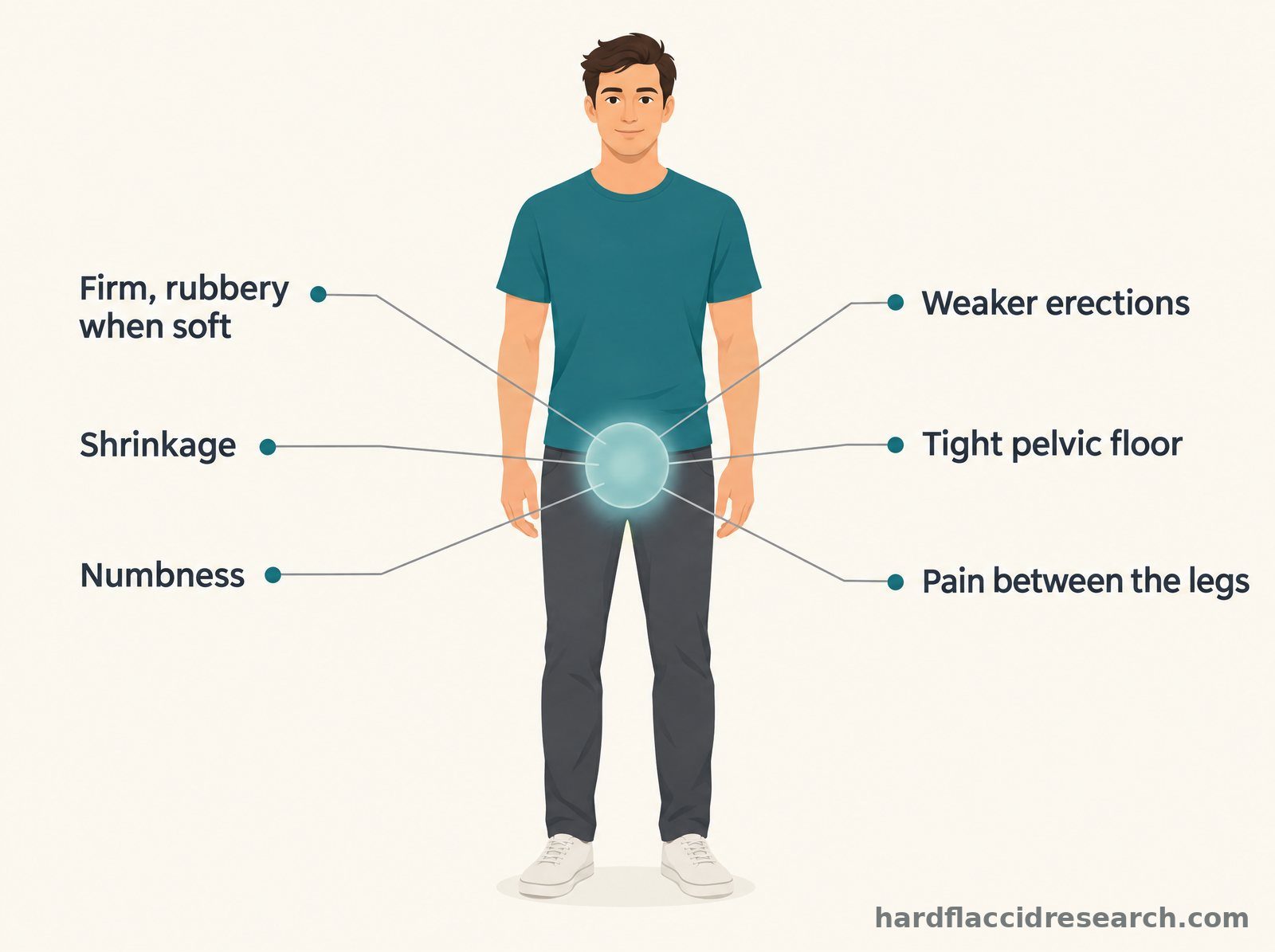
- Hard flaccid syndrome is when the penis stays firm, rubbery and often shrunken when it should be soft, usually with a tight pelvic floor, numbness or weaker erections.
- Of 2,661 men who described their symptoms, 58% describe that firm flaccid state.
- There is no single test or proven cure yet, but in a June 2023 poll 42% said they were at least half better.
193 men with hard flaccid asked this question.
Hard flaccid syndrome is a condition where the penis feels firm, rubbery or semi-hard when it should be soft and relaxed. It often looks smaller or pulled in, and it usually comes with a tight, uncomfortable pelvic floor. Many men also notice numbness, weaker erections or pain.
Hard flaccid is not yet an official diagnosis, there is no single test for it, and nobody knows exactly what causes it. Since December 2020 we have counted what 6,026 men shared about it, once per person. This page sets out what they describe, what they think started it, what they tried and where to start.
By the numbers: between December 2020 and October 2026, 2,661 of the 6,026 men who shared their experiences described their symptoms, and men cast 43,067 votes in our 818 polls.
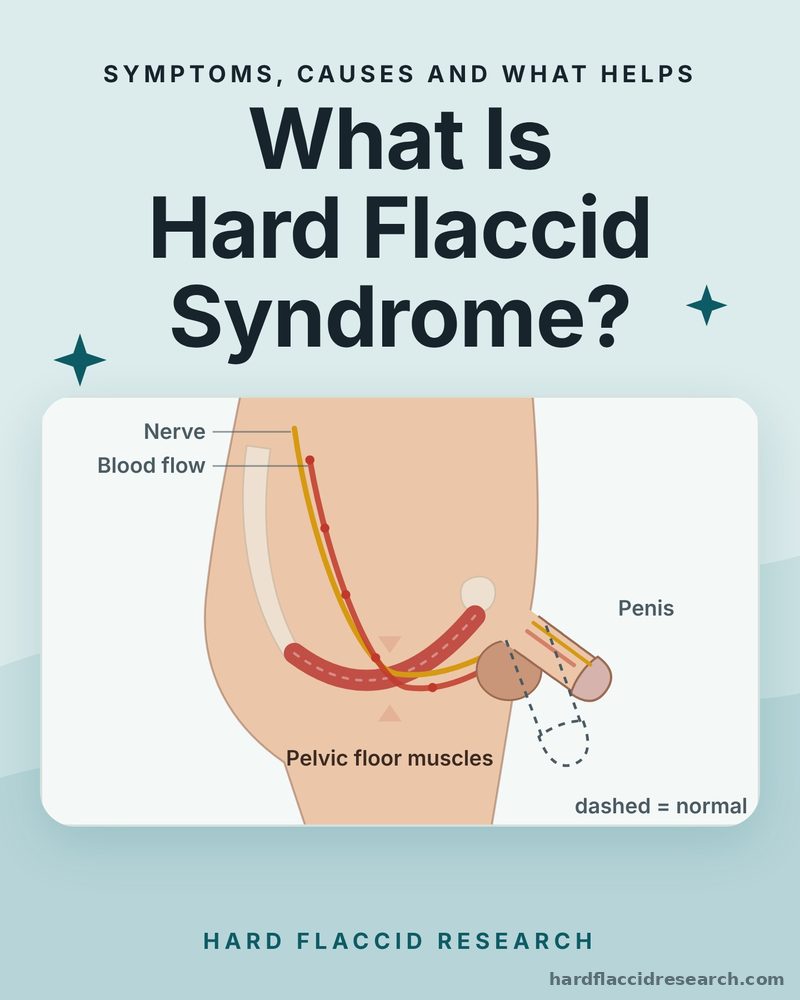
What is hard flaccid syndrome?
In hard flaccid syndrome, the resting (flaccid) penis doesn't relax the way it used to. Men describe it as firm, rubbery, cold or semi-hard, often with a shrunken look. For most men it is firmer when standing and softer when lying down.
Hard flaccid only appeared in medical journals in the last few years, so many doctors haven't heard of it. In a June 2023 poll, 99% said they first learned about hard flaccid on the internet (69 of 70 men).
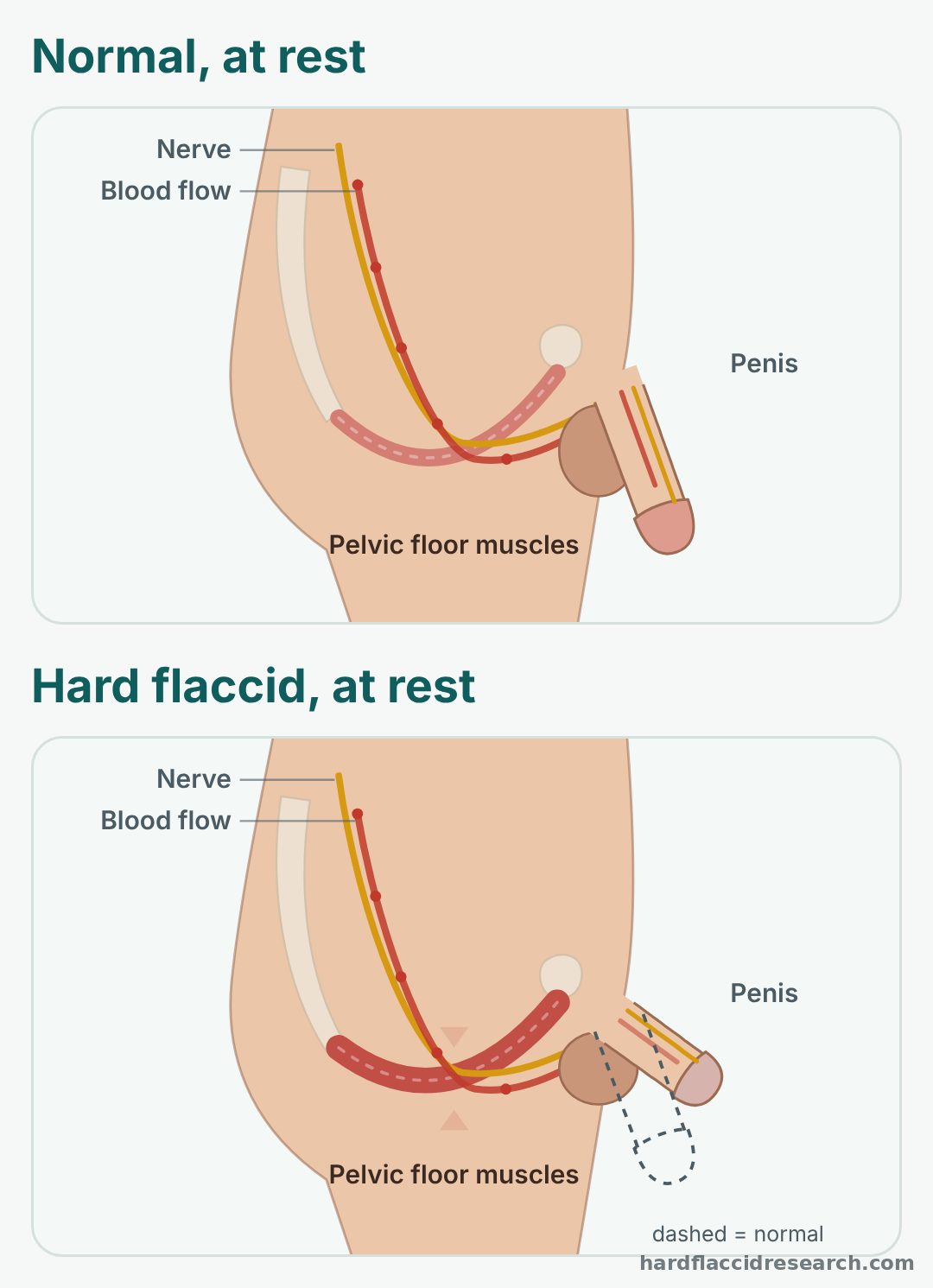
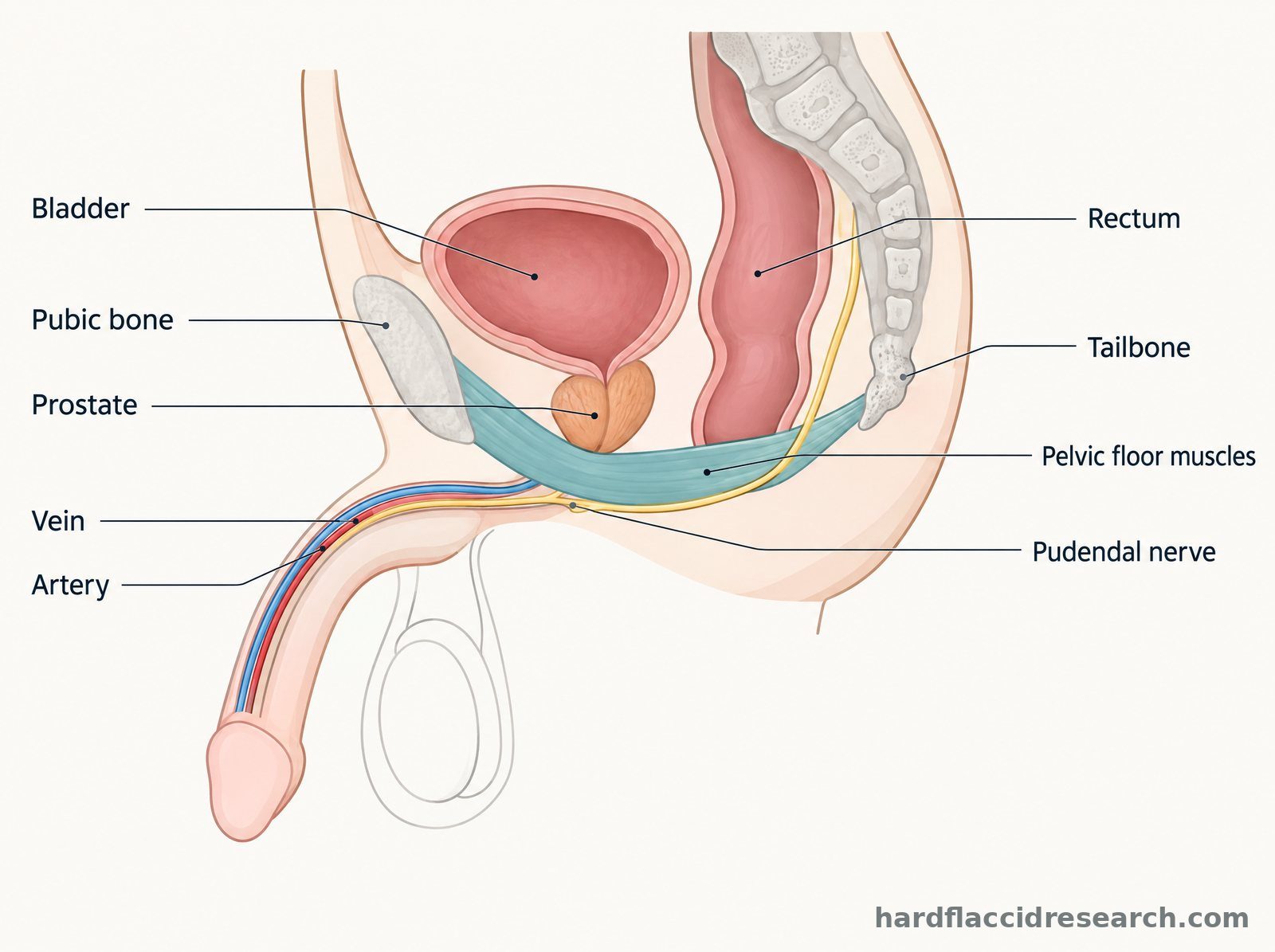
Many doctors and pelvic health physios who see hard flaccid think the pelvic floor plays a big part. The pelvic floor is the sling of muscles between your legs that supports your bladder and bowel and helps control erections. If these muscles stay clenched, they may press on the nerves and blood vessels an erection depends on.
Hard Flaccid Explorerby Hard Flaccid Research
How hard flaccid may work
A 7-minute animated explainer of this article. Press play, or skip between chapters. The first minute is free for everyone.
A picture to explain, not a diagnosis. Nobody knows the cause for sure yet.
What does hard flaccid look like?
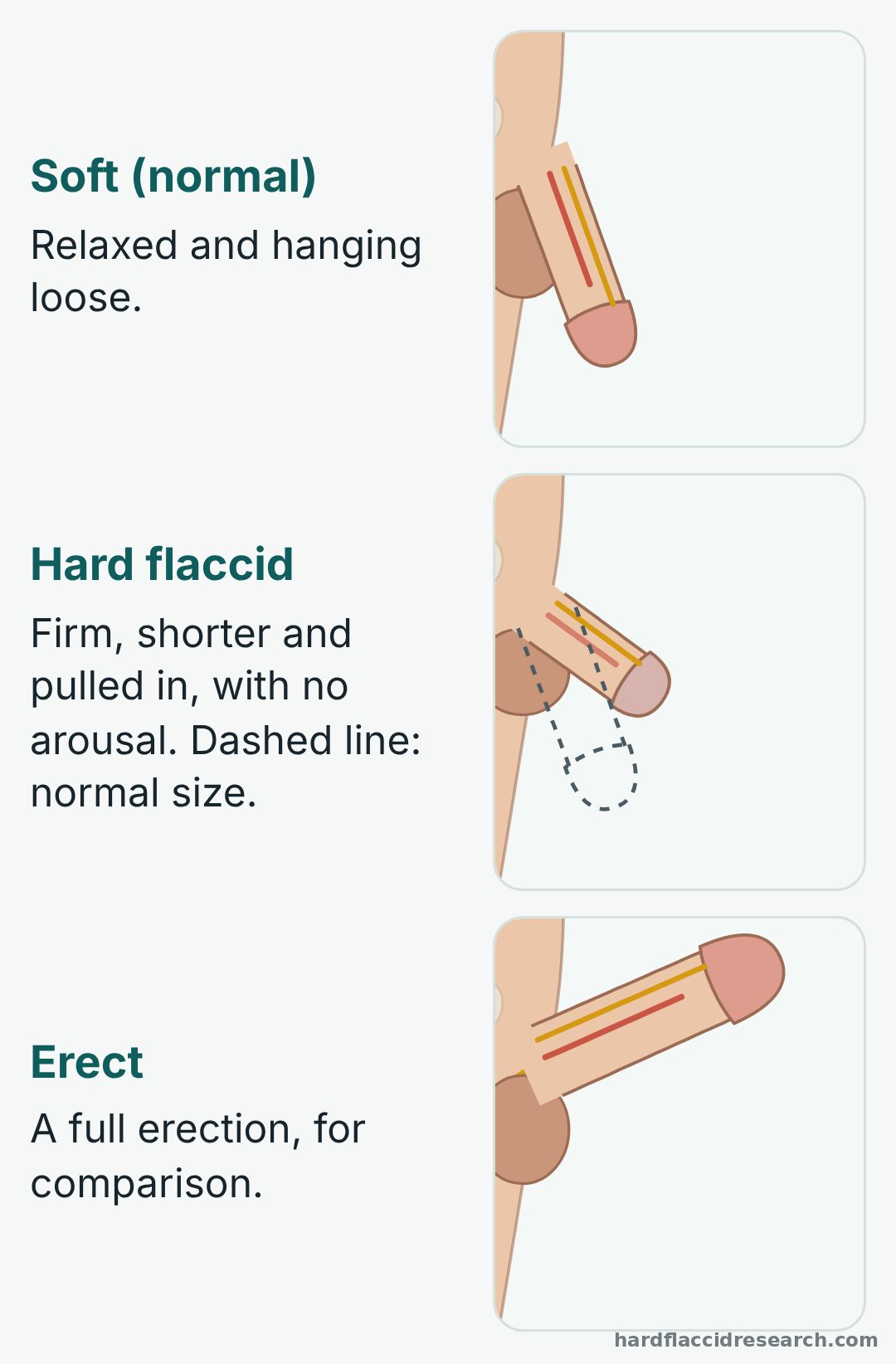
Hard flaccid often looks like a penis that is firmer than usual when it should be soft, and sometimes smaller or more pulled in. Many men say it looks almost normal to other people but feels firm and rubbery to them.
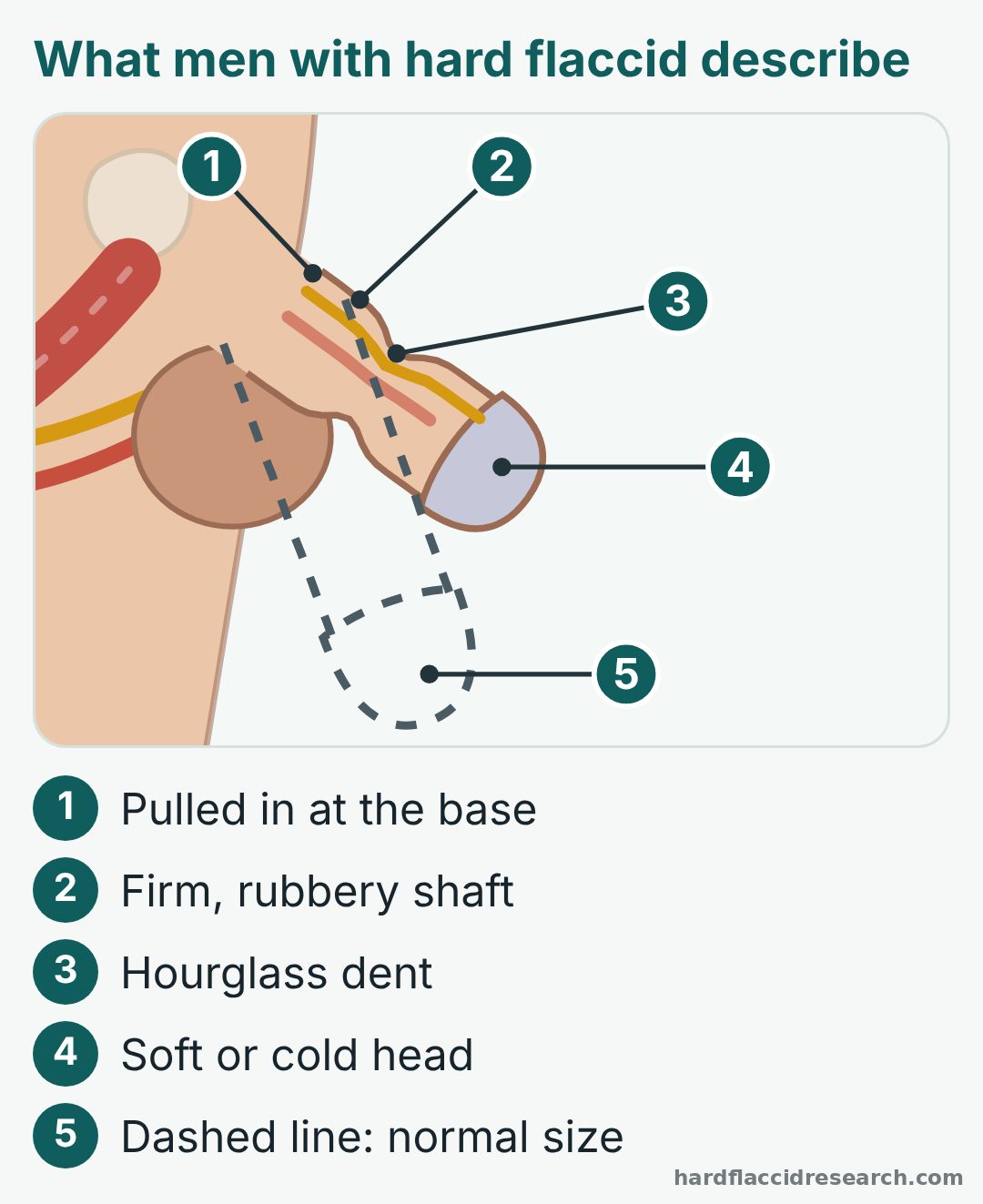
These are the changes men describe most when they look and touch:
- It feels firm, rubbery or semi-rigid when it should be soft and relaxed.
- It looks shorter and pulled in towards the body, which some men call turtling.
- The shaft feels firm while the head feels soft, under-filled or cold.
- There is an hourglass shape, or dents along the shaft.
- It is firmer when you stand and softer when you lie down.
It sits between soft and erect: firmer than a relaxed penis, but not an erection, and it happens without any arousal. The pictures below show the difference. Not every man has every change.
Our picture guide to what hard flaccid looks like shows more of the signs men describe, in diagrams, including a new curve, visible veins and colour changes.
Related: Does NoFap Help Hard Flaccid? 51% Who Tried It Said Yes »
What are the symptoms of hard flaccid syndrome?
Of 2,661 men who described their symptoms between December 2020 and October 2026, these are the ones mentioned most:
- A firm, semi-rigid flaccid state: 58% (1,553 of 2,661).
- Weak or lost erections: 35% (926 of 2,661).
- Numbness or loss of feeling: 34% (914 of 2,661).
- Shrinkage or retraction, sometimes called turtling: 27% (720 of 2,661).
- Pelvic floor tightness, spasm or twitching: 23% (601 of 2,661).
- An hourglass shape or dents along the shaft: 15% (411 of 2,661).
Fewer men describe bowel symptoms (391 men), urinary problems (337 men), a loose long flaccid state (302 men), pelvic or perineal pain (267 men), a cold glans (163 men) or fewer morning erections (147 men).
These are self-selected reports, not a clinical study. Still, they show which symptoms come up most.
The symptoms tend to come together. Among the 1,553 men who describe the firm flaccid state, 38% also mention weaker erections, 37% numbness and 32% shrinkage.
Many men say it changes through the day. In a March 2023 poll, 86% said it is harder when standing than lying down (54 of 63 men). In a February 2023 poll, 78% said their hard flaccid syndrome was worse after sex or masturbation (92 of 118 men).
Do I have hard flaccid?
Only a doctor can check for other causes, but these are the signs men with hard flaccid syndrome describe most:
- Your penis feels firm, rubbery or semi-hard when it should be soft.
- It looks smaller, pulled in or a different shape.
- It is firmer when you stand and softer when you lie down.
- There is tightness, twitching or discomfort between your legs.
- It started or got worse after an event, such as rough or very frequent masturbation, an enlargement method or an injury.
Other conditions can cause some of the same symptoms, including Peyronie's disease, venous leak, chronic prostatitis and pudendal nerve problems. That is one reason a check-up matters.
Our free self-check compares your answers with what other men report. It can't diagnose you, but it can help you decide what to tell your doctor.
Related: Penis Half-Hard All Day? 1,553 Men Call It Hard Flaccid »
How is hard flaccid syndrome diagnosed?
There is no single test for hard flaccid syndrome. When doctors diagnose it, they usually go by what you describe and a physical exam, after ruling out other conditions that can look similar. Because it is new to medicine, many doctors haven't heard of it, so it helps to describe your symptoms plainly.
A typical path looks like this:
- Your GP asks about your symptoms, examines your penis and testicles, and may test your urine.
- If your erections have changed, a blood test for blood sugar and cholesterol is worth asking for. Some doctors also check hormones such as testosterone.
- A urologist, a doctor who specialises in the urinary and genital organs, can look for other causes. A penile Doppler ultrasound, a scan of the blood flow in the penis, is usually only done if the urologist thinks it would change your care.
- A pelvic health physiotherapist, a physio trained in the pelvic floor, can check whether these muscles are tight or tender.
If you've had numbness for a while, or pain that is clearly worse when sitting, ask the doctor to check the nerves, including the pudendal nerve. If numbness around your back passage, genitals or inner thighs is new, get urgent care straight away (see When to see a doctor, below).
Writing your symptoms down before the visit helps. Our doctor visit kit lists what to say and what to ask.
Hard flaccid or something else?
Several conditions share some symptoms with hard flaccid syndrome, which is one reason a check-up matters. These are the ones that come up most, and how they usually differ:
- Peyronie's disease: scar tissue that makes the penis bend, dent or shorten, mostly during erections, often with a firm lump you can feel. It responds best to early care, so get any new curve, dent or other shape change checked early.
- Venous leak: blood drains out of the penis too fast during an erection, so erections fade. On its own it doesn't make the resting penis firm.
- Chronic prostatitis, also called chronic pelvic pain syndrome: mainly pelvic pain and peeing problems, usually with no infection. It can overlap with hard flaccid, and a tight pelvic floor seems to be part of both.
- Pudendal nerve entrapment: the main nerve of the genitals is squeezed or irritated, causing burning pain, numbness or tingling that is usually worse when sitting. Numbness is common in both, and a tight pelvic floor may irritate the nerve, so you can have features of both. Hard flaccid is often firmer when standing, which can be a useful clue.
- Erectile dysfunction on its own: erections are weaker, but the penis is soft and normal at rest.
You can have more than one of these, and only a doctor can tell them apart for sure.
What causes hard flaccid syndrome?
Nobody knows for sure yet. The ideas doctors and pelvic health physios discuss most are a pelvic floor stuck in a tight, guarded state, irritated nerves and changes in blood flow. These may feed each other.
The pudendal nerve is the main nerve of the genitals and pelvic floor. It carries feeling and helps trigger erections. Tight muscles around it may irritate it, which would fit the numbness many men describe.
Most men link the start to a clear event. Among the men who named a cause, the ones named most were:
- Penis enlargement methods such as jelqing, pumps, extenders or clamping: 155 men.
- Aggressive or excessive masturbation: 125 men.
- Edging or very long sessions: 72 men.
- A medicine or supplement: 38 men.
- Stress or anxiety: 37 men.
- Rough sex or a direct injury to the penis: 34 men.
Not everyone can name a trigger. In a November 2022 poll, 26% said their symptoms came on with no clear cause (28 of 108 men).
Anxiety is common, but most men don't think hard flaccid syndrome is all in the mind. In an April 2023 poll, 76% said they had anxiety before hard flaccid (94 of 123 men). In a January 2023 poll, 84% said the cause is not psychological (88 of 105 men).
Who gets hard flaccid syndrome, and how common is it?
Hard flaccid syndrome mostly affects young men. In a July 2023 poll, 68% said they realised they had it between the ages of 19 and 30 (80 of 118 men), and 21% between the ages of 10 and 18 (25 of 118 men).
Nobody knows how common hard flaccid is. No study has yet measured how many men have it, and our numbers come from men who chose to share their experiences, not from a survey of all men.
Many men live with it for a long time. In a February 2023 poll, 25% said they had had hard flaccid for five years or more (38 of 150 men), and 18% for less than a year (27 of 150 men).
Is hard flaccid permanent?
Not for everyone. In a June 2023 poll, 42% said they were at least half better than when it started (56 of 132 men). In the same poll, 10 of 132 men said they were about 90% better, and 3% said they were fully healed (4 of 132 men).
Most men aren't there yet: 58% in that poll said they were not healed (76 of 132 men). Where improvement comes, it is often slow.
We have 126 recovery stories from men who say they got better. Our article on whether hard flaccid is permanent looks at what those stories have in common.
How is hard flaccid syndrome treated?
There is no proven treatment yet, and no single approach works for everyone. Most men try several things over time, ideally with a doctor and a pelvic health physio.
The approaches men mentioned most were stretching (1,288 men), tadalafil (969 men), Kegels (846 men), rest or abstinence (779 men), reverse Kegels (704 men) and pelvic floor physio (656 men).
Being mentioned is not the same as working. In the 126 recovery stories, the approaches that came up most were stretching (40 of 126), rest or abstinence (28 of 126), tadalafil (20 of 126) and reverse Kegels (20 of 126).
Many men with hard flaccid syndrome say their pelvic floor feels tight, so a physio often focuses on relaxing those muscles rather than strengthening them. That is why reverse Kegels, which gently let the pelvic floor drop, come up so often.
Rest or abstinence means taking a break from sex, masturbation and porn for a while. Men often try it because their symptoms are worse afterwards.
Talk to a doctor first. Tadalafil and similar medicines are prescription drugs, and they are not safe for everyone with heart or blood pressure problems. Never take them with nitrate medicines for chest pain or with poppers, because together they can drop your blood pressure dangerously, and tell your doctor about any other medicines, including alpha blockers. Only a doctor who knows your health can say if one is right for you. Don't buy them online without a prescription.
How hard flaccid affects your life
Hard flaccid syndrome can be hard to live with. In a January 2023 poll, 67% said it affects their life dramatically (83 of 124 men). In a May 2023 poll, 54% said they had cut down on seeing people heavily or stopped leaving the house (67 of 125 men).
Anxiety and low mood are common: 916 men wrote about anxiety and 550 about depression. Feeling this way is not a sign of weakness, and help is there.
If you are feeling hopeless or having thoughts of ending your life, please visit our Support page now. It lists crisis lines you can call or text today.
Common questions about hard flaccid syndrome
Is hard flaccid syndrome real? Yes. It isn't an official diagnosis yet, but doctors have described it in medical journals, and urologists and pelvic health physios now see men with it.
Is hard flaccid the same as erectile dysfunction? No. Erectile dysfunction is about erections. Hard flaccid is mainly about the resting penis staying firm, though many men with it also have weaker erections.
Can hard flaccid go away on its own? Some men say it eased over time, often after stopping what started it, but we don't have numbers on this yet. The recovery stories men shared show what those who got better did.
Can I still have sex with hard flaccid? Many men do, though many say their symptoms are worse afterwards. Our article on sex with hard flaccid covers what men report.
Is it all in my head? Most men in one of our polls don't think so. Anxiety is common with hard flaccid, and our article on whether hard flaccid is psychological looks at both sides.
Does masturbation cause hard flaccid? Many men link the start to aggressive or very frequent masturbation, or to edging, though this isn't proven. Normal masturbation hasn't been shown to cause it.
When to see a doctor
See a doctor if your penis, erections or pelvic area have changed and you haven't had a check-up yet. These changes can have other causes besides hard flaccid syndrome, including infections, hormone problems, blood vessel disease and nerve problems in the lower back. A doctor can check for these.
Many men find it hard to be taken seriously. In a November 2022 poll of men who had seen a urologist, 95% called their visits bad and unhelpful (63 of 66 men). That's a reason to prepare well, not to skip the visit. Your GP is a good place to start, and a pelvic health physio can also help.
Get urgent care straight away if you have:
- An erection lasting more than 4 hours.
- Blood in your urine that you can see.
- Sudden, severe pain in the penis, testicles or pelvis.
- New numbness around your back passage, genitals or inner thighs, or new weakness in your legs.
- New trouble starting or controlling your pee, not being able to pee, or not feeling when your bladder is full.
- Loss of control of your bladder or bowel.
- A fever or chills with pelvic pain or pain when peeing.
What to do next
- Book a check-up with your GP to rule out other causes.
- Write down your symptoms, when they started and what makes them better or worse. Take the list with you.
- Ask about a referral to a pelvic health physiotherapist.
- While you get checked, stop anything you think may have started it, such as an enlargement method or very rough masturbation.
- Use our self-check to see how your symptoms compare.
Our members' guide, New to Hard Flaccid? What 6,026 Men Wish They'd Known, sets out the first steps men found most useful, week by week.
Free tools that can help
- Self-check: do I have hard flaccid?Compare your symptoms with what 6,026 men report.
- Doctor visit kitA one-page summary to take to your appointment.
- Habit trackerCount your days without porn or masturbation, and get through urges.
- Diaphragm breathing toolBreathe with a moving picture of your diaphragm and pelvic floor.
- Add your experienceTell us what you tried and how it went. No name needed.
- Hard Flaccid Syndrome CensusWhat men answered in 818 polls.
- Symptom trackerLog your symptoms and see what helps you.
- Ask us a questionThe questions men ask most become new articles.
The numbers behind this article
Every number in this article comes from what men with hard flaccid syndrome shared between December 2020 and October 2026, counted once per person, or from their polls. These are self-selected reports, not a clinical study. See hard flaccid syndrome statistics, the Hard Flaccid Syndrome Census and how we count.
The symptoms men with hard flaccid syndrome describe most
Share of the 2,661 men who described their symptoms between December 2020 and October 2026. Each man is counted once.These are self-selected reports, not a clinical study.
Source: Hard Flaccid Research, hardflaccidresearch.com
Less common hard flaccid syndrome symptoms
Number of men who mentioned each one, counted once per person, December 2020 to October 2026.Source: Hard Flaccid Research, hardflaccidresearch.com
The symptoms tend to come together
Share of the 1,553 men who describe the firm flaccid state who also mention each symptom.Source: Hard Flaccid Research, hardflaccidresearch.com
When hard flaccid syndrome feels worse
Each bar is a separate poll of men with hard flaccid syndrome, with its own number of men.Source: Hard Flaccid Research, hardflaccidresearch.com
What men blame for their hard flaccid syndrome
Number of men who named each cause, counted once per person, December 2020 to October 2026.Source: Hard Flaccid Research, hardflaccidresearch.com
Doctors, anxiety and the mind
Each bar is a separate poll of men with hard flaccid syndrome, with its own number of men.Source: Hard Flaccid Research, hardflaccidresearch.com
Who gets hard flaccid syndrome, and for how long
Age when men realised they had hard flaccid syndrome, from a July 2023 poll of 118 men, and how long they have had it, from a February 2023 poll of 150 men.We can't say how common hard flaccid syndrome is in all men.
Source: Hard Flaccid Research, hardflaccidresearch.com
How men are doing
How much better men say they are than when hard flaccid syndrome started, from a June 2023 poll of 132 men.Source: Hard Flaccid Research, hardflaccidresearch.com
What men with hard flaccid syndrome tried most
Number of men who mentioned each approach, counted once per person. Being mentioned doesn't mean it worked.Being mentioned is not the same as working.
Source: Hard Flaccid Research, hardflaccidresearch.com
What came up most in 126 recovery stories
Share of the 126 men who shared a story of getting better who mentioned each approach.Source: Hard Flaccid Research, hardflaccidresearch.com
How hard flaccid syndrome affects men's lives
Each bar is a separate poll of men with hard flaccid syndrome, with its own number of men.Source: Hard Flaccid Research, hardflaccidresearch.com
How men with hard flaccid syndrome feel
Number of men who wrote about each, counted once per person, December 2020 to October 2026.Source: Hard Flaccid Research, hardflaccidresearch.com
Every number in this article, with its source
| In this article | Source |
|---|---|
| 6,026 men shared their experiences | 6,026 men, counted from what men wrote, once per person |
| 58% (1,553 of 2,661) describe the firm, semi-rigid flaccid state | 1,553 of 2,661 men, counted from what men wrote, once per person |
| 35% (926 of 2,661) mentioned weak or lost erections | 926 of 2,661 men, counted from what men wrote, once per person |
| 34% (914 of 2,661) mentioned numbness or loss of feeling | 914 of 2,661 men, counted from what men wrote, once per person |
| 27% (720 of 2,661) mentioned shrinkage or retraction | 720 of 2,661 men, counted from what men wrote, once per person |
| 23% (601 of 2,661) describe pelvic floor tightness, spasm or twitching | 601 of 2,661 men, counted from what men wrote, once per person |
| 15% (411 of 2,661) mentioned an hourglass shape or dents | 411 of 2,661 men, counted from what men wrote, once per person |
| 391 men mentioned bowel symptoms | 391 men, counted from what men wrote, once per person |
| 337 men mentioned urinary problems | 337 men, counted from what men wrote, once per person |
| 302 men mentioned a long flaccid state | 302 men, counted from what men wrote, once per person |
| 267 men mentioned pelvic or perineal pain | 267 men, counted from what men wrote, once per person |
| 163 men mentioned a cold glans | 163 men, counted from what men wrote, once per person |
| 147 men mentioned fewer or no morning erections | 147 men, counted from what men wrote, once per person |
| Among men with the firm flaccid state: 38% weaker erections, 37% numbness, 32% shrinkage | 1,553 men with the firm flaccid state, counted from what men wrote, once per person |
| 86% harder when standing than lying down (54 of 63 men) | 54 of 63 men, poll, Mar 2023 |
| 78% worse after sex or masturbation (92 of 118 men) | 92 of 118 men, poll, Feb 2023 |
| 99% first learned about hard flaccid syndrome on the internet (69 of 70 men) | 69 of 70 men, poll, Jun 2023 |
| 155 men named penis enlargement methods | 155 men, counted from what men wrote, once per person |
| 125 men named aggressive or excessive masturbation | 125 men, counted from what men wrote, once per person |
| 72 men named edging or long sessions | 72 men, counted from what men wrote, once per person |
| 38 men named a medicine or supplement | 38 men, counted from what men wrote, once per person |
| 37 men named stress or anxiety | 37 men, counted from what men wrote, once per person |
| 34 men named rough sex or a direct injury | 34 men, counted from what men wrote, once per person |
| 26% no clear cause (28 of 108 men) | 28 of 108 men, poll, Nov 2022 |
| 76% had anxiety before hard flaccid (94 of 123 men) | 94 of 123 men, poll, Apr 2023 |
| 84% say the cause is not psychological (88 of 105 men) | 88 of 105 men, poll, Jan 2023 |
| 68% realised they had hard flaccid between the ages of 19 and 30 (80 of 118 men) | 80 of 118 men, poll, Jul 2023 |
| 21% realised between the ages of 10 and 18 (25 of 118 men) | 25 of 118 men, poll, Jul 2023 |
| 25% have had hard flaccid five years or more (38 of 150 men) | 38 of 150 men, poll, Feb 2023 |
| 18% have had hard flaccid less than a year (27 of 150 men) | 27 of 150 men, poll, Feb 2023 |
| 42% at least half better (56 of 132 men) | 56 of 132 men, poll, Jun 2023 |
| 10 of 132 men about 90% better | 10 of 132 men, poll, Jun 2023 |
| 3% fully healed (4 of 132 men) | 4 of 132 men, poll, Jun 2023 |
| 58% not healed (76 of 132 men) | 76 of 132 men, poll, Jun 2023 |
| 126 recovery stories | 126 men, counted from what men wrote, once per person |
| 1,288 men mentioned stretching | 1,288 men, counted from what men wrote, once per person |
| 969 men mentioned tadalafil | 969 men, counted from what men wrote, once per person |
| 846 men mentioned Kegels | 846 men, counted from what men wrote, once per person |
| 779 men mentioned rest or abstinence | 779 men, counted from what men wrote, once per person |
| 704 men mentioned reverse Kegels and pelvic floor relaxation | 704 men, counted from what men wrote, once per person |
| 656 men mentioned pelvic floor physio | 656 men, counted from what men wrote, once per person |
| Stretching came up in 40 of 126 recovery stories | 40 of 126 recovery stories |
| Rest or abstinence came up in 28 of 126 recovery stories | 28 of 126 recovery stories |
| Tadalafil came up in 20 of 126 recovery stories | 20 of 126 recovery stories |
| Reverse Kegels came up in 20 of 126 recovery stories | 20 of 126 recovery stories |
| 67% say hard flaccid affects their life dramatically (83 of 124 men) | 83 of 124 men, poll, Jan 2023 |
| 54% cut down on seeing people heavily or stopped leaving the house (67 of 125 men) | 67 of 125 men, poll, May 2023 |
| 916 men wrote about anxiety | 916 men, counted from what men wrote, once per person |
| 550 men wrote about depression | 550 men, counted from what men wrote, once per person |
| 95% called urologist visits bad and unhelpful (63 of 66 men) | 63 of 66 men, poll, Nov 2022 |
| Counting since December 2020 | Research data, December 2020 to October 2026 |
| 2,661 men described their symptoms | 2,661 men, counted from what men wrote, once per person |
| 43,067 votes in 818 polls | Research data, December 2020 to October 2026 |
How we made this article
We started from the question 193 men asked. Every number was checked against our data. Our editorial team edited it and Dr. Julian Reyes reviewed it medically. Read our editorial policy.
Read next
See more of us on Google
Add Hard Flaccid Research as a preferred source, and Google shows you our pages more often when you search.
Add as a preferred sourceDon't see your question? Ask us. We answer the most-asked ones in new articles.
Cite and share this article
You're welcome to quote this article. Please name Hard Flaccid Research and link to this page, so others can find the full answer and the data behind it. To cite this page, use its link.
Citation
Hard Flaccid Research. (2026). What Is Hard Flaccid Syndrome? Symptoms, Causes, What Helps. Written by the Editorial Team, medically reviewed by Dr. Julian Reyes. https://hardflaccidresearch.com/what-is-hard-flaccid-syndrome
Credit link for your article
Source: <a href="https://hardflaccidresearch.com/what-is-hard-flaccid-syndrome">Hard Flaccid Research</a>
Wikipedia reference
<ref>{{cite web |url=https://hardflaccidresearch.com/what-is-hard-flaccid-syndrome |title=What Is Hard Flaccid Syndrome? Symptoms, Causes, What Helps |website=Hard Flaccid Research |date=2026 |access-date=28 October 2026}}</ref>
How the data was collected: our methodology. Journalists and researchers: key numbers, data and contact.