Peyronie's Disease or Hard Flaccid? Symptoms, Causes and Treatment
In short
- Peyronie's disease is scar tissue (a plaque) inside the penis that makes it bend, dent, narrow or shorten, mostly during erections, often with a lump you can feel and pain in the early months.
- Hard flaccid syndrome mainly changes the resting penis, and the shape often changes through the day; 256 men with hard flaccid syndrome described a new curve, which on its own doesn't mean Peyronie's disease.
- You can have both, and a urologist can tell the two apart.
64 men with hard flaccid asked this question.
Peyronie's disease is scar tissue (a plaque) inside the penis that makes it bend, dent, narrow or shorten, mostly during erections. Many men can feel the plaque as a hard lump, and erections often hurt in the early months. Hard flaccid syndrome mainly changes the resting penis: it can feel firm, look shrunken or uneven, and change shape through the day. You can have both, and a urologist can tell them apart. Peyronie's disease is worth getting checked early, because it responds best to early care. Our doctor visit kit helps you prepare for the appointment.
256 men with hard flaccid described a new curve or bend, 411 an hourglass shape or dents, and 64 asked whether they have Peyronie's disease instead. This page explains the symptoms, causes and treatment of Peyronie's disease, how it differs from hard flaccid, and when to see a doctor.
By the numbers: between December 2020 and October 2026, 2,661 of the 6,026 men with hard flaccid who shared their experiences described their symptoms, and 10% of them described a new curve or bend (256 of 2,661). These are men with hard flaccid, not men with Peyronie's disease.

What is Peyronie's disease?
In Peyronie's disease, scar tissue called a plaque forms in the tough sheath around the erectile chambers (the tough outer wall in the diagram). The sheath is normally elastic and expands evenly as the chambers fill. Where there's a plaque, it can't stretch, so the penis bends towards it, narrows into an hourglass or gets shorter during an erection.
It is not cancer, and it is not catching. It can make sex painful or difficult, and it often affects how a man feels about himself, so it is worth getting help.
Hard Flaccid Explorerby Hard Flaccid Research
Peyronie's disease or hard flaccid?
A 7-minute animated explainer of this article. Press play, or skip between chapters. The first minute is free for everyone.
A picture to explain, not a diagnosis. Only a doctor's exam can tell the two apart.
Peyronie's disease symptoms
Common signs of Peyronie's disease include:
- A curve or bend in the erect penis, up, down or to one side.
- A hard lump or band under the skin of the shaft, which may be tender.
- A dent, a narrowing or an hourglass shape when erect.
- Shortening of the erect penis.
- Pain, with or without an erection, mostly in the early months.
- Erection problems, which some men notice first.
It often starts with pain during erections and a curve that is still changing (the active phase), then settles into a stable phase, usually within six months to a year and a half. Many men can feel the plaque as a hard lump or band under the skin.
Pain usually eases with time, but the curve, the lump and any shortening often stay. Peyronie's disease rarely goes away on its own: for most men it stays the same or gets a little worse at first, which is why early care matters.
Related: Why Is My Penis Shrinking? Causes of Penis Shrinkage and What Helps »
What causes Peyronie's disease?
Doctors don't fully know. It most often seems to follow repeated small injuries to the penis, for example from bending during sex, sport or an accident, which heal with scar tissue instead of normal stretchy tissue. Many men can't remember an injury. You may be more likely to get it with:
- A family member who has Peyronie's disease.
- Dupuytren's contracture, a thickening in the palm of the hand, or another connective tissue condition.
- Older age: it is more common in middle age and later life.
- Diabetes or a smoking habit, or you have had some types of prostate surgery.
A curve that has been there since puberty, with no lump or pain, is usually congenital curvature (one you were born with). It is usually harmless, though a large one can make sex difficult, and a urologist can check it. A small bend is normal.
Peyronie's disease or hard flaccid: how to tell them apart
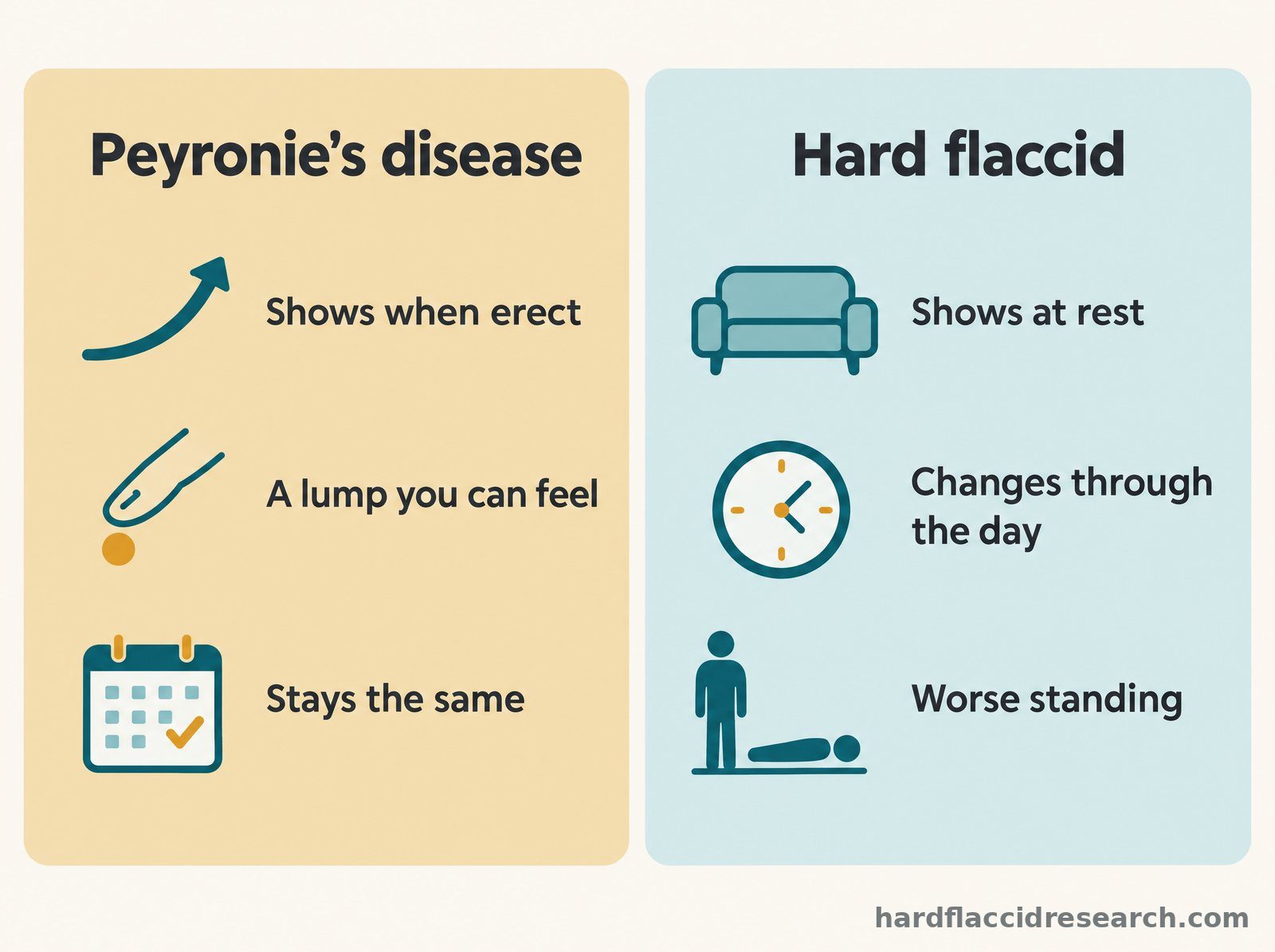
The two can look alike, but they usually differ in when and how the shape changes:
- When it shows: Peyronie's mainly changes the erect penis. Hard flaccid syndrome mainly changes the resting penis.
- A lump: many men with Peyronie's can feel a hard plaque. There is no plaque in hard flaccid.
- Through the day: a Peyronie's curve stays much the same. Hard flaccid shape changes often come and go, and are often worse standing.
- Pain: Peyronie's often hurts during erections in the early months. Pain in hard flaccid is more often in the pelvis, the perineum or the penis at rest.
- Other symptoms: hard flaccid often comes with a firm resting penis, numbness or a feeling of pelvic floor tightness, though a link to the pelvic floor isn't proven.
You can have both, and only a doctor's exam can tell you for sure.
Related: Hourglass Dent in Your Penis? The Hard Flaccid Link »
How hard flaccid changes the shape
In hard flaccid syndrome, the shape changes men describe are mostly in the resting penis, and often change through the day. One idea, though it isn't proven, is that a tight pelvic floor squeezes the blood flowing in at rest, so the chambers fill unevenly and the resting penis looks shrunken, dented or uneven.
Of the 2,661 men who described their symptoms, 58% describe the firm flaccid state (1,553 of 2,661), 27% shrinkage or retraction (720 of 2,661), 15% an hourglass shape or dents (411 of 2,661) and 10% a new curve or bend (256 of 2,661). These are self-selected reports, not a clinical study.
Position matters too. In one March 2023 poll of men with hard flaccid, 86% said their hard flaccid is harder when standing than lying down (54 of 63 men). A Peyronie's curve doesn't change with position.
Among the 256 men with hard flaccid who described a new curve, 66% also described the firm flaccid state, 50% weaker erections, 39% numbness, 37% an hourglass shape or dents and 37% shrinkage.
Among the 411 men with hard flaccid who described an hourglass shape or dents, 64% also described the firm flaccid state, 46% weaker erections, 45% numbness and 42% shrinkage. These are self-selected reports, not a clinical study.
How doctors diagnose Peyronie's disease
A urologist will ask when the curve started, whether it hurts, and whether it shows at rest or only when erect, then gently feel along the shaft for a plaque. The doctor should explain each step and ask before examining you. Photos of an erection from the top and the side can help.
If treatment is being planned, a urologist may suggest an ultrasound scan to see the plaque, sometimes with an injection that gives an erection in the clinic so the curve can be measured. The injection can cause pain, bruising or scarring, and rarely an erection that won't go down, which needs urgent care. Our doctor visit kit helps you describe when the curve started, how it has changed and whether it hurts.
Peyronie's disease treatment
Treatment depends on how much the curve affects you, whether it is still changing, and how your erections are. A mild curve that doesn't get in the way of sex often needs no treatment, and a urologist can keep an eye on it. Options a urologist may discuss include:
- Pain relief. Anti-inflammatory painkillers may ease pain in the early, active phase, though they can upset the stomach and affect the kidneys and heart.
- Traction therapy. A device worn on the penis that gently pulls it straight for a set time each day, usually for months, may reduce the curve or the loss of length a little, though the studies are small and the evidence is limited. It can cause discomfort, mild pain, swelling, skin changes or some numbness of the head of the penis. Only use one a urologist suggests, in the way they show you.
- Injections into the plaque, for a curve that has stopped changing: in some countries an enzyme called collagenase that breaks down the plaque, or medicines such as verapamil or interferon. Each can cause bruising, swelling and pain where the needle goes in. Collagenase can rarely cause a tear inside the penis, verapamil can cause dizziness or feeling sick, and interferon can cause flu-like symptoms.
- Surgery, for a curve that has been stable for some months and makes sex difficult: shortening the longer side, cutting or removing the plaque and patching it with a graft, or a penile implant for men who also have erection problems. Surgery can shorten the penis further and can cause numbness, erection problems or an infection, and rarely the curve comes back. An implant can't be undone, and the device can fail and need another operation.
- Erection medicines such as tadalafil, if erections are weak, though they don't straighten a curve. They are prescription medicines: never take them with nitrate medicines for chest pain or with poppers, because together they can drop your blood pressure dangerously.
US urology guidelines advise against vitamin E, tamoxifen or omega-3 (fish oil) tablets, or vitamin E taken with L-carnitine, for Peyronie's disease, because they haven't been shown to help. They say doctors may offer shockwave therapy to ease pain, a weaker (conditional) recommendation, but shouldn't use it to straighten a curve or shrink a plaque.
Talk to a doctor first. Every treatment has risks, and a urologist will explain them. Collagenase injections can cause bruising, swelling and pain, and rarely a tear inside the penis, so the doctor will explain how to protect it afterwards. Verapamil injections can cause bruising, pain, dizziness or feeling sick, and interferon injections can cause flu-like symptoms, a blocked or sore nose and some swelling. Surgery can shorten the penis further and can cause numbness, erection problems or an infection, and rarely the curve comes back. An implant can't be undone, and the device can fail and need another operation. A traction device can cause discomfort, swelling, skin changes or some numbness. Anti-inflammatory painkillers can upset the stomach and affect the kidneys and heart. Tadalafil, sildenafil and similar medicines are not safe for everyone with heart or blood pressure problems, so a doctor needs to check your heart, blood pressure and other medicines, and will take extra care with a curved penis. Never take them with nitrate medicines for chest pain or with poppers, because together they can drop your blood pressure dangerously. The same goes for riociguat, a medicine for high blood pressure in the lungs. If you get chest pain, tell the ambulance crew or doctor which medicine you've taken, and when: nitrate medicines must not be given within 24 hours of a sildenafil dose, or within 48 hours of a tadalafil dose. Side effects such as headache or flushing usually ease within a day or two. Rarely, they cause sudden loss of sight or hearing, or an erection that won't go down, and each needs urgent care. Only get them through a doctor or a registered pharmacy. Never start, stop or change a medicine on your own.
Treatment when hard flaccid is the more likely cause
Pelvic floor relaxation and physio aim at the muscles, not at scar tissue. Physios often suggest them when hard flaccid syndrome is the more likely cause, because hard flaccid is often linked to a tight pelvic floor, though the link isn't proven. Get a new shape change checked by a doctor first.
Among the 256 men with hard flaccid who described a new curve, 50% mentioned stretching of the hips and legs, 43% tadalafil, 41% Kegels and 39% rest or abstinence. Other approaches came up too, and being mentioned is not the same as working. Tadalafil is a prescription medicine: never take it with nitrate medicines for chest pain or with poppers, because together they can drop your blood pressure dangerously. If your pelvic floor feels tight, ask a pelvic floor physio before doing Kegels, and if you do them, let go fully between squeezes.
Shockwave therapy came up too: 303 men with hard flaccid mentioned it, and it came up in 4 of 126 recovery stories. These numbers come from men with hard flaccid, not from men with a proven Peyronie's disease, and a story mentioning something is not proof that it worked.
Don't try to straighten a curve yourself by bending, pumping or jelqing, and only use a device a urologist has suggested. In what men wrote, penis enlargement methods were the cause men with hard flaccid named most (155 men blamed them), though more men named masturbation in our polls, and what men blame is not proof of a cause.
Living with Peyronie's disease
Many men with Peyronie's disease feel anxious, low or embarrassed, and it can strain a relationship. Talking with your partner about what feels comfortable, and finding positions that avoid bending the penis, may help sex feel easier. A doctor can also suggest a counsellor or sex therapist.
If you are feeling hopeless or having thoughts of ending your life, please visit our Support page now. It lists crisis lines you can call or text.
Common questions about Peyronie's disease
Can Peyronie's disease go away on its own? Rarely. Pain often eases with time, but the curve and lump usually stay, and for many men the curve gets a little worse at first.
Can you still have sex with Peyronie's disease? Many men can. A large curve can make sex painful or difficult for you or your partner, and treatment may help.
Can Peyronie's disease be fixed naturally? No home remedy has been shown to straighten it, and US guidelines advise against vitamin E and similar tablets. Don't try to bend it straight yourself, which can make it worse.
Is Peyronie's disease serious? It isn't cancer, but it can affect erections, sex and how you feel. Peyronie's disease is worth getting checked early, because it responds best to early care.
Can hard flaccid cause a curve? We don't know. Hard flaccid mostly changes the resting penis, while Peyronie's disease mainly changes the erect penis. A new curve, dent or lump during erections should be checked.
Can Viagra or Cialis help Peyronie's disease? They can help erection problems that come with it, but they don't straighten a curve. Viagra (sildenafil) and Cialis (tadalafil) are prescription medicines.
Talk to a doctor first. Viagra and Cialis are prescription medicines and are not safe for everyone with heart or blood pressure problems, so a doctor needs to check your heart, blood pressure and other medicines, and will take extra care with a curved penis. Never take either with nitrate medicines for chest pain or with poppers, because together they can drop your blood pressure dangerously. The same goes for riociguat, a medicine for high blood pressure in the lungs. If you get chest pain, tell the ambulance crew or doctor which medicine you've taken, and when: nitrate medicines must not be given within 24 hours of a sildenafil dose, or within 48 hours of a tadalafil dose. Side effects such as headache or flushing usually ease within a day or two. Rarely, they cause sudden loss of sight or hearing, or an erection that won't go down, and each needs urgent care. Only get them through a doctor or a registered pharmacy: pills sold online without a prescription can be fake or contain other drugs. Never start, stop or change a medicine on your own.
When to see a doctor
See a urologist if you have a new curve, dent, lump or shortening, especially with pain during erections. Early on, while the curve is still changing, some treatments may stop it getting worse. If you've had a curve for a long time and it bothers you or your partner, a check-up is still worth it.
Get urgent care straight away if you have:
- A popping or cracking sound followed by sudden pain, a quick loss of erection and rapid swelling or dark bruising.
- An erection lasting more than 4 hours.
- Blood in your urine that you can see.
- Sudden, severe pain in the penis, testicles or pelvis.
- New numbness around your back passage, genitals or inner thighs, or new weakness in your legs.
- New trouble starting or controlling your pee, not being able to pee, or not feeling when your bladder is full.
- Loss of control of your bladder or bowel.
- A fever or chills with pelvic pain or pain when peeing.
What to do next
- Note when the curve or dent shows: erect, at rest, standing or lying down.
- Feel gently along the shaft for a hard lump, and note any pain during erections.
- Take photos of an erection from the top and the side to show your doctor.
- Book a urologist appointment if you have a new curve, lump or pain, and take a doctor visit kit.
- Take our self-check to see how your symptoms compare.
If you're worried about how a visit will go, many men with hard flaccid syndrome feel the same: in one November 2022 poll of men with hard flaccid who had seen a urologist, 95% called their visits bad and unhelpful (63 of 66 men). That poll was about hard flaccid, not Peyronie's disease, and a urologist is the right doctor for a curve. It's a reason to prepare well with the doctor visit kit, not to skip the visit.
Our members' guide, Numbness and Shrinkage With Hard Flaccid: What Men Try, covers shape changes in hard flaccid in more depth.
Free tools that can help
- Self-check: do I have hard flaccid?Compare your symptoms with what 6,026 men report.
- Doctor visit kitA one-page summary to take to your appointment.
- Habit trackerCount your days without porn or masturbation, and get through urges.
- Diaphragm breathing toolBreathe with a moving picture of your diaphragm and pelvic floor.
- Add your experienceTell us what you tried and how it went. No name needed.
- Hard Flaccid Syndrome CensusWhat men answered in 818 polls.
- Symptom trackerLog your symptoms and see what helps you.
- Ask us a questionThe questions men ask most become new articles.
The numbers behind this article
Every number in this article comes from what men with hard flaccid syndrome shared between December 2020 and October 2026, counted once per person, or from their polls. These are self-selected reports, not a clinical study. See hard flaccid syndrome statistics, the Hard Flaccid Syndrome Census and how we count.
Shape changes men with hard flaccid syndrome describe
Share of the 2,661 men with hard flaccid syndrome who described their symptoms. Most are changes at rest.These are self-selected reports, not a clinical study.
Source: Hard Flaccid Research, hardflaccidresearch.com
What else men with hard flaccid syndrome and a new curve described
Share of the 256 men with hard flaccid syndrome who described a new curve or bend who also described each symptom.These are self-selected reports, not a clinical study.
Source: Hard Flaccid Research, hardflaccidresearch.com
What else men with an hourglass shape or dents described
Share of the 411 men with hard flaccid syndrome who described an hourglass shape or dents who also described each symptom.These are self-selected reports, not a clinical study.
Source: Hard Flaccid Research, hardflaccidresearch.com
What men with hard flaccid syndrome and a new curve mentioned
Share of the 256 men with hard flaccid syndrome who described a new curve or bend who mentioned each. Other approaches came up too. Mentioned is not the same as worked.Tadalafil: never with nitrate medicines for chest pain or with poppers.
Source: Hard Flaccid Research, hardflaccidresearch.com
Curves, questions and shockwave
Number of men with hard flaccid syndrome, counted once per person.Source: Hard Flaccid Research, hardflaccidresearch.com
Position, recovery stories and doctors, in men with hard flaccid syndrome
Each bar has its own base: a separate poll of men with hard flaccid syndrome, or the 126 hard flaccid syndrome recovery stories.These are men with hard flaccid syndrome, not men with Peyronie's disease. A story mentioning something is not proof that it worked.
Source: Hard Flaccid Research, hardflaccidresearch.com
Every number in this article, with its source
| In this article | Source |
|---|---|
| 64 men asked whether it's Peyronie's disease instead | Question group, 64 men, research data |
| 10% (256 of 2,661) described a new curve or bend | 256 of 2,661 men, counted from what men wrote, once per person |
| 15% (411 of 2,661) describe an hourglass shape or dents | 411 of 2,661 men, counted from what men wrote, once per person |
| 58% (1,553 of 2,661) describe the firm, semi-rigid flaccid state | 1,553 of 2,661 men, counted from what men wrote, once per person |
| 27% (720 of 2,661) describe shrinkage or retraction | 720 of 2,661 men, counted from what men wrote, once per person |
| 86% harder when standing than lying down (54 of 63 men) | 54 of 63 men, poll, Mar 2023 |
| Of men with a new curve: 66% firm flaccid state, 50% weaker erections, 39% numbness, 37% hourglass shape or dents, 37% shrinkage | 256 men with a new curve or bend, counted from what men wrote, once per person |
| Of men with a new curve: 50% stretching, 43% tadalafil, 41% Kegels, 39% rest or abstinence | 256 men with a new curve or bend, counted from what men wrote, once per person |
| 303 men mentioned shockwave therapy | 303 men, counted from what men wrote, once per person |
| 126 recovery stories | 126 men, counted from what men wrote, once per person |
| Shockwave came up in 4 of 126 recovery stories | 4 of 126 recovery stories |
| 155 men named penis enlargement methods | 155 men, counted from what men wrote, once per person |
| 95% called urologist visits bad and unhelpful (63 of 66 men) | 63 of 66 men, poll, Nov 2022 |
| Counting since December 2020 | Research data, December 2020 to October 2026 |
| 2,661 of the 6,026 men who shared their experiences described their symptoms | Research data, December 2020 to October 2026 |
| Of 411 men with an hourglass shape or dents: 64% firm flaccid state, 46% weaker erections, 45% numbness, 42% shrinkage | 411 men with an hourglass shape or dents, counted from what men wrote, once per person |
How we made this article
We started from the question 64 men asked. Every number was checked against our data. Our editorial team edited it and Dr. Julian Reyes reviewed it medically. Read our editorial policy.
Read next
See more of us on Google
Add Hard Flaccid Research as a preferred source, and Google shows you our pages more often when you search.
Add as a preferred sourceDon't see your question? Ask us. We answer the most-asked ones in new articles.
Cite and share this article
You're welcome to quote this article. Please name Hard Flaccid Research and link to this page, so others can find the full answer and the data behind it. To cite this page, use its link.
Citation
Hard Flaccid Research. (2026). Peyronie's Disease or Hard Flaccid? Symptoms, Causes and Treatment. Written by the Editorial Team, medically reviewed by Dr. Julian Reyes. https://hardflaccidresearch.com/articles/peyronies-disease-or-hard-flaccid
Credit link for your article
Source: <a href="https://hardflaccidresearch.com/articles/peyronies-disease-or-hard-flaccid">Hard Flaccid Research</a>
Wikipedia reference
<ref>{{cite web |url=https://hardflaccidresearch.com/articles/peyronies-disease-or-hard-flaccid |title=Peyronie's Disease or Hard Flaccid? Symptoms, Causes and Treatment |website=Hard Flaccid Research |date=2026 |access-date=28 October 2026}}</ref>
How the data was collected: our methodology. Journalists and researchers: key numbers, data and contact.