Gabapentin for Hard Flaccid: Worth the Side Effects?
In short
- Gabapentin and other nerve pain medicines, such as pregabalin and amitriptyline, are thought to calm overactive nerve signals, so they may ease burning, shooting or electric pain.
- They don't fix what's behind hard flaccid syndrome, relax the pelvic floor or bring back lost feeling, they haven't been tested in hard flaccid syndrome, and drowsiness, dizziness and dependence are real risks, so whether one is worth it is a decision to weigh up with your doctor.
Gabapentin is a prescription medicine for nerve pain and epilepsy. For hard flaccid syndrome, where the penis stays firm, rubbery or shrunken when it should be soft, a doctor may discuss gabapentin, or another nerve pain medicine such as pregabalin or amitriptyline, if you have nerve-type pain: burning, shooting or electric pain, or pins and needles. It may ease that pain, but it doesn't treat what's behind hard flaccid, it hasn't been tested in men with hard flaccid, side effects such as drowsiness and dizziness are common, and some people become dependent on it, so weigh it up carefully with your doctor.
232 men with hard flaccid asked why there is pain, 100 asked whether their hard flaccid is a nerve problem, and 122 discussed nerve pain medicines. This page explains what gabapentin is, how it works for nerve pain and how long it takes, what it can and can't do for hard flaccid, what men with hard flaccid report, the side effects, gabapentin versus pregabalin, and how to decide whether it is worth it. Our doctor visit kit helps you describe your pain and list every medicine you take.
By the numbers: between December 2020 and October 2026, 2,661 of the 6,026 men with hard flaccid who shared their experiences described their symptoms: 34% described numbness (914 of 2,661), 10% pelvic, perineal or tailbone pain (267 of 2,661) and 8% penile pain or burning (206 of 2,661). These are men with hard flaccid, not men in general.
What is gabapentin?
Gabapentin was first licensed for epilepsy. Doctors now prescribe it mostly for nerve pain, such as pain after shingles, nerve damage from diabetes, or a trapped or irritated nerve. Pregabalin is a close relative that works in a similar way. Amitriptyline is different: an older antidepressant that, in small doses, is also used for nerve pain.
Their licences don't cover hard flaccid syndrome or chronic pelvic pain itself, so using them for it is usually off-label, which doctors are allowed to do when they think it may help. They are all prescription medicines, and gabapentin and pregabalin are controlled medicines in some countries, including the UK, and pregabalin in the US, because they can be misused.
Hard Flaccid Explorerby Hard Flaccid Research
What gabapentin does and doesn't do
A 7-minute animated explainer of this article. Press play, or skip between chapters. The first minute is free for everyone.
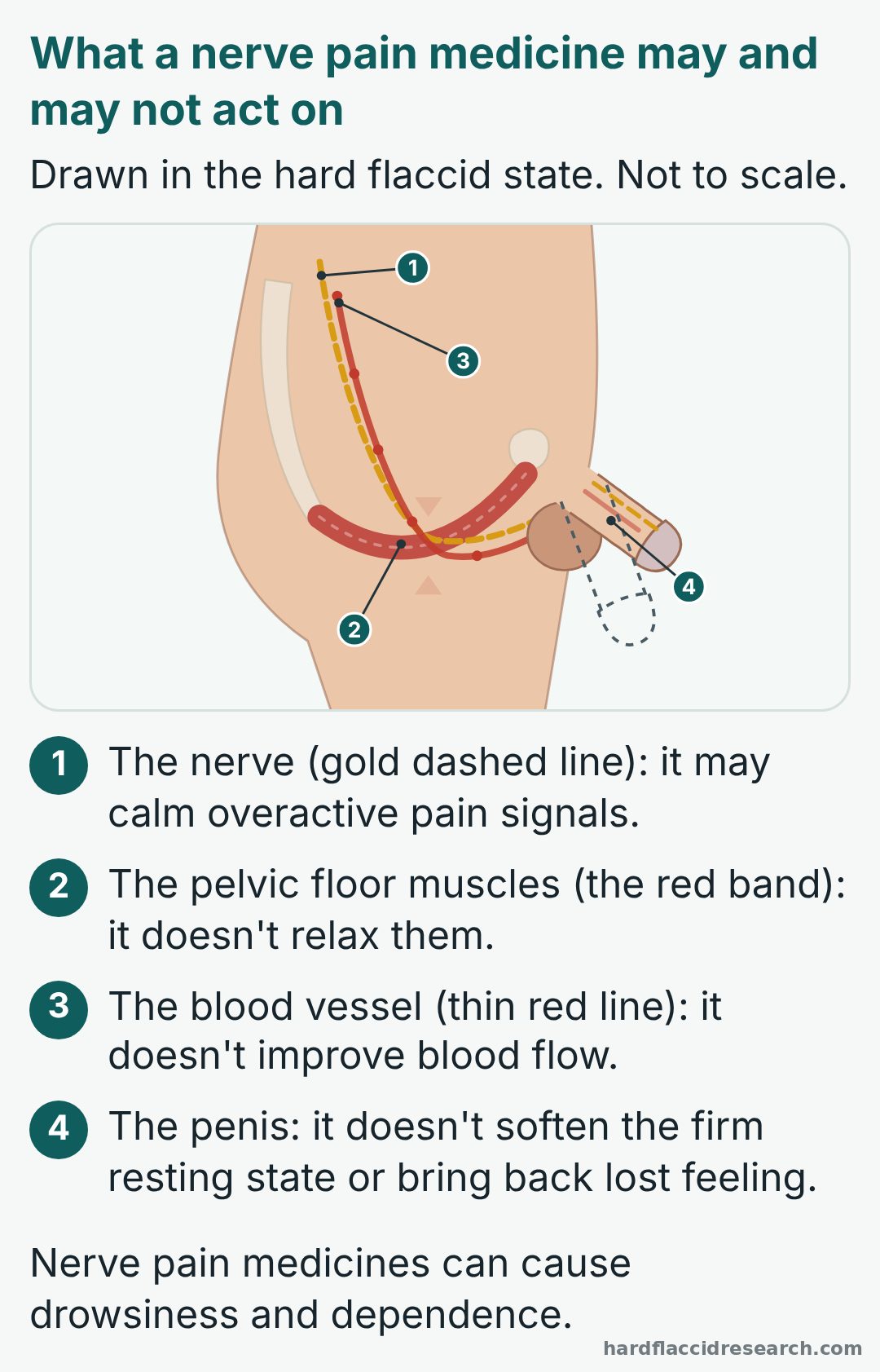
A picture to explain, not a diagnosis. Medicines aren't drawn: the picture shows the nerve, the pelvic floor and blood flow.
Gabapentin for nerve pain: how it works
Nerve pain is different from the ache of a pulled muscle. An irritated or damaged nerve can fire too easily and send pain signals on its own, which is why it often feels burning, shooting or electric, or like pins and needles. Gabapentin and pregabalin are thought to calm these overactive nerves by reducing the chemical signals they send on through the spinal cord and brain. Amitriptyline is thought to strengthen the body's own pain-damping signals.
They work slowly. Doctors usually start low and build up, and it can take a few weeks to know whether one is helping. Many people find they ease nerve pain rather than take it away.
Related: Perineum Pain With Hard Flaccid: Why It Hurts, What Helps »
What gabapentin does for hard flaccid
What nerve pain medicines act on is nerve signals. So they may help pain that feels burning, shooting or electric, or like pins and needles. They don't relax a tight pelvic floor, improve blood flow, bring back lost feeling or soften the firm resting state of hard flaccid syndrome. They don't fix a cause: they may ease pain while you take them.
That matters, because pain isn't always the main problem. In one May 2023 poll of men with hard flaccid asked which one symptom they would fix, 7% chose pain or discomfort (7 of 104 men), against 43% erection problems (45 of 104 men), 27% loss of sensation (28 of 104 men) and 20% the hard flaccid state itself (21 of 104 men).
When doctors consider nerve pain medicines
Doctors usually think about them when pain sounds like it comes from a nerve: burning or electric pain in the penis, the perineum (between the scrotum and the anus) or between the legs, pins and needles, or pain that's clearly worse when you sit. One idea is that in some men with hard flaccid syndrome, a tight pelvic floor may irritate the pudendal nerve, the main nerve of the genitals, though this isn't proven.
Doctors often start with simpler steps, such as pelvic floor physio, less pressure from sitting and talking therapy for the stress that pain brings, and add a nerve pain medicine if pain is still getting in the way of sleep, work or daily life.
A doctor will also want to check for other causes of pain first, such as an infection, and to check your kidneys, your mood and every medicine you take before suggesting one. If you're not sure whether your pain comes from the pudendal nerve, our article on pudendal nerve entrapment explains the signs.
Related: Hard Flaccid Pudendal Surgery: 82 Men, 0 Recovery Stories »
What men with hard flaccid report
Of the 2,661 men with hard flaccid syndrome who described their symptoms, 34% described numbness (914 of 2,661), 10% pelvic, perineal or tailbone pain (267 of 2,661), 8% penile pain or burning (206 of 2,661) and 4% testicle pain or a tight or high scrotum (102 of 2,661). Of the 206 men with penile pain or burning, 72% also described the firm flaccid state, 55% weaker erections, 53% numbness, 49% shrinkage and 37% pelvic floor tightness, and other symptoms came up too.
In one April 2023 poll of men with hard flaccid asked how much sensation they had lost, 79% said they had lost some sensation (85 of 108 men), including 21% who said the whole penis felt numb (23 of 108 men). Nerve pain medicines aren't known to bring lost feeling back, so they may make more sense when pain, not numbness, is the main problem.
122 men with hard flaccid discussed nerve pain medicines such as gabapentin, pregabalin or amitriptyline. Among the men who discussed them and also described their symptoms, 75% described the firm flaccid state, 64% weaker erections, 56% numbness and 50% shrinkage. Nerve pain medicines came up in 3 of 126 recovery stories, and a story mentioning something is not proof that it worked. We don't have numbers yet on how many men felt they helped, or stopped them because of side effects.
Low mood and worry come up in hard flaccid too: 550 men with hard flaccid described depression or low mood and 916 anxiety. That is one reason the mood side effects below matter, and why a doctor should know how you are feeling before you start one. These are self-selected reports, not a clinical study.
What published studies say
These medicines haven't been tested in men with hard flaccid syndrome, and in a published survey, men with hard flaccid rated nerve pain medicines as giving little or no help. In the largest trial of pregabalin in men with chronic pelvic pain, a condition that shares many symptoms with hard flaccid, pregabalin didn't work clearly better than a dummy pill, and a review of that trial concluded it doesn't improve chronic pelvic pain in men and often causes side effects. US urology guidelines say doctors may offer these medicines for nerve-type pain in men with chronic pelvic pain, a weak (conditional) recommendation based on limited evidence. For nerve pain from shingles or diabetes, the evidence is much stronger.
Gabapentin side effects to know about
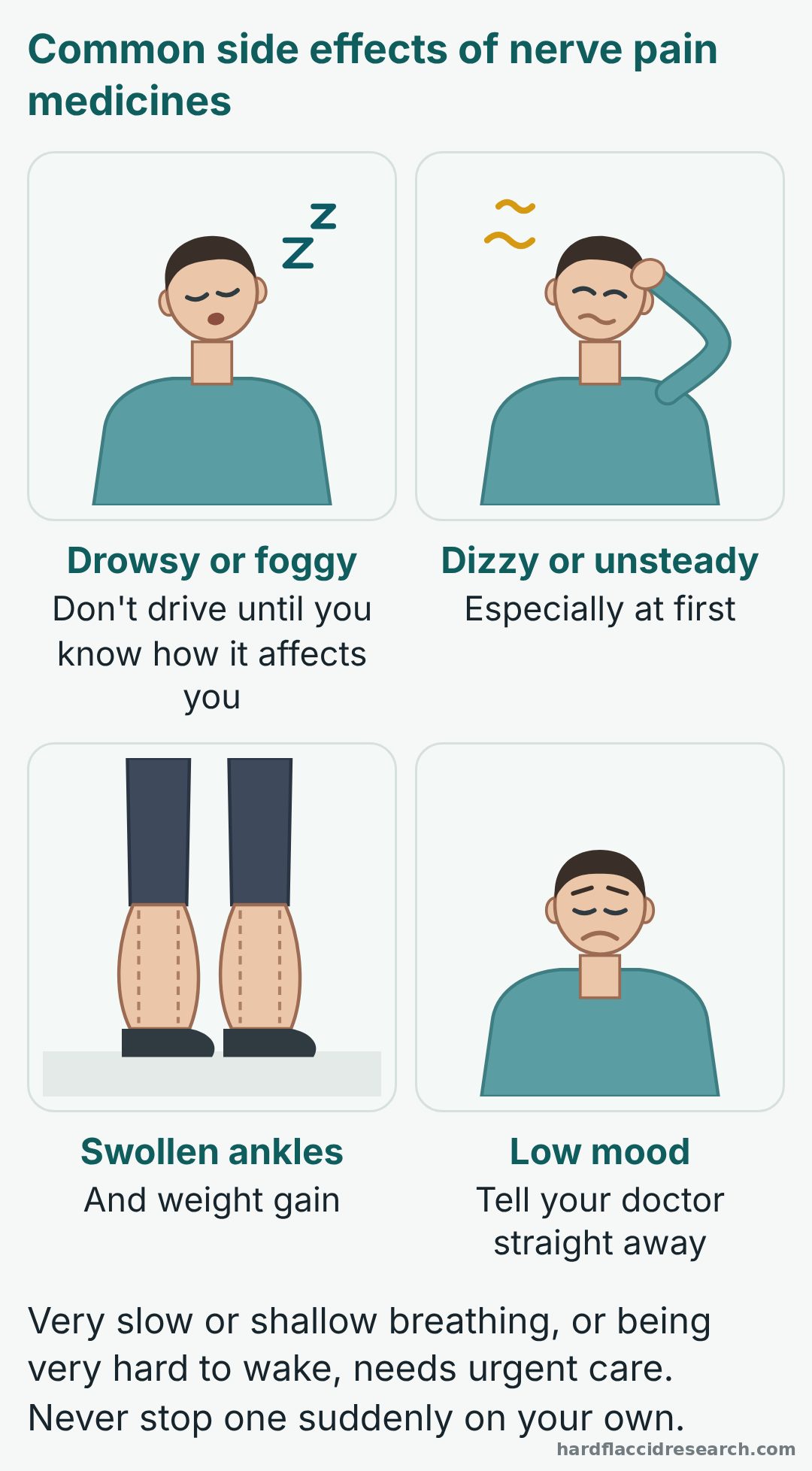
Side effects are common, especially at the start or after a dose change, and they are why "worth it?" is the real question. The common ones:
- Drowsiness, dizziness, feeling foggy or unsteady. Don't drive, cycle or use machinery until you know how it affects you.
- Weight gain, and swelling in the ankles or legs.
- Blurred or double vision.
- Feeling sick, diarrhoea, a dry mouth, headaches, memory problems or mood changes.
- Sexual side effects, such as a lower sex drive, weaker erections or trouble reaching orgasm, which matters when hard flaccid syndrome already affects sex.
Less common but serious:
- Thoughts of suicide. Rarely, these medicines can bring on very low mood or thoughts of suicide, so tell your doctor straight away if your mood drops.
- Gabapentin and pregabalin can be habit-forming for some people and are controlled medicines in some countries. With opioid painkillers, alcohol, diazepam or other sedating medicines, if you have a lung condition, or if you're older, they can slow your breathing dangerously.
- Rarely, a serious allergic or skin reaction, or an inflamed pancreas (long-lasting stomach pain and being sick). These need a doctor straight away.
Amitriptyline has its own: a dry mouth, drowsiness, dizziness, weight gain and constipation, which matters because straining may make hard flaccid symptoms worse for some men. It can make it harder to pee, can cause sexual side effects, and is dangerous in overdose, so tell your doctor if you've had thoughts of suicide. It isn't suitable with some heart rhythm problems, and it can interact with other medicines, including other antidepressants.
Talk to a doctor first. Gabapentin, pregabalin and amitriptyline are prescription medicines. They can cause drowsiness and dizziness, gabapentin and pregabalin can cause dependence, and with alcohol, opioid painkillers or other calming medicines, or with a lung condition, they can slow your breathing dangerously. Rarely, they can bring on low mood or thoughts of suicide. Amitriptyline can also cause constipation and trouble peeing, can affect heart rhythm and is dangerous in overdose. Stopping suddenly can cause withdrawal symptoms and, rarely, seizures, so a doctor will lower the dose slowly. Tell your doctor if you have kidney problems, which change how gabapentin and pregabalin leave the body, and about every other medicine and supplement you take, especially opioid painkillers, sleeping tablets and anxiety medicines, and how much alcohol you drink. Never buy them online without a prescription, and never share them. Never start, stop or change a medicine on your own.
Gabapentin vs pregabalin
Gabapentin and pregabalin work on the same part of nerve cells, so they help the same kinds of pain and share most side effects, including drowsiness, dizziness, weight gain and dependence. The main differences:
- Pregabalin is absorbed more reliably, so the dose is easier to predict, and it is usually taken fewer times a day.
- Pregabalin is also used for anxiety in some countries, and some studies suggest it is more often misused.
- Some people get on better with one than the other. A doctor can switch you safely; never swap or combine them on your own.
Neither has been tested in hard flaccid syndrome, and pregabalin didn't clearly help men with chronic pelvic pain in its largest trial. Amitriptyline is another common choice, and a doctor may suggest it instead, for example if pain stops you sleeping, though it has its own side effects (above).
Is gabapentin worth it for hard flaccid?
It depends on what you need it for. These are the things doctors and men tend to weigh up:
- A doctor may suggest one if nerve-type pain is a main problem, it's stopping you sleeping, working or sitting, and simpler steps haven't been enough.
- It's less likely to help if your main symptoms are the firm resting state, weaker erections or numbness without pain, because it doesn't act on those.
- Side effects weigh more if you drive for work, already feel foggy or low, or already have sexual side effects.
If you and your doctor decide to try one, treat it as a trial. Agree what 'better' would look like, such as sleeping through the night, and set a date to review it. Ask your doctor to plan how to start and stop it. Change one thing at a time.
Our members' guide, Hard Flaccid Syndrome Medicines: What to Ask Your Doctor, goes through each medicine men are offered and the questions to ask about it.
Common questions about gabapentin
How long does gabapentin take to work for nerve pain? It can take a few weeks to work fully, and the pain may continue in that time, because doctors usually build the dose up slowly. If nothing has changed by the review your doctor sets, talk to them rather than stopping or taking more on your own.
Is gabapentin addictive? It can be for some people, and pregabalin may be more so. Signs include finding it hard to stop, needing more for the same effect, or taking it more often than prescribed. Tell your doctor if you have ever had problems with alcohol or drugs.
What happens if you stop gabapentin? Stopping suddenly can cause withdrawal symptoms such as anxiety, poor sleep, sweating, shaking and aches, and rarely seizures. A doctor will lower the dose slowly; never stop on your own.
Can I drink alcohol with gabapentin? Alcohol adds to the drowsiness, and together with gabapentin or pregabalin it can slow your breathing, so it's best to avoid it, especially at first, and to ask your doctor what is safe for you.
Does gabapentin cause weight gain? It can, partly because it can make you hungrier, and it can cause swelling in the ankles. Tell your doctor if your weight or swelling changes.
Can gabapentin cause erection problems? It can, along with a lower sex drive or trouble reaching orgasm, which matters when hard flaccid syndrome already affects sex. If your erections change, tell your doctor rather than stopping it on your own: a blood test for blood sugar (HbA1c) and cholesterol is worth asking for too.
Can I drive on gabapentin? Not until you know how it affects you. Drowsiness, dizziness and blurred vision are common at the start and after a dose change, and in many countries it is an offence to drive while impaired by a medicine.
Questions to ask your doctor
- Does my pain sound like it comes from a nerve, and which one?
- What should this medicine help, and what won't it change?
- Which side effects should I watch for, and is it safe for me to drive?
- How does it mix with my other medicines, alcohol and any opioid painkillers?
- If it doesn't help, how do I come off it safely, and what would we try next?
When to see a doctor
If your symptoms haven't been checked yet, see your GP first. See a doctor if you have burning, shooting or electric pain, pins and needles, pain that's worse when you sit, or numbness between your legs that's been there a while, so they can check your nerves, including the pudendal nerve. Take your doctor visit kit. If you're already taking a nerve pain medicine, tell your doctor about side effects rather than stopping it on your own.
Get urgent care straight away if you have:
- Thoughts of ending your life, or of harming yourself.
- Very slow or shallow breathing, or being very hard to wake, while taking a nerve pain medicine, especially with alcohol, opioid painkillers or other calming medicines. If this happens to someone else, call an ambulance.
- Swelling of the lips, mouth, tongue or throat, or trouble breathing or swallowing.
- Sudden, severe pain in the penis, testicles or pelvis.
- New numbness around your back passage, genitals or inner thighs, or new weakness in your legs.
- New trouble starting or controlling your pee, not being able to pee, or not feeling when your bladder is full.
- Loss of control of your bladder or bowel.
- A fever or chills with pelvic pain or pain when peeing.
If you are feeling hopeless or having thoughts of ending your life, please visit our Support page now. It lists crisis lines you can call or text.
What to do next
- Take our self-check to see how your symptoms compare.
- Write down what your pain feels like (burning, shooting, electric or aching), where it is and what makes it worse.
- Ask about pelvic floor physio and less pressure from sitting, whatever you decide about medicine.
- If you start a medicine, keep a short daily note of your pain and any side effects to take to your review.
- If you've tried a nerve pain medicine, add your experience, so the next man has better numbers than we do.
Free tools that can help
- Self-check: do I have hard flaccid?Compare your symptoms with what 6,026 men report.
- Doctor visit kitA one-page summary to take to your appointment.
- Habit trackerCount your days without porn or masturbation, and get through urges.
- Diaphragm breathing toolBreathe with a moving picture of your diaphragm and pelvic floor.
- Add your experienceTell us what you tried and how it went. No name needed.
- Hard Flaccid Syndrome CensusWhat men answered in 818 polls.
- Symptom trackerLog your symptoms and see what helps you.
- Ask us a questionThe questions men ask most become new articles.
The numbers behind this article
Every number in this article comes from what men with hard flaccid syndrome shared between December 2020 and October 2026, counted once per person, or from their polls. These are self-selected reports, not a clinical study. See hard flaccid syndrome statistics, the Hard Flaccid Syndrome Census and how we count.
More men with hard flaccid syndrome described numbness than pain
Share of the 2,661 men with hard flaccid syndrome who described their symptoms. Each man is counted once.These count men who raised a symptom on their own, not men who were asked, so they are lower than poll answers.
Source: Hard Flaccid Research, hardflaccidresearch.com
72% of men with hard flaccid syndrome and penile pain or burning also described the firm flaccid state
Share of the 206 men with hard flaccid syndrome who described penile pain or burning who also described each symptom. Other symptoms came up too.These are self-selected reports, not a clinical study.
Source: Hard Flaccid Research, hardflaccidresearch.com
In one poll, 7% of men with hard flaccid syndrome would fix pain first (7 of 104 men)
How 104 men with hard flaccid syndrome answered a May 2023 poll: "If you could fix one symptom, which would it be?" One more answer, urinary or rectal symptoms, is not shown.These are self-selected reports, not a clinical study.
Source: Hard Flaccid Research, hardflaccidresearch.com
In one poll, 79% of men with hard flaccid syndrome had lost some sensation (85 of 108 men)
How 108 men with hard flaccid syndrome answered an April 2023 poll on how much sensation they had lost. The 23 men whose whole penis felt numb are among the 85 who had lost some.Nerve pain medicines aren't known to bring lost feeling back. These are self-selected reports, not a clinical study.
Source: Hard Flaccid Research, hardflaccidresearch.com
232 men with hard flaccid syndrome asked why there is pain
Number of men with hard flaccid syndrome, counted once per person.Source: Hard Flaccid Research, hardflaccidresearch.com
More men with hard flaccid syndrome wrote about anxiety than about depression or low mood
Number of men with hard flaccid syndrome who wrote about each, counted once per person.Nerve pain medicines can affect mood. If you feel hopeless, our Support page lists crisis lines.
Source: Hard Flaccid Research, hardflaccidresearch.com
Nerve pain medicines came up in 3 of the 126 hard flaccid syndrome recovery stories
Share of the 126 stories from men with hard flaccid syndrome who got better that mention a nerve pain medicine. Mentioned is not the same as worked.A story mentioning something is not proof that it worked. These medicines can cause drowsiness and dependence.
Source: Hard Flaccid Research, hardflaccidresearch.com
Every number in this article, with its source
| In this article | Source |
|---|---|
| 122 men discussed nerve pain medicines such as gabapentin, pregabalin or amitriptyline | 122 men discussing nerve pain medication, counted from what men wrote, once per person |
| Among men who discussed nerve pain medicines and also described their symptoms: 75% firm flaccid state, 64% weaker erections, 56% numbness, 50% shrinkage | 122 men discussing nerve pain medication, counted from what men wrote, once per person; shares are of those who also described their symptoms |
| Nerve pain medicines came up in 3 of 126 recovery stories | 3 of 126 recovery stories |
| 2,661 of the 6,026 men who shared their experiences described their symptoms | Research data, December 2020 to October 2026 |
| 34% described numbness (914 of 2,661) | 914 of 2,661 men, counted from what men wrote, once per person |
| 10% described pelvic, perineal or tailbone pain (267 of 2,661) | 267 of 2,661 men, counted from what men wrote, once per person |
| 8% described penile pain or burning (206 of 2,661) | 206 of 2,661 men, counted from what men wrote, once per person |
| 4% described testicle pain or a tight or high scrotum (102 of 2,661) | 102 of 2,661 men, counted from what men wrote, once per person |
| Of 206 men with penile pain or burning: 72% firm flaccid state, 55% weaker erections, 53% numbness, 49% shrinkage, 37% pelvic floor tightness | 206 men with penile pain or burning, counted from what men wrote, once per person |
| 79% said they had lost some sensation (85 of 108 men) | 85 of 108 men, poll, Apr 2023 |
| 21% said the whole penis felt numb (23 of 108 men) | 23 of 108 men, poll, Apr 2023 |
| 7% would fix pain or discomfort first (7 of 104 men) | 7 of 104 men, poll, May 2023 |
| 43% would fix erection problems first (45 of 104 men) | 45 of 104 men, poll, May 2023 |
| 27% would fix loss of sensation first (28 of 104 men) | 28 of 104 men, poll, May 2023 |
| 20% would fix the hard flaccid state first (21 of 104 men) | 21 of 104 men, poll, May 2023 |
| 232 men asked why there is pain | Question group, 232 men, research data |
| 100 men asked whether their hard flaccid is a nerve problem, such as the pudendal nerve | Question group, 100 men, research data |
| 550 men described depression or low mood | 550 men who wrote about depression or low mood, counted from what men wrote, once per person |
| 916 men described anxiety | 916 men who wrote about anxiety, counted from what men wrote, once per person |
How we made this article
We started from the question many men asked. Every number was checked against our data. Our editorial team edited it and Dr. Julian Reyes reviewed it medically. Read our editorial policy.
Read next
See more of us on Google
Add Hard Flaccid Research as a preferred source, and Google shows you our pages more often when you search.
Add as a preferred sourceDon't see your question? Ask us. We answer the most-asked ones in new articles.
Cite and share this article
You're welcome to quote this article. Please name Hard Flaccid Research and link to this page, so others can find the full answer and the data behind it. To cite this page, use its link.
Citation
Hard Flaccid Research. (2026). Gabapentin for Hard Flaccid: Worth the Side Effects? Written by the Editorial Team, medically reviewed by Dr. Julian Reyes. https://hardflaccidresearch.com/articles/gabapentin-hard-flaccid
Credit link for your article
Source: <a href="https://hardflaccidresearch.com/articles/gabapentin-hard-flaccid">Hard Flaccid Research</a>
Wikipedia reference
<ref>{{cite web |url=https://hardflaccidresearch.com/articles/gabapentin-hard-flaccid |title=Gabapentin for Hard Flaccid: Worth the Side Effects? |website=Hard Flaccid Research |date=2026 |access-date=28 October 2026}}</ref>
How the data was collected: our methodology. Journalists and researchers: key numbers, data and contact.