Valium for Hard Flaccid? What Muscle Relaxants Really Do
In short
- Muscle relaxants such as diazepam (Valium), baclofen and cyclobenzaprine act through the brain and spinal cord, so they relax muscles all over the body, not only the pelvic floor, and the effect wears off.
- There's no good evidence that they help hard flaccid syndrome.
- They can make you drowsy, diazepam can be habit-forming, and all are dangerous with alcohol or opioid painkillers, so talk to a doctor first.
Muscle relaxants such as diazepam (Valium), baclofen and cyclobenzaprine ease muscle tension by acting on the brain and spinal cord, so they relax muscles all over the body, not only the pelvic floor. In hard flaccid syndrome, where the penis stays firm, rubbery or shrunken when it should be soft, many men also describe a tight pelvic floor, though that link isn't proven. 174 men with hard flaccid discussed muscle relaxants.
There's no good evidence yet that muscle relaxants help hard flaccid. They can make you drowsy, diazepam can be habit-forming, and all are dangerous with alcohol or opioid painkillers, so talk to a doctor first, and never stop one suddenly on your own.
By the numbers: of the 6,026 men with hard flaccid who shared their experiences between December 2020 and October 2026, 174 discussed muscle relaxants and 2,661 described their symptoms. These are self-selected reports, not a clinical study.
What do muscle relaxants like Valium do?
Muscle relaxants are medicines that make muscles less tense, and in most countries they need a prescription. The ones men with hard flaccid syndrome write about work through the nervous system, not on the muscle itself, so they turn down tension right across the body. They are:
- Diazepam (Valium). A benzodiazepine, a type of calming medicine, used for anxiety and for muscle spasms. It can make you sleepy, can be habit-forming, and is dangerous with alcohol or opioid painkillers.
- Baclofen. It acts mainly on the spinal cord to ease stiffness and spasms, for example in multiple sclerosis or after a spinal injury. It can cause drowsiness, dizziness and weakness, is dangerous with alcohol or opioid painkillers, can build up if your kidneys don't work well, and must never be stopped suddenly, because that can cause hallucinations and seizures.
- Cyclobenzaprine. Used in the US and some other countries for a short spell of muscle spasm, for example in the back. It can cause drowsiness, a dry mouth, constipation and trouble peeing, is dangerous with alcohol or opioid painkillers, isn't suitable with some heart problems, and with some antidepressants or opioid painkillers it can rarely cause serotonin syndrome, a dangerous reaction.
None of them can pick out one muscle: your pelvic floor may relax a little, but so do your legs, your back and your concentration. Other muscle relaxants exist, each with its own risks, so ask a doctor or pharmacist about any you're prescribed.
Hard Flaccid Explorerby Hard Flaccid Research
What muscle relaxants may do
A 7-minute animated explainer of this article. Press play, or skip between chapters. The first minute is free for everyone.
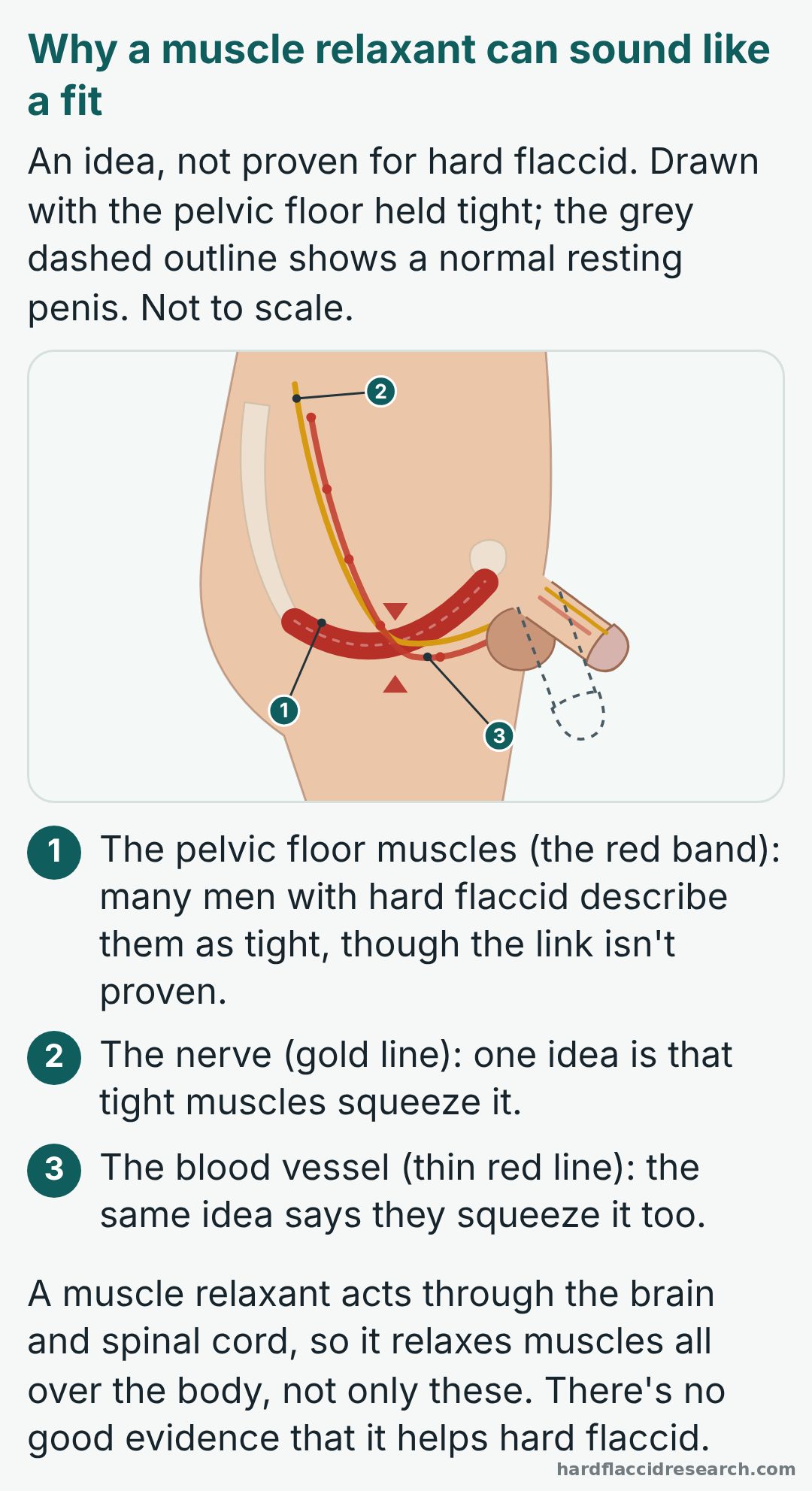
A picture to explain, not a diagnosis. Medicines aren't drawn: the picture shows the pelvic floor, a nerve, blood flow and the penis.
Why some doctors suggest a muscle relaxant for hard flaccid
Many men with hard flaccid syndrome describe a firm, rubbery penis at rest, and some a tight pelvic floor, the hammock of muscles between your legs that holds up the bladder and bowel. Of the 2,661 men with hard flaccid who described their symptoms, 58% described the firm flaccid state (1,553 men) and 23% pelvic floor tightness, spasm or twitching (601). One idea, though it isn't proven, is that a tight pelvic floor squeezes the nerves and blood vessels on their way to the penis.
So a medicine that relaxes muscles can sound like a fit, and some doctors suggest a short course to help break a cycle of tension, alongside physio. Diazepam also calms anxiety, which may be part of why some men feel better on it for a while. But the body gets used to it and it can be habit-forming, so doctors usually prescribe it only for a short time.
Related: Your Breathing May Be Keeping Your Hard Flaccid Tight »
Valium suppositories for the pelvic floor
Some pelvic pain specialists prescribe diazepam as a suppository, a small pellet placed in the back passage (or, for women, the vagina), often made up specially by a pharmacy. The idea is that more of it acts on the pelvic floor and less on the rest of the body, but this isn't proven. Diazepam is absorbed into the blood from there, so it still reaches the brain: it can still make you drowsy, it can still be habit-forming, and it is still dangerous with alcohol or opioid painkillers.
The few small trials, in women, have mostly found diazepam suppositories no better than a dummy suppository, and there is very little research in men. Use one only if a doctor has prescribed it in that form, and never make your own from tablets.
What muscle relaxants can't do for hard flaccid
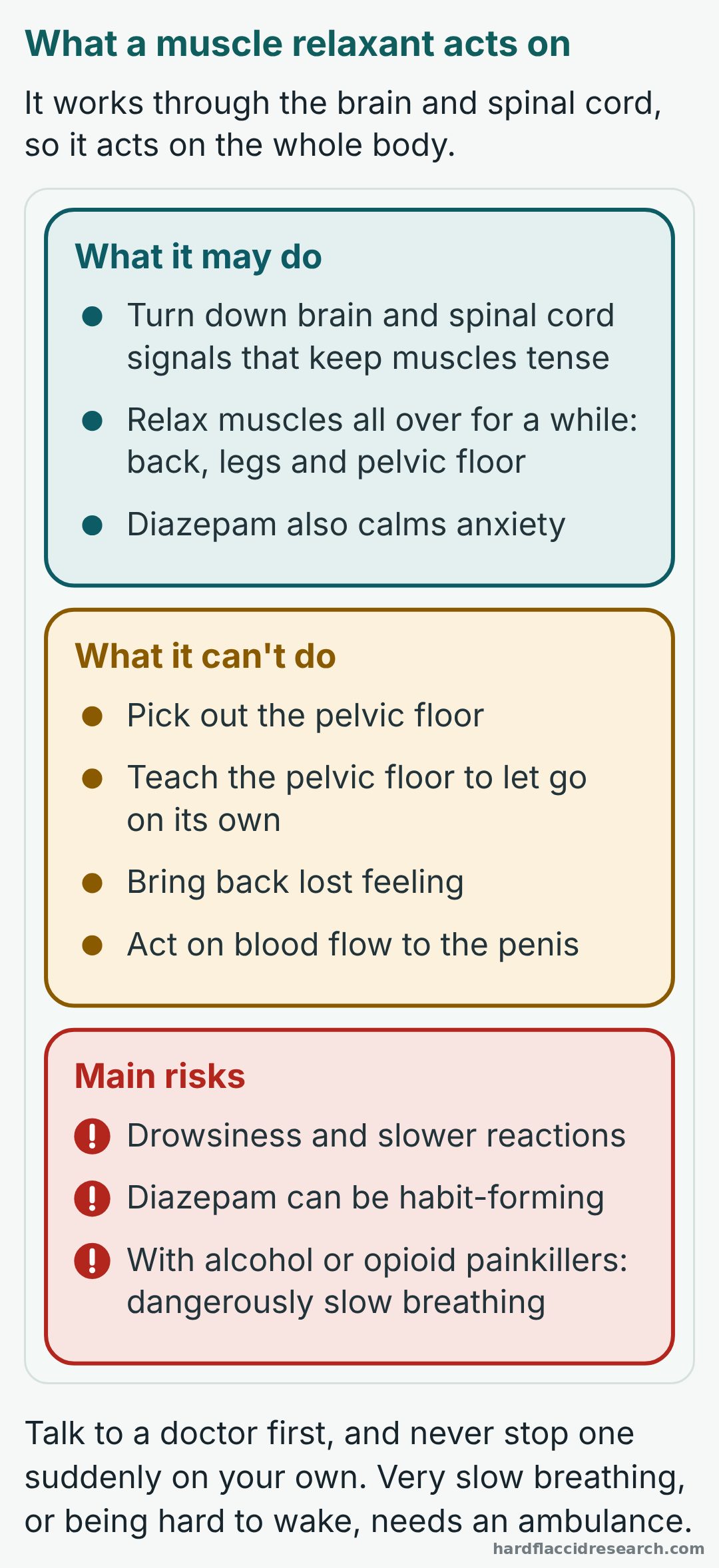
- They don't target the pelvic floor. They relax muscles everywhere, and they don't teach your pelvic floor to let go on its own.
- They aren't known to calm an irritated nerve, and they don't bring back lost feeling.
- They don't act on blood flow to the penis.
- The effect fades as each dose wears off, and your body can get used to diazepam, so it may do less over time.
No trial has tested muscle relaxants in hard flaccid syndrome, and in a published survey, men with hard flaccid rated them as giving little or no help. There are no good trials in men with chronic pelvic pain either, and US urology guidelines for chronic pelvic pain in men don't include muscle relaxants among the treatments they recommend.
Related: Hard Flaccid Worse After a Bowel Movement? Here's Why »
What men with hard flaccid report about muscle relaxants
174 men with hard flaccid syndrome discussed muscle relaxants, which can cause drowsiness and dependence and are dangerous with alcohol or opioid painkillers. Among the men who discussed them and also described their symptoms, 80% described the firm flaccid state, 58% weaker erections, 54% numbness, 51% pelvic floor tension and 46% shrinkage. These shares run higher than among all the men who described their symptoms, perhaps partly because men who wrote more tended to describe more symptoms of every kind, so they don't show what muscle relaxants do. Muscle relaxants came up in 1 of the 126 recovery stories, and other approaches came up more often; a story mentioning something is not proof that it worked. We don't have numbers yet on how men rate muscle relaxants.
Valium and muscle relaxant side effects
The main side effects and risks:
- Drowsiness, dizziness and slower reactions. Diazepam's drowsiness can last into the next day. Don't drive, cycle or use machinery until you know how a medicine affects you, and older people are more likely to fall.
- Dependence and withdrawal. US regulators give diazepam and similar medicines their strongest warning, for misuse, addiction, dependence and withdrawal. After regular use, stopping suddenly can cause anxiety, poor sleep, shaking and sweating, and rarely seizures, and stopping baclofen suddenly can cause hallucinations and seizures. A doctor lowers the dose slowly.
- Dangerous mixes. Alcohol, opioid painkillers, sleeping pills, nerve pain medicines such as gabapentin or pregabalin (which can themselves cause drowsiness and dependence) and other calming medicines add to the effect and can slow your breathing dangerously; with opioids this can lead to coma or death. Don't drink grapefruit juice while taking diazepam, because it can make side effects more likely. Cyclobenzaprine with some antidepressants or opioid painkillers can rarely cause serotonin syndrome, with agitation, a high temperature, sweating and shaking, which needs urgent care.
- Memory, mood and sex. Some men notice forgetfulness, confusion, low mood or mood swings. Diazepam can change sex drive, and baclofen can rarely cause erection or ejaculation problems, which matters if hard flaccid syndrome already affects your sex life.
- Extra care. Doctors are more careful, or avoid them, if you have breathing problems or sleep apnoea, liver or kidney problems, myasthenia gravis (a condition that makes muscles weak), a type of glaucoma (raised pressure in the eye), epilepsy, low mood or another mental health condition, or past problems with alcohol or drugs, and in older age. Cyclobenzaprine may not suit you after a recent heart attack, or with heart failure, some heart rhythm problems, an overactive thyroid or trouble peeing, or soon after taking an MAOI antidepressant.
Talk to a doctor first. In most countries, muscle relaxants need a prescription. All of them can cause drowsiness and dizziness, and with alcohol, opioid painkillers, nerve pain medicines such as gabapentin or pregabalin (which can also cause drowsiness and dependence), sleeping pills or other calming medicines they can slow your breathing dangerously. Diazepam can be habit-forming, and after regular use stopping it suddenly can cause withdrawal and, rarely, seizures; don't drink grapefruit juice while taking it. Baclofen must also be reduced slowly, because stopping it suddenly can cause hallucinations and seizures, and it can build up if your kidneys don't work well. Cyclobenzaprine can cause a dry mouth, constipation and trouble peeing, isn't suitable with some heart problems or with some antidepressants (MAOIs), and with some antidepressants or opioid painkillers it can rarely cause serotonin syndrome, which needs urgent care. Tell your doctor or pharmacist about every medicine and supplement you take and how much alcohol you drink. Never take someone else's, never buy them online, where pills can contain other, stronger drugs, and never make your own suppositories. Never start, stop or change a medicine on your own.
Muscle relaxants, anxiety and mood
916 men with hard flaccid syndrome wrote about anxiety and 550 about low mood or depression. In one April 2023 poll, 76% of men with hard flaccid said they had anxiety before hard flaccid (94 of 123 men), though that doesn't show that anxiety caused it, and in one January 2023 poll, 84% said the cause of hard flaccid isn't psychological (88 of 105 men). Neither poll asked about muscle relaxants.
A calming medicine can take the edge off worry for a while, but it isn't a long-term treatment for anxiety, it doesn't treat low mood, and diazepam can sometimes make low mood worse. Talking therapy, such as CBT, may help with both, so tell your doctor how you're feeling.
If you are feeling hopeless or having thoughts of ending your life, please visit our Support page now. It lists crisis lines you can call or text today.
Questions to ask your doctor about muscle relaxants
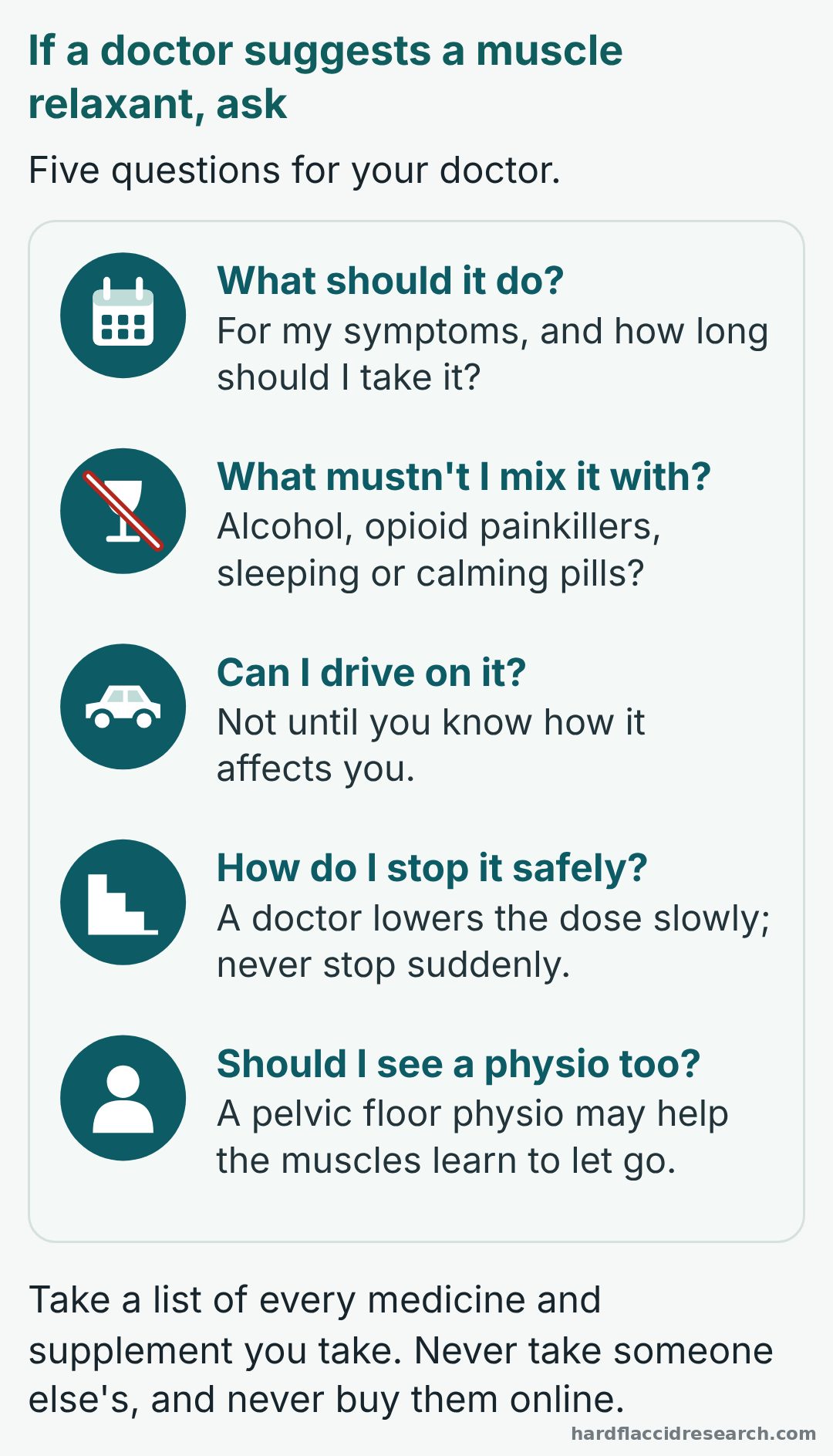
If a doctor suggests one, these questions help:
- What should it do for my symptoms, and how long should I take it?
- What mustn't I mix it with, and can I drive on it?
- How do I stop it safely when the time comes?
- Should I see a pelvic floor physio as well?
Our members' guide, Hard Flaccid Syndrome Medicines: What to Ask Your Doctor, goes through each medicine men are offered, step by step.
What often comes first for a tight pelvic floor
For a tight pelvic floor, doctors and physios often start with ways to teach the muscles to let go: pelvic floor physio, reverse Kegels (a gentle letting go, never a push) with slow belly breathing, gentle stretches, and ways to ease day-to-day tension, such as talking therapy. A physio should explain each step and ask before any hands-on or internal work. US urology guidelines say doctors may offer hands-on physio to men with chronic pelvic pain whose pelvic floor muscles are tender (a weaker recommendation). A medicine may sit alongside these for a short time, not replace them.
In one February 2023 poll, 59% of men with hard flaccid syndrome had never seen a pelvic floor physio (91 of 155 men), and in one November 2022 poll of men with hard flaccid who had seen one, 36% said it helped quite a bit or cured them (17 of 47 men). Neither poll asked about muscle relaxants. Separately, the counts of men with hard flaccid who discussed each approach run from stretching (1,288 men) and reverse Kegels or pelvic floor relaxation (704) down to muscle relaxants (174), which can cause drowsiness and dependence. The charts at the end of the page show more, and discussing something is not the same as it working.
Common questions about muscle relaxants
Is Valium a muscle relaxant? Partly. Valium is a brand name for diazepam, a calming medicine that also relaxes muscles, and doctors use it for muscle spasms as well as anxiety. Its main risks are drowsiness, dependence, and danger with alcohol or opioid painkillers.
Can you drink alcohol on muscle relaxants? No. Alcohol adds to the drowsiness, and with diazepam and other calming medicines it can slow your breathing dangerously. Don't drink while you take one, and ask your pharmacist when it is safe after you stop.
Is diazepam addictive? It can be, even at prescribed doses, which is why doctors usually prescribe it only for a short time. Signs include needing more for the same effect, finding it hard to stop, or taking it more often than prescribed. Tell your doctor if you have ever had problems with alcohol or drugs.
What happens if you stop diazepam suddenly? After regular use, it can bring on withdrawal: anxiety, poor sleep, irritability, shaking and sweating, and rarely seizures. For some people, withdrawal symptoms can last weeks or months, which is another reason a doctor lowers the dose slowly; never stop on your own.
How long does diazepam stay in your system? A long time. It leaves the body slowly, so drowsiness can carry into the next day and can build up with daily doses. Ask your pharmacist before you drive after a dose, and how long to wait after your last dose before you drink alcohol.
Which muscle relaxant is the strongest? We don't rank medicines. A stronger effect often means more drowsiness, not a better result for the pelvic floor, and none has good evidence in hard flaccid syndrome. Which one, if any, suits you is your doctor's call.
Do muscle relaxants help a tight pelvic floor? There is little good research, and the small trials of diazepam suppositories, in women, mostly haven't shown clear benefit. In any form, diazepam can still cause drowsiness and dependence. Many physios focus on teaching the muscles to let go, which a medicine can't do.
When to see a doctor
If your symptoms haven't been checked yet, see your GP first. See a doctor before you start or stop any muscle relaxant, and if your pelvic floor feels tight or painful most days; ask whether a pelvic floor physio could check it. If numbness between your legs has been there a while, or pain is worse when sitting, ask a doctor to check the nerves, including the pudendal nerve. Our doctor visit kit helps you list your symptoms and every medicine you take.
Get urgent care straight away if you have:
- Thoughts of ending your life, or of harming yourself.
- Very slow or shallow breathing, or being very hard to wake, while taking a muscle relaxant, especially with alcohol, opioid painkillers or other calming medicines. If this happens to someone else, call an ambulance.
- Agitation, confusion, a high temperature, heavy sweating, shaking, stiff muscles or a fast heartbeat while taking cyclobenzaprine, especially after starting another medicine.
- A seizure (fit), or new hallucinations or confusion, especially after stopping diazepam or baclofen suddenly.
- Swelling of the lips, mouth, tongue or throat, or trouble breathing or swallowing.
- Sudden, severe pain in the penis, testicles or pelvis.
- New numbness around your back passage, genitals or inner thighs, or new weakness in your legs.
- New trouble starting or controlling your pee, not being able to pee, or not feeling when your bladder is full.
- Loss of control of your bladder or bowel.
- A fever or chills with pelvic pain or pain when peeing.
What to do next
- If your symptoms haven't been checked, see a doctor first.
- Take our self-check to see how your symptoms compare.
- List every medicine and supplement you take, and bring it with your doctor visit kit.
- Ask your doctor about pelvic floor physio, and try gentle reverse Kegels with slow belly breathing: a letting go, never a push.
- Never mix a muscle relaxant with alcohol, and don't drive until you know how it affects you.
- If you've tried a muscle relaxant, add your experience, so the next man has better numbers than we do.
Free tools that can help
- Self-check: do I have hard flaccid?Compare your symptoms with what 6,026 men report.
- Doctor visit kitA one-page summary to take to your appointment.
- Habit trackerCount your days without porn or masturbation, and get through urges.
- Diaphragm breathing toolBreathe with a moving picture of your diaphragm and pelvic floor.
- Add your experienceTell us what you tried and how it went. No name needed.
- Hard Flaccid Syndrome CensusWhat men answered in 818 polls.
- Symptom trackerLog your symptoms and see what helps you.
- Ask us a questionThe questions men ask most become new articles.
The numbers behind this article
Every number in this article comes from what men with hard flaccid syndrome shared between December 2020 and October 2026, counted once per person, or from their polls. These are self-selected reports, not a clinical study. See hard flaccid syndrome statistics, the Hard Flaccid Syndrome Census and how we count.
In what men with hard flaccid syndrome wrote, 58% described a firm resting state, and 23% a tight pelvic floor
Share of the 2,661 men with hard flaccid syndrome who described their symptoms. Each man is counted once in each bar.Counts from what men wrote run lower than poll answers, because men weren't asked. The link between a tight pelvic floor and hard flaccid syndrome isn't proven.
Source: Hard Flaccid Research, hardflaccidresearch.com
Muscle relaxants came up in 1 of the 126 hard flaccid syndrome recovery stories
Share of the 126 stories from men with hard flaccid syndrome who got better that mention a muscle relaxant. Mentioned is not the same as worked.A story mentioning something is not proof that it worked, and other approaches came up more often. Muscle relaxants can cause drowsiness and dependence, and are dangerous with alcohol or opioid painkillers.
Source: Hard Flaccid Research, hardflaccidresearch.com
In one poll, 36% of men with hard flaccid syndrome who had seen a pelvic floor physio said it helped quite a bit or cured them (17 of 47 men)
Two separate polls of men with hard flaccid syndrome, each with its own number of men.Neither poll asked about muscle relaxants. These are self-selected reports, not a clinical study.
Source: Hard Flaccid Research, hardflaccidresearch.com
In one poll, 76% of men with hard flaccid syndrome said they had anxiety before hard flaccid syndrome (94 of 123 men)
Each bar is a different poll of men with hard flaccid syndrome, with its own number of men.Having anxiety first doesn't show that anxiety caused hard flaccid syndrome, and a poll can't settle what causes it. Neither poll asked about muscle relaxants.
Source: Hard Flaccid Research, hardflaccidresearch.com
1,288 men with hard flaccid syndrome discussed stretching, and 174 muscle relaxants
Number of men with hard flaccid syndrome who discussed each, counted once per person.The groups overlap, other approaches came up too, and discussing something is not the same as it working. Reverse Kegels are a gentle letting go, never a push; keep heat warm, not hot, and never use it on numb skin or while you sleep; muscle relaxants can cause drowsiness and dependence and are dangerous with alcohol or opioid painkillers.
Source: Hard Flaccid Research, hardflaccidresearch.com
916 men with hard flaccid syndrome wrote about anxiety, and 550 about low mood or depression
Number of men with hard flaccid syndrome in each group, counted once per person.The groups overlap. Blaming something isn't proof that it caused hard flaccid syndrome. If you feel hopeless, our Support page lists crisis lines.
Source: Hard Flaccid Research, hardflaccidresearch.com
118 men with hard flaccid syndrome asked whether to do Kegels or reverse Kegels
Number of men with hard flaccid syndrome who asked each question, counted once per person.The groups overlap: one man can ask more than one question. If your pelvic floor feels tight, ask a physio before doing Kegels, and let go fully between squeezes.
Source: Hard Flaccid Research, hardflaccidresearch.com
Every number in this article, with its source
| In this article | Source |
|---|---|
| 6,026 men shared their experiences; 2,661 described their symptoms | Research data, December 2020 to October 2026 |
| 174 men discussed muscle relaxants | 174 men discussing muscle relaxants, counted from what men wrote, once per person |
| Among the men who discussed muscle relaxants and also described their symptoms: 80% firm flaccid state, 58% weaker erections, 54% numbness, 51% pelvic floor tension, 46% shrinkage | 174 men discussing muscle relaxants, counted from what men wrote, once per person; shares are of those who also described their symptoms |
| 58% described the firm flaccid state (1,553 of 2,661) | 1,553 of 2,661 men, counted from what men wrote, once per person |
| 23% described pelvic floor tightness, spasm or twitching (601 of 2,661) | 601 of 2,661 men, counted from what men wrote, once per person |
| Muscle relaxants came up in 1 of 126 recovery stories | 1 of 126 recovery stories, counted from what men wrote |
| 126 recovery stories | 126 men, counted from what men wrote, once per person |
| 916 men wrote about anxiety | 916 men who wrote about anxiety, research data |
| 550 men wrote about low mood or depression | 550 men who wrote about low mood or depression, research data |
| 76% had anxiety before hard flaccid syndrome (94 of 123 men) | 94 of 123 men, poll, Apr 2023 |
| 84% said the cause of hard flaccid is not psychological (88 of 105 men) | 88 of 105 men, poll, Jan 2023 |
| 59% had never seen a pelvic floor physio (91 of 155 men) | 91 of 155 men, poll, Feb 2023 |
| 38% of men who had seen a pelvic floor physio said it dramatically helped (24 of 64 men) | 24 of 64 men, poll, Feb 2023 |
| 36% said physio helped quite a bit or cured them (17 of 47 men) | 17 of 47 men, poll, Nov 2022 |
| 1,288 men discussed stretching | 1,288 men, counted from what men wrote, once per person |
| 704 men discussed reverse Kegels and pelvic floor relaxation | 704 men, counted from what men wrote, once per person |
| 656 men discussed pelvic floor physio | 656 men, counted from what men wrote, once per person |
| 603 men discussed talking therapy, CBT, mindfulness or meditation | 603 men, counted from what men wrote, once per person |
| 481 men discussed massage, myofascial release or trigger point work | 481 men, counted from what men wrote, once per person |
| 425 men discussed breathing exercises | 425 men, counted from what men wrote, once per person |
| 230 men discussed heat or warm baths | 230 men, counted from what men wrote, once per person |
| 202 men discussed yoga or Pilates | 202 men, counted from what men wrote, once per person |
| 37 men blamed stress or anxiety for their hard flaccid | 37 men, counted from what men wrote, once per person |
| 118 men asked whether to do Kegels or reverse Kegels | Question group, 118 men, research data |
| 100 men asked whether their hard flaccid is a nerve problem, such as the pudendal nerve | Question group, 100 men, research data |
| 82 men asked how to cope mentally | Question group, 82 men, research data |
| 50 men asked why symptoms flare up | Question group, 50 men, research data |
| 41 men asked whether pelvic floor physio helps | Question group, 41 men, research data |
How we made this article
We started from the question many men asked. Every number was checked against our data. Our editorial team edited it and Dr. Julian Reyes reviewed it medically. Read our editorial policy.
Read next
See more of us on Google
Add Hard Flaccid Research as a preferred source, and Google shows you our pages more often when you search.
Add as a preferred sourceDon't see your question? Ask us. We answer the most-asked ones in new articles.
Cite and share this article
You're welcome to quote this article. Please name Hard Flaccid Research and link to this page, so others can find the full answer and the data behind it. To cite this page, use its link.
Citation
Hard Flaccid Research. (2026). Valium for Hard Flaccid? What Muscle Relaxants Really Do. Written by the Editorial Team, medically reviewed by Dr. Julian Reyes. https://hardflaccidresearch.com/articles/valium-muscle-relaxants-hard-flaccid
Credit link for your article
Source: <a href="https://hardflaccidresearch.com/articles/valium-muscle-relaxants-hard-flaccid">Hard Flaccid Research</a>
Wikipedia reference
<ref>{{cite web |url=https://hardflaccidresearch.com/articles/valium-muscle-relaxants-hard-flaccid |title=Valium for Hard Flaccid? What Muscle Relaxants Really Do |website=Hard Flaccid Research |date=2026 |access-date=28 October 2026}}</ref>
How the data was collected: our methodology. Journalists and researchers: key numbers, data and contact.