Nerve Blocks or Botox for Hard Flaccid? Read This First
In short
- Nerve blocks and Botox aren't properly tested for hard flaccid syndrome: a pudendal nerve block is mainly a test for nerve pain, and Botox gave mixed results in pelvic pain.
- In the 126 recovery stories men shared, nerve blocks came up in 3, PRP in 2 and Botox in none, while stretching came up in 40.
- Many men get better with gentle steps, so try those first and ask the questions on this page before any injection.
42 men with hard flaccid asked this question.
Nerve blocks and Botox are injections that numb a nerve or relax tight muscles for a while. Neither has been properly tested for hard flaccid syndrome, and a pudendal nerve block is mainly a test for nerve pain.
Many men get better without them. This page covers each injection, including PRP (platelet-rich plasma), the evidence, what to expect and what to ask first.
By the numbers: of the 6,026 men who shared their experiences between December 2020 and October 2026, 42 asked whether nerve blocks or Botox help. What men wrote and what they answered in our polls are self-selected reports, not a clinical study.

Key facts
- Men do get better: in a June 2023 poll, 42% said they were at least half better (56 of 132 men). Men who recover may stop answering polls, so this may undercount recovery.
- Nerve blocks came up in 3 of the 126 recovery stories, PRP in 2, Botox in none, and hip and leg stretching in 40.
- A pudendal nerve block numbs one nerve for a while, often as a test.
- Botox relaxes muscles for a few months; trials in pelvic pain found small, mixed results.
- No US guideline recommends any of these injections for hard flaccid.
Hard Flaccid Explorerby Hard Flaccid Research
Do nerve blocks or Botox help hard flaccid?
A 7-minute animated explainer of this article. Press play, or skip between chapters. The first minute is free for everyone.
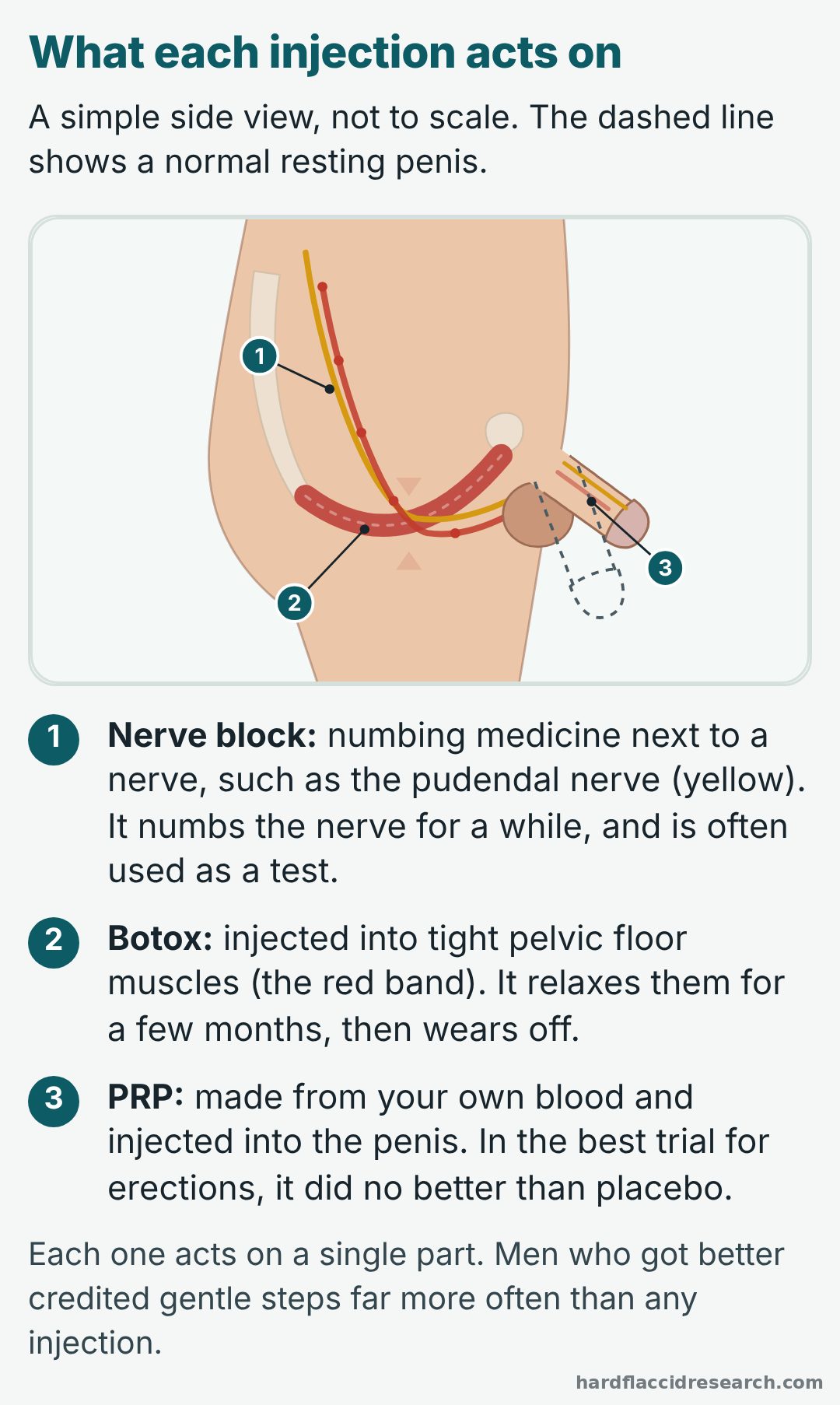
A picture to explain, not a diagnosis. The drawing shows what each injection acts on, not how anyone will do after one.
What are nerve blocks, Botox and PRP injections?
A nerve block numbs a nerve, Botox relaxes muscle, and PRP is made from your own blood. All three are injections.
Nerve blocks
A nerve block is an injection of numbing medicine (a local anesthetic), sometimes with a steroid, next to a nerve, often guided by a scan.
The best known is a pudendal nerve block. The pudendal nerve (pyoo-DEN-dul) carries feeling from the penis, the area between your legs and the back passage.
Botox in the pelvic floor
Botox is botulinum toxin (BOT-yoo-LY-num). It blocks the signal from nerve to muscle, so the muscle relaxes and weakens for a few months. For pelvic pain, it's injected into tight pelvic floor muscles, the sling of muscles between your legs.
The FDA hasn't approved Botox for the pelvic floor, so using it there is off-label: allowed, but not an approved use.
PRP
PRP is made by spinning a sample of your blood to concentrate the platelets (the parts of blood that help it clot), then injecting it, here into the penis. Clinics sometimes call it the P-shot. The idea is that platelets may help tissue heal.
Injections aren't surgery: operations such as pudendal nerve decompression are covered on our page about surgery for hard flaccid. If you've been offered an injection, write down its exact name.
Related: Surgery for Hard Flaccid? What 126 Recovery Stories Show »
How might an injection help hard flaccid?
Each one acts on a single part that doctors think may play a role. These are ideas only:
- A nerve block. If an irritated pudendal nerve is part of the pain, numbing it may ease the pain for a while. Mostly, it shows whether that nerve is involved.
- Botox. Doctors think a tight pelvic floor may press on the nerves and blood vessels the penis depends on. Relaxing the muscle may ease that pressure for a while.
- PRP. It's aimed at the erectile tissue, but blood flow scans in hard flaccid are often normal, so it's unclear what it would fix.
An injection doesn't teach muscles to let go or calm a stressed nervous system. When Botox wears off, the muscles can tighten again unless something else has changed.
246 men discussed nerve blocks, 137 Botox and 106 PRP. Among those who also described their symptoms, 72%, 75% and 67% described the firm flaccid state, against 58% of all men who described their symptoms (1,553 of 2,661).
Pelvic floor tension was described by 53% of the men who discussed Botox and also described their symptoms, and by 45% of those who discussed nerve blocks. That compares with 23% of all men who described their symptoms (601 of 2,661). Ask the doctor which of your symptoms an injection is meant to change, and which it won't.
Do nerve blocks or Botox help hard flaccid?
It isn't known yet, because no injection has been tested in a proper trial for hard flaccid. In a published survey of men with hard flaccid syndrome, those who had tried nerve blocks rated them as giving no change to little improvement, like most treatments in it. Our polls didn't ask about injections.
Nerve blocks
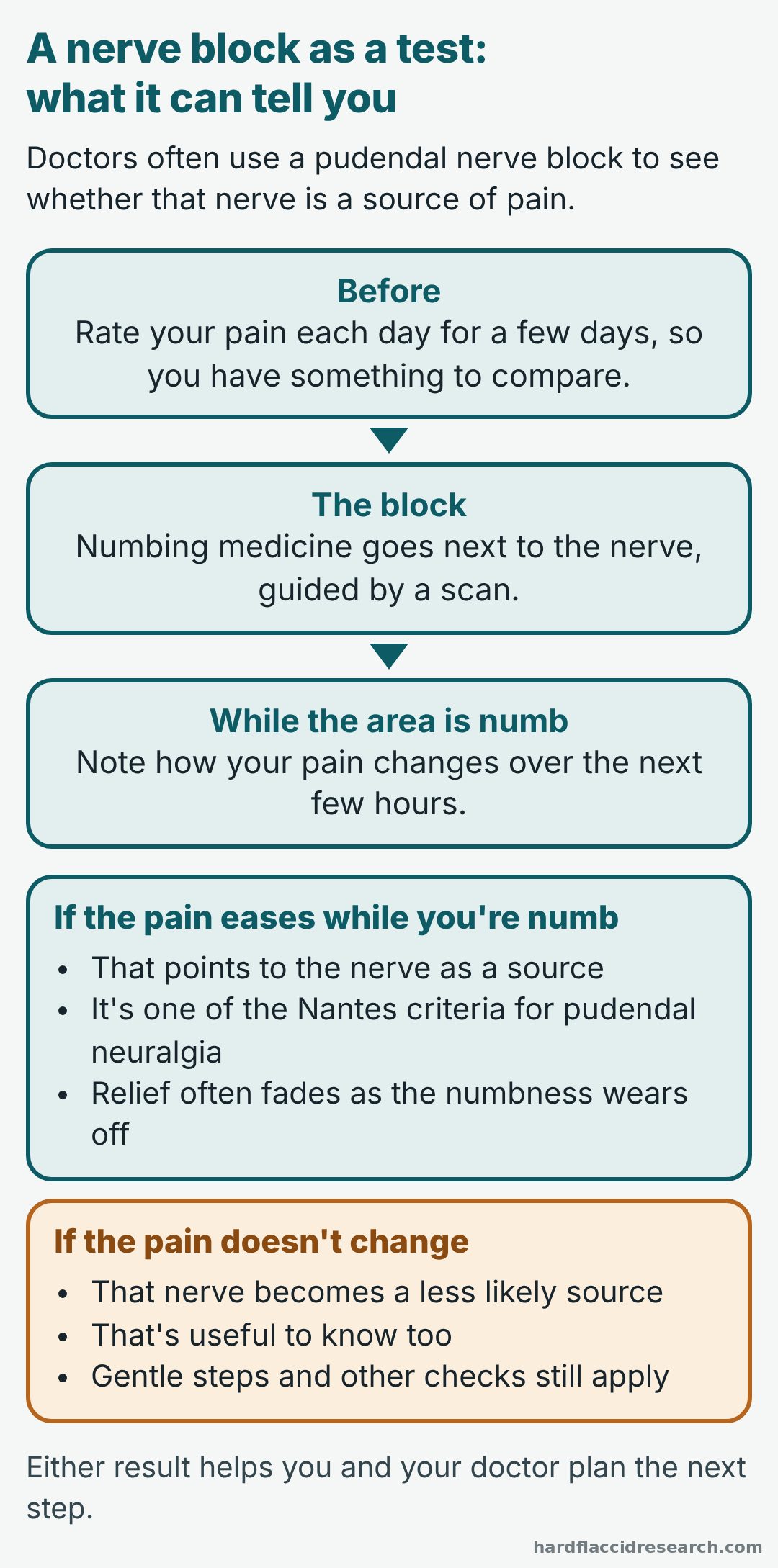
Doctors use a pudendal nerve block mainly as a test. The Nantes criteria, a checklist for pudendal neuralgia (pain from an irritated or trapped pudendal nerve), include pain that eases after a numbing block of the nerve. As a treatment, relief from repeated blocks often fades.
Our page on pudendal nerve entrapment explains the other signs doctors check.
Botox
In the largest trial of Botox in the pelvic floor, in women with long-lasting pelvic pain and tight muscles, Botox relaxed the muscles. But it didn't clearly ease pain more than a dummy (placebo) injection.
In men with chronic pelvic pain syndrome (long-lasting pelvic pain, also called chronic prostatitis), a review found two small trials. Botox in the pelvic floor muscles may not ease symptoms, while one trial of Botox in the prostate suggests it may. Both gave low-certainty evidence.
PRP
No study has looked at PRP for hard flaccid. In the best trial in men with erectile dysfunction, PRP was safe but worked no better than placebo injections.
What US guidelines say
No US guideline covers hard flaccid. US guidelines on pelvic pain in men make no recommendation on pudendal nerve blocks or on Botox in the pelvic floor. They say doctors should discuss seeing a pain specialist if pain isn't well controlled.
If a clinic offers an injection for hard flaccid itself, ask which published study supports it.
Related: Perineum Pain With Hard Flaccid: Why It Hurts, What Helps »
What gentle steps helped men who got better?
Men who got better credited gentle, low-risk steps far more than injections. Stretching the hips and legs came up in 40 of the 126 recovery stories, more than anything else. Next came a break from masturbation and porn in 28, and reverse Kegels or pelvic floor relaxation in 20.
Kegels came up in 19, but if your pelvic floor feels tight, ask a physical therapist first, and let go fully between squeezes. Breathing exercises came up in 16, and pelvic floor physical therapy, talking therapy or mindfulness, and core strengthening in 15 each.
Doctors suggest some of these too. US guidelines on pelvic pain in men say doctors may offer hands-on physical therapy for tight, tender pelvic floor muscles, and CBT (cognitive behavioral therapy) alongside other care.
In a November 2022 poll of men who had seen a pelvic floor physical therapist, 36% said it helped quite a bit or cured them (17 of 47 men). This week, try slow belly breathing for a few minutes a day, and a reverse Kegel: a gentle letting go, never a push.
What happens during a nerve block or Botox injection?
Both are short procedures, often done at a pain clinic or a hospital outpatient unit, and you go home the same day. A thin needle, often guided by a scan, places the medicine. Here's what to expect.
Before the injection
The doctor asks about your symptoms and examines you. They should explain each step and ask before touching you, and you can ask for a chaperone. An internal check, through the back passage, happens only if you agree.
Tell them about every medicine you take, especially blood thinners, but don't stop any medicine unless the doctor who prescribed it says so. For a few days before, rate your pain and symptoms each day, so you have something to compare.
During a nerve block
You lie on your front or side. The doctor cleans and numbs the skin, then uses a scan to guide a thin needle next to the nerve. The injection itself takes minutes.
Afterward, the area may feel numb for some hours, and a leg may feel weak, so arrange a ride home. If the block is a test, note how your pain changes while you're numb.
During a Botox injection
Botox is injected into the tight pelvic floor muscles, often guided by a scan or done under sedation (medicine that makes you sleepy). It takes some days to start working and wears off over a few months.
In the largest trial, every woman in it was also booked for pelvic floor physical therapy sessions afterward. Ask whether therapy is part of your plan, and who to call if something feels wrong.
Are nerve blocks and Botox safe?
Every injection carries some risk. Possible problems include:
- Pain, bruising or bleeding where the needle went in.
- Infection, which can cause a fever or a red, hot, swollen spot.
- After a nerve block, numbness, and sometimes leg weakness or leaking of pee or stool, for some hours.
- After Botox, weakness of nearby muscles. Sometimes this causes trouble controlling the bladder or bowel, or constipation, for a while.
- The FDA warns that Botox can, in some cases, spread beyond where it was injected and weaken other muscles, hours to weeks later.
- After PRP, bruising or bleeding where it was injected, and a small hard scar in some cases.
Talk to a doctor first. Nerve blocks, Botox and PRP are medical procedures that only a trained specialist should do. Ask what the plan is if the injection doesn't help, and make sure you know how to reach the clinic afterward.
If it helps, bring someone you trust to the appointment.
Who gives these injections, and what should I ask?
A pain specialist often gives nerve blocks and Botox, sometimes with a urologist (a doctor for the bladder and male sex organs) involved. A good specialist welcomes questions. Take these with you:
- Is this injection a test to find the source of my pain, or a treatment?
- Which of my symptoms is it meant to change, and which won't it change?
- What does the published evidence show for men with symptoms like mine?
- How will we know if it worked, and what happens if it doesn't?
- What are the risks for me, and who do I call if something goes wrong?
- How many injections might I need, and what is the total cost, including repeats?
Our members' guide, Hard Flaccid Treatments: Read This Before You Pay, goes through each treatment men ask about, with its risks and questions to ask.
Write the answers down during the visit, so you can decide at home rather than in the room.
How do I know if an injection is working?
Track your symptoms the same way each day, before and after. If the nerve is a source of pain, a test block eases it while the area is numb, and relief that fades as the numbness wears off is expected. Botox takes longer, so judge it over several weeks, not days.
Each day, note:
- Your pain, and how long you can sit comfortably.
- How firm your penis feels at rest, and how often.
- Your erections, numbness, and good and bad days.
Our symptom tracker keeps these in one place, so you and your doctor can see real change rather than one good day.
When should I see a doctor?
See a primary care provider or a urologist before you agree to an injection, or if symptoms aren't easing with gentler steps. If pain is clearly worse when sitting, ask a doctor to check your nerves, including the pudendal nerve. If numbness between your legs is new, get urgent care (see the list below).
Numbness for some hours after a nerve block is expected, so ask how long yours should last. Our doctor visit kit helps you set out your symptoms and what you've tried.
Get urgent care straight away (call 911 or go to the emergency room) if you have:
- After Botox: new trouble swallowing, speaking or breathing, double vision, drooping eyelids, or weakness in muscles far from where it was injected.
- After any injection: a fever, or skin where the needle went in that becomes red, hot, swollen or starts to leak.
- Sudden, severe pain in the penis, testicles or pelvis.
- New numbness around your back passage, genitals or inner thighs, or new weakness in your legs.
- New trouble starting or controlling your pee, not being able to pee, or not feeling when your bladder is full.
- Loss of control of your bladder or bowel.
- A fever or chills with pelvic pain or pain when peeing.
Frequently asked questions
Is a nerve block a test or a treatment?
Often a test. If numbing the pudendal nerve eases your pain for a while, that points to the nerve as one source of it. Some pain clinics repeat blocks as a treatment, but relief often fades, so ask which one yours is before you agree to it.
How long does Botox in the pelvic floor last?
It wears off over a few months. Then the muscles can tighten again unless they've learned to relax, which is why it's often paired with pelvic floor physical therapy. Some people go on to have repeat injections.
Does PRP (the P-shot) help hard flaccid?
There's no evidence that it does. No study has tested PRP for hard flaccid, and in the best trial for erectile dysfunction it did no better than placebo. 106 men discussed PRP, and it came up in 2 of the 126 recovery stories.
What if an injection didn't help?
That's not the end of the road. A test block that didn't ease your pain makes the pudendal nerve a less likely source, which is useful to know. Many men get better with gentle steps, so go back to them, and ask about a pelvic floor physical therapist or a pain specialist.
Takeaway
Nerve blocks, Botox and PRP each act on one part. A nerve block can help find the source of pain, Botox may relax tight muscles for a while, and PRP did no better than placebo for erections.
Men who got better credited gentle steps far more. Start with our free self-check, take the doctor visit kit to your next appointment, and if you've had an injection, add your experience so the next man has better numbers.
This article is for general information and isn't a substitute for advice from your own doctor. Hard Flaccid Research doesn't diagnose or treat. If you have new or worsening symptoms, see a qualified clinician. In an emergency, call 911.
Free tools that can help
- Self-check: do I have hard flaccid?Compare your symptoms with what 6,026 men report.
- Doctor visit kitA one-page summary to take to your appointment.
- Habit trackerCount your days without porn or masturbation, and get through urges.
- Diaphragm breathing toolBreathe with a moving picture of your diaphragm and pelvic floor.
- Add your experienceTell us what you tried and how it went. No name needed.
- Hard Flaccid Syndrome CensusWhat men answered in 818 polls.
- Symptom trackerLog your symptoms and see what helps you.
- Ask us a questionThe questions men ask most become new articles.
The numbers behind this article
Every number in this article comes from what men with hard flaccid syndrome shared between December 2020 and October 2026, counted once per person, or from their polls. These are self-selected reports, not a clinical study. See hard flaccid syndrome statistics, the Hard Flaccid Syndrome Census and how we count.
In a June 2023 poll, 42% said they were at least half better and 11% about 90% better or fully healed
How 132 men answered: have you healed?Men who recover may stop answering polls, so these numbers may undercount recovery.
Source: Hard Flaccid Research, hardflaccidresearch.com
What men who got better credited: gentle steps far more often than injections
Number of the 126 stories men shared of getting much better that mentioned each: the most-mentioned steps that aren't medicines, then the three injections.A story mentioning something is what the man credited, not proof it worked.
Source: Hard Flaccid Research, hardflaccidresearch.com
In a November 2022 poll, 36% said pelvic floor physical therapy helped quite a bit or cured them, 36% a little and 28% not at all
How the 47 men who had seen a pelvic floor physical therapist answered: did it help you?Polls are self-selected.
Source: Hard Flaccid Research, hardflaccidresearch.com
246 men discussed nerve blocks, 137 Botox and 106 PRP, and 42 asked whether nerve blocks or Botox help
Number of men, counted once per person. Nerve blocks include pudendal, penile and sympathetic blocks. Discussing something is not the same as trying it.Source: Hard Flaccid Research, hardflaccidresearch.com
Among men who described their symptoms, 72% of those who discussed nerve blocks, 75% Botox and 67% PRP described the firm flaccid state, against 58% of all
Share who described the firm flaccid state: first all men who described their symptoms, then the men who discussed each injection and also described their symptoms.Men who discussed any treatment tended to describe more symptoms of every kind.
Source: Hard Flaccid Research, hardflaccidresearch.com
Among men who described their symptoms, 53% of those who discussed Botox and 45% nerve blocks described pelvic floor tension, against 23% of all
Share who described pelvic floor tightness, spasm or twitching: first all men who described their symptoms, then the men who discussed each injection and also described their symptoms.Source: Hard Flaccid Research, hardflaccidresearch.com
Every number in this article, with its source
| In this article | Source |
|---|---|
| 6,026 men | 6,026 men, counted from what men wrote, once per person |
| 42 men asked whether nerve blocks or Botox help | Question group, 42 men, research data |
| 246 men discussed nerve blocks | 246 men discussing nerve blocks, counted from what men wrote, once per person |
| 137 men discussed Botox | 137 men discussing Botox, counted from what men wrote, once per person |
| 106 men discussed PRP injections | 106 men discussing PRP injections, counted from what men wrote, once per person |
| Among the men who discussed nerve blocks and also described their symptoms: 72% described the firm flaccid state, 45% pelvic floor tension | 246 men who discussed nerve blocks, counted from what men wrote, once per person; shares are of those who also described their symptoms |
| Among the men who discussed Botox and also described their symptoms: 75% described the firm flaccid state, 53% pelvic floor tension | 137 men who discussed Botox, counted from what men wrote, once per person; shares are of those who also described their symptoms |
| Among the men who discussed PRP and also described their symptoms: 67% described the firm flaccid state | 106 men who discussed PRP injections, counted from what men wrote, once per person; shares are of those who also described their symptoms |
| 58% of all men who described their symptoms described the firm flaccid state (1,553 of 2,661) | 1,553 of 2,661 men, counted from what men wrote, once per person |
| 23% of all men who described their symptoms described pelvic floor tension (601 of 2,661) | 601 of 2,661 men, counted from what men wrote, once per person |
| 126 recovery stories | 126 men, counted from what men wrote, once per person |
| Nerve blocks came up in 3 of 126 recovery stories | 3 of 126 recovery stories |
| PRP injections came up in 2 of 126 recovery stories | 2 of 126 recovery stories |
| Botox came up in 0 of 126 recovery stories | 0 of 126 recovery stories |
| Stretching came up in 40 of 126 recovery stories | 40 of 126 recovery stories |
| A break from masturbation and porn came up in 28 of 126 recovery stories | 28 of 126 recovery stories |
| Reverse Kegels or pelvic floor relaxation came up in 20 of 126 recovery stories | 20 of 126 recovery stories |
| Kegels came up in 19 of 126 recovery stories | 19 of 126 recovery stories |
| Breathing exercises came up in 16 of 126 recovery stories | 16 of 126 recovery stories |
| Pelvic floor physical therapy came up in 15 of 126 recovery stories | 15 of 126 recovery stories |
| Talking therapy, CBT, mindfulness or meditation came up in 15 of 126 recovery stories | 15 of 126 recovery stories |
| Core, glute and posture strengthening came up in 15 of 126 recovery stories | 15 of 126 recovery stories |
| 42% said they were at least half better (56 of 132 men) | 56 of 132 men, poll, Jun 2023 |
| 11% said they were about 90% better or fully healed (14 of 132 men) | 14 of 132 men, poll, Jun 2023 |
| Of men who had seen a pelvic floor physical therapist, 36% said it helped quite a bit or cured them (17 of 47 men) | 17 of 47 men, poll, Nov 2022 |
| Of men who had seen a pelvic floor physical therapist, 36% said it helped a little (17 of 47 men) | 17 of 47 men, poll, Nov 2022 |
| Of men who had seen a pelvic floor physical therapist, 28% said it didn't help at all (13 of 47 men) | 13 of 47 men, poll, Nov 2022 |
| Counting since December 2020 | Research data, December 2020 to October 2026 |
Medical sources
What this article says about medical research, guidelines and urgent care comes from these sources.
- Abdessater M, Kanbar A, Akakpo W, Beley S. Hard flaccid syndrome: state of current knowledge. Basic Clin Androl. 2020;30:7. https://doi.org/10.1186/s12610-020-00105-5
- Pang KH, Feng J, Zhang Y. Hard-flaccid syndrome: a systematic review of aetiopathophysiology, clinical presentation and management. Int J Impot Res. 2026;38:393-403. https://doi.org/10.1038/s41443-025-01118-2
- Niedenfuehr J, Stevens DM. Hard flaccid syndrome symptoms, comorbidities, and self-reported efficacy and satisfaction of treatments: a cross-sectional survey. Int J Impot Res. 2025;37:458-464. https://doi.org/10.1038/s41443-024-00853-2
- Labat JJ, Riant T, Robert R, Amarenco G, Lefaucheur JP, Rigaud J. Diagnostic criteria for pudendal neuralgia by pudendal nerve entrapment (Nantes criteria). Neurourol Urodyn. 2008;27:306-310. https://pubmed.ncbi.nlm.nih.gov/17828787/
- Spruijt MA, Klerkx WM, Notten K, et al. The efficacy of botulinum toxin A injection in pelvic floor muscles in chronic pelvic pain patients: a double-blinded randomised controlled trial. BJOG. 2025. https://doi.org/10.1111/1471-0528.17991
- Franco JVA, Turk T, Jung JH, et al. Pharmacological interventions for treating chronic prostatitis/chronic pelvic pain syndrome. Cochrane Database Syst Rev. 2019;10:CD012552. https://doi.org/10.1002/14651858.CD012552.pub2
- Masterson TA, Molina M, Ledesma B, et al. Platelet-rich plasma for the treatment of erectile dysfunction: a prospective, randomized, double-blind, placebo-controlled clinical trial. J Urol. 2023;210:154-161. https://doi.org/10.1097/JU.0000000000003481
- Sullivan J, Salter C, Flores J, Ghuring P, Parker M, Mulhall J. Exploring erectile hemodynamics in men complaining of hard-flaccid syndrome (meeting abstract). J Sex Med. 2023;20(Suppl 1):i124-i125. https://doi.org/10.1093/jsxmed/qdad060.194
- Lai HH, Pontari MA, Argoff CE, et al. Male chronic pelvic pain: AUA guideline. J Urol. 2025. https://www.auanet.org/guidelines-and-quality/guidelines/male-chronic-pelvic-pain
- Allergan (AbbVie). BOTOX (onabotulinumtoxinA) for injection: full prescribing information, including boxed warning on distant spread of toxin effect. DailyMed, US National Library of Medicine. Revised November 2023. https://dailymed.nlm.nih.gov/dailymed/drugInfo.cfm?setid=33d066a9-34ff-4a1a-b38b-d10983df3300
How we made this article
We started from the question 42 men asked. Every number was checked against our data. Our editorial team edited it and Dr. Julian Reyes reviewed it medically. Read our editorial policy.
Read next
See more of us on Google
Add Hard Flaccid Research as a preferred source, and Google shows you our pages more often when you search.
Add as a preferred sourceDon't see your question? Ask us. We answer the most-asked ones in new articles.
Cite and share this article
You're welcome to quote this article. Please name Hard Flaccid Research and link to this page, so others can find the full answer and the data behind it. To cite this page, use its link.
Citation
Hard Flaccid Research. (2026). Nerve Blocks or Botox for Hard Flaccid? Read This First. Written by the Editorial Team, medically reviewed by Dr. Julian Reyes. https://hardflaccidresearch.com/articles/nerve-blocks-botox-hard-flaccid
Credit link for your article
Source: <a href="https://hardflaccidresearch.com/articles/nerve-blocks-botox-hard-flaccid">Hard Flaccid Research</a>
Wikipedia reference
<ref>{{cite web |url=https://hardflaccidresearch.com/articles/nerve-blocks-botox-hard-flaccid |title=Nerve Blocks or Botox for Hard Flaccid? Read This First |website=Hard Flaccid Research |date=2026 |access-date=28 October 2026}}</ref>
How the data was collected: our methodology. Journalists and researchers: key numbers, data and contact.