Reverse Kegels for Men: How to Do Them, Benefits & Mistakes
In short
- A reverse Kegel is the opposite of a Kegel: you gently let your pelvic floor drop and lengthen as you breathe in, instead of squeezing it up.
- It is for a pelvic floor that is too tight, not one that is weak. 704 men with hard flaccid mentioned them, and reverse Kegels came up in 20 of 126 recovery stories, but a story mentioning something is not proof that it worked.
118 men with hard flaccid syndrome asked this question.
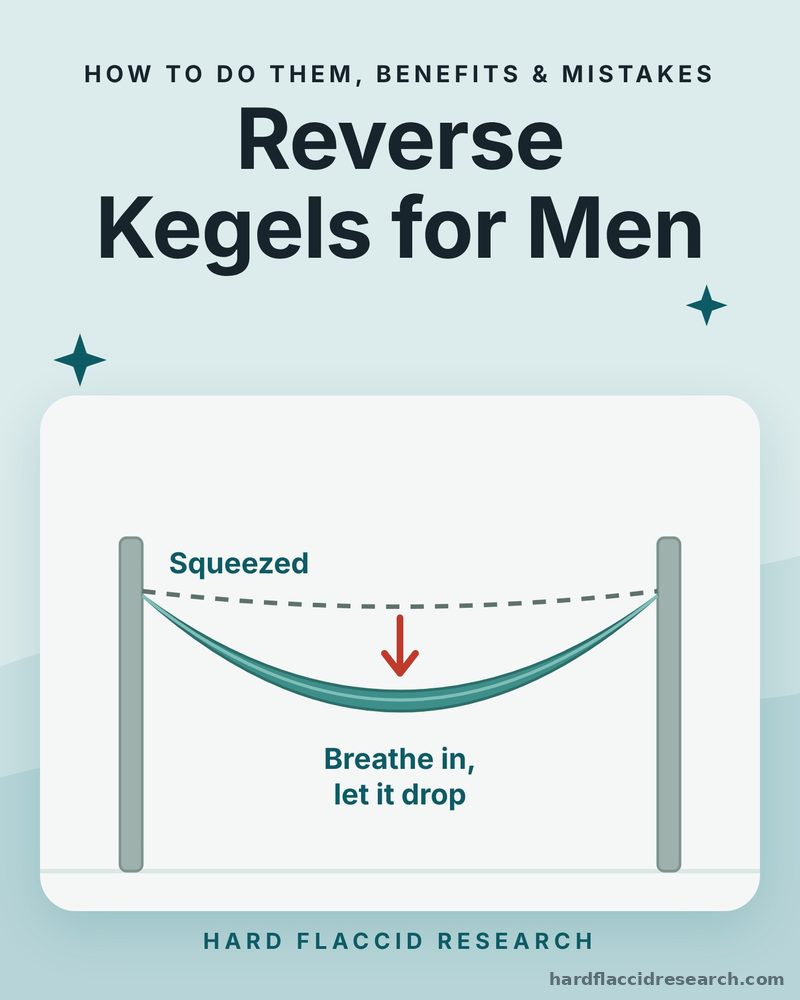
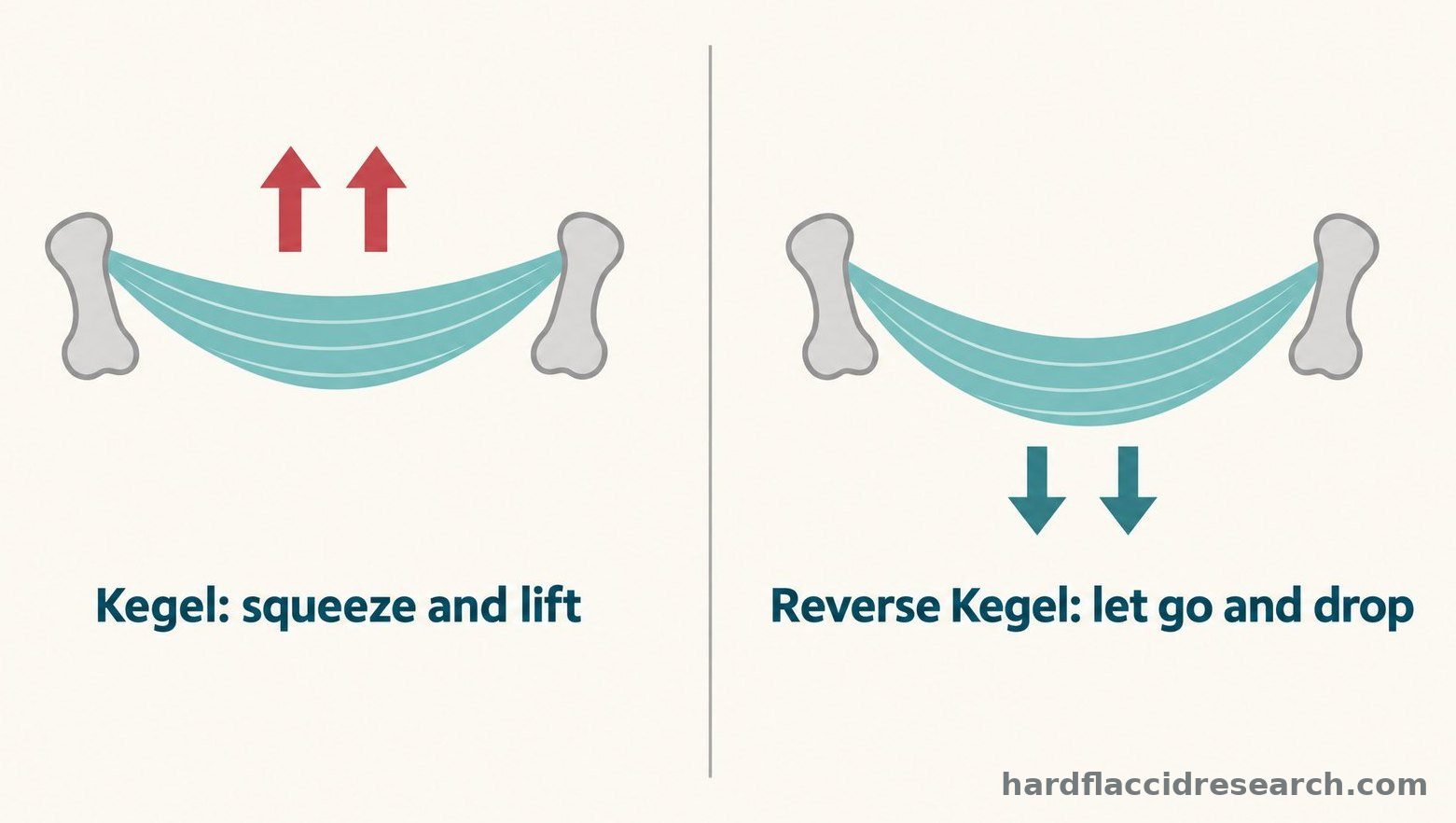
A reverse Kegel is the opposite of a Kegel. Instead of squeezing and lifting your pelvic floor, you gently let it soften and drop, the way it does when you breathe deeply into your belly. Men with a tight pelvic floor, including many with hard flaccid syndrome, use them to help those muscles relax.
Of the men who shared their experiences with us, 704 mentioned reverse Kegels or pelvic floor relaxation. This page shows who they may help, how to do them step by step, how to tell you are doing them right, the positions to try, common mistakes, whether they are safe, and what men report.
By the numbers: between December 2020 and October 2026, 2,661 of the 6,026 men who shared their experiences described their symptoms, and 601 of them described pelvic floor tightness, spasm or twitching. 704 men mentioned reverse Kegels or pelvic floor relaxation, 216 asked which stretches or exercises help, and 118 asked whether to do Kegels or reverse Kegels.
What is a reverse Kegel?
The pelvic floor is the sling of muscles between your legs that supports your bladder and bowel and helps control erections. A Kegel squeezes and lifts these muscles, like stopping the flow of urine. A reverse Kegel does the opposite: you let them soften, lengthen and drop.
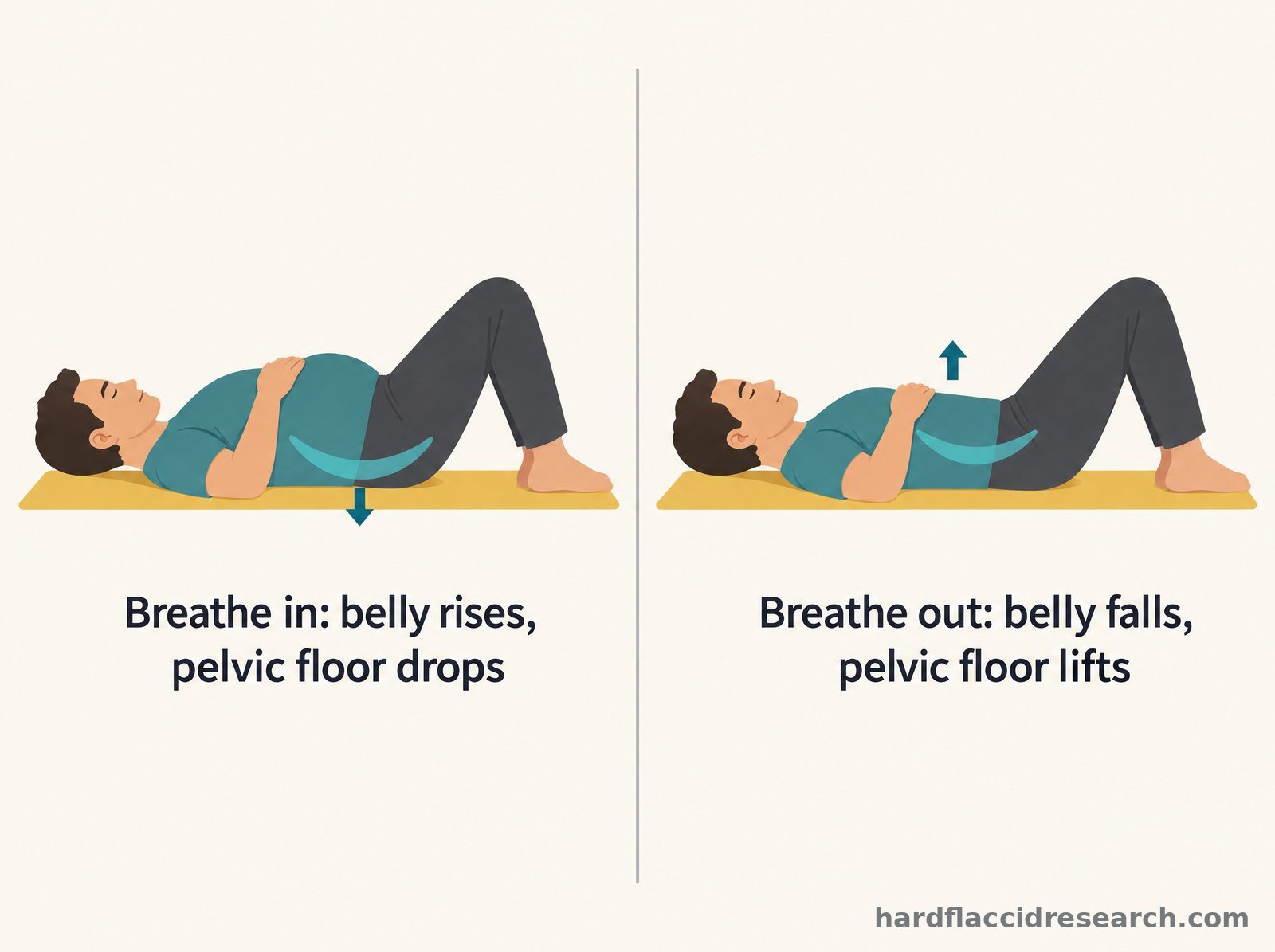
As you breathe in, your diaphragm moves down and your belly rises. The pelvic floor moves with your breath: it drops a little as you breathe in and lifts a little as you breathe out. A reverse Kegel uses that natural movement.
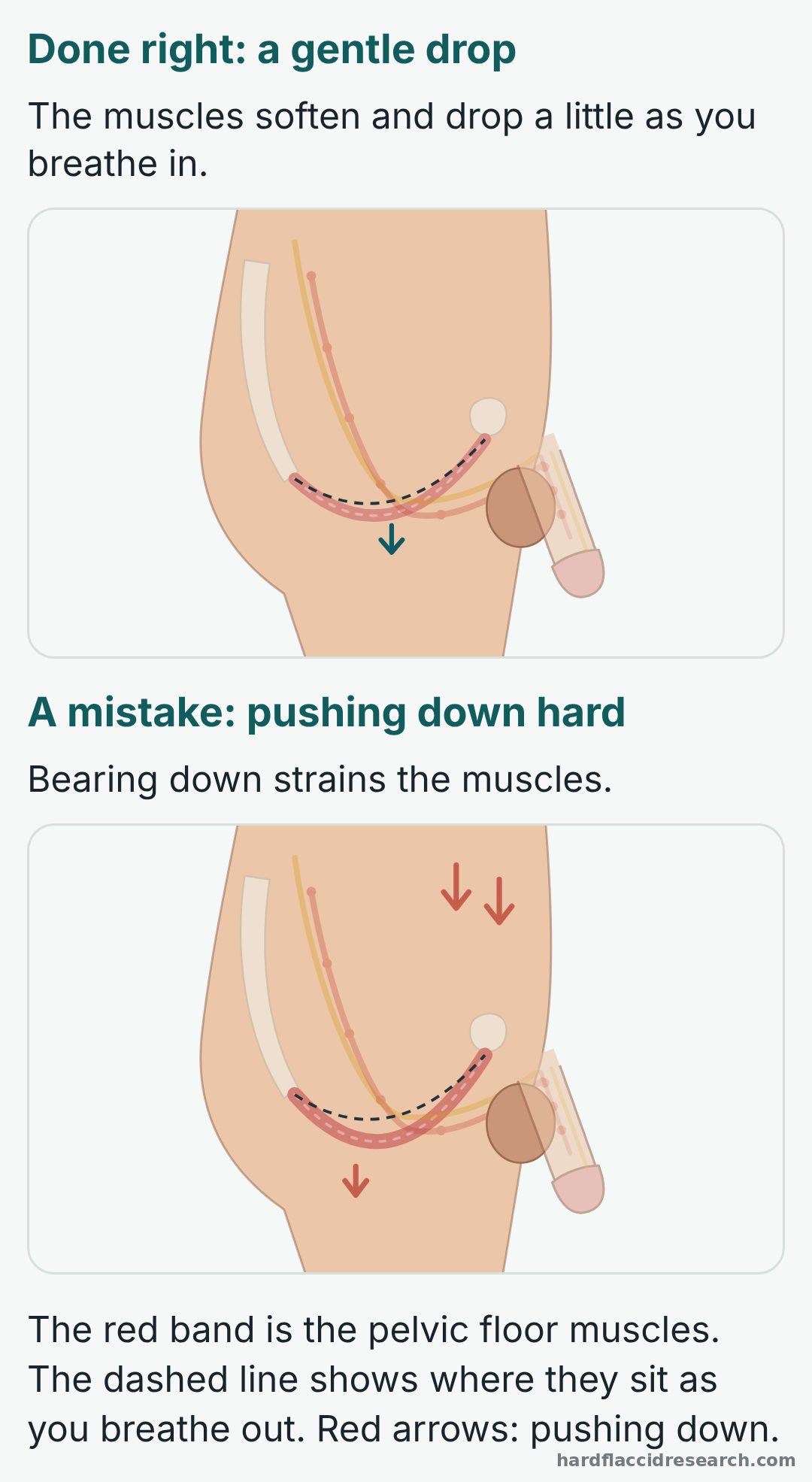
Physios also call it pelvic floor relaxation or a pelvic floor drop. It should feel like a gentle letting go, not a push.
Hard Flaccid Explorerby Hard Flaccid Research
Reverse Kegels, step by step
A 7-minute animated explainer of this article. Press play, or skip between chapters. The first minute is free for everyone.
A picture to explain, not a diagnosis. A physio can check whether your pelvic floor is tight, weak or both.
Reverse Kegel benefits: who they may help
Reverse Kegels are for a pelvic floor that is too tight, not one that is weak. Physios use them to help muscles that stay partly clenched learn to let go. If a tight pelvic floor is part of the cause, learning to let it go may ease some of the signs below, though reverse Kegels on their own haven't been well studied. Signs of a tight pelvic floor can include:
- Pain or aching between the legs, in the perineum or around the tailbone.
- A slow stream, trouble starting to pee, or needing to pee often.
- Straining to empty your bowel, or constipation.
- Pain with or after ejaculation.
- For men with hard flaccid syndrome, a resting penis that stays firm. Some doctors think a tight pelvic floor may play a part, though this isn't proven.
Among the 2,661 men with hard flaccid who described their symptoms, 391 mentioned bowel symptoms such as constipation, 337 urinary problems, 267 pelvic, perineal or tailbone pain and 202 weak or painful orgasm or ejaculation problems. These signs can have other causes, such as an infection or a prostate problem, so get checked by a doctor first.
Reverse Kegels are not the answer for a weak pelvic floor. If you leak, for example after prostate surgery, strengthening may be what you need, and our article on Kegels for men explains how. Dribbling after peeing can come from a weak or a tight pelvic floor, so a pelvic health physio can check which you have. If your pelvic floor feels tight, ask a pelvic health physio before doing Kegels, and let go fully between squeezes.
Related: Kegel Exercises for Men: How to Do Them, Benefits & When to Stop »
Why do men with hard flaccid do reverse Kegels?
Many men with hard flaccid syndrome say their pelvic floor feels tight. Of 2,661 men who described their symptoms, 23% describe pelvic floor tightness, spasm or twitching (601 of 2,661).
If these muscles stay clenched, one idea is that they may press on the nerves and blood vessels an erection depends on. Helping them relax is one of the main things pelvic health physios work on with hard flaccid, which is why reverse Kegels come up so often.
Among the men who mentioned reverse Kegels and also described their symptoms, 67% described the firm flaccid state, 52% weaker erections, 46% numbness and 42% pelvic floor tightness.
How to do a reverse Kegel, step by step
Start lying on your back. It is the easiest position to feel the muscles let go.
- Lie on your back with your knees bent and your feet flat. Put one hand on your belly and one on your chest.
- Breathe in slowly through your nose for about four seconds. Let your belly rise while your chest stays still.
- As you breathe in, imagine the area between your sitting bones softening and widening. You may feel a gentle fullness at the perineum, the area between your scrotum and back passage.
- Breathe out slowly for about six seconds and let the muscles come back up on their own. Don't squeeze them up.
- Repeat for five to ten breaths, two or three times a day. Once it feels easy lying down, try it sitting, then standing.
Another way to find the feeling is to imagine you are about to start peeing, and let go just as gently. Don't actually push.
Related: Your Breathing May Be Keeping Your Hard Flaccid Tight »
How to know you're doing it right
A reverse Kegel is a small, gentle movement, so it's easy to miss at first. Signs you are doing it right:
- The perineum, the area between your scrotum and back passage, feels a little fuller or softer as you breathe in. If you rest your fingers there over your underwear, you may feel it move down slightly.
- It feels like the moment just before you start to pee, without any push.
- Your buttocks, thighs and stomach stay soft.
- Your breathing stays slow and easy.
If you hold your breath, your stomach tightens or you feel strain or pressure, you are trying too hard. Ease off, breathe, and try a smaller movement. If you can't feel anything yet, that is common: a pelvic health physio can use touch or biofeedback, where a sensor shows on a screen how tense the muscles are, to help you find it.
Reverse Kegel positions
Start lying down, because it is the easiest position to feel the muscles let go. Once that feels easy, practise in other positions, so the relaxing carries over into daily life:
- Lying on your back with your knees bent and your feet flat, or on your side with a pillow between your knees.
- Sitting on a firm chair with your feet flat, leaning forward a little, with your weight on your sitting bones.
- Standing with your knees soft and your weight even on both feet.
- On the toilet: let the pelvic floor drop rather than pushing hard. A small footstool that raises your knees can help.
Some physios add the drop to gentle stretches such as child's pose or happy baby.
How often should you do reverse Kegels?
Many physios suggest little and often rather than long sessions. That can mean a few minutes, two or three times a day, plus quick check-ins through the day: notice whether you are clenching, breathe, and let go.
There is no set timeline. It can take regular practice before the muscles let go easily, and a physio can tell you whether you are on the right track. If your symptoms get worse, stop and get checked.
Common mistakes
- Pushing or bearing down hard, as if on the toilet. A reverse Kegel should feel like a gentle letting go, not straining.
- Breathing into your chest. Let your belly rise while your chest stays still.
- Holding your breath. Keep breathing slowly the whole time.
- Squeezing your buttocks, thighs or stomach. Only the area between your legs should change.
- Clenching through the day. Many men clench these muscles without noticing, for example when stressed, sitting at a desk or concentrating. In an April 2023 poll, 76% said they had anxiety before hard flaccid syndrome (94 of 123 men), though that doesn't show that anxiety caused it.
- Expecting quick results. If your pelvic floor is already tight, it can take a lot of practice to feel it let go.
Are reverse Kegels safe?
Gentle reverse Kegels are generally low-risk. The main thing to avoid is pushing or bearing down hard, which strains the muscles and can make piles (haemorrhoids) worse.
Talk to a doctor first if you have piles, a hernia, or have had surgery on your belly, pelvis or prostate recently. Stop if it hurts, and see a doctor if pain, or changes in peeing or your bowel habits, carry on. Reverse Kegels don't treat infections, a prostate problem, a trapped nerve or other causes of pelvic pain, so get checked if your symptoms haven't been.
Kegels or reverse Kegels?
This is one of the questions men with hard flaccid syndrome ask most: 118 men asked whether they should do Kegels or reverse Kegels.
It depends on what your pelvic floor is doing. Kegels strengthen muscles that are weak, for example after prostate surgery. Reverse Kegels may help muscles that are too tight to relax. Many men with hard flaccid describe the tight kind, so physios usually start with relaxation and often advise pausing strengthening Kegels until the muscles can let go. Dribbling after peeing can come from either. A pelvic health physio can examine you and tell which you have. If your pelvic floor feels tight, ask a pelvic health physio before doing Kegels, and let go fully between squeezes.
Men mention both a lot: 846 men mentioned Kegels and 704 mentioned reverse Kegels. Among the 601 men who describe pelvic floor tightness, 64% mentioned stretching, 48% Kegels, 45% pelvic floor physio and 41% reverse Kegels.
Some men think clenching helped start their problem: 27 men blamed Kegeling or clenching to keep an erection.
Do reverse Kegels help hard flaccid?
There are no studies of reverse Kegels in men with hard flaccid syndrome. For men with chronic pelvic pain and tight, painful pelvic floor muscles, US urology guidelines say doctors may offer tailored, hands-on pelvic floor physical therapy (a conditional recommendation based on low-certainty evidence) and, based on expert opinion, may use biofeedback to help the muscles relax.
We don't have a poll on reverse Kegels alone yet. In the 126 recovery stories, reverse Kegels came up in 20, Kegels in 19, breathing exercises in 16 and pelvic floor physio in 15. Stretching came up in 40.
A story mentioning something is not proof that it worked. Men mention what they did while they got better, and most did several things at once.
Polls on pelvic floor physio, where reverse Kegels are usually taught, give a mixed picture. In a November 2022 poll of men who had seen a pelvic floor physio, 36% said it helped quite a bit or cured them (17 of 47 men), and 28% said it didn't help at all (13 of 47 men). In a February 2023 poll, 38% said physio dramatically helped (24 of 64 men).
Reverse Kegels are one part of what a physio does. Many men combine them with diaphragmatic breathing, stretching and changes to habits such as long hours sitting and straining on the toilet.
Common questions about reverse Kegels
Can reverse Kegels help erections? They might, if a tight pelvic floor is part of the problem, but there is no research on this in men with hard flaccid syndrome. Erection problems have many causes, including heart and blood vessel problems, so see a doctor if your erections have changed. A doctor may suggest a blood test for blood sugar and cholesterol.
Do reverse Kegels help premature ejaculation? Some physios include pelvic floor relaxation when they treat premature ejaculation, but research is limited, and most studies used strengthening exercises instead. A doctor can talk you through the options.
Can I do Kegels and reverse Kegels together? Some physios add gentle squeezes once the muscles can relax easily, always letting go fully afterwards. If your pelvic floor feels tight, ask a pelvic health physio before doing Kegels, and let go fully between squeezes.
How do I know if I need reverse Kegels? Pain, trouble starting to pee or straining on the toilet can be signs of a tight pelvic floor, and leaking can be a sign of a weak one, but each of these can have other causes too. A doctor or pelvic health physio can examine you and tell which you have. New or sudden trouble peeing needs urgent care (see the list below).
What if I can't feel anything? That is common at first. Go back to lying down, keep one hand on your belly, and focus on the breath. A physio can help you find the muscles.
When to see a doctor
See a doctor or a pelvic health physio if you have pelvic floor symptoms and haven't been checked. Pain, urinary or bowel problems and erection changes can have other causes that need treatment, and a physio can check whether your pelvic floor is tight, weak or both before you start. See a doctor soon, too, if you notice blood in your stools or black stools.
Get urgent care straight away if you have:
- Blood in your urine that you can see.
- Sudden, severe pain in the penis, testicles or pelvis.
- New numbness around your back passage, genitals or inner thighs, or new weakness in your legs.
- New trouble starting or controlling your pee, not being able to pee, or not feeling when your bladder is full.
- Loss of control of your bladder or bowel.
- A fever or chills with pelvic pain or pain when peeing.
If you are feeling hopeless or having thoughts of ending your life, please visit our Support page now. It lists crisis lines you can call or text.
What to do next
- If you haven't been checked, see a doctor first, because these symptoms can have other causes.
- Practise the belly breathing first, lying down, for a few days.
- Add the gentle drop on each in-breath: five to ten breaths, two or three times a day.
- Stop if it hurts, and ask a pelvic health physiotherapist to check your technique.
- Track your symptoms with our symptom tracker to see whether anything changes over time.
- Use our self-check to see how your symptoms compare, and our doctor visit kit to prepare for an appointment.
In a November 2022 poll of men who had seen a urologist, 95% called their visits bad and unhelpful (63 of 66 men). That's a reason to prepare well, not to skip the visit.
Our members' guide, Hard Flaccid Pelvic Floor Reset: Why Kegels May Backfire, has a guided daily routine with a breathing timer.
Free tools that can help
- Self-check: do I have hard flaccid?Compare your symptoms with what 6,026 men report.
- Doctor visit kitA one-page summary to take to your appointment.
- Habit trackerCount your days without porn or masturbation, and get through urges.
- Diaphragm breathing toolBreathe with a moving picture of your diaphragm and pelvic floor.
- Add your experienceTell us what you tried and how it went. No name needed.
- Hard Flaccid Syndrome CensusWhat men answered in 818 polls.
- Symptom trackerLog your symptoms and see what helps you.
- Ask us a questionThe questions men ask most become new articles.
The numbers behind this article
Every number in this article comes from what men with hard flaccid syndrome shared between December 2020 and October 2026, counted once per person, or from their polls. These are self-selected reports, not a clinical study. See hard flaccid syndrome statistics, the Hard Flaccid Syndrome Census and how we count.
How many men mentioned each pelvic floor exercise
Number of men, counted once per person: who mentioned each exercise, or blamed Kegeling or clenching, December 2020 to October 2026.Being mentioned is not the same as working.
Source: Hard Flaccid Research, hardflaccidresearch.com
What men with a tight pelvic floor mentioned
Share of the 601 men who describe pelvic floor tightness, spasm or twitching who mentioned each approach.Being mentioned is not the same as working. Other approaches came up too.
Source: Hard Flaccid Research, hardflaccidresearch.com
Symptoms men with hard flaccid syndrome describe that can go with a tight pelvic floor
Share of the 2,661 men who described their symptoms. Each man is counted once.These signs can have other causes. These are self-selected reports, not a clinical study.
Source: Hard Flaccid Research, hardflaccidresearch.com
Pelvic floor work in 126 recovery stories
Share of the 126 men who shared a story of getting better who mentioned each approach.A story mentioning something is not proof that it worked.
Source: Hard Flaccid Research, hardflaccidresearch.com
What men with hard flaccid syndrome asked
Number of men who asked each question, counted once per person.Source: Hard Flaccid Research, hardflaccidresearch.com
What men said in our polls
Each bar comes from one of our polls of men with hard flaccid syndrome, with its own number of men. The first two bars are answers to the same poll.Source: Hard Flaccid Research, hardflaccidresearch.com
Every number in this article, with its source
| In this article | Source |
|---|---|
| 704 men mentioned reverse Kegels and pelvic floor relaxation | 704 men, counted from what men wrote, once per person |
| 23% (601 of 2,661) describe pelvic floor tightness, spasm or twitching | 601 of 2,661 men, counted from what men wrote, once per person |
| Among men who mentioned reverse Kegels and also described their symptoms: 67% firm flaccid state, 52% weaker erections, 46% numbness, 42% pelvic floor tightness | 704 men mentioning reverse Kegels, counted from what men wrote, once per person; shares are of those who also described their symptoms |
| 118 men asked whether to do Kegels or reverse Kegels | Question group, 118 men, research data |
| 846 men mentioned Kegels | 846 men, counted from what men wrote, once per person |
| Among men with pelvic floor tightness: 64% stretching, 48% Kegels, 45% pelvic floor physio, 41% reverse Kegels | 601 men with pelvic floor tightness, counted from what men wrote, once per person |
| 27 men blamed Kegeling or clenching to keep an erection | 27 men, counted from what men wrote, once per person |
| 126 recovery stories | 126 men, counted from what men wrote, once per person |
| Reverse Kegels came up in 20 of 126 recovery stories | 20 of 126 recovery stories |
| Kegels came up in 19 of 126 recovery stories | 19 of 126 recovery stories |
| Breathing exercises came up in 16 of 126 recovery stories | 16 of 126 recovery stories |
| Pelvic floor physio came up in 15 of 126 recovery stories | 15 of 126 recovery stories |
| Stretching came up in 40 of 126 recovery stories | 40 of 126 recovery stories |
| 425 men mentioned breathing exercises | 425 men, counted from what men wrote, once per person |
| 36% said physio helped quite a bit or cured them (17 of 47 men) | 17 of 47 men, poll, Nov 2022 |
| 28% said physio didn't help at all (13 of 47 men) | 13 of 47 men, poll, Nov 2022 |
| 38% said physio dramatically helped (24 of 64 men) | 24 of 64 men, poll, Feb 2023 |
| 76% had anxiety before hard flaccid (94 of 123 men) | 94 of 123 men, poll, Apr 2023 |
| 95% called urologist visits bad and unhelpful (63 of 66 men) | 63 of 66 men, poll, Nov 2022 |
| Counting since December 2020 | Research data, December 2020 to October 2026 |
| 6,026 men shared their experiences | Research data, December 2020 to October 2026 |
| 391 of 2,661 men mentioned bowel symptoms such as constipation | 391 of 2,661 men, counted from what men wrote, once per person |
| 337 of 2,661 men mentioned urinary problems | 337 of 2,661 men, counted from what men wrote, once per person |
| 267 of 2,661 men mentioned pelvic, perineal or tailbone pain | 267 of 2,661 men, counted from what men wrote, once per person |
| 202 of 2,661 men mentioned weak or painful orgasm or ejaculation problems | 202 of 2,661 men, counted from what men wrote, once per person |
| 216 men asked which stretches or exercises help | Question group, 216 men, research data |
| 41 men asked whether pelvic floor physio helps | Question group, 41 men, research data |
| Among the 601 men with pelvic floor tightness, 45% mentioned pelvic floor physio | 601 men with pelvic floor tightness, counted from what men wrote, once per person |
How we made this article
We started from the question 118 men asked. Every number was checked against our data. Our editorial team edited it and Dr. Julian Reyes reviewed it medically. Read our editorial policy.
Read next
See more of us on Google
Add Hard Flaccid Research as a preferred source, and Google shows you our pages more often when you search.
Add as a preferred sourceDon't see your question? Ask us. We answer the most-asked ones in new articles.
Cite and share this article
You're welcome to quote this article. Please name Hard Flaccid Research and link to this page, so others can find the full answer and the data behind it. To cite this page, use its link.
Citation
Hard Flaccid Research. (2026). Reverse Kegels for Men: How to Do Them, Benefits & Mistakes. Written by the Editorial Team, medically reviewed by Dr. Julian Reyes. https://hardflaccidresearch.com/articles/reverse-kegels-for-men
Credit link for your article
Source: <a href="https://hardflaccidresearch.com/articles/reverse-kegels-for-men">Hard Flaccid Research</a>
Wikipedia reference
<ref>{{cite web |url=https://hardflaccidresearch.com/articles/reverse-kegels-for-men |title=Reverse Kegels for Men: How to Do Them, Benefits & Mistakes |website=Hard Flaccid Research |date=2026 |access-date=28 October 2026}}</ref>
How the data was collected: our methodology. Journalists and researchers: key numbers, data and contact.