Hard Flaccid Recovery: What Men Who Got Better Did Most
In short
- Men who got better from hard flaccid syndrome often combined several gentle steps over time.
- In 126 recovery stories, stretching came up most (40 of 126), then a break from masturbation and porn (28 of 126).
- Reverse Kegels and tadalafil came up in 20 of 126 each.
- Procedures came up in few stories.
- Start with low-risk basics and get checked by a doctor.
Hard flaccid syndrome is when the penis stays firm, rubbery or shrunken at rest, often with numbness and weaker erections. Men who got better often combined several gentle steps, and stretching came up in more recovery stories than anything else.
Nothing is proven to make hard flaccid go away yet. Below is every step men credited, in order, with what the evidence says and how to start it safely.
By the numbers: 6,026 men shared their experiences between December 2020 and October 2026. 126 men shared a story of getting better, and 428 men wrote about something that gave them hope. What men wrote and what they answered in our polls are self-selected reports, not a clinical study.
Key facts
- Many men get better: in a June 2023 poll, 42% said they were at least half better (56 of 132 men). Men who recover may stop answering polls, so this may undercount recovery.
- Stretching came up in 40 of the 126 recovery stories, and a break from masturbation and porn in 28.
- Reverse Kegels and tadalafil came up in 20 stories each, and pelvic floor physical therapy in 15.
- Procedures came up in few stories: shockwave therapy in 4, and Botox and pudendal nerve (pyoo-DEN-dul) decompression surgery in none.
Hard Flaccid Explorerby Hard Flaccid Research
What men who got better did
A 7-minute animated explainer of this article. Press play, or skip between chapters. The first minute is free for everyone.
A picture to explain, not a diagnosis. What helped one man may not help another.
What did men who recovered from hard flaccid do?
They often combined several gentle, low-risk steps. They stretched, took a break from masturbation and porn, helped a tight pelvic floor let go, moved more and calmed stress. Some added a medicine or physical therapy with a doctor's help.
Our article Is hard flaccid permanent? covers how many men get better, and our article on hard flaccid recovery time covers how long it took. Our members' guide, How 126 Men Recovered From Hard Flaccid: What They Did, turns the steps into a plan.
This week, pick two or three of the gentle steps below and do them every day.
Related: Is Hard Flaccid Permanent? What 126 Recovery Stories Show »
How did men who got better use each step?
Many of the steps men credited were self-care at home, and others came with help from a doctor or physical therapist. Each heading shows how many of the 126 stories credited it, and the evidence.
1. Stretching (limited evidence): 40 stories
Men credited stretches for the hips, hamstrings and inner thighs. In a survey of men with hard flaccid syndrome, many said stretching helped, though some said it made symptoms worse.
Try two or three hip flexor stretches a day, held gently while you breathe slowly. Stop any stretch that hurts.
2. A break from masturbation and porn (men's reports only): 28 stories
Many men rested from masturbation and porn so symptoms could settle. In a June 2023 poll of men who had tried no fap, 51% said it improved their hard flaccid syndrome at least some (39 of 77 men). Another 49% said it didn't (38 of 77).
When you come back, go gently, because a long break can add worry about sex. Stop any enlargement method for good.
3. Reverse Kegels and pelvic floor relaxation (limited evidence): 20 stories
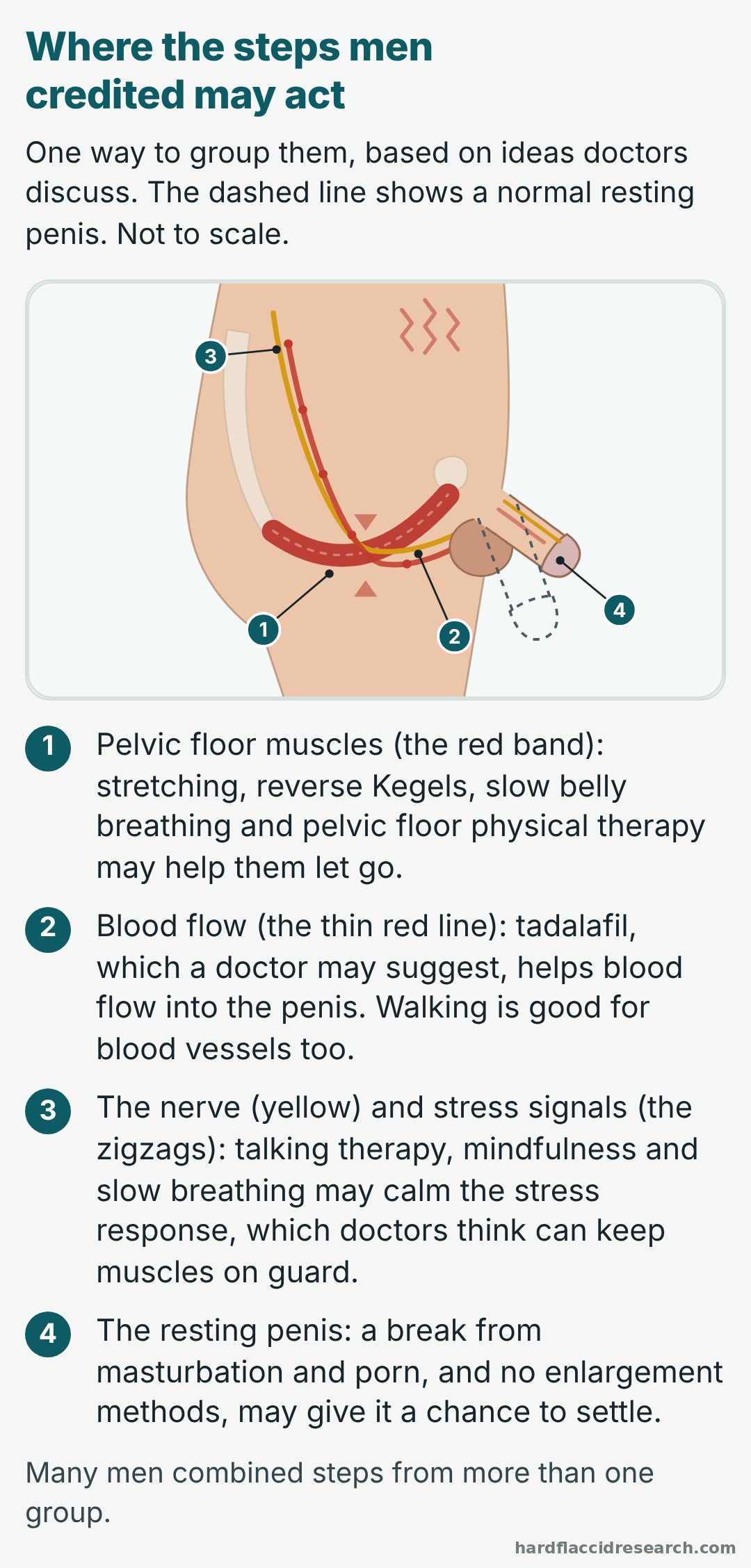
The pelvic floor is the sling of muscles between your legs, and doctors think it may stay tight in hard flaccid syndrome. A reverse Kegel is a gentle letting go of these muscles, never a push. Reviews of hard flaccid advise learning to relax the pelvic floor.
Breathe in and let the area between your legs soften and drop, then let it settle as you breathe out. Our article on how to do a reverse Kegel has more.
4. Tadalafil (early or mixed evidence): 20 stories
A doctor may suggest tadalafil (Cialis), a prescription medicine for erection problems. It helps blood flow into the penis, but it doesn't relax the pelvic floor. In a June 2023 poll, 76% said Cialis had helped them (34 of 45 men), and 20% said a lot (9 of 45).
In published hard flaccid syndrome reports it was often given with physical therapy, so its own effect is unclear. US guidelines on pelvic pain in men say doctors may prescribe it (a conditional recommendation).
Talk to a doctor first: tadalafil can cause headaches, flushing, indigestion or back pain, which usually ease within a day or two. Never take it, or a similar medicine such as sildenafil, with nitrate medicines for chest pain or with poppers, because together they can drop your blood pressure dangerously. If you get chest pain, tell the ambulance crew or doctor that you've taken tadalafil, and when: nitrate medicines must not be given within 48 hours of a dose.
Ask your doctor whether it suits you.
5. Kegels (men's reports only for hard flaccid syndrome): 19 stories
Kegels squeeze and lift the pelvic floor. They help some men with weak erections who don't have pelvic pain, but men with pelvic pain tend to have tighter pelvic floor muscles.
If your pelvic floor feels tight, ask a physical therapist before doing Kegels, and let go fully between squeezes.
6. Breathing exercises (limited evidence): 16 stories
Doctors think the breathing muscle and the pelvic floor move together, so slow belly breathing may help the pelvic floor let go. It's a central part of relaxation programs for pelvic pain in men.
Breathe in slowly, letting your belly rise and the area between your legs soften, then breathe out slowly. Try a few minutes once or twice a day.
7. Pelvic floor physical therapy (limited evidence): 15 stories
A pelvic floor physical therapist checks how these muscles work and teaches you to relax them, sometimes with hands-on release. The same guidelines say doctors may offer this for tight, tender muscles (a conditional recommendation). It was part of the care in many published hard flaccid syndrome cases where men improved.
In a February 2023 poll of men who had seen one, 38% said it dramatically helped (24 of 64 men). In a November 2022 poll, 36% said it helped quite a bit or cured them (17 of 47 men). Another 36% said some, but very little (17 of 47), and 28% not at all (13 of 47).
The therapist should explain each step and ask before touching, and an internal check happens only if you agree. You can ask for a chaperone. Our article on pelvic floor therapy covers what to expect.
8. Talking therapy, CBT, mindfulness or meditation (limited evidence): 15 stories
Evidence for the physical symptoms is limited, but hard flaccid syndrome often brings worry and low mood, and looking after your mood is part of getting better. The same guidelines say doctors may offer CBT (cognitive behavioral therapy), a practical talking therapy, alongside other treatment.
If hard flaccid is wearing you down, or you're thinking about suicide, call or text 988, or visit our Support page for more crisis lines. If you can't keep yourself safe, call 911.
This week, try a short mindfulness or breathing practice each day, or ask your primary care provider about CBT.
9. Core and glute strengthening (limited evidence): 15 stories
Gentle strength work for the core, glutes and posture muscles was part of exercise programs in hard flaccid syndrome reports where men improved.
Start with light moves, such as glute bridges. Breathe out as you lift, since bracing can tighten the pelvic floor.
10. Diet or weight loss (limited evidence): 14 stories
In a March 2023 poll, 23% said weight loss had improved their symptoms (20 of 86 men), though the poll didn't ask who had lost weight. In a trial of men with extra weight and erection problems, diet and exercise helped erections.
If you carry extra weight, make slow, steady changes rather than crash diets. Our article on weight and hard flaccid covers how.
11. Supplements (men's reports only): 13 stories
No supplement has been studied for hard flaccid syndrome, and vitamins and minerals are only likely to help if a blood test shows a low level. Some male enhancement products contain hidden prescription drugs.
Tell your doctor about everything you take, because some supplements interact with medicines.
12. Walking or other cardio (limited evidence): 12 stories
In a trial of men with chronic pelvic pain, regular aerobic exercise eased symptoms more than stretching did. The same guidelines say doctors may discuss aerobic exercise (a conditional recommendation).
Start with a short daily walk and build up slowly. If you cycle, take breaks, because the saddle presses on the area between your legs.
13. Yoga or Pilates (early or mixed evidence): 11 stories
In one small trial in men with pelvic pain, symptoms improved with yoga, but the evidence is very uncertain.
Choose slow, relaxing poses with breathing, since classes that keep telling you to brace your core may not suit a tight pelvic floor.
14. Massage or trigger point release (limited evidence): 10 stories
In men with chronic pelvic pain, trigger point release with relaxation training helped many, though those studies had no comparison group. In a small trial, hands-on pelvic floor therapy helped more people than general massage.
Ask a pelvic floor physical therapist, and say if anything hurts.
15. Heat or warm baths (men's reports only): 7 stories
Some men used heat or a warm bath to help the muscles relax.
Keep it warm, not hot. Never put heat on numb skin, and never fall asleep with it.
16. Alpha blockers (early or mixed evidence): 6 stories
Alpha blockers are prescription medicines that relax the muscle where the bladder meets the prostate, so peeing may be easier. They don't relax the pelvic floor. In a May 2023 poll, 45% said an alpha blocker had helped at least somewhat (22 of 49 men).
Talk to a doctor first: alpha blockers can make you dizzy, especially when you stand up, and can mean less or no semen when you ejaculate. Taking one with tadalafil or sildenafil can lower your blood pressure.
If peeing is slow or stop-start, tell your doctor: the same guidelines say doctors should offer an alpha blocker then (a moderate recommendation).
What came up in few or no recovery stories?
Procedures came up in few stories: shockwave therapy in 4 of the 126, nerve blocks in 3, and vein procedures and PRP injections in 2 each. The Emsella chair and other surgery came up in 1 each, and Botox and pudendal nerve decompression surgery in none. The Emsella chair makes the pelvic floor squeeze hard, the opposite of letting go.
Antidepressants or anti-anxiety medicines and nerve pain medicines came up in 3 stories each, and sildenafil or a similar medicine in 2. Muscle relaxants, testosterone and ketamine came up in 1 each, and a chiropractor or osteopath and acupuncture or dry needling in 2 each.
A low count doesn't mean something never helps: US pelvic pain guidelines say doctors should discuss shockwave therapy (a moderate recommendation), but make no recommendation on nerve blocks or Botox. Never start, stop or change a medicine on your own. Before you pay for a procedure, ask about the evidence and the risks.
Related: How Long Does Hard Flaccid Last? 15 Men's Recovery Times »
How can I start safely this week?
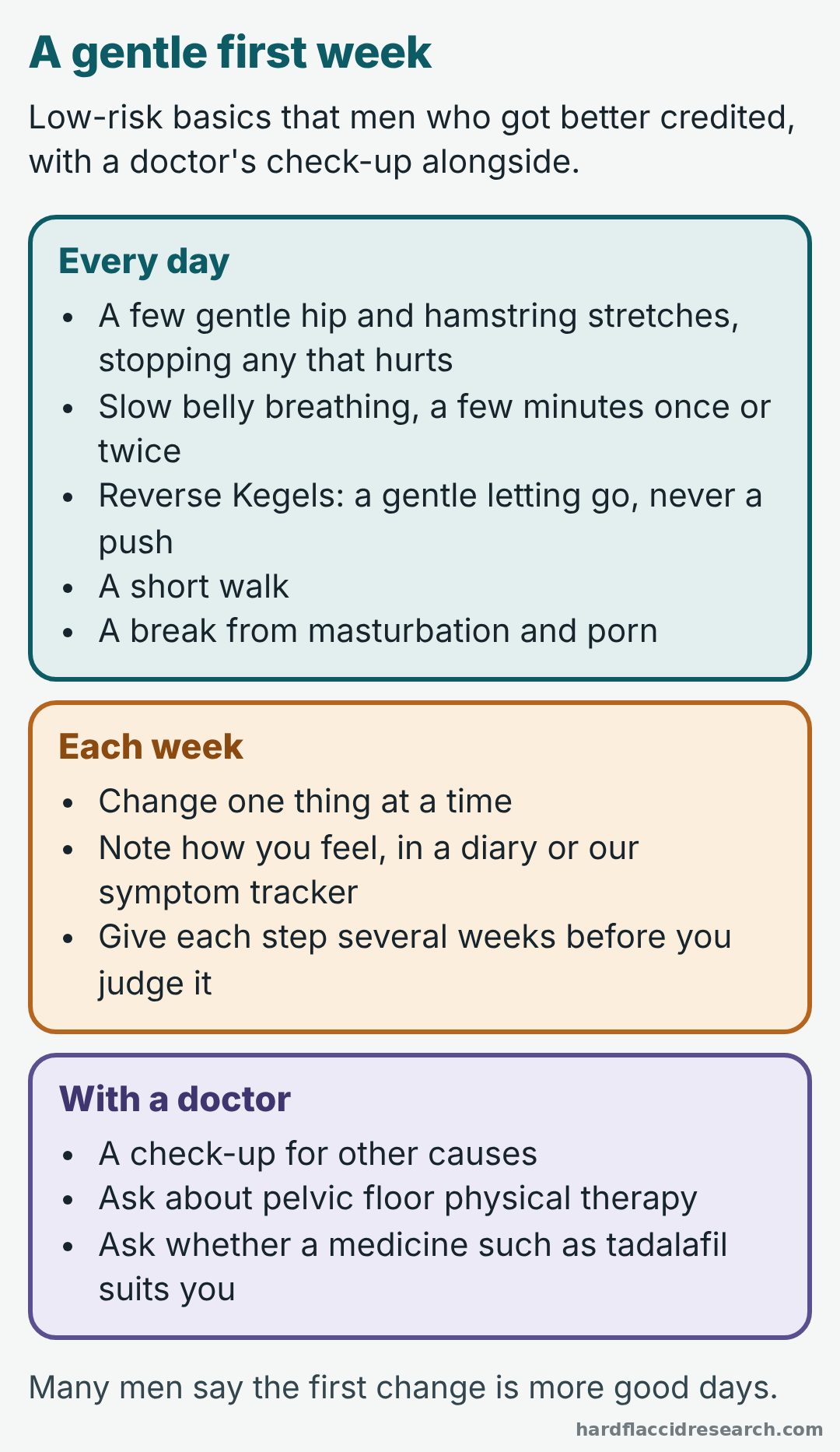
Start with low-risk basics and get checked by a doctor:
- Book a check-up with a primary care provider or urologist.
- Pick two or three daily basics, such as stretching, slow belly breathing, reverse Kegels and a walk.
- Give each change several weeks before you judge it, so you can tell what helps you.
- Note how you feel each week, in a diary or our symptom tracker.
- Expect ups and downs: many men say the first change is more good days.
When should I see a doctor?
See a primary care provider or a urologist before you start, if you haven't been checked, and again if symptoms change or nothing improves after a few months. Conditions such as Peyronie's disease (pay-roe-NEEZ), venous leak and pudendal nerve problems can look similar. Our doctor visit kit helps you explain your symptoms and what you've tried.
Get urgent care straight away (call 911 or go to the emergency room) if you have:
- An erection lasting more than 4 hours.
- A plan to end your life, or feeling you can't keep yourself safe.
- Sudden, severe pain in the penis, testicles or pelvis.
- New numbness around your back passage, genitals or inner thighs, or new weakness in your legs.
- New trouble starting or controlling your pee, not being able to pee, or not feeling when your bladder is full.
- Loss of control of your bladder or bowel.
- A fever or chills with pelvic pain or pain when peeing.
Frequently asked questions
Did men who got better do one thing or several?
Often several. Many recovery stories credit more than one step. After your first two or three basics, add one new thing at a time and keep notes.
Why did stretching come up so often?
It's low risk and easy to do every day, and doctors think it may ease tight muscles around the pelvis. In one trial in men with pelvic pain, though, aerobic exercise helped more, so add a walk too.
Is it safe to try several steps at once?
Gentle self-care such as stretching, slow breathing, reverse Kegels and walking is low risk together. Check any medicine or supplement with a doctor first.
Takeaway
Men who got better from hard flaccid often combined gentle steps: stretching, a break from masturbation and porn, and relaxing the pelvic floor. Some added tadalafil or physical therapy with a doctor's help.
This week, pick two or three basics and book a check-up. Start with our free self-check, and add your experience when things change.
This article is for general information and isn't a substitute for advice from your own doctor. Hard Flaccid Research doesn't diagnose or treat. If you have new or worsening symptoms, see a qualified clinician. In an emergency, call 911.
Free tools that can help
- Self-check: do I have hard flaccid?Compare your symptoms with what 6,026 men report.
- Doctor visit kitA one-page summary to take to your appointment.
- Habit trackerCount your days without porn or masturbation, and get through urges.
- Diaphragm breathing toolBreathe with a moving picture of your diaphragm and pelvic floor.
- Add your experienceTell us what you tried and how it went. No name needed.
- Hard Flaccid Syndrome CensusWhat men answered in 818 polls.
- Symptom trackerLog your symptoms and see what helps you.
- Ask us a questionThe questions men ask most become new articles.
The numbers behind this article
Every number in this article comes from what men with hard flaccid syndrome shared between December 2020 and October 2026, counted once per person, or from their polls. These are self-selected reports, not a clinical study. See hard flaccid syndrome statistics, the Hard Flaccid Syndrome Census and how we count.
In a June 2023 poll, 42% said they were at least half better
How 132 men answered: have you healed? The first bar adds up the next three answers.Men who recover may stop answering polls, so these numbers may undercount recovery.
Source: Hard Flaccid Research, hardflaccidresearch.com
Stretching came up in more recovery stories than anything else
How many of the 126 stories of getting better credited each step, most-credited first. A story can credit several. Besides these stories, 428 men wrote about something that gave them hope.A story mentioning something is what the man credited, not proof it worked. Polls are self-selected.
Source: Hard Flaccid Research, hardflaccidresearch.com
In a June 2023 poll, 51% of men who had tried no fap said it improved their hard flaccid syndrome at least some
How the 77 men who had tried it answered: does no fap improve your hard flaccid syndrome? Men who said they hadn't tried it are left out.These figures come from voluntary polls. They describe the men who answered, not everyone with hard flaccid syndrome, and aren't clinical findings.
Source: Hard Flaccid Research, hardflaccidresearch.com
In a June 2023 poll, 76% said Cialis had helped them, and 20% said a lot
How 45 men answered: has Cialis helped your hard flaccid syndrome?Source: Hard Flaccid Research, hardflaccidresearch.com
Pelvic floor therapy polls: 38% said it dramatically helped and 62% not (Feb 2023); 36% said quite a bit or cured them, 36% some but very little and 28% not at all (Nov 2022)
Two polls of men who had seen a pelvic floor physical therapist, each with its own question and number of men. Men who hadn't seen one are left out.Source: Hard Flaccid Research, hardflaccidresearch.com
In a March 2023 poll, 23% said weight loss had improved their symptoms
How 86 men answered: has weight loss improved your symptoms?The poll didn't ask who had lost weight, so a no may include men who hadn't tried.
Source: Hard Flaccid Research, hardflaccidresearch.com
In a May 2023 poll, 45% said an alpha blocker had helped at least somewhat
How 49 men answered: has an alpha blocker helped?Source: Hard Flaccid Research, hardflaccidresearch.com
Every number in this article, with its source
| In this article | Source |
|---|---|
| 6,026 men | 6,026 men, counted from what men wrote, once per person |
| 126 recovery stories | 126 men, counted from what men wrote, once per person |
| 428 men wrote about something that gave them hope | 428 men who wrote about hope, research data |
| 42% said they were at least half better (56 of 132 men) | 56 of 132 men, poll, Jun 2023 |
| 32% said they were at least half better, short of about 90% (42 of 132 men) | 42 of 132 men, poll, Jun 2023 |
| 10 of 132 men said they were about 90% better | 10 of 132 men, poll, Jun 2023 |
| 3% said they were fully healed (4 of 132 men) | 4 of 132 men, poll, Jun 2023 |
| 58% said they were not healed (76 of 132 men) | 76 of 132 men, poll, Jun 2023 |
| Stretching came up in 40 of 126 recovery stories | 40 of 126 recovery stories |
| A break from masturbation and porn came up in 28 of 126 recovery stories | 28 of 126 recovery stories |
| Reverse Kegels or pelvic floor relaxation came up in 20 of 126 recovery stories | 20 of 126 recovery stories |
| Tadalafil came up in 20 of 126 recovery stories | 20 of 126 recovery stories |
| Kegels came up in 19 of 126 recovery stories | 19 of 126 recovery stories |
| Breathing exercises came up in 16 of 126 recovery stories | 16 of 126 recovery stories |
| Pelvic floor physical therapy came up in 15 of 126 recovery stories | 15 of 126 recovery stories |
| Talking therapy, CBT, mindfulness or meditation came up in 15 of 126 recovery stories | 15 of 126 recovery stories |
| Core and glute strengthening came up in 15 of 126 recovery stories | 15 of 126 recovery stories |
| Diet or weight loss came up in 14 of 126 recovery stories | 14 of 126 recovery stories |
| Supplements came up in 13 of 126 recovery stories | 13 of 126 recovery stories |
| Walking or other cardio came up in 12 of 126 recovery stories | 12 of 126 recovery stories |
| Yoga or Pilates came up in 11 of 126 recovery stories | 11 of 126 recovery stories |
| Massage or trigger point release came up in 10 of 126 recovery stories | 10 of 126 recovery stories |
| Heat or warm baths came up in 7 of 126 recovery stories | 7 of 126 recovery stories |
| Alpha blockers came up in 6 of 126 recovery stories | 6 of 126 recovery stories |
| Shockwave therapy came up in 4 of 126 recovery stories | 4 of 126 recovery stories |
| Nerve blocks came up in 3 of 126 recovery stories | 3 of 126 recovery stories |
| Antidepressants or anti-anxiety medicines came up in 3 of 126 recovery stories | 3 of 126 recovery stories |
| Nerve pain medicines came up in 3 of 126 recovery stories | 3 of 126 recovery stories |
| Sildenafil or a similar medicine came up in 2 of 126 recovery stories | 2 of 126 recovery stories |
| A chiropractor or osteopath came up in 2 of 126 recovery stories | 2 of 126 recovery stories |
| Vein procedures came up in 2 of 126 recovery stories | 2 of 126 recovery stories |
| PRP injections came up in 2 of 126 recovery stories | 2 of 126 recovery stories |
| Acupuncture or dry needling came up in 2 of 126 recovery stories | 2 of 126 recovery stories |
| Muscle relaxants came up in 1 of 126 recovery stories | 1 of 126 recovery stories |
| Other surgery came up in 1 of 126 recovery stories | 1 of 126 recovery stories |
| Testosterone came up in 1 of 126 recovery stories | 1 of 126 recovery stories |
| Ketamine came up in 1 of 126 recovery stories | 1 of 126 recovery stories |
| The Emsella chair came up in 1 of 126 recovery stories | 1 of 126 recovery stories |
| Botox came up in 0 of 126 recovery stories | 0 of 126 recovery stories |
| Pudendal nerve decompression surgery came up in 0 of 126 recovery stories | 0 of 126 recovery stories |
| 51% of men who had tried no fap said it improved their hard flaccid syndrome at least some (39 of 77 men) | 39 of 77 men, poll, Jun 2023 |
| 17% said it improved their hard flaccid quite a bit (13 of 77 men) | 13 of 77 men, poll, Jun 2023 |
| 34% said some (26 of 77 men) | 26 of 77 men, poll, Jun 2023 |
| 49% said it didn't improve their hard flaccid (38 of 77 men) | 38 of 77 men, poll, Jun 2023 |
| 76% said Cialis had helped them (34 of 45 men) | 34 of 45 men, poll, Jun 2023 |
| 20% said Cialis helped a lot (9 of 45 men) | 9 of 45 men, poll, Jun 2023 |
| 56% said it helped a bit (25 of 45 men) | 25 of 45 men, poll, Jun 2023 |
| 24% said it didn't help (11 of 45 men) | 11 of 45 men, poll, Jun 2023 |
| 0 of 45 men said it made them worse | 0 of 45 men, poll, Jun 2023 |
| Of men who had seen a pelvic floor physical therapist, 38% said it dramatically helped (24 of 64 men) | 24 of 64 men, poll, Feb 2023 |
| 62% said it didn't dramatically help (40 of 64 men) | 40 of 64 men, poll, Feb 2023 |
| Of men who had seen a pelvic floor physical therapist, 36% said it helped quite a bit or cured them (17 of 47 men) | 17 of 47 men, poll, Nov 2022 |
| 36% said it helped some, but very little (17 of 47 men) | 17 of 47 men, poll, Nov 2022 |
| 28% said it didn't help at all (13 of 47 men) | 13 of 47 men, poll, Nov 2022 |
| 23% said weight loss had improved their symptoms (20 of 86 men) | 20 of 86 men, poll, Mar 2023 |
| 77% said weight loss hadn't improved their symptoms (66 of 86 men) | 66 of 86 men, poll, Mar 2023 |
| 45% said an alpha blocker had helped at least somewhat (22 of 49 men) | 22 of 49 men, poll, May 2023 |
| 14% said it had helped significantly (7 of 49 men) | 7 of 49 men, poll, May 2023 |
| 31% said it had helped somewhat (15 of 49 men) | 15 of 49 men, poll, May 2023 |
| 55% said it hadn't helped (27 of 49 men) | 27 of 49 men, poll, May 2023 |
| Counting since December 2020 | Research data, December 2020 to October 2026 |
Medical sources
What this article says about medical research, guidelines and urgent care comes from these sources.
- Gul M, Towe M, Yafi FA, Serefoglu EC. Hard flaccid syndrome: initial report of four cases. Int J Impot Res. 2020;32:176-179. https://doi.org/10.1038/s41443-019-0133-z
- Abdessater M, Kanbar A, Akakpo W, Beley S. Hard flaccid syndrome: state of current knowledge. Basic Clin Androl. 2020;30:7. https://doi.org/10.1186/s12610-020-00105-5
- Pang KH, Feng J, Zhang Y. Hard-flaccid syndrome: a systematic review of aetiopathophysiology, clinical presentation and management. Int J Impot Res. 2026;38:393-403. https://doi.org/10.1038/s41443-025-01118-2
- Niedenfuehr J, Stevens DM. Hard flaccid syndrome symptoms, comorbidities, and self-reported efficacy and satisfaction of treatments: a cross-sectional survey. Int J Impot Res. 2025;37:458-464. https://doi.org/10.1038/s41443-024-00853-2
- Billis E, Kontogiannis S, Tsounakos S, Konstantinidou E, Giannitsas K. Hard flaccid syndrome: a biopsychosocial management approach with emphasis on pain management, exercise therapy and education. Healthcare. 2023;11:2793. https://doi.org/10.3390/healthcare11202793
- Nico E, Rubin R, Trosch L. Successful treatment of hard flaccid syndrome: a case report (conference abstract). J Sex Med. 2022;19:S103. https://doi.org/10.1016/j.jsxm.2022.01.218
- Mendias CL, Awan TM. Multimodal rehabilitation for hard flaccid syndrome in a retrospective case series. Front Rehabil Sci. 2026;7:1970062. https://doi.org/10.3389/fresc.2026.1970062
- Lai HH, Pontari MA, Argoff CE, et al. Male chronic pelvic pain: AUA guideline. J Urol. 2025. https://www.auanet.org/guidelines-and-quality/guidelines/male-chronic-pelvic-pain
- Tawfik AM, Radwan MH, Abdulmonem M, Abo-Elenen M, Elgamal SA, Aboufarha MO. Tadalafil monotherapy in management of chronic prostatitis/chronic pelvic pain syndrome: a randomized double-blind placebo controlled clinical trial. World J Urol. 2022. https://pmc.ncbi.nlm.nih.gov/articles/PMC9512753/
- Giubilei G, Mondaini N, Minervini A, et al. Physical activity of men with chronic prostatitis/chronic pelvic pain syndrome not satisfied with conventional treatments: could it represent a valid option? A double-blind, randomized study. J Urol. 2007;177:159-165. https://doi.org/10.1016/j.juro.2006.08.107
- Esposito K, Giugliano F, Di Palo C, et al. Effect of lifestyle changes on erectile dysfunction in obese men: a randomized controlled trial. JAMA. 2004;291:2978-2984. https://doi.org/10.1001/jama.291.24.2978
- Anderson RU, Wise D, Sawyer T, Chan C. Integration of myofascial trigger point release and paradoxical relaxation training treatment of chronic pelvic pain in men. J Urol. 2005;174:155-160. https://doi.org/10.1097/01.ju.0000161609.31185.d5
- Anderson RU, Wise D, Sawyer T, Glowe P, Orenberg EK. 6-day intensive treatment protocol for refractory chronic prostatitis/chronic pelvic pain syndrome using myofascial release and paradoxical relaxation training. J Urol. 2011;185:1294-1299. https://doi.org/10.1016/j.juro.2010.11.076
- FitzGerald MP, Anderson RU, Potts J, et al. Randomized multicenter feasibility trial of myofascial physical therapy for the treatment of urological chronic pelvic pain syndromes. J Urol. 2009;182:570-580. https://doi.org/10.1016/j.juro.2009.04.022
- Hetrick DC, Ciol MA, Rothman I, Turner JA, Frest M, Berger RE. Musculoskeletal dysfunction in men with chronic pelvic pain syndrome type III: a case-control study. J Urol. 2003;170:828-831. https://doi.org/10.1097/01.ju.0000080513.13968.56
- Dorey G, Speakman MJ, Feneley RCL, Swinkels A, Dunn CDR. Pelvic floor exercises for erectile dysfunction. BJU Int. 2005;96:595-597. https://doi.org/10.1111/j.1464-410X.2005.05690.x
- Franco JVA, Turk T, Jung JH, et al. Pharmacological interventions for treating chronic prostatitis/chronic pelvic pain syndrome. Cochrane Database Syst Rev. 2019;10:CD012552. https://doi.org/10.1002/14651858.CD012552.pub2
- Sabique C, Nayak P, Mandal S, et al. Comparing efficacy of alfuzosin and amitriptyline versus yoga and placebo in males with chronic pelvic pain syndrome: a single-center randomized crossover trial. International Continence Society 2024, abstract 657. https://www.ics.org/2024/abstract/657
- Bivalacqua TJ, Allen BK, Brock G, et al. Acute ischemic priapism: an AUA/SMSNA guideline. J Urol. 2021;206(5):1114-1121. https://doi.org/10.1097/JU.0000000000002236
- Substance Abuse and Mental Health Services Administration. 988 Suicide and Crisis Lifeline. https://988lifeline.org/
How we made this article
We started from the question many men asked. Every number was checked against our data. Our editorial team edited it and Dr. Julian Reyes reviewed it medically. Read our editorial policy.
Read next
See more of us on Google
Add Hard Flaccid Research as a preferred source, and Google shows you our pages more often when you search.
Add as a preferred sourceDon't see your question? Ask us. We answer the most-asked ones in new articles.
Cite and share this article
You're welcome to quote this article. Please name Hard Flaccid Research and link to this page, so others can find the full answer and the data behind it. To cite this page, use its link.
Citation
Hard Flaccid Research. (2026). Hard Flaccid Recovery: What Men Who Got Better Did Most. Written by the Editorial Team, medically reviewed by Dr. Julian Reyes. https://hardflaccidresearch.com/articles/hard-flaccid-recovery-what-helped
Credit link for your article
Source: <a href="https://hardflaccidresearch.com/articles/hard-flaccid-recovery-what-helped">Hard Flaccid Research</a>
Wikipedia reference
<ref>{{cite web |url=https://hardflaccidresearch.com/articles/hard-flaccid-recovery-what-helped |title=Hard Flaccid Recovery: What Men Who Got Better Did Most |website=Hard Flaccid Research |date=2026 |access-date=28 October 2026}}</ref>
How the data was collected: our methodology. Journalists and researchers: key numbers, data and contact.