Anterior Pelvic Tilt and Hard Flaccid: Is Posture to Blame?
In short
- Anterior pelvic tilt means the pelvis tips forward, so the lower back arches and the belly pushes out.
- A small forward tilt is normal, and no study shows that it or posture causes hard flaccid syndrome, though 233 men with hard flaccid syndrome described lower back, hip or hamstring tightness.
- Gentle stretching, strengthening without clenching and breaks from sitting may ease stiffness, and a pelvic health physio can check your posture, hips and pelvic floor together.
63 men with hard flaccid asked this question.
Anterior pelvic tilt means your pelvis tips forward, so your lower back arches more and your belly and bottom push out. A small forward tilt is normal, and many people with a clear tilt have no symptoms at all. No study shows that anterior pelvic tilt or posture causes hard flaccid syndrome, where the penis stays firm, rubbery or shrunken when it should be soft, but tight hips and backs come up in men with hard flaccid.
63 men with hard flaccid asked whether posture or pelvic tilt causes it, and 233 described tightness in their lower back, hips or hamstrings. This page explains what anterior pelvic tilt is, the signs, the causes, how to check for it, what it may have to do with hard flaccid, what men with hard flaccid report, and the exercises and habits that may help. Our self-check shows how your symptoms compare.
By the numbers: between December 2020 and October 2026, 2,661 of the 6,026 men with hard flaccid who shared their experiences described their symptoms, and 9% described lower back, hip or hamstring tightness (233 of 2,661). These are men with hard flaccid, not men in general.
What is anterior pelvic tilt?
Your pelvis is the ring of bone at the base of your spine. Your lower back and your thigh bones join it, and the pelvic floor, the sling of muscles between your legs that supports your bladder and bowel and helps control erections, is fixed to its inside. The pelvis can tip a little forward or back, and where it rests changes the curve of your lower back.
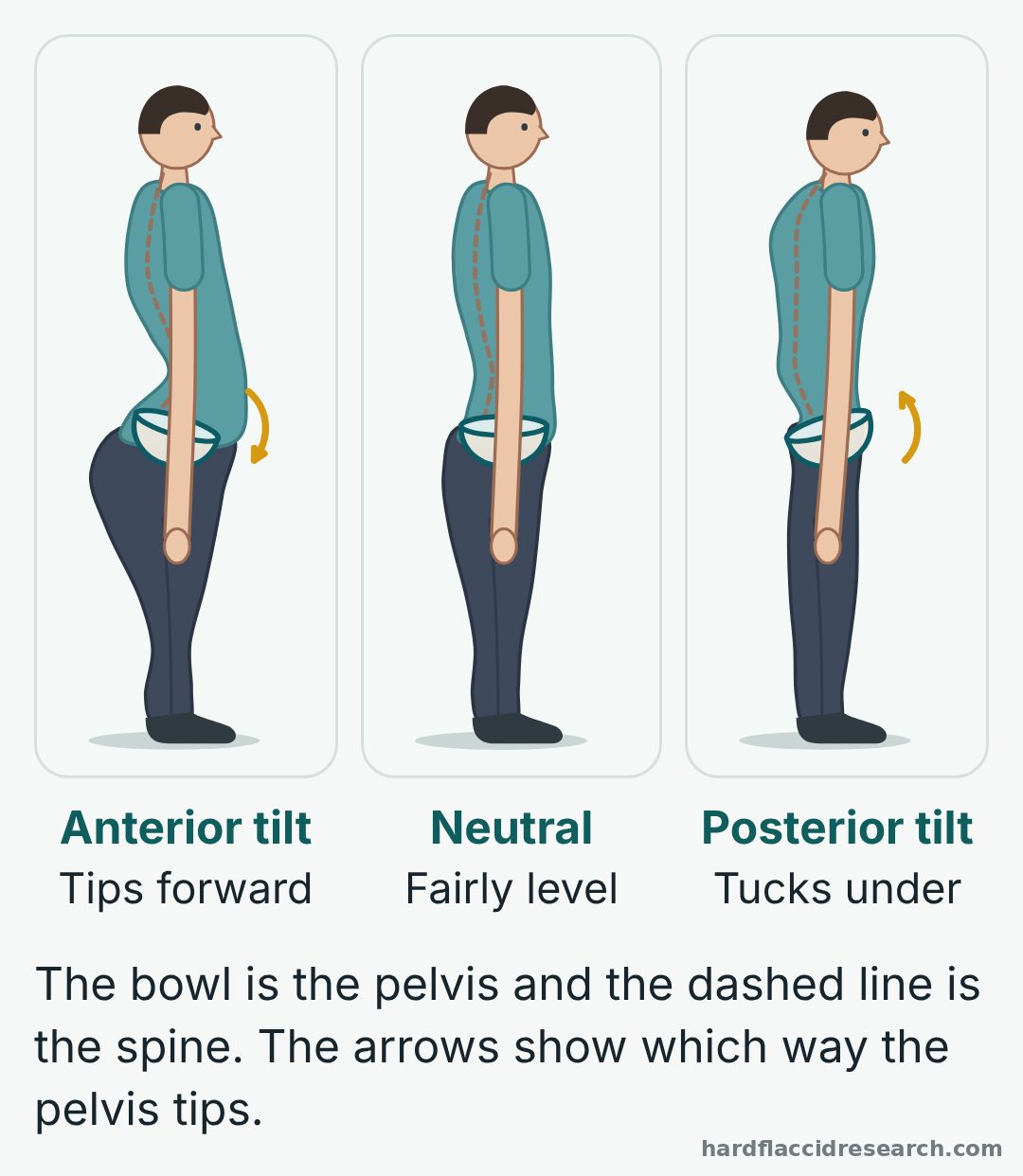
- Anterior pelvic tilt. The pelvis tips forward. The lower back arches more, the belly pushes out and the bottom sticks out behind.
- Neutral. The pelvis sits fairly level, with a gentle curve in the lower back.
- Posterior pelvic tilt. The pelvis tucks under, the lower back flattens and you slump. Sitting slumped back onto your tailbone is the everyday version.
A small forward tilt is the usual position, not a fault. In studies of healthy men with no pain, most stood with some forward tilt. The shape of the pelvis itself also varies from person to person, so the usual ways of judging tilt can mislead. Many physios only treat anterior pelvic tilt as a problem when it is large, changes how you move, or comes with stiffness or pain.
Hard Flaccid Explorerby Hard Flaccid Research
Anterior pelvic tilt and hard flaccid
A 7-minute animated explainer of this article. Press play, or skip between chapters. The first minute is free for everyone.
A picture to explain, not a diagnosis. No study shows that posture causes hard flaccid syndrome.
Anterior pelvic tilt symptoms
Anterior pelvic tilt often causes no symptoms at all. When people do notice it, it is usually because of how they look side-on or how their back and hips feel:
- A deep arch in the lower back, with the belly pushing forward and the bottom sticking out.
- Tight hip flexors, the muscles at the front of the hip that lift your thigh, often felt when you stand up after sitting.
- An ache or stiffness in the lower back, especially after standing for a long time.
- Tight hamstrings, or hips that feel stiff when you exercise.
Each of these can have other causes. The link between pelvic tilt and back pain is also weaker than many posture videos suggest: studies comparing people with and without back pain have mostly found a similar tilt in both. So a tilt may be worth working on if it comes with stiffness, but on its own it is unlikely to be the whole explanation.
Back pain that comes with numbness or tingling down a leg needs a doctor's check first. New weakness in your legs, or new numbness between your legs, needs urgent care (see the list near the end of this page).
Related: Pelvic Floor & Hip Flexor Stretches for Men »
What causes anterior pelvic tilt?
Nobody knows exactly, and it is probably different for each person. These are the ideas physios discuss most:
- Long hours sitting. When you sit, the hip flexors stay short. Over time they may feel tight, and some physios think they then pull the front of the pelvis down when you stand.
- Weak glutes and belly muscles. The glutes (your buttock muscles) and the deep belly muscles help hold the pelvis level from behind and in front. If they are weak, the pelvis may tip forward more easily.
- Habit. Some men stand with their weight forward, lock their knees or push their chest out to stand up straight.
- Your build. The shape of your pelvis and spine differs from person to person, and carrying weight around the belly may pull the pelvis forward.
Some physios call the pattern of tight hip flexors and lower back with weak glutes and belly muscles 'lower crossed syndrome'. Some find it a useful way to think about it, but it is an idea, not a proven cause.
How to check for anterior pelvic tilt
You can get a rough idea at home, but none of these checks is exact, and because the shape of the pelvis varies so much, a tilt can look bigger or smaller than it really is:
- A side-on photo. Stand relaxed, side-on to a camera, in fitted clothes. A clear arch in the lower back, a belly that pushes forward and a bottom that sticks out suggest more forward tilt.
- The wall check. Stand with your heels a few inches from a wall and your bottom, shoulder blades and the back of your head touching it. Slide a flat hand behind your lower back. If it slides in easily with lots of room to spare, your back may arch more than most.
- The hip flexor check. Lie on your back at the very end of a firm bed or bench with your lower legs hanging off, and hug one knee to your chest. If the other thigh lifts up off the bed, the front of that hip may be tight. Physios call a version of this the Thomas test and do it more accurately.
A physio or doctor can measure the tilt more accurately and, more usefully, check how your hips, lower back and pelvic floor move. Scans are not usually needed for posture alone. Try not to check the mirror over and over: checking may keep you tense, and for men with hard flaccid syndrome, easing pelvic floor tension is often one of the aims.
Related: Hard Flaccid Worse When Standing? 86% of Men Noticed It »
Does anterior pelvic tilt cause hard flaccid?
No study has tested whether anterior pelvic tilt or posture causes hard flaccid syndrome. Doctors think a tight pelvic floor may be part of hard flaccid, though this isn't proven. Because the pelvic floor is fixed to the inside of the pelvis, these are the ideas pelvic health physios discuss about how posture could play a part:
- Tight hips and back. Tight hip flexors, hamstrings and lower back muscles may pull on the pelvis and change how it rests, which some physios think puts more strain on the pelvic floor.
- Weak glutes and core. When the glutes and deep core are weak, other muscles, including the pelvic floor, may end up doing more of the work of holding you upright.
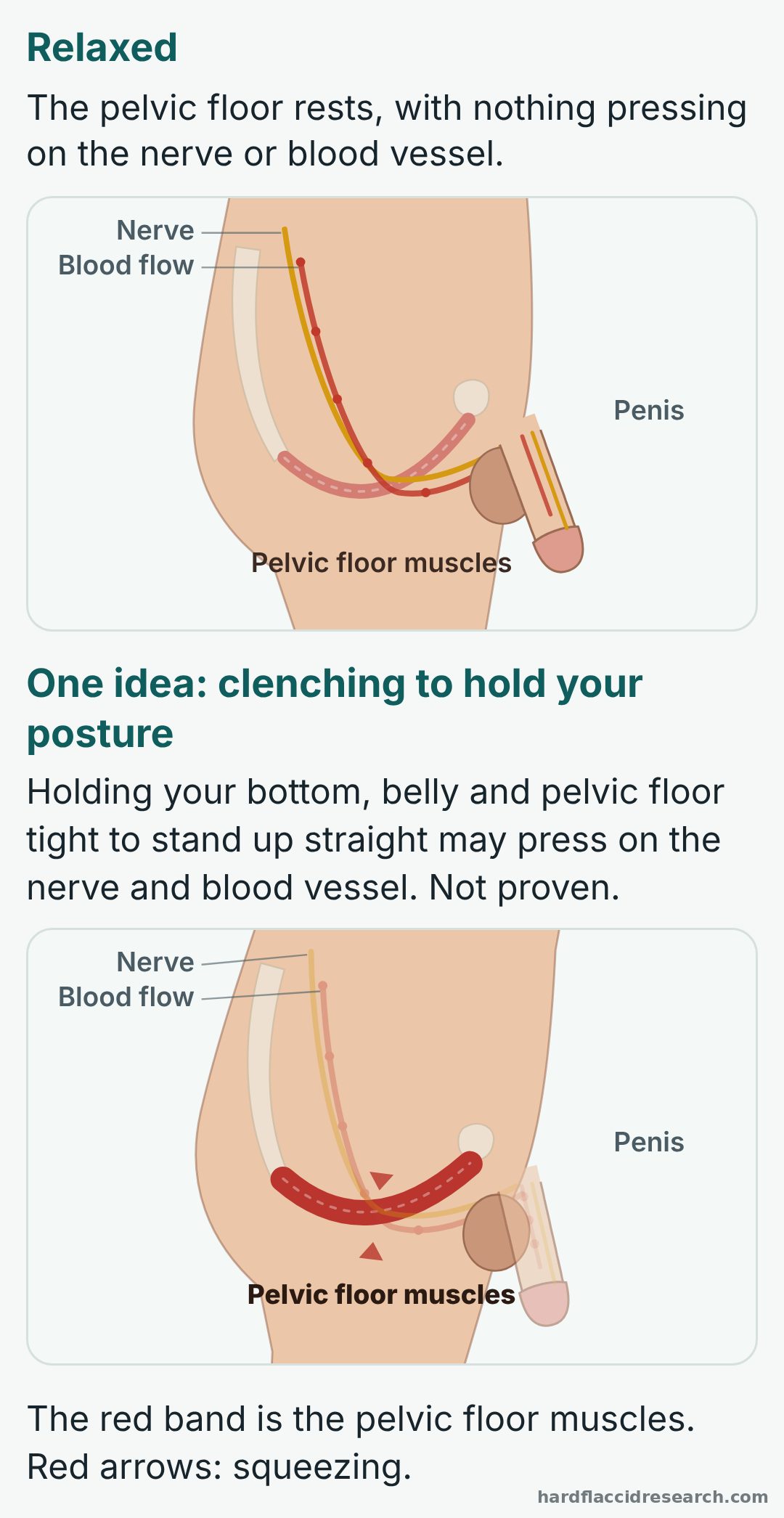
- Clenching. Some men hold their belly, buttocks and pelvic floor tight to stand up straight, without noticing. One idea is that a pelvic floor that stays clenched may press on the nerves and blood vessels an erection depends on.
- Slumped sitting. One idea is that long hours slumped back onto your tailbone may load the tailbone and the pelvic floor muscles fixed to it, near where the pudendal nerve, the main nerve to the penis, runs. This isn't proven.
In what men with hard flaccid wrote, far more blamed penis enlargement methods (155 men) or aggressive or excessive masturbation (125 men) than long hours sitting (24 men) or the gym, heavy lifting or sports (14 men), and more men named masturbation in our polls. Men could name more than one cause.
Posture may be one of several things that keep the pelvic floor tight, rather than a cause on its own, though this isn't proven. Our article on what causes hard flaccid explains the main ideas.
What men with hard flaccid syndrome and tight hips report
233 men with hard flaccid syndrome described tightness in their lower back, hips or hamstrings. Of them, 66% also described the firm flaccid state, 55% weaker erections, 54% numbness, 44% shrinkage and 42% pelvic floor tightness. These are self-selected reports, not a clinical study, and they don't show that the tightness caused the other symptoms.
Of the same 233 men, 67% mentioned stretching, 51% pelvic floor physio, 48% talking therapy or mindfulness and 48% Kegels, and other approaches came up too. Mentioning something isn't the same as it working. Physios often advise against Kegels while the pelvic floor feels tight: if yours feels tight, ask a pelvic health physio before doing them, and if you do them, let go fully between squeezes.
In what men with hard flaccid wrote, 1,288 discussed stretching of the hips and legs, 483 walking, running or cardio, 361 core, glute and posture strengthening, 202 yoga or Pilates and 118 a chiropractor or osteopath. In the 126 recovery stories, stretching came up in 40, core, glute and posture strengthening in 15, walking, running or cardio in 12, yoga or Pilates in 11 and a chiropractor or osteopath in 2. A story mentioning something is not proof that it worked.
Standing matters to many men with hard flaccid. In one March 2023 poll of men with hard flaccid, 86% said it is harder when they stand than when they lie down (54 of 63 men). That poll didn't ask about posture, so it doesn't show that pelvic tilt is the reason. Our page on hard flaccid worse when standing explains the other ideas.
Posture and exercise come up in what men with hard flaccid ask, too: 216 asked which stretches or exercises help, 63 why it is worse when standing and 45 whether sitting makes it worse.
What published studies say
No study has looked at posture or pelvic tilt in hard flaccid syndrome. The published hard flaccid research is small, mostly case reports, small case series and surveys, and no hard flaccid treatment has been tested in a randomised trial. Strengthening and posture work were part of the exercise programmes in published hard flaccid reports where men improved, but never on their own, so their own effect can't be separated out. In a published survey of men with hard flaccid, stretching got mixed reviews: many said it helped, and some said it made them worse.
For anterior pelvic tilt in general, a systematic review (a study that pulls together all the studies on a question) found only a few small studies of non-surgical treatment, such as exercise, hands-on therapy and taping, and called the evidence very low quality. It found no clear evidence that any of them reduce the tilt, no proof that a large tilt causes pain, and no proof that changing it relieves pain.
US urology guidelines on chronic pelvic pain in men say doctors should check the spine, hips and pelvis in men with pelvic pain, and refer them on if needed. This is based on expert opinion rather than trials. Each treatment page on this site has a plain-English summary of the research.
Anterior pelvic tilt exercises and stretches
Exercise is the usual approach: stretch the muscles that feel tight and strengthen the ones that hold the pelvis level. It can't promise to change how your pelvis sits, but many people find it eases stiffness. If you have hard flaccid syndrome or a tight pelvic floor, the aim is to move and strengthen without clenching. If you have pain, or your symptoms haven't been checked, see a doctor first, and a pelvic health physio can tailor the exercises to you. These exercises use the glutes and belly muscles, not a pelvic floor squeeze: if your pelvic floor feels tight, ask a pelvic health physio before doing Kegels, and let go fully between squeezes.
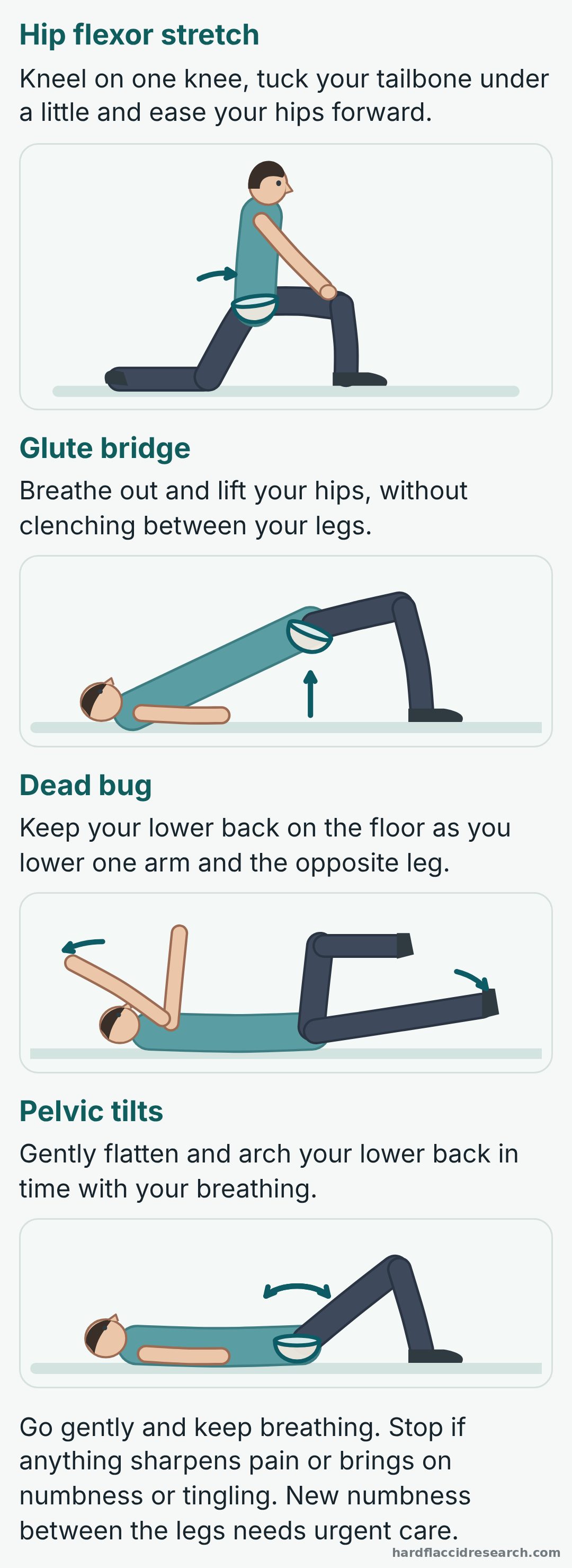
- Half-kneeling hip flexor stretch. Kneel on one knee on a cushion with the other foot flat in front. Tuck your tailbone under a little, then ease your hips forward until you feel a gentle stretch at the front of the back hip. Hold for a few slow breaths, then swap sides.
- Glute bridge. Lie on your back with your knees bent and feet flat. Breathe out as you lift your hips by pushing through your heels until your body is in a line from shoulders to knees, then lower slowly. Use your buttock muscles without clenching hard between your legs.
- Dead bug. Lie on your back with your arms pointing up and your knees bent above your hips. Keep your lower back resting gently on the floor as you slowly lower one arm and the opposite leg, breathing out, then swap. It trains the deep belly muscles without holding your breath.
- Pelvic tilts. Lie on your back with your knees bent. Slowly tip your pelvis so your lower back flattens gently onto the floor, then let it arch a little, in time with slow breaths. It helps you feel where neutral is.
- If your hamstrings, inner thighs or lower back feel tight too, add a gentle stretch for each.
Go gently. Ease into each one, breathe slowly, and stop if it sharpens pain or brings on numbness or tingling. New numbness between the legs needs urgent care. Posture changes slowly, so gentle and regular is usually advised over hard and occasional.
Forcing a perfect posture by holding everything tight may make the pelvic floor tighter, not looser. Keep breathing: the pelvic floor drops and lets go a little as you breathe in, and rises back as you breathe out.
Our members' guide, The Hard Flaccid Stretch Plan, goes through eight stretches for tight hips, glutes and hamstrings step by step.
Everyday habits that may help
- Break up sitting. Stand up and move every half hour or so, and when you sit, sit up on your sitting bones rather than slumping back onto your tailbone.
- Stand easy. Spread your weight through your whole foot, keep your knees soft rather than locked, and let your belly and bottom relax. You don't need to hold yourself rigid.
- Breathe out on the effort. When you lift or exercise, breathe out as you push rather than holding your breath and bracing hard, which may also tighten the pelvic floor.
- Keep moving. Walking is a gentle way to use your hips and glutes. If you cycle, use a saddle with a cut-out and take breaks, because cycling presses on the area between your legs. Numbness after a ride that doesn't go away, or that comes with leg weakness or bladder or bowel changes, needs urgent care.
- Notice tension. A few times a day, check whether you are clenching your bottom, belly or pelvic floor, and let it go with a slow breath in.
Common questions about anterior pelvic tilt
Can anterior pelvic tilt be fixed? It may be eased a little. Stretching and strengthening may ease stiffness, though there is little proof that they change how your pelvis sits. A small forward tilt is normal, so you don't need to aim for a flat back.
How long does it take to fix anterior pelvic tilt? Nobody knows. The studies were small and short, and posture changes slowly. Many physios suggest gentle exercise most days rather than hard, occasional sessions.
Does anterior pelvic tilt cause back pain? It may play a part for some people, but studies have mostly found that people with and without back pain stand with a similar tilt. Back pain usually has more than one cause.
Can anterior pelvic tilt cause erectile dysfunction? No study shows that it does. A tight pelvic floor may affect erections, and some physios think posture is one of the things that may keep it tight, though this isn't proven. If your erections have changed, see a doctor: a blood test for blood sugar (HbA1c) and cholesterol is worth asking for, because erection changes can be an early sign of heart and blood vessel problems.
Is posterior pelvic tilt better? No. Tucking your pelvis under all the time, or slumping back onto your tailbone, can strain the lower back too, and slumping may load the tailbone and the pelvic floor. The aim is a pelvis that sits easily near neutral and moves freely both ways.
Do posture correctors or braces help? There is little evidence that they change pelvic tilt for long, and holding yourself rigid can make you tense. Building strength, moving more and sitting less are the usual advice.
Should I see a chiropractor or osteopath? Chiropractic and osteopathy haven't been studied for hard flaccid syndrome, and there is very little research on them for pelvic pain in men. Spinal manipulation can leave you sore for a day or two, and rarely causes more serious problems. A pelvic health physio is another option to ask your doctor about. New numbness around your back passage or genitals, new leg weakness, or loss of bladder or bowel control needs urgent medical care, not manipulation.
When to see a doctor
See a GP if back, hip or leg pain is getting worse, or if you haven't had your symptoms checked yet, because they can have other causes. A GP can refer you to a pelvic health physio, who can check your posture, your hips and your pelvic floor together, which no posture video can do. Our doctor visit kit helps you mention back or hip tightness alongside your other symptoms.
Back pain with numbness or tingling down a leg needs a doctor's check before you exercise. New weakness in your legs is on the urgent list below.
If you've had numbness between your legs for a while, or pain that's clearly worse when you sit, ask a doctor to check your nerves, including the pudendal nerve.
Get urgent care straight away if you have:
- Sudden, severe pain in the penis, testicles or pelvis.
- New numbness around your back passage, genitals or inner thighs, or new weakness in your legs.
- New trouble starting or controlling your pee, not being able to pee, or not feeling when your bladder is full.
- Loss of control of your bladder or bowel.
- A fever or chills with pelvic pain or pain when peeing.
What to do next
- For a few days, notice how you stand and sit: do you arch, tuck or slump, and do you clench your bottom, belly or pelvic floor?
- Pick one stretch and two strengthening exercises from this page, and do them gently most days.
- Break up long spells of sitting, and walk more if you can.
- Take our self-check, and make a doctor visit kit that mentions any back or hip tightness.
If you're worried about how a visit will go, many men with hard flaccid syndrome feel the same: in one November 2022 poll of men with hard flaccid who had seen a urologist, 95% called their visits bad and unhelpful (63 of 66 men). It's a reason to prepare well with the doctor visit kit, not to skip the visit.
Free tools that can help
- Self-check: do I have hard flaccid?Compare your symptoms with what 6,026 men report.
- Doctor visit kitA one-page summary to take to your appointment.
- Habit trackerCount your days without porn or masturbation, and get through urges.
- Diaphragm breathing toolBreathe with a moving picture of your diaphragm and pelvic floor.
- Add your experienceTell us what you tried and how it went. No name needed.
- Hard Flaccid Syndrome CensusWhat men answered in 818 polls.
- Symptom trackerLog your symptoms and see what helps you.
- Ask us a questionThe questions men ask most become new articles.
The numbers behind this article
Every number in this article comes from what men with hard flaccid syndrome shared between December 2020 and October 2026, counted once per person, or from their polls. These are self-selected reports, not a clinical study. See hard flaccid syndrome statistics, the Hard Flaccid Syndrome Census and how we count.
What else men with hard flaccid syndrome and tight hips and backs described
Share of the 233 men with hard flaccid syndrome who described lower back, hip or hamstring tightness (9% of the 2,661 who described their symptoms) who also described each symptom. Other symptoms came up too.These are self-selected reports, not a clinical study. They don't show that the tightness caused the other symptoms.
Source: Hard Flaccid Research, hardflaccidresearch.com
What men with hard flaccid syndrome and tight hips and backs mentioned
Share of the same 233 men with hard flaccid syndrome who mentioned each, counted once per person. Other approaches came up too. Mentioned is not the same as worked.If your pelvic floor feels tight, ask a pelvic health physio before doing Kegels, and let go fully between squeezes.
Source: Hard Flaccid Research, hardflaccidresearch.com
Men with hard flaccid syndrome who discussed movement and posture approaches
Number of men with hard flaccid syndrome who discussed each, counted once per person. Many discussed more than one. Discussed is not the same as worked.Source: Hard Flaccid Research, hardflaccidresearch.com
Movement and posture in hard flaccid syndrome recovery stories
Number of the 126 hard flaccid syndrome recovery stories that mention each.A story mentioning something is not proof that it worked.
Source: Hard Flaccid Research, hardflaccidresearch.com
What men with hard flaccid syndrome blamed, in what they wrote
Number of men with hard flaccid syndrome who blamed each for their hard flaccid syndrome, counted once per person. Men could name more than one cause.More men named masturbation in our polls. Blaming something is not proof that it was the cause.
Source: Hard Flaccid Research, hardflaccidresearch.com
What men with hard flaccid syndrome said in two separate polls
Each bar is a separate poll of men with hard flaccid syndrome, with its own base, so the bars can't be compared.These are self-selected reports, not a clinical study.
Source: Hard Flaccid Research, hardflaccidresearch.com
What men with hard flaccid syndrome asked about posture and exercise
Number of men with hard flaccid syndrome in each question group, counted once per person.Source: Hard Flaccid Research, hardflaccidresearch.com
Every number in this article, with its source
| In this article | Source |
|---|---|
| 63 men asked whether posture or pelvic tilt causes hard flaccid syndrome | Question group, 63 men, research data |
| 233 men described lower back, hip or hamstring tightness | 233 men with lower back, hip or hamstring tightness, counted from what men wrote, once per person |
| Of 233 men with lower back, hip or hamstring tightness: 67% mentioned stretching, 51% pelvic floor physio, 48% talking therapy or mindfulness, 48% Kegels | 233 men with lower back, hip or hamstring tightness, counted from what men wrote, once per person |
| 361 men mentioned core, glute or posture strengthening | 361 men, counted from what men wrote, once per person |
| Core, glute or posture strengthening came up in 15 of 126 recovery stories | 15 of 126 recovery stories |
| Stretching came up in 40 of 126 recovery stories | 40 of 126 recovery stories |
| Yoga or Pilates came up in 11 of 126 recovery stories | 11 of 126 recovery stories |
| 126 recovery stories | 126 men, counted from what men wrote, once per person |
| 95% called urologist visits bad and unhelpful (63 of 66 men) | 63 of 66 men, poll, Nov 2022 |
| Counting since December 2020 | Research data, December 2020 to October 2026 |
| Of 233 men with lower back, hip or hamstring tightness: 66% firm flaccid state, 55% weaker erections, 54% numbness, 44% shrinkage, 42% pelvic floor tightness | 233 men with lower back, hip or hamstring tightness, counted from what men wrote, once per person |
| 2,661 of the 6,026 men who shared their experiences described their symptoms | Research data, December 2020 to October 2026 |
| 9% described lower back, hip or hamstring tightness (233 of 2,661) | 233 of 2,661 men, counted from what men wrote, once per person |
| 1,288 men discussed stretching of the hips and legs | 1,288 men discussing stretching, counted from what men wrote, once per person |
| 483 men discussed walking, running or cardio | 483 men discussing walking, running or cardio, counted from what men wrote, once per person |
| 202 men discussed yoga or Pilates | 202 men discussing yoga or Pilates, counted from what men wrote, once per person |
| 118 men discussed a chiropractor or osteopath | 118 men discussing a chiropractor or osteopath, counted from what men wrote, once per person |
| Walking, running or cardio came up in 12 of 126 recovery stories | 12 of 126 recovery stories |
| A chiropractor or osteopath came up in 2 of 126 recovery stories | 2 of 126 recovery stories |
| 155 men blamed penis enlargement methods | 155 men who blamed penis enlargement methods, counted from what men wrote, once per person |
| 125 men blamed aggressive or excessive masturbation | 125 men who blamed aggressive or excessive masturbation, counted from what men wrote, once per person |
| 24 men blamed long hours sitting | 24 men who blamed long hours sitting, counted from what men wrote, once per person |
| 14 men blamed the gym, heavy lifting or sports | 14 men who blamed the gym, heavy lifting or sports, counted from what men wrote, once per person |
| 86% said it is harder when standing than lying down (54 of 63 men) | 54 of 63 men, poll, Mar 2023 |
| 216 men asked which stretches or exercises help | Question group, 216 men, research data |
| 63 men asked why it is worse when standing | Question group, 63 men, research data |
| 45 men asked whether sitting makes it worse | Question group, 45 men, research data |
How we made this article
We started from the question 63 men asked. Every number was checked against our data. Our editorial team edited it and Dr. Julian Reyes reviewed it medically. Read our editorial policy.
Read next
See more of us on Google
Add Hard Flaccid Research as a preferred source, and Google shows you our pages more often when you search.
Add as a preferred sourceDon't see your question? Ask us. We answer the most-asked ones in new articles.
Cite and share this article
You're welcome to quote this article. Please name Hard Flaccid Research and link to this page, so others can find the full answer and the data behind it. To cite this page, use its link.
Citation
Hard Flaccid Research. (2026). Anterior Pelvic Tilt and Hard Flaccid: Is Posture to Blame? Written by the Editorial Team, medically reviewed by Dr. Julian Reyes. https://hardflaccidresearch.com/articles/posture-pelvic-tilt-hard-flaccid
Credit link for your article
Source: <a href="https://hardflaccidresearch.com/articles/posture-pelvic-tilt-hard-flaccid">Hard Flaccid Research</a>
Wikipedia reference
<ref>{{cite web |url=https://hardflaccidresearch.com/articles/posture-pelvic-tilt-hard-flaccid |title=Anterior Pelvic Tilt and Hard Flaccid: Is Posture to Blame? |website=Hard Flaccid Research |date=2026 |access-date=28 October 2026}}</ref>
How the data was collected: our methodology. Journalists and researchers: key numbers, data and contact.