Yoga for Hard Flaccid: The Poses That Help vs Hurt
In short
- Yoga hasn't been studied for hard flaccid syndrome, so no pose is proven to help or to harm.
- For a tight pelvic floor, physios generally suggest gentle, supported poses that open the hips and may help the pelvic floor lengthen, done with slow breathing, and easing off squeezing cues like a 'root lock', breath-holding and long, hard holds.
- Stop any pose that hurts, and see a doctor if your symptoms haven't been checked.
Yoga for hard flaccid syndrome has never been studied, so no pose is proven to help or to harm. Hard flaccid is when the penis stays firm, rubbery or shrunken when it should be soft, often with numbness and weaker erections, and it is often linked to a tight pelvic floor, though this isn't proven. For a tight pelvic floor, pelvic health physios generally suggest gentle, supported poses that open the hips and may help the pelvic floor lengthen, done with slow breathing.
Poses and cues that make you squeeze, bear down, hold your breath or brace hard may do the opposite. Separately, 202 men with hard flaccid discussed yoga or Pilates, which we count together. This page explains which poses may help or hurt, which styles of class are gentler, and when to see a doctor. If your symptoms haven't been checked, see a doctor first, and take our self-check to see how your symptoms compare.
By the numbers: of the 6,026 men with hard flaccid who shared their experiences between December 2020 and October 2026, 202 discussed yoga or Pilates and 2,661 described their symptoms. These are self-selected reports, not a clinical study.
Does yoga help hard flaccid?
Nobody knows yet. No study has looked at yoga or Pilates for hard flaccid syndrome. For long-lasting pelvic pain in men, a condition with a lot of overlap, only one small trial has been reported, at medical conferences rather than as a full paper, so the evidence is very uncertain.
Yoga is generally safe, and reviews suggest it may ease stress and anxiety a little. So this page follows what physios usually suggest for a tight pelvic floor, the sling of muscles between your legs that supports your bladder and bowel and helps control erections.
Separately, of the 2,661 men with hard flaccid who described their symptoms, 23% described pelvic floor tightness, spasm or twitching (601 men), 10% pelvic, perineal or tailbone pain (267) and 9% lower back, hip or hamstring tightness (233).
Hard Flaccid Explorerby Hard Flaccid Research
Which yoga poses may help or hurt
A 7-minute animated explainer of this article. Press play, or skip between chapters. The first minute is free for everyone.
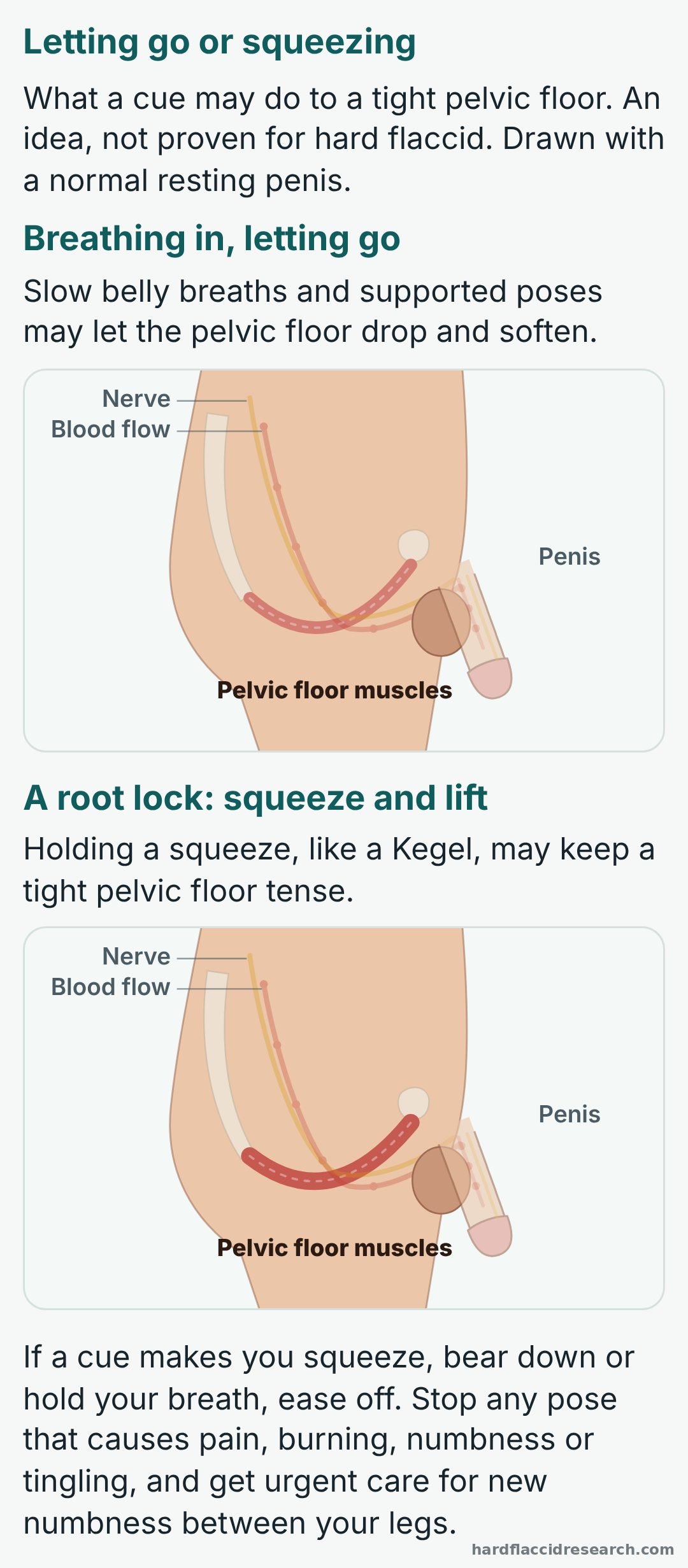
A picture to explain, not a diagnosis. Yoga isn't drawn: the picture shows the pelvic floor, a nerve, blood flow and the penis.
Why some yoga poses may help and others may hurt
Physios discuss a few reasons one pose may help a tense pelvic floor let go and another may not. These are ideas, not proven for hard flaccid syndrome:
- Lengthening or squeezing. Poses that open the hips and let the area between your legs soften may give the pelvic floor room to lengthen. Cues that squeeze it, or make you push down, may do the opposite.
- Breath. As you breathe in slowly, the pelvic floor drops a little along with your diaphragm, the dome-shaped muscle under your lungs. Holding your breath, or fast, forceful breathing, may keep it held up. Our article on breathing and the pelvic floor explains more.
- Bracing. Holding a hard pose can make many people tense their belly, buttocks and pelvic floor without noticing.
- Gravity. Lying down, the pelvic floor carries less of the weight of your belly and organs, which may be one reason physios often start there. In one March 2023 poll of men with hard flaccid, 86% said the hard flaccid state was harder when standing than lying down (54 of 63 men); it asked nothing about yoga.
- Pressure. Meditation and breathing practice are often done sitting on the floor. A long sit on a hard floor, especially leaning forward or sitting on your heels, may press on the area between your legs.
Related: Pelvic Floor & Hip Flexor Stretches for Men »
Yoga poses that may help hard flaccid
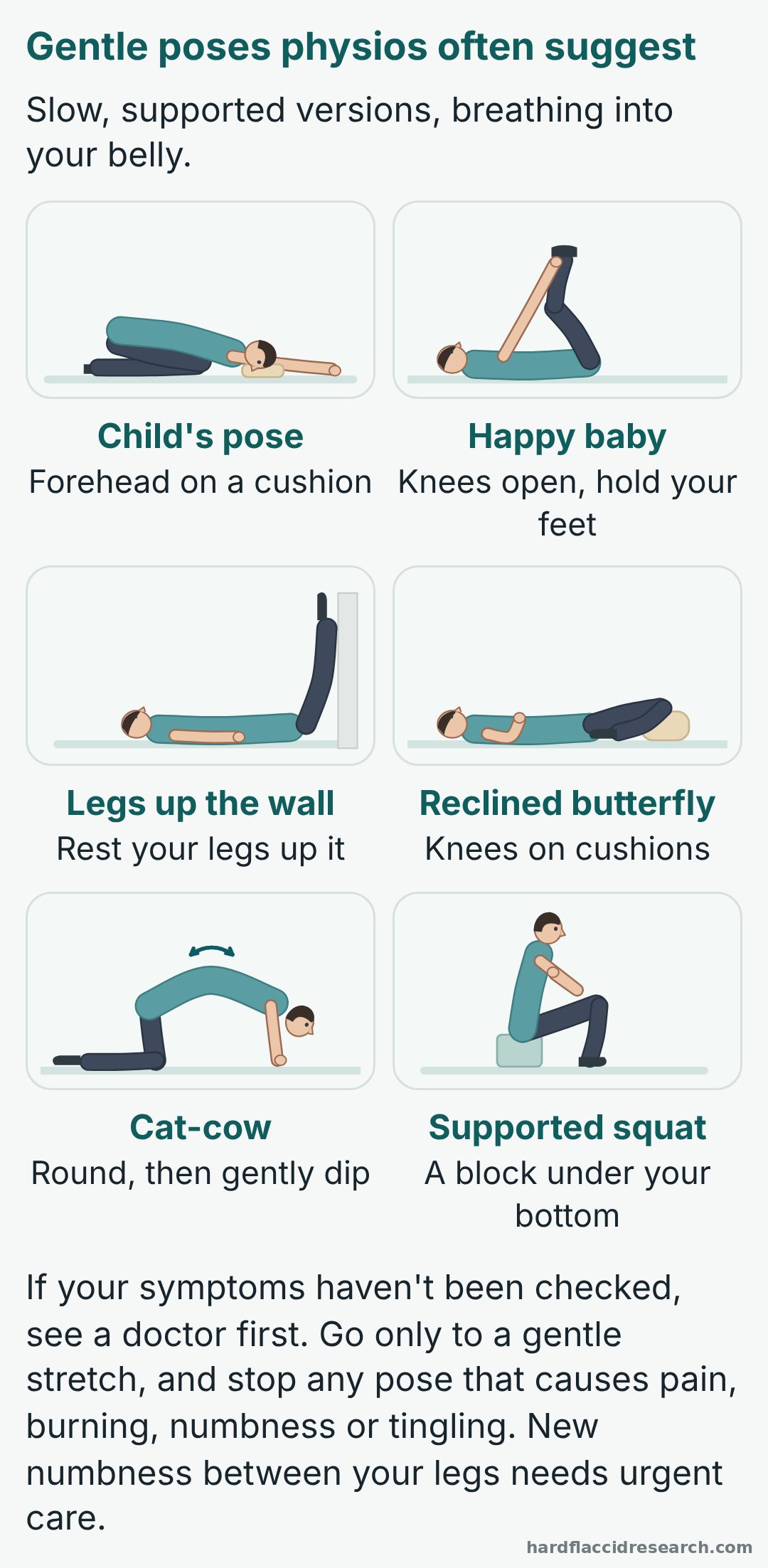
If your symptoms haven't been checked, see a doctor first. These are the kinds of poses physios often suggest for a tight pelvic floor. Choose slow, supported versions, breathe into your belly and let the area between your legs soften on each breath in:
- Child's pose and happy baby, both described step by step in our article on pelvic floor stretches.
- Legs up the wall: lie on your back close to a wall and rest your legs up it, with a folded blanket under your hips if that feels better.
- Reclined butterfly (supta baddha konasana): lie on your back with the soles of your feet together and let your knees fall out onto cushions.
- Cat-cow: on your hands and knees, slowly round your back, then let it gently dip, in time with your breath.
- Lying twist: on your back with your knees bent, let both knees fall slowly to one side, then the other.
- Reclined pigeon: lying on your back, rest one ankle across the opposite knee and ease the other thigh gently towards your chest. Some classes call it the figure-four stretch. It is a gentler version of pigeon pose, which can strain the knees and hips if you force it.
- Supported squat (malasana): sink into a squat with a yoga block or a low stool under your bottom. Skip it if your knees hurt.
- Corpse pose (savasana): at the end, lie still on your back and simply breathe.
Check with a doctor or physio before starting yoga if you have a back, hip or knee problem, have had recent surgery, or have glaucoma or high blood pressure: poses that put your head below your heart can raise the pressure in your eyes and head, and with glaucoma even legs up the wall can raise eye pressure. Hot yoga needs extra care if you have heart problems or low blood pressure. Go only to a gentle stretch, and stop any pose that causes pain, burning, numbness or tingling. If numbness between your legs is new, get urgent care (see the list below).
Our members' guide, The Hard Flaccid Stretch Plan, puts child's pose, happy baby and a supported squat into a stretching routine for tight hips, with a timer.
Poses and cues that may make hard flaccid worse
None of these is dangerous in itself, and a physio may bring some back later. But while your pelvic floor feels tight, physios often suggest easing off anything that makes you squeeze, bear down or hold your breath:
- The root lock. Some classes teach a 'root lock' (mula bandha): squeezing and lifting the pelvic floor and holding it, which is close to a Kegel. If your pelvic floor feels tight, skip it and ask a physio before doing any Kegels. A squeeze only gets stronger safely if you let go fully between squeezes.
- Core cues held all class. 'Engage your core', 'draw your navel to your spine' or 'lift your pelvic floor' can turn into bracing your belly and pelvic floor for an hour. Let your belly move as you breathe.
- Holding your breath, or breath of fire: fast, forceful breathing that pumps the belly in and out. Keep your breathing slow and easy.
- Long, hard holds. Plank, boat pose (balancing on your bottom with your legs raised) and long chair poses can make many people brace. Pilates moves that curl your head and shoulders up, like a crunch, can make you bear down.
- Heated classes, where warm muscles make it easy to push the splits or a hip opener much further than you would on a cool day.
- Long sitting on a hard floor, cross-legged or on your heels, for example in meditation. It may press on the area between your legs, especially if you lean forward, so sit on a folded blanket, a cushion or a chair.
Related: Hard Flaccid Recovery: What Men Who Got Better Did Most »
Hot yoga, yin, restorative and other styles
Classes vary a lot. For a tight pelvic floor, slower styles with props and rests are usually the gentler place to start:
- Restorative yoga: a few poses, lying or sitting, fully supported on cushions and blankets. It is about resting, not stretching hard.
- Gentle hatha and beginners' classes: slower, with time to rest and adjust.
- Yin yoga: floor poses held for a long time. It is slow, but long holds can pull a stretch further than you mean, so stay well short of a strong stretch and use props.
- Yoga nidra: a guided relaxation done lying down, with no poses at all. Small studies suggest it may help stress and sleep.
- Power, vinyasa and ashtanga yoga: fast-flowing, with many planks and hard holds, so there is more bracing.
- Hot yoga and Bikram yoga: done in a heated room. Besides making it easy to overstretch, the heat can cause dizziness, dehydration, heat exhaustion and, rarely, heatstroke. Drink water, rest when you need to, stop and cool down if you feel dizzy, sick or faint, and ask a doctor first if you have heart problems or low blood pressure, or have had a heat illness before.
Pilates vs yoga for a tight pelvic floor
Pilates is a slow, controlled exercise method built around core strength, often with cues to draw in your belly and lift your pelvic floor. That makes it closer to strengthening than relaxing, which may not suit a pelvic floor that already feels tight. Yoga can be gentler, but it depends on the class: a power class can mean more bracing than a gentle Pilates class.
Some men move on to Pilates or core work later, once their pelvic floor can let go fully. Separately, 361 men with hard flaccid syndrome discussed core, glute and posture strengthening, which overlaps with Pilates. A pelvic health physio can check your pelvic floor and tell you whether Pilates suits you for now; if a class asks you to lift your pelvic floor, let go fully between squeezes.
Yoga for stress and anxiety
Reviews of trials suggest yoga may ease stress and anxiety a little, and slow breathing and relaxation are often part of programmes for long-lasting pelvic pain in men. Hard flaccid syndrome can bring its own anxiety, and doctors think stress may tense the pelvic floor, though this isn't proven. Yoga nidra, slow breathing and corpse pose are the parts most about relaxing.
Separately, 916 men with hard flaccid wrote about anxiety and 603 discussed talking therapy, CBT, mindfulness or meditation. Yoga doesn't replace treatment for anxiety or low mood. If worry or low mood is taking over, talk to a GP.
If you are feeling hopeless or having thoughts of ending your life, please visit our Support page now. It lists crisis lines you can call or text today.
What men with hard flaccid report about yoga
Among the men with hard flaccid syndrome who discussed yoga or Pilates and also described their symptoms, 73% described the firm flaccid state, 57% weaker erections and 51% numbness, higher than among all men who described symptoms, perhaps partly because men who wrote more tended to describe more of every kind. That doesn't show what yoga does. Yoga or Pilates came up in 11 of the 126 recovery stories, and other approaches came up more often; a story mentioning something is not proof that it worked, and many men did several things at once. Separately, 216 men with hard flaccid asked which stretches or exercises help.
More men discussed the approaches yoga overlaps with, such as stretching, reverse Kegels and breathing exercises. Our article on how to do reverse Kegels shows how to add a gentle letting go, never a push, on each breath in.
How to choose a class and adapt it
Physios often start by teaching men to relax the pelvic floor with slow breathing, lying down, before adding poses. When you go to a class:
- Choose a slow class, such as gentle, restorative or beginners' yoga, rather than power, fast-flowing or heated classes.
- Tell the teacher you have a pelvic muscle problem and need to keep things gentle. You don't have to say more.
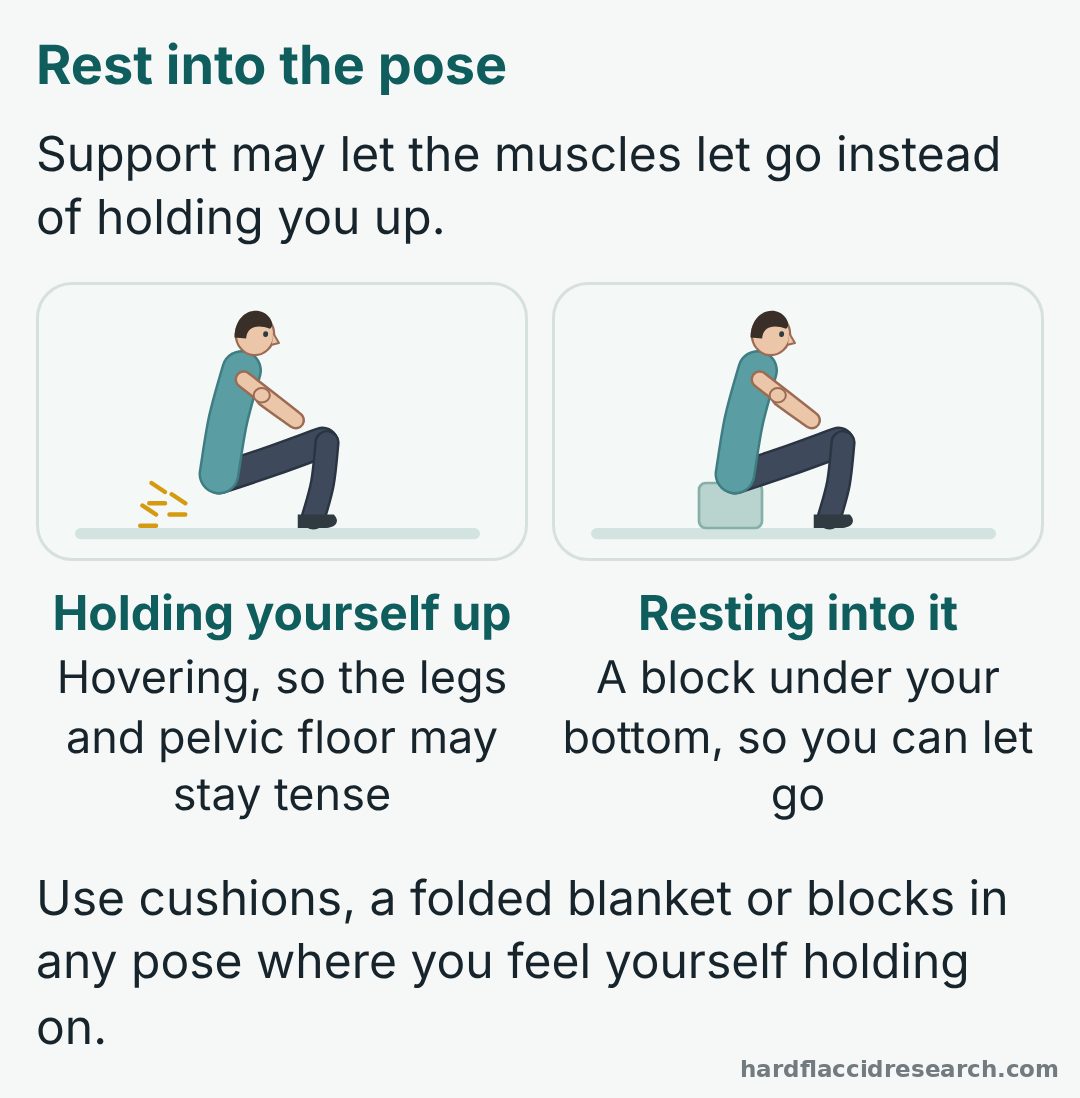
- Use a cushion, a folded blanket or blocks, so you can rest into a pose instead of holding yourself up.
- Breathe out as you move into a harder position, and rest in child's pose while the class holds a hard pose.
- Notice how you feel later that day and the next morning. If you're more clenched or sore, change something.
A pelvic health physio can check your pelvic floor and tell you which poses suit you. Separately, in one November 2022 poll of men with hard flaccid syndrome who had seen a pelvic floor physio, 36% said it helped quite a bit or cured them (17 of 47 men); it asked nothing about yoga.
Common questions
Is yoga safe with hard flaccid? Gentle yoga is generally low risk. Stop any pose that causes pain, burning, numbness or tingling. If numbness between your legs is new, get urgent care (see the list below); otherwise, see a doctor if pain or tingling doesn't settle.
Is mula bandha the same as a Kegel? It is very close: both squeeze and lift the pelvic floor. If your pelvic floor feels tight, skip it and ask a physio before doing either, and if you do squeeze, let go fully between squeezes.
Can yoga help erectile dysfunction? There is very little research on yoga for erection problems. A few small studies, mostly in men who come too quickly, suggest yoga may help a little, but they were not well controlled, and none was in men with hard flaccid syndrome. If your erections have changed, see a doctor and ask about a blood sugar (HbA1c) and cholesterol test.
Is yoga good for men? Yoga can build flexibility and balance and may ease stress, and men of any fitness level can start with a gentle class. With a tight pelvic floor, the style of class matters more than how flexible you are.
How often should I do yoga for a tight pelvic floor? There's no proven amount. Physios often suggest short, gentle sessions most days rather than one long, hard class, and noticing how you feel the next day.
Should I stretch or strengthen? While the pelvic floor feels tight, physios usually start with relaxing and gentle stretching, and add strengthening later if it is needed, always letting go fully between squeezes. A physio can check which you need.
Can I do yoga from videos at home? Yes, if you choose gentle or restorative ones and skip the root lock, breath-holding and long, hard holds.
When to see a doctor
Yoga doesn't replace a check-up. See a doctor if your symptoms haven't been checked, or if a pose brings on pain or tingling that doesn't settle. If numbness between your legs is new, get urgent care (see the list below). Pain, urinary or bowel problems and erection changes can have other causes that need treatment.
If you've had numbness between your legs for a while, or pain that's clearly worse when you sit, ask a doctor to check your nerves, including the pudendal nerve. Take your doctor visit kit, with a note of which poses seem to make things better or worse.
Get urgent care straight away if you have:
- Chest pain, fainting, or feeling confused or very unwell during or after exercise, including in the heat of a hot yoga class.
- Sudden, severe pain in the penis, testicles or pelvis.
- New numbness around your back passage, genitals or inner thighs, or new weakness in your legs.
- New trouble starting or controlling your pee, not being able to pee, or not feeling when your bladder is full.
- Loss of control of your bladder or bowel.
- A fever or chills with pelvic pain or pain when peeing.
What to do next
- See a GP if your symptoms haven't been checked, and ask about a referral to a pelvic health physio.
- Take our self-check to see how your symptoms compare.
- Try two or three of the gentle poses above for a few minutes, breathing slowly into your belly.
- In a class, skip the root lock, breath-holding and long, hard holds for now.
- Track your symptoms for a few weeks to see whether yoga changes anything for you.
- Add your experience, so the next man has better numbers than we do.
Free tools that can help
- Self-check: do I have hard flaccid?Compare your symptoms with what 6,026 men report.
- Doctor visit kitA one-page summary to take to your appointment.
- Habit trackerCount your days without porn or masturbation, and get through urges.
- Diaphragm breathing toolBreathe with a moving picture of your diaphragm and pelvic floor.
- Add your experienceTell us what you tried and how it went. No name needed.
- Hard Flaccid Syndrome CensusWhat men answered in 818 polls.
- Symptom trackerLog your symptoms and see what helps you.
- Ask us a questionThe questions men ask most become new articles.
The numbers behind this article
Every number in this article comes from what men with hard flaccid syndrome shared between December 2020 and October 2026, counted once per person, or from their polls. These are self-selected reports, not a clinical study. See hard flaccid syndrome statistics, the Hard Flaccid Syndrome Census and how we count.
In what men with hard flaccid syndrome wrote, 23% described pelvic floor tightness, spasm or twitching
Share of the 2,661 men with hard flaccid syndrome who described their symptoms. Each man is counted once in each bar.Counts from what men wrote run lower than poll answers, because men weren't asked. The link between a tight pelvic floor and hard flaccid syndrome isn't proven.
Source: Hard Flaccid Research, hardflaccidresearch.com
202 men with hard flaccid syndrome discussed yoga or Pilates, and more discussed the approaches it overlaps with
Number of men with hard flaccid syndrome who discussed each, counted once per person. Discussed is not the same as worked.The groups overlap, and yoga and Pilates are counted together. If your pelvic floor feels tight, ask a physio before doing Kegels, and let go fully between squeezes.
Source: Hard Flaccid Research, hardflaccidresearch.com
What the 601 men with hard flaccid syndrome who described pelvic floor tightness discussed
Share of the 601 men with pelvic floor tightness who discussed each of these four approaches. Other approaches came up too.Discussing something is not the same as it working. If your pelvic floor feels tight, ask a physio before doing Kegels, and let go fully between squeezes.
Source: Hard Flaccid Research, hardflaccidresearch.com
Yoga or Pilates came up in 11 of the 126 hard flaccid syndrome recovery stories
Share of the 126 stories from men with hard flaccid syndrome who got better that mention yoga or Pilates.A story mentioning something is not proof that it worked, other approaches came up more often, and many men did several things at once.
Source: Hard Flaccid Research, hardflaccidresearch.com
In one poll, 86% of men with hard flaccid syndrome said it was harder when standing than lying down (54 of 63 men)
Each bar is from a separate poll of men with hard flaccid syndrome, with its own date and number of men.Neither poll asked about yoga. These are self-selected reports, not a clinical study.
Source: Hard Flaccid Research, hardflaccidresearch.com
916 men with hard flaccid syndrome wrote about anxiety, and 603 discussed talking therapy, CBT, mindfulness or meditation
Number of men with hard flaccid syndrome who wrote about each, counted once per person.Hard flaccid syndrome can bring its own anxiety. Yoga doesn't replace treatment for anxiety or low mood; if worry or low mood is taking over, talk to a GP.
Source: Hard Flaccid Research, hardflaccidresearch.com
216 men with hard flaccid syndrome asked which stretches or exercises help
Number of men with hard flaccid syndrome who asked each question, counted once per person.The groups overlap: one man can ask more than one question.
Source: Hard Flaccid Research, hardflaccidresearch.com
Every number in this article, with its source
| In this article | Source |
|---|---|
| 6,026 men shared their experiences; 2,661 described their symptoms | Research data, December 2020 to October 2026 |
| 202 men discussed yoga or Pilates | 202 men, counted from what men wrote, once per person |
| Among the men who discussed yoga or Pilates and also described their symptoms: 73% firm flaccid state, 57% weaker erections, 51% numbness | 202 men discussing yoga or Pilates, counted from what men wrote, once per person; shares are of those who also described their symptoms |
| Yoga or Pilates came up in 11 of 126 recovery stories | 11 of 126 recovery stories, counted from what men wrote |
| 126 recovery stories | 126 men, counted from what men wrote, once per person |
| 23% described pelvic floor tightness, spasm or twitching (601 of 2,661) | 601 of 2,661 men, counted from what men wrote, once per person |
| 10% described pelvic, perineal or tailbone pain (267 of 2,661) | 267 of 2,661 men, counted from what men wrote, once per person |
| 9% described lower back, hip or hamstring tightness (233 of 2,661) | 233 of 2,661 men, counted from what men wrote, once per person |
| 35% described weaker or lost erections (926 of 2,661) | 926 of 2,661 men, counted from what men wrote, once per person |
| 86% said it was harder when standing than lying down (54 of 63 men) | 54 of 63 men, poll, Mar 2023 |
| 36% said physio helped quite a bit or cured them (17 of 47 men) | 17 of 47 men, poll, Nov 2022 |
| 1,288 men discussed stretching | 1,288 men, counted from what men wrote, once per person |
| 846 men discussed Kegels | 846 men, counted from what men wrote, once per person |
| 704 men discussed reverse Kegels and pelvic floor relaxation | 704 men, counted from what men wrote, once per person |
| 656 men discussed pelvic floor physio | 656 men, counted from what men wrote, once per person |
| 425 men discussed breathing exercises | 425 men, counted from what men wrote, once per person |
| 361 men discussed core, glute and posture strengthening | 361 men, counted from what men wrote, once per person |
| Among men with pelvic floor tightness: stretching 64%, Kegels 48%, pelvic floor physio 45%, reverse Kegels 41% | 601 men with pelvic floor tightness, counted from what men wrote, once per person |
| 916 men wrote about anxiety | 916 men who wrote about anxiety, research data |
| 550 men wrote about low mood or depression | 550 men who wrote about low mood or depression, research data |
| 603 men discussed talking therapy, CBT, mindfulness or meditation | 603 men, counted from what men wrote, once per person |
| 216 men asked which stretches or exercises help | Question group, 216 men, research data |
| 118 men asked whether to do Kegels or reverse Kegels | Question group, 118 men, research data |
| 63 men asked whether posture or pelvic tilt causes it | Question group, 63 men, research data |
| 45 men asked whether sitting makes it worse | Question group, 45 men, research data |
How we made this article
We started from the question many men asked. Every number was checked against our data. Our editorial team edited it and Dr. Julian Reyes reviewed it medically. Read our editorial policy.
Read next
See more of us on Google
Add Hard Flaccid Research as a preferred source, and Google shows you our pages more often when you search.
Add as a preferred sourceDon't see your question? Ask us. We answer the most-asked ones in new articles.
Cite and share this article
You're welcome to quote this article. Please name Hard Flaccid Research and link to this page, so others can find the full answer and the data behind it. To cite this page, use its link.
Citation
Hard Flaccid Research. (2026). Yoga for Hard Flaccid: The Poses That Help vs Hurt. Written by the Editorial Team, medically reviewed by Dr. Julian Reyes. https://hardflaccidresearch.com/articles/yoga-hard-flaccid
Credit link for your article
Source: <a href="https://hardflaccidresearch.com/articles/yoga-hard-flaccid">Hard Flaccid Research</a>
Wikipedia reference
<ref>{{cite web |url=https://hardflaccidresearch.com/articles/yoga-hard-flaccid |title=Yoga for Hard Flaccid: The Poses That Help vs Hurt |website=Hard Flaccid Research |date=2026 |access-date=28 October 2026}}</ref>
How the data was collected: our methodology. Journalists and researchers: key numbers, data and contact.