Hard Flaccid Syndrome Treatment: What Men Tried and What Helped
In short
- There is no proven treatment for hard flaccid syndrome yet, and no single approach works for everyone.
- The approaches men mentioned most were stretching, tadalafil, Kegels, a break from sex and masturbation, and reverse Kegels, and the ones that came up most in 126 recovery stories were stretching and rest.
- Procedures such as Botox and nerve surgery barely appear in those stories.
There is no proven treatment for hard flaccid syndrome yet, and no single approach works for everyone. Most men who improve combine a few things over months or years: helping a tight pelvic floor relax, stretching, a break from whatever made it worse, and help for anxiety, with a doctor checking for other causes first.
Since December 2020 we have counted what 6,026 men shared about hard flaccid, once per person. This page sets out the approaches men discussed, what came up in 126 recovery stories, and what men said in our polls about the treatments they used.
By the numbers: between December 2020 and October 2026, 6,026 men shared their experiences with us, and 126 of them shared a story of getting better. Men also cast 43,067 votes in our 818 polls.
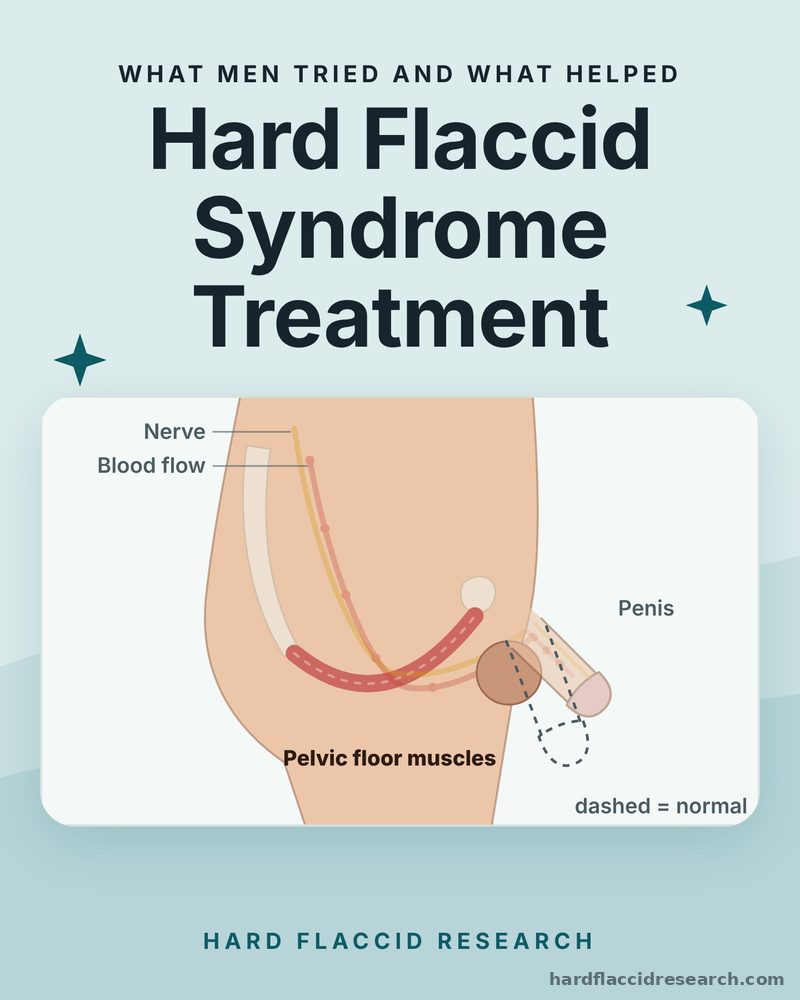
Is there a cure for hard flaccid syndrome?
Not a proven one. Nobody has tested hard flaccid syndrome treatments in proper clinical trials yet. Some men do get better: in a June 2023 poll, 42% said they were at least half better than when it started (56 of 132 men), and 3% said they were fully healed (4 of 132 men).
Be wary of anyone who promises a cure, especially for an expensive procedure. Our article on what men who got better did goes through what came up most in their stories.
Hard Flaccid Explorerby Hard Flaccid Research
How hard flaccid treatment may work
A 7-minute animated explainer of this article. Press play, or skip between chapters. The first minute is free for everyone.
A picture to explain, not a diagnosis. Nothing here is proven, and a doctor should check you first.
How hard flaccid syndrome treatment usually works
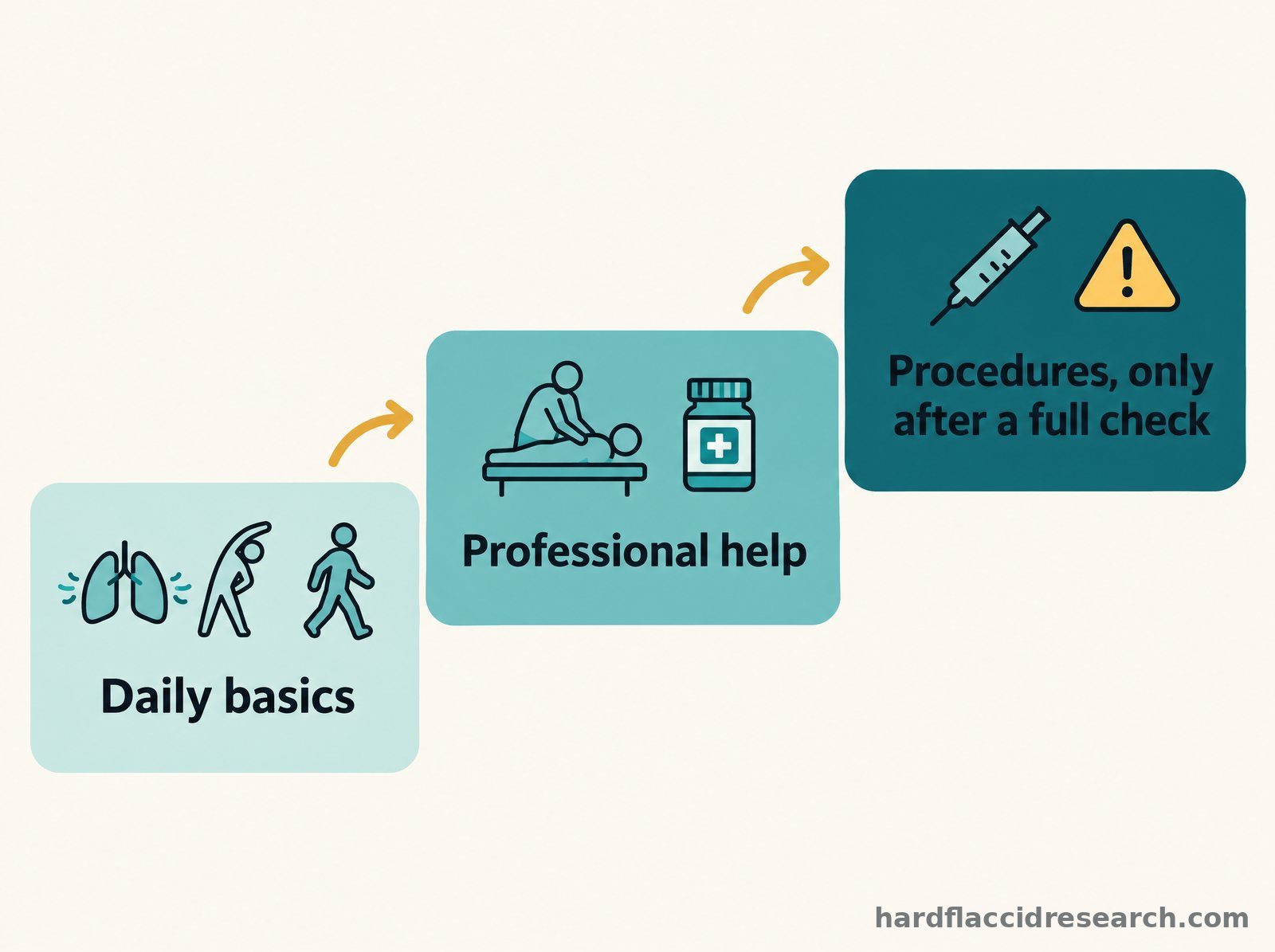
Because there is no single cure, many men build a plan in steps, starting with what is cheap and low-risk. Doctors and pelvic health physios often suggest something like this:
- Get checked first, so a doctor can look for other conditions that need different treatment.
- Start the basics at home: belly breathing, reverse Kegels, gentle stretching, daily walks, and a break from anything that seems to make it worse.
- See a pelvic health physio, who can check how tight your pelvic floor is and show you how to help it relax.
- If symptoms don't settle, a doctor may discuss medicines for specific problems, such as weaker erections or nerve pain.
- Leave procedures until last, after a full assessment and ideally a second opinion.
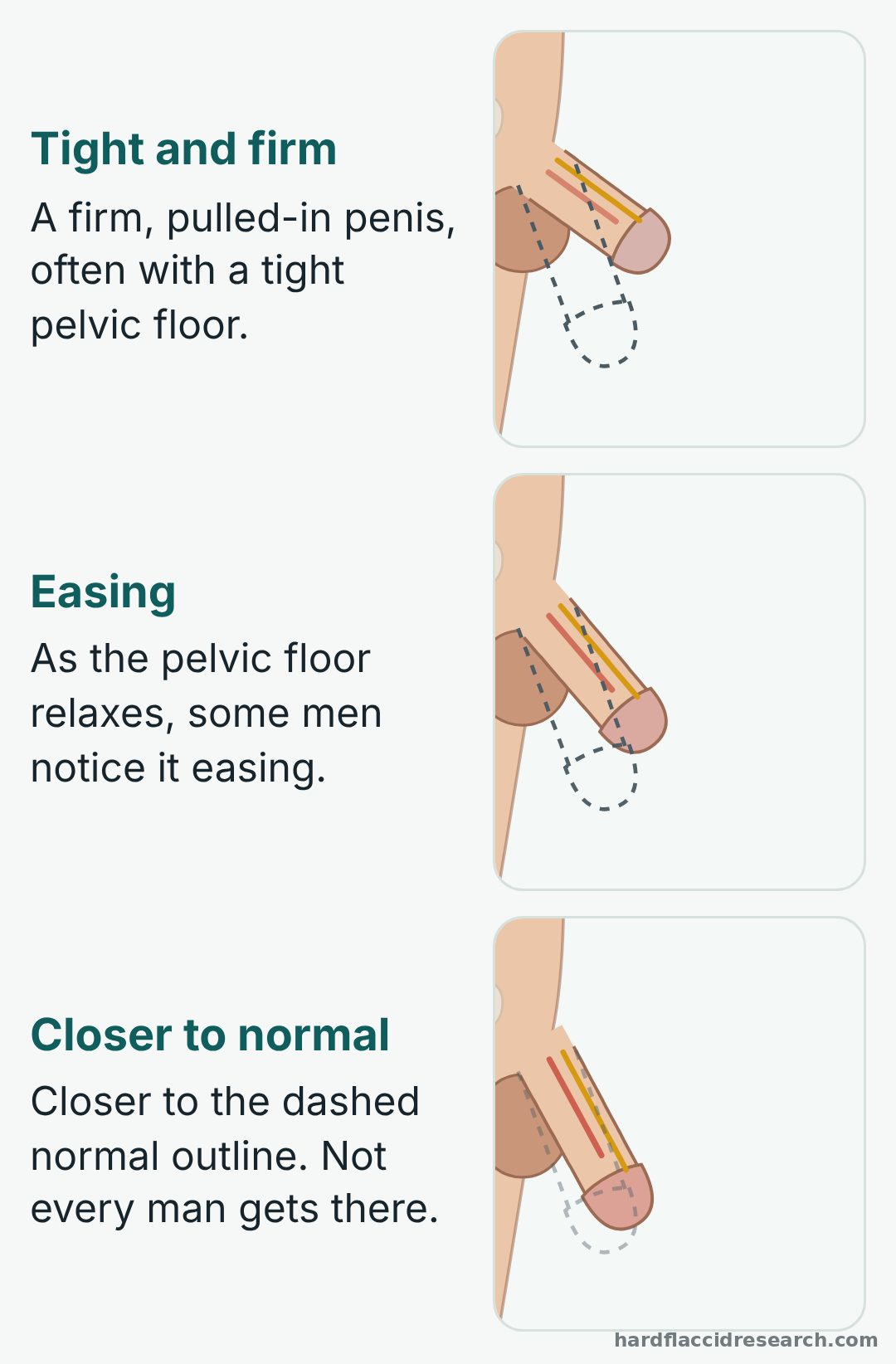
Many men who got better did several of these at once. Much of it comes back to one idea many doctors and physios share: helping a tight pelvic floor let go. This isn't proven yet.
Related: Hard Flaccid Recovery: What Men Who Got Better Did Most »
What men with hard flaccid syndrome tried most
The approaches men mentioned most were:
- Stretching the hips, hamstrings and inner thighs: 1,288 men.
- Tadalafil (Cialis): 969 men.
- Kegels: 846 men.
- Rest or abstinence, a break from sex, masturbation and porn: 779 men.
- Reverse Kegels and pelvic floor relaxation: 704 men.
- Pelvic floor physio: 656 men.
- Supplements: 624 men.
- Talking therapy, CBT, mindfulness or meditation: 603 men.
Being mentioned is not the same as working. Men mention what they tried, whether it helped or not.
What came up in 126 recovery stories
We have 126 recovery stories from men who say they got better. Most did several things at once. The approaches mentioned most were stretching (40 of 126), rest or abstinence (28 of 126), tadalafil (20 of 126), reverse Kegels (20 of 126), Kegels (19 of 126) and breathing exercises (16 of 126).
Pelvic floor physio, talking therapy or mindfulness, and core and glute strengthening each came up in 15 of 126, and diet or weight loss in 14 of 126.
These stories tell us what men did while they got better, not what caused it. Some men may have got better with time alone. Stress and anxiety can keep the pelvic floor clenched, and help for the mind came up in recovery stories too.
Related: Is Hard Flaccid Permanent? What 126 Recovery Stories Show »
What men said helped in our polls
Polls asked men who had tried a treatment whether it helped. The groups are small and self-selected, so treat these as signals, not proof.
- Tadalafil: 76% said it helped at least a bit (34 of 45 men, June 2023), and 20% said it helped a lot (9 of 45 men).
- A break from masturbation: 51% said it improved their hard flaccid syndrome at least some (39 of 77 men, June 2023).
- Anti-inflammatories: 56% noticed at least a small improvement (18 of 32 men, February 2023).
- Alpha blockers: 45% said they helped significantly or somewhat (22 of 49 men, May 2023), and 55% said they didn't help (27 of 49 men).
- Pelvic floor physio: 36% said it helped quite a bit or cured them (17 of 47 men, November 2022).
- Weight loss: 23% said losing weight improved their symptoms (20 of 86 men, March 2023).
Pelvic floor treatments
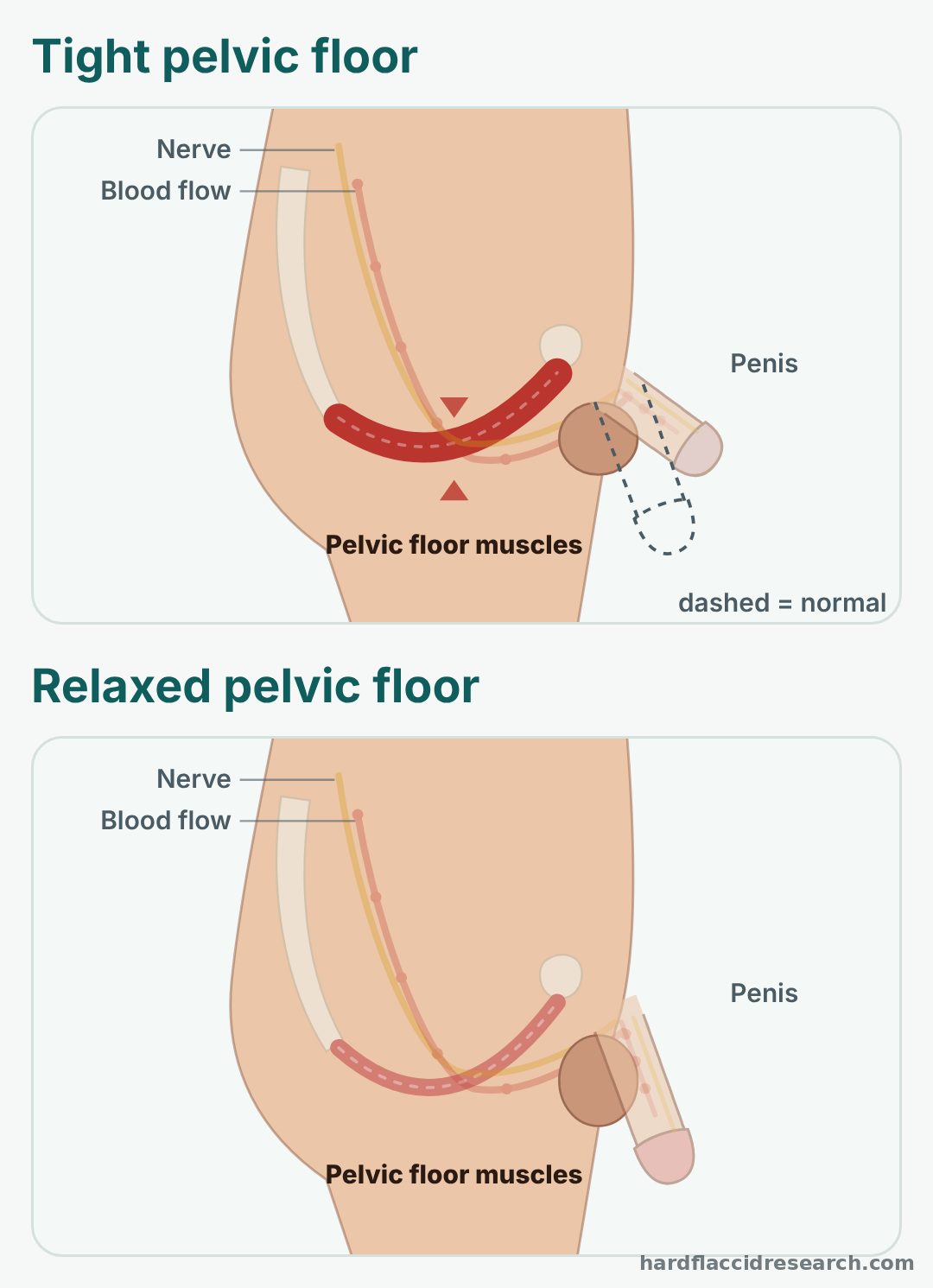
Many men with hard flaccid syndrome say their pelvic floor feels tight, so a physio often focuses on relaxing those muscles rather than strengthening them. The pelvic floor is the sling of muscles between your legs that supports your bladder and bowel and helps control erections.
Relaxation usually means diaphragmatic breathing, reverse Kegels and gentle stretching, done daily. Our article on how to do reverse Kegels shows the steps, and our article on a tight pelvic floor in men covers the signs.
Kegels strengthen and tighten. They came up often, but many physios advise men with a tight pelvic floor to pause them until the muscles can relax. If your pelvic floor feels tight, ask a physio before doing them. If you do them, let the muscles go fully between squeezes.
A physio may also use hands-on release to ease tight, tender spots in the muscles, and may teach you to do some of it yourself. Massage or release was mentioned by 481 men.
Breathing can help too. Physios teach that slow belly breathing lets the pelvic floor drop a little with each breath in, and 425 men mentioned breathing exercises.
Medicines doctors may suggest
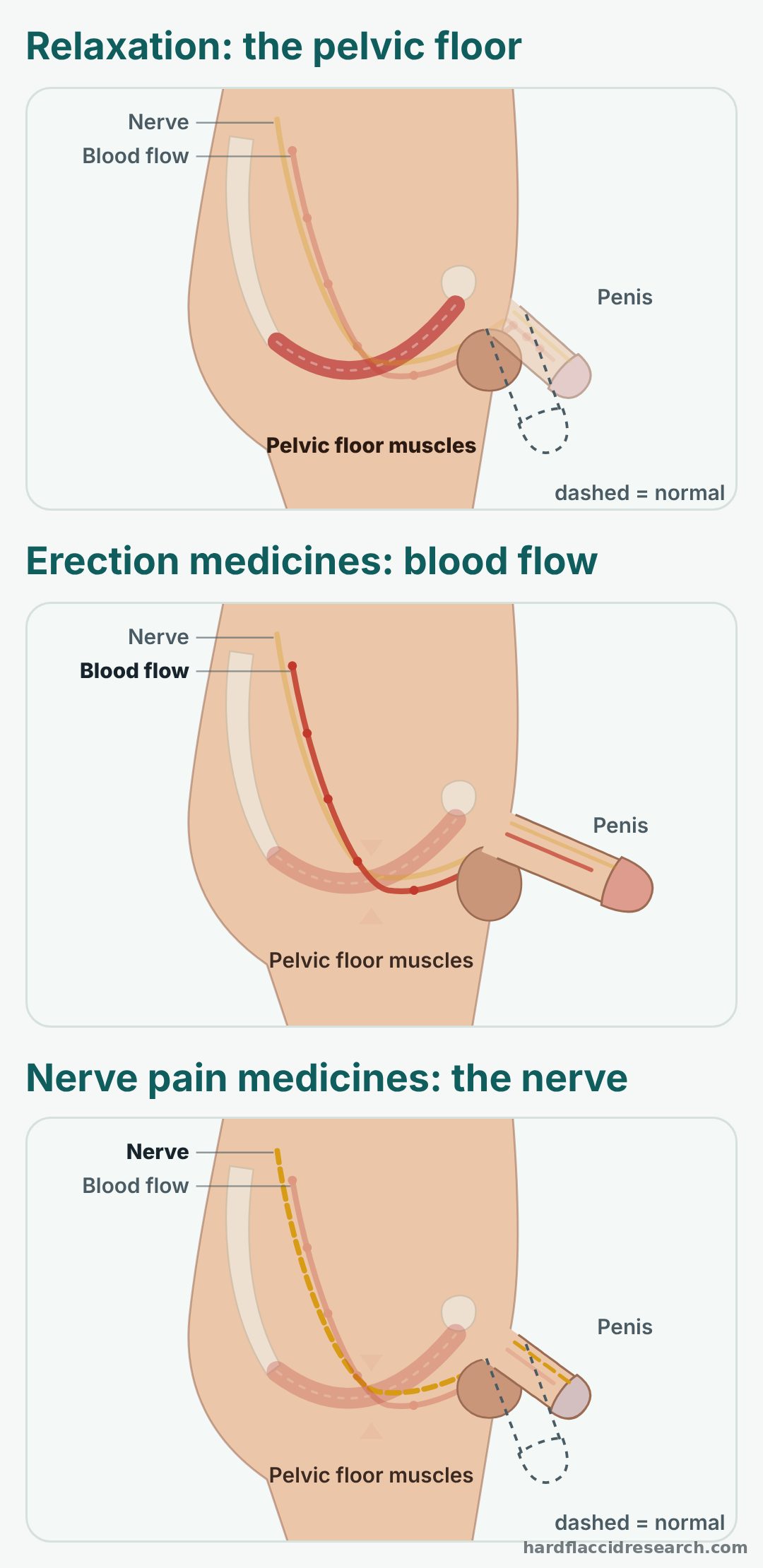
No medicine is approved for hard flaccid syndrome, but doctors sometimes try medicines used for related problems:
- Tadalafil (969 men) or sildenafil and similar medicines (381 men). These erection medicines relax the smooth muscle in the penis and help the arteries open, so more blood can flow in during arousal. They don't relax the pelvic floor.
- Alpha blockers such as tamsulosin (378 men). They relax the muscle where the bladder meets the prostate, so peeing may be easier. They don't treat inflammation or relax the pelvic floor.
- Antidepressants or anti-anxiety medicines (236 men).
- Muscle relaxants (174 men), and nerve pain medicines such as gabapentin or amitriptyline (122 men). Irritated nerves may cause numbness, burning or pain, and some doctors try nerve pain medicines for the burning or pain.
Talk to a doctor first. Tadalafil and similar medicines are prescription drugs, and they are not safe for everyone with heart or blood pressure problems. Never take them with nitrate medicines for chest pain or with poppers, because together they can drop your blood pressure dangerously. If you get chest pain, tell the ambulance crew or doctor which medicine you've taken, and when: nitrate medicines must not be given within 24 hours of a sildenafil dose, or within 48 hours of a tadalafil dose. Side effects such as headache usually ease within a day or two. Alpha blockers can make you dizzy, especially when you stand up, and can mean less or no semen when you ejaculate. Taken with tadalafil or a similar medicine, they can drop your blood pressure too far. Nerve pain medicines can cause drowsiness and dependence. Antidepressants can have sexual side effects, and stopping one suddenly can cause withdrawal symptoms. Some anti-anxiety medicines and muscle relaxants, such as diazepam, can cause drowsiness and dependence, and are dangerous with alcohol or opioid painkillers. Only a doctor who knows your health can say if a medicine is right for you. Never start, stop or change a medicine on your own, and don't buy them online without a prescription.
Procedures: think twice before you pay
Procedures are expensive and some carry real risks. They also barely appear in recovery stories:
- Shockwave therapy: 303 men mentioned it, and it came up in 4 of 126 recovery stories.
- Nerve blocks: 246 men, and 3 of 126 recovery stories.
- Vein procedures: 112 men, and 2 of 126 recovery stories.
- PRP injections: 106 men, and 2 of 126 recovery stories.
- Botox: 137 men, and none of the 126 recovery stories.
- Pudendal nerve decompression surgery: 82 men, and none of the 126 recovery stories.
That doesn't prove they never help. It does mean there is very little to go on, so get a full assessment and ideally a second opinion first.
Lifestyle changes men made
Everyday changes came up a lot, and they are cheap and low-risk. Walking or other cardio was mentioned by 483 men and came up in 12 of 126 recovery stories. Diet or weight loss was mentioned by 391 men, core and glute strengthening by 361 men, and yoga or pilates by 202 men, which came up in 11 of 126 stories.
Heat also helps some men relax: 230 men mentioned warm baths or sitz baths.
How long does hard flaccid treatment take?
It is often slow. Of the 126 recovery stories, 15 said how long the man had had hard flaccid syndrome before things improved, and the middle value was 3 years. The shortest was 2 months and the longest 7 years (84 months).
That is only 15 men, and only men who got better, so treat it as a rough guide, not a promise. Some men say they noticed small changes long before they felt better overall, which is one reason a symptom tracker helps.
What to be careful with
- Anyone promising a cure, especially for an expensive procedure or a programme you pay for up front.
- Kegels, if your pelvic floor feels tight. Ask a physio first.
- Supplements. They were mentioned by 624 men, but they aren't checked like medicines, and some carry real risks: ashwagandha has been linked to liver problems, and saw palmetto can affect hormones. Tell your doctor about everything you take.
- Medicines bought online without a prescription, which may not contain what the label says.
- Anything that seems to have started your symptoms, such as an enlargement device or very rough masturbation. Stop it while you get checked.
Common questions about hard flaccid syndrome treatment
Can hard flaccid syndrome be cured? There is no proven cure yet, but some men do get better.
Does Cialis (tadalafil) help hard flaccid? Some men say it helps. It is an erection medicine: it helps blood flow in during arousal, but it doesn't relax a tight pelvic floor. It isn't safe for everyone, and it must never be taken with nitrate medicines for chest pain or with poppers, so talk to a doctor first.
Does shockwave therapy work for hard flaccid? We don't know yet: nobody has tested it in hard flaccid. In chronic pelvic pain in men it is one of the better-tested treatments, with trials finding less pain for up to about three months. Shockwave therapy was mentioned by 303 men, and it came up in 4 of the 126 recovery stories.
Is surgery an option? There is very little to go on. Pudendal nerve surgery came up in none of the 126 recovery stories, and surgery carries real risks. A specialist may discuss it if they find a clear cause it can treat, such as a trapped pudendal nerve, so get a full assessment and a second opinion first.
Should I stop masturbating? Many men say their symptoms are worse afterwards, so they take a break. In one poll, 51% of men who tried a break from masturbation said it improved their hard flaccid at least some (39 of 77 men, June 2023).
Do I need a pelvic floor physio? Not every man does. A physio can check whether your pelvic floor is tight and show you how to help it relax, and in one poll 36% of men who had seen one said it helped quite a bit or cured them (17 of 47 men).
When to see a doctor
See a doctor before you start any treatment if you haven't been checked. Hard flaccid syndrome symptoms can overlap with other conditions, such as prostate problems, Peyronie's disease, nerve problems in the back and blood vessel disease, and some of these need different treatment.
Many men find it hard to be taken seriously, so prepare well: our doctor visit kit helps. Your GP is a good place to start, and a pelvic health physio can also help. In a November 2022 poll of men who had seen a urologist, 95% called their visits bad and unhelpful (63 of 66 men), which is a reason to prepare, not to skip the visit.
Get urgent care straight away if you have:
- An erection lasting more than 4 hours, especially after taking a medicine.
- Chest pain, fainting, or sudden loss of sight or hearing after taking an erection medicine.
- Sudden, severe pain in the penis, testicles or pelvis.
- New numbness around your back passage, genitals or inner thighs, or new weakness in your legs.
- New trouble starting or controlling your pee, not being able to pee, or not feeling when your bladder is full.
- Loss of control of your bladder or bowel.
- A fever or chills with pelvic pain or pain when peeing.
If you are feeling hopeless or having thoughts of ending your life, please visit our Support page now. It lists crisis lines you can call or text.
What to do next
- Get checked by your GP, and ask about a referral to a pelvic health physiotherapist.
- Start with the cheap, low-risk basics: belly breathing, reverse Kegels, gentle stretching and daily walks.
- Take a break from anything that seems to make it worse.
- Track your symptoms so you can tell what helps you.
- Use our doctor visit kit before you discuss medicines or procedures.
Our members' guide, Hard Flaccid Treatments: Read This Before You Pay, goes through each treatment, what it does, and the questions to ask before you spend money.
Free tools that can help
- Self-check: do I have hard flaccid?Compare your symptoms with what 6,026 men report.
- Doctor visit kitA one-page summary to take to your appointment.
- Habit trackerCount your days without porn or masturbation, and get through urges.
- Diaphragm breathing toolBreathe with a moving picture of your diaphragm and pelvic floor.
- Add your experienceTell us what you tried and how it went. No name needed.
- Hard Flaccid Syndrome CensusWhat men answered in 818 polls.
- Symptom trackerLog your symptoms and see what helps you.
- Ask us a questionThe questions men ask most become new articles.
The numbers behind this article
Every number in this article comes from what men with hard flaccid syndrome shared between December 2020 and October 2026, counted once per person, or from their polls. These are self-selected reports, not a clinical study. See hard flaccid syndrome statistics, the Hard Flaccid Syndrome Census and how we count.
What men with hard flaccid syndrome tried most
Number of men who mentioned each approach, counted once per person, December 2020 to October 2026.Being mentioned is not the same as working.
Source: Hard Flaccid Research, hardflaccidresearch.com
What came up most in 126 recovery stories
Share of the 126 men who shared a story of getting better who mentioned each approach.Source: Hard Flaccid Research, hardflaccidresearch.com
Did it help? What men who tried each one said
Each bar is a separate poll of men with hard flaccid syndrome who had tried that treatment, with its own number of men.Being mentioned is not the same as working.
Source: Hard Flaccid Research, hardflaccidresearch.com
Pelvic floor approaches men mentioned
Number of men who mentioned each, counted once per person.Source: Hard Flaccid Research, hardflaccidresearch.com
Medicines men mentioned
Number of men who mentioned each, counted once per person.Source: Hard Flaccid Research, hardflaccidresearch.com
Procedures: how many men mentioned them
Number of men who mentioned each, counted once per person.Source: Hard Flaccid Research, hardflaccidresearch.com
Procedures in 126 recovery stories
Share of the 126 men who shared a story of getting better who mentioned each procedure.Source: Hard Flaccid Research, hardflaccidresearch.com
Everyday changes men made
Number of men who mentioned each, counted once per person.Source: Hard Flaccid Research, hardflaccidresearch.com
How long the men who got better had hard flaccid syndrome
The 15 recovery stories that said how long the man had had hard flaccid syndrome before things improved.Middle value 3 years; shortest 2 months, longest 7 years (84 months). Only men who got better are counted.
Source: Hard Flaccid Research, hardflaccidresearch.com
How men are doing
June 2023 poll of 132 men with hard flaccid syndrome, and a November 2022 poll of 66 men who had seen a urologist.Source: Hard Flaccid Research, hardflaccidresearch.com
Every number in this article, with its source
| In this article | Source |
|---|---|
| 6,026 men shared their experiences | 6,026 men, counted from what men wrote, once per person |
| 126 recovery stories | 126 men, counted from what men wrote, once per person |
| 42% at least half better (56 of 132 men) | 56 of 132 men, poll, Jun 2023 |
| 3% fully healed (4 of 132 men) | 4 of 132 men, poll, Jun 2023 |
| 1,288 men mentioned stretching | 1,288 men, counted from what men wrote, once per person |
| 969 men mentioned tadalafil | 969 men, counted from what men wrote, once per person |
| 846 men mentioned Kegels | 846 men, counted from what men wrote, once per person |
| 779 men mentioned rest or abstinence | 779 men, counted from what men wrote, once per person |
| 704 men mentioned reverse Kegels and pelvic floor relaxation | 704 men, counted from what men wrote, once per person |
| 656 men mentioned pelvic floor physio | 656 men, counted from what men wrote, once per person |
| 624 men mentioned supplements | 624 men, counted from what men wrote, once per person |
| 603 men mentioned talking therapy, CBT, mindfulness or meditation | 603 men, counted from what men wrote, once per person |
| Stretching came up in 40 of 126 recovery stories | 40 of 126 recovery stories |
| Rest or abstinence came up in 28 of 126 recovery stories | 28 of 126 recovery stories |
| Tadalafil came up in 20 of 126 recovery stories | 20 of 126 recovery stories |
| Reverse Kegels came up in 20 of 126 recovery stories | 20 of 126 recovery stories |
| Kegels came up in 19 of 126 recovery stories | 19 of 126 recovery stories |
| Breathing exercises came up in 16 of 126 recovery stories | 16 of 126 recovery stories |
| Physio, talking therapy, and core and glute strengthening each came up in 15 of 126 recovery stories | 15 of 126 recovery stories |
| Diet or weight loss came up in 14 of 126 recovery stories | 14 of 126 recovery stories |
| 76% said tadalafil helped at least a bit (34 of 45 men) | 34 of 45 men, poll, Jun 2023 |
| 20% said tadalafil helped a lot (9 of 45 men) | 9 of 45 men, poll, Jun 2023 |
| 51% said a break from masturbation improved their hard flaccid syndrome at least some (39 of 77 men) | 39 of 77 men, poll, Jun 2023 |
| 56% noticed at least a small improvement with anti-inflammatories (18 of 32 men) | 18 of 32 men, poll, Feb 2023 |
| 45% said alpha blockers helped significantly or somewhat (22 of 49 men) | 22 of 49 men, poll, May 2023 |
| 55% said alpha blockers didn't help (27 of 49 men) | 27 of 49 men, poll, May 2023 |
| 36% said physio helped quite a bit or cured them (17 of 47 men) | 17 of 47 men, poll, Nov 2022 |
| 23% said weight loss improved their symptoms (20 of 86 men) | 20 of 86 men, poll, Mar 2023 |
| 381 men mentioned sildenafil or a similar medicine | 381 men, counted from what men wrote, once per person |
| 378 men mentioned alpha blockers | 378 men, counted from what men wrote, once per person |
| 236 men mentioned antidepressants or anti-anxiety medicines | 236 men, counted from what men wrote, once per person |
| 174 men mentioned muscle relaxants | 174 men, counted from what men wrote, once per person |
| 122 men mentioned nerve pain medicines | 122 men, counted from what men wrote, once per person |
| 303 men mentioned shockwave therapy | 303 men, counted from what men wrote, once per person |
| Shockwave therapy came up in 4 of 126 recovery stories | 4 of 126 recovery stories |
| 246 men mentioned nerve blocks | 246 men, counted from what men wrote, once per person |
| Nerve blocks came up in 3 of 126 recovery stories | 3 of 126 recovery stories |
| 112 men mentioned vein procedures | 112 men, counted from what men wrote, once per person |
| 106 men mentioned PRP injections | 106 men, counted from what men wrote, once per person |
| Vein procedures and PRP each came up in 2 of 126 recovery stories | 2 of 126 recovery stories |
| 137 men mentioned Botox | 137 men, counted from what men wrote, once per person |
| 82 men mentioned pudendal nerve decompression surgery | 82 men, counted from what men wrote, once per person |
| Botox and pudendal nerve surgery came up in 0 of 126 recovery stories | 0 of 126 recovery stories |
| 483 men mentioned walking or cardio | 483 men, counted from what men wrote, once per person |
| Walking or cardio came up in 12 of 126 recovery stories | 12 of 126 recovery stories |
| 391 men mentioned diet or weight loss | 391 men, counted from what men wrote, once per person |
| 361 men mentioned core and glute strengthening | 361 men, counted from what men wrote, once per person |
| 202 men mentioned yoga or pilates | 202 men, counted from what men wrote, once per person |
| Yoga or pilates came up in 11 of 126 recovery stories | 11 of 126 recovery stories |
| 230 men mentioned warm baths or sitz baths | 230 men, counted from what men wrote, once per person |
| 95% called urologist visits bad and unhelpful (63 of 66 men) | 63 of 66 men, poll, Nov 2022 |
| Counting since December 2020 | Research data, December 2020 to October 2026 |
| 43,067 votes in 818 polls | Research data, December 2020 to October 2026 |
| 481 men mentioned massage or release | 481 men, counted from what men wrote, once per person |
| 425 men mentioned breathing exercises | 425 men, counted from what men wrote, once per person |
| 15 of 126 recovery stories said how long | 15 of 126 recovery stories said how long |
| Under a year: 3 of 15 | 3 of 15 recovery stories that said how long, under 1 year |
| One to two years: 2 of 15 | 2 of 15 recovery stories that said how long, 1 to 2 years |
| Two to three years: 2 of 15 | 2 of 15 recovery stories that said how long, 2 to 3 years |
| Three years or more: 8 of 15 | 8 of 15 recovery stories that said how long, 3 years or more |
| The middle value was 3 years | Median of 15 recovery stories that said how long, 3 years |
| Shortest 2 months, longest 7 years (84 months) | Range of 15 recovery stories that said how long, 2 to 84 months |
How we made this article
We started from the question many men asked. Every number was checked against our data. Our editorial team edited it and Dr. Julian Reyes reviewed it medically. Read our editorial policy.
Read next
See more of us on Google
Add Hard Flaccid Research as a preferred source, and Google shows you our pages more often when you search.
Add as a preferred sourceDon't see your question? Ask us. We answer the most-asked ones in new articles.
Cite and share this article
You're welcome to quote this article. Please name Hard Flaccid Research and link to this page, so others can find the full answer and the data behind it. To cite this page, use its link.
Citation
Hard Flaccid Research. (2026). Hard Flaccid Syndrome Treatment: What Men Tried and What Helped. Written by the Editorial Team, medically reviewed by Dr. Julian Reyes. https://hardflaccidresearch.com/articles/how-to-treat-hard-flaccid
Credit link for your article
Source: <a href="https://hardflaccidresearch.com/articles/how-to-treat-hard-flaccid">Hard Flaccid Research</a>
Wikipedia reference
<ref>{{cite web |url=https://hardflaccidresearch.com/articles/how-to-treat-hard-flaccid |title=Hard Flaccid Syndrome Treatment: What Men Tried and What Helped |website=Hard Flaccid Research |date=2026 |access-date=28 October 2026}}</ref>
How the data was collected: our methodology. Journalists and researchers: key numbers, data and contact.