Pelvic Floor Twitching With Hard Flaccid: What It Means
In short
- Pelvic floor twitching, flickering or brief spasms between the legs are something men with hard flaccid syndrome describe: 601 men with hard flaccid syndrome described pelvic floor tightness, spasm or twitching.
- Brief muscle twitches that come and go, called fasciculations, are common in anyone and usually harmless, and in hard flaccid one idea, not yet studied, is that they come from tight, tired pelvic floor muscles.
- Twitching that spreads, or comes with weakness or nerve pain, needs a doctor, and new numbness between the legs or new weakness in the legs needs urgent care.
Pelvic floor twitching is a flicker, flutter or brief jumping feeling in the muscles between your legs: in the perineum (the area between the scrotum and the back passage), around the back passage, or at the base of the penis. Some men with hard flaccid syndrome, where the penis stays firm, rubbery or shrunken when it should be soft, notice it, and many worry it means a nerve is damaged. Brief muscle twitches that come and go, which doctors call fasciculations, are common in anyone and usually harmless. In hard flaccid, one idea is that they come from tight, tired pelvic floor muscles, though this hasn't been studied. Twitching that spreads, or comes with weakness or nerve pain, needs a doctor, and new numbness between your legs or new weakness in your legs needs urgent care.
601 men with hard flaccid described pelvic floor tightness, spasm or twitching. This page explains what pelvic floor twitching and spasms feel like, how normal muscle twitching differs from signs worth a check, why the pelvic floor may twitch with hard flaccid, what may calm it in the moment, what treatment for a pelvic floor spasm involves, and when to see a doctor.
By the numbers: of the 6,026 men with hard flaccid who shared their experiences between December 2020 and October 2026, 2,661 described their symptoms, and 23% of them described pelvic floor tightness, spasm or twitching (601 of 2,661). Counts from what men wrote run lower than poll answers, because men weren't asked. These are men with hard flaccid, not men in general.

What pelvic floor twitching feels like
Men describe pelvic floor twitching in different ways:
- A quick flicker or flutter that comes and goes, a bit like an eyelid twitch.
- A brief jump or pulse at the base of the penis, often when sitting still or lying in bed.
- A spasm: a short, cramp-like tightening between the legs or around the back passage.
- A buzzing or crawling feeling is more likely a nerve sensation than a twitch; see the nerve signs below.
In what men with hard flaccid syndrome wrote, twitching is counted together with tightness and spasm, in the 601 men above. We don't have numbers on twitching on its own yet.
Many of the 601 men described other hard flaccid symptoms too: the firm flaccid state (66%), weaker erections (49%), numbness (45%), shrinkage (40%) and bowel symptoms (28%). Men who described one symptom tended to describe more of every kind, so this doesn't show that twitching causes the others. These are self-selected reports, not a clinical study.
Hard Flaccid Explorerby Hard Flaccid Research
Why the pelvic floor may twitch
A 7-minute animated explainer of this article. Press play, or skip between chapters. The first minute is free for everyone.
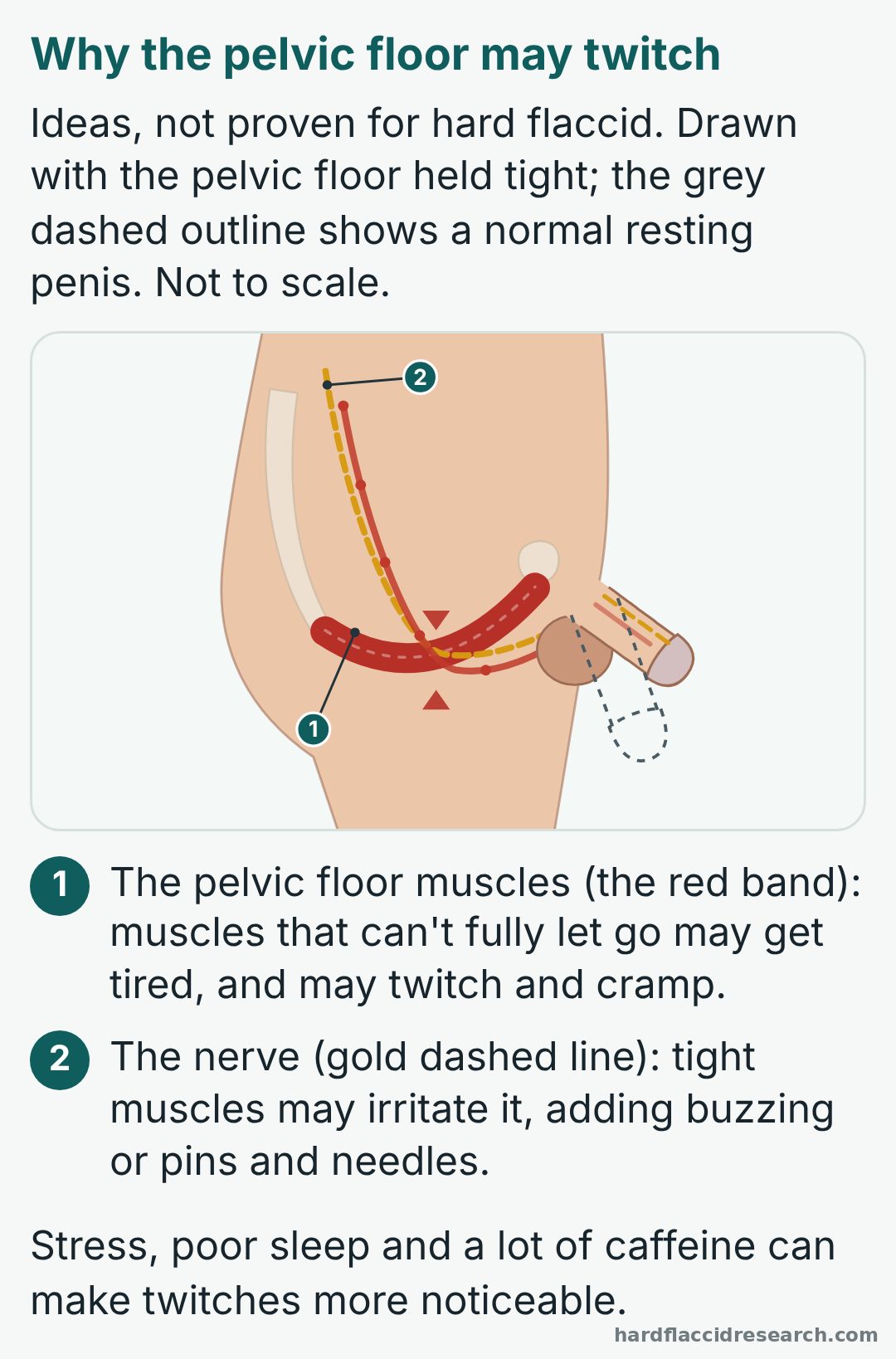
A picture to explain, not a diagnosis. Twitching itself isn't drawn: the picture shows the pelvic floor, a nerve and blood flow.
Muscle twitching and fasciculations: what is normal
Many people get muscle twitches from time to time: an eyelid that flickers, a calf that jumps after a run, a thumb that pulses for a few seconds. Doctors call these small, visible flickers fasciculations. They happen when a few muscle fibres fire on their own, and on their own they are usually harmless.
Twitches tend to come more often with:
- Stress, worry and poor sleep.
- A lot of caffeine, energy drinks, alcohol or nicotine.
- Hard exercise, tiredness, or an overworked muscle.
- Some medicines, such as stimulant medicines and water tablets (diuretics). If you think a medicine is causing twitches, keep taking it and ask your doctor or pharmacist: stopping some medicines suddenly can be dangerous.
- Low levels of some minerals, such as magnesium, calcium or potassium, which a blood test can check.
When twitches keep coming back for a long time, in one or more muscles, with no other problem found, doctors sometimes call it benign fasciculation syndrome. "Benign" means it isn't a sign of a serious disease. Twitching is worth a doctor's check when it comes with weakness, muscles that look thinner, trouble swallowing or speaking, or when it keeps spreading. Twitching without weakness is very rarely a sign of a nerve or muscle disease.
Related: Your Breathing May Be Keeping Your Hard Flaccid Tight »
Pelvic floor spasm symptoms
A pelvic floor spasm is the muscles between your legs tightening hard and not letting go for a while. It can cause:
- A deep ache or cramp in the perineum, around the back passage or at the base of the penis.
- Pain that is worse when sitting, or a feeling of sitting on a ball.
- Pain during or after ejaculation.
- Peeing more often, a slow start, or a feeling of not emptying fully. These can have other causes, so see a doctor soon, and if trouble starting your pee is new, get urgent care (see below).
- Straining to open your bowels, or feeling you haven't finished.
- A sudden, sharp cramp in the back passage that fades within minutes has its own name, proctalgia fugax. It is usually harmless, but it's worth mentioning to a doctor the first time.
A longer, dull ache or pressure high in the back passage, lasting half an hour or more and often worse when sitting, is sometimes called levator ani syndrome, after the levator ani, the main group of pelvic floor muscles. Perineum pain has other causes too, such as prostatitis, a pinched or irritated pudendal nerve, an anal fissure, piles or an abscess, long hours cycling or sitting, or an infection, so new pain there is worth a doctor's check.
In what men with hard flaccid syndrome wrote, 267 men described pelvic, perineal or tailbone pain (10% of 2,661) and 391 described bowel symptoms (15% of 2,661). Of the 267 with pelvic, perineal or tailbone pain, 45% also described pelvic floor tightness, spasm or twitching, and of the 391 with bowel symptoms, 43%. Men who described one symptom tended to describe more of every kind, so this doesn't show that a tight pelvic floor causes pain or bowel symptoms. Separately, 232 men with hard flaccid asked why there is pain, and 90 asked why it is worse around bowel movements.
Why the pelvic floor may twitch with hard flaccid
These are ideas doctors and pelvic health physios discuss. None is proven for hard flaccid syndrome:
- Muscles that can't fully let go. Hard flaccid is often linked to a tight pelvic floor, though this isn't proven. A muscle that stays partly clenched may get tired, and tired muscles may twitch and cramp more easily, a bit like a calf muscle after a long run.
- An irritated nerve. One idea is that tight muscles may irritate the pudendal nerve, the main nerve of the genitals and pelvic floor, which may add flickering, buzzing or pins and needles.
- A nervous system on alert. When you're worried, the small twitches everyone has can feel bigger and harder to ignore.
Things that may make pelvic floor twitching more noticeable:
- Stress and anxiety. Hard flaccid often brings anxiety, and separately, 916 men with hard flaccid wrote about anxiety. Tense, worried days may leave muscles tense and twitchy.
- Poor sleep, and a lot of caffeine or energy drinks.
- Hard exercise, heavy lifting while holding your breath, or long hours sitting.
- Squeezing, prodding or checking the area many times a day, which may keep the muscles switched on.
- Clenching, including Kegels done when the pelvic floor is already tight.
In one April 2023 poll of men with hard flaccid, 76% said they had anxiety before hard flaccid began (94 of 123 men), though that doesn't show that anxiety caused it, and the poll asked nothing about twitching.
Related: Hard Flaccid Flare-Up? Why It Gets Worse and How to Calm It »
Is pelvic floor twitching a sign of nerve damage?
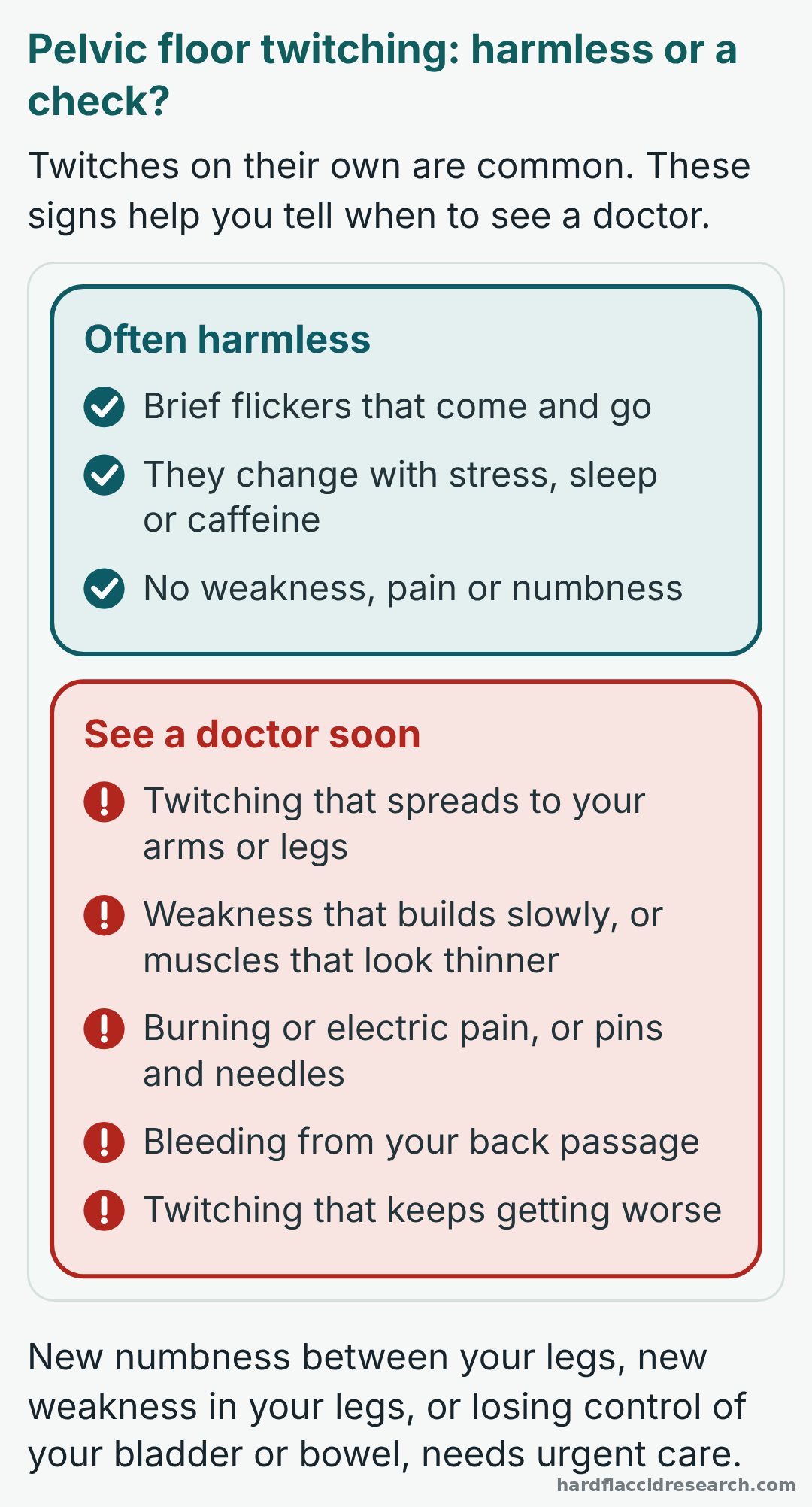
On its own, usually not, though only a doctor can check your nerves. Brief twitches that come and go, change with stress and sleep, and don't come with weakness are common in any muscle, in people with and without hard flaccid syndrome. Doctors call them fasciculations.
Separately, 100 men with hard flaccid asked whether their hard flaccid is a nerve problem, such as the pudendal nerve. Signs that point more towards an irritated nerve, and are worth a doctor's check, are:
- burning, shooting or electric pain, or pins and needles
- pain or numbness that's clearly worse when you sit
- numbness between your legs that's been there a while
Our article on pudendal nerve entrapment goes through these signs. Rarely, twitching that spreads across the body and comes with muscle weakness can be a sign of a nerve or muscle condition, which is why spreading twitches need a doctor (see below).
What may calm the twitching
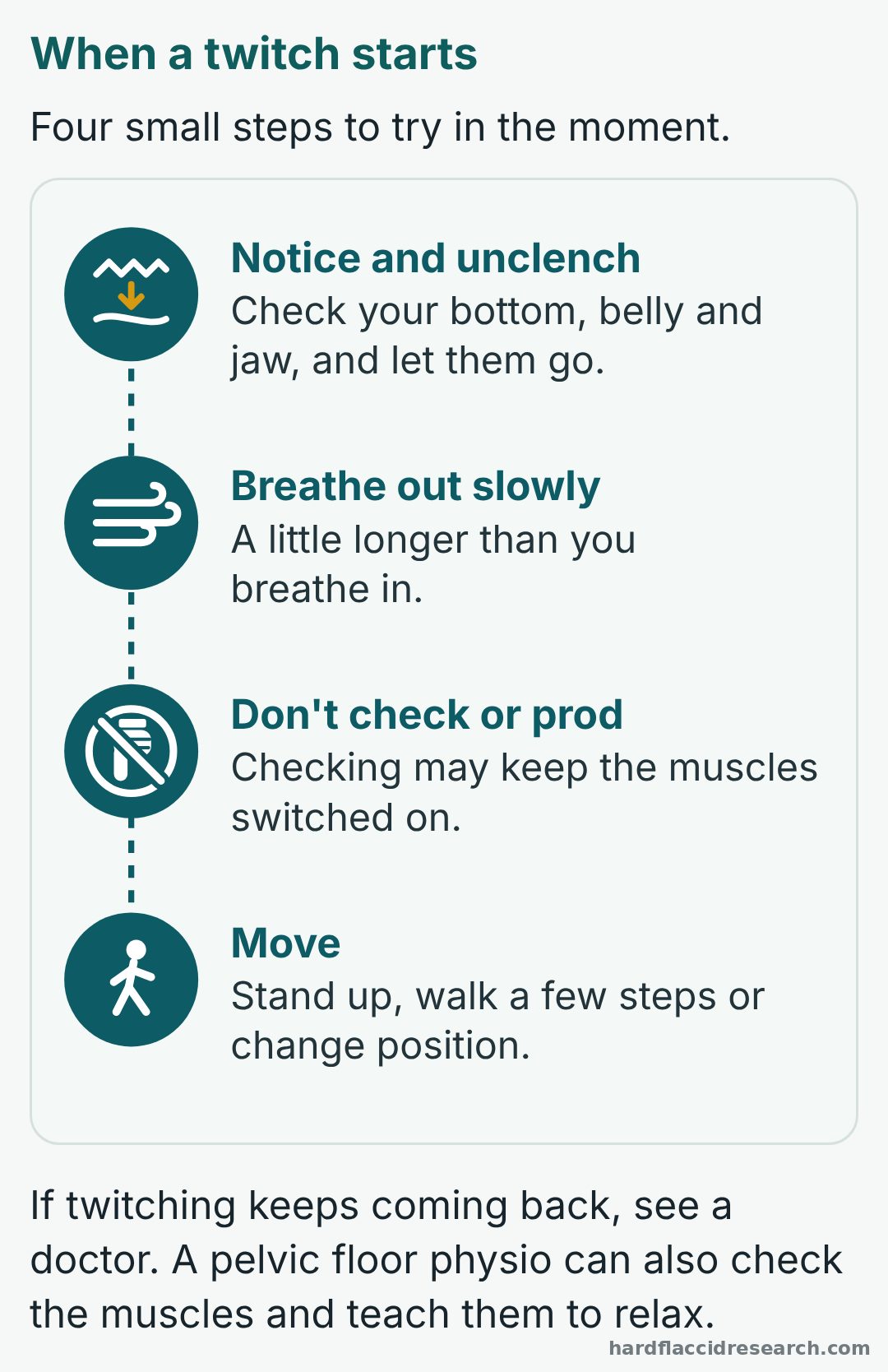
Harmless twitching usually needs no treatment of its own, so the aim is to help a tight pelvic floor let go and your nervous system settle. When a twitch starts, try this in the moment:
- Notice it, and check whether you're clenching your bottom, belly or jaw.
- Let go there, and breathe out slowly, a little longer than you breathe in.
- Don't check, prod or squeeze the area. Checking may keep the muscles switched on and your attention locked on every flicker.
- Move: stand up, walk a few steps, or change position if you've been sitting.
Warmth may help too: a warm bath or a heat pack on the lower belly, not too hot, and never on numb skin or while you sleep. If your pelvic floor feels tight, pause strengthening Kegels and ask a physio before going back to them. If you do them later, let go fully between squeezes.
With time, the same things that may help a tight pelvic floor may also make twitches less frequent: slow belly breathing, the gentle letting go of a reverse Kegel (never a push), regular breaks from sitting, and cutting back on caffeine.
Our members' guide, Hard Flaccid Pelvic Floor Reset: Why Kegels May Backfire, goes through a daily routine to help a tight pelvic floor let go, step by step.
Pelvic floor spasm treatment
If twitching or spasms keep coming back, see a doctor first if your symptoms haven't been checked. A pelvic floor physio can check how the muscles work and teach them to relax, with breathing, gentle stretches, hands-on release of tight spots, and sometimes biofeedback, a sensor on the skin or inside the back passage that shows the muscle working on a screen. A physio should explain each step and ask before any hands-on or internal work. US urology guidelines for long-lasting pelvic pain in men say doctors may offer hands-on pelvic floor physio when these muscles are tender or painful, a conditional recommendation. Our article on pelvic floor therapy for men explains what to expect.
In one November 2022 poll of men with hard flaccid syndrome who had seen a pelvic floor physio, 36% said it helped quite a bit or cured them (17 of 47 men). In one February 2023 poll of men with hard flaccid who had seen one, 38% said it dramatically helped (24 of 64 men). Neither poll asked about twitching, and these are self-selected reports, not a clinical study. Separately, 41 men with hard flaccid asked whether pelvic floor physio helps.
Separately, men with hard flaccid discussed many self-help and hands-on approaches: 704 discussed reverse Kegels or pelvic floor relaxation, 656 pelvic floor physio, 481 massage, myofascial release or trigger point work, 425 breathing exercises and 230 heat or warm baths (warm, not hot, and never on numb skin or while you sleep). Other approaches came up too. These counts are for hard flaccid in general, not twitching, and discussing something is not the same as it working.
Magnesium is often suggested for twitches, but there is little evidence that it helps unless a blood test shows you are low, and it can cause diarrhoea, build up to harmful levels if your kidneys don't work well, and stop some antibiotics working. Separately, 624 men with hard flaccid discussed supplements, a group that includes magnesium, and 40 asked whether supplements help; these counts don't show how many discussed magnesium itself. Doctors sometimes discuss a muscle relaxant for spasms: these relax muscles all over the body, not just the pelvic floor, can cause drowsiness and dependence, and are dangerous with alcohol or opioid painkillers, and there's no good evidence they help hard flaccid. Separately, 174 men with hard flaccid discussed muscle relaxants.
Talk to a doctor first. Ask your doctor or pharmacist before taking any supplement or medicine for twitching or spasms, and tell them about everything you already take. Magnesium can cause diarrhoea, can build up to harmful levels if your kidneys don't work well, and can stop some antibiotics and other medicines working properly. Muscle relaxants are prescription medicines: they can cause drowsiness and dependence, are dangerous with alcohol, opioid painkillers or sleeping tablets, and some must never be stopped suddenly. Never take someone else's, and never buy them online, where pills can contain other, stronger drugs. If you think a medicine you take, such as a stimulant or a water tablet, is causing twitches, keep taking it and ask, because stopping some medicines suddenly can be dangerous. Never start, stop or change a medicine on your own.
Common questions about pelvic floor twitching
Is it normal for the pelvic floor to twitch? Brief twitches that come and go are common in any muscle, and the pelvic floor is a muscle too. If they come with pain or weakness, or keep getting worse, see a doctor. New numbness between your legs or new weakness in your legs needs urgent care.
Why does my perineum twitch when I sit? Long or slumped sitting, or a hard seat, may load the pelvic floor and the nerves running through it, and may leave the muscles tense. Standing up, moving and changing position may ease it. If sitting brings burning pain, or you've had numbness between your legs for a while, ask a doctor to check your nerves, including the pudendal nerve. New numbness there needs urgent care. Separately, 45 men with hard flaccid syndrome asked whether sitting makes it worse.
Can anxiety cause muscle twitching? Stress and anxiety can make twitches more frequent and much more noticeable, and worrying about a twitch can keep attention on it. That doesn't mean the twitch is imagined.
Does magnesium help muscle twitching? There's little evidence that it does unless you are low in it, which a blood test can check. Too much can cause diarrhoea or build up to harmful levels if your kidneys don't work well, and it can stop some antibiotics working, so ask a doctor or pharmacist first.
Should I do Kegels if my pelvic floor twitches? If your pelvic floor feels tight, pause strengthening Kegels and ask a pelvic health physio first. If you do them later, let go fully between squeezes. Separately, 118 men with hard flaccid asked whether they should do Kegels or reverse Kegels.
Is pelvic floor twitching a sign of ALS? Twitching without weakness is very rarely a sign of motor neurone disease (ALS). Doctors look for weakness, muscles getting thinner, or trouble speaking or swallowing. If you have any of those, see a doctor soon. New weakness in your legs needs urgent care.
When to see a doctor
See a doctor soon, rather than waiting, if pelvic floor twitching or spasm:
- spreads to other parts of your body, such as your arms or legs
- comes with muscle weakness that builds slowly, muscles that look thinner, or cramps elsewhere (new weakness in your legs needs urgent care: see below)
- comes with burning or electric pain, pins and needles, or numbness between your legs that's been there a while, so they can check your nerves, including the pudendal nerve
- comes with bleeding from your back passage or a change in your bowel habit
- is steadily getting worse, or stops you sleeping or working
- doesn't settle after a couple of weeks, or keeps coming back
- comes with pain in the perineum, pelvis or back passage, pain when peeing or ejaculating, or changes in how you pee
- started after a new medicine (don't stop it on your own: ask your doctor or pharmacist)
A doctor will usually ask where and when the twitching happens, and check your muscle strength, reflexes and feeling in your legs and between your legs. Nerve tests, such as an EMG, are usually only needed if these checks point there. Take your doctor visit kit, with a note of when the twitching happens and what makes it worse.
Get urgent care straight away if you have:
- Sudden, severe pain in the penis, testicles or pelvis.
- New numbness around your back passage, genitals or inner thighs, or new weakness in your legs.
- New trouble starting or controlling your pee, not being able to pee, or not feeling when your bladder is full.
- Loss of control of your bladder or bowel.
- A fever or chills with pelvic pain or pain when peeing.
What to do next
- If your symptoms haven't been checked, see a doctor first, because they can have other causes.
- Take our self-check to see how your symptoms compare.
- For a week, note when the twitching happens: after sitting, exercise, caffeine, poor sleep or a stressful day.
- Next time a twitch starts, unclench, breathe out slowly and move, instead of checking.
- Ask your GP about a referral to a pelvic health physio.
- Add your experience, so the next man has better numbers than we do.
Free tools that can help
- Self-check: do I have hard flaccid?Compare your symptoms with what 6,026 men report.
- Doctor visit kitA one-page summary to take to your appointment.
- Habit trackerCount your days without porn or masturbation, and get through urges.
- Diaphragm breathing toolBreathe with a moving picture of your diaphragm and pelvic floor.
- Add your experienceTell us what you tried and how it went. No name needed.
- Hard Flaccid Syndrome CensusWhat men answered in 818 polls.
- Symptom trackerLog your symptoms and see what helps you.
- Ask us a questionThe questions men ask most become new articles.
The numbers behind this article
Every number in this article comes from what men with hard flaccid syndrome shared between December 2020 and October 2026, counted once per person, or from their polls. These are self-selected reports, not a clinical study. See hard flaccid syndrome statistics, the Hard Flaccid Syndrome Census and how we count.
In what men with hard flaccid syndrome wrote, 23% described pelvic floor tightness, spasm or twitching
Share of the 2,661 men with hard flaccid syndrome who described their symptoms. Each man is counted once in each bar.Twitching is counted together with tightness and spasm. Counts from what men wrote run lower than poll answers, because men weren't asked.
Source: Hard Flaccid Research, hardflaccidresearch.com
Of the 601 men with hard flaccid syndrome who described pelvic floor tightness, spasm or twitching, 66% also described the firm flaccid state
Share of the 601 men who also described each symptom. Each man is counted once in each bar.Men who described one symptom tended to describe more of every kind, so this doesn't show that twitching causes the others.
Source: Hard Flaccid Research, hardflaccidresearch.com
Of the 267 men with hard flaccid syndrome who described pelvic, perineal or tailbone pain, 45% also described pelvic floor tightness, spasm or twitching
Share of each group of men with hard flaccid syndrome who also described pelvic floor tightness, spasm or twitching.The groups overlap. Men who described one symptom tended to describe more of every kind, so this doesn't show what causes what.
Source: Hard Flaccid Research, hardflaccidresearch.com
916 men with hard flaccid syndrome wrote about anxiety, and 704 discussed reverse Kegels or pelvic floor relaxation
Number of men with hard flaccid syndrome in each group, counted once per person. Seven bars are question groups. The approaches are for hard flaccid syndrome in general, not twitching.The groups overlap. Other approaches came up too. Discussing something is not the same as it working. Muscle relaxants can cause drowsiness and dependence, and magnesium can build up if your kidneys don't work well; never start, stop or change a medicine on your own.
Source: Hard Flaccid Research, hardflaccidresearch.com
In one poll, 76% of men with hard flaccid syndrome said they had anxiety before hard flaccid syndrome (94 of 123 men)
How 123 men with hard flaccid syndrome answered an April 2023 poll: "Did you have anxiety before hard flaccid syndrome?"Having anxiety first doesn't show that anxiety caused hard flaccid syndrome. The poll asked nothing about twitching.
Source: Hard Flaccid Research, hardflaccidresearch.com
In one poll, 36% of men with hard flaccid syndrome who had seen a pelvic floor physio said it helped quite a bit or cured them (17 of 47 men)
How the 47 men with hard flaccid syndrome who had seen a pelvic floor physio answered a November 2022 poll: "Did pelvic floor physio help you?"The poll asked nothing about twitching. These are self-selected reports, not a clinical study.
Source: Hard Flaccid Research, hardflaccidresearch.com
In one poll, 38% of men with hard flaccid syndrome who had seen a pelvic floor physio said it dramatically helped (24 of 64 men)
How the 64 men with hard flaccid syndrome who had seen a pelvic floor physio answered a February 2023 poll: "Did a pelvic floor physio dramatically help?"The poll asked nothing about twitching. These are self-selected reports, not a clinical study.
Source: Hard Flaccid Research, hardflaccidresearch.com
Every number in this article, with its source
| In this article | Source |
|---|---|
| 2,661 of the 6,026 men who shared their experiences described their symptoms | Research data, December 2020 to October 2026 |
| 23% described pelvic floor tightness, spasm or twitching (601 of 2,661) | 601 of 2,661 men, counted from what men wrote, once per person |
| Of the 601 men who described tightness, spasm or twitching: 66% firm flaccid state, 49% weaker erections, 45% numbness, 40% shrinkage, 28% bowel symptoms | 601 men with pelvic floor tightness, spasm or twitching, counted from what men wrote, once per person |
| 10% described pelvic, perineal or tailbone pain (267 of 2,661) | 267 of 2,661 men, counted from what men wrote, once per person |
| 15% described bowel symptoms (391 of 2,661) | 391 of 2,661 men, counted from what men wrote, once per person |
| Of the 267 men with pelvic, perineal or tailbone pain, 45% also described pelvic floor tightness, spasm or twitching | 267 men with pelvic, perineal or tailbone pain, counted from what men wrote, once per person |
| Of the 391 men with bowel symptoms, 43% also described pelvic floor tightness, spasm or twitching | 391 men with bowel symptoms, counted from what men wrote, once per person |
| 232 men asked why there is pain | Question group, 232 men, research data |
| 90 men asked why it is worse around bowel movements | Question group, 90 men, research data |
| 916 men wrote about anxiety | 916 men who wrote about anxiety, research data |
| 76% had anxiety before hard flaccid syndrome (94 of 123 men) | 94 of 123 men, poll, Apr 2023 |
| 24% did not have anxiety before hard flaccid (29 of 123 men) | 29 of 123 men, poll, Apr 2023 |
| 100 men asked whether their hard flaccid is a nerve problem, such as the pudendal nerve | Question group, 100 men, research data |
| 36% said physio helped quite a bit or cured them (17 of 47 men) | 17 of 47 men, poll, Nov 2022 |
| 30% said physio helped quite a bit (14 of 47 men) | 14 of 47 men, poll, Nov 2022 |
| 6% said physio cured them (3 of 47 men) | 3 of 47 men, poll, Nov 2022 |
| 36% said physio helped some, but very little (17 of 47 men) | 17 of 47 men, poll, Nov 2022 |
| 28% said physio didn't help at all (13 of 47 men) | 13 of 47 men, poll, Nov 2022 |
| 38% said physio dramatically helped (24 of 64 men) | 24 of 64 men, poll, Feb 2023 |
| 62% said physio didn't dramatically help (40 of 64 men) | 40 of 64 men, poll, Feb 2023 |
| 704 men discussed reverse Kegels and pelvic floor relaxation | 704 men, counted from what men wrote, once per person |
| 656 men discussed pelvic floor physio | 656 men, counted from what men wrote, once per person |
| 481 men discussed massage, myofascial release or trigger point work | 481 men, counted from what men wrote, once per person |
| 425 men discussed breathing exercises | 425 men, counted from what men wrote, once per person |
| 230 men discussed heat or warm baths | 230 men, counted from what men wrote, once per person |
| 174 men discussed muscle relaxants | 174 men, counted from what men wrote, once per person |
| 118 men asked whether to do Kegels or reverse Kegels | Question group, 118 men, research data |
| 45 men asked whether sitting makes it worse | Question group, 45 men, research data |
| 41 men asked whether pelvic floor physio helps | Question group, 41 men, research data |
| 40 men asked whether supplements help | Question group, 40 men, research data |
| 624 men discussed supplements | 624 men, counted from what men wrote, once per person |
How we made this article
We started from the question many men asked. Every number was checked against our data. Our editorial team edited it and Dr. Julian Reyes reviewed it medically. Read our editorial policy.
Read next
See more of us on Google
Add Hard Flaccid Research as a preferred source, and Google shows you our pages more often when you search.
Add as a preferred sourceDon't see your question? Ask us. We answer the most-asked ones in new articles.
Cite and share this article
You're welcome to quote this article. Please name Hard Flaccid Research and link to this page, so others can find the full answer and the data behind it. To cite this page, use its link.
Citation
Hard Flaccid Research. (2026). Pelvic Floor Twitching With Hard Flaccid: What It Means. Written by the Editorial Team, medically reviewed by Dr. Julian Reyes. https://hardflaccidresearch.com/articles/pelvic-floor-twitching-hard-flaccid
Credit link for your article
Source: <a href="https://hardflaccidresearch.com/articles/pelvic-floor-twitching-hard-flaccid">Hard Flaccid Research</a>
Wikipedia reference
<ref>{{cite web |url=https://hardflaccidresearch.com/articles/pelvic-floor-twitching-hard-flaccid |title=Pelvic Floor Twitching With Hard Flaccid: What It Means |website=Hard Flaccid Research |date=2026 |access-date=28 October 2026}}</ref>
How the data was collected: our methodology. Journalists and researchers: key numbers, data and contact.