Post-Orgasmic Illness Syndrome (POIS): Symptoms and Help
In short
- Post-orgasmic illness syndrome (POIS) is a rare condition where men feel ill within minutes to hours of ejaculating, with flu-like tiredness, aching, brain fog, a runny nose or burning eyes that can last several days.
- Its cause isn't known; one theory is a reaction to a man's own semen.
- There's no treatment known to work yet, but doctors have tried several approaches, and keeping a symptom diary is a good first step.
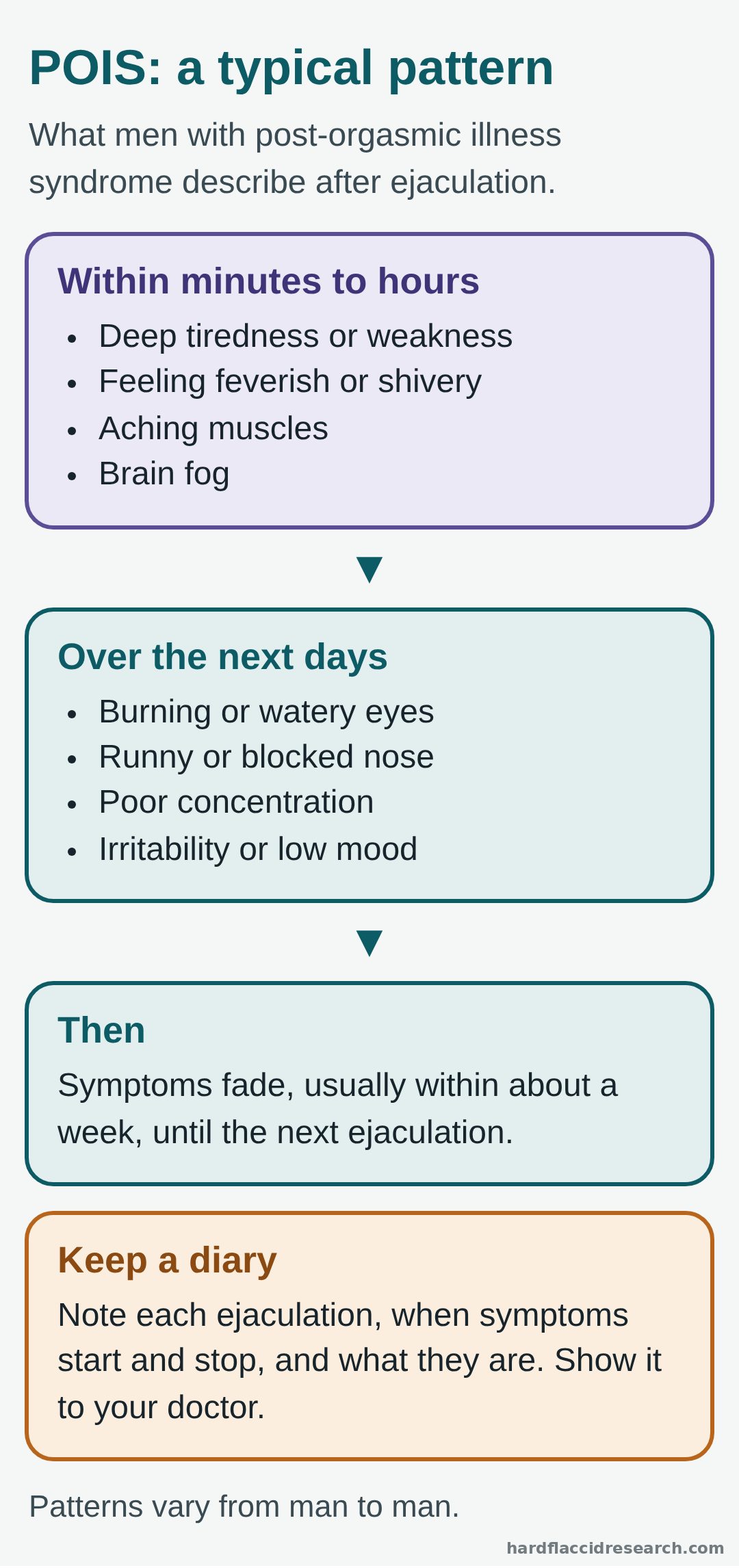
Post-orgasmic illness syndrome (POIS) is a rare condition where men feel ill soon after they ejaculate, whether from sex, masturbation or a wet dream. Symptoms start within minutes to hours and often feel like the flu: deep tiredness, aching, feeling feverish, brain fog, a runny nose or burning eyes. They usually fade over several days, then return after the next ejaculation.
POIS was first described by Dutch doctors in a report of two men only about two decades ago, and much is still unknown. Its cause isn't clear, and there's no treatment known to work yet. But it's a real, recognized condition, and doctors have tried several approaches that have helped some men. This page explains the symptoms, the possible causes, how it's diagnosed and what may help.
By the numbers: of the 6,026 men who shared their experiences with hard flaccid syndrome, 2,661 described their symptoms, and 202 of them described a weak or painful orgasm or ejaculation problems.
Key facts
- POIS causes flu-like or allergy-like symptoms after ejaculation, starting within seconds to a few hours.
- Symptoms usually last a few days, often up to about a week, and come back after each ejaculation.
- It's rare, but it may be under-recognized because men are often embarrassed to mention it.
- The cause isn't known. Leading theories include a reaction to a man's own semen and changes in the body's chemical messengers after orgasm.
- There's no treatment known to work. Doctors have tried antihistamines, anti-inflammatory medicines, desensitization to semen, and other approaches in small numbers of men.
- A symptom diary is the best first step, along with a doctor's check to rule out other causes.
What are the symptoms of POIS?
Men with POIS describe a mix of these after ejaculating:
- Extreme tiredness or weakness.
- Feeling feverish, hot or cold, or shivery, often without an actual fever.
- Aching muscles and joints.
- Brain fog: trouble concentrating, remembering words or reading.
- Burning, itchy or watery eyes.
- A runny or blocked nose, sneezing or a sore throat.
- Headache.
- Irritability, anxiety or low mood.
- Sometimes itching or redness of the skin.
The pattern
Doctors proposed five criteria to describe POIS. In plain words: symptoms affect the body generally or feel like an allergy; they start within seconds, minutes or hours of ejaculation; they happen after all or nearly all ejaculations; they last a few days; and they go away on their own.
There are two types: men who've had it since their first ejaculations in puberty, and men who develop it later in life.
Related: Death Grip Syndrome: Is It Real? What 125 Men Say »
What causes POIS?
The cause isn't known. Researchers have suggested:
- A reaction to semen: in a study of men with POIS, many reacted to a skin-prick test with their own diluted semen, which led researchers to suggest an allergy-like reaction to semen. Other researchers haven't found this in every case.
- Changes in brain and body chemicals after orgasm: such as a sudden shift in hormones or in messengers like dopamine and opioid chemicals, similar to a withdrawal.
- Inflammation or immune reactions in other forms.
It's likely that POIS has more than one cause, which may be why different treatments help different men.
How is POIS diagnosed?
There's no single test. A doctor will usually:
- Ask about your symptoms, when they start, how long they last and whether they happen after every ejaculation.
- Check for other causes of tiredness and flu-like symptoms, such as infections, thyroid problems, anemia, low testosterone, sleep problems or depression.
- Sometimes test for allergies, including a skin test with semen in specialist settings.
A diary is very helpful. Note the date of each ejaculation, when symptoms start, what they are and when they fade. Our doctor visit kit helps you bring this information to your appointment.
Many doctors haven't heard of POIS. If you feel brushed off, our members' guide, Hard Flaccid and Doctors: How to Get Taken Seriously, has tips for getting your symptoms heard, and they apply to POIS too.
Related: Hard Flaccid Flare-Up? Why It Gets Worse and How to Calm It »
How is POIS treated?
There's no treatment known to work, and most reports involve only one or a few men. Approaches doctors have tried include:
- Antihistamines, taken around the time of ejaculation, for allergy-like symptoms.
- Anti-inflammatory medicines.
- Hyposensitization: in a small study, two men were given gradually increasing amounts of their own diluted semen under the skin over a long period, and their symptoms eased. This is experimental and only done in specialist settings.
- Medicines that affect brain chemicals, or hormone treatments, in single case reports.
- Treating early ejaculation, when present, since some men with POIS also have it.
Any medicine should be started only with a doctor's advice. Some men choose to ejaculate less often or plan around symptoms, for example avoiding ejaculation before an important day.
Is it POIS or something else?
Feeling tired or a bit low after orgasm is common and normal, as the body relaxes and hormones shift. POIS is different: the symptoms are stronger, affect the whole body, follow nearly every ejaculation and last days.
Other things a doctor may consider include:
- Allergies, sinus problems or a cold that just happen to line up with ejaculation.
- Low mood, anxiety or guilt about sex, which can cause a heavy feeling afterwards.
- Chronic prostatitis or pelvic pain, which causes pain rather than flu-like symptoms.
- Sleep problems, thyroid problems or low iron, which cause tiredness at any time.
- Headaches linked to sex, which need their own check.
POIS and hard flaccid syndrome
Hard flaccid syndrome is a firm, shrunken penis at rest, often with numbness, weaker erections and pelvic pain. POIS and hard flaccid are different conditions, but many men with hard flaccid notice their penile and pelvic symptoms flare after ejaculation.
In a February 2023 poll, 78% said their symptoms were worse after masturbation or sex (92 of 118 men). That poll was about hard flaccid symptoms, not the whole-body illness of POIS. In separate counts, 779 men discussed abstinence or rest.
If ejaculation makes you feel generally unwell, with flu-like symptoms or brain fog, that's worth raising with a doctor as possible POIS, rather than assuming it's part of hard flaccid.
Living with POIS
- Keep a diary to understand your pattern.
- Plan ejaculation around work, exams and important events, if that helps.
- Talk openly with a partner, so they understand it isn't about them.
- Look after sleep, food and exercise, which can help you recover faster.
- Seek support for low mood or anxiety, which are common with long-term conditions.
When should I see a doctor?
See a primary care provider or a urologist (a doctor for urinary and sexual health) if you regularly feel ill after ejaculating, especially if it affects your work, relationships or mood. A sexual medicine specialist may know more about POIS.
Get urgent care straight away (call 911 or go to the emergency room) if you have:
- Trouble breathing, swelling of the face, lips or throat, or a widespread rash.
- A high fever, a stiff neck or severe headache.
- Chest pain, especially during or after sex.
- Sudden, severe pain in the penis, testicles or pelvis.
If you feel hopeless or have thoughts of harming yourself, call or text 988 to reach the Suicide and Crisis Lifeline.
Frequently asked questions
Is POIS real?
Yes. It's been described in medical journals for about two decades and is listed as a rare condition by the US National Institutes of Health.
How long do POIS symptoms last?
Usually a few days, often up to about a week, then they fade until the next ejaculation.
Is POIS caused by an allergy to semen?
That's one leading theory, supported by skin tests in some men, but it doesn't seem to explain every case.
Can POIS go away?
Some men report changes over time, but there's not enough research to say how often it improves on its own.
Does abstaining from ejaculation help?
It avoids the symptoms, but it isn't a treatment, and many men don't want or need to abstain. Talk to a doctor about options that suit you.
Can women get POIS?
A few cases in women have been described, but almost all reports are in men.
Does POIS affect fertility?
POIS isn't known to affect fertility, but avoiding ejaculation to prevent symptoms can make trying for a baby harder. A doctor can help you plan.
Should I see an allergist?
An allergist can help if you have allergy-like symptoms such as itching, sneezing or burning eyes after ejaculation. Ask your primary care provider whether a referral makes sense.
Takeaway
POIS is a rare condition where men feel flu-like and foggy for days after ejaculating. Its cause isn't known, and there's no treatment known to work yet, but it's real and recognized.
Keep a diary, see a doctor to rule out other causes, and ask about the approaches that have helped some men. Take our free self-check if you also notice changes in your penis at rest.
This article is for general information and isn't a substitute for advice from your own doctor. Hard Flaccid Research doesn't diagnose or treat. If you have new or worsening symptoms, see a qualified clinician. In an emergency, call 911.
Free tools that can help
- Self-check: do I have hard flaccid?Compare your symptoms with what 6,026 men report.
- Doctor visit kitA one-page summary to take to your appointment.
- Habit trackerCount your days without porn or masturbation, and get through urges.
- Diaphragm breathing toolBreathe with a moving picture of your diaphragm and pelvic floor.
- Add your experienceTell us what you tried and how it went. No name needed.
- Hard Flaccid Syndrome CensusWhat men answered in 818 polls.
- Symptom trackerLog your symptoms and see what helps you.
- Ask us a questionThe questions men ask most become new articles.
The numbers behind this article
Every number in this article comes from what men with hard flaccid syndrome shared between December 2020 and October 2026, counted once per person, or from their polls. These are self-selected reports, not a clinical study. See hard flaccid syndrome statistics, the Hard Flaccid Syndrome Census and how we count.
78% said their symptoms were worse after masturbation or sex
How 118 men with hard flaccid syndrome answered a February 2023 poll.In our polls, men choose to answer. This is about hard flaccid symptoms, not POIS.
Source: Hard Flaccid Research, hardflaccidresearch.com
Every number in this article, with its source
| In this article | Source |
|---|---|
| 8% of the men who described their symptoms described a weak or painful orgasm or ejaculation problems (202 of 2,661) | 202 of 2,661 men, counted |
| 6,026 men shared their experiences, and 2,661 of them described their symptoms | 2,661 of 6,026 men, counted |
| 78% said their symptoms were worse after masturbation or sex (92 of 118 men) | 92 of 118 men, poll, Feb 2023 |
| 779 men discussed abstinence or rest | 779 men discussing abstinence or rest, counted from what men wrote, once per person |
Medical sources
What this article says about medical research, guidelines and urgent care comes from these sources.
- Waldinger MD, Schweitzer DH. Postorgasmic illness syndrome: two cases. J Sex Marital Ther. 2002;28(3):251-255. https://doi.org/10.1080/009262302760328280
- Waldinger MD, Meinardi MMHM, Zwinderman AH, Schweitzer DH. Postorgasmic illness syndrome (POIS) in 45 Dutch caucasian males: clinical characteristics and evidence for an immunogenic pathogenesis (part 1). J Sex Med. 2011;8(4):1164-1170. https://doi.org/10.1111/j.1743-6109.2010.02166.x
- Waldinger MD. Post orgasmic illness syndrome (POIS). Transl Androl Urol. 2016;5(4):602-606. https://doi.org/10.21037/tau.2016.07.01
- Novel treatment for post-orgasmic illness syndrome: a case report and literature review. Asian J Androl. 2022;24(3):332-334. https://doi.org/10.4103/aja202170
- Genetic and Rare Diseases Information Center (GARD). Postorgasmic illness syndrome. National Institutes of Health. https://rarediseases.info.nih.gov/diseases/10809/postorgasmic-illness-syndrome
- Review of recent data on disorders of ejaculation and orgasm in men: recommendations from the Fifth International Consultation on Sexual Medicine. Sex Med Rev. 2025;13(3):318-337. https://doi.org/10.1093/sxmrev/qeaf016
How we made this article
We started from the question many men asked. Every number was checked against our data. Our editorial team edited it and Dr. Julian Reyes reviewed it medically. Read our editorial policy.
Read next
See more of us on Google
Add Hard Flaccid Research as a preferred source, and Google shows you our pages more often when you search.
Add as a preferred sourceDon't see your question? Ask us. We answer the most-asked ones in new articles.
Cite and share this article
You're welcome to quote this article. Please name Hard Flaccid Research and link to this page, so others can find the full answer and the data behind it. To cite this page, use its link.
Citation
Hard Flaccid Research. (2026). Post-Orgasmic Illness Syndrome (POIS): Symptoms and Help. Written by the Editorial Team, medically reviewed by Dr. Julian Reyes. https://hardflaccidresearch.com/articles/post-orgasmic-illness-syndrome
Credit link for your article
Source: <a href="https://hardflaccidresearch.com/articles/post-orgasmic-illness-syndrome">Hard Flaccid Research</a>
Wikipedia reference
<ref>{{cite web |url=https://hardflaccidresearch.com/articles/post-orgasmic-illness-syndrome |title=Post-Orgasmic Illness Syndrome (POIS): Symptoms and Help |website=Hard Flaccid Research |date=2026 |access-date=22 November 2026}}</ref>
How the data was collected: our methodology. Journalists and researchers: key numbers, data and contact.