Low Testosterone and Hard Flaccid: Should You Get Tested?
In short
- Low testosterone isn't a known cause of hard flaccid syndrome, but it can cause some of the same problems, such as a lower sex drive and fewer morning erections.
- A morning blood test, usually repeated, can check your level, especially if those are your main symptoms.
- Testosterone replacement therapy (TRT) only helps if the test shows a low level, and it can switch off your own sperm production, thicken the blood and raise blood pressure, so never buy it or start it yourself. 99 men with hard flaccid discussed testosterone or hormone treatment.
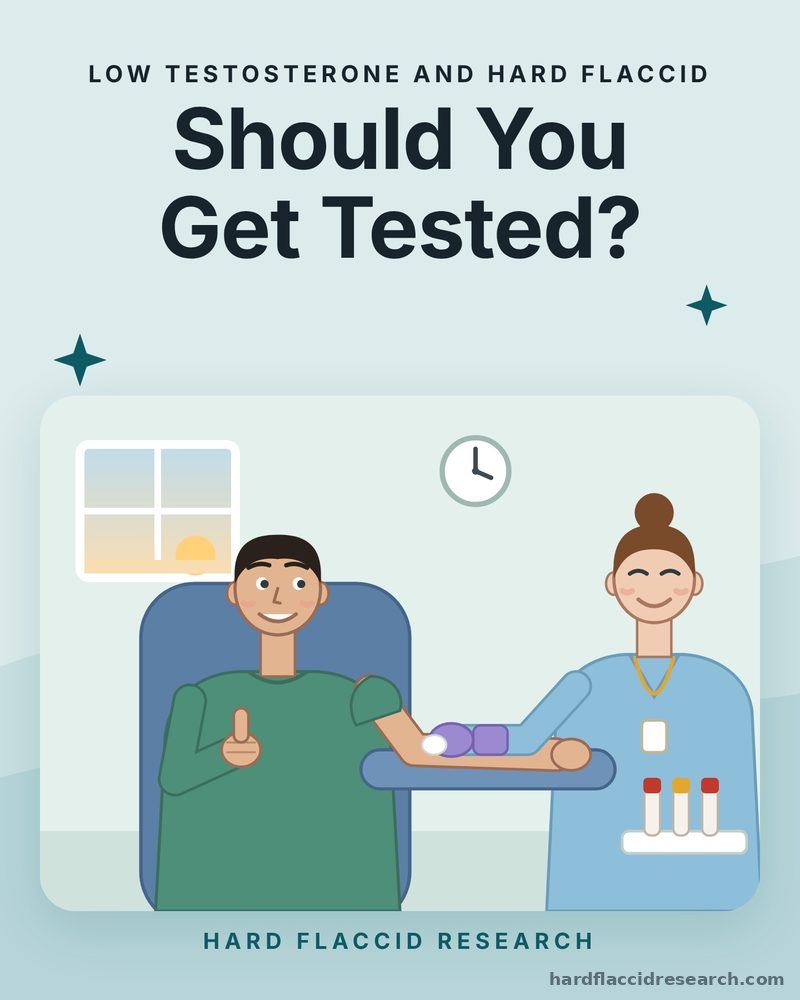
Low testosterone isn't a known cause of hard flaccid syndrome, where the penis stays firm, rubbery or shrunken when it should be soft. But low testosterone can cause some of the same problems, such as a lower sex drive and weaker or fewer morning erections, so a morning blood test can be worth asking for, especially if those are your main symptoms. Testosterone treatment only helps if a test shows a low level, and it can switch off your own sperm production, thicken the blood and raise blood pressure, so never buy it or start it yourself.
99 men with hard flaccid discussed testosterone or hormone treatment, and it came up in 1 of 126 recovery stories, though a story mentioning something is not proof that it worked. This page explains where low testosterone and hard flaccid overlap, what low testosterone is, its symptoms and causes, what the test and the result mean, what testosterone replacement therapy (TRT) can and can't do, and what to know about testosterone boosters.
By the numbers: between December 2020 and October 2026, 2,661 of the 6,026 men with hard flaccid who shared their experiences described their symptoms: 9% described low libido (230 of 2,661). These are men with hard flaccid, not men in general.
Can low testosterone cause hard flaccid?
Testosterone is the main male sex hormone. It is made mostly in the testicles, and it helps keep your sex drive, energy, muscle strength, bones and mood going. It also plays a part in erections, especially the ones that happen during sleep.
Hard flaccid is different. Men describe a penis that stays firm and rubbery at rest, often with pelvic tightness or pain, numbness or shrinkage. Many men with hard flaccid syndrome also describe a tight pelvic floor, the muscles between your legs, though that link isn't proven.
Low testosterone isn't known to cause the firm, rubbery resting state, pelvic pain or numbness. In the few published reports where doctors checked hormone levels in men with hard flaccid, they were normal, and no published medical report describes a hard flaccid patient treated with testosterone. But the two can happen together, and some of their signs look alike.
Hard Flaccid Explorerby Hard Flaccid Research
Low testosterone or hard flaccid?
A 7-minute animated explainer of this article. Press play, or skip between chapters. The first minute is free for everyone.
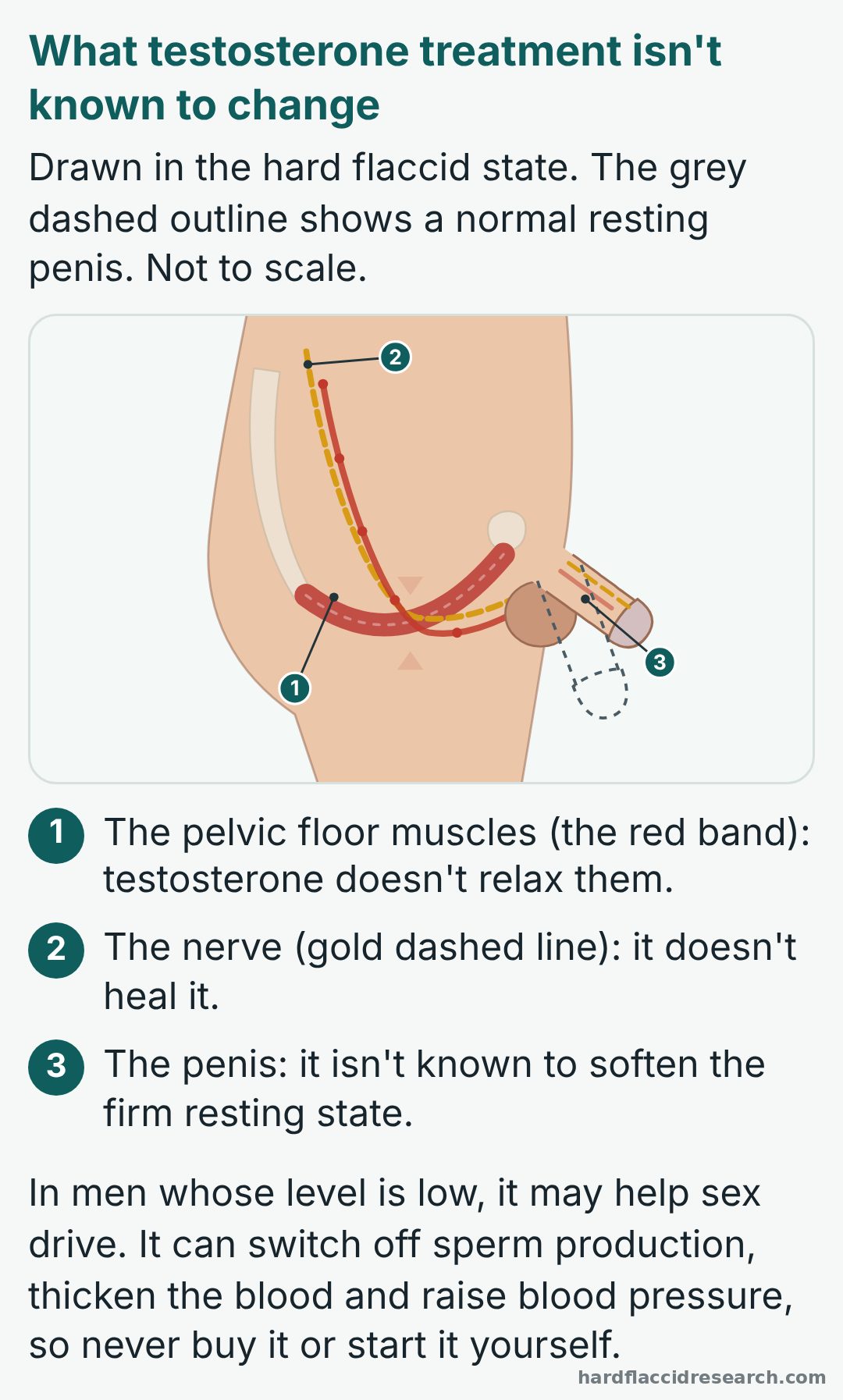
A picture to explain, not a diagnosis. Hormones aren't drawn: the picture shows the pelvic floor, a nerve and blood flow.
What is low testosterone?
Low testosterone, also called testosterone deficiency or hypogonadism, means your body makes less testosterone than it needs. Doctors diagnose it only when two things come together: symptoms that fit, and a level that is low on blood tests taken in the morning, usually repeated. A low number without symptoms, or symptoms with a normal number, isn't enough.
Testosterone falls slowly through adult life, so many older men have a little less than they did, but a big drop isn't a normal part of ageing. The idea of a 'male menopause' is misleading: men don't have a sudden fall in hormones the way women do at menopause, and many of the symptoms blamed on it have other causes.
Related: Low Libido and Hard Flaccid: Why 83% Say Their Drive Dropped »
Low testosterone symptoms
Symptoms tend to come on slowly, and none of them is specific to low testosterone. They can include:
- A lower sex drive, and weaker erections or fewer morning erections.
- Tiredness and low energy, low mood, irritability or poor concentration.
- Less muscle and strength, and more fat around the middle.
- Hot flushes or sweats.
- Less body or facial hair, so you shave less often.
- Swollen or tender breasts, or smaller, softer testicles.
- Fertility problems, such as a low sperm count.
- Over time, thinner bones that break more easily.
Many of these have other causes, such as stress, depression, poor sleep, heavy drinking or another illness, so a blood test, not a checklist, is what shows whether your testosterone is low.
Low mood is common with hard flaccid syndrome. It deserves treatment in its own right, whatever your testosterone level, so tell your doctor.
If you are feeling hopeless or having thoughts of ending your life, please visit our Support page now. It lists crisis lines you can call or text today.
Where the signs overlap
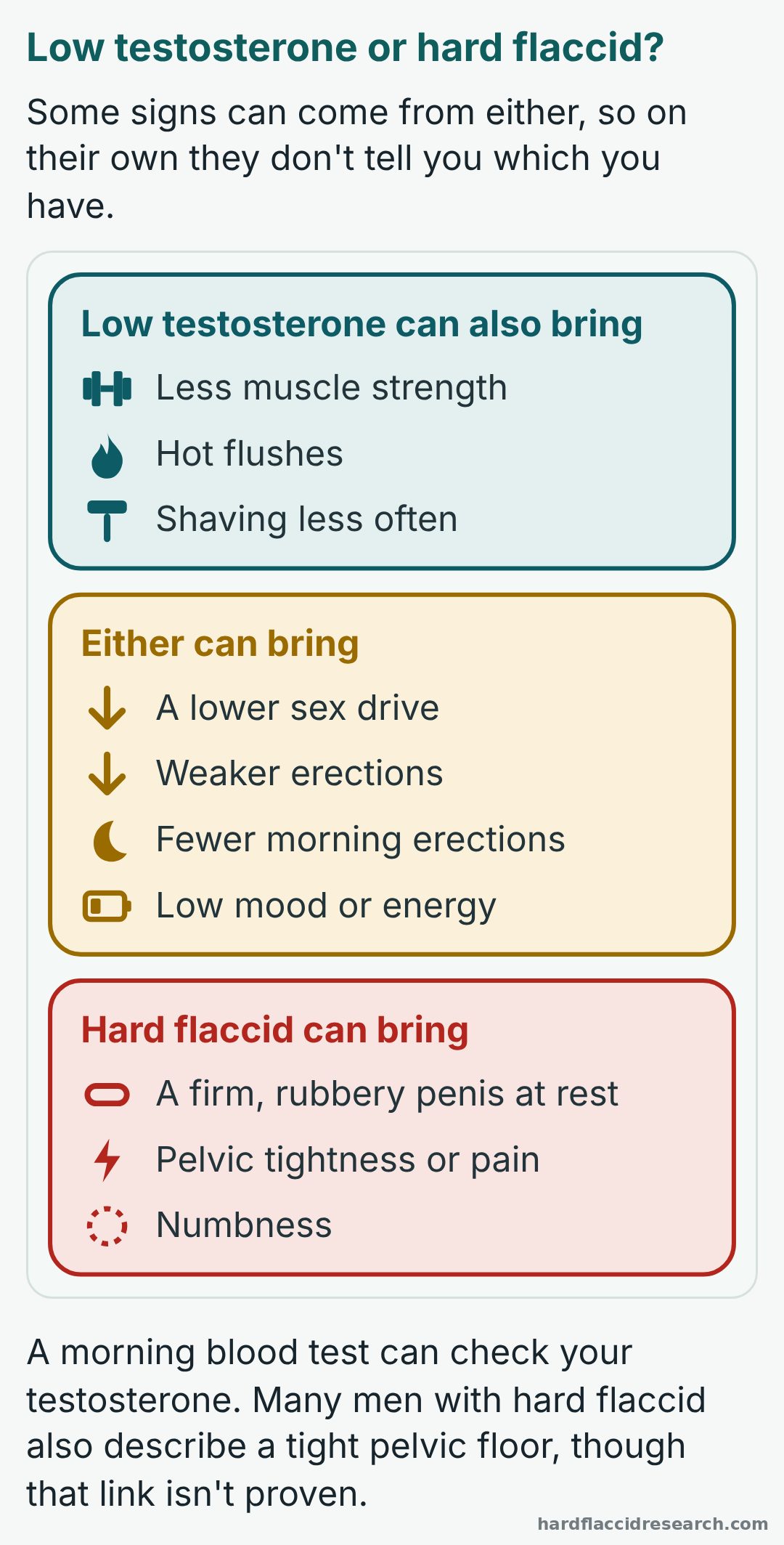
Some problems can come from either, so on their own they don't tell you which one you have:
- A lower sex drive.
- Weaker erections.
- Fewer or weaker morning erections.
- Low mood or low energy.
Low testosterone can also bring less muscle strength, hot flushes or needing to shave less. Hard flaccid syndrome can bring the firm, rubbery resting state, pelvic tightness or pain, and numbness, which low testosterone doesn't explain.
Of the 2,661 men with hard flaccid who described their symptoms, 35% described weaker erections (926 of 2,661), 9% low libido (230 of 2,661) and 6% fewer or no morning erections (147 of 2,661). In one April 2023 poll of men with hard flaccid, 83% said their libido was lower or gone since hard flaccid began (71 of 86 men). In one January 2023 poll of men with hard flaccid, 46% said they never get morning erections, or only weak ones (59 of 128 men). Neither poll asked anything about testosterone.
The shares from what men wrote are lower than in the polls because they count men who raised a sign on their own, not men who were asked about it. Of the 230 men with hard flaccid who described low libido, 72% also described the firm flaccid state, 67% weaker erections and 63% numbness. Men who described one symptom tended to describe more symptoms of every kind, so this doesn't show what lowered their drive: a lower sex drive alongside hard flaccid doesn't by itself point to hormones, and a blood test is what can check. Separately, 45 men with hard flaccid asked why their libido is low. These are self-selected reports, not a clinical study.
Related: Post-Finasteride Syndrome and Hard Flaccid: The Overlap »
What causes low testosterone?
Low testosterone has many possible causes, and finding the cause matters, because treating it can sometimes bring the level back up:
- Carrying a lot of extra weight, and type 2 diabetes.
- Sleep apnoea, where your breathing stops and starts while you sleep, and long-term poor sleep.
- Some medicines, such as opioid painkillers and steroid tablets. Stopping either suddenly can be dangerous, so don't stop or change a medicine on your own: ask your doctor.
- Using anabolic steroids or testosterone without a prescription, which can switch off your body's own supply, sometimes for a long time after stopping.
- Heavy drinking, and serious or long-term illness.
- Problems with the testicles, such as an injury, an infection like mumps, cancer treatment, testicles that didn't come down in childhood, or a genetic condition such as Klinefelter syndrome.
- Problems with the pituitary, a small gland under the brain that tells the testicles to make testosterone, such as too much of a hormone called prolactin.
Hard flaccid syndrome itself isn't known to lower testosterone. But pain, poor sleep and worry can all affect how you feel, and poor sleep may lower testosterone too, so it's worth telling your doctor about them.
Should you get your testosterone tested?
Often, yes. Doctors commonly check testosterone when sex drive or erections change, and a test is most worth asking about if:
- A lower sex drive, fewer morning erections or tiredness are your main symptoms.
- These changes came on slowly, or before your hard flaccid syndrome began.
- You have other signs, such as less muscle strength or hot flushes.
- You have used anabolic steroids or testosterone, which can switch off your body's own supply.
- You have diabetes, carry a lot of extra weight or take opioid painkillers, which can all lower testosterone (don't stop a painkiller on your own).
If erections have changed, blood tests for blood sugar (HbA1c) and cholesterol are worth asking for too, because erection problems can be an early sign of diabetes or heart disease.
The testosterone test and normal levels
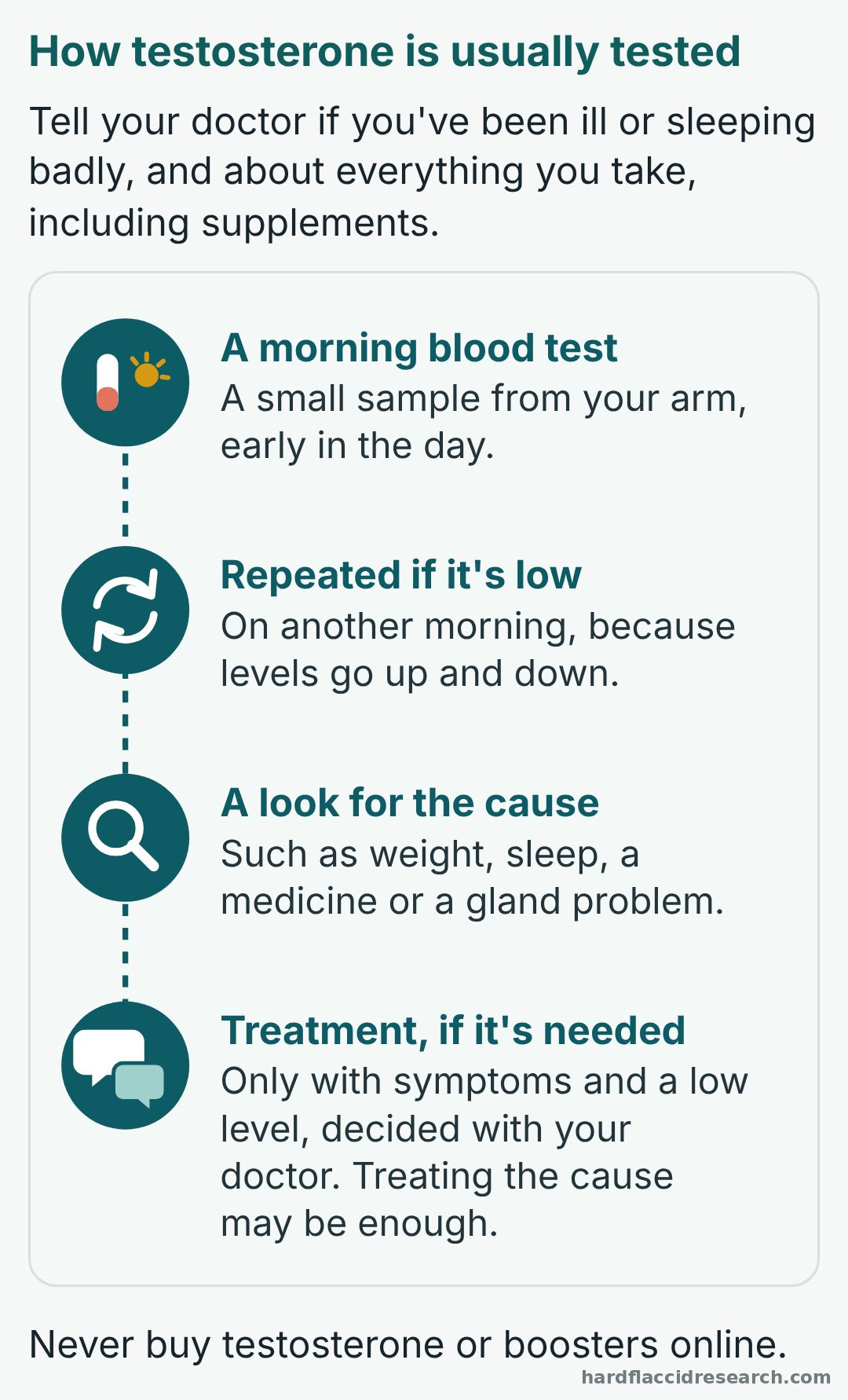
It's an ordinary blood test: a small sample taken from a vein in your arm. Testosterone is highest in the morning, so the test is usually done early in the day, and some doctors ask you not to eat first. If you can, book an early appointment.
Levels go up and down, and poor sleep, an illness or some medicines can lower them for a while, so a low result is usually repeated on another morning before anything is decided. If you've been unwell or sleeping badly, say so when you book. Tell them about everything you take, including supplements, because some can change the result.
What counts as normal depends on the lab: each one gives its own range on the report, and levels tend to be a little lower in older men. Your doctor reads the number alongside your symptoms, not on its own.
In the blood, testosterone mostly travels attached to proteins, chiefly sex hormone-binding globulin (SHBG). Free testosterone is the small share that isn't attached, and it acts on the body along with some that is only loosely attached. The usual test measures the total. If the total is borderline, or something may be raising or lowering your SHBG, a doctor may measure SHBG and work out your free testosterone. Your doctor may also check the hormones that tell the testicles to make testosterone.
Our members' guide, Hard Flaccid Blood Tests: Testosterone, Sugar and Hormones, goes through each blood test and what to ask about the results.
What the result can and can't tell you
A blood test can show whether your testosterone is low. It can't show whether you have hard flaccid syndrome: there's no blood test for hard flaccid, and doctors go by your symptoms and an examination, after checking for other conditions.
If your level is normal, low testosterone is less likely to be behind your symptoms, and you and your doctor can look at other possible causes.
If it's low, a doctor will usually repeat the test and look for a reason, such as poor sleep, weight, a medicine or a problem with the pituitary gland. Treating the cause may be enough. Low testosterone may explain a lower sex drive, but not the firm resting state, pelvic pain or numbness of hard flaccid.
Questions worth asking about your result:
- Is my level low, normal or borderline, and should it be repeated on another morning?
- If it's low, what might be causing it, and how will you check?
- Did you also check the hormones that control testosterone, and my blood sugar and cholesterol?
- If you suggest treatment, how will it affect my fertility, and how will you keep an eye on it?
Testosterone replacement therapy: what it can and can't do
Testosterone replacement therapy (TRT) only helps if blood tests show a low level. In men who are low, it can improve sex drive, and may help erections and mood a little; any effect on energy is less certain. It doesn't relax the pelvic floor, calm irritated nerves or bring back lost feeling, and it won't fix low mood on its own. It also has real risks, set out below: it can switch off sperm production, thicken the blood and raise blood pressure. If your symptoms haven't got better on it, a doctor may talk to you about coming off it.
It comes as a gel, injections, patches, implants or capsules, depending on the country. If you use a gel, wash your hands after putting it on and cover the skin, because it can pass to a partner or children through skin contact and cause unwanted effects, especially in children.
Among the men with hard flaccid syndrome who discussed testosterone or hormone treatment and also described their symptoms, 75% described the firm flaccid state, 69% weaker erections, 64% numbness, 57% shrinkage and 32% pelvic floor tightness. Men who wrote about a treatment tended to describe more symptoms of every kind, so these shares run higher than among all men who described symptoms. It came up in 1 of the 126 recovery stories, and a story mentioning something is not proof that it worked.
TRT side effects and risks
Like any medicine, testosterone has side effects, which doctors watch for with regular blood tests and check-ups:
- It switches off your body's own testosterone and sperm production, so it can cause infertility, sometimes for a long time after stopping. Tell your doctor if you might want children.
- Smaller testicles.
- Thicker blood, because it raises red blood cells, which can raise the risk of clots.
- Higher blood pressure.
- Acne or oily skin, swollen or tender breasts, and ankle swelling.
- Worse sleep apnoea.
A large trial in middle-aged and older men with low testosterone and a raised risk of heart disease found that testosterone didn't raise the risk of heart attack, stroke or death from heart disease, but more men on it had an irregular heartbeat (atrial fibrillation), blood clots in the lungs and sudden kidney problems. Doctors also check the prostate before and during treatment.
It isn't usually given to men who are trying for a baby; men with breast cancer or some prostate cancers, or a prostate lump or raised PSA (a prostate blood test) that a urologist hasn't checked; men with very thick blood, a blood clotting disorder, severe peeing problems from an enlarged prostate or untreated severe sleep apnoea; or men who have had a heart attack or stroke in the last few months, or have poorly controlled heart failure.
Talk to a doctor first. In most countries testosterone is a prescription medicine. It switches off your body's own testosterone and sperm production, even in men who need it, and can cause infertility, so tell your doctor if you might want children. Taken when your level isn't low, it brings these risks with no proven benefit. It can also thicken the blood and raise blood pressure, so men on it need regular blood tests and checks. Get urgent care for chest pain, sudden breathlessness, or a painful, swollen leg. Never buy testosterone, steroids or boosters online or from a gym, and tell your doctor about everything you take. Never start, stop or change a medicine on your own.
Testosterone boosters and natural ways to raise it
Testosterone boosters sold online and in shops are supplements, not testosterone. A review of popular boosters found that most of their claims weren't backed by research, and some contained more of a vitamin or mineral than is safe to take every day. None has been tested in hard flaccid syndrome.
- Ashwagandha, a herb often sold for stress and testosterone, has small studies with mixed results. It has been linked to rare cases of liver damage, so stop it and see a doctor if your skin or eyes turn yellow or your pee turns dark. It may not be safe if you have prostate cancer or a thyroid problem, and it can interact with some medicines, so ask a doctor or pharmacist first.
- Zinc and vitamin D: if a blood test shows you're short of one, correcting it may help, but extra doesn't seem to raise testosterone when you already have enough. Taking a lot of zinc for months can leave you short of copper, and too much vitamin D can push up the calcium in your blood.
- Regulators have found hidden steroids or prescription medicines in some products sold for testosterone, muscle or 'male enhancement'. A hidden steroid can switch off your own testosterone, and a hidden erection medicine can drop your blood pressure dangerously if you take nitrate medicines for chest pain.
624 men with hard flaccid discussed supplements of any kind, not only ones sold for testosterone. Of the 230 men with hard flaccid who described low libido, 40% also discussed supplements, though other approaches came up more often. Separately, 40 men with hard flaccid asked whether supplements help. In what men wrote, 38 men with hard flaccid named a medicine or supplement as how their symptoms began, though naming something as the start doesn't show that it caused hard flaccid.
Everyday changes may help raise a low level, and they help your general health whatever your level:
- Losing weight if you carry a lot of extra weight, which can raise a low level.
- Being active, including strength training.
- Sleeping well. Get loud snoring or stopping breathing in your sleep checked too: treating sleep apnoea is good for your health, though it hasn't clearly been shown to raise testosterone.
- Cutting down on alcohol.
- Asking your doctor to review medicines that can lower testosterone, without stopping them on your own.
In one March 2023 poll of men with hard flaccid, 23% said weight loss had improved their symptoms (20 of 86 men), and 77% said it hadn't (66 of 86 men). That poll asked about hard flaccid symptoms, not testosterone, and these are self-selected reports, not a clinical study.
Common questions about testosterone
Can low testosterone cause erectile dysfunction? It can play a part, but it more often lowers sex drive than stops erections. Most erection problems have other causes, such as blood flow, nerves, medicines or stress, so a check-up looks at all of them.
Can hard flaccid lower my testosterone? There's no evidence that it does. In the reported cases where doctors checked, hormone levels were normal.
Will TRT fix my hard flaccid? It isn't known to. No published medical report describes a hard flaccid syndrome patient treated with it, and it doesn't act on the pelvic floor or the nerves. If your level is low, treating it may help your sex drive, but it can switch off sperm production, thicken the blood and raise blood pressure, so it needs a doctor and regular checks.
Is TRT safe for young men? It can be used when a young man's level is truly low, but a doctor will usually look for the cause first. It switches off sperm production, which matters if you might want children, and it can thicken the blood and raise blood pressure. For some men, a specialist may suggest other treatments that help the body make its own testosterone instead.
Does masturbation or abstinence change testosterone? Short changes have been reported, but as far as studies show, neither causes low testosterone.
Do I need to fast before a testosterone test? Some labs and doctors ask you to, because eating may lower the level a little. Ask when you book.
At what age does testosterone drop? It usually starts falling slowly from your thirties or forties, and levels tend to be a little lower in older men. Symptoms that come on quickly, or a clearly low result, aren't a normal part of ageing at any age and are worth checking.
When to see a doctor
See a doctor if your sex drive, morning erections or energy have dropped for more than a few weeks, and ask about a morning testosterone test. Erection problems can be an early sign of heart disease or diabetes, so a check-up is worth it even if you think hard flaccid syndrome is the cause. If you've had numbness between your legs for a while, or pain that is clearly worse when sitting, ask a doctor to check the nerves, including the pudendal nerve. New numbness there needs urgent care (see the list below). Our doctor visit kit helps you list your symptoms and when each started.
Get urgent care straight away if you have:
- Thoughts of ending your life, or of harming yourself.
- Chest pain, sudden breathlessness, or a painful, swollen leg, especially if you take testosterone.
- An erection lasting more than 4 hours.
- Sudden, severe pain in the penis, testicles or pelvis.
- New numbness around your back passage, genitals or inner thighs, or new weakness in your legs.
- New trouble starting or controlling your pee, not being able to pee, or not feeling when your bladder is full.
- Loss of control of your bladder or bowel.
- A fever or chills with pelvic pain or pain when peeing.
What to do next
- If your symptoms haven't been checked, see a doctor first, because they can have other causes.
- Take our self-check to see how your symptoms compare.
- Note when your sex drive, morning erections and energy changed, and whether that was before or after your hard flaccid syndrome began.
- Book a GP appointment and take the questions above with you.
- Don't buy testosterone or boosters online.
- If you've been tested, add your experience, so the next man has better numbers than we do.
Free tools that can help
- Self-check: do I have hard flaccid?Compare your symptoms with what 6,026 men report.
- Doctor visit kitA one-page summary to take to your appointment.
- Habit trackerCount your days without porn or masturbation, and get through urges.
- Diaphragm breathing toolBreathe with a moving picture of your diaphragm and pelvic floor.
- Add your experienceTell us what you tried and how it went. No name needed.
- Hard Flaccid Syndrome CensusWhat men answered in 818 polls.
- Symptom trackerLog your symptoms and see what helps you.
- Ask us a questionThe questions men ask most become new articles.
The numbers behind this article
Every number in this article comes from what men with hard flaccid syndrome shared between December 2020 and October 2026, counted once per person, or from their polls. These are self-selected reports, not a clinical study. See hard flaccid syndrome statistics, the Hard Flaccid Syndrome Census and how we count.
99 men with hard flaccid syndrome discussed testosterone or hormone treatment
Number of men with hard flaccid syndrome in each group, counted once per person. Two bars are question groups.The groups overlap. Discussing something is not the same as using it. Naming something as the start is not proof that it caused hard flaccid syndrome.
Source: Hard Flaccid Research, hardflaccidresearch.com
In what men with hard flaccid syndrome wrote, 35% described weaker erections
Share of the 2,661 men with hard flaccid syndrome who described their symptoms. Each man is counted once.These count men who raised a symptom on their own, not men who were asked, so they are lower than poll answers.
Source: Hard Flaccid Research, hardflaccidresearch.com
In one poll, 83% of men with hard flaccid syndrome said their libido was lower or gone since hard flaccid syndrome began (71 of 86 men)
How 86 men with hard flaccid syndrome answered an April 2023 poll: "How has hard flaccid syndrome affected your libido?"The poll asked nothing about testosterone. These are self-selected reports, not a clinical study.
Source: Hard Flaccid Research, hardflaccidresearch.com
In one poll, 46% of men with hard flaccid syndrome said they never get morning erections, or only weak ones (59 of 128 men)
How 128 men with hard flaccid syndrome answered a January 2023 poll: "Do you get morning erections?"The poll asked nothing about testosterone. These are self-selected reports, not a clinical study.
Source: Hard Flaccid Research, hardflaccidresearch.com
Of the 230 men with hard flaccid syndrome who described low libido, 72% also described the firm flaccid state
Share of the 230 men with hard flaccid syndrome who described low libido who also described each symptom, or discussed supplements. Each man is counted once in each bar.The groups overlap, and men who described low libido tended to describe more symptoms of every kind, so the shares may partly reflect how much men wrote. Other approaches came up more often than supplements. A lower sex drive alongside hard flaccid syndrome doesn't by itself point to hormones. These are self-selected reports, not a clinical study.
Source: Hard Flaccid Research, hardflaccidresearch.com
Testosterone or hormone treatment came up in 1 of the 126 hard flaccid syndrome recovery stories
Share of the 126 stories from men with hard flaccid syndrome who got better that mention testosterone or hormone treatment. Mentioned is not the same as worked.A story mentioning something is not proof that it worked. Testosterone only helps if a blood test shows a low level.
Source: Hard Flaccid Research, hardflaccidresearch.com
In one poll, 23% of men with hard flaccid syndrome said weight loss had improved their symptoms (20 of 86 men)
How 86 men with hard flaccid syndrome answered a March 2023 poll: "Has weight loss improved your symptoms?"The poll asked about hard flaccid syndrome symptoms, not testosterone. These are self-selected reports, not a clinical study.
Source: Hard Flaccid Research, hardflaccidresearch.com
Every number in this article, with its source
| In this article | Source |
|---|---|
| 99 men discussed testosterone or hormone treatment | 99 men discussing testosterone or hormone treatment, counted from what men wrote, once per person |
| Testosterone or hormones came up in 1 of 126 recovery stories | 1 of 126 recovery stories |
| 2,661 of the 6,026 men who shared their experiences described their symptoms | Research data, December 2020 to October 2026 |
| 35% described weaker erections (926 of 2,661) | 926 of 2,661 men, counted from what men wrote, once per person |
| 9% described low libido (230 of 2,661) | 230 of 2,661 men, counted from what men wrote, once per person |
| 6% described fewer or no morning erections (147 of 2,661) | 147 of 2,661 men, counted from what men wrote, once per person |
| 83% said their libido was lower or gone since hard flaccid syndrome began (71 of 86 men) | 71 of 86 men, poll, Apr 2023 |
| 42% said their libido was lower (36 of 86 men) | 36 of 86 men, poll, Apr 2023 |
| 41% said their libido was gone (35 of 86 men) | 35 of 86 men, poll, Apr 2023 |
| 17% said their libido hadn't changed (15 of 86 men) | 15 of 86 men, poll, Apr 2023 |
| 46% never or only weak morning erections (59 of 128 men) | 59 of 128 men, poll, Jan 2023 |
| 9% said they got morning erections every day (12 of 128 men) | 12 of 128 men, poll, Jan 2023 |
| 45% said they got morning erections on some days (57 of 128 men) | 57 of 128 men, poll, Jan 2023 |
| 28% said they got morning erections, but not very strong (36 of 128 men) | 36 of 128 men, poll, Jan 2023 |
| 18% said they never got morning erections (23 of 128 men) | 23 of 128 men, poll, Jan 2023 |
| Of the 230 men who described low libido: 72% also described the firm flaccid state, 67% weaker erections, 63% numbness, 48% shrinkage, 34% pelvic floor tightness; 40% also discussed supplements | 230 men who described low libido, counted from what men wrote, once per person |
| 45 men asked why their libido is low | Question group, 45 men, research data |
| Among men who discussed testosterone or hormone treatment and also described their symptoms: 75% firm flaccid state, 69% weaker erections, 64% numbness, 57% shrinkage, 32% pelvic floor tightness | 99 men discussing testosterone or hormone treatment, counted from what men wrote, once per person; shares are of those who also described their symptoms |
| 624 men discussed supplements of any kind | 624 men discussing supplements, counted from what men wrote, once per person |
| 40 men asked whether supplements help | Question group, 40 men, research data |
| 38 men named a medicine or supplement as how their symptoms began | 38 men, counted from what men wrote, once per person |
| 23% said weight loss had improved their symptoms (20 of 86 men) | 20 of 86 men, poll, Mar 2023 |
| 77% said weight loss hadn't improved their symptoms (66 of 86 men) | 66 of 86 men, poll, Mar 2023 |
How we made this article
We started from the question many men asked. Every number was checked against our data. Our editorial team edited it and Dr. Julian Reyes reviewed it medically. Read our editorial policy.
Read next
See more of us on Google
Add Hard Flaccid Research as a preferred source, and Google shows you our pages more often when you search.
Add as a preferred sourceDon't see your question? Ask us. We answer the most-asked ones in new articles.
Cite and share this article
You're welcome to quote this article. Please name Hard Flaccid Research and link to this page, so others can find the full answer and the data behind it. To cite this page, use its link.
Citation
Hard Flaccid Research. (2026). Low Testosterone and Hard Flaccid: Should You Get Tested? Written by the Editorial Team, medically reviewed by Dr. Julian Reyes. https://hardflaccidresearch.com/articles/low-testosterone-hard-flaccid
Credit link for your article
Source: <a href="https://hardflaccidresearch.com/articles/low-testosterone-hard-flaccid">Hard Flaccid Research</a>
Wikipedia reference
<ref>{{cite web |url=https://hardflaccidresearch.com/articles/low-testosterone-hard-flaccid |title=Low Testosterone and Hard Flaccid: Should You Get Tested? |website=Hard Flaccid Research |date=2026 |access-date=28 October 2026}}</ref>
How the data was collected: our methodology. Journalists and researchers: key numbers, data and contact.