Prostatitis or Hard Flaccid? Symptoms, Types and Treatment
In short
- Prostatitis means a sore, inflamed prostate: a sudden infection that needs urgent care, an infection that keeps coming back, or, most often, chronic prostatitis, also called chronic pelvic pain syndrome (CPPS), with pelvic pain and peeing problems but no infection found.
- Hard flaccid syndrome shares many of these symptoms, and 337 men with hard flaccid syndrome described urinary problems.
- Fever or chills with pain when you pee needs urgent care.
107 men with hard flaccid asked this question.
Prostatitis means a sore, inflamed prostate, the small gland below the bladder. It can be a sudden infection that needs urgent care, an infection that keeps coming back, or, most often, chronic prostatitis, also called chronic pelvic pain syndrome (CPPS): pain in the pelvis, the perineum (the area between the scrotum and the back passage), the testicles or the penis, often with peeing problems and pain after ejaculation, with no infection found. Hard flaccid syndrome shares many of these symptoms, and a tight pelvic floor may be part of both. Our doctor visit kit helps you prepare for a doctor's appointment. Fever or chills with pain when you pee needs urgent care straight away.
337 men with hard flaccid described urinary problems, 267 pelvic, perineal or tailbone pain, and 107 asked why they have peeing problems. This page explains the types of prostatitis, the symptoms, causes, tests and treatment, how chronic prostatitis differs from hard flaccid, and when to see a doctor.
By the numbers: between December 2020 and October 2026, 2,661 of the 6,026 men with hard flaccid who shared their experiences described their symptoms: 13% described urinary problems (337 of 2,661) and 10% pelvic, perineal or tailbone pain (267 of 2,661). These are men with hard flaccid, not men with prostatitis.
What is prostatitis?
The prostate is a small gland below the bladder that makes part of the semen. Prostatitis means inflammation of the prostate. There are a few kinds:
- Acute bacterial prostatitis: a sudden infection with fever, chills and painful peeing. It needs urgent treatment with antibiotics.
- Chronic bacterial prostatitis: infections that keep coming back, found in urine or prostate fluid tests.
- Chronic prostatitis or chronic pelvic pain syndrome (CPPS): pelvic pain for at least three of the past six months, with no infection found. This is by far the most common kind.
- Asymptomatic inflammatory prostatitis: inflammation found during tests for something else, with no symptoms. It usually needs no treatment.
Prostatitis isn't cancer, and there's no proof that it leads to prostate cancer. It is also different from an enlarged prostate, which is common as men get older.
Hard Flaccid Explorerby Hard Flaccid Research
Prostatitis or hard flaccid?
A 7-minute animated explainer of this article. Press play, or skip between chapters. The first minute is free for everyone.
A picture to explain, not a diagnosis. Fever with pain when you pee needs urgent care.
Prostatitis symptoms
Symptoms depend on the type, and they can include:
- Pain in the perineum, the testicles, the tip of the penis, the lower belly or the lower back.
- Pain during or after ejaculation.
- Needing to pee often, especially at night, or urgently, a weak or stop-start stream, or feeling you haven't finished.
- Pain or burning when you pee, cloudy urine, or blood in your urine.
- Fever, chills and aches like the flu, with acute bacterial prostatitis.
- Symptoms that flare after sitting, sex or stressful weeks.
Acute bacterial prostatitis comes on suddenly. Chronic prostatitis often comes and goes over months, with good weeks and flares.
Related: Alpha Blockers for Hard Flaccid: 45% of Men Said They Help »
What causes prostatitis?
Bacterial prostatitis is caused by bacteria, often the same ones that cause urine infections, which may spread from the urine or nearby organs. You may be more likely to get it after a urine infection, with a urinary catheter, or after a prostate biopsy. Chronic bacterial prostatitis can follow an infection that treatment didn't fully clear.
For chronic prostatitis or CPPS, nobody knows exactly, and the same is true of hard flaccid syndrome. These are the ideas doctors and physios discuss most:
- The prostate area. Inflammation in or around the prostate can make the area sore and make peeing uncomfortable. The muscle where the bladder meets the prostate can also tighten, which makes the stream slow or stop-start.
- The pelvic floor. Tight pelvic floor muscles may squeeze the urethra, the tube you pee through, and press on nearby nerves. The pelvic floor is the sling of muscles between your legs that supports your bladder and bowel and helps control erections.
- The nerves. Over time, the nerves and the nervous system may become more sensitive, so the same signals hurt more.
- Stress. Pain makes you tense, and tension can make pain worse.
Despite the name, CPPS often isn't about the prostate at all. Many doctors now think tight, tender pelvic floor muscles, irritated nerves and a sensitive nervous system may play a big part, though this isn't proven, which may be why it overlaps so much with hard flaccid.
Things linked to a higher chance of prostatitis include being a young or middle-aged man, having had it before, urine or sexually transmitted infections, and, for CPPS, stress and nerve injury in the pelvis.
How doctors diagnose prostatitis
A doctor will usually test your urine, and may check for sexually transmitted infections, examine your prostate with a gloved finger (the doctor should explain each step and ask before examining you), check how well you empty your bladder and sometimes measure your urine flow.
A PSA blood test, which measures a protein the prostate makes, is not a test for prostatitis, though inflammation can raise it. Because other conditions can cause similar pain and peeing problems, a doctor may also check your bladder, your pelvic floor muscles and your nerves. Our doctor visit kit helps you describe where it hurts, how often you pee and what makes it worse.
Related: Perineum Pain With Hard Flaccid: Why It Hurts, What Helps »
Prostatitis treatment
Treatment depends on the type:
- Acute bacterial prostatitis is treated with antibiotics straight away, sometimes in hospital.
- Chronic bacterial prostatitis is treated with a longer course of antibiotics chosen from urine or prostate fluid tests.
- Chronic prostatitis or CPPS has no single cure. If no infection is found, US urology guidelines advise against repeated courses of antibiotics, and suggest matching a mix of treatments to each man's symptoms, often with more than one specialist.
For CPPS, a doctor may suggest:
- Alpha blockers, such as tamsulosin, relax the muscle at the neck of the bladder and in the prostate, which may make peeing easier. They don't treat inflammation or relax the pelvic floor. US urology guidelines say doctors should offer one to men with CPPS who have peeing problems (a moderate recommendation), though how much they help is uncertain. They can make you dizzy, especially when you stand up, and can reduce semen when you ejaculate.
- Pelvic floor physio to relax tight, tender muscles and trigger points (small, tender knots in the muscle). Pelvic floor physio means working with a physiotherapist trained in these muscles. For pain linked to tight muscles, physios often focus on relaxing the pelvic floor, not strengthening it. US urology guidelines say doctors may offer hands-on physio to men whose pelvic floor muscles are tender (a weaker recommendation). The physio should explain each step and ask before touching you.
- Anti-inflammatory medicines for a short time, which can upset the stomach and affect the kidneys and heart.
- Help for the nervous system: medicines for nerve pain, which can cause drowsiness and dependence, and talking therapy such as CBT (cognitive behavioural therapy) for the stress and worry that come with pain. Talking therapy, mindfulness or meditation may help you break the loop between pain and tension.
- Daily habits: warm (not hot) baths, breaks from sitting, avoiding constipation, and cutting down on alcohol, caffeine and spicy food if they make it worse. Never put heat on numb skin or use it while you sleep.
Talk to a doctor first. Alpha blockers can make you dizzy, especially when you stand up, and can reduce or stop semen coming out when you ejaculate. Rarely, they cause an erection that won't go down, which needs urgent care. Tell an eye surgeon if you take one, or have taken one, before any cataract surgery. Taking one with tadalafil or a similar medicine can lower your blood pressure, so tell your doctor about both. Tadalafil is a prescription medicine: never take it with nitrate medicines for chest pain or with poppers, because together they can drop your blood pressure dangerously. Only a doctor who knows your health can say if one is right for you.
Anti-inflammatories can upset the stomach and affect the kidneys and heart, so don't take them for long without advice. Nerve pain medicines can cause drowsiness and dependence, and some must not be stopped suddenly. Some antibiotics used for prostatitis, such as ciprofloxacin, can rarely damage tendons or nerves, affect mood, or very rarely weaken the wall of the body's main blood vessel, so tell your doctor about any problems with that blood vessel before taking one, and tell them straight away about tendon pain, tingling or a change in mood. Never start, stop or change a medicine on your own.
Chronic prostatitis or hard flaccid: how to tell them apart
The main feature of hard flaccid syndrome is the resting penis: it feels firm, rubbery or shrunken when it should be soft. Of the 2,661 men with hard flaccid who described their symptoms, 58% describe this firm flaccid state (1,553 of 2,661), 34% numbness (914 of 2,661), 13% urinary problems (337 of 2,661) and 10% pelvic, perineal or tailbone pain (267 of 2,661). These are self-selected reports, not a clinical study.
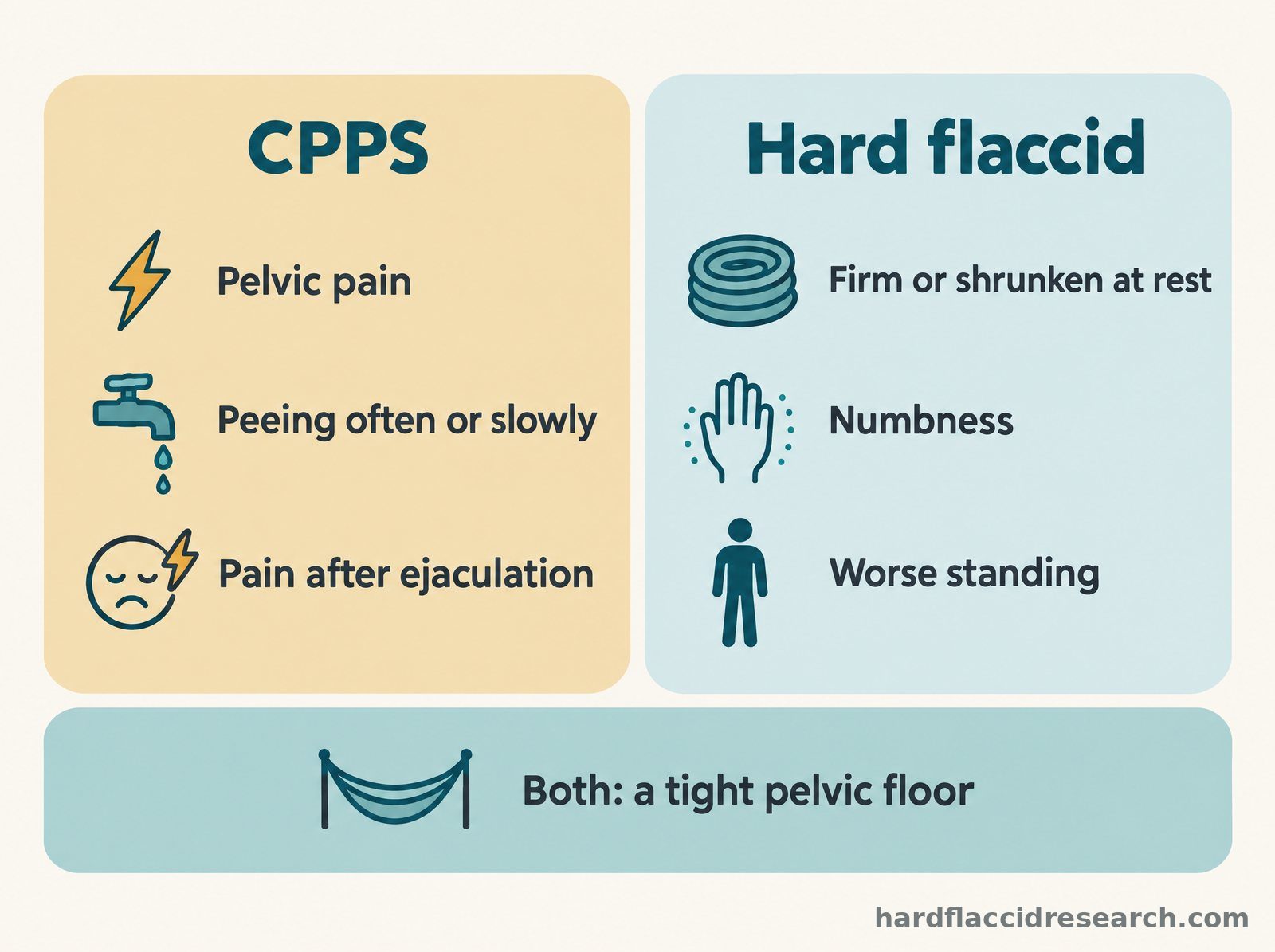
In CPPS, pain is the main feature, and the resting penis usually looks and feels normal. Numbness is less typical.
Many men have features of both. Among the 337 men with hard flaccid who described urinary problems, 69% also described the firm flaccid state, 56% numbness, 56% weaker erections and 37% pelvic floor tightness.
Among the 267 men with hard flaccid who described pelvic, perineal or tailbone pain, 72% also described the firm flaccid state, 56% numbness, 55% weaker erections and 45% pelvic floor tightness. These are self-selected reports, not a clinical study.
The main differences:
- Main feature: CPPS is mainly pain and peeing problems. Hard flaccid is mainly a firm, shrunken or numb resting penis.
- The resting penis: usually normal in CPPS. Firm, rubbery or shrunken in hard flaccid.
- Ejaculation: pain during or after ejaculation is common in CPPS. In hard flaccid, 202 men described weak or painful orgasms or ejaculation problems, so ejaculation problems don't tell the two apart on their own.
- Shared ground: both are often linked to a tight pelvic floor, though this isn't proven, and both flare with sitting, sex and stress. In one February 2023 poll of men with hard flaccid, 78% said their hard flaccid was worse after sex or masturbation (92 of 118 men). In one April 2023 poll of men with hard flaccid, 76% said they had anxiety before hard flaccid (94 of 123 men), though that doesn't show that anxiety caused it, and hard flaccid often causes anxiety too.
You can have both, and only a doctor's check can tell. Get checked for an infection first.
What men with hard flaccid syndrome report
These numbers come from men with hard flaccid syndrome, not from men with proven prostatitis. 378 men with hard flaccid mentioned alpha blockers. In one May 2023 poll of men with hard flaccid who had tried one, 45% said it helped at least somewhat (22 of 49 men) and 55% said it didn't help (27 of 49 men). Alpha blockers came up in 6 of 126 recovery stories, though a story mentioning something is not proof that it worked. Alpha blockers can make you dizzy, especially when you stand up.
In a separate February 2023 poll of men with hard flaccid who had tried anti-inflammatories, 56% noticed at least a small improvement (18 of 32 men). The two polls asked different men, so they don't show which works better. Anti-inflammatories can upset the stomach and affect the kidneys and heart.
Among the 337 men with hard flaccid and urinary problems, the approaches mentioned most were stretching of the hips and legs (62%), tadalafil (51%), Kegels (46%), rest or abstinence (40%), pelvic floor physio (39%) and reverse Kegels (38%). Other approaches came up too, and being mentioned is not the same as working. Tadalafil is a prescription medicine: never take it with nitrate medicines for chest pain or with poppers, because together they can drop your blood pressure dangerously. If your pelvic floor feels tight, ask a pelvic floor physio before doing Kegels, and if you do them, let go fully between squeezes.
Living with chronic prostatitis
Long-lasting pelvic pain can wear you down. Many men with chronic prostatitis feel worried or low, and it can affect erections, sex and relationships. It can also change semen, so see a doctor if you are trying for a baby. Pacing your days, regular gentle exercise and talking with your partner may help, and a doctor can suggest a counsellor.
If you are feeling hopeless or having thoughts of ending your life, please visit our Support page now. It lists crisis lines you can call or text.
Common questions about prostatitis
Is prostatitis a sexually transmitted infection? Usually not. Chronic prostatitis or CPPS isn't an infection, and bacterial prostatitis is usually caused by the bacteria that cause urine infections, though a sexually transmitted infection can cause it, so a doctor may test for one.
Can prostatitis go away? Acute bacterial prostatitis usually clears with prompt antibiotics. Chronic bacterial prostatitis can need a longer course and can come back. Many men with chronic prostatitis or CPPS get some relief with treatment, though not always complete relief, and it can come and go.
Can you have sex with prostatitis? Usually yes. If the infection may have come from sex, avoid sex until you and your partner have been tested and, if needed, treated. Some men have pain during or after ejaculation, and a doctor can help with that. Whether ejaculating more often helps hasn't been proven.
Does prostatitis cause prostate cancer? There's no proof that it does. It can raise a PSA blood test result for a while, so tell your doctor if you have symptoms when you have one.
Can prostatitis cause erection problems? It can, especially chronic prostatitis. Doctors think pain, worry and tight pelvic floor muscles may each play a part. A doctor can help with the pain and with erections, and if your erections have changed, a blood test for blood sugar (HbA1c) and cholesterol is worth asking for.
Is prostatitis the same as an enlarged prostate? No. An enlarged prostate is a non-cancerous growth of the gland that is common in older men and can slow the stream. Prostatitis is soreness or inflammation, and it is more common in younger and middle-aged men.
When to see a doctor
See a doctor soon if you have pain or burning when you pee, pelvic pain, peeing problems, pain when you ejaculate, or blood in your semen. Don't wait for it to pass, because an infection needs prompt treatment. A GP can test for infection and refer you to a urologist or a pelvic health physio.
Get urgent care straight away if you have:
- An erection lasting more than 4 hours.
- Blood in your urine that you can see.
- Sudden, severe pain in the penis, testicles or pelvis.
- New numbness around your back passage, genitals or inner thighs, or new weakness in your legs.
- New trouble starting or controlling your pee, not being able to pee, or not feeling when your bladder is full.
- Loss of control of your bladder or bowel.
- A fever or chills with pelvic pain or pain when peeing.
What to do next
- Ask your GP for a urine test to check for an infection.
- Keep a diary for two weeks: how often you pee, where it hurts, and what makes it worse.
- Ask for a referral to a pelvic health physiotherapist.
- Take breaks from sitting and avoid straining on the toilet.
- Take a doctor visit kit to your appointment, and take our self-check to see how your symptoms compare.
If you're worried about how a visit will go, many men with hard flaccid syndrome feel the same: in one November 2022 poll of men with hard flaccid who had seen a urologist, 95% called their visits bad and unhelpful (63 of 66 men). That poll was about hard flaccid, not prostatitis, and a urologist is the right doctor for prostatitis. It's a reason to prepare well with the doctor visit kit, not to skip the visit.
Our members' guide, Bladder and Bowel Problems With Hard Flaccid: What Helps, covers peeing and bowel symptoms step by step.
Free tools that can help
- Self-check: do I have hard flaccid?Compare your symptoms with what 6,026 men report.
- Doctor visit kitA one-page summary to take to your appointment.
- Habit trackerCount your days without porn or masturbation, and get through urges.
- Diaphragm breathing toolBreathe with a moving picture of your diaphragm and pelvic floor.
- Add your experienceTell us what you tried and how it went. No name needed.
- Hard Flaccid Syndrome CensusWhat men answered in 818 polls.
- Symptom trackerLog your symptoms and see what helps you.
- Ask us a questionThe questions men ask most become new articles.
The numbers behind this article
Every number in this article comes from what men with hard flaccid syndrome shared between December 2020 and October 2026, counted once per person, or from their polls. These are self-selected reports, not a clinical study. See hard flaccid syndrome statistics, the Hard Flaccid Syndrome Census and how we count.
Symptoms men with hard flaccid syndrome describe, and where CPPS fits
Share of the 2,661 men with hard flaccid syndrome who described their symptoms. CPPS is mainly pain and peeing problems; hard flaccid syndrome is mainly the resting penis.These are self-selected reports, not a clinical study.
Source: Hard Flaccid Research, hardflaccidresearch.com
What else men with hard flaccid syndrome and urinary problems described
Share of the 337 men with hard flaccid syndrome who described urinary problems who also described each symptom. Other symptoms came up too.These are self-selected reports, not a clinical study.
Source: Hard Flaccid Research, hardflaccidresearch.com
What else men with hard flaccid syndrome and pelvic pain described
Share of the 267 men with hard flaccid syndrome who described pelvic, perineal or tailbone pain who also described each symptom. Other symptoms came up too.These are self-selected reports, not a clinical study.
Source: Hard Flaccid Research, hardflaccidresearch.com
What men with hard flaccid syndrome and urinary problems mentioned
Share of the 337 men with hard flaccid syndrome who described urinary problems who mentioned each. Other approaches came up too. Mentioned is not the same as worked.Tadalafil: never with nitrate medicines for chest pain or with poppers.
Source: Hard Flaccid Research, hardflaccidresearch.com
Men with hard flaccid syndrome who described, mentioned or asked about each
Number of men with hard flaccid syndrome, counted once per person.Source: Hard Flaccid Research, hardflaccidresearch.com
What men with hard flaccid syndrome said about alpha blockers
Each bar has its own base: one poll of men with hard flaccid syndrome who tried an alpha blocker, or the 126 hard flaccid syndrome recovery stories.These are men with hard flaccid syndrome, not men with prostatitis. A story mentioning something is not proof that it worked. Alpha blockers can make you dizzy.
Source: Hard Flaccid Research, hardflaccidresearch.com
What men with hard flaccid syndrome said in four separate polls
Each bar is a separate poll of men with hard flaccid syndrome, with its own base, so the bars can't be compared.These are men with hard flaccid syndrome, not men with prostatitis. Having anxiety before hard flaccid syndrome doesn't show that anxiety caused it. Anti-inflammatories can upset the stomach and affect the kidneys and heart.
Source: Hard Flaccid Research, hardflaccidresearch.com
Every number in this article, with its source
| In this article | Source |
|---|---|
| 337 men described urinary problems (13% of 2,661) | 337 of 2,661 men, counted from what men wrote, once per person |
| 107 men asked why they have urinary problems | Question group, 107 men, research data |
| 58% (1,553 of 2,661) describe the firm, semi-rigid flaccid state | 1,553 of 2,661 men, counted from what men wrote, once per person |
| 34% (914 of 2,661) describe numbness or loss of feeling | 914 of 2,661 men, counted from what men wrote, once per person |
| 10% (267 of 2,661) describe pelvic, perineal or tailbone pain | 267 of 2,661 men, counted from what men wrote, once per person |
| Of men with urinary problems: 69% firm flaccid state, 56% numbness, 56% weaker erections, 37% pelvic floor tightness | 337 men with urinary problems, counted from what men wrote, once per person |
| Approaches mentioned by men with urinary problems: stretching 62%, tadalafil 51%, Kegels 46%, rest or abstinence 40%, pelvic floor physio 39%, reverse Kegels 38% | 337 men with urinary problems, counted from what men wrote, once per person |
| 202 men described weak or painful orgasms or ejaculation problems | 202 men, counted from what men wrote, once per person |
| 78% worse after sex or masturbation (92 of 118 men) | 92 of 118 men, poll, Feb 2023 |
| 76% had anxiety before hard flaccid (94 of 123 men) | 94 of 123 men, poll, Apr 2023 |
| 378 men mentioned alpha blockers | 378 men, counted from what men wrote, once per person |
| 45% said an alpha blocker helped at least somewhat (22 of 49 men) | 22 of 49 men, poll, May 2023 |
| 55% said an alpha blocker didn't help (27 of 49 men) | 27 of 49 men, poll, May 2023 |
| 126 recovery stories | 126 men, counted from what men wrote, once per person |
| Alpha blockers came up in 6 of 126 recovery stories | 6 of 126 recovery stories |
| 56% noticed at least a small improvement from anti-inflammatories (18 of 32 men) | 18 of 32 men, poll, Feb 2023 |
| 95% called urologist visits bad and unhelpful (63 of 66 men) | 63 of 66 men, poll, Nov 2022 |
| Counting since December 2020 | Research data, December 2020 to October 2026 |
| 2,661 of the 6,026 men who shared their experiences described their symptoms | Research data, December 2020 to October 2026 |
| Of 267 men with pelvic, perineal or tailbone pain: 72% firm flaccid state, 56% numbness, 55% weaker erections, 45% pelvic floor tightness | 267 men with pelvic, perineal or tailbone pain, counted from what men wrote, once per person |
How we made this article
We started from the question 107 men asked. Every number was checked against our data. Our editorial team edited it and Dr. Julian Reyes reviewed it medically. Read our editorial policy.
Read next
- Alpha Blockers for Hard Flaccid: 45% of Men Said They HelpArticle
- Perineum Pain With Hard Flaccid: Why It Hurts, What HelpsArticle
- Hard Flaccid Pudendal Surgery: 82 Men, 0 Recovery StoriesArticle
- Urinary problemsSymptom
- Pelvic and perineal painSymptom
- Orgasm and ejaculation problemsSymptom
- Alpha blockersTreatment
See more of us on Google
Add Hard Flaccid Research as a preferred source, and Google shows you our pages more often when you search.
Add as a preferred sourceDon't see your question? Ask us. We answer the most-asked ones in new articles.
Cite and share this article
You're welcome to quote this article. Please name Hard Flaccid Research and link to this page, so others can find the full answer and the data behind it. To cite this page, use its link.
Citation
Hard Flaccid Research. (2026). Prostatitis or Hard Flaccid? Symptoms, Types and Treatment. Written by the Editorial Team, medically reviewed by Dr. Julian Reyes. https://hardflaccidresearch.com/articles/prostatitis-or-hard-flaccid
Credit link for your article
Source: <a href="https://hardflaccidresearch.com/articles/prostatitis-or-hard-flaccid">Hard Flaccid Research</a>
Wikipedia reference
<ref>{{cite web |url=https://hardflaccidresearch.com/articles/prostatitis-or-hard-flaccid |title=Prostatitis or Hard Flaccid? Symptoms, Types and Treatment |website=Hard Flaccid Research |date=2026 |access-date=28 October 2026}}</ref>
How the data was collected: our methodology. Journalists and researchers: key numbers, data and contact.