Psychogenic ED: When Erection Problems Start in the Mind
In short
- Psychogenic erectile dysfunction is trouble getting or keeping an erection that comes mainly from psychological factors, such as performance anxiety, stress, depression or relationship problems, rather than from a physical problem.
- Clues include a sudden start, erections that come and go depending on the situation, and normal morning or solo erections.
- It's very treatable, often with talk therapy, sex therapy, sensate focus and, when needed, medicines.
Psychogenic erectile dysfunction (ED) is trouble getting or keeping an erection that comes mainly from the mind rather than from a physical problem. Performance anxiety, stress, depression, relationship difficulties, past bad experiences and worries about sex can all interfere with the signals that start and keep an erection.
It's common, especially in younger men, and it's very treatable. Many men find that once they understand how anxiety affects erections, and take the pressure off sex, things improve. Talk therapy, sex therapy, a technique called sensate focus and, when needed, medicines all help. This page explains how psychological factors affect erections, the signs that ED may be psychogenic, and the treatments that work.
By the numbers: of the 6,026 men who shared their experiences with hard flaccid syndrome, 2,661 described their symptoms, and 926 of them described weaker or lost erections.

Key facts
- Psychogenic ED comes mainly from psychological factors rather than from blood vessels, nerves or hormones.
- Performance anxiety, stress, depression and relationship problems are common causes.
- Clues include a sudden start, erections that depend on the situation, and normal morning or solo erections.
- Many men have a mix of physical and psychological factors. Anxiety often follows even a physical cause.
- US urology guidelines describe ED as a condition with physical and psychological sides, and support referral to a mental health professional when it helps.
- A review of trials found that group therapy focused on sex helped ED, and therapy plus medicine worked better than medicine alone.
- Sensate focus, a step-by-step touching exercise, is a key part of sex therapy.
How does anxiety affect erections?
An erection starts with arousal in the brain and body. Nerve signals tell the arteries and erectile tissue of the penis to relax, so blood rushes in. This relaxation is controlled by the parasympathetic nervous system, the body's rest-and-digest system.
Anxiety switches on the opposite system, the sympathetic or fight-or-flight system. It tightens blood vessels and smooth muscle and helps the penis go soft. That's why it's hard to get or keep an erection when you're worried, stressed or watching yourself closely.
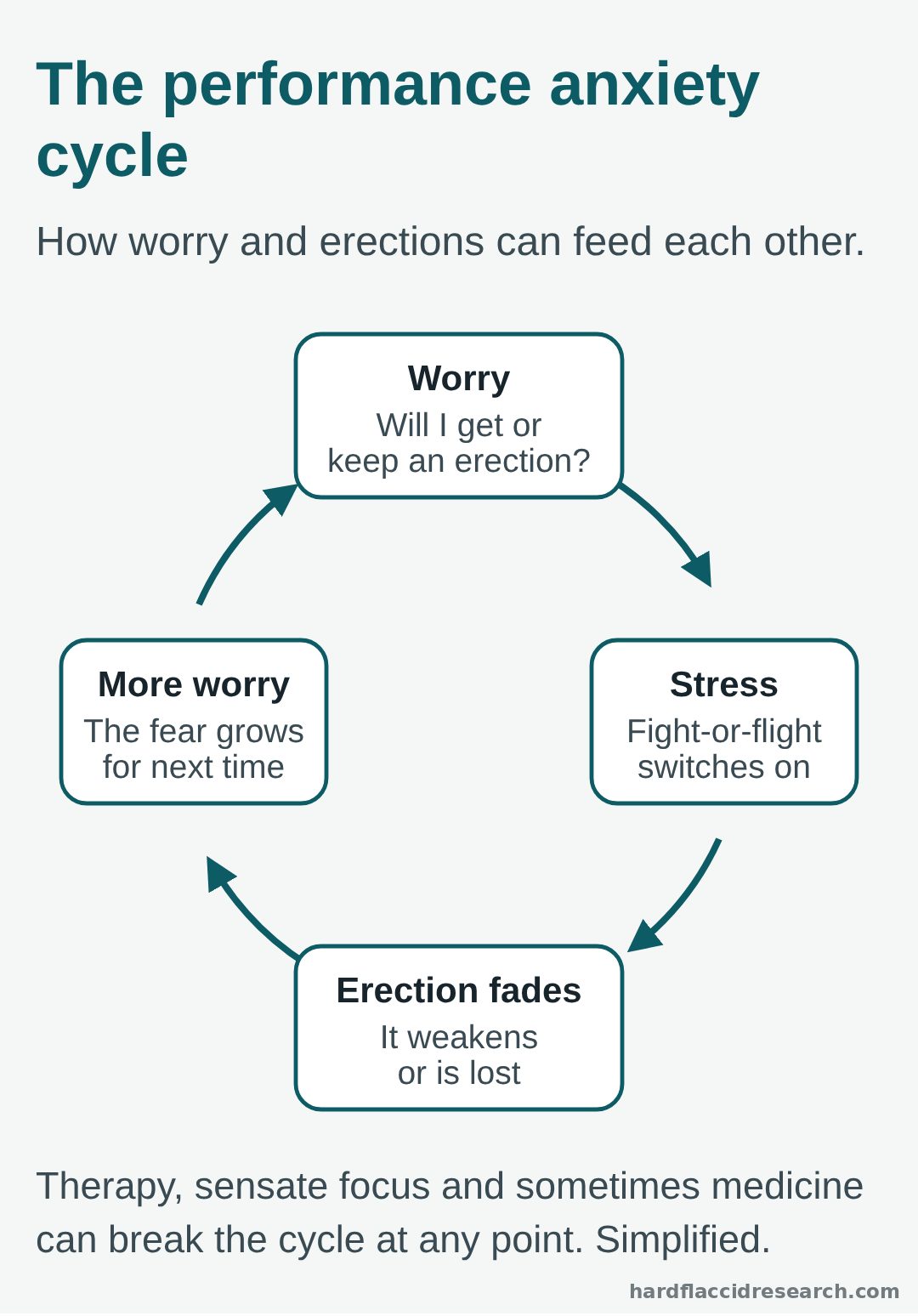
This can turn into a cycle:
- A man worries about whether he'll get or keep an erection.
- The worry switches on the stress response.
- The erection weakens or is lost.
- The next time, the worry is stronger.
What causes psychogenic ED?
- Performance anxiety, worry about satisfying a partner or about erections themselves.
- General stress, from work, money or life changes.
- Depression and anxiety disorders.
- Relationship problems, conflict or lack of trust.
- Past negative sexual experiences, trauma or shame about sex.
- Pornography habits that make real-life sex feel different, for some men.
- Some medicines for depression and anxiety can also affect erections, which can make it harder to tell causes apart.
Is my ED psychological or physical?
These clues suggest a psychological cause, though none is proof:
- It started suddenly, often around a stressful event or a bad experience.
- Erections are fine in some situations, such as alone or with one partner, but not others.
- You still have morning or night-time erections.
- You're young and otherwise healthy.
These suggest a physical cause may be involved:
- It came on gradually and is the same in every situation.
- Morning and night-time erections have faded too.
- You have diabetes, high blood pressure, heart disease, high cholesterol, or you smoke.
- You've had pelvic surgery, an injury or nerve problems.
Many men have both. A doctor can help sort out the mix, and a check for physical causes is always worthwhile.
Related: Low Libido and Hard Flaccid: Why 83% Say Their Drive Dropped »
What about morning erections?
Erections during sleep, which men often notice as morning erections, happen during dream sleep and don't depend on arousal or anxiety. If they're normal, the blood vessels and nerves are likely working, which points toward a psychological cause. But morning erections vary from day to day with sleep and other factors, so their absence alone doesn't prove a physical problem. Doctors can test night-time erections more formally if needed.
How is psychogenic ED treated?
Talk therapy and sex therapy
A therapist, ideally one trained in sexual health, can help with performance anxiety, stress, low mood and relationship issues. Cognitive behavioral therapy helps you notice and change anxious thoughts. A review of trials found that focused sex group therapy improved ED compared with no treatment.
Sensate focus
Sensate focus is a series of touching exercises that a couple does in stages, starting with non-sexual touch and slowly building up, with intercourse off the table at first. It takes the pressure off performance and helps arousal return naturally.
Medicines
Medicines for ED can help break the anxiety cycle by giving confidence. In trials reviewed, men who had group therapy plus medicine did better than with medicine alone. A doctor can advise whether medicine is right for you.
Treating anxiety and depression
Treating an underlying anxiety disorder or depression often improves erections. If a medicine for mood seems to affect erections, talk to your doctor rather than stopping it.
Lifestyle
Exercise, good sleep, cutting back on alcohol and not smoking all help mood, stress and blood flow.
What can I do on my own?
- Take the focus off erections. Enjoy touch and closeness without aiming for intercourse.
- Talk openly with your partner about what's happening. Many partners worry it's about them.
- Notice anxious thoughts and practice letting them pass, using slow breathing.
- Limit alcohol, which lowers erection quality and can add to worry.
- Get regular exercise and enough sleep.
- Cut back on porn if you notice it affects arousal with a partner.
- Be patient. Erections often return as the pressure eases.
Psychogenic ED and hard flaccid syndrome
Hard flaccid syndrome is a firm, shrunken penis at rest, often with numbness, weaker erections and pelvic pain. Some doctors think stress and the fight-or-flight response, along with a tense pelvic floor, may help keep hard flaccid going. This isn't proven. Hard flaccid isn't simply psychological, but anxiety about it can add a psychogenic layer to weaker erections.
Of the 2,661 men who described their symptoms, 35% described weaker or lost erections (926 men). In an April 2023 poll, 76% said they had anxiety before hard flaccid (94 of 123 men), and in a January 2023 poll, 9% said they had morning erections every day (12 of 128 men). In a separate count, 603 men discussed therapy, CBT, mindfulness or meditation.
Our members' guide, Hard Flaccid and Anxiety: How to Get Your Life Back, has practical tools for calming the stress response.
When should I see a doctor?
See a primary care provider or a urologist if erection problems last more than a few weeks or affect your life or relationship. A check for physical causes is important, and your doctor can refer you to a therapist.
Get urgent care straight away (call 911 or go to the emergency room) if you have:
- Thoughts of harming yourself. In the US, call or text 988 for the Suicide and Crisis Lifeline.
- Chest pain, pressure or shortness of breath.
- An erection that lasts more than four hours, or a painful erection that won't go down.
- New numbness around your back passage, genitals or inner thighs, or new weakness in your legs.
Frequently asked questions
Does psychogenic ED go away?
It's very treatable, and many men recover fully with therapy, sensate focus, lifestyle changes and, when needed, medicine.
How do I know if my ED is psychological?
A sudden start, erections that depend on the situation and normal morning erections suggest it. A doctor should still check for physical causes.
Can anxiety cause ED in young men?
Yes. Performance anxiety is one of the most common causes of ED in younger men.
Do ED medicines work for psychogenic ED?
They often help, especially to break the anxiety cycle. Combining them with therapy tends to work better.
How long does psychogenic ED last?
It varies. With the right help, many men improve within weeks to months.
Can porn cause psychogenic ED?
For some men, heavy use may make real-life arousal feel different. Cutting back helps some men.
Can a urologist diagnose psychogenic ED?
A urologist or primary care provider can check for physical causes and, if they find none or only minor ones, refer you to a therapist.
Is psychogenic ED my partner's fault?
No. It's common and has many causes. Working on it together, without blame, usually helps most.
Can stress at work cause erection problems?
Yes. Ongoing stress keeps the fight-or-flight system switched on, which can make erections harder to get and keep.
Takeaway
Psychogenic ED comes mainly from anxiety, stress, mood or relationship factors, and often shows as a sudden start, situational erections and normal morning erections.
It's very treatable with therapy, sensate focus, lifestyle changes and, when needed, medicine, after a check for physical causes. Take our free self-check if you also notice changes in your penis at rest.
This article is for general information and isn't a substitute for advice from your own doctor. Hard Flaccid Research doesn't diagnose or treat. If you have new or worsening symptoms, see a qualified clinician. In an emergency, call 911.
Free tools that can help
- Self-check: do I have hard flaccid?Compare your symptoms with what 6,026 men report.
- Doctor visit kitA one-page summary to take to your appointment.
- Habit trackerCount your days without porn or masturbation, and get through urges.
- Diaphragm breathing toolBreathe with a moving picture of your diaphragm and pelvic floor.
- Add your experienceTell us what you tried and how it went. No name needed.
- Hard Flaccid Syndrome CensusWhat men answered in 818 polls.
- Symptom trackerLog your symptoms and see what helps you.
- Ask us a questionThe questions men ask most become new articles.
The numbers behind this article
Every number in this article comes from what men with hard flaccid syndrome shared between December 2020 and October 2026, counted once per person, or from their polls. These are self-selected reports, not a clinical study. See hard flaccid syndrome statistics, the Hard Flaccid Syndrome Census and how we count.
9% said they had morning erections every day
How 128 men with hard flaccid syndrome answered a January 2023 poll.In our polls, men choose to answer.
Source: Hard Flaccid Research, hardflaccidresearch.com
76% said they had anxiety before hard flaccid
How 123 men answered an April 2023 poll.In our polls, men choose to answer. This doesn't show that anxiety causes hard flaccid.
Source: Hard Flaccid Research, hardflaccidresearch.com
Every number in this article, with its source
| In this article | Source |
|---|---|
| 35% of the men who described their symptoms described weaker or lost erections (926 of 2,661) | 926 of 2,661 men, counted |
| 6,026 men shared their experiences, and 2,661 of them described their symptoms | 2,661 of 6,026 men, counted |
| 76% said they had anxiety before hard flaccid (94 of 123 men) | 94 of 123 men, poll, Apr 2023 |
| 603 men discussed therapy, CBT, mindfulness or meditation | 603 men discussing therapy, CBT, mindfulness or meditation, counted from what men wrote, once per person |
| 9% said they had morning erections every day (12 of 128 men) | 12 of 128 men, poll, Jan 2023 |
Medical sources
What this article says about medical research, guidelines and urgent care comes from these sources.
- Burnett AL, Nehra A, Breau RH, et al. Erectile dysfunction: AUA guideline. J Urol. 2018;200(3):633-641. https://doi.org/10.1016/j.juro.2018.05.004
- Melnik T, Soares B, Nasello AG. Psychosocial interventions for erectile dysfunction. Cochrane Database Syst Rev. 2007;(3):CD004825. https://doi.org/10.1002/14651858.CD004825.pub2
- Dean RC, Lue TF. Physiology of penile erection and pathophysiology of erectile dysfunction. Urol Clin North Am. 2005;32(4):379-395. https://doi.org/10.1016/j.ucl.2005.08.007
- Physiology, Erection. In: StatPearls. Treasure Island (FL): StatPearls Publishing. https://www.ncbi.nlm.nih.gov/books/NBK513278/
- Lue TF. Erectile dysfunction. N Engl J Med. 2000;342(24):1802-1813. https://doi.org/10.1056/NEJM200006153422407
- Abdessater M, Kanbar A, Akakpo W, Beley S. Hard flaccid syndrome: state of current knowledge. Basic Clin Androl. 2020;30:7. https://doi.org/10.1186/s12610-020-00105-5
How we made this article
We started from the question many men asked. Every number was checked against our data. Our editorial team edited it and Dr. Julian Reyes reviewed it medically. Read our editorial policy.
Read next
See more of us on Google
Add Hard Flaccid Research as a preferred source, and Google shows you our pages more often when you search.
Add as a preferred sourceDon't see your question? Ask us. We answer the most-asked ones in new articles.
Cite and share this article
You're welcome to quote this article. Please name Hard Flaccid Research and link to this page, so others can find the full answer and the data behind it. To cite this page, use its link.
Citation
Hard Flaccid Research. (2026). Psychogenic ED: When Erection Problems Start in the Mind. Written by the Editorial Team, medically reviewed by Dr. Julian Reyes. https://hardflaccidresearch.com/articles/psychogenic-erectile-dysfunction
Credit link for your article
Source: <a href="https://hardflaccidresearch.com/articles/psychogenic-erectile-dysfunction">Hard Flaccid Research</a>
Wikipedia reference
<ref>{{cite web |url=https://hardflaccidresearch.com/articles/psychogenic-erectile-dysfunction |title=Psychogenic ED: When Erection Problems Start in the Mind |website=Hard Flaccid Research |date=2026 |access-date=22 November 2026}}</ref>
How the data was collected: our methodology. Journalists and researchers: key numbers, data and contact.