Low Libido and Hard Flaccid: Why 83% Say Their Drive Dropped
In short
- Low libido, a lower sex drive, is something many men with hard flaccid syndrome report: in one April 2023 poll of men with hard flaccid syndrome, 83% said their libido was lower or gone since hard flaccid began (71 of 86 men).
- Desire depends on the body, the mind and how sex feels, and hard flaccid may affect it through numbness, worry about erections and low mood, though none of this is proven.
- Low libido also has many other causes, so a doctor can check hormones, medicines and mood, and taking the pressure off sex may help.
45 men with hard flaccid asked this question.
Low libido means less interest in sex than you'd expect, or than you used to have. Many men with hard flaccid syndrome report it. Hard flaccid is when the penis stays firm, rubbery or shrunken when it should be soft, and in one April 2023 poll of men with hard flaccid, 83% said their libido was lower or gone since hard flaccid began (71 of 86 men).
230 men with hard flaccid described low libido in their own words, and separately, 45 men with hard flaccid asked why their libido is low. This page explains what libido is, how it differs from erection problems, why hard flaccid may turn it down, what else can lower it, how to raise it, what to know about libido boosters, and how sensate focus can take the pressure off sex.
By the numbers: of the 6,026 men with hard flaccid who shared their experiences between December 2020 and October 2026, 2,661 described their symptoms, and 9% of them described low libido (230 of 2,661). Counts from what men wrote run lower than poll answers, because men weren't asked. These are men with hard flaccid, not men in general.
What is libido?
Libido is your sex drive: how much you want sex, think about it or notice that you fancy someone. There is no normal amount. It varies a lot from one man to the next, and for the same man it rises and falls with age, stress, health, sleep, mood and how a relationship is going. Partners often have different sex drives, which is common and doesn't mean anything is wrong.
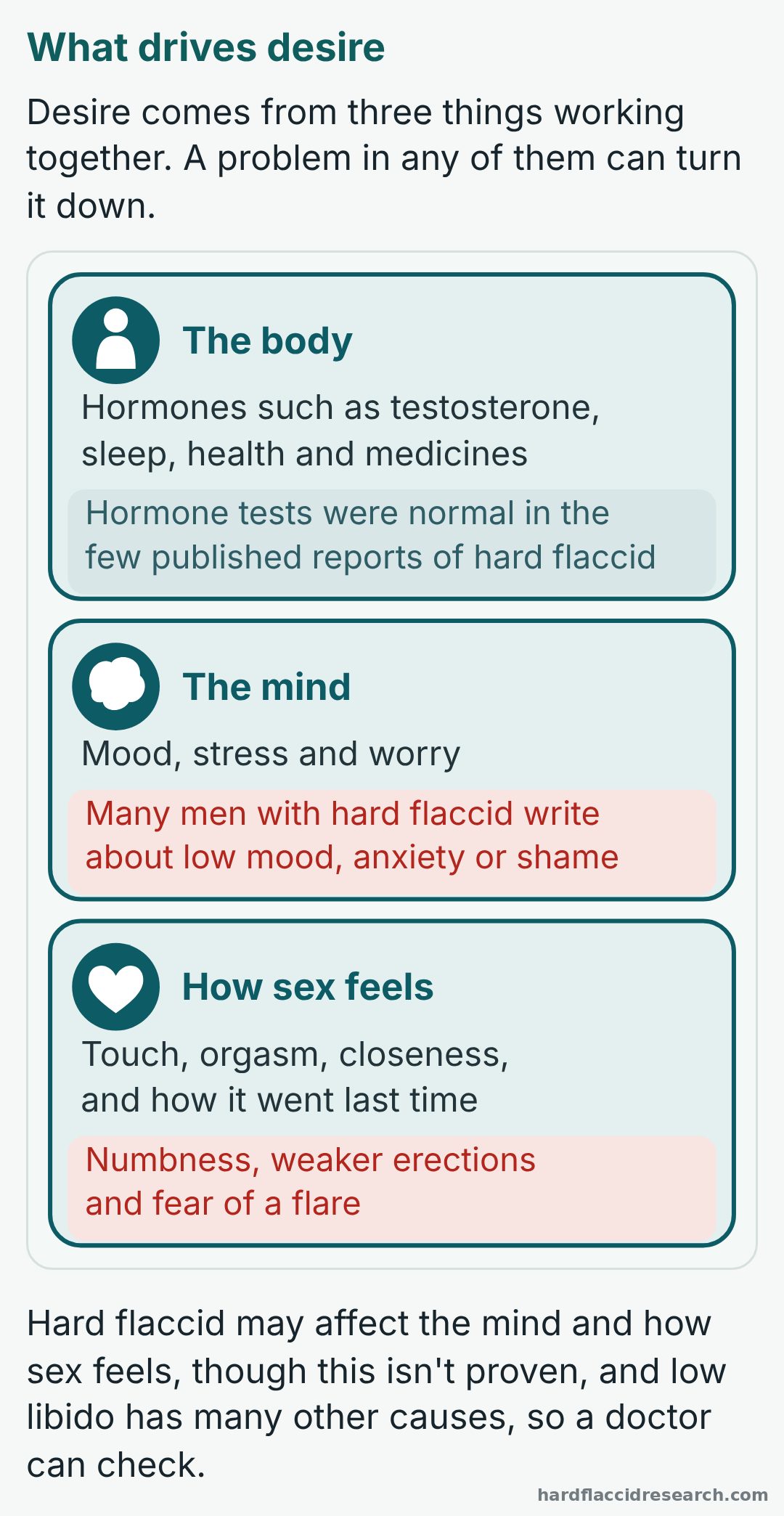
Desire comes from three things working together, a bit like a three-legged stool. Hormones such as testosterone keep the body's desire signal switched on. Mood and stress set how much room the brain has for desire. How sex feels, and whether it goes well, teaches the brain whether to want more of it. A problem in any of them can turn desire down.
Low libido is a problem when it bothers you or your relationship, or when it is a change from what is usual for you. A drop that comes on quickly, or that comes with other changes, is worth getting checked.
Hard Flaccid Explorerby Hard Flaccid Research
Why sex drive may drop
A 7-minute animated explainer of this article. Press play, or skip between chapters. The first minute is free for everyone.
A picture to explain, not a diagnosis. Desire isn't drawn: the picture shows the pelvic floor, a nerve and blood flow.
Low libido or erectile dysfunction?
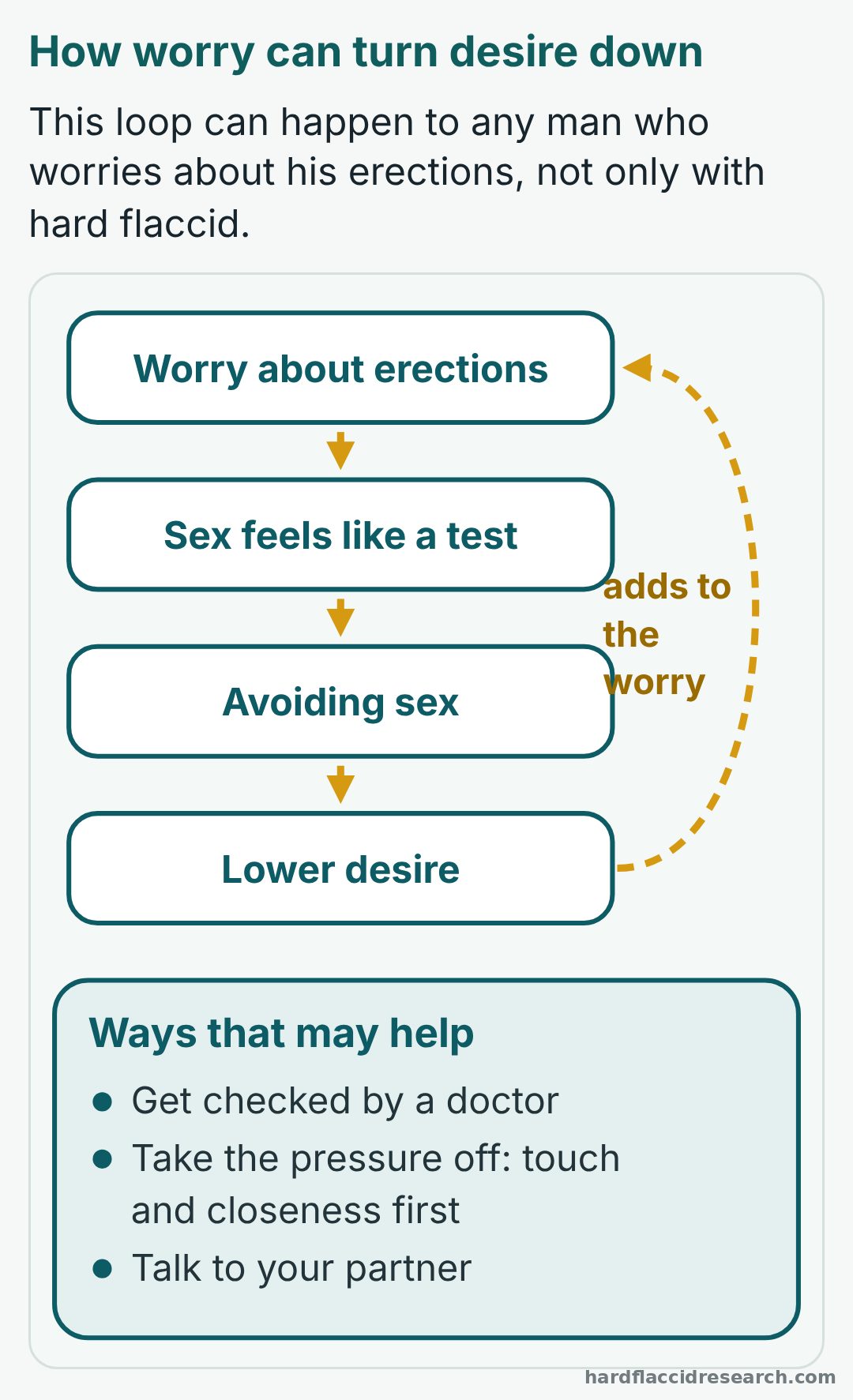
They are different things. Low libido means wanting sex less. Erectile dysfunction (ED) means trouble getting or keeping an erection firm enough for sex, even when you want it. Many men with hard flaccid syndrome have both, and each can feed the other: unreliable erections can make sex feel like a test and turn desire down, and low desire can make erections harder to get.
Telling a doctor which came first, and whether you still wake with erections, helps them work out what's going on.
Related: Post-Finasteride Syndrome and Hard Flaccid: The Overlap »
Why might hard flaccid lower libido?
Research hasn't looked closely at why desire drops in hard flaccid syndrome. These are the reasons that fit what men with hard flaccid describe, though none is proven:
- Sex feels different. Numbness can make touch and orgasm feel weaker, and weak or painful orgasms can make sex less rewarding.
- Worry about erections. When erections are unreliable, sex can feel like a test. Worry often turns into avoiding sex, and avoiding it can lower desire further.
- Low mood and anxiety. Living with hard flaccid is hard, and both low mood and anxiety can lower desire.
- Fear of a flare. Men who notice their symptoms are worse after sex or masturbation may hold back.
- Shame or embarrassment, which can make closeness harder to start.
Many of the 230 men with hard flaccid who described low libido described other symptoms too: the firm flaccid state (72%), weaker erections (67%), numbness (63%), shrinkage (48%) and pelvic floor tightness (34%). Men who described one symptom tended to describe more of every kind, so these shares can't show what turned their drive down. 202 men with hard flaccid described weak or painful orgasms or ejaculation problems (8% of 2,661).
916 men with hard flaccid wrote about anxiety, 550 about low mood or depression, and 186 about shame or embarrassment. Separately, one February 2023 poll asked men with hard flaccid whether their symptoms were worse after sex or masturbation, and nothing about libido: 78% said they were (92 of 118 men) and 22% noticed no change (26 of 118 men). In the April 2023 poll, 42% said their libido was lower (36 of 86 men), 41% that it was gone (35 of 86 men) and 17% that it hadn't changed (15 of 86 men). These are self-selected reports, not a clinical study.
Other causes of low libido
Low libido has many causes besides hard flaccid syndrome, and more than one can be at work:
- Low testosterone, which a morning blood test, usually repeated, can check. Our article on low testosterone and hard flaccid explains the test.
- Some antidepressants, especially SSRIs and SNRIs, which often lower desire or make orgasm harder. Don't stop them suddenly, which can cause withdrawal symptoms and bring back low mood: a doctor can often change the dose or the medicine. In some people these effects carry on after stopping, and doctors don't yet know how often.
- Finasteride and dutasteride, for hair loss or an enlarged prostate, which can lower desire and cause other sexual side effects in some men. They can also cause low mood, and finasteride, rarely, thoughts of suicide. In some men, sexual side effects have been reported to carry on after stopping. Don't stop or change them on your own: talk to your doctor.
- Opioid painkillers, which can lower testosterone and desire. Stopping them suddenly can be dangerous, so ask your doctor first.
- Anabolic steroids, which can shut down your own testosterone for a long time after you stop.
- Depression, which lowers desire whatever its cause and is worth treating in its own right.
- Poor sleep, tiredness and long-term stress.
- Heavy drinking or drug use.
- Relationship problems, or a lot of pressure around sex.
- Other health conditions, such as diabetes, an underactive thyroid, too much of a hormone called prolactin, or a long-term illness.
Separately, 236 men with hard flaccid discussed antidepressants or anti-anxiety medicines. Anti-anxiety medicines can cause drowsiness, and some can be habit-forming. If you take any medicine and your desire changed after you started it, tell your doctor rather than stopping it yourself.
Related: Low Testosterone and Hard Flaccid: Should You Get Tested? »
When low desire is a condition
When low desire lasts a long time and causes you real distress, doctors may call it hypoactive sexual desire disorder. It is only called that when another condition, a medicine, serious relationship problems or other major stress don't explain it better. In men with hard flaccid syndrome, hard flaccid itself, mood, a medicine or another condition may explain a lower drive, so the first step is a check-up rather than a label.
How to increase libido
There's no instant fix. Treating what's behind it is the first step, and these may help:
- Get checked. A doctor can look at hormones, medicines, mood and other conditions, and treat what they find.
- Treat low mood and anxiety. Talking therapy, such as CBT, and mindfulness or meditation may help with worry and low mood whatever caused them, and a sex therapist may help with pressure around sex.
- Review your medicines with a doctor or pharmacist, without stopping any on your own.
- Look after the basics: sleep, being active, cutting down on alcohol and managing stress.
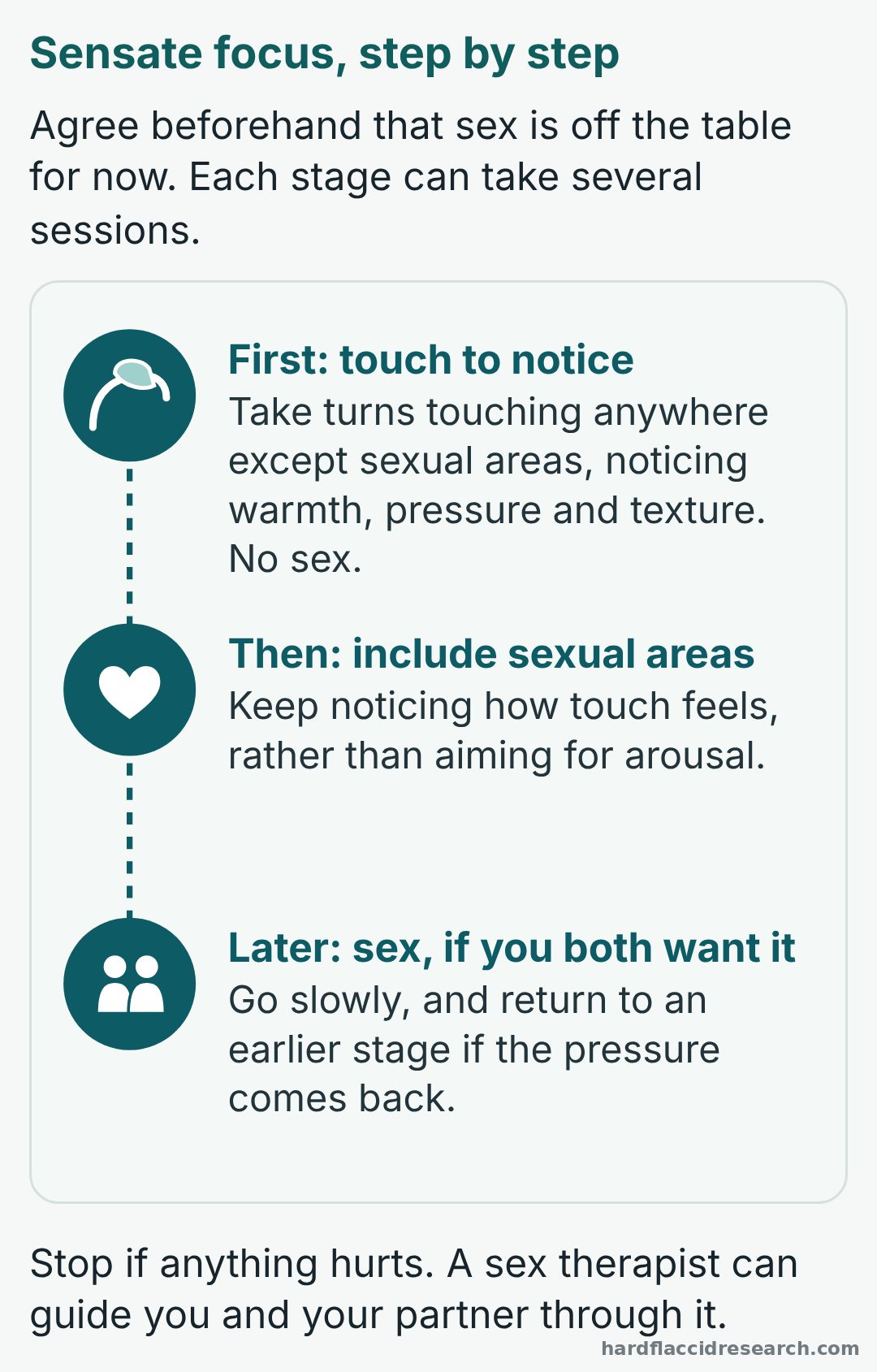
- Make time for closeness without pressure, such as sensate focus (below).
- A doctor may offer testosterone only if blood tests show a low level. It can switch off sperm production, thicken the blood and raise blood pressure (see below).
Talk to a doctor first. In most countries testosterone is a prescription medicine, and it only helps if blood tests show a low level. It switches off your body's own testosterone and sperm production and can cause infertility, and it can thicken the blood and raise blood pressure, so men on it need regular checks. Get urgent care for chest pain, sudden breathlessness, or a painful, swollen leg. Antidepressants can lower desire and make orgasm harder, and stopping them suddenly can cause withdrawal. Finasteride and dutasteride can cause sexual side effects and low mood, and finasteride, rarely, thoughts of suicide. Opioid painkillers can lower desire, and stopping them suddenly can be dangerous. Never buy testosterone, steroids or boosters online, and tell your doctor about every medicine and supplement you take. Never start, stop or change a medicine on your own.
Separately, 603 men with hard flaccid syndrome discussed talking therapy, CBT, mindfulness or meditation. In a different group, 99 men with hard flaccid discussed testosterone or hormone treatment, which needs a doctor because of the risks above. The two counts don't compare the treatments, and discussing something is not the same as using it, or as it working.
Libido boosters, supplements and foods
Supplements sold as libido boosters for men contain herbs such as maca, ginseng, tribulus or horny goat weed. Most have only small studies with mixed results, none has been tested in hard flaccid syndrome, and 'natural' doesn't mean safe. Maca may not be safe with hormone-sensitive conditions. Ginseng can cause trouble sleeping and can interact with blood thinners and diabetes medicines. Tribulus can upset the stomach and has been linked to rare cases of liver and kidney damage. Horny goat weed may lower blood pressure, which matters if you take blood pressure or nitrate medicines, and can cause a fast or uneven heartbeat. Tell your doctor or pharmacist about every supplement you take.
Some products sold for 'male enhancement' have been found to contain hidden prescription erection medicines, which regulators warn about. Taken with nitrate medicines for chest pain or with poppers, these can drop your blood pressure dangerously. Don't buy sexual enhancement products online or from shops: their labels may not say what's in them.
No food has been shown to boost libido on its own. A diet that is good for your heart is good for your blood vessels too, which may help erections, and feeling well tends to help desire.
Sex, relationships and sensate focus
Our article on sex life and relationships with hard flaccid covers flare-ups after sex and talking to a partner. On this page, one number matters: in one July 2023 poll that asked men with hard flaccid syndrome whether they had had regular sex since hard flaccid began, and nothing about desire, 42% had had none (67 of 159 men), 28% some but not regular (45 of 159 men) and 30% regular sex (47 of 159 men). Separately, 37 men with hard flaccid asked whether they can have a relationship or sex life with hard flaccid.
Sensate focus is a technique sex therapists use to take the pressure off. You agree beforehand that sex is off the table for now. Then you and your partner take turns touching, paying attention to how the touch feels, such as warmth, pressure and texture, rather than trying to arouse each other or reach an erection or orgasm. Touch starts away from the genitals and breasts, moves on to them over later sessions, and sex is added back only when you both feel ready. A sex therapist can guide you through it, and many couples find that desire comes back more easily once sex stops feeling like a test.
If your sex drives don't match, that's common in couples and doesn't mean anything is wrong. A sex therapist or couples counsellor may help you both find a way through.
Will libido come back?
We don't have numbers on libido coming back by itself. Desire is closely linked to mood, worry and how sex feels, so it may lift as those improve. In one June 2023 poll of men with hard flaccid syndrome, 42% said they were at least half better than when hard flaccid started (56 of 132 men); that poll asked about hard flaccid overall, not libido.
Looking after your mood
Low libido can feel like losing part of yourself, and it often comes with low mood. Talk to someone you trust, and tell your doctor how you're feeling, because low mood deserves treatment in its own right.
If you are feeling hopeless or having thoughts of ending your life, please visit our Support page now. It lists crisis lines you can call or text today.
Common questions about libido
Does libido drop with age? It tends to fall slowly over the years, but a sudden or big drop is unlikely to be age alone and is worth getting checked.
Can hard flaccid lower testosterone? It isn't known to: in the few published cases where doctors measured hormones in men with hard flaccid syndrome, levels were normal. A morning blood test is how to check yours.
Does masturbation lower libido? Not in a lasting way that's known. Desire normally dips for a while after orgasm and then comes back.
Can stress kill your sex drive? It can lower it a lot. Stress keeps the body on alert, which leaves little room for desire, and it often brings poor sleep and worry about sex with it.
Can I have no sex drive but still get erections? Yes. Desire and erections are linked but not the same, so you can have erections, including morning ones, with little desire, or desire with weak erections. Telling your doctor which you have helps.
Does exercise increase libido? Being active may help by lifting mood, energy and sleep, and it is good for your blood vessels too. Very hard training with too little rest can lower desire in some men.
Is low libido a sign of something serious? Often not, but it can be an early sign of low testosterone, diabetes, depression or, rarely, a problem with the pituitary gland under the brain, which is why a check-up is worth it.
When to see a doctor
See a doctor if your libido has dropped for more than a few weeks, especially with low mood, tiredness or erection problems. Ask about blood tests for testosterone, thyroid and blood sugar, and go through any medicines you take. If you've had numbness between your legs for a while, or pain that is clearly worse when sitting, ask a doctor to check the nerves, including the pudendal nerve. New numbness there needs urgent care (see the list below).
Talking about sex drive can feel awkward, but doctors hear about it every day. It helps to say when it changed, whether that was before or after your hard flaccid syndrome began, whether you still get erections, including in the morning, what medicines and supplements you take, and how your mood and sleep are. Our doctor visit kit helps you put it on one page.
Get urgent care straight away if you have:
- Thoughts of ending your life, or of harming yourself.
- An erection lasting more than 4 hours.
- Sudden, severe pain in the penis, testicles or pelvis.
- New numbness around your back passage, genitals or inner thighs, or new weakness in your legs.
- New trouble starting or controlling your pee, not being able to pee, or not feeling when your bladder is full.
- Loss of control of your bladder or bowel.
- A fever or chills with pelvic pain or pain when peeing.
What to do next
- If your symptoms haven't been checked, see a doctor first, because low libido can have other causes.
- Book a GP appointment and ask for a morning testosterone test and other blood tests.
- Go through your medicines with a doctor or pharmacist.
- Look after sleep, alcohol and stress, and track what changes.
- Try taking the pressure off sex with your partner: touch and closeness first.
- Use our self-check to see how your symptoms compare.
Our members' guide, Weak Erections With Hard Flaccid: The Gentle Way Back to Sex, has a step-by-step plan for coming back to sex gently.
Free tools that can help
- Self-check: do I have hard flaccid?Compare your symptoms with what 6,026 men report.
- Doctor visit kitA one-page summary to take to your appointment.
- Habit trackerCount your days without porn or masturbation, and get through urges.
- Diaphragm breathing toolBreathe with a moving picture of your diaphragm and pelvic floor.
- Add your experienceTell us what you tried and how it went. No name needed.
- Hard Flaccid Syndrome CensusWhat men answered in 818 polls.
- Symptom trackerLog your symptoms and see what helps you.
- Ask us a questionThe questions men ask most become new articles.
The numbers behind this article
Every number in this article comes from what men with hard flaccid syndrome shared between December 2020 and October 2026, counted once per person, or from their polls. These are self-selected reports, not a clinical study. See hard flaccid syndrome statistics, the Hard Flaccid Syndrome Census and how we count.
In one poll, 83% of men with hard flaccid syndrome said their libido was lower or gone since hard flaccid syndrome began (71 of 86 men)
How 86 men with hard flaccid syndrome answered an April 2023 poll: "How has hard flaccid syndrome affected your libido?"These are self-selected reports, not a clinical study.
Source: Hard Flaccid Research, hardflaccidresearch.com
Of the 230 men with hard flaccid syndrome who described low libido, 72% also described the firm flaccid state
Share of the 230 men with hard flaccid syndrome who described low libido who also described each symptom. Each man is counted once in each bar.Men who described one symptom tended to describe more of every kind, so this doesn't show what lowered their drive. These are self-selected reports, not a clinical study.
Source: Hard Flaccid Research, hardflaccidresearch.com
916 men with hard flaccid syndrome wrote about anxiety, and 230 described low libido
Number of men with hard flaccid syndrome in each group, counted once per person. Two bars are question groups.The groups overlap. Discussing something is not the same as using it, or as it working. Antidepressants can lower desire, and testosterone can switch off sperm production, thicken the blood and raise blood pressure. Never start, stop or change a medicine on your own.
Source: Hard Flaccid Research, hardflaccidresearch.com
In one poll, 78% of men with hard flaccid syndrome said their hard flaccid syndrome was worse after sex or masturbation (92 of 118 men)
How 118 men with hard flaccid syndrome answered a February 2023 poll: "Is your hard flaccid syndrome worse after masturbation or sex?"The poll asked nothing about libido. These are self-selected reports, not a clinical study.
Source: Hard Flaccid Research, hardflaccidresearch.com
In one poll, 42% of men with hard flaccid syndrome hadn't had sex since hard flaccid syndrome began (67 of 159 men)
How 159 men with hard flaccid syndrome answered a July 2023 poll: "Have you had regular sex since hard flaccid syndrome?"The poll asked about sex, not libido. These are self-selected reports, not a clinical study.
Source: Hard Flaccid Research, hardflaccidresearch.com
In one poll, 42% of men with hard flaccid syndrome said they were at least half better than at the start (56 of 132 men)
How 132 men with hard flaccid syndrome answered a June 2023 poll: "Have you healed?"The poll asked about hard flaccid syndrome overall, not libido. These are self-selected reports, not a clinical study.
Source: Hard Flaccid Research, hardflaccidresearch.com
In what men with hard flaccid syndrome wrote, 9% described low libido (230 of 2,661)
Share of the 2,661 men with hard flaccid syndrome who described their symptoms. Each man is counted once in each bar.Counts from what men wrote run lower than poll answers, because men weren't asked. These are self-selected reports, not a clinical study.
Source: Hard Flaccid Research, hardflaccidresearch.com
Every number in this article, with its source
| In this article | Source |
|---|---|
| 83% lower or no libido (71 of 86 men) | 71 of 86 men, poll, Apr 2023 |
| 42% said it was lower (36 of 86 men) | 36 of 86 men, poll, Apr 2023 |
| 41% said their libido was gone (35 of 86 men) | 35 of 86 men, poll, Apr 2023 |
| 17% said it hadn't changed (15 of 86 men) | 15 of 86 men, poll, Apr 2023 |
| 2,661 of the 6,026 men who shared their experiences described their symptoms | Research data, December 2020 to October 2026 |
| 9% described low libido (230 of 2,661) | 230 of 2,661 men, counted from what men wrote, once per person |
| 45 men asked why their libido is low | Question group, 45 men, research data |
| Of the 230 men who described low libido: 72% also described the firm flaccid state, 67% weaker erections, 63% numbness, 48% shrinkage, 34% pelvic floor tightness | 230 men who described low libido, counted from what men wrote, once per person |
| 8% described weak or painful orgasms or ejaculation problems (202 of 2,661) | 202 of 2,661 men, counted from what men wrote, once per person |
| 916 men wrote about anxiety | 916 men who wrote about anxiety, research data |
| 550 men wrote about low mood or depression | 550 men who wrote about low mood or depression, research data |
| 186 men wrote about shame or embarrassment | 186 men who wrote about shame or embarrassment, research data |
| 78% worse after sex or masturbation (92 of 118 men) | 92 of 118 men, poll, Feb 2023 |
| 22% noticed no change after sex or masturbation (26 of 118 men) | 26 of 118 men, poll, Feb 2023 |
| 236 men discussed antidepressants or anti-anxiety medicines | 236 men discussing antidepressants or anti-anxiety medicines, counted from what men wrote, once per person |
| 603 men discussed therapy, CBT, mindfulness or meditation | 603 men discussing therapy, CBT, mindfulness or meditation, counted from what men wrote, once per person |
| 99 men discussed testosterone or hormone treatment | 99 men discussing testosterone or hormone treatment, counted from what men wrote, once per person |
| 42% no sex since hard flaccid syndrome began (67 of 159 men) | 67 of 159 men, poll, Jul 2023 |
| 28% had sex but not regularly (45 of 159 men) | 45 of 159 men, poll, Jul 2023 |
| 30% had sex regularly (47 of 159 men) | 47 of 159 men, poll, Jul 2023 |
| 37 men asked whether they can have a relationship or sex life with hard flaccid | Question group, 37 men, research data |
| 42% at least half better (56 of 132 men) | 56 of 132 men, poll, Jun 2023 |
| 3% said fully healed (4 of 132 men) | 4 of 132 men, poll, Jun 2023 |
| 8% said about 90% better (10 of 132 men) | 10 of 132 men, poll, Jun 2023 |
| 32% said more than half better (42 of 132 men) | 42 of 132 men, poll, Jun 2023 |
| 58% said not healed (76 of 132 men) | 76 of 132 men, poll, Jun 2023 |
How we made this article
We started from the question 45 men asked. Every number was checked against our data. Our editorial team edited it and Dr. Julian Reyes reviewed it medically. Read our editorial policy.
Read next
See more of us on Google
Add Hard Flaccid Research as a preferred source, and Google shows you our pages more often when you search.
Add as a preferred sourceDon't see your question? Ask us. We answer the most-asked ones in new articles.
Cite and share this article
You're welcome to quote this article. Please name Hard Flaccid Research and link to this page, so others can find the full answer and the data behind it. To cite this page, use its link.
Citation
Hard Flaccid Research. (2026). Low Libido and Hard Flaccid: Why 83% Say Their Drive Dropped. Written by the Editorial Team, medically reviewed by Dr. Julian Reyes. https://hardflaccidresearch.com/articles/low-libido-hard-flaccid
Credit link for your article
Source: <a href="https://hardflaccidresearch.com/articles/low-libido-hard-flaccid">Hard Flaccid Research</a>
Wikipedia reference
<ref>{{cite web |url=https://hardflaccidresearch.com/articles/low-libido-hard-flaccid |title=Low Libido and Hard Flaccid: Why 83% Say Their Drive Dropped |website=Hard Flaccid Research |date=2026 |access-date=28 October 2026}}</ref>
How the data was collected: our methodology. Journalists and researchers: key numbers, data and contact.