What Does a Sex Therapist Do? When Men Should See One
In short
- A sex therapist is a licensed mental health professional who uses talk therapy to help with sexual problems, worries and relationships.
- Sessions are talk only, with homework you do in private, and there's no nudity or touching.
- Men see one for erection problems, trouble finishing, low desire, performance anxiety, or porn and masturbation habits that feel out of control.
A sex therapist is a licensed mental health professional who uses talk therapy to help with sexual problems, worries and relationships. You talk in sessions and do practice exercises at home, in private. There's no nudity or touching.
This page explains what a sex therapist does, what they can help men with, what the research shows, what happens in sessions and how to find a good one.
By the numbers: 71,368 men reported to us about porn and masturbation between January and October 2026. Of the 3,115 who told us what had helped them, 385 named therapy or counseling. These are reports from men who chose to tell us, not a clinical study.
Key facts
- Sex therapy is talk therapy for sexual concerns, and sessions involve no nudity, touching or sexual contact.
- It can help men with erection problems, trouble finishing, finishing too fast, low desire, performance anxiety, and porn or masturbation habits.
- Reviews of trials suggest talking treatments can help some sexual problems, especially alongside medical care, though studies in men are small.
- Of 3,115 men who told us what had helped them, 12% named therapy or counseling (385 men).
- Look for a licensed therapist with sex therapy training, such as one certified by AASECT, a US body for sex therapists.
Hard Flaccid Explorerby Hard Flaccid Research
What a sex therapist does
A 7-minute animated explainer of this article. Press play, or skip between chapters. The first minute is free for everyone.
A picture to explain, not a diagnosis.
What does a sex therapist do?
A sex therapist helps you understand what's going on with sex, then change it step by step. They talk with you about your body, thoughts, feelings, habits and relationship, and set goals with you.
They also explain how arousal, erections and orgasm work, which can ease a lot of worry. Between sessions, they give you exercises to practice at home, alone or with a partner.
Certified sex therapists hold a license in a field such as psychology, counseling, social work, marriage and family therapy, nursing or medicine. On top of that, they train in sexual health. If you need medicine or a physical exam, a sex therapist works alongside your doctor.
Before a first visit, it helps to write down your symptoms, when they began and what makes them better or worse.
What can a sex therapist help men with?
Sex therapists help with sexual problems that have a mental or relationship side, even when a physical cause is part of the picture. For men, that includes:
- Erection problems, especially ones that happen with a partner but not alone, or that come with worry before sex.
- Trouble finishing (delayed ejaculation) or finishing too fast (premature ejaculation). A US guideline on ejaculation disorders says doctors should consider referring men to a mental health professional with sexual health expertise.
- Death grip, when orgasm comes to depend on a very tight or fast masturbation style. It's a popular term, not a diagnosis.
- Low desire, or a gap between your desire and your partner's.
- Performance anxiety: worry about how you'll do in bed that makes sex harder.
- Porn or masturbation habits that feel out of control, and the shame that can come with them.
- Worries about what you like or who you're attracted to, and trouble talking about sex with a partner.
Of the 1,931 men who mentioned erection trouble when they reported to us, 43% also mentioned a partner (836 men).
Of the 293 men who described death grip symptoms to us between July 2024 and October 2026, 88 had trouble finishing during sex. Of those 88 men, 26% described anxiety, nerves or pressure to perform (23 men), and 28% described how their partner felt or reacted (25 men).
If you have hard flaccid syndrome
Hard flaccid syndrome is when the penis stays firm or shrunken at rest, often with numbness and weaker erections. A sex therapist can't treat the physical side, but may help with the worry and with your sex life, alongside medical care.
Talking therapy, cognitive behavioral therapy (CBT), mindfulness or meditation came up in 15 of 126 hard flaccid recovery stories that men shared with us. If you have hard flaccid, tell the sex therapist, and keep your doctor or pelvic floor physical therapist in the loop.
Can a sex therapist help with porn addiction?
It may. A sex therapist can help you understand why you turn to porn, cut back, and deal with shame and its effect on sex and relationships. Some focus on this work, so ask how they approach porn use before you book.
"Porn addiction" isn't an official diagnosis, though the World Health Organization's disease list (ICD-11) includes compulsive sexual behavior disorder. Feeling bad only because porn clashes with your values isn't enough for that diagnosis, and therapists don't all agree on the addiction label. Our porn addiction article covers the signs and the debate.
Shame can be part of it. Of the 3,613 men who called themselves addicted to porn when they reported to us, 34% described shame or guilt (1,227 men).
Of the 3,115 men who told us what had helped them, 25% named exercise and the gym (786 men). Therapy or counseling was named by 12% (385 men), about as often as faith and prayer or getting outside.
A therapist can help you build a plan that fits your life, such as phone rules, exercise and what to do when an urge hits.
If shame or low mood is wearing you down, or you're thinking about suicide, call or text 988, or visit our Support page for more crisis lines. If you can't keep yourself safe, call 911.
Related: Low Libido and Hard Flaccid: Why 83% Say Their Drive Dropped »
Does sex therapy work?
It can help some problems, but the research is small. Sex therapy seems to work best alongside medical care where that's needed, not instead of it.
A review of randomized trials, where people are put into groups by chance, found that psychological treatments improved sexual problems compared with waiting for treatment. The clearest results were for women's desire and orgasm problems, and the evidence for men's problems was thinner.
For erection problems, a review of small trials found that group therapy may improve erections compared with no treatment. Men who had group therapy as well as an erection pill did better than men who took the pill alone.
European sexual medicine experts recommend combining medical and psychological care for erection problems, and including partners where it fits. They also note that the studies so far are of low quality.
So sex therapy isn't a quick fix, and it doesn't replace a medical check. But it may reach the worry and habits that medicine can't. If worry or habits play a part, ask your doctor or a sex therapist how the two could fit together.
What happens in sex therapy?
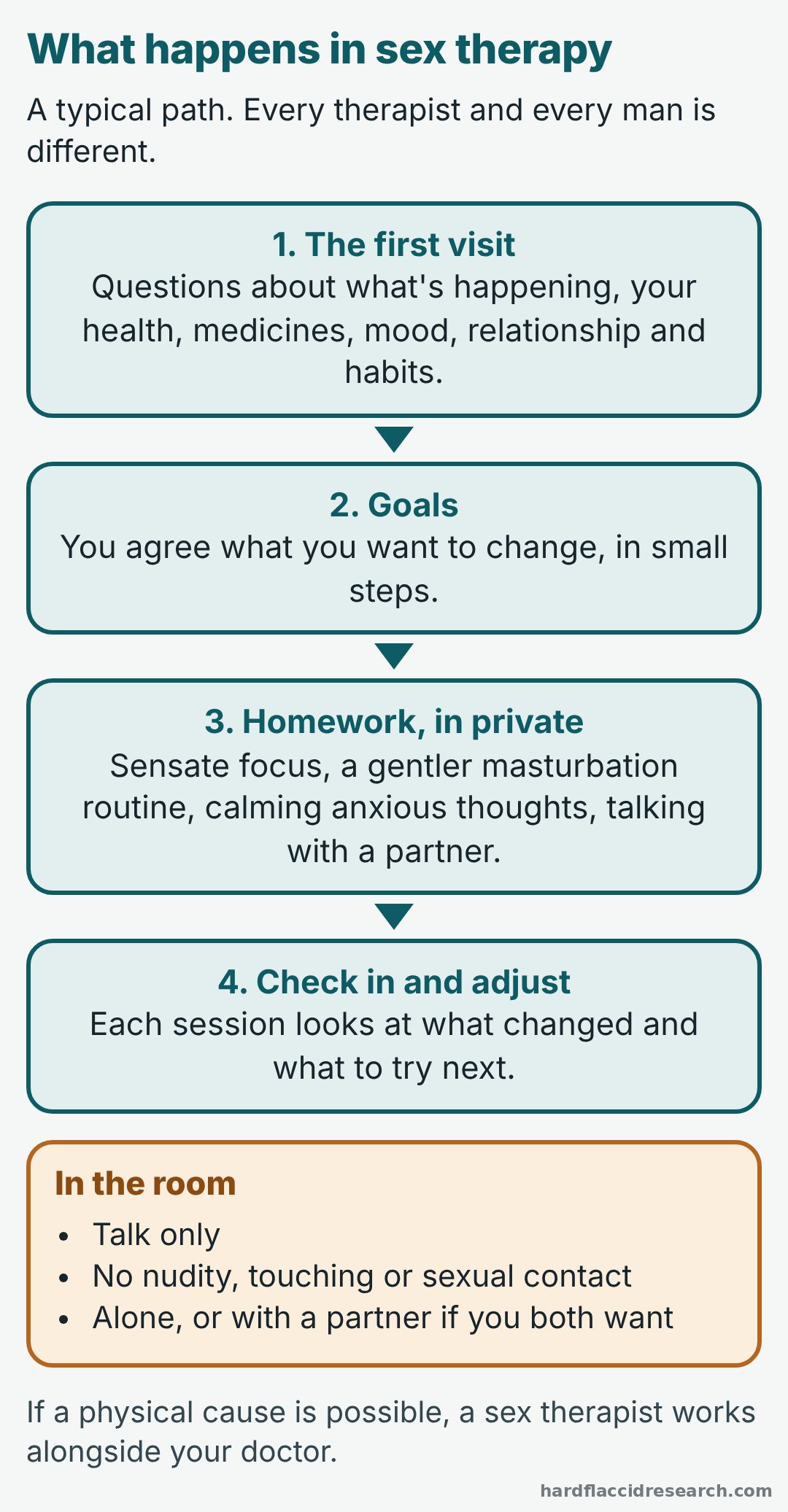
Sex therapy is a set of talk sessions. You and the therapist agree on goals, you practice exercises at home in private, and each visit looks at what changed.
The first session
The first visit is mostly questions. Expect to be asked what's happening, when it started, and whether it happens alone, with a partner, or both.
You'll also talk about your health, medicines, alcohol, mood and relationship, and how you masturbate and use porn. It can feel awkward, but these are everyday questions for a sex therapist.
If a physical cause is possible, they'll suggest you see a doctor too.
Homework at home
Much of the work happens between sessions, at home and in private. A sex therapist may suggest:
- Sensate focus: touching exercises with a partner, with no goal of an erection or orgasm, to take the pressure off.
- A new masturbation routine, such as a lighter grip, a slower pace and less porn, if your habit makes sex with a partner harder.
- Ways to notice and question anxious thoughts, from cognitive behavioral therapy (CBT).
- Mindfulness: paying attention to touch and feelings in the moment, instead of watching yourself.
- Talking exercises, so you and your partner can say what you want.
Our members' guide, Weak Erections With Hard Flaccid: The Gentle Way Back to Sex, goes through sensate focus step by step.
On your own or with a partner
You can go on your own. A partner may join some sessions if you both want, and US health guidance notes this can add support.
In what men told us about death grip, 479 named things they tried, or talked about trying. Of those, 16% named talking with their partner (78 men), 6% therapy (27 men), and 4% sensate focus or mindfulness (17 men). Naming something isn't proof it works.
If you have a partner, ask the therapist when it might help to bring them along.
Do sex therapists touch you?
No. Sex therapy is talk only. AASECT's code of conduct bans any sexual contact between a therapist and a client, even if the client agrees.
A sex therapist shouldn't ask you to undress or do anything sexual in a session. If one does, that's misconduct: stop the sessions and report them to their state licensing board.
A physical exam is a job for a doctor, or for a pelvic floor physical therapist if your pelvic muscles need checking. They should explain each step, ask before touching, offer a chaperone, and do an internal check only if you agree.
Licensed therapists must follow privacy rules set by law and by their licensing boards. Ask at the start how they keep what you say private.
Should I see a sex therapist or a doctor first?
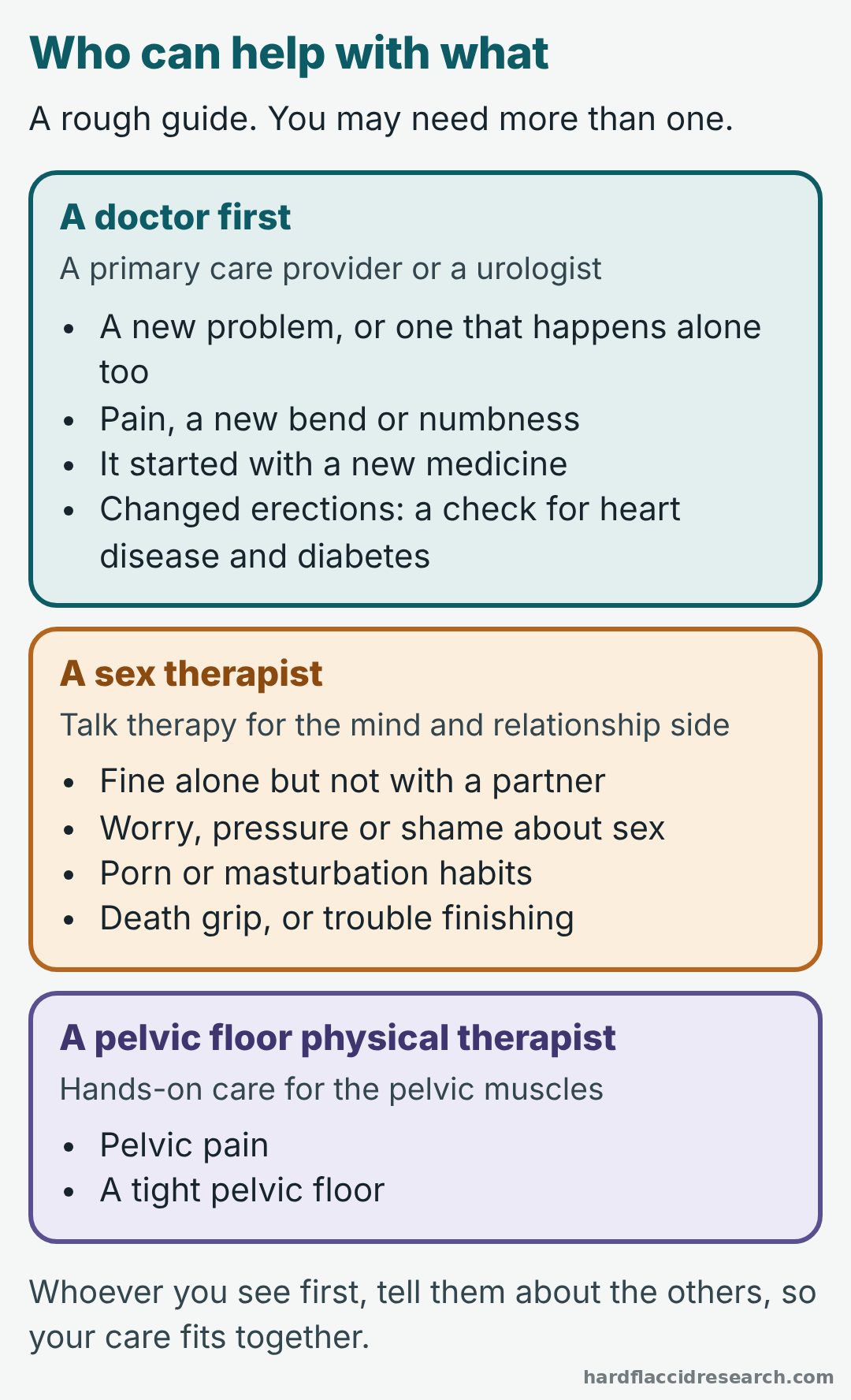
It depends on what's going on, and you may need both. As a rough guide:
- See a doctor first if the problem is new, happens alone as well as with a partner, comes with pain, a bend or numbness, or started with a new medicine.
- A sex therapist may be a good first step if things work alone but not with a partner, or if worry, shame or porn habits are driving it.
- See a pelvic floor physical therapist if you have pelvic pain or a tight pelvic floor.
Whoever you see first, tell them about the others, so your care fits together.
How do I find a sex therapist?
Start with the AASECT referral directory, which lists certified sex therapists by US state. You can also ask your primary care provider or a urologist (a doctor for urinary and sexual health) for a referral.
Check that the therapist is licensed where you live, and ask a few questions before you book:
- Do you see men with problems like mine?
- How do you work with porn or masturbation habits?
- Do you offer video sessions?
- Will you work with my doctor if I need medical care too?
Ask your health plan whether it covers therapy, and whether you need a referral. It's fine to try another therapist if the first one doesn't feel right.
What does AASECT certified mean?
An AASECT-certified sex therapist holds a state license in a field such as psychology, counseling, social work, nursing, medicine, or marriage and family therapy. They also complete sexuality education, sex therapy training, and hundreds of hours of supervised work with clients.
AASECT also certifies sexuality counselors. They use education and counseling skills, but they don't hold a license to provide psychotherapy.
Men who reported to us mentioned therapy far more often than sex therapy itself. In all, 1,123 men mentioned a therapist, counselor or psychologist, while 50 men mentioned sex therapy by name. If you already see a therapist, ask whether they have sex therapy training or can refer you to someone who does.
How do I know if sex therapy is working?
Look for small changes first. Signs it's working include:
- Less worry before and during sex.
- Reaching the small goals you set, such as finishing alone with a lighter touch.
- Talking about sex with your partner more easily.
- Feeling more in control of porn or masturbation.
Change takes time. If nothing has shifted after a few months, talk to your therapist about the plan, and see a doctor to check for a physical cause.
When should I see a doctor?
See a primary care provider or a urologist too if your erections have changed, or if it happens when you're alone as well. A US erection guideline says changed erections can be a warning sign of heart disease. Ask about a blood test for blood sugar and cholesterol too.
See one as well if it started with a new medicine, and don't stop a prescribed medicine on your own. Get pain, a new bend, or a penis that stays firm or numb at rest checked too.
Get urgent care straight away (call 911 or go to the emergency room) if you have:
- A popping or cracking sound during sex or masturbation, followed by sudden pain, a quick loss of erection, or rapid swelling or dark bruising.
- An erection lasting more than 4 hours.
- A plan to end your life, or feeling you can't keep yourself safe.
- Sudden, severe pain in the penis, testicles or pelvis.
- New numbness around your back passage, genitals or inner thighs, or new weakness in your legs.
- New trouble starting or controlling your pee, not being able to pee, or not feeling when your bladder is full.
- Loss of control of your bladder or bowel.
- A fever or chills with pelvic pain or pain when peeing.
For everything else, book a routine visit and bring our doctor visit kit, so you can explain what's going on without hunting for words.
Frequently asked questions
Can I see a sex therapist on my own?
Yes. You don't need a partner to see a sex therapist. Performance anxiety, death grip and porn habits can all be worked on alone, and a partner can join later if you both want.
Will a sex therapist judge me?
They shouldn't. AASECT certification includes structured training that has therapists examine their own attitudes about sex, so they can listen without judging. If you do feel judged, it's okay to find someone else.
Can I see a sex therapist online?
Yes, some sex therapists offer video sessions. Check that they're licensed in the state where you live, and find a private space where you can talk freely.
How long does sex therapy take?
It varies with the problem. Some problems ease in a few sessions, while others take months. Ask at the first visit what to expect, and review your progress together as you go.
Takeaway
A sex therapist helps with sexual problems through talk and private homework, with no touching. They can help with erection worries, trouble finishing, low desire and porn habits, alongside medical care when it's needed.
Start by writing down what's going on. Then look up an AASECT-certified sex therapist in your state, and see a doctor too if your erections have changed.
This article is for general information and isn't a substitute for advice from your own doctor. Hard Flaccid Research doesn't diagnose or treat. If you have new or worsening symptoms, see a qualified clinician. In an emergency, call 911.
Free tools that can help
- Self-check: do I have hard flaccid?Compare your symptoms with what 6,026 men report.
- Doctor visit kitA one-page summary to take to your appointment.
- Habit trackerCount your days without porn or masturbation, and get through urges.
- Diaphragm breathing toolBreathe with a moving picture of your diaphragm and pelvic floor.
- Add your experienceTell us what you tried and how it went. No name needed.
- Hard Flaccid Syndrome CensusWhat men answered in 818 polls.
- Symptom trackerLog your symptoms and see what helps you.
- Ask us a questionThe questions men ask most become new articles.
The numbers behind this article
Most numbers in this article come from what 71,368 men reported to us about porn and masturbation between January and October 2026, and from what 1,175 men reported to us about death grip between July 2024 and October 2026, counted once per person. A few come from what men with hard flaccid syndrome shared between December 2020 and October 2026, kept separate from the rest. These are reports from men who chose to tell us, not a clinical study, and a man counts only when he described something about himself. See how we count.
12% of men who told us what had helped them named therapy or counseling
Share of the 3,115 men who told us what had helped them who named each one.These are reports from men who chose to tell us, not a clinical study. Men could name more than one thing, and saying something helped isn't proof that it works. A man counted when he named a method and a word such as helped or worked for me in one sentence. Some answers, such as medicines, aren't shown.
Source: Hard Flaccid Research, hardflaccidresearch.com
34% of men who called themselves addicted to porn described shame or guilt
Share of the 3,613 men who called themselves addicted to porn who described or mentioned each.We don't know how many of these men tried therapy, so the last bar isn't a success rate. Reports from men who chose to tell us, not a clinical study.
Source: Hard Flaccid Research, hardflaccidresearch.com
43% of men who mentioned erection trouble also mentioned a partner
Share of the 1,931 men who mentioned erection trouble who mentioned or described each.Mentioning something isn't the same as having it diagnosed or treated. Reports from men who chose to tell us, not a clinical study.
Source: Hard Flaccid Research, hardflaccidresearch.com
26% of men who had trouble finishing during sex described anxiety or pressure to perform
Share of the 88 men in our death grip reports with trouble finishing during sex who described each.A small group, from reports men chose to send us, not a clinical study.
Source: Hard Flaccid Research, hardflaccidresearch.com
16% of men who told us what they tried for death grip named talking with their partner
Share of the 479 men in our death grip reports who named things they tried, or talked about trying, who named each of these. Naming something isn't proof it works.Only the talking and therapy answers are shown here. Men could name more than one thing, and naming something isn't proof that it works.
Source: Hard Flaccid Research, hardflaccidresearch.com
1,123 men mentioned a therapist, counselor or psychologist; 50 mentioned sex therapy
Number of men who mentioned each kind of professional when they reported to us about porn and masturbation.A mention isn't the same as a visit. Reports from men who chose to tell us, not a clinical study.
Source: Hard Flaccid Research, hardflaccidresearch.com
Every number in this article, with its source
| In this article | Source |
|---|---|
| 71,368 men reported to us about porn and masturbation | 71,368 men who reported to us about porn and masturbation, Jan to Oct 2026 |
| 12% named therapy or counseling as something that had helped them (385 of 3,115 men) | 385 of 3,115 men who reported to us about porn and masturbation, Jan to Oct 2026 |
| 25% named exercise and the gym as something that had helped them (786 of 3,115 men) | 786 of 3,115 men who reported to us about porn and masturbation, Jan to Oct 2026 |
| 13% named faith and prayer as something that had helped them (409 of 3,115 men) | 409 of 3,115 men who reported to us about porn and masturbation, Jan to Oct 2026 |
| 12% named getting outside or walks as something that had helped them (379 of 3,115 men) | 379 of 3,115 men who reported to us about porn and masturbation, Jan to Oct 2026 |
| 11% named staying busy or hobbies as something that had helped them (335 of 3,115 men) | 335 of 3,115 men who reported to us about porn and masturbation, Jan to Oct 2026 |
| 8% named sleep as something that had helped them (260 of 3,115 men) | 260 of 3,115 men who reported to us about porn and masturbation, Jan to Oct 2026 |
| 8% named telling someone or accountability as something that had helped them (256 of 3,115 men) | 256 of 3,115 men who reported to us about porn and masturbation, Jan to Oct 2026 |
| 7% named friends and people as something that had helped them (215 of 3,115 men) | 215 of 3,115 men who reported to us about porn and masturbation, Jan to Oct 2026 |
| 8% named cold showers as something that had helped them (234 of 3,115 men) | 234 of 3,115 men who reported to us about porn and masturbation, Jan to Oct 2026 |
| 6% named blocking apps and filters as something that had helped them (200 of 3,115 men) | 200 of 3,115 men who reported to us about porn and masturbation, Jan to Oct 2026 |
| 6% named meditation as something that had helped them (173 of 3,115 men) | 173 of 3,115 men who reported to us about porn and masturbation, Jan to Oct 2026 |
| 4% named journaling as something that had helped them (139 of 3,115 men) | 139 of 3,115 men who reported to us about porn and masturbation, Jan to Oct 2026 |
| 5% named phone rules as something that had helped them (156 of 3,115 men) | 156 of 3,115 men who reported to us about porn and masturbation, Jan to Oct 2026 |
| 3,613 men called themselves addicted to porn | 3,613 men who reported to us about porn and masturbation, Jan to Oct 2026 |
| 34% of them described shame or guilt (1,227 of 3,613 men) | 1,227 of 3,613 men who reported to us about porn and masturbation, Jan to Oct 2026 |
| 36% of them mentioned a partner (1,290 of 3,613 men) | 1,290 of 3,613 men who reported to us about porn and masturbation, Jan to Oct 2026 |
| 12% of them mentioned depression (420 of 3,613 men) | 420 of 3,613 men who reported to us about porn and masturbation, Jan to Oct 2026 |
| 8% of them mentioned erection trouble (297 of 3,613 men) | 297 of 3,613 men who reported to us about porn and masturbation, Jan to Oct 2026 |
| 3% of them said therapy or counseling had helped (117 of 3,613 men) | 117 of 3,613 men who reported to us about porn and masturbation, Jan to Oct 2026 |
| 1,931 men mentioned erection trouble | 1,931 men who reported to us about porn and masturbation, Jan to Oct 2026 |
| 43% of them also mentioned a partner (836 of 1,931 men) | 836 of 1,931 men who reported to us about porn and masturbation, Jan to Oct 2026 |
| 24% of them described shame or guilt (466 of 1,931 men) | 466 of 1,931 men who reported to us about porn and masturbation, Jan to Oct 2026 |
| 7% of them mentioned a doctor (127 of 1,931 men) | 127 of 1,931 men who reported to us about porn and masturbation, Jan to Oct 2026 |
| 1,123 men mentioned a therapist, counselor or psychologist | 1,123 men who reported to us about porn and masturbation, Jan to Oct 2026 |
| 505 men mentioned a doctor, urologist or physician | 505 men who reported to us about porn and masturbation, Jan to Oct 2026 |
| 50 men mentioned sex therapy by name | 50 men who reported to us about porn and masturbation, Jan to Oct 2026 |
| 1,175 men reported to us about death grip, July 2024 to October 2026 | 1,175 men who reported to us about death grip, Jul 2024 to Oct 2026 |
| Death grip reports, July 2024 to October 2026: 88 of 293 men who described their symptoms had trouble finishing during sex | 88 of 293 men who reported to us about death grip, Jul 2024 to Oct 2026 |
| 26% of the 88 described anxiety, nerves or pressure to perform (23 of 88 men) | 23 of 88 men who reported to us about death grip, Jul 2024 to Oct 2026 |
| 28% of the 88 described how their partner felt or reacted (25 of 88 men) | 25 of 88 men who reported to us about death grip, Jul 2024 to Oct 2026 |
| 19% of the 88 described less feeling (17 of 88 men) | 17 of 88 men who reported to us about death grip, Jul 2024 to Oct 2026 |
| 479 men named things they tried for death grip, or talked about trying | 479 men who reported to us about death grip, Jul 2024 to Oct 2026 |
| 16% named talking with their partner (78 of 479 men) | 78 of 479 men who reported to us about death grip, Jul 2024 to Oct 2026 |
| 6% named therapy (27 of 479 men) | 27 of 479 men who reported to us about death grip, Jul 2024 to Oct 2026 |
| 4% named sensate focus or mindfulness (17 of 479 men) | 17 of 479 men who reported to us about death grip, Jul 2024 to Oct 2026 |
| Talking therapy, CBT, mindfulness or meditation came up in 15 of 126 hard flaccid recovery stories men shared | 15 of 126 recovery stories |
| 126 hard flaccid recovery stories | 126 men, counted from what men wrote, once per person |
Medical sources
What this article says about medical research, guidelines and urgent care comes from these sources.
- American Association of Sexuality Educators, Counselors and Therapists (AASECT). AASECT certified sex therapist: requirements. https://www.aasect.org/node/333
- American Association of Sexuality Educators, Counselors and Therapists (AASECT). AASECT certified sexuality counselor: requirements. https://www.aasect.org/node/331
- American Association of Sexuality Educators, Counselors and Therapists (AASECT). Position on touch and the AASECT certified professional. https://www.aasect.org/node/5059
- American Association of Sexuality Educators, Counselors and Therapists (AASECT). AASECT position on sex addiction. https://www.aasect.org/node/6341
- American Association of Sexuality Educators, Counselors and Therapists (AASECT). Referral directory. https://www.aasect.org/referral-directory
- Frühauf S, Gerger H, Schmidt HM, Munder T, Barth J. Efficacy of psychological interventions for sexual dysfunction: a systematic review and meta-analysis. Arch Sex Behav. 2013;42(6):915-933. https://doi.org/10.1007/s10508-012-0062-0
- Melnik T, Soares BGO, Nasello AG. Psychosocial interventions for erectile dysfunction. Cochrane Database Syst Rev. 2007;(3):CD004825. https://doi.org/10.1002/14651858.CD004825.pub2
- Dewitte M, Bettocchi C, Carvalho J, et al. A psychosocial approach to erectile dysfunction: position statements from the European Society of Sexual Medicine (ESSM). Sex Med. 2021;9(6):100434. https://doi.org/10.1016/j.esxm.2021.100434
- Shindel AW, Althof SE, Carrier S, et al. Disorders of ejaculation: an AUA/SMSNA guideline. J Urol. 2022;207(3):504-512. https://doi.org/10.1097/JU.0000000000002392
- Burnett AL, Nehra A, Breau RH, et al. Erectile dysfunction: AUA guideline. J Urol. 2018;200(3):633-641. https://doi.org/10.1016/j.juro.2018.05.004
- National Institute of Diabetes and Digestive and Kidney Diseases. Treatment for erectile dysfunction. https://www.niddk.nih.gov/health-information/urologic-diseases/erectile-dysfunction/treatment
- Baxter R. What is the sensate focus technique? International Society for Sexual Medicine (ISSM), 21 February 2024. https://www.issm.info/sexual-health-qa/what-is-the-sensate-focus-technique
- South H. What is "death grip syndrome" during male masturbation and how might it affect partnered sexual activity? International Society for Sexual Medicine, April 9, 2025. https://www.issm.info/sexual-health-qa/what-is-death-grip-syndrome-during-male-masturbation-and-how-might-it-affect-partnered-sexual-activity
- World Health Organization. ICD-11 for Mortality and Morbidity Statistics: 6C72 Compulsive sexual behaviour disorder. https://icd.who.int/browse/2024-01/mms/en#1630268048
- Kraus SW, Krueger RB, Briken P, et al. Compulsive sexual behaviour disorder in the ICD-11. World Psychiatry. 2018;17(1):109-110. https://doi.org/10.1002/wps.20499
- National Institute of Mental Health. Psychotherapies. https://www.nimh.nih.gov/health/topics/psychotherapies
- National Center for Complementary and Integrative Health. Meditation and mindfulness: effectiveness and safety. https://www.nccih.nih.gov/health/meditation-and-mindfulness-effectiveness-and-safety
- American Medical Association. Code of Medical Ethics Opinion 1.2.4: Use of chaperones. https://code-medical-ethics.ama-assn.org/ethics-opinions/use-chaperones
- Vilson F, MacDonald S, Terlecki R. Contemporary management of penile fracture: a urologist's guide. Curr Sex Health Rep. 2016;8(2):91-96. https://doi.org/10.1007/s11930-016-0069-y
- Bivalacqua TJ, Allen BK, Brock G, et al. Acute ischemic priapism: an AUA/SMSNA guideline. J Urol. 2021;206(5):1114-1121. https://doi.org/10.1097/JU.0000000000002236
- Substance Abuse and Mental Health Services Administration. 988 Suicide and Crisis Lifeline. https://988lifeline.org/
How we made this article
We started from the question many men asked. Every number was checked against our data. Our editorial team edited it and Dr. Julian Reyes reviewed it medically. Read our editorial policy.
Read next
See more of us on Google
Add Hard Flaccid Research as a preferred source, and Google shows you our pages more often when you search.
Add as a preferred sourceDon't see your question? Ask us. We answer the most-asked ones in new articles.
Cite and share this article
You're welcome to quote this article. Please name Hard Flaccid Research and link to this page, so others can find the full answer and the data behind it. To cite this page, use its link.
Citation
Hard Flaccid Research. (2026). What Does a Sex Therapist Do? When Men Should See One. Written by the Editorial Team, medically reviewed by Dr. Julian Reyes. https://hardflaccidresearch.com/articles/sex-therapist
Credit link for your article
Source: <a href="https://hardflaccidresearch.com/articles/sex-therapist">Hard Flaccid Research</a>
Wikipedia reference
<ref>{{cite web |url=https://hardflaccidresearch.com/articles/sex-therapist |title=What Does a Sex Therapist Do? When Men Should See One |website=Hard Flaccid Research |date=2026 |access-date=28 October 2026}}</ref>
How the data was collected: our methodology. Journalists and researchers: key numbers, data and contact.