Anorgasmia in Men: Why You Can't Orgasm and What Helps
In short
- Anorgasmia means you can't reach orgasm despite enough arousal and stimulation; in men it's grouped with delayed ejaculation.
- Medicines such as antidepressants, low testosterone, nerve damage, pelvic surgery, anxiety and masturbation habits can play a part.
- It's often treatable: a doctor checks for causes, and specialists advise seeing a sex therapist too.
Anorgasmia (an-or-GAZ-mee-uh) means you can't reach orgasm, or almost never can, even though you're aroused and getting enough stimulation. It can affect ejaculation too, because not being able to ejaculate is usually caused by not reaching orgasm.
It's a real problem, and it often has a cause a doctor can look for. This page covers the signs, the causes, how it's checked and what may help.
By the numbers: 293 men described their symptoms when they reported to us about death grip between July 2024 and October 2026. Of them, 88 had trouble finishing during sex. These are reports from men who chose to tell us, not a clinical study.
Key facts
- Anorgasmia means not being able to orgasm despite enough arousal and stimulation. Doctors group men's orgasm trouble with delayed ejaculation.
- It can be lifelong or start later, and it can happen every time or only in some situations, such as with a partner.
- Possible causes include some medicines, especially antidepressants, low testosterone, nerve damage, pelvic surgery, and anxiety or relationship stress.
- Of the 293 men who described their symptoms when they reported to us about death grip, 30% had trouble finishing during sex (88 men).
- Specialists advise that nearly everyone with it sees a sex therapist, alongside a doctor's check of medicines, hormones and nerves.
Hard Flaccid Explorerby Hard Flaccid Research
Anorgasmia in men, explained
A 7-minute animated explainer of this article. Press play, or skip between chapters. The first minute is free for everyone.
A picture to explain, not a diagnosis.
What is anorgasmia?
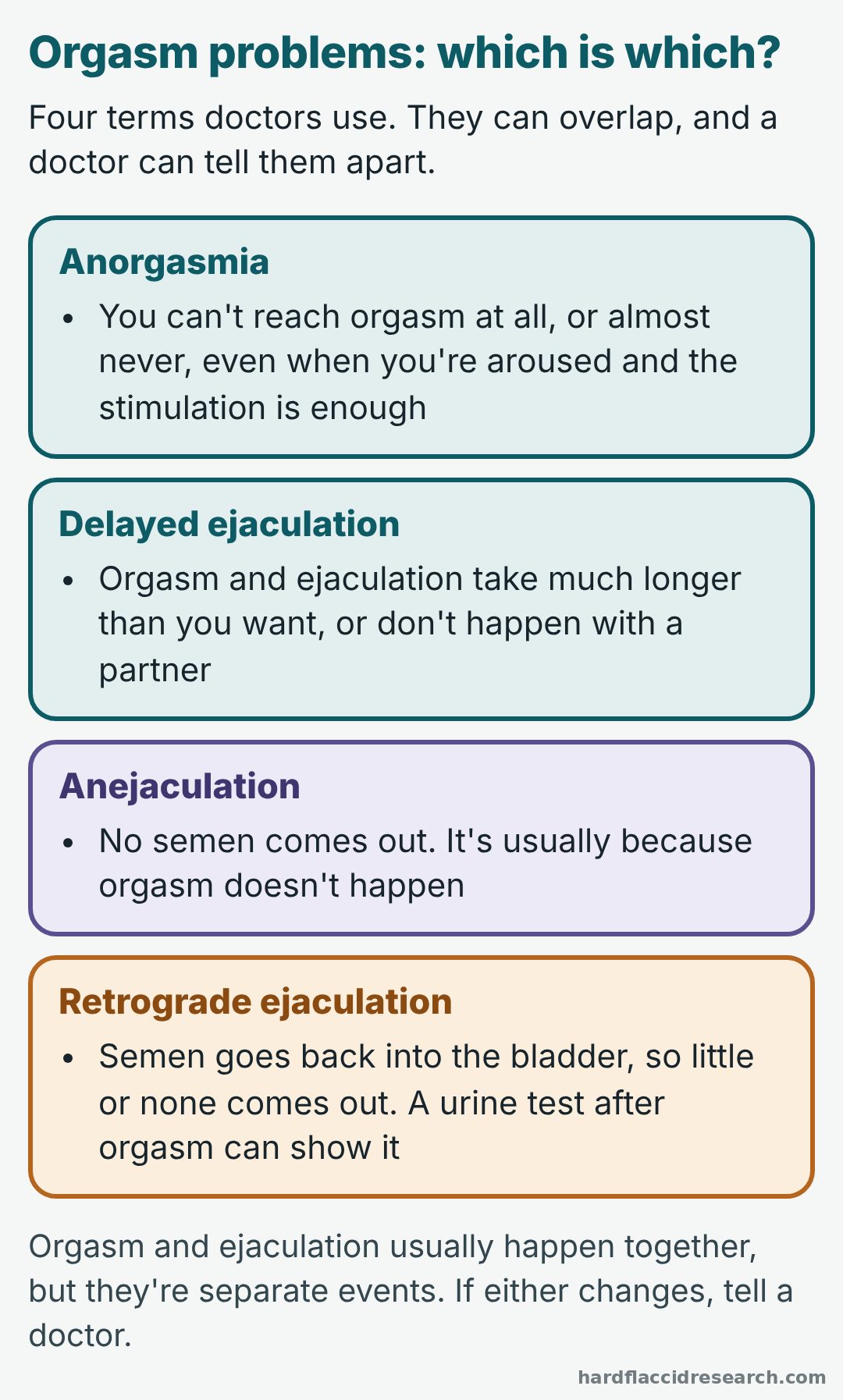
Anorgasmia is when you can't reach orgasm, or it almost never happens, despite feeling aroused and having enough stimulation. It's often seen as the most extreme form of delayed orgasm, where climax takes much longer than you want.
Orgasm and ejaculation usually happen together, but they're separate events. Not being able to ejaculate (anejaculation) is usually caused by not being able to reach orgasm. In retrograde ejaculation, semen goes back into the bladder instead of out, and a urine test after orgasm can show it.
How do orgasm and ejaculation work?
When you're aroused, blood fills the penis, and touch sends signals along nerves to the spinal cord and brain. When those signals build enough, the prostate and nearby glands squeeze semen into the urethra, and the opening of the bladder closes.
Then the muscles at the base of the penis, part of the pelvic floor, contract in waves to push semen out. Orgasm itself is a feeling in the brain. In anorgasmia, the build-up never reaches that point.
Types of anorgasmia
- Lifelong (primary): you've never been able to orgasm, from your first sexual experiences.
- Acquired (secondary): orgasm used to happen, then became hard or stopped.
- Generalized: it happens in every situation, alone or with a partner.
- Situational: it happens only with certain partners, kinds of touch or settings, such as with a partner but not alone.
Is anorgasmia the same as delayed ejaculation?
They overlap. The main US psychiatric manual and the World Health Organization's disease list both place men's orgasm trouble under delayed ejaculation. Anorgasmia sits at the far end, where orgasm doesn't come at all.
If you're not sure which one fits you, a urologist can help tell them apart.
Related: Death Grip Syndrome: Is It Real? What 125 Men Say »
What are the symptoms of anorgasmia?
Signs that you may have anorgasmia include:
- No orgasm, even when you feel aroused and the stimulation is enough.
- Orgasm only one way, such as alone by hand, but not with a partner.
- Orgasm that takes much longer than you want, or happens only now and then.
- Weaker orgasms, or less pleasure even when you're aroused.
- Frustration, worry or strain in your relationship because of it.
When men reported to us about porn and masturbation between January and October 2026, 164 described trouble finishing with a partner. Of those 164 men, 28% also mentioned erection trouble (46 men) and 12% mentioned death grip (20 men).
If you notice any of these for weeks or months, write down when it happens and when it doesn't. It helps a doctor find the cause.
What causes anorgasmia in men?
Anorgasmia often has more than one cause, and the mind and body can both play a part.
Medicines
Brain chemicals help control orgasm: dopamine helps trigger ejaculation, and serotonin mainly holds it back. That may be why some medicines that raise serotonin can delay or block orgasm.
Antidepressants called selective serotonin reuptake inhibitors (SSRIs) are the best known. Others include some antipsychotics and medicines for high blood pressure, and some antihistamines and decongestants are linked with ejaculation problems.
If you think a medicine is the cause, don't stop or change it on your own. Talk with the doctor who prescribed it.
Hormones
Low testosterone may make orgasm harder. A high level of prolactin (a hormone made by the pituitary gland at the base of the brain) and thyroid problems are also linked with delayed orgasm.
Nerves and other health conditions
- Diabetes, multiple sclerosis (MS) and other conditions that affect the nerves.
- Spinal cord injury.
- Surgery in the pelvis, such as removing the prostate or bladder, or bowel surgery, which can damage nerves.
- Less feeling in the penis, which can come with age.
The mind and relationships
Anxiety, including worry about performing, depression and stress can all get in the way. So can relationship problems, a strict sexual or religious upbringing, and past sexual trauma.
Masturbation habits
A masturbation style that sex with a partner can't match, such as a very tight grip or fast pace, may make a partner's touch feel like too little. Some men call this death grip, though it isn't a medical diagnosis. Frequent, forceful masturbation may also dull sensation, though that isn't certain.
A review of the research found no study linking porn use itself to orgasm problems. Of the 88 men in our death grip reports who had trouble finishing during sex, 75% mentioned porn (66 men). That's a mention, not proof that porn caused it.
If your masturbation is very different from sex, try a lighter grip, a slower pace and different kinds of touch for a while.
Related: Do I Have Death Grip Syndrome? Signs and a Self-Check »
Who is more likely to have anorgasmia?
You may be more likely to have trouble reaching orgasm if you:
- Take an SSRI or another medicine that can affect orgasm.
- Have low testosterone, diabetes or a condition that affects the nerves.
- Have had surgery in the pelvis, or an injury to the spine.
- Are older, since feeling in the penis can fade with age.
- Live with anxiety, depression or stress, or problems in your relationship.
- Masturbate often, with a grip or pace that sex can't match.
Having a risk factor doesn't mean you'll have anorgasmia. But if you have one, mention it when you see a doctor.
When should I see a doctor?
See a primary care provider or a urologist (a doctor for urinary and sexual health) if you can't orgasm and it bothers you or your partner. See one sooner if it started after a new medicine, surgery or injury, or comes with numbness or erection changes.
Get urgent care straight away (call 911 or go to the emergency room) if you have:
- A popping or cracking sound during sex or masturbation, followed by sudden pain, a quick loss of erection, or rapid swelling or dark bruising.
- An erection lasting more than 4 hours.
- A plan to end your life, or feeling you can't keep yourself safe.
- Sudden, severe pain in the penis, testicles or pelvis.
- New numbness around your back passage, genitals or inner thighs, or new weakness in your legs.
- New trouble starting or controlling your pee, not being able to pee, or not feeling when your bladder is full.
- Loss of control of your bladder or bowel.
- A fever or chills with pelvic pain or pain when peeing.
For everything else, book a routine visit and bring our doctor visit kit, so you can explain what's going on without hunting for words.
How is anorgasmia diagnosed?
There's no single test. A doctor looks for the cause, starting with a conversation.
Talking it through
Expect questions about when it started, whether it happens alone or only with a partner, your medicines, your mood and relationship, and how you masturbate. These are everyday questions for a doctor or sex therapist.
A physical exam
The doctor may check your genitals and look for signs of low testosterone or nerve problems, and ask about past surgery or injury.
Blood tests
Blood tests may check testosterone, prolactin, thyroid function and blood sugar.
Sensation tests
If less feeling in the penis may be the cause, a doctor may test how well you feel vibration. These tests aren't needed for everyone.
Before your visit, note what you've noticed, and take our free self-check if you also have pain or changes in the penis at rest.
How is anorgasmia treated?
Treatment depends on the cause, and there's no one fix that works for everyone. Many men need more than one approach.
Treating the cause
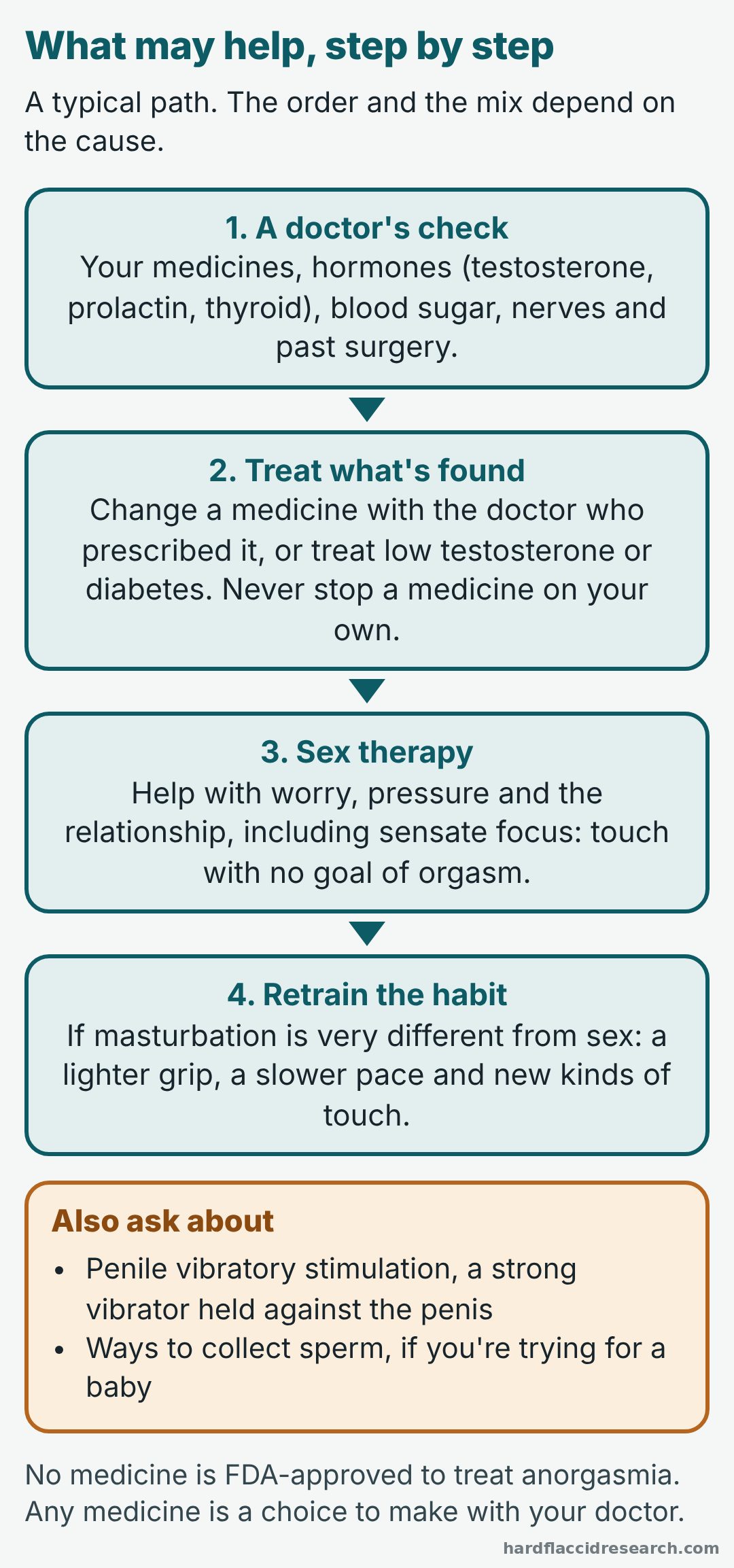
If a medicine may be the problem, your doctor may suggest a lower dose or a different medicine. Don't make that change on your own.
If tests show low testosterone, your doctor may discuss treating it. If you have diabetes, your doctor may also check how well it's controlled.
Sex therapy and counseling
Specialists advise that nearly everyone with anorgasmia sees a sex therapist or counselor, even when there's a physical cause. A sex therapist can help with worry, relationship stress and habits, using talk therapy, cognitive behavioral therapy (CBT), mindfulness or couples sessions.
Sensate focus is one exercise: touching with a partner without any goal of orgasm, to take the pressure off.
Breathing and the pelvic floor
Your diaphragm, the dome of muscle under your lungs, and your pelvic floor move together as you breathe. Both move down a little as you breathe in, and back up as you breathe out.
Slow belly breathing may help you relax, which can help if worry gets in the way. If your pelvic floor feels tight or sex hurts, a pelvic floor physical therapist can help.
Retraining masturbation
If your masturbation is very different from sex, a sex therapist may suggest changing it: a lighter grip, a slower pace, and different kinds of touch. A US guideline on ejaculation problems says that changing sexual positions or practices to increase arousal may help.
Penile vibratory stimulation
A strong vibrator held against the penis, called penile vibratory stimulation, has helped some men reach orgasm in small studies. The evidence is limited, but the risk is low, so specialists say it may be offered to men who want to try it.
Medicines
No medicine is approved by the US Food and Drug Administration (FDA) to treat anorgasmia. Some doctors try other medicines off-label, but the evidence for them is limited, so any choice is made with your doctor.
What isn't recommended
Injections and nerve surgery for orgasm problems aren't currently recommended, because there isn't enough evidence that they work.
What men told us they tried
Of the 479 men in our death grip reports who named things they tried, 16% named talking with their partner (78 men) and 6% named therapy (27 men). Naming something isn't proof that it works.
If anorgasmia is affecting your sex life, start with a doctor's check, then ask about a sex therapist.
What are the complications of anorgasmia?
- Stress, frustration or low mood, which can make orgasm even harder.
- Strain in your relationship, or avoiding sex.
- Trouble getting a partner pregnant, if you can't ejaculate.
If you're trying for a baby, tell a urologist. There are ways to collect sperm for fertility treatment.
If shame or low mood is wearing you down, or you're thinking about suicide, call or text 988, or visit our Support page for more crisis lines.
Can anorgasmia be prevented?
Not always, but some habits may lower the chance:
- Keep your masturbation close to what sex feels like, with a lighter grip and a slower pace.
- When you start a new medicine, ask whether it can affect orgasm.
- Look after your mood and stress, and talk with your partner about sex.
Living with anorgasmia
Anorgasmia can be upsetting, but it's often treatable once the cause is found. Treating it can take time, so give each change a fair try and tell your doctor how it's going.
Of the 88 men in our death grip reports who had trouble finishing during sex, 28% described how their partner felt or reacted (25 men).
Talk with your partner. Sex can still be close and enjoyable without orgasm as the goal, and taking that pressure off may help.
Anorgasmia and hard flaccid syndrome
Hard flaccid syndrome is when the penis stays firm or shrunken at rest, and it can come with numbness and weaker erections. Of the 6,026 men who shared their experiences of hard flaccid between December 2020 and October 2026, 2,661 described their symptoms.
Of those 2,661 men, 202 described a weak or painful orgasm or ejaculation problems, and 62% of those 202 also described numbness. Naming a symptom isn't proof of what caused it. If your penis is firm or numb at rest, see a doctor and take our free self-check.
Questions to ask your doctor
- What do you think is causing my trouble reaching orgasm?
- Could any of my medicines be playing a part?
- Should I have my testosterone, prolactin, thyroid or blood sugar checked?
- Could nerve damage or less feeling in the penis be a cause?
- Would seeing a sex therapist help, and can you refer me?
- Is penile vibratory stimulation an option for me?
- If we're trying for a baby, what are my options?
Frequently asked questions
Does anorgasmia in men get better?
It often improves once the cause is treated, such as changing a medicine with your doctor or treating low testosterone. Sex therapy and changing masturbation habits can help too. There's no single fix that works for everyone.
Can porn cause anorgasmia?
A review of the research found no study linking porn use itself to orgasm problems. But a masturbation style that sex can't match may play a part, so try a lighter grip and a slower pace for a while.
Can you ejaculate without having an orgasm?
Yes. Orgasm and ejaculation are separate events, even though they usually happen together. If either changes, tell a doctor, since different causes need different care.
Is it anorgasmia if I can finish alone but not with a partner?
That's called situational. It's more likely to come from worry, habits or the relationship than from nerves or hormones. A sex therapist can help, and a doctor can check for physical causes.
Takeaway
Anorgasmia means you can't reach orgasm despite enough arousal and stimulation. Medicines, hormones, nerves, worry and masturbation habits can all play a part.
It's often treatable. Start with a doctor's check, ask about a sex therapist, and bring our doctor visit kit to your visit.
This article is for general information and isn't a substitute for advice from your own doctor. Hard Flaccid Research doesn't diagnose or treat. If you have new or worsening symptoms, see a qualified clinician. In an emergency, call 911.
Free tools that can help
- Self-check: do I have hard flaccid?Compare your symptoms with what 6,026 men report.
- Doctor visit kitA one-page summary to take to your appointment.
- Habit trackerCount your days without porn or masturbation, and get through urges.
- Diaphragm breathing toolBreathe with a moving picture of your diaphragm and pelvic floor.
- Add your experienceTell us what you tried and how it went. No name needed.
- Hard Flaccid Syndrome CensusWhat men answered in 818 polls.
- Symptom trackerLog your symptoms and see what helps you.
- Ask us a questionThe questions men ask most become new articles.
The numbers behind this article
Most numbers in this article come from what 1,175 men reported to us about death grip between July 2024 and October 2026, and from what 71,368 men reported to us about porn and masturbation between January and October 2026, counted once per person. A few come from what men with hard flaccid syndrome shared between December 2020 and October 2026, kept separate from the rest. These are reports from men who chose to tell us, not a clinical study, and a man counts only when he described something about himself. See how we count.
30% of men who described their symptoms in our death grip reports had trouble finishing during sex
Of the 1,175 men who reported to us about death grip between July 2024 and October 2026, 293 described their symptoms. Share of those 293 who described each.These are reports from men who chose to tell us, not a clinical study. A mention isn't proof of what caused anything.
Source: Hard Flaccid Research, hardflaccidresearch.com
Of men who had trouble finishing during sex, 26% mentioned anxiety, nerves or pressure to perform
Share of the 88 men who had trouble finishing during sex, when they reported to us about death grip, who mentioned or described each.These are reports from men who chose to tell us, not a clinical study. A mention isn't proof of what caused anything.
Source: Hard Flaccid Research, hardflaccidresearch.com
16% of men who told us what they tried for death grip named talking with their partner
Share of the 479 men in our death grip reports who named things they tried, or talked about trying, who named each of these. Naming something isn't proof it works.Only the talking and therapy answers are shown here. Men could name more than one thing, and naming something isn't proof that it works. These are reports from men who chose to tell us, not a clinical study.
Source: Hard Flaccid Research, hardflaccidresearch.com
Of men who had trouble finishing with a partner, 28% also mentioned erection trouble
Share of the 164 men who described trouble finishing with a partner, of the 71,368 men who reported to us about porn and masturbation between January and October 2026.These are reports from men who chose to tell us, not a clinical study. A mention isn't proof of what caused anything.
Source: Hard Flaccid Research, hardflaccidresearch.com
Of men who shared their experiences of hard flaccid and described orgasm or ejaculation problems, 62% also described numbness
Of 6,026 men who shared their experiences of hard flaccid (December 2020 to October 2026), 2,661 described their symptoms and 202 described a weak or painful orgasm, or ejaculation problems. Share of those 202 who described each.Men who shared their experiences of hard flaccid, kept separate from the other numbers on this page. Naming a symptom isn't proof of its cause. These are reports from men who chose to tell us, not a clinical study.
Source: Hard Flaccid Research, hardflaccidresearch.com
Every number in this article, with its source
| In this article | Source |
|---|---|
| 1,175 men reported to us about death grip, July 2024 to October 2026 | 1,175 men who reported to us about death grip, Jul 2024 to Oct 2026 |
| 293 of them described their symptoms | 293 men who reported to us about death grip, Jul 2024 to Oct 2026 |
| Death grip reports: 88 of 293 men who described their symptoms had trouble finishing during sex (30%) | 88 of 293 men who reported to us about death grip, Jul 2024 to Oct 2026 |
| 23% of the 293 described a tight grip or fast pace (67 of 293 men) | 67 of 293 men who reported to us about death grip, Jul 2024 to Oct 2026 |
| 22% of the 293 described less feeling (64 of 293 men) | 64 of 293 men who reported to us about death grip, Jul 2024 to Oct 2026 |
| 41% of the 293 mentioned erection trouble (120 of 293 men) | 120 of 293 men who reported to us about death grip, Jul 2024 to Oct 2026 |
| 3% of the 293 said they couldn't orgasm or mentioned anorgasmia (8 of 293 men) | 8 of 293 men who reported to us about death grip, Jul 2024 to Oct 2026 |
| 75% of the 88 men who had trouble finishing during sex mentioned porn (66 of 88 men) | 66 of 88 men who reported to us about death grip, Jul 2024 to Oct 2026 |
| 23% of the 88 mentioned erection trouble (20 of 88 men) | 20 of 88 men who reported to us about death grip, Jul 2024 to Oct 2026 |
| 26% of the 88 mentioned anxiety, nerves or pressure to perform (23 of 88 men) | 23 of 88 men who reported to us about death grip, Jul 2024 to Oct 2026 |
| 28% of the 88 described how their partner felt or reacted (25 of 88 men) | 25 of 88 men who reported to us about death grip, Jul 2024 to Oct 2026 |
| 19% of the 88 described less feeling (17 of 88 men) | 17 of 88 men who reported to us about death grip, Jul 2024 to Oct 2026 |
| 479 men named things they tried for death grip, or talked about trying | 479 men who reported to us about death grip, Jul 2024 to Oct 2026 |
| 16% named talking with their partner (78 of 479 men) | 78 of 479 men who reported to us about death grip, Jul 2024 to Oct 2026 |
| 6% named therapy (27 of 479 men) | 27 of 479 men who reported to us about death grip, Jul 2024 to Oct 2026 |
| 71,368 men reported to us about porn and masturbation, January to October 2026 | 71,368 men who reported to us about porn and masturbation, Jan to Oct 2026 |
| 164 men described trouble finishing with a partner | 164 men who reported to us about porn and masturbation, Jan to Oct 2026 |
| 28% of them also mentioned erection trouble (46 of 164 men) | 46 of 164 men who reported to us about porn and masturbation, Jan to Oct 2026 |
| 12% of them mentioned death grip (20 of 164 men) | 20 of 164 men who reported to us about porn and masturbation, Jan to Oct 2026 |
| 5% of them described less feeling (9 of 164 men) | 9 of 164 men who reported to us about porn and masturbation, Jan to Oct 2026 |
| 4% of them mentioned edging (6 of 164 men) | 6 of 164 men who reported to us about porn and masturbation, Jan to Oct 2026 |
| 6,026 men shared their experiences of hard flaccid; 2,661 described their symptoms | Research data, December 2020 to October 2026 |
| Hard flaccid reports counted since December 2020 | Research data, December 2020 to October 2026 |
| 8% (202 of 2,661) described a weak or painful orgasm, or ejaculation problems | 202 of 2,661 men, counted from what men wrote, once per person |
| Of the men with a weak or painful orgasm, or ejaculation problems: 76% firm flaccid state, 62% numbness, 58% erection problems, 46% shrinkage or retraction, 44% pelvic floor tension | 202 men with a weak or painful orgasm, or ejaculation problems, counted from what men wrote, once per person |
Medical sources
What this article says about medical research, guidelines and urgent care comes from these sources.
- Nguyen V, Dolendo I, Uloko M, Hsieh TC, Patel D. Male delayed orgasm and anorgasmia: a practical guide for sexual medicine providers. Int J Impot Res. 2024;36(3):186-193. https://doi.org/10.1038/s41443-023-00692-7
- Shindel AW, Althof SE, Carrier S, et al. Disorders of ejaculation: an AUA/SMSNA guideline. J Urol. 2022;207(3):504-512. https://doi.org/10.1097/JU.0000000000002392
- Abdel-Hamid IA, Ali OI. Delayed ejaculation: pathophysiology, diagnosis, and treatment. World J Mens Health. 2018;36(1):22-40. https://doi.org/10.5534/wjmh.17051
- Cleveland Clinic. Anorgasmia: causes, symptoms, diagnosis and treatment. Last updated January 23, 2023. https://my.clevelandclinic.org/health/diseases/24640-anorgasmia
- Baxter R. What are the signs of anorgasmia? International Society for Sexual Medicine (ISSM). October 30, 2024. https://www.issm.info/sexual-health-qa/what-are-the-signs-of-anorgasmia
- Solan M. Seeking help for orgasm problems. Harvard Health Publishing. April 1, 2024. https://www.health.harvard.edu/mens-health/seeking-help-for-orgasm-problems
- Jimbo M. Inability to ejaculate. Merck Manual Consumer Version. Reviewed September 2024. https://www.merckmanuals.com/home/men-s-health-issues/sexual-function-and-dysfunction-in-men/inability-to-ejaculate
- International Continence Society (ICS). Orgasmic disorder (male): anorgasmia. ICS glossary. https://www.ics.org/glossary/diagnosis/orgasmicdisordermaleanorgasmia
- South H. What is "death grip syndrome" during male masturbation and how might it affect partnered sexual activity? International Society for Sexual Medicine (ISSM). April 9, 2025. https://www.issm.info/sexual-health-qa/what-is-death-grip-syndrome-during-male-masturbation-and-how-might-it-affect-partnered-sexual-activity
- Vilson F, MacDonald S, Terlecki R. Contemporary management of penile fracture: a urologist's guide. Curr Sex Health Rep. 2016;8(2):91-96. https://doi.org/10.1007/s11930-016-0069-y
- Bivalacqua TJ, Allen BK, Brock G, et al. Acute ischemic priapism: an AUA/SMSNA guideline. J Urol. 2021;206(5):1114-1121. https://doi.org/10.1097/JU.0000000000002236
- Gray M, Zillioux J, Khourdaji I, Smith RP. Contemporary management of ejaculatory dysfunction. Transl Androl Urol. 2018;7(4):686-702. https://doi.org/10.21037/tau.2018.06.20
- Talasz H, Kremser C, Kofler M, et al. Phase-locked parallel movement of diaphragm and pelvic floor during breathing and coughing: a dynamic MRI investigation in healthy females. Int Urogynecol J. 2011;22(1):61-68. https://doi.org/10.1007/s00192-010-1240-z
- Zaccaro A, Piarulli A, Laurino M, et al. How breath-control can change your life: a systematic review on psycho-physiological correlates of slow breathing. Front Hum Neurosci. 2018;12:353. https://doi.org/10.3389/fnhum.2018.00353
- Lai HH, Pontari MA, Argoff CE, et al. Male chronic pelvic pain: AUA guideline. J Urol. 2025. https://www.auanet.org/guidelines-and-quality/guidelines/male-chronic-pelvic-pain
- Gul M, Towe M, Yafi FA, Serefoglu EC. Hard flaccid syndrome: initial report of four cases. Int J Impot Res. 2020;32:176-179. https://doi.org/10.1038/s41443-019-0133-z
- Abdessater M, Kanbar A, Akakpo W, Beley S. Hard flaccid syndrome: state of current knowledge. Basic Clin Androl. 2020;30:7. https://doi.org/10.1186/s12610-020-00105-5
How we made this article
We started from the question many men asked. Every number was checked against our data. Our editorial team edited it and Dr. Julian Reyes reviewed it medically. Read our editorial policy.
Read next
See more of us on Google
Add Hard Flaccid Research as a preferred source, and Google shows you our pages more often when you search.
Add as a preferred sourceDon't see your question? Ask us. We answer the most-asked ones in new articles.
Cite and share this article
You're welcome to quote this article. Please name Hard Flaccid Research and link to this page, so others can find the full answer and the data behind it. To cite this page, use its link.
Citation
Hard Flaccid Research. (2026). Anorgasmia in Men: Why You Can't Orgasm and What Helps. Written by the Editorial Team, medically reviewed by Dr. Julian Reyes. https://hardflaccidresearch.com/articles/anorgasmia-men
Credit link for your article
Source: <a href="https://hardflaccidresearch.com/articles/anorgasmia-men">Hard Flaccid Research</a>
Wikipedia reference
<ref>{{cite web |url=https://hardflaccidresearch.com/articles/anorgasmia-men |title=Anorgasmia in Men: Why You Can't Orgasm and What Helps |website=Hard Flaccid Research |date=2026 |access-date=28 October 2026}}</ref>
How the data was collected: our methodology. Journalists and researchers: key numbers, data and contact.