Cremaster Muscle and Reflex: Why Testicles Pull Up
In short
- The cremaster is a thin muscle wrapped around the spermatic cord that lifts the testicle towards the body.
- It pulls the testicles up in the cold, during arousal and with stress or fear, and relaxes them in the warmth.
- A touch on the inner thigh makes it twitch, which doctors call the cremasteric reflex.
- A very active cremaster can pull a testicle up so often that it aches.
The cremaster (kree-MAS-ter) muscle is a thin muscle that wraps around the spermatic cord, the cord each testicle hangs from. When it contracts, it lifts the testicle up towards the body. Its name comes from a Greek word meaning "suspender".
It pulls the testicles up in the cold, during sexual arousal, and with stress, fear or exercise, then lets them drop again in the warmth. A light touch on the inner thigh makes it twitch, which doctors call the cremasteric reflex. This page explains how the muscle works, why some men feel their testicles pull up a lot, and when testicle pain needs urgent care.
By the numbers: of the 6,026 men who shared their experiences with hard flaccid syndrome, 2,661 described their symptoms, and 102 of them described testicle pain or a tight scrotum.
Key facts
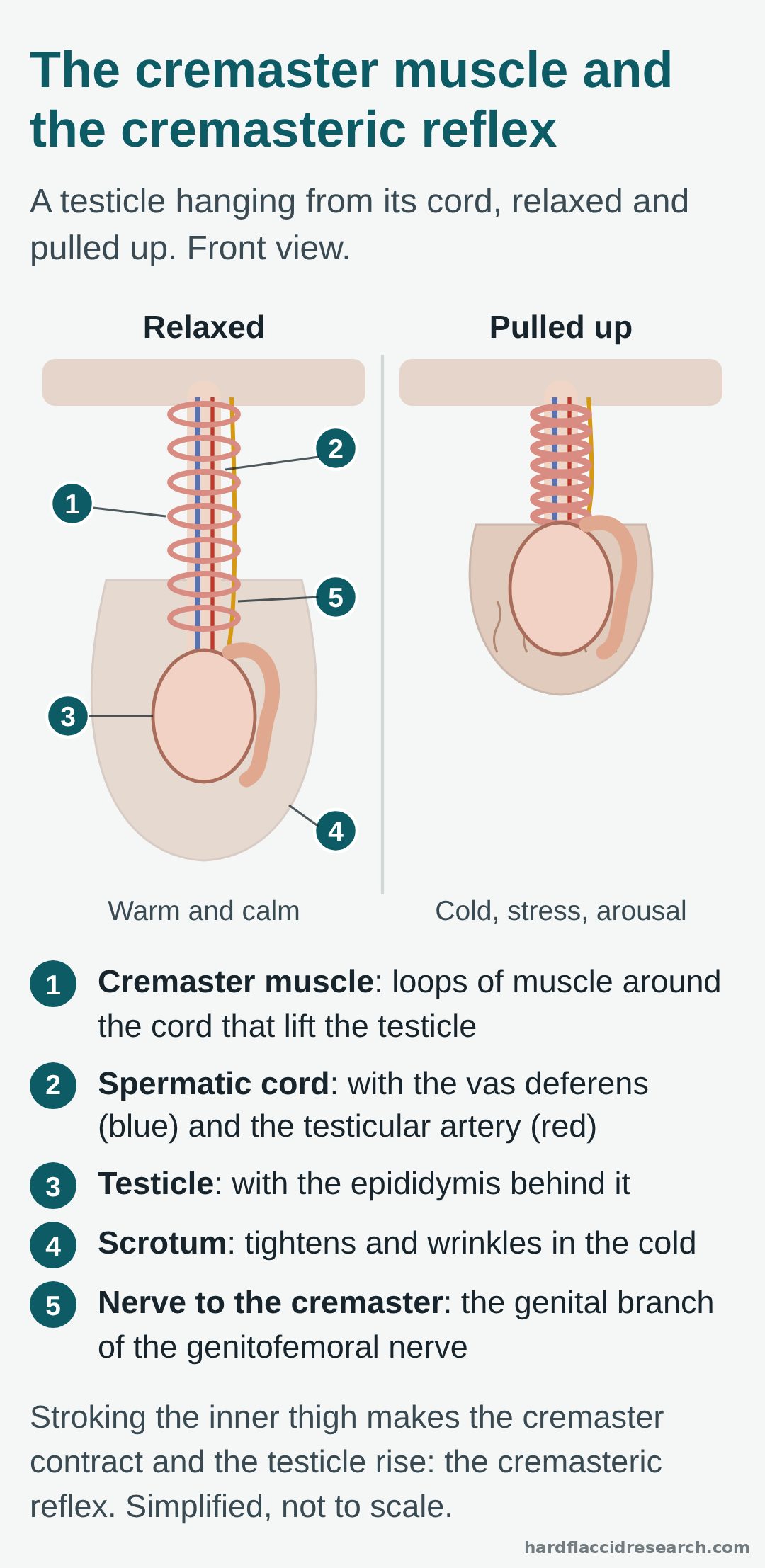
- The cremaster muscle covers the spermatic cord and the testicle in loops of muscle.
- It lifts the testicle to keep it at the right temperature, and to protect it.
- The cremasteric reflex: stroking the inner thigh makes the testicle on that side rise.
- It's supplied by the genital branch of the genitofemoral nerve, which runs through the groin.
- An overactive cremaster can pull a testicle up so often or so hard that it aches. Doctors call this a hyperactive cremasteric reflex or a retractile testicle.
- In sudden, severe testicle pain, a missing cremasteric reflex can be a warning sign of testicular torsion, an emergency.
What is the cremaster muscle?
As a baby's testicles move down from the abdomen into the scrotum before birth, they pull layers of the belly wall down with them. One of these layers becomes the cremaster muscle. It comes from the lower edge of the internal oblique muscle of the abdomen and the inguinal ligament in the groin, and runs down around the spermatic cord in loose loops that reach the testicle.
It's a skeletal muscle, the kind you can sometimes tense on purpose, but it's mostly controlled by reflexes. It works alongside the dartos, a thin layer of smooth muscle under the skin of the scrotum that wrinkles and tightens it.
Related: Why Is My Penis Shrinking? Causes of Penis Shrinkage and What Helps »
What does the cremaster muscle do?
Keeping the testicles at the right temperature
Sperm develop best a little below body temperature. In the cold, the cremaster lifts the testicles closer to the body to keep them warm. In the warmth, it relaxes and they hang lower to cool.
Protecting the testicles
The cremaster pulls the testicles up during fear, sudden movement and physical effort, which may help protect them from injury.
During arousal and orgasm
The testicles rise during sexual arousal and pull up close to the body just before ejaculation.
The cremasteric reflex
When the skin of the upper inner thigh is lightly stroked, nerves in the spinal cord fire the cremaster, and the testicle on that side rises. Doctors use this reflex as a quick test of the nerves in the lower spine, and when checking testicle pain.
The cremaster and the dartos: what's the difference?
Two muscles move the scrotum and testicles, and they're easy to mix up:
- The cremaster is a skeletal muscle around the spermatic cord. It lifts the testicle itself, quickly, as a reflex.
- The dartos is a thin sheet of smooth muscle in the skin of the scrotum. It slowly wrinkles and tightens the skin in the cold and relaxes it in the warmth.
Together, they keep the testicles at the right temperature. A tight, wrinkled scrotum is mostly the dartos, while a testicle that rises is mostly the cremaster.
Related: Scrotum Anatomy: Layers, the Dartos Muscle and What's Normal »
Why do my testicles pull up so much?
It's normal for the testicles to move up and down through the day. Some men notice it more, or feel it as an ache.
- Cold, swimming or a cold shower.
- Stress, anxiety or a sudden fright.
- Exercise and heavy lifting.
- Sexual arousal.
- Tight underwear or sitting in one position.
- A tight pelvic floor, which can tense the muscles around the groin and scrotum.
Retractile testicles
In some boys and men, the cremaster is very strong and pulls a testicle right up into the groin, where it can be felt or gently brought back down. This is called a retractile testicle. It's usually harmless and often settles with age, but a testicle that stays up should be checked, because it may be undescended.
A hyperactive cremaster in adults
A few adult men have a cremaster that pulls a testicle up so often or so hard that it causes aching or pain in the groin or testicle. Doctors call this a hyperactive cremasteric reflex. Treatments that may help include pelvic floor and groin relaxation, warmth, and, for severe cases in specialist clinics, injections or a small operation to release the muscle. A urologist can explain what's suitable.
The cremaster and hard flaccid syndrome
Hard flaccid syndrome is a firm, shrunken penis at rest, often with numbness, weaker erections and pelvic pain. Many men with hard flaccid also describe a tight, high scrotum or a feeling that the genitals pull in, especially with stress or cold.
Of the 2,661 men who described their symptoms, 27% described shrinkage or retraction (720 men) and 4% described testicle pain or a tight scrotum (102 men). In an April 2023 poll, 76% said they had anxiety before hard flaccid (94 of 123 men). That doesn't show anxiety causes hard flaccid, but stress can tense the cremaster and the pelvic floor.
Our members' guide, Hard Flaccid and Anxiety: How to Get Your Life Back, covers calming routines that help the body let go of tension.
What helps when the testicles pull up and ache
- Warmth: a warm bath or shower often lets the cremaster and scrotum relax.
- Slow belly breathing, letting the pelvic floor and groin soften as you breathe in.
- Gentle stretches for the inner thighs and hips.
- Loose, supportive underwear.
- Managing stress, with exercise, sleep and relaxation.
- Seeing a pelvic floor physical therapist if you also have pelvic floor tension.
How do doctors check the cremaster?
A primary care provider or a urologist (a doctor for urinary and sexual health) will examine both testicles standing and lying down, check whether a testicle can be brought down into the scrotum, and test the cremasteric reflex by lightly stroking the inner thigh. An ultrasound scan can check the testicles and their blood flow. Our doctor visit kit helps you describe when the pulling or pain happens.
When should I see a doctor?
See a primary care provider or a urologist if a testicle often pulls up and aches, if a testicle seems to stay up in the groin, or if you notice a lump or swelling.
Get urgent care straight away (call 911 or go to the emergency room) if you have:
- Sudden, severe pain or swelling in a testicle, especially with nausea or vomiting. This can be testicular torsion, where the testicle twists and loses its blood supply. Surgery within hours can save the testicle.
- A testicle that suddenly sits higher than usual or lies sideways, with pain.
- A fever or chills with a painful, swollen scrotum.
- New numbness around your back passage, genitals or inner thighs, or new weakness in your legs.
Frequently asked questions
Is it normal for testicles to move up and down?
Yes. The cremaster and dartos muscles move them through the day, mostly with temperature, arousal and stress.
Can you control the cremaster muscle?
Some men can tense it on purpose, but it's mostly controlled by reflexes.
What does a missing cremasteric reflex mean?
In someone with sudden, severe testicle pain, a missing reflex can be a sign of testicular torsion, which needs emergency care. In other situations, it can be normal for some men or point to a nerve problem, so a doctor looks at it alongside other signs.
Why do my testicles pull up when I'm anxious?
Stress hormones and the fight-or-flight response tense many muscles, including the cremaster and the pelvic floor, pulling the testicles closer to the body.
Can a tight pelvic floor affect the testicles?
It can contribute to a tight, high scrotum and a dull ache that seems to come from the testicles.
Can the cremaster cause pain after ejaculation?
The cremaster pulls the testicles up during orgasm, and a strong pull can leave a brief ache. Ongoing pain after ejaculation is worth checking, because it often has other causes.
Takeaway
The cremaster muscle wraps the spermatic cord and lifts the testicles in the cold, during arousal and with stress. Its reflex, triggered by touching the inner thigh, is a normal sign that the nerves are working.
A very active cremaster can cause aching, and warmth, relaxation and stretches often help. Sudden, severe testicle pain is always an emergency. Take our free self-check if you also notice changes in your penis at rest.
This article is for general information and isn't a substitute for advice from your own doctor. Hard Flaccid Research doesn't diagnose or treat. If you have new or worsening symptoms, see a qualified clinician. In an emergency, call 911.
Free tools that can help
- Self-check: do I have hard flaccid?Compare your symptoms with what 6,026 men report.
- Doctor visit kitA one-page summary to take to your appointment.
- Habit trackerCount your days without porn or masturbation, and get through urges.
- Diaphragm breathing toolBreathe with a moving picture of your diaphragm and pelvic floor.
- Add your experienceTell us what you tried and how it went. No name needed.
- Hard Flaccid Syndrome CensusWhat men answered in 818 polls.
- Symptom trackerLog your symptoms and see what helps you.
- Ask us a questionThe questions men ask most become new articles.
The numbers behind this article
Every number in this article comes from what men with hard flaccid syndrome shared between December 2020 and October 2026, counted once per person, or from their polls. These are self-selected reports, not a clinical study. See hard flaccid syndrome statistics, the Hard Flaccid Syndrome Census and how we count.
27% of men who described their symptoms described shrinkage or retraction
Share of the 2,661 men who described their symptoms. Each man is counted once.These are self-selected reports, not a clinical study.
Source: Hard Flaccid Research, hardflaccidresearch.com
76% said they had anxiety before hard flaccid
How 123 men answered an April 2023 poll.In our polls, men choose to answer. This doesn't show that anxiety causes hard flaccid.
Source: Hard Flaccid Research, hardflaccidresearch.com
Every number in this article, with its source
| In this article | Source |
|---|---|
| 4% of the men who described their symptoms described testicle pain or a tight scrotum (102 of 2,661) | 102 of 2,661 men, counted |
| 27% of the men who described their symptoms described shrinkage or retraction (720 of 2,661) | 720 of 2,661 men, counted |
| 6,026 men shared their experiences, and 2,661 of them described their symptoms | 2,661 of 6,026 men, counted |
| 76% said they had anxiety before hard flaccid (94 of 123 men) | 94 of 123 men, poll, Apr 2023 |
Medical sources
What this article says about medical research, guidelines and urgent care comes from these sources.
- Mellick LB, Mowery ML, Al-Dhahir MA. Cremasteric Reflex. In: StatPearls. Treasure Island (FL): StatPearls Publishing. https://www.ncbi.nlm.nih.gov/books/NBK513348/
- Anatomy, Abdomen and Pelvis: Genitofemoral Nerve. In: StatPearls. Treasure Island (FL): StatPearls Publishing. https://www.ncbi.nlm.nih.gov/books/NBK430733/
- Human cremaster muscle and cremasteric reflex: a comprehensive review. Clin Neurophysiol. 2020;131(6):1354-1364. https://doi.org/10.1016/j.clinph.2020.03.011
- Cremaster muscle thickening: the anatomic difference in men with testicular retraction due to hyperactive cremaster muscle reflex. Asian J Androl. 2023;25(4):484-486. https://doi.org/10.4103/aja202296
- Testicular Torsion. In: StatPearls. Treasure Island (FL): StatPearls Publishing. https://www.ncbi.nlm.nih.gov/books/NBK448199/
- Testicular torsion: diagnosis, evaluation, and management. Am Fam Physician. 2013;88(12):835-840. https://pubmed.ncbi.nlm.nih.gov/24364548/
How we made this article
We started from the question many men asked. Every number was checked against our data. Our editorial team edited it and Dr. Julian Reyes reviewed it medically. Read our editorial policy.
Read next
See more of us on Google
Add Hard Flaccid Research as a preferred source, and Google shows you our pages more often when you search.
Add as a preferred sourceDon't see your question? Ask us. We answer the most-asked ones in new articles.
Cite and share this article
You're welcome to quote this article. Please name Hard Flaccid Research and link to this page, so others can find the full answer and the data behind it. To cite this page, use its link.
Citation
Hard Flaccid Research. (2026). Cremaster Muscle and Reflex: Why Testicles Pull Up. Written by the Editorial Team, medically reviewed by Dr. Julian Reyes. https://hardflaccidresearch.com/articles/cremaster-muscle
Credit link for your article
Source: <a href="https://hardflaccidresearch.com/articles/cremaster-muscle">Hard Flaccid Research</a>
Wikipedia reference
<ref>{{cite web |url=https://hardflaccidresearch.com/articles/cremaster-muscle |title=Cremaster Muscle and Reflex: Why Testicles Pull Up |website=Hard Flaccid Research |date=2026 |access-date=22 November 2026}}</ref>
How the data was collected: our methodology. Journalists and researchers: key numbers, data and contact.