Hard Flaccid Worse When Standing? 86% of Men Noticed It
In short
- Many men find hard flaccid syndrome worse when they stand: in a March 2023 poll, 86% said it is more hard flaccid standing than lying down (54 of 63 men).
- Gravity and a pelvic floor that works harder upright may play a part, and sitting can press on the area between the legs.
- Standing breaks, a chair set up to ease that pressure, slow breathing, stretching and walking may help, and many men get better.
63 men with hard flaccid asked this question.
Hard flaccid syndrome is when the penis stays firm, rubbery or shrunken at rest, often with numbness and weaker erections. Many men notice it is worse when they stand, and better when they lie down.
Gravity and a pelvic floor that works harder upright may play a part, and long sitting can add pressure of its own. This page covers what helps on your feet, in your chair and through the day.
By the numbers: 6,026 men shared their experiences with us between December 2020 and October 2026. Of them, 63 asked why it is worse when standing, and 45 whether sitting makes it worse. What men wrote and answered in our polls are self-selected reports, not a clinical study.
Key facts
- In a March 2023 poll, 86% said it is more hard flaccid standing than lying down (54 of 63 men).
- Sitting can add pressure too: 24 men named long hours sitting as the trigger of their hard flaccid syndrome.
- Standing breaks, a chair that eases pressure between your legs, and slow breathing may help.
- Stretching came up in 40 of the 126 recovery stories, more than anything else.
- Many men improve: 42% said they were at least half better in a June 2023 poll (56 of 132 men). Men who recover may stop answering polls, so this may undercount recovery.
Hard Flaccid Explorerby Hard Flaccid Research
Why hard flaccid may be worse when standing
A 7-minute animated explainer of this article. Press play, or skip between chapters. The first minute is free for everyone.
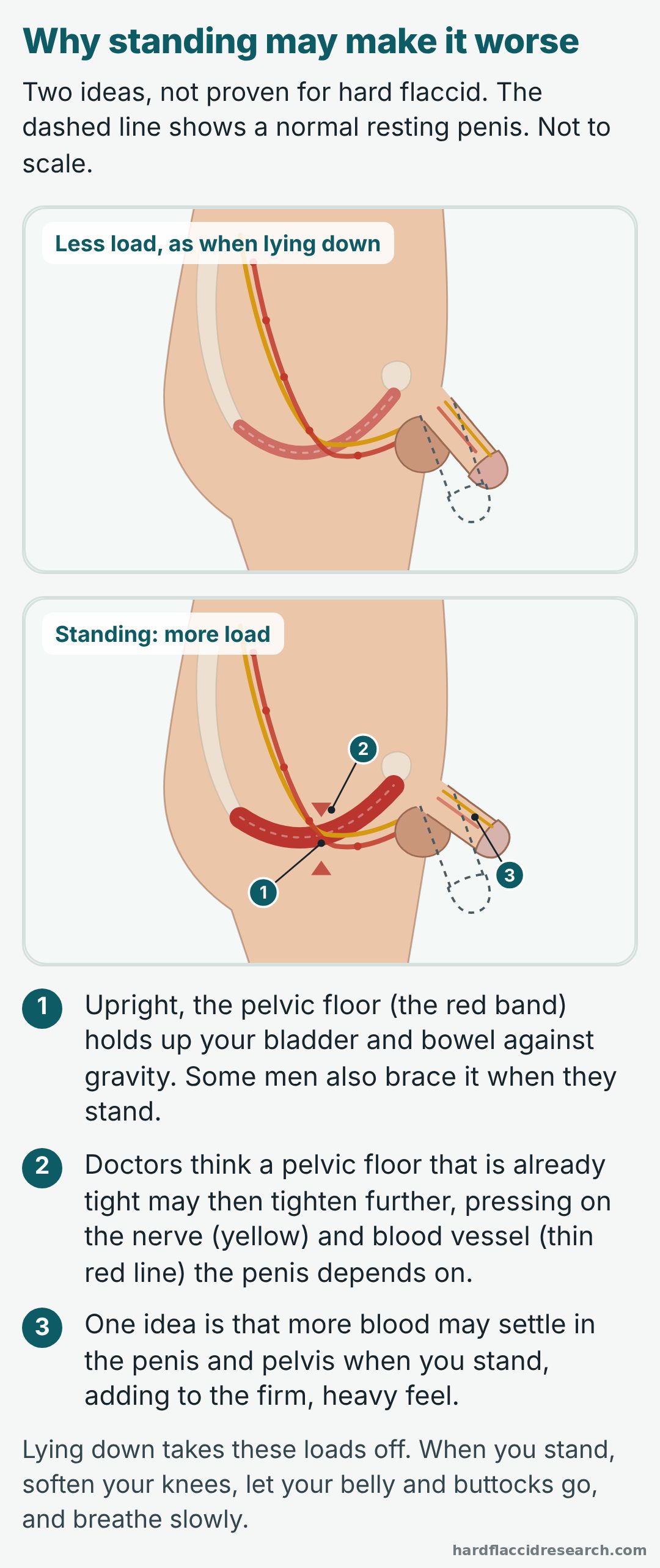
A picture to explain, not a diagnosis. The corner tag shows the position, and the drawing shows the ideas on this page.
Why is hard flaccid worse when standing?
No study has measured why, but there are two main ideas. Upright, gravity pulls blood down, and the pelvic floor, the sling of muscles that holds up your bladder and bowel, has more work to do. Lying down takes both loads off.
- Gravity and blood. One idea is that more blood may settle in the penis and pelvis when you stand, adding to the firm, heavy feel.
- A guarded pelvic floor. Some men brace their belly, buttocks and pelvic floor when they stand. Doctors think a pelvic floor that is already tight may then tighten further, pressing on the nerves and blood vessels the penis depends on.
In the March 2023 poll, 10% noticed no change at all (6 of 63 men), and 5% chose very minimal change but a little bit softer (3 of 63). A published survey of men with hard flaccid syndrome found many felt better lying down and worse standing.
Next time it builds on your feet, soften your knees, let your belly and buttocks go, and take a few slow breaths low into your belly.
Related: Pelvic Floor & Hip Flexor Stretches for Men »
Does sitting make hard flaccid worse?
It can for some men, but in a different way. Sitting puts some of your weight on the perineum (per-ih-NEE-um), the area between your legs. The pudendal nerve (pyoo-DEN-dul), the main nerve of this area, and the blood vessels to the penis run through it.
One idea is that steady pressure there may irritate a sensitive nerve and keep a tight pelvic floor tense.
In what men wrote, 24 named long hours sitting as the trigger of their hard flaccid syndrome. Of them, 79% described the firm flaccid state, 71% weaker erections and 54% numbness. Pelvic floor tightness was described by 58% of this group, against 23% of all 2,661 men who described their symptoms (601 of 2,661).
If pain is clearly worse sitting and eases when you stand or lie down, ask a doctor to check your nerves, including the pudendal nerve. Pain made worse by sitting is one of the signs doctors look for in pudendal neuralgia, a nerve pain condition.
This week, notice how long you can sit before it builds, and get up a little before then.
What helps if I have to stand for a long time?
Break up long spells of standing still, and let your pelvic floor go while you're upright:
- Take breaks before it builds: sit, or lie on your back with your knees bent if you can.
- Shift your weight from foot to foot, walk a few steps, or rest one foot on a low step and swap.
- Each time you notice it, let your belly, buttocks and pelvic floor go.
- Try a reverse Kegel: breathe in low and let the pelvic floor drop gently, a letting go, never a push.
Pick two of these for your next long spell on your feet.
Related: Anterior Pelvic Tilt and Hard Flaccid: Is Posture to Blame? »
How should I set up my chair?
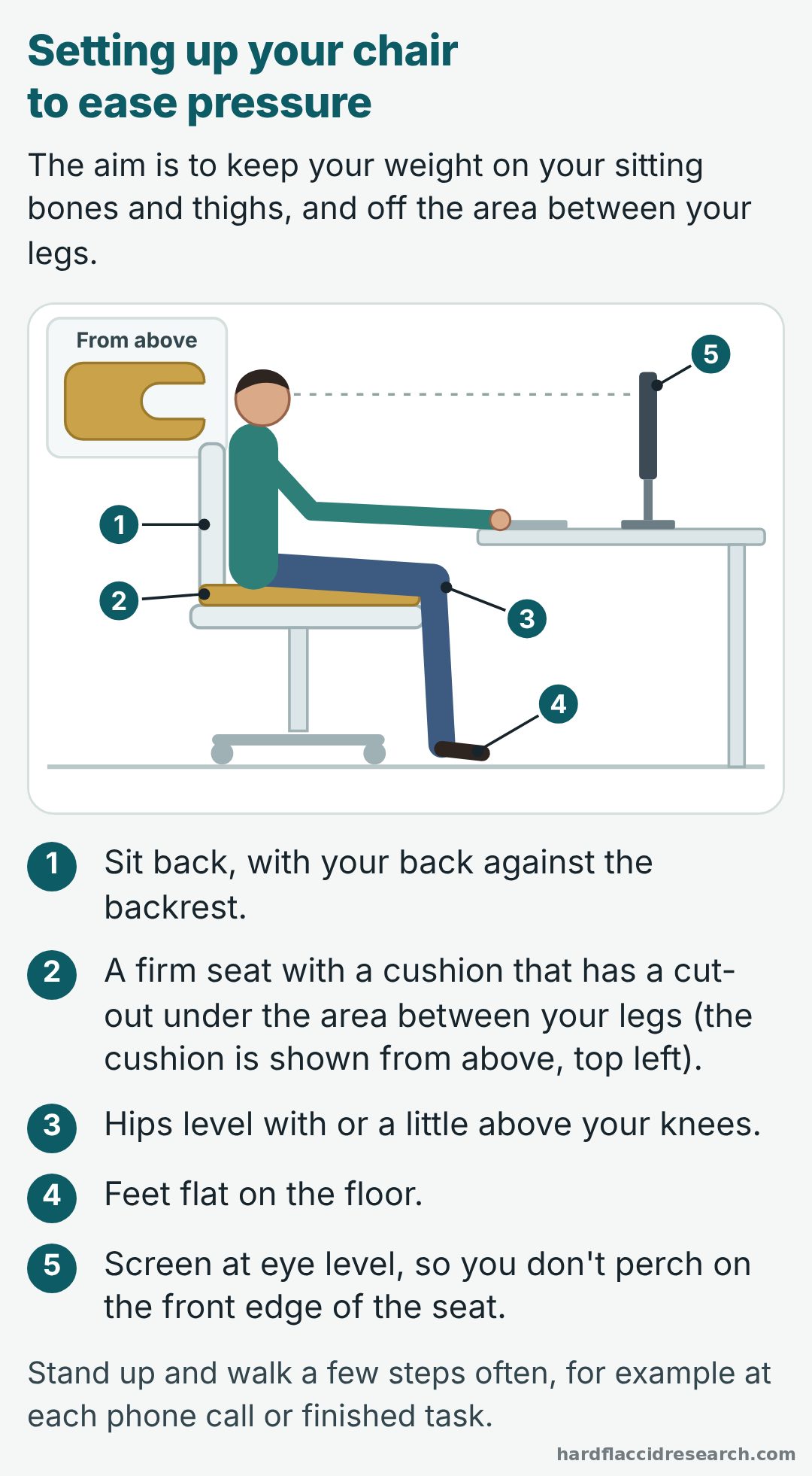
Keep your weight on your sitting bones and thighs, and off the area between your legs:
- Choose a firm seat over a soft sofa you sink into.
- Try a cushion with a cut-out under the area between your legs, or two folded towels, one under each side of your bottom.
- Sit with your feet flat, hips level with or a little above your knees, and your back against the backrest.
- Put your screen at eye level, so you don't perch on the front edge of the seat.
- Stand up often, for example at each phone call or finished task, and stop for breaks on long drives.
Our page on anterior pelvic tilt and hard flaccid covers posture. Today, check your chair against this list and change one thing.
What do men who got better say helped?
In the 126 stories men shared of getting better, stretching came up more than anything else, in 40. Reverse Kegels or pelvic floor relaxation came up in 20, breathing exercises in 16, core, glute (buttock) and posture strengthening in 15, and walking, running or cardio in 12.
And many men improve. In the June 2023 poll, 42% said they were at least half better (56 of 132 men), including 11% about 90% better or fully healed (14 of 132).
US guidelines on chronic pelvic pain in men say doctors may suggest aerobic exercise, such as walking, and hands-on pelvic floor physical therapy for tight, tender muscles. Both are conditional, or weaker, recommendations.
A pelvic floor physical therapist can check how your pelvic floor behaves lying, sitting and standing. In a November 2022 poll of men who had seen one, 36% said it helped quite a bit or cured them (17 of 47 men).
Our members' guide, Hard Flaccid Pelvic Floor Reset: Why Kegels May Backfire, has a daily relaxation routine.
Go gently with stretches, stopping any that hurt, and this week add a hip stretch, a walk or slow belly breathing most days.
What does a pelvic-floor-friendly day look like?
A simple plan to fit around work:
- Morning: a few slow belly breaths before you get up, then a gentle stretch.
- At work: swap between sitting and standing, get up at every change of task, and walk at lunch.
- Standing jobs: lean on a counter or wall when you can, rest a foot on a low step, and sit on your breaks.
- Evening: lie on your back with your knees bent and supported, and let your pelvic floor soften as you breathe.
- Before bed: a warm bath or shower may help you relax. Keep it warm, not hot.
Try it for a week or two and note which positions are worst.
When should I see a doctor?
See a primary care provider or a urologist, a doctor for the urinary tract and male sex organs, if you haven't had your symptoms checked, or if they're getting worse. Other conditions can feel similar, such as pudendal nerve problems and chronic pelvic pain syndrome (long-lasting pelvic pain), and a check can look for them.
Our doctor visit kit helps you explain your symptoms, including which positions make them worse.
Get urgent care straight away (call 911 or go to the emergency room) if you have:
- An erection lasting more than 4 hours.
- Sudden, severe pain in the penis, testicles or pelvis.
- New numbness around your back passage, genitals or inner thighs, or new weakness in your legs.
- New trouble starting or controlling your pee, not being able to pee, or not feeling when your bladder is full.
- Loss of control of your bladder or bowel.
- A fever or chills with pelvic pain or pain when peeing.
Frequently asked questions
Is a standing desk better for hard flaccid?
It can help if you use it to change position, not to stand all day: some sitting, some standing and short walks in between.
Does cycling make hard flaccid worse?
It may. US workplace safety researchers link saddle pressure on the area between the legs to genital numbness in riders, and found that no-nose saddles reduce that pressure. Breaks and standing on the pedals now and then may help too.
Should I avoid standing or sitting?
No. Staying active matters: walking, running or cardio came up in 12 of the 126 recovery stories. Aim for shorter spells in any one position, with breaks to move.
Takeaway
Many men find hard flaccid worse when they stand, and long sitting can add pressure. Change position often, set up your chair, and help your pelvic floor let go with slow breathing, stretching and walking.
Many men get better. Start with our free self-check, and add your experience to help the next man.
This article is for general information and isn't a substitute for advice from your own doctor. Hard Flaccid Research doesn't diagnose or treat. If you have new or worsening symptoms, see a qualified clinician. In an emergency, call 911.
Free tools that can help
- Self-check: do I have hard flaccid?Compare your symptoms with what 6,026 men report.
- Doctor visit kitA one-page summary to take to your appointment.
- Habit trackerCount your days without porn or masturbation, and get through urges.
- Diaphragm breathing toolBreathe with a moving picture of your diaphragm and pelvic floor.
- Add your experienceTell us what you tried and how it went. No name needed.
- Hard Flaccid Syndrome CensusWhat men answered in 818 polls.
- Symptom trackerLog your symptoms and see what helps you.
- Ask us a questionThe questions men ask most become new articles.
The numbers behind this article
Every number in this article comes from what men with hard flaccid syndrome shared between December 2020 and October 2026, counted once per person, or from their polls. These are self-selected reports, not a clinical study. See hard flaccid syndrome statistics, the Hard Flaccid Syndrome Census and how we count.
In a March 2023 poll, 86% said it is more hard flaccid when standing than lying down
How 63 men answered: is it more "hard flaccid" when standing than lying down?These figures come from voluntary polls. They describe the men who answered, not everyone with hard flaccid syndrome, and aren't clinical findings.
Source: Hard Flaccid Research, hardflaccidresearch.com
63 men asked why it is worse when standing, and 45 whether sitting makes it worse
Number of men who asked each question, counted once per person.The two groups may overlap.
Source: Hard Flaccid Research, hardflaccidresearch.com
Of the 24 men who named long hours sitting, 79% described the firm flaccid state
Share of the 24 men who named long hours sitting as the trigger of their hard flaccid syndrome who described each of these.A small group. These are self-selected reports, not a clinical study, and one man can describe several symptoms.
Source: Hard Flaccid Research, hardflaccidresearch.com
Pelvic floor tightness: 23% of all men who described symptoms, 45% who described pelvic pain, 58% who named sitting
Share who described pelvic floor tightness, spasm or twitching in each group of men.Men who named any trigger tended to describe more symptoms, and the sitting group is small.
Source: Hard Flaccid Research, hardflaccidresearch.com
In a June 2023 poll, 42% said they were at least half better, and 11% about 90% better or fully healed
How 132 men answered: have you healed?Men who recover may stop answering polls, so these numbers may undercount recovery.
Source: Hard Flaccid Research, hardflaccidresearch.com
Stretching came up in 40 of the 126 recovery stories, more than anything else
Share of the 126 stories of getting better that credited each.A story mentioning something is what the man credited, not proof it worked. One story can credit several things.
Source: Hard Flaccid Research, hardflaccidresearch.com
In a November 2022 poll, 36% of men who had seen a pelvic floor physical therapist said it helped quite a bit or cured them
How the 47 men who had seen a pelvic floor physical therapist answered: did it help you?These figures come from voluntary polls. They describe the men who answered, not everyone with hard flaccid syndrome, and aren't clinical findings.
Source: Hard Flaccid Research, hardflaccidresearch.com
Every number in this article, with its source
| In this article | Source |
|---|---|
| 6,026 men | 6,026 men, counted from what men wrote, once per person |
| 63 men asked why it is worse when standing | Question group, 63 men, research data |
| 45 men asked whether sitting makes it worse | Question group, 45 men, research data |
| 86% said it is more hard flaccid when standing than lying down (54 of 63 men) | 54 of 63 men, poll, Mar 2023 |
| 10% noticed no change at all (6 of 63 men) | 6 of 63 men, poll, Mar 2023 |
| 5% chose very minimal change but a little bit softer (3 of 63 men) | 3 of 63 men, poll, Mar 2023 |
| 24 men named long hours sitting | 24 men, counted from what men wrote, once per person |
| Of the 24 men who named long hours sitting: 79% firm flaccid state, 71% weaker erections, 58% pelvic floor tightness, 54% numbness, 50% long flaccid, 46% bowel symptoms | 24 men who named long hours sitting, counted from what men wrote, once per person |
| 2,661 men described their symptoms | 2,661 men, counted from what men wrote, once per person |
| 23% of men who described their symptoms described pelvic floor tightness (601 of 2,661) | 601 of 2,661 men, counted from what men wrote, once per person |
| Of 267 men who described pelvic, perineal or tailbone pain: 45% pelvic floor tightness | 267 men who described pelvic, perineal or tailbone pain, counted from what men wrote, once per person |
| 42% said they were at least half better (56 of 132 men) | 56 of 132 men, poll, Jun 2023 |
| 11% said they were about 90% better or fully healed (14 of 132 men) | 14 of 132 men, poll, Jun 2023 |
| 126 recovery stories | 126 men, counted from what men wrote, once per person |
| Stretching came up in 40 of 126 recovery stories | 40 of 126 recovery stories |
| Reverse Kegels or pelvic floor relaxation came up in 20 of 126 recovery stories | 20 of 126 recovery stories |
| Breathing exercises came up in 16 of 126 recovery stories | 16 of 126 recovery stories |
| Core, glute and posture strengthening came up in 15 of 126 recovery stories | 15 of 126 recovery stories |
| Pelvic floor physical therapy came up in 15 of 126 recovery stories | 15 of 126 recovery stories |
| Walking, running or cardio came up in 12 of 126 recovery stories | 12 of 126 recovery stories |
| Of men who had seen a pelvic floor physical therapist, 36% said it helped quite a bit or cured them (17 of 47 men) | 17 of 47 men, poll, Nov 2022 |
| Of men who had seen a pelvic floor physical therapist, 36% said maybe some but very little (17 of 47 men) | 17 of 47 men, poll, Nov 2022 |
| Of men who had seen a pelvic floor physical therapist, 28% said it didn't help at all (13 of 47 men) | 13 of 47 men, poll, Nov 2022 |
| Counting since December 2020 | Research data, December 2020 to October 2026 |
Medical sources
What this article says about medical research, guidelines and urgent care comes from these sources.
- Niedenfuehr J, Stevens DM. Hard flaccid syndrome symptoms, comorbidities, and self-reported efficacy and satisfaction of treatments: a cross-sectional survey. Int J Impot Res. 2025;37:458-464. https://doi.org/10.1038/s41443-024-00853-2
- Abdessater M, Kanbar A, Akakpo W, Beley S. Hard flaccid syndrome: state of current knowledge. Basic Clin Androl. 2020;30:7. https://doi.org/10.1186/s12610-020-00105-5
- Pang KH, Feng J, Zhang Y. Hard-flaccid syndrome: a systematic review of aetiopathophysiology, clinical presentation and management. Int J Impot Res. 2026;38:393-403. https://doi.org/10.1038/s41443-025-01118-2
- Lai HH, Pontari MA, Argoff CE, et al. Male chronic pelvic pain: AUA guideline. J Urol. 2025. https://www.auanet.org/guidelines-and-quality/guidelines/male-chronic-pelvic-pain
- Labat JJ, Riant T, Robert R, Amarenco G, Lefaucheur JP, Rigaud J. Diagnostic criteria for pudendal neuralgia by pudendal nerve entrapment (Nantes criteria). Neurourol Urodyn. 2008;27:306-310. https://pubmed.ncbi.nlm.nih.gov/17828787/
- Hetrick DC, Ciol MA, Rothman I, Turner JA, Frest M, Berger RE. Musculoskeletal dysfunction in men with chronic pelvic pain syndrome type III: a case-control study. J Urol. 2003;170:828-831. https://doi.org/10.1097/01.ju.0000080513.13968.56
- National Institute for Occupational Safety and Health (CDC). About contact stress and reproductive health. https://www.cdc.gov/niosh/reproductive-health/prevention/contact-stress.html
- Bivalacqua TJ, Allen BK, Brock G, et al. Acute ischemic priapism: an AUA/SMSNA guideline. J Urol. 2021;206(5):1114-1121. https://doi.org/10.1097/JU.0000000000002236
How we made this article
We started from the question 63 men asked. Every number was checked against our data. Our editorial team edited it and Dr. Julian Reyes reviewed it medically. Read our editorial policy.
Read next
See more of us on Google
Add Hard Flaccid Research as a preferred source, and Google shows you our pages more often when you search.
Add as a preferred sourceDon't see your question? Ask us. We answer the most-asked ones in new articles.
Cite and share this article
You're welcome to quote this article. Please name Hard Flaccid Research and link to this page, so others can find the full answer and the data behind it. To cite this page, use its link.
Citation
Hard Flaccid Research. (2026). Hard Flaccid Worse When Standing? 86% of Men Noticed It. Written by the Editorial Team, medically reviewed by Dr. Julian Reyes. https://hardflaccidresearch.com/articles/hard-flaccid-worse-standing-sitting
Credit link for your article
Source: <a href="https://hardflaccidresearch.com/articles/hard-flaccid-worse-standing-sitting">Hard Flaccid Research</a>
Wikipedia reference
<ref>{{cite web |url=https://hardflaccidresearch.com/articles/hard-flaccid-worse-standing-sitting |title=Hard Flaccid Worse When Standing? 86% of Men Noticed It |website=Hard Flaccid Research |date=2026 |access-date=28 October 2026}}</ref>
How the data was collected: our methodology. Journalists and researchers: key numbers, data and contact.