Your Breathing May Be Keeping Your Hard Flaccid Tight
In short
- Breathing won't cure hard flaccid syndrome on its own, but your diaphragm and pelvic floor move together with every breath, so shallow chest breathing, holding your breath and stress may keep a tight pelvic floor on guard, though the link between a tight pelvic floor and hard flaccid syndrome isn't proven.
- Slow diaphragmatic breathing is low risk, and pelvic health physios often teach it with reverse Kegels. 425 men with hard flaccid discussed breathing exercises, and they came up in 16 of 126 recovery stories, though a story mentioning something is not proof that it worked.
Breathing exercises won't cure hard flaccid syndrome on their own, but the way you breathe may affect how tight your pelvic floor stays. Your main breathing muscle and your pelvic floor move together with every breath, so slow belly breathing, also called diaphragmatic breathing, is one of the simplest, lowest-risk ways to help those muscles let go. In hard flaccid, the penis stays firm, rubbery or shrunken when it should be soft, and many men with hard flaccid describe a tight pelvic floor, though how the two are linked isn't proven.
425 men with hard flaccid discussed breathing exercises, and they came up in 16 of 126 recovery stories, and a story mentioning something is not proof that it worked. This page explains what diaphragmatic breathing is, how breathing and the pelvic floor move together, signs your breathing is shallow or tight, how to do diaphragmatic breathing step by step, box breathing and other techniques, and what breathing can and can't do.
By the numbers: between December 2020 and October 2026, 2,661 of the 6,026 men with hard flaccid who shared their experiences described their symptoms: 23% described pelvic floor tightness, spasm or twitching (601 of 2,661). These are men with hard flaccid, not men in general.

What is diaphragmatic breathing?
Diaphragmatic breathing, or belly breathing, means breathing mainly with the diaphragm, the dome of muscle under your lungs, instead of lifting your chest and shoulders. As you breathe in, the diaphragm moves down, your belly and lower ribs widen, and your chest stays fairly still. It is the way most people breathe when they are calm or asleep.
Slow diaphragmatic breathing, with a breath out a little longer than the breath in, is widely used to help the body settle when you are stressed or anxious, and pelvic health physios use it to help a tight pelvic floor let go. Small studies suggest slow breathing can ease stress and anxiety a little, though results vary. It is free, and it is safe for most people.
Hard Flaccid Explorerby Hard Flaccid Research
How your breathing may affect the pelvic floor
A 7-minute animated explainer of this article. Press play, or skip between chapters. The first minute is free for everyone.
A picture to explain, not a diagnosis. The diaphragm isn't drawn: the picture shows the pelvic floor, a nerve and blood flow.
How breathing and the pelvic floor move together
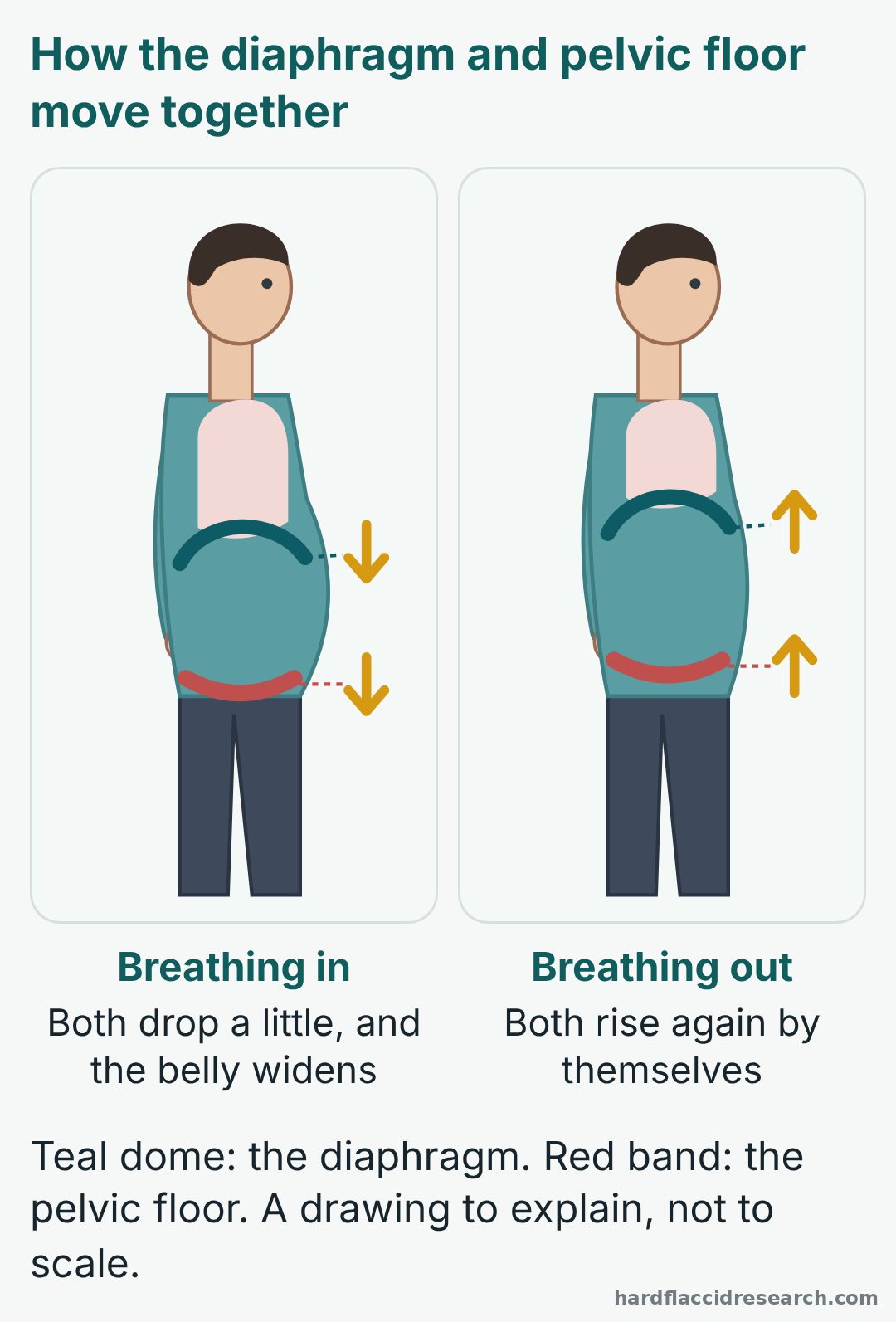
The pelvic floor is the layer of muscle at the base of your pelvis, between your legs. It holds up your bladder and bowel and plays a part in erections. It and the diaphragm work as a pair, a bit like a piston.
- When you breathe in, the diaphragm moves down, your belly widens, and the pelvic floor drops and lengthens a little.
- When you breathe out, the diaphragm rises again and the pelvic floor lifts back up by itself.
It's one reason pelvic health physios often start with breathing when the pelvic floor is tight: it uses a movement your body already makes.
Related: Pelvic Floor Twitching With Hard Flaccid: What It Means »
How breathing might keep hard flaccid tight
This is one idea doctors and physios discuss. It isn't proven for hard flaccid syndrome, and breathing is unlikely to be the whole story.
If you breathe mostly into your chest, the diaphragm moves less, so the pelvic floor gets less of that gentle drop with each breath. Holding your breath or bracing your belly may keep those muscles partly switched on. Pushing down while you hold your breath, as when you lift something heavy or strain on the toilet, loads the pelvic floor, and it may tighten to resist.
Of the 2,661 men with hard flaccid who described their symptoms, 23% described pelvic floor tightness, spasm or twitching (601 of 2,661). In what men with hard flaccid wrote, some linked the start to things that can involve bracing or pushing down: 14 men with hard flaccid named the gym, heavy lifting or sports, and 23 straining or constipation, though naming something as the start doesn't show that it caused hard flaccid.
Among the men with hard flaccid who discussed breathing exercises and also described their symptoms, 72% described the firm flaccid state, 55% numbness, 53% weaker erections, 48% pelvic floor tightness and 44% shrinkage. Men who wrote about a treatment tended to describe more symptoms of every kind, so these shares run higher than among all men who described symptoms. These are self-selected reports, not a clinical study.
Stress, worry and your breathing
When you're stressed, you tend to breathe faster and higher in your chest, and the body's fight-or-flight response tightens muscles, which may include the pelvic floor. 916 men with hard flaccid syndrome wrote about anxiety, and 37 men with hard flaccid named stress or anxiety as how their symptoms began. In one April 2023 poll of men with hard flaccid, 76% said they had anxiety before hard flaccid began (94 of 123 men), though that doesn't show that anxiety caused it.
That doesn't mean hard flaccid is all in the mind. Hard flaccid often causes anxiety, and in one January 2023 poll of men with hard flaccid, 84% said the cause is not psychological (88 of 105 men). But worry and symptoms can feed each other, and slow breathing with a long breath out is one way to turn the body's alarm down. Talking therapy, such as CBT, and mindfulness or meditation may help with worry and anxiety too. Separately, 603 men with hard flaccid discussed them.
If you are feeling hopeless or having thoughts of ending your life, please visit our Support page now. It lists crisis lines you can call or text today.
Related: Hard Flaccid Flare-Up? Why It Gets Worse and How to Calm It »
Signs your breathing may be shallow or tight
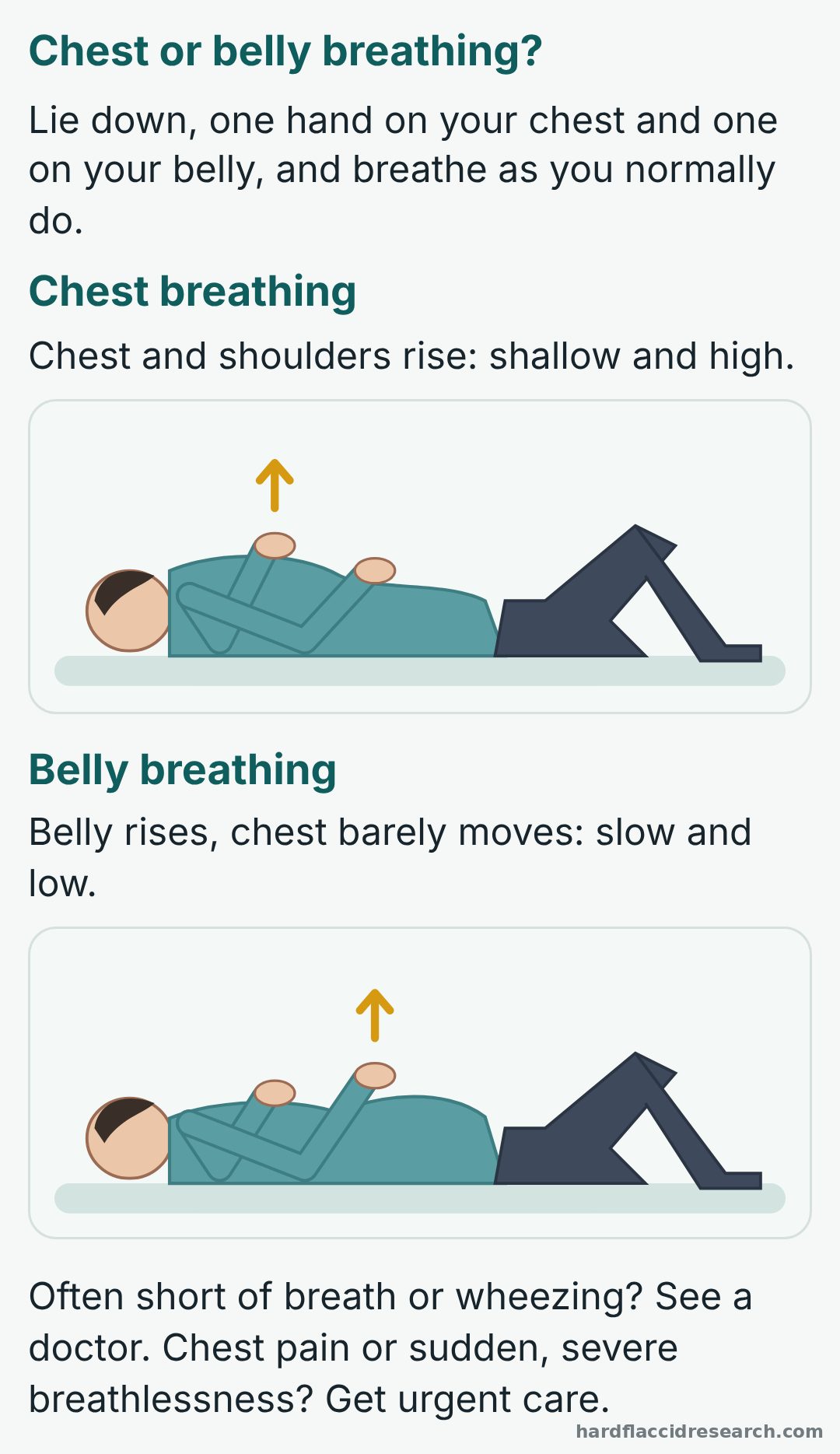
Lie on your back, one hand on your chest and one on your belly, and breathe normally for a minute. Common signs your breathing is high and tight:
- Your chest hand moves more than your belly hand.
- Your shoulders rise when you breathe in.
- You hold your breath without noticing, for example when you concentrate, read your phone, lift something or sit on the toilet.
- You keep your belly held in for most of the day.
- You sigh or yawn a lot.
Breathing can get shallow for many reasons: stress and anxiety, long hours sitting hunched over a desk or phone, holding your belly in, a tight waistband, pain, or simply habit. Some people also hold their breath without noticing when they feel pain or worry.
Shallow breathing like this is often a habit that practice can change. Feeling short of breath, often feeling you can't get a full breath, wheezing or a cough that won't go away are different, and need a doctor. Chest pain, or sudden or severe shortness of breath, needs urgent care straight away.
How to do diaphragmatic breathing, step by step
Start lying down, where it is easiest to feel. Keep it gentle: the aim is a soft, slow breath, not a big one.
- Lie on your back with a pillow under your head and your knees bent. Place one hand flat on your upper belly, just below your ribs, and the other on your upper chest.
- Breathe in gently through your nose, slowly counting to about four. Your belly hand should rise first while your chest hand hardly moves. Some men feel a gentle softening between the legs.
- Let the breath go slowly through your nose or softly pursed lips, counting to about six. Your belly falls back on its own, so there's no need to push the air out.
- Keep going for a few minutes, once or twice a day. Once it feels natural lying down, practise it sitting, standing and then walking, so it carries into daily life.
Keep it gentle. If you feel dizzy or light-headed, you may be breathing too hard or too fast: stop, breathe normally, and next time take smaller, slower breaths. If the dizziness doesn't pass, or comes with chest pain, get medical help. It usually gets easier with daily practice.
Breathing guideby Hard Flaccid Research
Breathe with the picture
Press Start, and a calm voice talks you through it. Breathe in as the diaphragm and pelvic floor drop, and out as they float back up.
- Lie on your back with your knees bent, or sit back in a chair.
- Put one hand on your belly. It should rise and fall more than your chest.
- Breathe in through your nose as the picture drops. Let the area between your legs soften, without pushing.
- Breathe out slowly as it rises, a little longer than the breath in. Don’t squeeze.
- Light-headed? Make each breath smaller and softer.
© 2026 Hard Flaccid Research · hardflaccidresearch.com
Box breathing and other breathing exercises
There are many breathing exercises. These are the ones people ask about most, and how they fit a tight pelvic floor:
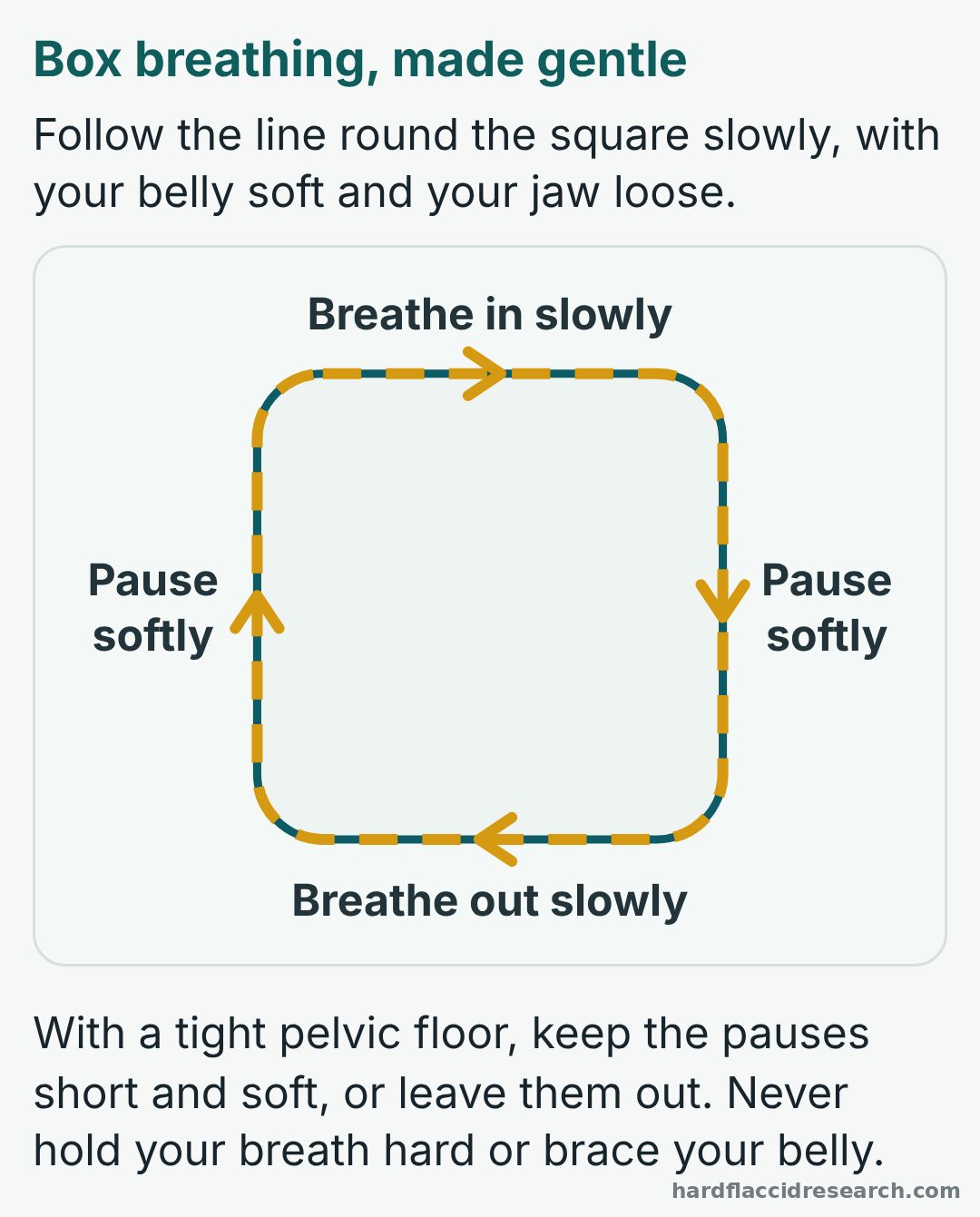
- Box breathing. Breathe in, hold, breathe out and hold again, each for the same slow count, like the four sides of a square. It is often used to stay calm under pressure. If your pelvic floor is tight, keep the holds (pauses) short and soft, or leave them out, because holding your breath hard can make you brace your belly and pelvic floor.
- Slow breathing and resonance breathing. Breathe in and out slowly and evenly, much slower than your usual pace, with the breath out as long as or a little longer than the breath in. Resonance breathing is a form of slow breathing, often taught with a heart rate monitor, at the steady pace where your heart rate rises and falls most smoothly with each breath. Slow down gradually, and stop if you feel short of breath.
- 360 breathing. Breathe so that your belly, sides and lower back all widen, not just your front. Some physios use it to help the ribs, belly and pelvic floor move together.
- The physiological sigh. Take a breath in through your nose, add a second short sniff on top, then let a long, slow breath out. Some people use one or two when they feel stress building.
Whichever you use, keep it slow and comfortable, and stop if you feel dizzy, tingly or out of breath. Avoid forceful breathing methods and long breath holds, especially if you have heart or lung problems or high blood pressure, and ask a doctor first if you are unsure. Breathing exercises don't replace inhalers or other medicines for asthma or a lung condition; don't stop or change them on your own. Never practise long breath holds or fast breathing in or near water, or while driving.
Breathing with reverse Kegels
A reverse Kegel is a gentle letting go of the pelvic floor, the opposite of a Kegel squeeze, never a push or a strain. It rides on the breath in: as your belly widens, you let the area between your legs soften and drop a little more, then let it come back up by itself on the breath out, without squeezing it up. 704 men with hard flaccid syndrome discussed reverse Kegels or pelvic floor relaxation. Separately, 118 men with hard flaccid asked whether they should do Kegels or reverse Kegels.
If your pelvic floor feels tight, ask a pelvic health physio before doing Kegels, which squeeze and tighten. A Kegel squeeze only gets stronger safely if you let go fully between squeezes. Our members' guide, Hard Flaccid Pelvic Floor Reset: Why Kegels May Backfire, has a breathing guide and a daily routine.
Breathing through the day
- Now and then, notice whether you've stopped breathing or tensed your jaw, shoulders or belly, and soften them as the breath goes out.
- When you lift something heavy or get up from a chair, let your breath out as you move rather than holding it.
- On the toilet, don't hold your breath and push. Breathe slowly and give it time.
- When you notice stress building, take three or four slow belly breaths with a long breath out.
- If you sit a lot, get up and move regularly, taking a few slow breaths as you do. In what men wrote, 24 men with hard flaccid syndrome named long hours sitting as how their symptoms began, though that doesn't show that sitting caused it.
What breathing can and can't do
Breathing exercises are low risk and free, and they may help the pelvic floor relax and the body settle. They can't fix a nerve problem or a blood flow problem, or treat another condition that may be causing your symptoms, and no study has tested breathing on its own for hard flaccid syndrome. It is part of relaxation programmes for chronic pelvic pain in men, but it hasn't been tested on its own there either.
In the 126 recovery stories, breathing exercises came up in 16. Being mentioned is not the same as working: men mention what they did while they got better, and they often did several things at once.
A pelvic health physio can check what your pelvic floor actually does and teach you to relax it. In one November 2022 poll of men with hard flaccid who had seen a pelvic floor physio, 36% said it helped quite a bit or cured them (17 of 47 men). In one February 2023 poll of men with hard flaccid, 59% had never seen a pelvic floor physio (91 of 155 men), and of the 64 who had, 38% said physio dramatically helped (24 of 64 men). These are self-selected reports, not a clinical study.
Common questions about breathing and the pelvic floor
How long until breathing exercises make a difference? It varies. Breathing is a skill, so it usually takes regular practice before it feels natural, and some men notice little change from breathing on its own. Keep it up alongside other steps and track your symptoms. If nothing changes, or things get worse, see a doctor or physio.
Can breathing exercises make things worse? Gentle diaphragmatic breathing is very unlikely to. Breathing too hard or fast can make you dizzy or tingly, and long, forced breath holds can make you brace. If anything hurts, stop, and ask a doctor or physio.
Is box breathing good for the pelvic floor? It can help you feel calmer, but the holds can make some people brace. If your pelvic floor is tight, a slow breath with a longer breath out, and soft or no holds, may suit you better.
What is the best breathing exercise for the pelvic floor? There's no single best one. Slow diaphragmatic breathing with a longer breath out, combined with the gentle drop of a reverse Kegel, is a common starting point with pelvic health physios.
Are deep breathing exercises the same thing? Usually, yes: most deep breathing exercises are forms of diaphragmatic breathing. For a tight pelvic floor, many physios suggest a slow, soft breath rather than a big one.
How often should I do breathing exercises? Short, regular sessions are easier to keep up than long ones: a few minutes once or twice a day, plus a slow breath whenever you catch yourself holding your breath or clenching.
Should I breathe through my nose? Breathing in through your nose tends to slow your breath down, which may help you relax. Breathe out through your nose or softly through your lips, whichever is more relaxed. If your nose is often blocked, a pharmacist or GP can help.
Can breathing help erections? Not directly. Stress and worry can dampen the signal for an erection, and slow breathing may help you feel calmer, but it isn't a treatment for erection problems. If your erections have changed, see a doctor.
Does diaphragmatic breathing help anxiety? It can help you feel calmer in the moment, and small studies suggest slow breathing eases stress and anxiety a little. If anxiety is getting in the way of your life, talk to your doctor about treatments such as talking therapy.
When to see a doctor
Breathing exercises are safe for most people, but they don't replace a check-up. See a doctor if your symptoms haven't been checked, are getting worse, or include pain, urinary or bowel problems or erection changes, since these can have other causes that need treatment. If you've had numbness between your legs for a while, or pain that is clearly worse when sitting, ask a doctor to check the nerves, including the pudendal nerve. New numbness there needs urgent care (see the list below). Your GP can refer you to a pelvic health physio.
Get urgent care straight away if you have:
- Chest pain, or sudden or severe shortness of breath.
- Sudden, severe pain in the penis, testicles or pelvis.
- New numbness around your back passage, genitals or inner thighs, or new weakness in your legs.
- New trouble starting or controlling your pee, not being able to pee, or not feeling when your bladder is full.
- Loss of control of your bladder or bowel.
- A fever or chills with pelvic pain or pain when peeing.
What to do next
- If your symptoms haven't been checked, see a doctor first, because they can have other causes.
- Check how you breathe today, with one hand on your chest and one on your belly.
- Practise slow diaphragmatic breathing lying down for a few minutes, once or twice a day.
- Add the gentle drop of a reverse Kegel on each breath in, once the breathing feels easy.
- Track your symptoms for a few weeks to see whether anything changes.
- Take our self-check, and make a doctor visit kit before you see a GP or physio.
Free tools that can help
- Self-check: do I have hard flaccid?Compare your symptoms with what 6,026 men report.
- Doctor visit kitA one-page summary to take to your appointment.
- Habit trackerCount your days without porn or masturbation, and get through urges.
- Diaphragm breathing toolBreathe with a moving picture of your diaphragm and pelvic floor.
- Add your experienceTell us what you tried and how it went. No name needed.
- Hard Flaccid Syndrome CensusWhat men answered in 818 polls.
- Symptom trackerLog your symptoms and see what helps you.
- Ask us a questionThe questions men ask most become new articles.
The numbers behind this article
Every number in this article comes from what men with hard flaccid syndrome shared between December 2020 and October 2026, counted once per person, or from their polls. These are self-selected reports, not a clinical study. See hard flaccid syndrome statistics, the Hard Flaccid Syndrome Census and how we count.
425 men with hard flaccid syndrome discussed breathing exercises
Number of men with hard flaccid syndrome in each group, counted once per person. The last bar is a question group.The groups overlap. These are self-selected reports, not a clinical study.
Source: Hard Flaccid Research, hardflaccidresearch.com
In what men with hard flaccid syndrome wrote, 37 named stress or anxiety as how it began
Number of men with hard flaccid syndrome who named each as how their symptoms began, counted once per person. Only causes linked to tension or straining are shown; other causes came up more often, such as penis enlargement methods and masturbation.Naming something as the start is not proof that it caused hard flaccid syndrome. In our polls, more men named masturbation than any other cause.
Source: Hard Flaccid Research, hardflaccidresearch.com
In one poll, 76% of men with hard flaccid syndrome said they had anxiety before hard flaccid syndrome (94 of 123 men)
How 123 men with hard flaccid syndrome answered an April 2023 poll: "Did you have anxiety before hard flaccid syndrome?"Having anxiety first doesn't show that anxiety caused hard flaccid syndrome.
Source: Hard Flaccid Research, hardflaccidresearch.com
In one poll, 84% of men with hard flaccid syndrome said the cause is not psychological (88 of 105 men)
How 105 men with hard flaccid syndrome answered a January 2023 poll: "Is the cause of hard flaccid syndrome psychological?"These are self-selected reports, not a clinical study.
Source: Hard Flaccid Research, hardflaccidresearch.com
Breathing exercises came up in 16 of the 126 hard flaccid syndrome recovery stories
Share of the 126 stories from men with hard flaccid syndrome who got better that mention breathing exercises. Mentioned is not the same as worked.A story mentioning something is not proof that it worked. Men often did several things at once.
Source: Hard Flaccid Research, hardflaccidresearch.com
In one poll, 36% of men with hard flaccid syndrome who had seen a pelvic floor physio said it helped quite a bit or cured them (17 of 47 men)
How the 47 men with hard flaccid syndrome who had seen a pelvic floor physio answered a November 2022 poll: "Did pelvic floor physio help you?"In the same poll, 44 of the 91 men had never been to a pelvic floor physio. These are self-selected reports, not a clinical study.
Source: Hard Flaccid Research, hardflaccidresearch.com
In one poll, 38% of men with hard flaccid syndrome who had seen a pelvic floor physio said it dramatically helped (24 of 64 men)
How the 64 men with hard flaccid syndrome who had seen a pelvic floor physio answered a February 2023 poll: "Did a pelvic floor physio dramatically help?"In the same poll, 91 of the 155 men had never seen a pelvic floor physio. These are self-selected reports, not a clinical study.
Source: Hard Flaccid Research, hardflaccidresearch.com
Every number in this article, with its source
| In this article | Source |
|---|---|
| 425 men discussed breathing exercises | 425 men discussing breathing exercises, counted from what men wrote, once per person |
| Breathing exercises came up in 16 of 126 recovery stories | 16 of 126 recovery stories |
| 2,661 of the 6,026 men who shared their experiences described their symptoms | Research data, December 2020 to October 2026 |
| 23% described pelvic floor tightness, spasm or twitching (601 of 2,661) | 601 of 2,661 men, counted from what men wrote, once per person |
| 14 men named the gym, heavy lifting or sports as how their symptoms began | 14 men, counted from what men wrote, once per person |
| 23 men named straining or constipation as how their symptoms began | 23 men, counted from what men wrote, once per person |
| 24 men named long hours sitting as how their symptoms began | 24 men, counted from what men wrote, once per person |
| 37 men named stress or anxiety as how their symptoms began | 37 men, counted from what men wrote, once per person |
| Among men who discussed breathing exercises and also described their symptoms: 72% firm flaccid state, 55% numbness, 53% weaker erections, 48% pelvic floor tightness, 44% shrinkage | 425 men discussing breathing exercises, counted from what men wrote, once per person; shares are of those who also described their symptoms |
| 916 men wrote about anxiety | 916 men who wrote about anxiety, research data |
| 76% had anxiety before hard flaccid syndrome (94 of 123 men) | 94 of 123 men, poll, Apr 2023 |
| 24% did not have anxiety before hard flaccid (29 of 123 men) | 29 of 123 men, poll, Apr 2023 |
| 84% said the cause is not psychological (88 of 105 men) | 88 of 105 men, poll, Jan 2023 |
| 16% said the cause is psychological (17 of 105 men) | 17 of 105 men, poll, Jan 2023 |
| 603 men discussed therapy, CBT, mindfulness or meditation | 603 men discussing therapy, CBT, mindfulness or meditation, counted from what men wrote, once per person |
| 704 men discussed reverse Kegels and pelvic floor relaxation | 704 men discussing reverse Kegels and pelvic floor relaxation, counted from what men wrote, once per person |
| 30% said physio helped quite a bit (14 of 47 men) | 14 of 47 men, poll, Nov 2022 |
| 6% said physio cured them (3 of 47 men) | 3 of 47 men, poll, Nov 2022 |
| 36% said physio helped some, but very little (17 of 47 men) | 17 of 47 men, poll, Nov 2022 |
| 28% said physio didn't help at all (13 of 47 men) | 13 of 47 men, poll, Nov 2022 |
| 44 of 91 men had never been to a pelvic floor physio | 44 of 91 men, poll, Nov 2022 |
| 118 men asked whether to do Kegels or reverse Kegels | Question group, 118 men, research data |
| 36% said physio helped quite a bit or cured them (17 of 47 men) | 17 of 47 men, poll, Nov 2022 |
| 59% had never seen a pelvic floor physio (91 of 155 men) | 91 of 155 men, poll, Feb 2023 |
| 38% said physio dramatically helped (24 of 64 men) | 24 of 64 men, poll, Feb 2023 |
| 62% said physio didn't dramatically help (40 of 64 men) | 40 of 64 men, poll, Feb 2023 |
How we made this article
We started from the question many men asked. Every number was checked against our data. Our editorial team edited it and Dr. Julian Reyes reviewed it medically. Read our editorial policy.
Read next
See more of us on Google
Add Hard Flaccid Research as a preferred source, and Google shows you our pages more often when you search.
Add as a preferred sourceDon't see your question? Ask us. We answer the most-asked ones in new articles.
Cite and share this article
You're welcome to quote this article. Please name Hard Flaccid Research and link to this page, so others can find the full answer and the data behind it. To cite this page, use its link.
Citation
Hard Flaccid Research. (2026). Your Breathing May Be Keeping Your Hard Flaccid Tight. Written by the Editorial Team, medically reviewed by Dr. Julian Reyes. https://hardflaccidresearch.com/articles/breathing-hard-flaccid
Credit link for your article
Source: <a href="https://hardflaccidresearch.com/articles/breathing-hard-flaccid">Hard Flaccid Research</a>
Wikipedia reference
<ref>{{cite web |url=https://hardflaccidresearch.com/articles/breathing-hard-flaccid |title=Your Breathing May Be Keeping Your Hard Flaccid Tight |website=Hard Flaccid Research |date=2026 |access-date=28 October 2026}}</ref>
How the data was collected: our methodology. Journalists and researchers: key numbers, data and contact.