Detrusor Muscle: How Your Bladder Fills and Empties
In short
- The detrusor is the smooth muscle that makes up the wall of the bladder.
- It stays relaxed while the bladder fills, then squeezes to push urine out while the sphincters and pelvic floor relax.
- When it squeezes too early it causes urgency and overactive bladder, and when it's too weak the bladder doesn't empty properly.
The detrusor (dee-TROO-ser) muscle is the muscle that makes up the wall of the bladder. It's a smooth muscle, the kind you don't control directly, woven in layers that run in different directions so the bladder can stretch a lot and still squeeze firmly.
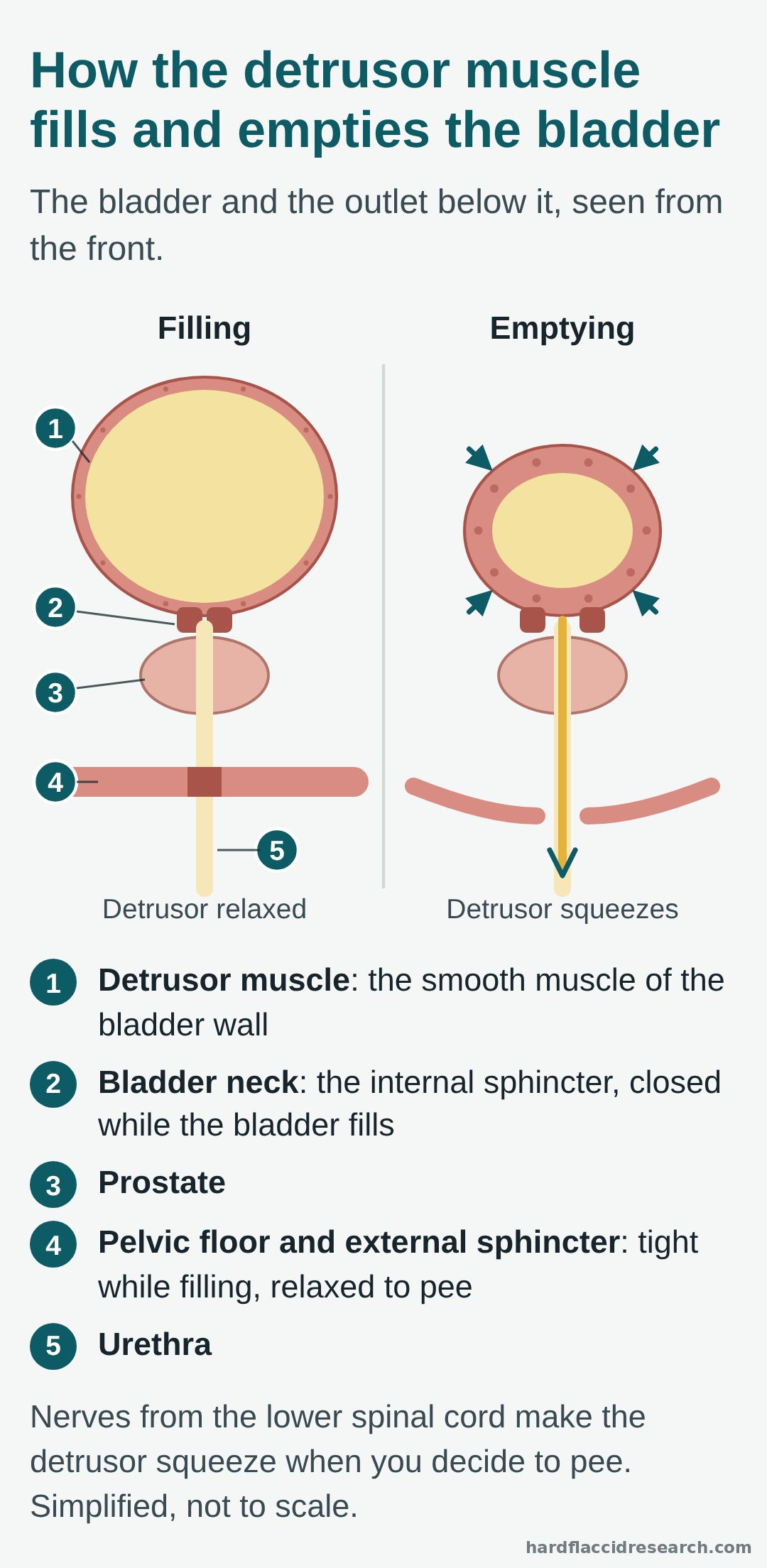
Its job has two halves. While the bladder fills, the detrusor stays relaxed and stretches. When you decide to pee, it squeezes to push urine out, while the sphincters and the pelvic floor relax to let it through. This page explains how that works, what goes wrong when the detrusor is overactive or weak, and what helps.
By the numbers: of the 6,026 men who shared their experiences with hard flaccid syndrome, 2,661 described their symptoms, and 337 of them described urinary problems.

Key facts
- The detrusor is the smooth muscle in the wall of the bladder.
- It relaxes to let the bladder fill and squeezes to empty it.
- Nerves from the lower spinal cord and signals from the brain control when it squeezes.
- At the same time, the sphincters at the bladder neck and around the urethra, and the pelvic floor, must relax.
- An overactive detrusor squeezes too early and causes urgency and frequent peeing. An underactive detrusor squeezes too weakly, so the bladder doesn't empty well.
- Many bladder symptoms in men come from the prostate or a tight pelvic floor rather than the detrusor itself, so a proper check matters.
What is the detrusor muscle?
The bladder is a hollow, stretchy bag that stores urine. Its wall has several layers:
- The urothelium: a waterproof inner lining.
- The lamina propria: a layer of connective tissue with blood vessels and nerves.
- The detrusor muscle: smooth muscle fibers arranged in criss-crossing layers, often described as an inner and outer layer running lengthwise and a middle layer running around.
- An outer covering.
At the bottom of the bladder, the detrusor merges with the internal urethral sphincter at the bladder neck. In men, the prostate sits just below, wrapped around the start of the urethra. Further down, the external urethral sphincter, a muscle you can control, sits within the pelvic floor.
Related: Dribbling After Urination: Why It Happens and How to Stop It »
How does the detrusor muscle work?
Filling
As urine trickles in from the kidneys, the detrusor stays relaxed and the bladder slowly expands with little rise in pressure. Signals from the sympathetic nervous system help keep the detrusor relaxed and the bladder neck closed. Stretch sensors in the wall send messages to the spinal cord and brain, so you gradually feel the need to pee.
Emptying
When you decide to pee, a control center in the brainstem switches the system over. Parasympathetic nerves from the lower spinal cord release a chemical messenger called acetylcholine, which makes the detrusor contract. At the same moment, the bladder neck and the external sphincter relax, and the pelvic floor lets go. Urine flows out until the bladder is nearly empty.
Why the brain matters
The brain normally keeps the detrusor quiet until it's a good time to pee. That's why urgency can be affected by stress, anxiety, cold, the sound of running water or arriving home.
What can go wrong with the detrusor?
Overactive bladder
In overactive bladder, the detrusor squeezes, or feels like it wants to, before the bladder is full. This causes:
- Sudden, strong urges to pee that are hard to put off.
- Peeing often during the day.
- Waking at night to pee.
- Sometimes leaking before reaching the toilet.
Doctors call the squeezing itself detrusor overactivity. US urology guidelines suggest starting with simple steps, such as bladder training, pelvic floor exercises guided by a therapist, and changes to fluids, caffeine and alcohol, before medicines.
Underactive detrusor
When the detrusor squeezes too weakly or too briefly, the bladder doesn't empty fully. You may notice a weak stream, straining, stopping and starting, or feeling that you still need to go. Causes include nerve damage, for example from diabetes, some medicines and long-term blockage.
Blockage below the bladder
An enlarged prostate or a narrowing of the urethra makes the detrusor work harder. Over time, its wall can thicken and become overactive, or wear out and weaken.
A pelvic floor that won't relax
If the pelvic floor and external sphincter don't relax while the detrusor squeezes, the stream can be slow, start and stop, or need pushing. This is common with a tight pelvic floor.
Related: Kegel Exercises for Men: How to Do Them, Benefits & When to Stop »
The detrusor and hard flaccid syndrome
Hard flaccid syndrome is a firm, shrunken penis at rest, often with numbness, weaker erections and pelvic pain. Many men with hard flaccid notice urinary changes, which more often come from a tight pelvic floor than from the detrusor itself.
Of the 2,661 men who described their symptoms, 13% described urinary problems (337 men) and 23% described pelvic floor tightness, spasm or twitching (601 men). In a separate count, 107 men asked why there are urinary problems.
Our members' guide, Bladder and Bowel Problems With Hard Flaccid: What Helps, explains the peeing and toilet habits that ease symptoms without straining.
How are detrusor problems diagnosed?
A primary care provider or a urologist (a doctor for urinary and sexual health) will ask about your symptoms and may suggest:
- A bladder diary: noting when and how much you pee and drink for a few days. Our doctor visit kit helps you bring this along.
- A urine test to look for infection or blood.
- A scan after peeing to see how much urine is left.
- A flow test, which measures how fast you pee.
- Urodynamic tests, which measure bladder pressure as it fills and empties. These show whether the detrusor is overactive, weak or working against a blockage.
How are detrusor problems treated?
Treatment depends on the cause.
- Bladder training: gradually stretching the time between toilet visits, using calm breathing to ride out urges.
- Fluids: drinking steadily through the day rather than in large amounts at once, and cutting back on caffeine, alcohol and fizzy drinks.
- Pelvic floor physical therapy: to strengthen a weak pelvic floor, or to relax a tight one. Which you need matters, so get checked by a therapist.
- Medicines for overactive bladder: these calm the detrusor. Common types can cause a dry mouth, constipation or, rarely, trouble emptying the bladder. Ask your doctor which suits you.
- Treating the prostate or a narrowing, if one is found.
- For overactive bladder that doesn't respond: Botox injections into the detrusor or nerve stimulation, in specialist clinics.
When should I see a doctor?
See a primary care provider or a urologist if you have urgency, peeing often, waking at night to pee, a weak stream or a feeling that your bladder doesn't empty, especially if it affects your daily life.
Get urgent care straight away (call 911 or go to the emergency room) if you have:
- New trouble starting or controlling your pee, not being able to pee, or not feeling when your bladder is full.
- New numbness around your back passage, genitals or inner thighs, or new weakness in your legs.
- Loss of control of your bladder or bowel.
- A fever or chills with pelvic pain or pain when peeing.
- Blood in your urine with clots, or pain in your side or back with a fever.
Frequently asked questions
Can you control your detrusor muscle?
Not directly, because it's smooth muscle. But your brain controls when it's allowed to squeeze, and bladder training can help you calm urges.
What is detrusor overactivity?
It's when the detrusor squeezes before you choose to pee, usually seen on urodynamic tests. It's a common cause of overactive bladder symptoms.
Can a tight pelvic floor cause urgency?
It can contribute. A tight pelvic floor can cause frequent urges, a slow stream and a feeling of not emptying, which can feel like an overactive bladder.
Does caffeine affect the detrusor?
Caffeine can make urgency and frequency worse in some people. Cutting back for a couple of weeks is an easy way to find out.
Can the detrusor get stronger?
It isn't trained like a muscle in your arm, but treating a blockage, bladder training and good toilet habits help it work well.
Why do I need to pee more when I'm nervous?
Stress and anxiety make the bladder more sensitive and the pelvic floor tenser, so urges come sooner. Slow breathing and bladder training can help.
Can an overactive bladder go away?
It often improves a lot with bladder training, changes to drinks and treatment of any cause, such as a tight pelvic floor or an enlarged prostate. Some people need ongoing treatment to keep symptoms under control.
Takeaway
The detrusor is the muscle in the bladder wall. It relaxes while the bladder fills and squeezes to empty it, while the sphincters and pelvic floor relax.
Urgency, frequent peeing and a weak stream can come from the detrusor, the prostate or a tight pelvic floor, so a proper check helps find the right treatment. Take our free self-check if you also notice changes in your penis at rest.
This article is for general information and isn't a substitute for advice from your own doctor. Hard Flaccid Research doesn't diagnose or treat. If you have new or worsening symptoms, see a qualified clinician. In an emergency, call 911.
Free tools that can help
- Self-check: do I have hard flaccid?Compare your symptoms with what 6,026 men report.
- Doctor visit kitA one-page summary to take to your appointment.
- Habit trackerCount your days without porn or masturbation, and get through urges.
- Diaphragm breathing toolBreathe with a moving picture of your diaphragm and pelvic floor.
- Add your experienceTell us what you tried and how it went. No name needed.
- Hard Flaccid Syndrome CensusWhat men answered in 818 polls.
- Symptom trackerLog your symptoms and see what helps you.
- Ask us a questionThe questions men ask most become new articles.
The numbers behind this article
Every number in this article comes from what men with hard flaccid syndrome shared between December 2020 and October 2026, counted once per person, or from their polls. These are self-selected reports, not a clinical study. See hard flaccid syndrome statistics, the Hard Flaccid Syndrome Census and how we count.
13% of men who described their symptoms described urinary problems
Share of the 2,661 men who described their symptoms. Each man is counted once.These are self-selected reports, not a clinical study.
Source: Hard Flaccid Research, hardflaccidresearch.com
Every number in this article, with its source
| In this article | Source |
|---|---|
| 13% of the men who described their symptoms described urinary problems (337 of 2,661) | 337 of 2,661 men, counted |
| 23% of the men who described their symptoms described pelvic floor tightness, spasm or twitching (601 of 2,661) | 601 of 2,661 men, counted |
| 6,026 men shared their experiences, and 2,661 of them described their symptoms | 2,661 of 6,026 men, counted |
| 107 men asked why there are urinary problems | 107 men asked why there are urinary problems, counted from what men wrote, once per person |
Medical sources
What this article says about medical research, guidelines and urgent care comes from these sources.
- Anatomy, Abdomen and Pelvis: Bladder Detrusor Muscle. In: StatPearls. Treasure Island (FL): StatPearls Publishing. https://www.ncbi.nlm.nih.gov/books/NBK482181/
- Anatomy, Abdomen and Pelvis: Bladder. In: StatPearls. Treasure Island (FL): StatPearls Publishing. https://www.ncbi.nlm.nih.gov/books/NBK531465/
- Physiology, Bladder. In: StatPearls. Treasure Island (FL): StatPearls Publishing. https://pubmed.ncbi.nlm.nih.gov/30860768/
- Cameron AP, Chung DE, Dielubanza EJ, et al. The AUA/SUFU guideline on the diagnosis and treatment of idiopathic overactive bladder. J Urol. 2024. https://doi.org/10.1097/JU.0000000000003985
- Lai HH, Pontari MA, Argoff CE, et al. Male chronic pelvic pain: AUA guideline. J Urol. 2025. https://www.auanet.org/guidelines-and-quality/guidelines/male-chronic-pelvic-pain
- FitzGerald MP, Anderson RU, Potts J, et al. Randomized multicenter feasibility trial of myofascial physical therapy for the treatment of urological chronic pelvic pain syndromes. J Urol. 2009;182:570-580. https://doi.org/10.1016/j.juro.2009.04.022
How we made this article
We started from the question many men asked. Every number was checked against our data. Our editorial team edited it and Dr. Julian Reyes reviewed it medically. Read our editorial policy.
Read next
See more of us on Google
Add Hard Flaccid Research as a preferred source, and Google shows you our pages more often when you search.
Add as a preferred sourceDon't see your question? Ask us. We answer the most-asked ones in new articles.
Cite and share this article
You're welcome to quote this article. Please name Hard Flaccid Research and link to this page, so others can find the full answer and the data behind it. To cite this page, use its link.
Citation
Hard Flaccid Research. (2026). Detrusor Muscle: How Your Bladder Fills and Empties. Written by the Editorial Team, medically reviewed by Dr. Julian Reyes. https://hardflaccidresearch.com/articles/detrusor-muscle
Credit link for your article
Source: <a href="https://hardflaccidresearch.com/articles/detrusor-muscle">Hard Flaccid Research</a>
Wikipedia reference
<ref>{{cite web |url=https://hardflaccidresearch.com/articles/detrusor-muscle |title=Detrusor Muscle: How Your Bladder Fills and Empties |website=Hard Flaccid Research |date=2026 |access-date=22 November 2026}}</ref>
How the data was collected: our methodology. Journalists and researchers: key numbers, data and contact.