Male Urethra: Anatomy, Parts and Common Problems
In short
- The male urethra is the tube that carries urine from the bladder and semen from the reproductive glands out through the tip of the penis.
- It runs through the prostate, the pelvic floor and the length of the penis, and doctors divide it into the prostatic, membranous and spongy parts.
- Infections, narrowing and a tight pelvic floor are common causes of urethral symptoms.
The male urethra (yoo-REE-thruh) is the tube that carries urine out of the bladder and semen out of the body, through the opening at the tip of the penis. It's much longer than the female urethra, because it runs through the prostate, through the pelvic floor and along the whole length of the penis.
Doctors divide it into parts named after what it passes through. Knowing these parts helps make sense of common symptoms, such as burning, a weak stream or dribbling after peeing. This page explains the anatomy of the male urethra, what each part does and the most common problems.
By the numbers: of the 6,026 men who shared their experiences with hard flaccid syndrome, 2,661 described their symptoms, and 337 of them described urinary problems.

Key facts
- The male urethra runs from the bladder neck to the opening at the tip of the penis (the meatus).
- Its main parts are the prostatic, membranous and spongy urethra. The spongy part is often split into the bulbar and penile urethra.
- It carries urine and semen, but not both at once: the bladder neck closes during ejaculation.
- Two sphincters control it: an internal one at the bladder neck, which you don't control, and an external one in the pelvic floor, which you do.
- Common problems include infections (urethritis), narrowing (stricture), dribbling after peeing and symptoms from an enlarged prostate or a tight pelvic floor.
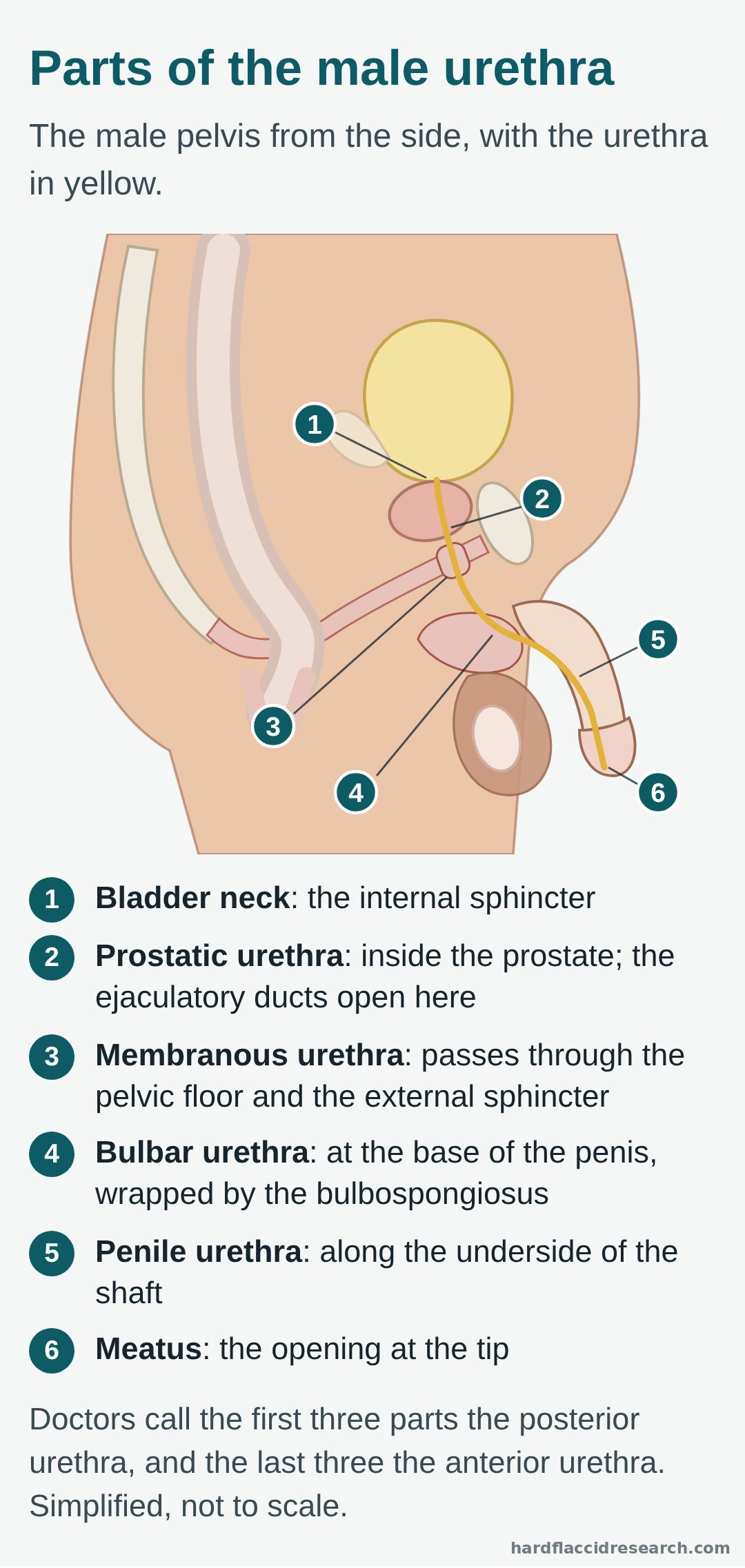
What are the parts of the male urethra?
The bladder neck
Where the bladder funnels into the urethra. A ring of smooth muscle here, the internal sphincter, stays closed while the bladder fills and during ejaculation.
The prostatic urethra
The part that runs down through the prostate. The two ejaculatory ducts open into it on a small mound called the verumontanum, along with the tiny ducts of the prostate. This is where semen is first gathered before ejaculation.
The membranous urethra
A short, narrow part that passes through the pelvic floor. It's surrounded by the external urethral sphincter, a ring of muscle you can tighten to stop peeing midstream. It's the narrowest and least stretchy part of the urethra.
The bulbar urethra
After passing through the pelvic floor, the urethra enters the corpus spongiosum, the spongy column of erectile tissue on the underside of the penis. The first, wider part sits in the bulb of the penis, behind the scrotum, wrapped by the bulbospongiosus muscle. Small glands called the bulbourethral (Cowper's) glands empty into it, releasing a clear fluid during arousal, often called pre-ejaculate.
The penile urethra
The part that runs along the underside of the shaft inside the corpus spongiosum. It widens slightly just before the tip and opens at the meatus.
Anterior and posterior
Doctors also talk about the posterior urethra (the prostatic and membranous parts) and the anterior urethra (the bulbar and penile parts). This matters for injuries and narrowing, which tend to affect one or the other.
Related: Alpha Blockers for Hard Flaccid: 45% of Men Said They Help »
What does the urethra do?
- Carries urine: when you pee, the detrusor muscle squeezes the bladder, the sphincters relax and urine flows out.
- Carries semen: during ejaculation, the bladder neck closes, semen collects in the prostatic urethra, and the pelvic floor muscles push it out in waves.
- Keeps urine in: the sphincters and pelvic floor hold the urethra closed between toilet visits.
- Clears itself: after peeing, the bulbospongiosus muscle squeezes the last drops out of the bulbar urethra.
What can go wrong with the urethra?
Urethritis
Inflammation of the urethra, usually from an infection. Sexually transmitted infections such as chlamydia and gonorrhea are common causes. It can cause burning when peeing, a discharge or itching at the tip.
Urethral stricture
Scarring that narrows the urethra, most often in the bulbar part. It can follow an infection, an injury, a catheter or surgery, and causes a weak, spraying or slow stream.
Dribbling after peeing
A few drops leaking after you've finished, often from urine left in the bulbar urethra. It's common, and it's helped by squeezing the pelvic floor or gently pressing behind the scrotum after peeing.
An enlarged prostate
Benign prostatic hyperplasia can squeeze the prostatic urethra, causing a weak stream, trouble starting and peeing often.
A tight pelvic floor
If the pelvic floor and external sphincter don't relax fully, the stream can be slow, start and stop, or need pushing, and there can be burning or a feeling of not emptying without any infection.
Injury
A fall astride a bar, a pelvic fracture or a penile fracture can injure the urethra. Blood at the tip of the penis after an injury needs urgent care.
Related: Bulbourethral Glands (Cowper's Glands): What They Do »
The urethra and hard flaccid syndrome
Hard flaccid syndrome is a firm, shrunken penis at rest, often with numbness, weaker erections and pelvic pain. Urinary symptoms in men with hard flaccid more often come from a tight pelvic floor squeezing the membranous and bulbar urethra than from the urethra itself.
Of the 2,661 men who described their symptoms, 23% described pelvic floor tightness, spasm or twitching (601 men), 13% described urinary problems (337 men) and 8% described penile pain (206 men). In a separate count, 107 men asked why there are urinary problems.
Our members' guide, Hard Flaccid Pelvic Floor Reset: Why Kegels May Backfire, explains how to help the pelvic floor relax so peeing is easier.
How do doctors check the urethra?
- A urine test, and tests for sexually transmitted infections from a urine sample or swab.
- A flow test, which measures how fast you pee, and a scan after peeing.
- A camera test (cystoscopy), where a thin tube looks inside the urethra and bladder.
- An X-ray with dye (urethrogram), to show a narrowing.
Our doctor visit kit helps you describe your stream, any burning and when it started.
How to keep the urethra healthy
- Use condoms with new partners and get tested for sexually transmitted infections.
- Drink enough water through the day, so urine is pale.
- Don't push or strain to pee. Let the pelvic floor relax and give it time.
- After peeing, squeeze the pelvic floor once or press gently behind the scrotum to clear the last drops.
- Never insert objects into the urethra.
- Get burning, a discharge or a change in your stream checked early, before an infection or narrowing gets worse.
When should I see a doctor?
See a primary care provider or a urologist (a doctor for urinary and sexual health) if you have burning when peeing, a discharge, a weak or spraying stream, trouble starting, dribbling that bothers you, or blood in your urine.
Get urgent care straight away (call 911 or go to the emergency room) if you have:
- Not being able to pee at all, or a painful, swollen bladder.
- Blood at the tip of the penis or trouble peeing after an injury.
- A fever or chills with pelvic pain or pain when peeing.
- New numbness around your back passage, genitals or inner thighs, or new weakness in your legs.
- Loss of control of your bladder or bowel.
Frequently asked questions
How long is the male urethra?
It runs the whole way from the bladder, through the prostate and pelvic floor, to the tip of the penis, so it's many times longer than the female urethra.
Why does it burn when I pee?
Burning is often from an infection, but it can also come from irritation, prostatitis or a tight pelvic floor. A urine test and infection checks are a good first step.
What is pre-ejaculate?
A small amount of clear fluid from the bulbourethral glands that comes out during arousal. It helps lubricate the urethra.
Can semen and urine come out together?
Normally not. The bladder neck closes during ejaculation, and it's hard to pee with an erection because of this.
Why do I dribble after peeing?
Usually because a little urine stays in the bulbar urethra. Squeezing the pelvic floor or pressing gently behind the scrotum after peeing helps empty it.
Is a discharge from the penis normal?
A clear fluid during arousal (pre-ejaculate) is normal. A white, yellow or green discharge at other times, especially with burning, usually means an infection and needs a check.
Why does my stream split or spray?
It's often harmless, for example from a bit of dried semen at the tip or a partly full bladder. A stream that keeps spraying or gets weaker can mean a narrowing, so it's worth a check.
Can a tight pelvic floor feel like a urinary infection?
Yes. Burning, urgency and a feeling of not emptying can happen without any infection when the pelvic floor is tight. If urine tests keep coming back clear, ask about a pelvic floor assessment.
Takeaway
The male urethra runs from the bladder through the prostate, the pelvic floor and the penis. Each part has its own job and its own common problems.
Burning, a weak stream or dribbling can come from the urethra, the prostate or the pelvic floor, and a doctor can help work out which. Take our free self-check if you also notice changes in your penis at rest.
This article is for general information and isn't a substitute for advice from your own doctor. Hard Flaccid Research doesn't diagnose or treat. If you have new or worsening symptoms, see a qualified clinician. In an emergency, call 911.
Free tools that can help
- Self-check: do I have hard flaccid?Compare your symptoms with what 6,026 men report.
- Doctor visit kitA one-page summary to take to your appointment.
- Habit trackerCount your days without porn or masturbation, and get through urges.
- Diaphragm breathing toolBreathe with a moving picture of your diaphragm and pelvic floor.
- Add your experienceTell us what you tried and how it went. No name needed.
- Hard Flaccid Syndrome CensusWhat men answered in 818 polls.
- Symptom trackerLog your symptoms and see what helps you.
- Ask us a questionThe questions men ask most become new articles.
The numbers behind this article
Every number in this article comes from what men with hard flaccid syndrome shared between December 2020 and October 2026, counted once per person, or from their polls. These are self-selected reports, not a clinical study. See hard flaccid syndrome statistics, the Hard Flaccid Syndrome Census and how we count.
13% of men who described their symptoms described urinary problems
Share of the 2,661 men who described their symptoms. Each man is counted once.These are self-selected reports, not a clinical study.
Source: Hard Flaccid Research, hardflaccidresearch.com
Every number in this article, with its source
| In this article | Source |
|---|---|
| 13% of the men who described their symptoms described urinary problems (337 of 2,661) | 337 of 2,661 men, counted |
| 8% of the men who described their symptoms described penile pain (206 of 2,661) | 206 of 2,661 men, counted |
| 23% of the men who described their symptoms described pelvic floor tightness, spasm or twitching (601 of 2,661) | 601 of 2,661 men, counted |
| 6,026 men shared their experiences, and 2,661 of them described their symptoms | 2,661 of 6,026 men, counted |
| 107 men asked why there are urinary problems | 107 men asked why there are urinary problems, counted from what men wrote, once per person |
Medical sources
What this article says about medical research, guidelines and urgent care comes from these sources.
- Histology, Male Urethra. In: StatPearls. Treasure Island (FL): StatPearls Publishing. https://www.ncbi.nlm.nih.gov/books/NBK542238/
- Surgical anatomy of the male and female urethra. Urol Clin North Am. 1992;19(2):339-346. https://pubmed.ncbi.nlm.nih.gov/1574824/
- Anatomy, Abdomen and Pelvis, Penis. In: StatPearls. Treasure Island (FL): StatPearls Publishing. https://www.ncbi.nlm.nih.gov/books/NBK482236/
- Anatomy, Abdomen and Pelvis: Deep Perineal Space. In: StatPearls. Treasure Island (FL): StatPearls Publishing. https://www.ncbi.nlm.nih.gov/books/NBK538272/
- Sandhu JS, Bixler BR, Dahm P, et al. Management of lower urinary tract symptoms attributed to benign prostatic hyperplasia (BPH): AUA guideline amendment 2023. J Urol. 2024;211(1):11-19. https://doi.org/10.1097/JU.0000000000003698
- Lai HH, Pontari MA, Argoff CE, et al. Male chronic pelvic pain: AUA guideline. J Urol. 2025. https://www.auanet.org/guidelines-and-quality/guidelines/male-chronic-pelvic-pain
How we made this article
We started from the question many men asked. Every number was checked against our data. Our editorial team edited it and Dr. Julian Reyes reviewed it medically. Read our editorial policy.
Read next
See more of us on Google
Add Hard Flaccid Research as a preferred source, and Google shows you our pages more often when you search.
Add as a preferred sourceDon't see your question? Ask us. We answer the most-asked ones in new articles.
Cite and share this article
You're welcome to quote this article. Please name Hard Flaccid Research and link to this page, so others can find the full answer and the data behind it. To cite this page, use its link.
Citation
Hard Flaccid Research. (2026). Male Urethra: Anatomy, Parts and Common Problems. Written by the Editorial Team, medically reviewed by Dr. Julian Reyes. https://hardflaccidresearch.com/articles/male-urethra
Credit link for your article
Source: <a href="https://hardflaccidresearch.com/articles/male-urethra">Hard Flaccid Research</a>
Wikipedia reference
<ref>{{cite web |url=https://hardflaccidresearch.com/articles/male-urethra |title=Male Urethra: Anatomy, Parts and Common Problems |website=Hard Flaccid Research |date=2026 |access-date=22 November 2026}}</ref>
How the data was collected: our methodology. Journalists and researchers: key numbers, data and contact.