Corpus Spongiosum: Where It Is, What It Does and Problems
In short
- The corpus spongiosum is the column of spongy erectile tissue along the underside of the penis that surrounds the urethra.
- It starts as the bulb at the root of the penis, behind the scrotum, and ends as the glans, the head of the penis.
- During an erection it fills with blood but stays softer than the corpora cavernosa, so the urethra stays open for ejaculation.
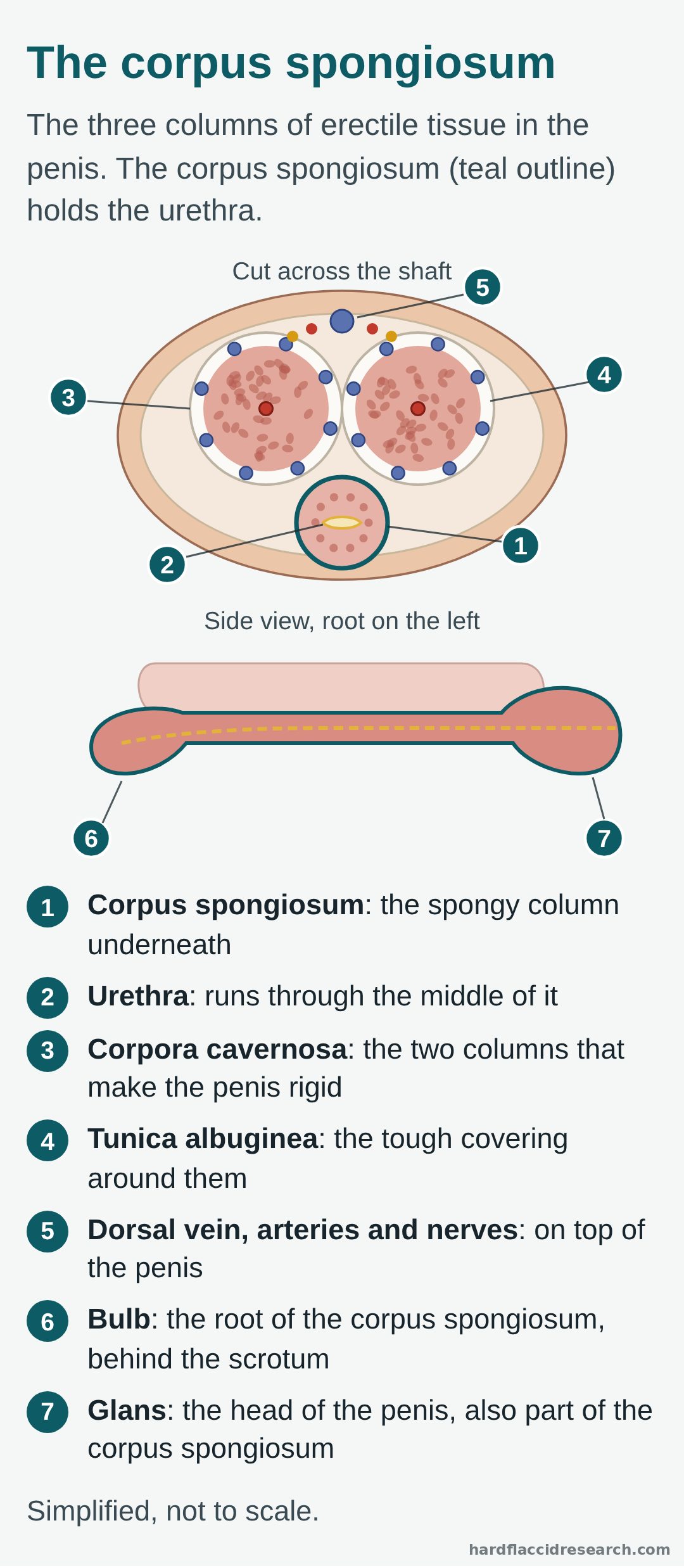
The corpus spongiosum is the column of spongy erectile tissue that runs along the underside of the penis. It surrounds the urethra, the tube that carries urine and semen out of the body. At the root of the penis, behind the scrotum, it widens into the bulb. At the tip, it expands to form the glans, the head of the penis.
It's one of three columns of erectile tissue in the penis. The other two, the corpora cavernosa, sit side by side above it and do most of the work of making the penis rigid. The corpus spongiosum fills with blood too, but it stays softer, which keeps the urethra open and the glans cushioned. This page explains where it is, how it works, what can go wrong and when to see a doctor.
By the numbers: of the 6,026 men who shared their experiences with hard flaccid syndrome, 2,661 described their symptoms, and 914 of them described numbness or reduced sensation.
Key facts
- The penis has three columns of erectile tissue: two corpora cavernosa on top and one corpus spongiosum underneath.
- The corpus spongiosum surrounds the urethra along its whole length through the penis.
- It forms the bulb at the root of the penis and the glans at the tip.
- Its covering is thinner and more stretchy than the tough tunica albuginea around the corpora cavernosa.
- During an erection it fills with blood but stays softer, so the urethra isn't squeezed shut.
- The bulbospongiosus muscle wraps its bulb and squeezes it to empty the urethra and help push out semen.
- Scarring of the corpus spongiosum around the urethra can narrow it, a problem called a urethral stricture.
Where is the corpus spongiosum?
The bulb
The corpus spongiosum starts as the bulb of the penis, a rounded swelling at the root of the penis that sits in the perineum, between the scrotum and the anus. It's anchored to the perineal membrane, a tough sheet in the pelvic floor, and wrapped by the bulbospongiosus muscle.
The shaft
From the bulb, it runs forward along the underside of the shaft, in the groove between the two corpora cavernosa. The urethra runs through its middle.
The glans
At the tip of the penis, the corpus spongiosum expands into the glans, which caps the ends of the corpora cavernosa. The urethra opens at the tip of the glans.
Related: Hard Flaccid Syndrome Medical Evidence Diagnosis Symptoms Treatment Urology »
What does the corpus spongiosum do?
It protects the urethra
The spongy tissue cushions the urethra and supports it along its length.
It keeps the urethra open during an erection
When you're aroused, the arteries of the penis open and blood fills all three columns. The corpora cavernosa are wrapped in a thick, tough covering, so they become very rigid. The corpus spongiosum has a thinner covering, so it fills but stays softer. That keeps the urethra open, so semen can pass through.
It shapes and cushions the glans
The glans fills and becomes fuller during an erection but stays softer than the shaft, which may help cushion it during sex. The glans has many nerve endings and is one of the most sensitive parts of the penis.
It helps empty the urethra
The bulbospongiosus muscle squeezes the bulb after you pee, pushing out the last drops, and contracts in waves during ejaculation to push semen out.
What can go wrong with the corpus spongiosum?
Urethral stricture
Injury, infection or inflammation can cause scarring in the lining of the urethra and the spongy tissue around it, which narrows the urethra. Doctors call this spongiofibrosis. It causes a weak or spraying stream, straining, dribbling and sometimes urinary infections. Common causes include a fall astride a bar, past catheters or procedures, and some infections. A urologist can treat it, sometimes with surgery to repair the urethra.
Injury
A blow to the perineum can crush the bulb against the pelvic bone, injuring the urethra inside it. Signs include blood at the tip of the penis and trouble peeing, and need urgent care. A penile fracture, a tear in the covering of the erect penis, can sometimes damage the urethra too.
Inflammation and swelling of the glans
Infections and skin conditions can make the glans red, sore and swollen. These are usually treated with good hygiene and medicines.
Related: How Common Is Hard Flaccid? What 6,026 Men Tell Us »
Corpus spongiosum and hard flaccid syndrome
Hard flaccid syndrome is a firm, shrunken penis at rest, often with numbness, weaker erections and pelvic pain. Many men with hard flaccid notice that the glans feels softer, colder or less full during erections, or less sensitive. The glans is part of the corpus spongiosum, and its fullness depends on blood flow and on the pelvic floor muscles around the bulb. Why this happens in hard flaccid isn't known, and it hasn't been studied.
Of the 2,661 men who described their symptoms, 58% described this firm flaccid state (1,553 men), 35% described weaker or lost erections (926 men) and 34% described numbness or reduced sensation (914 men).
Our members' guide, Numbness and Shrinkage With Hard Flaccid: What Men Try, covers changes in sensation and fullness step by step.
How does the corpus spongiosum work with the pelvic floor?
The bulb of the corpus spongiosum sits right in the pelvic floor, wrapped by the bulbospongiosus muscle. That muscle:
- Squeezes the bulb near the end of peeing, to clear the last drops from the urethra.
- Contracts in rhythmic waves during ejaculation, pushing semen out.
- Tightens during an erection, which may briefly push blood toward the glans.
Because of this close link, men with a tight or weak pelvic floor sometimes notice dribbling after peeing, changes in ejaculation or changes in how full the glans feels.
How are problems checked?
A primary care provider or a urologist (a doctor for urinary and sexual health) will ask about your urine stream, erections and sensation, and examine the penis. They may suggest:
- A urine test and a flow test, if your stream is weak.
- A camera look into the urethra or an X-ray with dye, if a stricture is possible.
- A penile Doppler ultrasound, which shows blood flow in the erectile tissue.
- Nerve tests, if sensation has changed.
Our doctor visit kit helps you describe the changes you've noticed.
When should I see a doctor?
See a primary care provider or a urologist if your urine stream has become weak or spraying, you strain to pee, the glans looks or feels different, or erections or sensation have changed.
Get urgent care straight away (call 911 or go to the emergency room) if you have:
- An erection that lasts more than four hours, or a painful erection that won't go down.
- A snap or pop, sudden pain, swelling or bruising of the penis during sex.
- Blood at the tip of the penis, or trouble peeing, after an injury to the perineum or penis.
- Not being able to pee at all, or a painful, swollen bladder.
- Sudden, severe pain in the penis, testicles or pelvis.
Frequently asked questions
What's the difference between the corpus spongiosum and the corpus cavernosum?
The two corpora cavernosa sit on top and make the penis rigid. The single corpus spongiosum sits underneath, holds the urethra and forms the glans.
Why is the head of the penis softer than the shaft during an erection?
The glans is part of the corpus spongiosum, which has a thinner, stretchier covering. It fills with blood but doesn't become as rigid.
Where is the bulb of the penis?
In the perineum, behind the scrotum. You can feel it as firm tissue in the middle of the perineum when you have an erection.
Can the corpus spongiosum affect peeing?
Yes. Scarring around the urethra can narrow it and weaken the stream.
Does the corpus spongiosum affect sensation?
The glans, which is part of it, has many nerve endings. Changes in blood flow or nerves can make it feel less sensitive.
Is a soft glans during erections normal?
Yes, the glans is normally softer than the shaft. If it has changed noticeably, it's worth mentioning to a doctor.
Can a urethral stricture come back?
It can. Some treatments, like stretching the urethra, have a higher chance of the narrowing returning than surgical repair. A urologist can explain the options.
Does the corpus spongiosum get hard?
It fills with blood and gets firmer during an erection, but it stays softer than the corpora cavernosa above it.
Can the bulb of the penis be injured by cycling?
Long hours on a narrow saddle press on the perineum, where the bulb sits. Numbness or pain after riding is worth taking seriously, and a better saddle and breaks help.
Takeaway
The corpus spongiosum is the spongy column under the penis that surrounds the urethra, forms the bulb at the root and the glans at the tip, and stays softer than the rest of the penis during an erection.
Problems are uncommon, but a weak stream, changes in the glans or an injury are worth checking. Take our free self-check if you also notice changes in your penis at rest.
This article is for general information and isn't a substitute for advice from your own doctor. Hard Flaccid Research doesn't diagnose or treat. If you have new or worsening symptoms, see a qualified clinician. In an emergency, call 911.
Free tools that can help
- Self-check: do I have hard flaccid?Compare your symptoms with what 6,026 men report.
- Doctor visit kitA one-page summary to take to your appointment.
- Habit trackerCount your days without porn or masturbation, and get through urges.
- Diaphragm breathing toolBreathe with a moving picture of your diaphragm and pelvic floor.
- Add your experienceTell us what you tried and how it went. No name needed.
- Hard Flaccid Syndrome CensusWhat men answered in 818 polls.
- Symptom trackerLog your symptoms and see what helps you.
- Ask us a questionThe questions men ask most become new articles.
The numbers behind this article
Every number in this article comes from what men with hard flaccid syndrome shared between December 2020 and October 2026, counted once per person, or from their polls. These are self-selected reports, not a clinical study. See hard flaccid syndrome statistics, the Hard Flaccid Syndrome Census and how we count.
35% of men who described their symptoms described weaker or lost erections
Share of the 2,661 men who described their symptoms. Each man is counted once.These are self-selected reports, not a clinical study.
Source: Hard Flaccid Research, hardflaccidresearch.com
Every number in this article, with its source
| In this article | Source |
|---|---|
| 34% of the men who described their symptoms described numbness or reduced sensation (914 of 2,661) | 914 of 2,661 men, counted |
| 35% of the men who described their symptoms described weaker or lost erections (926 of 2,661) | 926 of 2,661 men, counted |
| 58% of the men who described their symptoms described this firm flaccid state (1,553 of 2,661) | 1,553 of 2,661 men, counted |
| 6,026 men shared their experiences, and 2,661 of them described their symptoms | 2,661 of 6,026 men, counted |
Medical sources
What this article says about medical research, guidelines and urgent care comes from these sources.
- Anatomy, Abdomen and Pelvis, Penis. In: StatPearls. Treasure Island (FL): StatPearls Publishing. https://www.ncbi.nlm.nih.gov/books/NBK482236/
- Physiology, Erection. In: StatPearls. Treasure Island (FL): StatPearls Publishing. https://www.ncbi.nlm.nih.gov/books/NBK513278/
- Dean RC, Lue TF. Physiology of penile erection and pathophysiology of erectile dysfunction. Urol Clin North Am. 2005;32(4):379-395. https://doi.org/10.1016/j.ucl.2005.08.007
- Histology, Male Urethra. In: StatPearls. Treasure Island (FL): StatPearls Publishing. https://www.ncbi.nlm.nih.gov/books/NBK542238/
- Abdeen BM, Leslie SW, Badreldin AM. Urethral Strictures. In: StatPearls. Treasure Island (FL): StatPearls Publishing. https://www.ncbi.nlm.nih.gov/books/NBK564297/
- Burnett AL, Nehra A, Breau RH, et al. Erectile dysfunction: AUA guideline. J Urol. 2018;200(3):633-641. https://doi.org/10.1016/j.juro.2018.05.004
How we made this article
We started from the question many men asked. Every number was checked against our data. Our editorial team edited it and Dr. Julian Reyes reviewed it medically. Read our editorial policy.
Read next
See more of us on Google
Add Hard Flaccid Research as a preferred source, and Google shows you our pages more often when you search.
Add as a preferred sourceDon't see your question? Ask us. We answer the most-asked ones in new articles.
Cite and share this article
You're welcome to quote this article. Please name Hard Flaccid Research and link to this page, so others can find the full answer and the data behind it. To cite this page, use its link.
Citation
Hard Flaccid Research. (2026). Corpus Spongiosum: Where It Is, What It Does and Problems. Written by the Editorial Team, medically reviewed by Dr. Julian Reyes. https://hardflaccidresearch.com/articles/corpus-spongiosum
Credit link for your article
Source: <a href="https://hardflaccidresearch.com/articles/corpus-spongiosum">Hard Flaccid Research</a>
Wikipedia reference
<ref>{{cite web |url=https://hardflaccidresearch.com/articles/corpus-spongiosum |title=Corpus Spongiosum: Where It Is, What It Does and Problems |website=Hard Flaccid Research |date=2026 |access-date=22 November 2026}}</ref>
How the data was collected: our methodology. Journalists and researchers: key numbers, data and contact.