Venous Leak: Symptoms, Causes, Tests & Treatment
In short
- Venous leak means blood drains out of the penis too fast during an erection, so erections fade or won't stay hard.
- Doctors check for it with a blood flow scan and may treat it with erection medicines, a vacuum device or injections; US urology guidelines don't recommend vein surgery.
- Hard flaccid syndrome is different: it is mainly about the resting penis staying firm when it should be soft, which 58% of the 2,661 men with hard flaccid syndrome who described their symptoms mention.
218 men with hard flaccid asked this question.
Venous leak means blood drains out of the penis too quickly during an erection, so erections are hard to keep. Hard flaccid syndrome is mainly about the resting penis: it stays firm, rubbery or shrunken when it should be soft. The two can look alike, and some men are told they have one when they have the other.
This page explains venous leak in plain words: the symptoms, the causes, the tests doctors use, the treatments doctors may offer, and how to tell it apart from hard flaccid. 218 men asked whether their hard flaccid is a blood flow or vein problem, one of the questions asked most.
By the numbers: between December 2020 and October 2026, 2,661 of the 6,026 men who shared their experiences described their symptoms, and 926 of them mentioned weak or lost erections. 343 men asked why their erections are weaker and whether they will recover, and 218 asked whether their hard flaccid is a blood flow or vein problem.
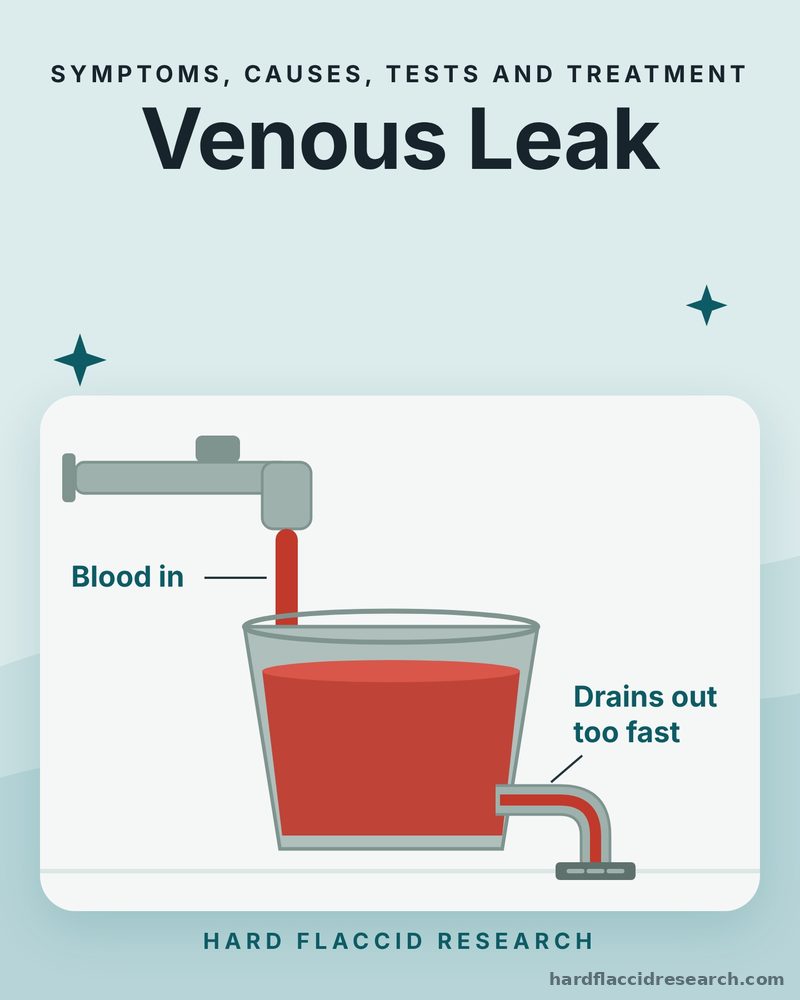
What is venous leak?
An erection needs blood to flow in and stay in. Arousal travels down nerves, including the pudendal nerve, to the penis. Smooth muscle in the arteries and chambers relaxes, and blood rushes in. The spongy chambers swell and squeeze their small veins shut, so the blood stays in until the erection ends.
In venous leak, those veins don't close properly, so blood drains out while you are still aroused. Doctors call it veno-occlusive dysfunction. Men describe erections that start well but fade quickly, or that won't stay hard enough for sex.
Venous leak is a type of erectile dysfunction. It is also called venous leakage, a cavernous leak or, by doctors, veno-occlusive dysfunction.
Hard Flaccid Explorerby Hard Flaccid Research
Venous leak, step by step
An 8-minute animated explainer of this article. Press play, or skip between chapters. The first minute is free for everyone.
A picture to explain, not a diagnosis. You can have features of both.
Venous leak symptoms
Men with venous leak often describe:
- Erections that start but fade quickly, even while you are still aroused.
- Erections that don't get fully hard, or that need constant touch to stay hard.
- For some men, losing the erection when they change position, for example when they stand up.
- Erection problems that have crept up over months or years.
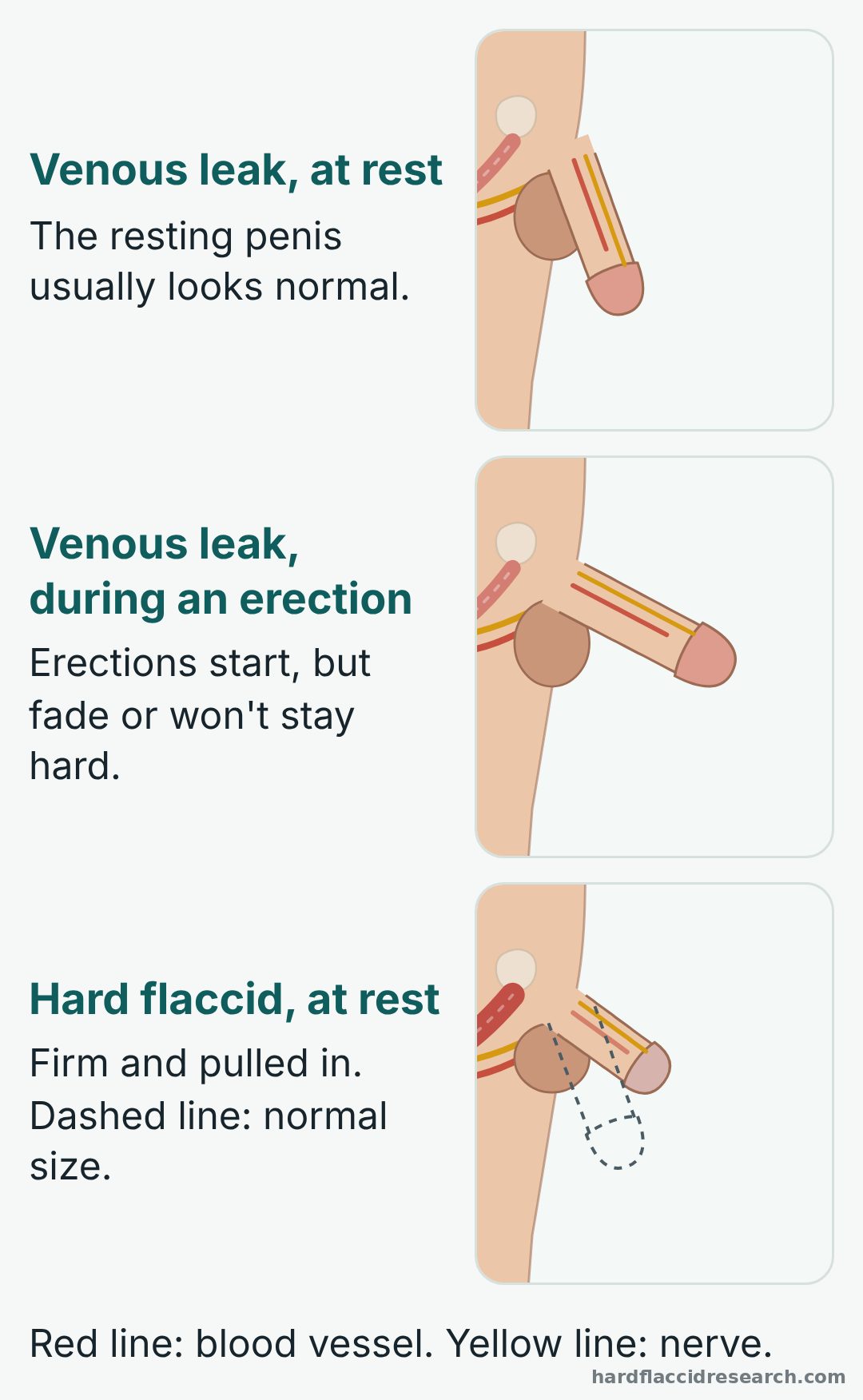
The resting penis usually looks and feels normal, and venous leak doesn't cause numbness. These signs can come from many other things, such as narrowed arteries, nerve problems, low testosterone, medicines or anxiety, so only a doctor and the right test can tell.
Related: Thinking of Vein Surgery for Hard Flaccid? Read This First »
What causes venous leak?
The veins only close if the spongy tissue fills well and its tough outer wall holds firm. Things that can stop that include:
- Changes in the spongy tissue or its outer wall with age.
- Peyronie's disease, which scars the outer wall.
- An injury to the penis, including a penile fracture, or a past erection that lasted many hours and its treatment.
- Surgery for prostate cancer, or radiation to the pelvis.
- Diabetes and other conditions that affect blood vessels.
- Stress hormones. Doctors think the stress hormones that come with anxiety may stop the smooth muscle relaxing fully. That can look like a leak, especially on a scan, even when the veins are fine.
Sometimes no cause is found. Venous leak can happen at any age, and one study found that men with it were on average younger than men whose erection problems came from narrowed arteries.
Venous leak or hard flaccid?
Hard flaccid syndrome is mostly about the resting state. In hard flaccid syndrome, the resting (flaccid) penis doesn't relax the way it used to. Of 2,661 men who described their symptoms, 58% describe the firm flaccid state (1,553 of 2,661).
Erections are affected too, but they are only one part: 35% mentioned weak or lost erections (926 of 2,661). Many men also describe numbness and a tight pelvic floor, which venous leak doesn't explain on its own. These are self-selected reports, not a clinical study.
The main differences:
- The main problem: venous leak affects erections. Hard flaccid affects the resting penis, and often erections too.
- The resting penis: usually normal in venous leak. Firm, rubbery, cold or shrunken in hard flaccid.
- Feeling: venous leak doesn't cause numbness. In hard flaccid, 34% describe numbness or loss of feeling (914 of 2,661).
- The pelvic floor: not part of venous leak. In hard flaccid, 23% describe pelvic floor tightness, spasm or twitching (601 of 2,661).
- Position: in a March 2023 poll, 86% of men with hard flaccid said it is harder when standing than lying down (54 of 63 men). Venous leak is about erections, not the resting penis.
- How it started: venous leak often develops gradually. Hard flaccid often starts after a clear event, such as an enlargement method, rough masturbation or an injury.
You can have features of both. Many men with hard flaccid describe a tight pelvic floor, and one idea is that tight muscles press on the nerves and blood vessels that pass through the pelvis. The pudendal nerve is the main nerve of the genitals and pelvic floor. It carries feeling and helps trigger erections.
Related: Cold or Soft Glans? Why It Happens With Hard Flaccid »
Why men with hard flaccid syndrome wonder about veins
The penis can look veiny, cold or pale in hard flaccid syndrome. Of 2,661 men who described their symptoms, 194 mentioned prominent or bulging veins, 192 a soft or under-filled glans, 163 a cold penis or glans and 73 grey, purple or darker skin colour.
Veins on the penis are normal. They can stand out more after exercise or when it is semi-firm. A visible vein on its own is not a sign of venous leak.
Among the 194 men who mentioned prominent veins, 68% also described the firm flaccid state, 54% weaker erections and 43% numbness.
How doctors test for venous leak
A urologist may suggest a blood flow scan if the result would change your care.
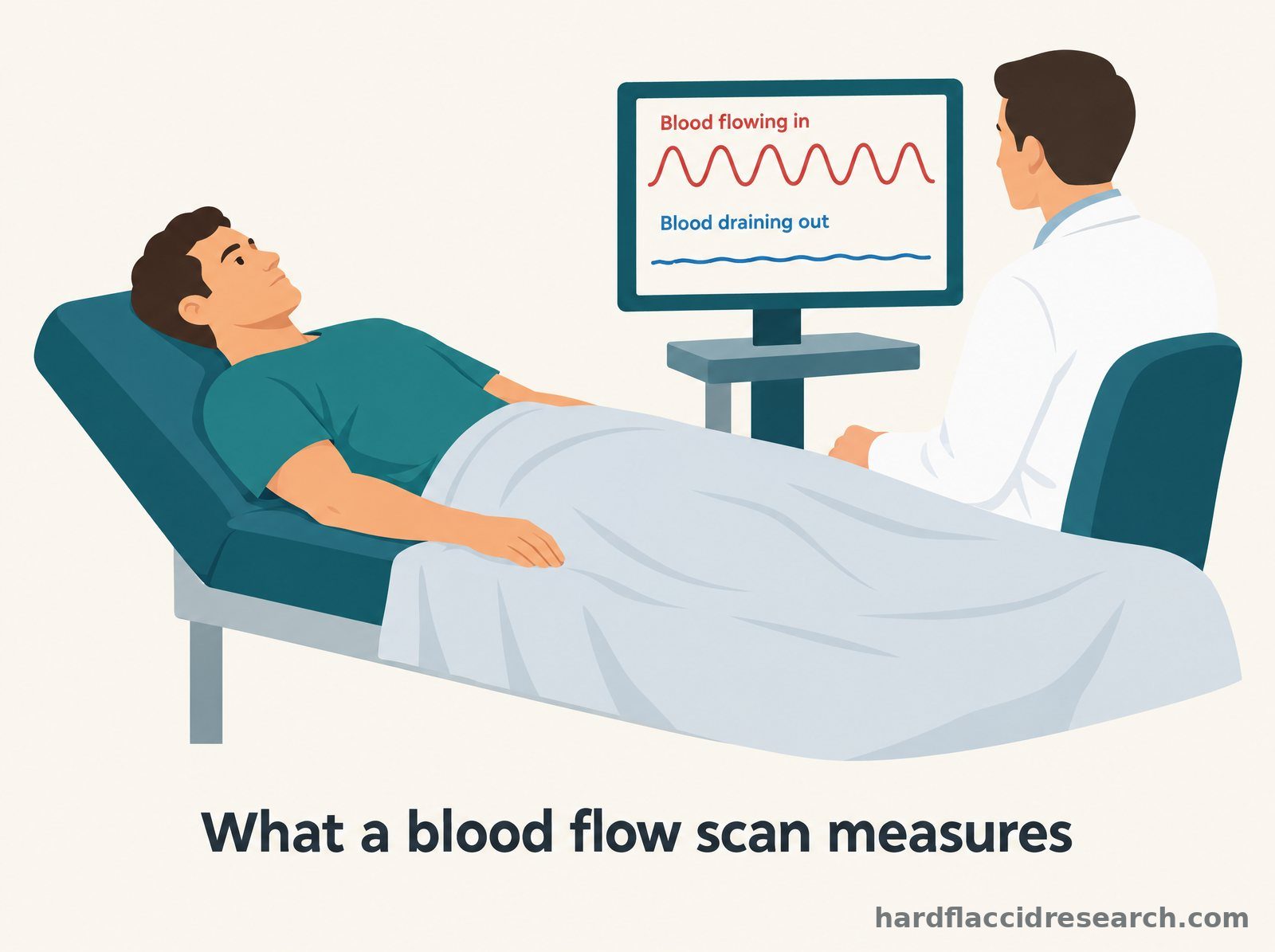
The main test is a penile duplex Doppler ultrasound. A doctor injects a medicine into the penis to cause an erection, then uses ultrasound to measure how fast blood flows in and how much keeps flowing out. Blood that keeps draining out during a full erection suggests venous leak. Rarely, the erection from the injection lasts too long and needs urgent treatment.
Some doctors use a more invasive test called cavernosometry, which measures the pressure inside the penis. A doctor may also check blood pressure, blood sugar, cholesterol and hormones, which affect blood vessels everywhere.
Results need care. A man who is tense or anxious during the test may not relax fully, which can make the result look like venous leak. Doctors sometimes give a second dose of the medicine or repeat the test for this reason.
We don't have numbers on how often tests find venous leak in men with hard flaccid syndrome yet. In the few small published studies of men with hard flaccid syndrome, blood flow on these scans was usually normal.
There is no reliable home test. How long your erections last, or whether you have morning erections, can't show a leak on its own.
Venous leak treatment
US urology guidelines say a doctor should tell you about every option that is safe for you. Many doctors start with the simplest and safest. They help some men with venous leak, though a bad leak may not respond as well to medicines:
- Look after your blood vessels: stop smoking, move more, and get blood pressure, blood sugar and cholesterol checked. Erection problems can be an early sign of heart and blood vessel disease.
- Erection medicines such as tadalafil or sildenafil, which help more blood flow in during arousal.
- A vacuum device, which draws blood in, with a ring at the base of the penis that helps keep it there.
- Injections into the penis that cause an erection, which a doctor first tests with you in the clinic.
- A penile implant, an operation some men choose when other treatments haven't worked. It can't be undone, and its main risks are infection and the device failing, which can mean another operation.
Vein surgery or embolisation, which blocks leaking veins through a thin tube, aims at the leak itself. US urology guidelines don't recommend vein surgery for erection problems, because long-term results are poor and leaks often come back. Embolisation has only small studies, and its long-term results aren't known yet. Surgery can cause numbness, shortening or a curve. Both can cause pain, bruising or infection, the leak can come back through other veins, and erections may not improve at all. Embolisation also uses X-ray dye and radiation, and rarely a blood clot travels to the lungs.
Talk to a doctor first. In most countries tadalafil and sildenafil need a prescription, and they are not safe for everyone with heart or blood pressure problems. Never take them with nitrate medicines for chest pain or with poppers, because together they can drop your blood pressure dangerously. If you get chest pain, tell the ambulance crew or doctor which medicine you've taken, and when: nitrate medicines must not be given within 24 hours of a sildenafil dose, or within 48 hours of a tadalafil dose. Taken with an alpha blocker, a medicine for peeing problems or high blood pressure, they can drop your blood pressure too far. Side effects such as headache, flushing, a blocked nose or indigestion usually ease within a day or two. Rarely, they cause sudden loss of sight or hearing, or an erection that won't go down, and each needs urgent care. A vacuum ring must come off within half an hour, and can bruise; ask a doctor first if you take blood thinners. Injections can cause pain, scarring and, rarely, an erection that won't go down, which needs urgent care. Never start, stop or change a medicine on your own, and don't buy medicines online without a prescription.
These numbers come from men with hard flaccid syndrome, not from men with a proven venous leak. Among men with hard flaccid, 969 mentioned tadalafil and 112 mentioned vein or vascular procedures. In the 126 recovery stories, tadalafil came up in 20 and vein procedures in 2. A story mentioning something is not proof that it worked.
Tadalafil (sold as Cialis) is a medicine doctors prescribe for erection problems. It helps the muscles relax and the arteries open, but it needs a nerve signal to work on. In a June 2023 poll of men with hard flaccid who had tried it, 76% said it helped their hard flaccid at least a bit (34 of 45 men) and 24% said it didn't help (11 of 45 men). That is a small, self-selected group.
Do exercises help venous leak?
Small trials suggest pelvic floor strengthening exercises can improve erections in some men with erection problems. The muscles at the base of the penis tighten during an erection, which raises the pressure inside and helps keep the blood in. There is little research on exercises for venous leak itself.
There is a catch for men with hard flaccid syndrome. Many describe a tight pelvic floor, and strengthening a tight pelvic floor may make it worse, so relaxation usually comes first. If your pelvic floor feels tight, ask a pelvic health physio before doing strengthening exercises, and let go fully between squeezes: the squeeze only gets stronger safely that way. A physio can examine you and tell which you need. Our articles on Kegels for men and how to do reverse Kegels go through both.
Regular exercise that gets you out of breath, such as brisk walking, is good for blood vessels everywhere. US urology guidelines say that for men whose health problems affect their erections, more physical activity and a better diet may improve erections.
Pelvic floor physio means working with a physiotherapist trained in the pelvic floor muscles. If a tight pelvic floor is part of the picture, a physio often focuses on relaxing those muscles rather than strengthening them.
Can venous leak be cured?
It depends on the cause. Some men manage it well with medicines or a vacuum device, though a bad leak may not respond as well to medicines, and anxiety-related problems can improve when the anxiety is treated. Procedures aimed at the leak often don't give lasting results, so there is rarely a one-off cure.
Talk to a doctor first. Vein procedures are invasive and carry real risks, and US urology guidelines don't recommend vein surgery even when a scan shows a leak. Get a full assessment, and ideally a second opinion from a urologist who doesn't offer the procedure, before agreeing to one.
Common questions about venous leak
Can young men get venous leak? Yes, though erection problems in young men more often have other causes, such as stress, anxiety or some medicines. A doctor can help sort out which.
Can anxiety make a scan look like venous leak? It can. If you are tense during the test, the medicine may not work fully, so blood seems to drain out faster. Doctors sometimes give a second dose or repeat the scan.
Do tadalafil or sildenafil work for venous leak? They help some men, but a bad leak may not respond as well, because blood still drains out. Talk to a doctor first, and never take them with nitrate medicines for chest pain or with poppers.
Is venous leak the same as hard flaccid? No. Venous leak affects erections. Hard flaccid syndrome mainly affects the resting penis, and many men with it also describe numbness or a tight pelvic floor. Some men have features of both.
Do visible veins mean venous leak? Not on their own. Veins on the penis are normal and stand out more at some times than others.
When to see a doctor
See a doctor if your erections have changed, or your penis often looks pale, blue or grey or feels cold. Erection problems can be an early sign of heart or blood vessel disease, so it is worth getting checked whether or not you have hard flaccid syndrome. A blood test for blood sugar and cholesterol, and a blood pressure check, are worth asking for.
Before the appointment, write down your symptoms, when they started and what makes them better or worse.
Get urgent care straight away if you have:
- An erection lasting more than 4 hours.
- A popping or cracking sound followed by sudden pain, a quick loss of erection and rapid swelling or dark bruising.
- A penis that suddenly turns dark, blue or black, or swells badly.
- Blood in your urine that you can see.
- Sudden, severe pain in the penis, testicles or pelvis.
- New numbness around your back passage, genitals or inner thighs, or new weakness in your legs.
- New trouble starting or controlling your pee, not being able to pee, or not feeling when your bladder is full.
- Loss of control of your bladder or bowel.
- A fever or chills with pelvic pain or pain when peeing.
If you are feeling hopeless or having thoughts of ending your life, please visit our Support page now. It lists crisis lines you can call or text.
What to do next
- Take our self-check to see how your symptoms compare with what other men report.
- Book a check-up with your GP and ask for basic heart and blood tests.
- Note whether your main problem is the resting state, erections, or both, and when it is worse.
- Ask your GP whether you need to see a urologist. A urologist may suggest a blood flow scan if the result would change your care.
- Ask about a pelvic health physiotherapist to check for muscle tightness.
- Use our doctor visit kit to take a clear summary to your appointment.
In a November 2022 poll of men who had seen a urologist, 95% called their visits bad and unhelpful (63 of 66 men). That's a reason to prepare well, not to skip the visit.
Our members' guide, Hard Flaccid and Doctors: How to Get Taken Seriously, covers how to prepare for these appointments step by step.
Free tools that can help
- Self-check: do I have hard flaccid?Compare your symptoms with what 6,026 men report.
- Doctor visit kitA one-page summary to take to your appointment.
- Habit trackerCount your days without porn or masturbation, and get through urges.
- Diaphragm breathing toolBreathe with a moving picture of your diaphragm and pelvic floor.
- Add your experienceTell us what you tried and how it went. No name needed.
- Hard Flaccid Syndrome CensusWhat men answered in 818 polls.
- Symptom trackerLog your symptoms and see what helps you.
- Ask us a questionThe questions men ask most become new articles.
The numbers behind this article
Every number in this article comes from what men with hard flaccid syndrome shared between December 2020 and October 2026, counted once per person, or from their polls. These are self-selected reports, not a clinical study. See hard flaccid syndrome statistics, the Hard Flaccid Syndrome Census and how we count.
What men with hard flaccid syndrome describe, compared with venous leak
Share of the 2,661 men with hard flaccid syndrome who described their symptoms. Venous leak mainly affects erections; hard flaccid syndrome also affects the resting penis, feeling and the pelvic floor.These are self-selected reports, not a clinical study.
Source: Hard Flaccid Research, hardflaccidresearch.com
The signs that make men wonder about veins
Number of the 2,661 men who described their symptoms who mentioned each, counted once per person.Source: Hard Flaccid Research, hardflaccidresearch.com
What else men with prominent veins describe
Share of the 194 men who mentioned prominent veins who also described each symptom.Source: Hard Flaccid Research, hardflaccidresearch.com
Erection medicines and vein procedures men mentioned
Number of men who mentioned each, counted once per person.Source: Hard Flaccid Research, hardflaccidresearch.com
In 126 recovery stories
Share of the 126 men who shared a story of getting better who mentioned each.A story mentioning something is not proof that it worked.
Source: Hard Flaccid Research, hardflaccidresearch.com
What men with hard flaccid syndrome asked
Number of men who asked each question, counted once per person.Source: Hard Flaccid Research, hardflaccidresearch.com
Tadalafil, position and doctors
Each bar is a separate poll of men with hard flaccid syndrome, with its own number of men.Source: Hard Flaccid Research, hardflaccidresearch.com
Every number in this article, with its source
| In this article | Source |
|---|---|
| 218 men asked whether hard flaccid syndrome is a blood flow or vein problem | Question group, 218 men, research data |
| 58% (1,553 of 2,661) describe the firm, semi-rigid flaccid state | 1,553 of 2,661 men, counted from what men wrote, once per person |
| 35% (926 of 2,661) mentioned weak or lost erections | 926 of 2,661 men, counted from what men wrote, once per person |
| 34% (914 of 2,661) describe numbness or loss of feeling | 914 of 2,661 men, counted from what men wrote, once per person |
| 23% (601 of 2,661) describe pelvic floor tightness, spasm or twitching | 601 of 2,661 men, counted from what men wrote, once per person |
| 86% harder when standing than lying down (54 of 63 men) | 54 of 63 men, poll, Mar 2023 |
| 194 men mentioned prominent or bulging veins | 194 men, counted from what men wrote, once per person |
| 192 men mentioned a soft or under-filled glans | 192 men, counted from what men wrote, once per person |
| 163 men mentioned a cold penis or glans | 163 men, counted from what men wrote, once per person |
| 73 men mentioned grey, purple or darker skin colour | 73 men, counted from what men wrote, once per person |
| Among men with prominent veins: 68% firm flaccid state, 54% weaker erections, 43% numbness | 194 men mentioning prominent veins, counted from what men wrote, once per person |
| 969 men mentioned tadalafil | 969 men, counted from what men wrote, once per person |
| 112 men mentioned vein or vascular procedures | 112 men, counted from what men wrote, once per person |
| 126 recovery stories | 126 men, counted from what men wrote, once per person |
| Tadalafil came up in 20 of 126 recovery stories | 20 of 126 recovery stories |
| Vein procedures came up in 2 of 126 recovery stories | 2 of 126 recovery stories |
| 76% said tadalafil helped at least a bit (34 of 45 men) | 34 of 45 men, poll, Jun 2023 |
| 24% said tadalafil didn't help (11 of 45 men) | 11 of 45 men, poll, Jun 2023 |
| 95% called urologist visits bad and unhelpful (63 of 66 men) | 63 of 66 men, poll, Nov 2022 |
| Counting since December 2020 | Research data, December 2020 to October 2026 |
| 6,026 men shared their experiences | Research data, December 2020 to October 2026 |
| 343 men asked why their erections are weaker | Question group, 343 men, research data |
How we made this article
We started from the question 218 men asked. Every number was checked against our data. Our editorial team edited it and Dr. Julian Reyes reviewed it medically. Read our editorial policy.
Read next
See more of us on Google
Add Hard Flaccid Research as a preferred source, and Google shows you our pages more often when you search.
Add as a preferred sourceDon't see your question? Ask us. We answer the most-asked ones in new articles.
Cite and share this article
You're welcome to quote this article. Please name Hard Flaccid Research and link to this page, so others can find the full answer and the data behind it. To cite this page, use its link.
Citation
Hard Flaccid Research. (2026). Venous Leak: Symptoms, Causes, Tests & Treatment. Written by the Editorial Team, medically reviewed by Dr. Julian Reyes. https://hardflaccidresearch.com/articles/venous-leak-or-hard-flaccid
Credit link for your article
Source: <a href="https://hardflaccidresearch.com/articles/venous-leak-or-hard-flaccid">Hard Flaccid Research</a>
Wikipedia reference
<ref>{{cite web |url=https://hardflaccidresearch.com/articles/venous-leak-or-hard-flaccid |title=Venous Leak: Symptoms, Causes, Tests & Treatment |website=Hard Flaccid Research |date=2026 |access-date=28 October 2026}}</ref>
How the data was collected: our methodology. Journalists and researchers: key numbers, data and contact.