Hard Flaccid Worse After a Bowel Movement? Here's Why
In short
- Many men with hard flaccid syndrome describe bowel symptoms: 391 did, 15% of the 2,661 men who described their symptoms.
- To pass a stool the pelvic floor has to relax, so if it stays tight, straining may irritate it and hard flaccid can flare afterwards.
- A footstool, breathing out rather than straining and soft stools help, and a pelvic floor physical therapist can teach the muscles to let go.
90 men with hard flaccid asked this question.
Hard flaccid syndrome is when the penis stays firm, rubbery or shrunken at rest, often with numbness and weaker erections. Many men notice it gets worse around bowel movements. The likely link is the pelvic floor, the sling of muscles that has to let go for a stool to pass.
The good news is that toilet habits are easy to change. This page explains why bowel movements may flare hard flaccid, what helps on the toilet, and when to see a doctor.
By the numbers: 391 men who shared their experiences described bowel symptoms, 15% of the 2,661 men who described their symptoms. And 90 men asked why hard flaccid is worse around bowel movements. These are self-selected reports, not a clinical study.
Key facts
- Many men with hard flaccid syndrome describe bowel symptoms: 391 did, 15% of the 2,661 men who described their symptoms.
- To pass a stool, the pelvic floor has to relax. If it stays tight, you may strain, and hard flaccid may flare afterwards.
- A footstool, breathing out rather than straining, and soft stools all make going easier.
- A pelvic floor physical therapist can teach the muscles to let go, sometimes with biofeedback.
- Many men get better. In a June 2023 poll, 42% said they were at least half better (56 of 132 men).
Hard Flaccid Explorerby Hard Flaccid Research
Why hard flaccid may flare around bowel movements
A 7-minute animated explainer of this article. Press play, or skip between chapters. The first minute is free for everyone.
A picture to explain, not a diagnosis. The drawing shows the pelvic floor, the bowel, a nerve, blood flow and the penis.
What does it feel like?
Men describe straining to go, feeling they haven't emptied fully, or a firm flaccid state and pelvic pain that flares for hours afterwards. Some have constipation, bloating or a feeling of pressure low in the pelvis.
Bowel symptoms often come with other hard flaccid syndrome symptoms. Among the 391 men who described them, 67% also described the firm flaccid state, 52% weaker erections, 47% numbness and 43% pelvic floor tightness. And 119 men described bloating, of whom 51% also described bowel symptoms.
Related: Your Breathing May Be Keeping Your Hard Flaccid Tight »
Why is hard flaccid worse around bowel movements?
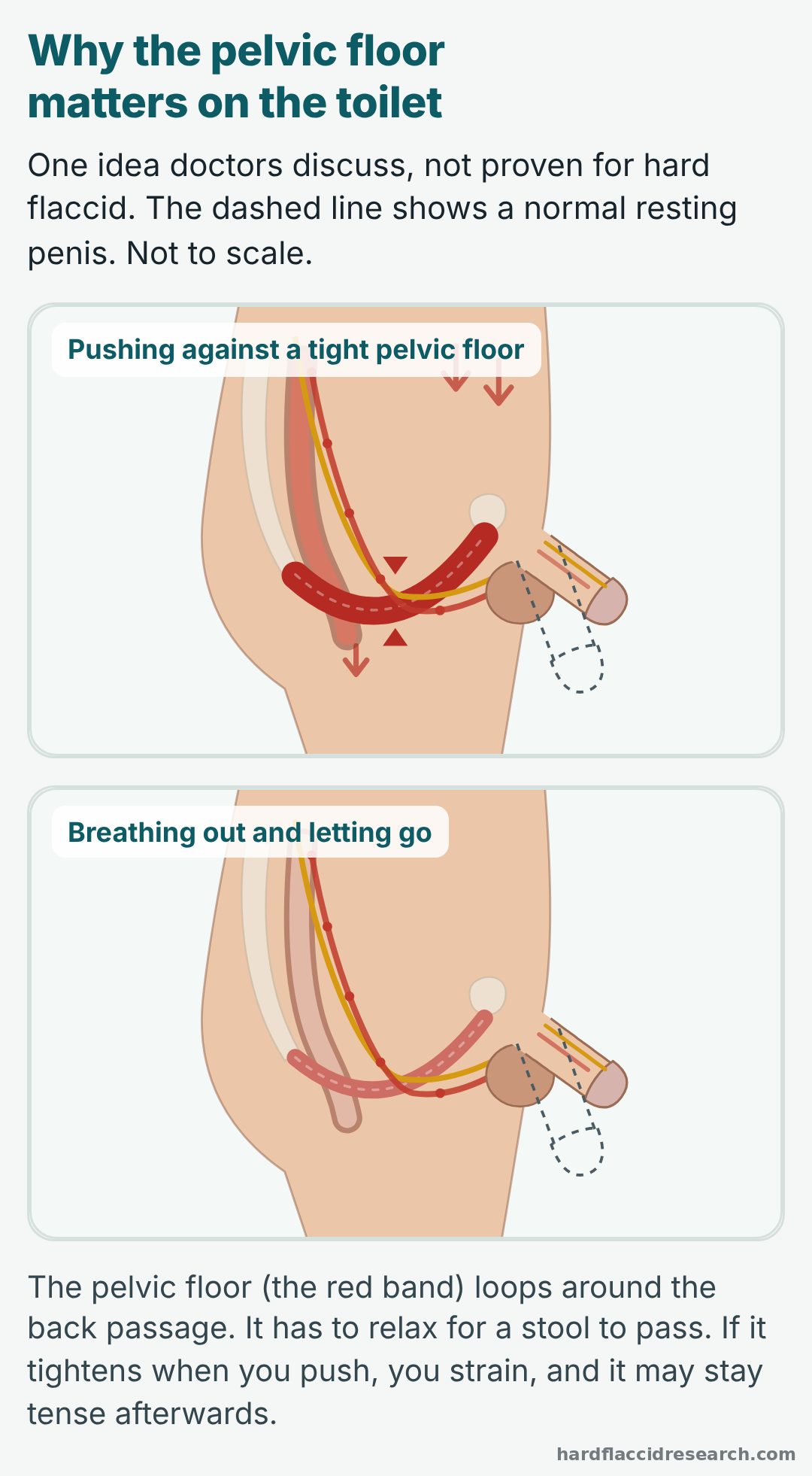
There's no proven answer, but doctors think the pelvic floor links the two. It has to relax for a stool to pass, and if it stays tight, you may strain against it and it may stay clenched afterwards.
Part of it loops around the back passage, keeping it kinked shut until you go. Specialists discuss these ideas:
A pelvic floor that won't let go
If the pelvic floor stays tight, or tightens when you push, you end up pushing against a closed door. Doctors call this dyssynergic defecation (dis-sin-ER-jik): the muscles don't work together during a bowel movement. Among the 601 men who described pelvic floor tightness, 28% also described bowel symptoms.
Straining
Pushing hard raises the pressure in your belly and bears down on the pelvic floor, which may irritate it further. Straining or constipation was named as a trigger by 23 men, and among them, 61% described bowel symptoms.
Constipation and hard stools
Hard, dry stools need more pushing. So constipation and a tight pelvic floor may feed each other, and pelvic floor problems are a known cause of constipation.
The clench afterwards
After a hard push, a tense pelvic floor may clench up again. That could be why some men feel worse for hours after a bowel movement.
How is the cause found?
A primary care provider will ask about your bowel habits and examine you. This may include a gentle check with a gloved finger, only if you agree.
If straining doesn't settle, a specialist may test how your pelvic floor works when you push, with a pressure test called anorectal manometry and a balloon expulsion test. A pelvic floor physical therapist can also check whether the muscles relax when they should.
Related: Perineum Pain With Hard Flaccid: Why It Hurts, What Helps »
What helps on the toilet?
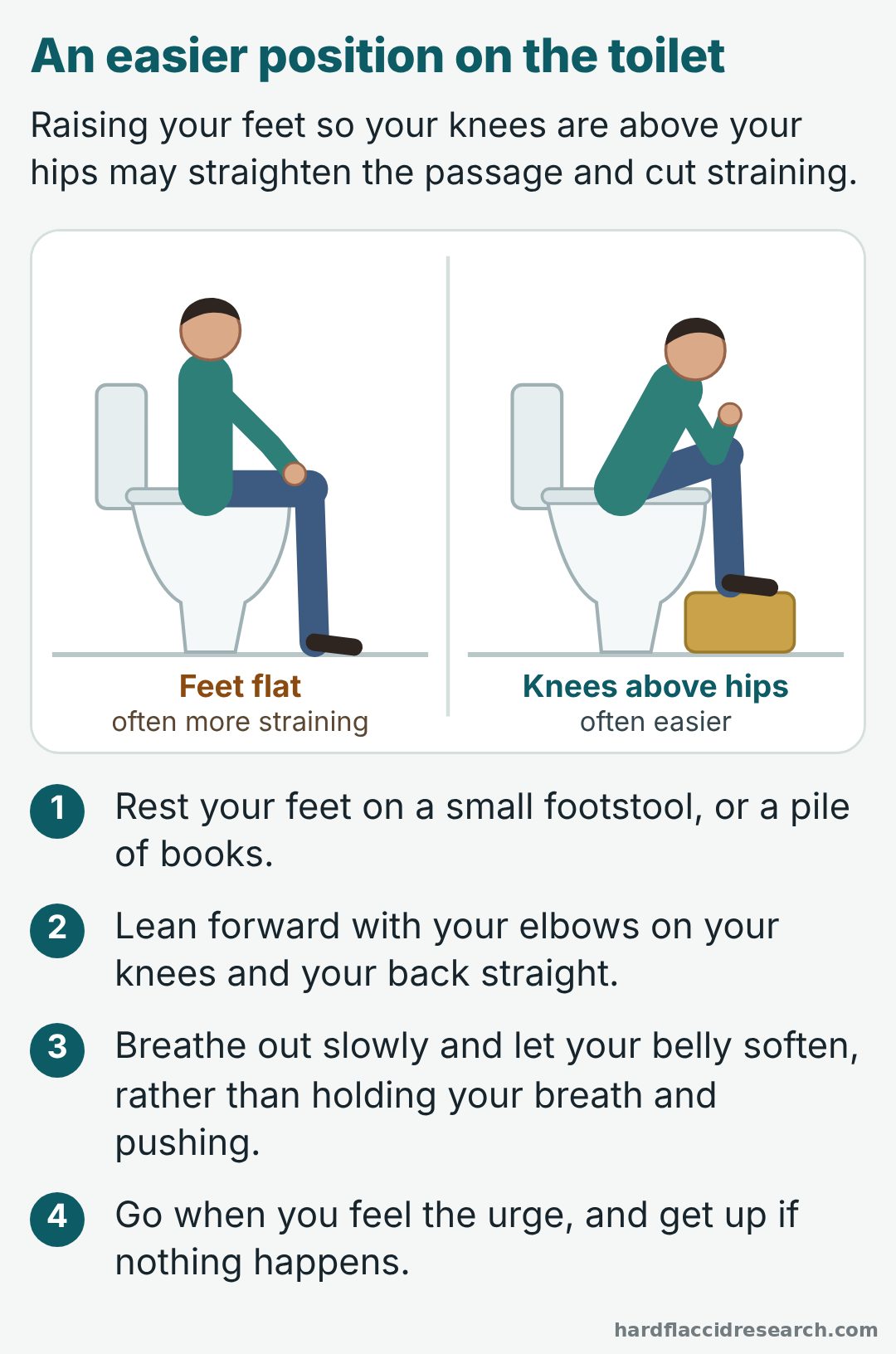
- Raise your feet on a small footstool, so your knees are above your hips. In a small study of healthy adults, a footstool-style device cut straining and helped people feel more fully emptied.
- Lean forward with your elbows on your knees and your back straight.
- Breathe out slowly as you go, rather than holding your breath and pushing. Let your belly soften.
- Try a reverse Kegel: a gentle letting go of the pelvic floor, the opposite of a squeeze, never a push.
- Go when you feel the urge, and don't sit scrolling on your phone. Get up if nothing happens and try later.
- Eat more fiber, slowly, from oats, beans, fruit and vegetables, and drink more water with it. Walking most days helps the bowel move too.
- A warm bath afterwards may help tense muscles settle.
If these don't help within a few weeks, ask about a pelvic floor physical therapist. Biofeedback, where a screen shows what your muscles are doing, is one of the most effective treatments for a pelvic floor that won't relax during bowel movements.
Men with bowel symptoms discussed many approaches: stretching (64%), Kegels (45%), tadalafil (45%), rest or abstinence (43%), pelvic floor physical therapy (41%) and reverse Kegels (40%). If your pelvic floor feels tight, ask a physical therapist before doing Kegels, and let go fully between squeezes.
Many men get better. In a June 2023 poll, 42% said they were at least half better (56 of 132 men). Reverse Kegels or pelvic floor relaxation came up in 20 of the 126 recovery stories.
Our members' guide, Bladder and Bowel Problems With Hard Flaccid: What Helps, has a step-by-step toilet routine.
When should I see a doctor?
See a primary care provider if your bowel habits have changed for more than a few weeks, or if you often strain or can't empty fully. See one soon if you have blood in your stool, weight loss you can't explain, or a family history of bowel cancer. Black, tarry stools need a doctor the same day.
Our doctor visit kit helps you explain your symptoms.
Get urgent care straight away (call 911 or go to the emergency room) if you have:
- Heavy bleeding from your back passage, or black, tarry stools with dizziness or fainting.
- Severe belly pain, or a swollen belly with vomiting or not being able to pass gas or stool.
- Sudden, severe pain in the penis, testicles or pelvis.
- New numbness around your back passage, genitals or inner thighs, or new weakness in your legs.
- New trouble starting or controlling your pee, not being able to pee, or not feeling when your bladder is full.
- Loss of control of your bladder or bowel.
- A fever or chills with pelvic pain or pain when peeing.
Frequently asked questions
Can constipation cause hard flaccid?
No one knows. Straining or constipation was named as a trigger by 23 men, far fewer than named other triggers. Straining may still irritate a tight pelvic floor and make symptoms worse.
Why does my penis feel worse after a bowel movement?
One idea is that pushing bears down on the pelvic floor, and a tense pelvic floor then clenches again afterwards. Breathing out rather than straining, and a footstool, may make it easier.
Can a pelvic floor physical therapist help with bowel problems?
Yes, often. They can teach your pelvic floor to relax when you go, sometimes with biofeedback, which reviews rank among the most effective treatments for this problem.
Takeaway
When hard flaccid syndrome flares around bowel movements, a tight pelvic floor is the likely link. Raise your feet, breathe out rather than straining, keep stools soft, and don't sit too long.
If it doesn't settle, a pelvic floor physical therapist can help, and many men get better. Our self-check can help you see your symptoms in one place before a visit.
This article is for general information and isn't a substitute for advice from your own doctor. Hard Flaccid Research doesn't diagnose or treat. If you have new or worsening symptoms, see a qualified clinician. In an emergency, call 911.
Free tools that can help
- Self-check: do I have hard flaccid?Compare your symptoms with what 6,026 men report.
- Doctor visit kitA one-page summary to take to your appointment.
- Habit trackerCount your days without porn or masturbation, and get through urges.
- Diaphragm breathing toolBreathe with a moving picture of your diaphragm and pelvic floor.
- Add your experienceTell us what you tried and how it went. No name needed.
- Hard Flaccid Syndrome CensusWhat men answered in 818 polls.
- Symptom trackerLog your symptoms and see what helps you.
- Ask us a questionThe questions men ask most become new articles.
The numbers behind this article
Every number in this article comes from what men with hard flaccid syndrome shared between December 2020 and October 2026, counted once per person, or from their polls. These are self-selected reports, not a clinical study. See hard flaccid syndrome statistics, the Hard Flaccid Syndrome Census and how we count.
Among 391 men with bowel symptoms, 67% also described the firm flaccid state
Share of the 391 men who described bowel symptoms who also described each of these.These are self-selected reports, not a clinical study. One man can describe several symptoms.
Source: Hard Flaccid Research, hardflaccidresearch.com
Bowel symptoms were more common with a tight pelvic floor or straining
Share who described bowel symptoms in each group of men.A link like this isn't proof of a cause, and the straining group is small.
Source: Hard Flaccid Research, hardflaccidresearch.com
What men with bowel symptoms discussed
Share of the 391 men who described bowel symptoms who discussed each approach. Discussed is not the same as worked.One man can discuss several approaches.
Source: Hard Flaccid Research, hardflaccidresearch.com
Many men get better: 42% said they were at least half better
The first bar is from a June 2023 poll. The others are the share of the 126 stories of getting better that credited each.Men who recover may stop answering polls, so these numbers may undercount recovery. A story mentioning something is what the man credited, not proof it worked.
Source: Hard Flaccid Research, hardflaccidresearch.com
391 men described bowel symptoms, 119 bloating, and 90 asked why it's worse around bowel movements
Number of men who wrote about each, counted once per person.The groups overlap.
Source: Hard Flaccid Research, hardflaccidresearch.com
Every number in this article, with its source
| In this article | Source |
|---|---|
| 391 men described bowel symptoms | 391 men, counted from what men wrote, once per person |
| 15% of men who described their symptoms described bowel symptoms (391 of 2,661) | 391 of 2,661 men, counted from what men wrote, once per person |
| 2,661 men described their symptoms | 2,661 men, counted from what men wrote, once per person |
| 90 men asked why hard flaccid syndrome is worse around bowel movements | Question group, 90 men, research data |
| Of 391 men with bowel symptoms: 67% firm flaccid state, 52% weaker erections, 47% numbness, 43% pelvic floor tightness | 391 men with bowel symptoms, counted from what men wrote, once per person |
| Of 391 men with bowel symptoms: stretching 64%, Kegels 45%, tadalafil 45%, rest or abstinence 43%, pelvic floor physio 41%, reverse Kegels 40% | 391 men with bowel symptoms, counted from what men wrote, once per person |
| 119 men described bloating | 119 men, counted from what men wrote, once per person |
| Of 119 men with bloating, 51% described bowel symptoms | 119 men with bloating, counted from what men wrote, once per person |
| 601 men described pelvic floor tightness | 601 men, counted from what men wrote, once per person |
| Of 601 men with pelvic floor tightness, 28% described bowel symptoms | 601 men with pelvic floor tightness, counted from what men wrote, once per person |
| 23 men named straining or constipation | 23 men, counted from what men wrote, once per person |
| Of 23 men who linked hard flaccid to straining or constipation, 61% described bowel symptoms | 23 men who linked hard flaccid to straining or constipation, counted from what men wrote, once per person |
| 42% said they were at least half better (56 of 132 men) | 56 of 132 men, poll, Jun 2023 |
| Reverse Kegels or pelvic floor relaxation came up in 20 of 126 recovery stories | 20 of 126 recovery stories |
| Breathing exercises came up in 16 of 126 recovery stories | 16 of 126 recovery stories |
| Pelvic floor physio came up in 15 of 126 recovery stories | 15 of 126 recovery stories |
| 126 recovery stories | 126 men, counted from what men wrote, once per person |
| Counting since December 2020 | Research data, December 2020 to October 2026 |
Medical sources
What this article says about medical research, guidelines and urgent care comes from these sources.
- National Institute of Diabetes and Digestive and Kidney Diseases. Treatment for constipation. https://www.niddk.nih.gov/health-information/digestive-diseases/constipation/treatment
- National Institute of Diabetes and Digestive and Kidney Diseases. Symptoms and causes of constipation. https://www.niddk.nih.gov/health-information/digestive-diseases/constipation/symptoms-causes
- Modi RM, Hinton A, Pinkhas D, et al. Implementation of a defecation posture modification device: impact on bowel movement patterns in healthy subjects. J Clin Gastroenterol. 2019;53(3):216-219. https://doi.org/10.1097/MCG.0000000000001143
- Sadeghi A, Akbarpour E, Majidirad F, et al. Dyssynergic defecation: a comprehensive review on diagnosis and management. Turk J Gastroenterol. 2023;34(3):182-195. https://doi.org/10.5152/tjg.2023.22148
- Barham DW, Alzweri L, Yafi FA. Hard-flaccid syndrome: definition, diagnosis and management. AUA News, April 1, 2022. https://auanews.net/issues/articles/2022/april-2022/hard-flaccid-syndrome-definition-diagnosis-and-management
- Abdessater M, Kanbar A, Akakpo W, Beley S. Hard flaccid syndrome: state of current knowledge. Basic Clin Androl. 2020;30:7. https://doi.org/10.1186/s12610-020-00105-5
- Hetrick DC, Ciol MA, Rothman I, Turner JA, Frest M, Berger RE. Musculoskeletal dysfunction in men with chronic pelvic pain syndrome type III: a case-control study. J Urol. 2003;170:828-831. https://doi.org/10.1097/01.ju.0000080513.13968.56
- Lai HH, Pontari MA, Argoff CE, et al. Male chronic pelvic pain: AUA guideline. J Urol. 2025. https://www.auanet.org/guidelines-and-quality/guidelines/male-chronic-pelvic-pain
How we made this article
We started from the question 90 men asked. Every number was checked against our data. Our editorial team edited it and Dr. Julian Reyes reviewed it medically. Read our editorial policy.
Read next
See more of us on Google
Add Hard Flaccid Research as a preferred source, and Google shows you our pages more often when you search.
Add as a preferred sourceDon't see your question? Ask us. We answer the most-asked ones in new articles.
Cite and share this article
You're welcome to quote this article. Please name Hard Flaccid Research and link to this page, so others can find the full answer and the data behind it. To cite this page, use its link.
Citation
Hard Flaccid Research. (2026). Hard Flaccid Worse After a Bowel Movement? Here's Why. Written by the Editorial Team, medically reviewed by Dr. Julian Reyes. https://hardflaccidresearch.com/articles/hard-flaccid-bowel-movements
Credit link for your article
Source: <a href="https://hardflaccidresearch.com/articles/hard-flaccid-bowel-movements">Hard Flaccid Research</a>
Wikipedia reference
<ref>{{cite web |url=https://hardflaccidresearch.com/articles/hard-flaccid-bowel-movements |title=Hard Flaccid Worse After a Bowel Movement? Here's Why |website=Hard Flaccid Research |date=2026 |access-date=28 October 2026}}</ref>
How the data was collected: our methodology. Journalists and researchers: key numbers, data and contact.