Corpus Cavernosum: Anatomy and How an Erection Works
In short
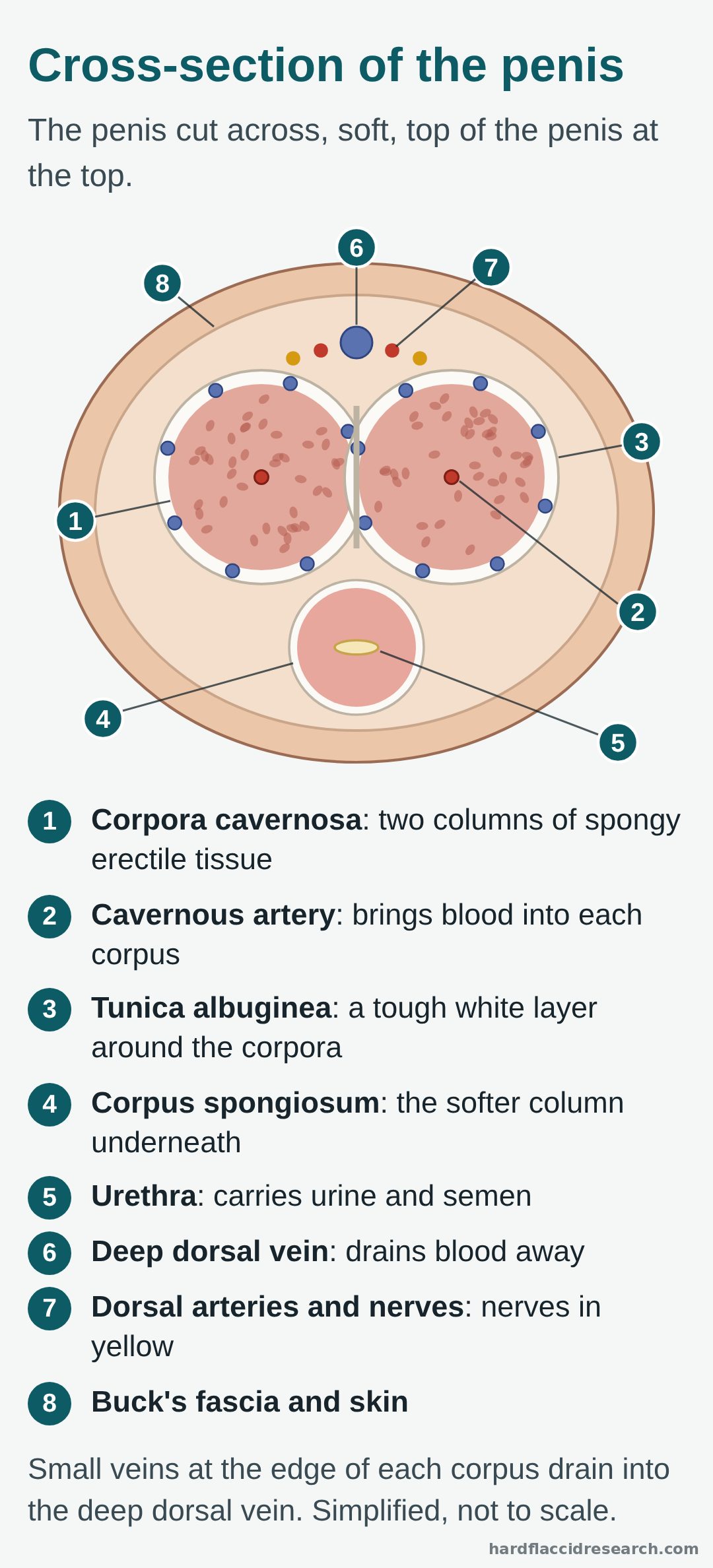
- The corpora cavernosa are two sponge-like columns of erectile tissue that run along the top of the penis.
- During an erection, their smooth muscle relaxes, blood rushes into tiny spaces inside them, and the tough outer layer squeezes the veins so the blood stays in.
- Problems with the blood vessels, nerves or this tissue can cause erectile dysfunction.
The corpus cavernosum (KOR-pus kav-er-NO-sum) is one of two sponge-like columns of erectile tissue that run along the top of the penis. Together they're called the corpora cavernosa. During an erection, they fill with blood and become firm, and they hold most of the blood in an erect penis.
Underneath them runs a third, smaller column, the corpus spongiosum, which carries the urethra and forms the head of the penis. This page explains what the corpora cavernosa are made of, how they fill and stay firm during an erection, and what can go wrong.
By the numbers: of the 6,026 men who shared their experiences with hard flaccid syndrome, 2,661 described their symptoms, and 926 of them described weaker or lost erections.
Key facts
- The corpora cavernosa are two parallel columns of erectile tissue on the top side of the penis.
- Inside, they're full of tiny spaces lined by smooth muscle, like a sponge.
- Each has a central artery, the cavernous artery, which brings blood in.
- A tough, stretchy layer called the tunica albuginea wraps around them.
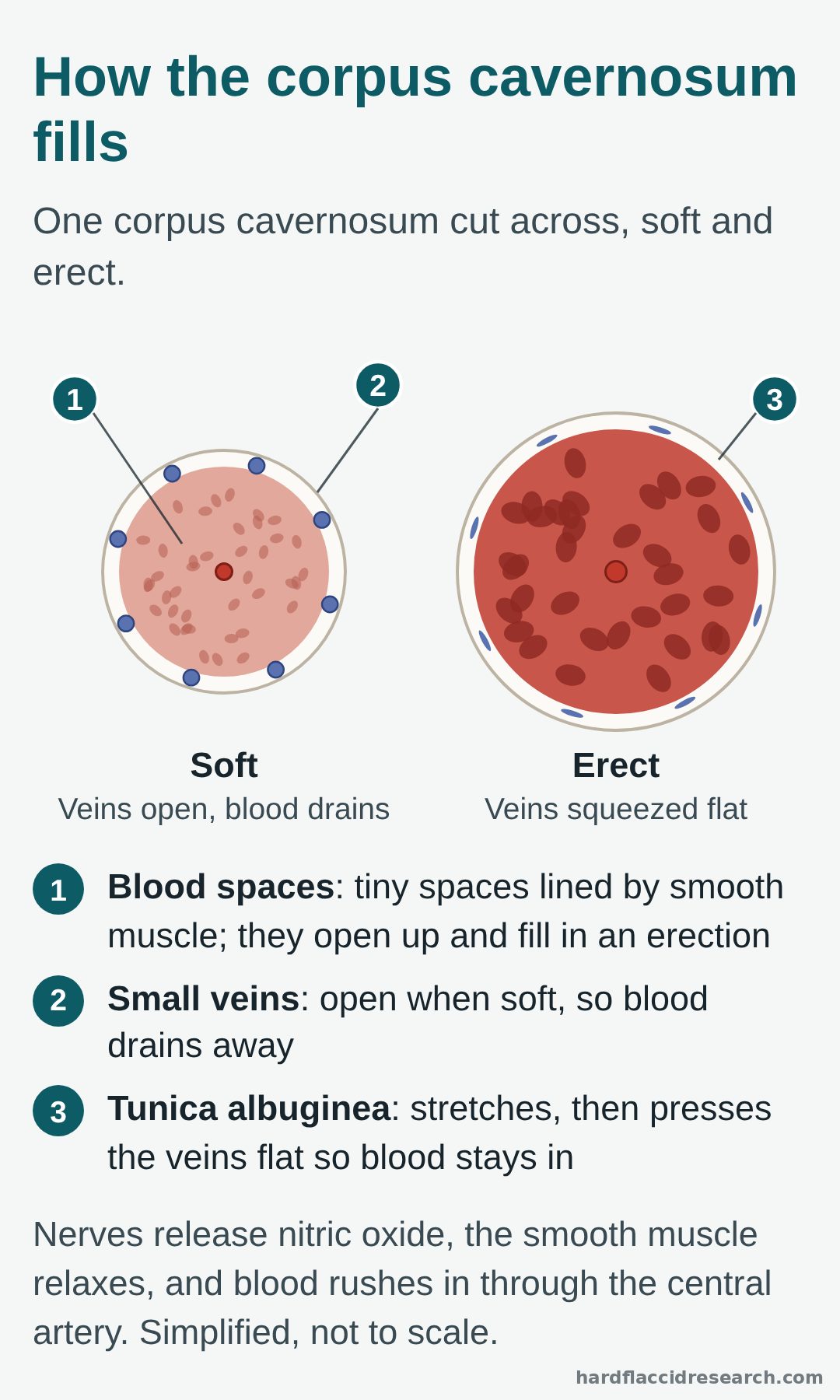
- In an erection, the smooth muscle relaxes, the spaces fill with blood, and the swelling squeezes the draining veins shut against the tunica.
- Problems with the arteries, the veins, the nerves or this tissue itself can cause erectile dysfunction.
What is the corpus cavernosum?
The penis has three columns of spongy tissue. Two of them, the corpora cavernosa, lie side by side along the top. The third, the corpus spongiosum, runs along the underside and widens at the end to form the glans, the head of the penis.
At the base of the penis, deep in the body, each corpus cavernosum splits off and attaches to the pubic bone on its own side. These attached ends are called the crura. They're covered by the ischiocavernosus muscles, part of the pelvic floor.
What's inside
- Erectile tissue: a mesh of tiny spaces called sinusoids, lined by smooth muscle and a thin inner layer of cells (the endothelium).
- The cavernous artery: one in the center of each corpus, with small coiled branches (helicine arteries) that open into the sinusoids.
- A septum: a wall between the two corpora with gaps in it, so blood can move between them.
What's around it
- The tunica albuginea: a strong, white, two-layered sheet of collagen and elastic fibers. It lets the penis stretch, and it becomes tight when the penis is erect.
- Small veins: they drain the sinusoids and pass through or under the tunica on their way to the deep dorsal vein on top of the penis.
- Buck's fascia and the skin: outer layers that hold everything together, with the dorsal arteries and nerves running along the top.
Related: Does Cialis Help Hard Flaccid? 76% of Men Said Yes »
How does an erection work?
An erection is a blood-flow event controlled by nerves.
- Arousal from touch, sights, thoughts or sleep sends signals down nerves from the lower spinal cord to the penis.
- The nerve endings and the lining of the blood vessels release nitric oxide, a chemical messenger.
- Nitric oxide makes the smooth muscle in the arteries and sinusoids relax.
- The arteries widen and blood rushes in, filling the sinusoids like water filling a sponge.
- The corpora swell against the tunica albuginea, which squeezes the small draining veins flat. This traps the blood and makes the penis firm.
- In the final stage, the ischiocavernosus muscles at the base contract and push the pressure even higher, making the penis fully rigid.
After orgasm, or when arousal fades, the smooth muscle tightens again, blood flows in more slowly, the veins open, and the penis softens.
This is also why medicines such as sildenafil and tadalafil help many men: they boost the effect of nitric oxide, so the smooth muscle relaxes more easily. They're prescription medicines and must never be taken with nitrate medicines for chest pain or with poppers.
The corpus spongiosum is different
The corpus spongiosum fills with blood too, but its outer layer is thinner. That keeps the urethra open so semen can pass, and keeps the glans softer than the shaft.
What can go wrong with the corpora cavernosa?
- Erectile dysfunction: if blood flow in is weak, the smooth muscle can't relax, or the veins don't close well, erections become weaker or don't last. US urology guidelines note that erectile dysfunction can be an early sign of heart and blood vessel disease.
- Venous leak: when the veins don't close properly, blood drains away and erections fade quickly. Doctors call this veno-occlusive dysfunction.
- Penile fracture: a tear in the tunica albuginea during an erection, usually during sex, with a cracking sound, sudden pain and swelling. It's an emergency.
- Peyronie's disease: scar tissue in the tunica albuginea that can cause a curve, dent or narrowing.
- Priapism: an erection that won't go down, usually painful, because blood is trapped. It's an emergency.
- Scarring (fibrosis): long-term damage, for example after untreated priapism, can stiffen the tissue.
Related: Hard Flaccid Syndrome Medical Evidence Diagnosis Symptoms Treatment Urology »
How to keep erectile tissue healthy
The smooth muscle and blood vessels in the corpora depend on good blood flow, like the heart. Things that help:
- Regular movement. Walking, running, cycling or swimming most days supports blood flow and mood.
- Not smoking or vaping nicotine, which narrows blood vessels.
- Good sleep, which allows normal night-time erections.
- Keeping blood pressure, blood sugar and cholesterol in a healthy range, with your doctor's help.
- Drinking alcohol in moderation.
- Treating a long-lasting erection as an emergency, because trapped blood can damage the tissue.
The corpora cavernosa and hard flaccid syndrome
Hard flaccid syndrome is a firm, shrunken penis at rest, often with numbness, weaker erections and pelvic pain. One idea doctors have proposed is that the smooth muscle in the corpora and their arteries stays partly tightened at rest, driven by stress signals from the nervous system and a tense pelvic floor. This isn't proven.
Of the 2,661 men who described their symptoms, 58% described this firm flaccid state (1,553 men) and 35% described weaker or lost erections (926 men). In a separate count, 218 men asked whether hard flaccid is a blood flow or vein problem.
In a January 2023 poll, 9% said they had morning erections every day (12 of 128 men), and 18% said they never had them (23 of 128 men). Erections during sleep help keep the tissue of the corpora healthy by bringing in oxygen-rich blood.
If you're wondering whether your blood flow is normal, our members' guide, Hard Flaccid Blood Flow Tests: The Doppler Scan Explained, walks through what the scan measures.
How do doctors check the corpora cavernosa?
- A physical examination of the penis, feeling for plaques or scar tissue.
- A penile Doppler ultrasound: a scan, usually after an injection that causes an erection, which measures blood flow in the cavernous arteries and shows whether the veins close.
- Overnight erection tests, which check whether erections happen during sleep.
- Blood tests for diabetes, cholesterol and testosterone.
Our doctor visit kit helps you describe your erections and symptoms clearly before any tests.
When should I see a doctor?
See a primary care provider or a urologist (a doctor for urinary and sexual health) if your erections have become weaker, don't last, or you notice a new curve, lump or dent in the penis.
Get urgent care straight away (call 911 or go to the emergency room) if you have:
- An erection lasting more than 4 hours.
- A cracking or popping sound during sex or masturbation, followed by sudden pain, a quick loss of erection, or rapid swelling or dark bruising.
- Sudden, severe pain in the penis, testicles or pelvis.
- Chest pain, especially during or after sex.
Frequently asked questions
Is the corpus cavernosum a muscle?
Not exactly. It's erectile tissue: a sponge-like mesh of blood spaces lined by smooth muscle. The muscle you can squeeze at the base of the penis is a different, pelvic floor muscle.
What's the difference between the corpus cavernosum and the corpus spongiosum?
There are two corpora cavernosa on top, which make the shaft rigid. The single corpus spongiosum is underneath, carries the urethra and forms the glans, and stays softer.
Can the corpus cavernosum be damaged?
Yes. Injury, a penile fracture, priapism or long-term blood vessel disease can damage it. That's why a painful injury or a long-lasting erection needs urgent care.
Can you strengthen the corpora cavernosa?
There's no exercise that builds this tissue directly. Regular exercise, not smoking, good sleep and managing blood pressure, sugar and cholesterol help keep the blood vessels that feed it healthy.
Why does the penis get hard at night?
During sleep, the nerves that relax the smooth muscle become more active. Night-time erections are normal and help keep the tissue healthy.
Takeaway
The corpora cavernosa are the two sponge-like chambers along the top of the penis. In an erection, their smooth muscle relaxes, they fill with blood, and the tunica albuginea traps it by squeezing the veins.
Weaker erections usually come from the blood vessels, nerves or this tissue, and a doctor can help find which. Take our free self-check if you also notice changes in your penis at rest.
This article is for general information and isn't a substitute for advice from your own doctor. Hard Flaccid Research doesn't diagnose or treat. If you have new or worsening symptoms, see a qualified clinician. In an emergency, call 911.
Free tools that can help
- Self-check: do I have hard flaccid?Compare your symptoms with what 6,026 men report.
- Doctor visit kitA one-page summary to take to your appointment.
- Habit trackerCount your days without porn or masturbation, and get through urges.
- Diaphragm breathing toolBreathe with a moving picture of your diaphragm and pelvic floor.
- Add your experienceTell us what you tried and how it went. No name needed.
- Hard Flaccid Syndrome CensusWhat men answered in 818 polls.
- Symptom trackerLog your symptoms and see what helps you.
- Ask us a questionThe questions men ask most become new articles.
The numbers behind this article
Every number in this article comes from what men with hard flaccid syndrome shared between December 2020 and October 2026, counted once per person, or from their polls. These are self-selected reports, not a clinical study. See hard flaccid syndrome statistics, the Hard Flaccid Syndrome Census and how we count.
35% of men who described their symptoms described weaker or lost erections
Share of the 2,661 men who described their symptoms. Each man is counted once.These are self-selected reports, not a clinical study.
Source: Hard Flaccid Research, hardflaccidresearch.com
9% said they had morning erections every day
How 128 men with hard flaccid syndrome answered a January 2023 poll.In our polls, men choose to answer.
Source: Hard Flaccid Research, hardflaccidresearch.com
Every number in this article, with its source
| In this article | Source |
|---|---|
| 35% of the men who described their symptoms described weaker or lost erections (926 of 2,661) | 926 of 2,661 men, counted |
| 58% of the men who described their symptoms described this firm flaccid state (1,553 of 2,661) | 1,553 of 2,661 men, counted |
| 6,026 men shared their experiences, and 2,661 of them described their symptoms | 2,661 of 6,026 men, counted |
| 218 men asked whether hard flaccid is a blood flow or vein problem | 218 men asked whether hard flaccid is a blood flow or vein problem, counted from what men wrote, once per person |
| 9% said they had morning erections every day (12 of 128 men) | 12 of 128 men, poll, Jan 2023 |
| 18% said they never had morning erections (23 of 128 men) | 23 of 128 men, poll, Jan 2023 |
Medical sources
What this article says about medical research, guidelines and urgent care comes from these sources.
- Anatomy, Abdomen and Pelvis, Penis. In: StatPearls. Treasure Island (FL): StatPearls Publishing. https://www.ncbi.nlm.nih.gov/books/NBK482236/
- Physiology, Erection. In: StatPearls. Treasure Island (FL): StatPearls Publishing. https://www.ncbi.nlm.nih.gov/books/NBK513278/
- Dean RC, Lue TF. Physiology of penile erection and pathophysiology of erectile dysfunction. Urol Clin North Am. 2005;32(4):379-395. https://doi.org/10.1016/j.ucl.2005.08.007
- Gratzke C, Angulo J, Chitaley K, et al. Anatomy, physiology, and pathophysiology of erectile dysfunction. J Sex Med. 2010;7(1 Pt 2):445-475. https://doi.org/10.1111/j.1743-6109.2009.01624.x
- Lue TF. Erectile dysfunction. N Engl J Med. 2000;342(24):1802-1813. https://doi.org/10.1056/NEJM200006153422407
- Burnett AL, Nehra A, Breau RH, et al. Erectile dysfunction: AUA guideline. J Urol. 2018;200(3):633-641. https://doi.org/10.1016/j.juro.2018.05.004
How we made this article
We started from the question many men asked. Every number was checked against our data. Our editorial team edited it and Dr. Julian Reyes reviewed it medically. Read our editorial policy.
Read next
See more of us on Google
Add Hard Flaccid Research as a preferred source, and Google shows you our pages more often when you search.
Add as a preferred sourceDon't see your question? Ask us. We answer the most-asked ones in new articles.
Cite and share this article
You're welcome to quote this article. Please name Hard Flaccid Research and link to this page, so others can find the full answer and the data behind it. To cite this page, use its link.
Citation
Hard Flaccid Research. (2026). Corpus Cavernosum: Anatomy and How an Erection Works. Written by the Editorial Team, medically reviewed by Dr. Julian Reyes. https://hardflaccidresearch.com/articles/corpus-cavernosum
Credit link for your article
Source: <a href="https://hardflaccidresearch.com/articles/corpus-cavernosum">Hard Flaccid Research</a>
Wikipedia reference
<ref>{{cite web |url=https://hardflaccidresearch.com/articles/corpus-cavernosum |title=Corpus Cavernosum: Anatomy and How an Erection Works |website=Hard Flaccid Research |date=2026 |access-date=22 November 2026}}</ref>
How the data was collected: our methodology. Journalists and researchers: key numbers, data and contact.