Edging: What It Is, Is It Safe, and Pelvic Floor Effects
In short
- Edging is stopping sexual stimulation just before orgasm, then starting again, to delay climax.
- Edging itself isn't known to be harmful, and a version of it is used for premature ejaculation.
- Long, rough sessions and clenching the pelvic floor to hold back may cause soreness, tension or trouble finishing, so keep it gentle.
Edging is stopping sexual stimulation just before orgasm, then starting again, to delay climax and make a session last longer. Edging itself isn't known to be harmful, and a version of it is used to treat premature ejaculation.
This page covers why men edge, whether it's bad for you, how it may affect erections, finishing and the pelvic floor, and how to keep it gentle.
By the numbers: 1,130 men mentioned edging when they reported to us about porn and masturbation between January and October 2026. These are reports from men who chose to tell us, not a clinical study.
Key facts
- Edging means stopping just before orgasm, letting arousal settle, then starting again, sometimes several times.
- A sexual medicine society describes it as a way to delay orgasm and doesn't list physical risks.
- A version called the stop-start technique is used for premature ejaculation, though the evidence for it is limited.
- Of the 1,130 men who mentioned edging when they reported to us, 51% also described a slip or relapse (575 men).
- Holding back by clenching the pelvic floor may leave those muscles tense, so letting go and breathing is a gentler way to pause.
Hard Flaccid Explorerby Hard Flaccid Research
Edging, explained
A 7-minute animated explainer of this article. Press play, or skip between chapters. The first minute is free for everyone.
A picture to explain, not a diagnosis.
What is edging?
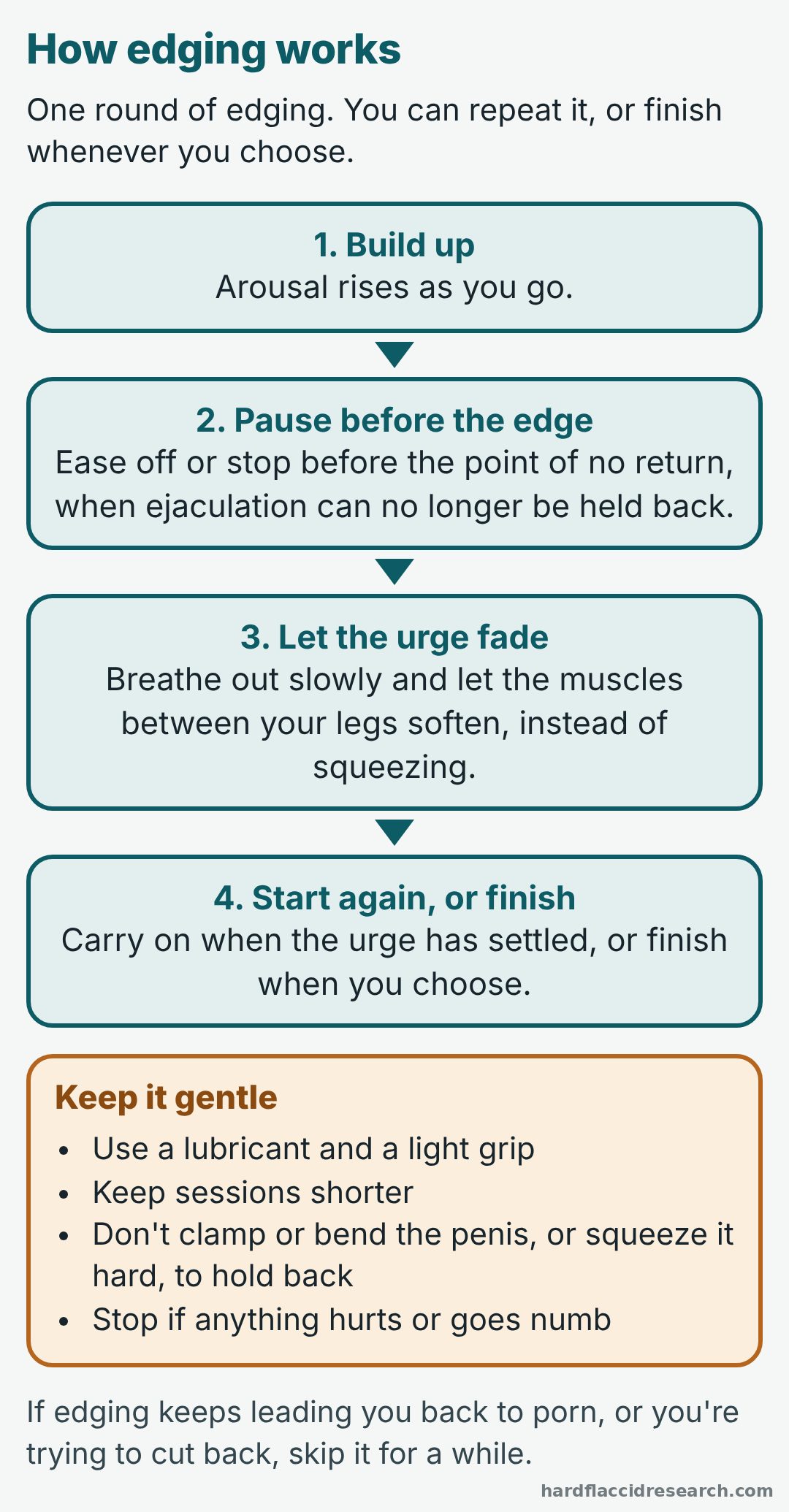
Edging is a way of controlling when you reach orgasm. You build arousal until you feel close to the edge, ease off or stop, wait for the urge to fade, then start again. You finish when you choose to.
Some people call it orgasm control. You can do it alone or with a partner, and a partner can slow down or pause when you say.
The idea is to pause before the point of no return, the moment when ejaculation can no longer be held back. Learning where that point is for you is the first step.
Related: Alpha Blockers for Hard Flaccid: 45% of Men Said They Help »
Why do men edge?
Men edge for different reasons:
- A stronger orgasm. Some people find that a delayed orgasm feels more intense.
- Lasting longer. Some men who finish sooner than they'd like use a version of edging to build control.
- Pleasure and variety. Some men simply enjoy the build-up, alone or with a partner.
- A habit with porn. Some men edge while watching porn for long stretches.
That last reason matters if you're trying to cut back. Of the 1,130 men who mentioned edging when they reported to us, 51% also described a slip or relapse (575 men), and 49% described urges (554 men). That's a mention, not proof that edging led to them.
If you're cutting back on porn, notice whether edging tends to lead you back to it.
How do you edge with a partner?
Edging with a partner works best when you talk first. ISSM suggests that couples share what each of them likes, get a sense of their own timing, and know what each other expects.
Agree on a simple signal, such as a word or a tap, for when you're close. Your partner can then slow down, pause or switch to something else until the urge fades.
Long sessions aren't for everyone. ISSM notes that a very long build-up can become boring for a partner, so keep it a shared choice, and finish whenever either of you wants to.
If worry about finishing too soon or too late is getting in the way of sex, a sex therapist can help you both.
Related: Death Grip and ED: Can Masturbation Cause Erection Problems? »
Is edging bad for you?
Edging itself isn't known to be harmful. The International Society for Sexual Medicine (ISSM) describes it as a way to delay orgasm and doesn't list physical risks.
Problems can come from how it's done rather than edging itself:
- Very long or rough sessions may leave the penis sore or chafed.
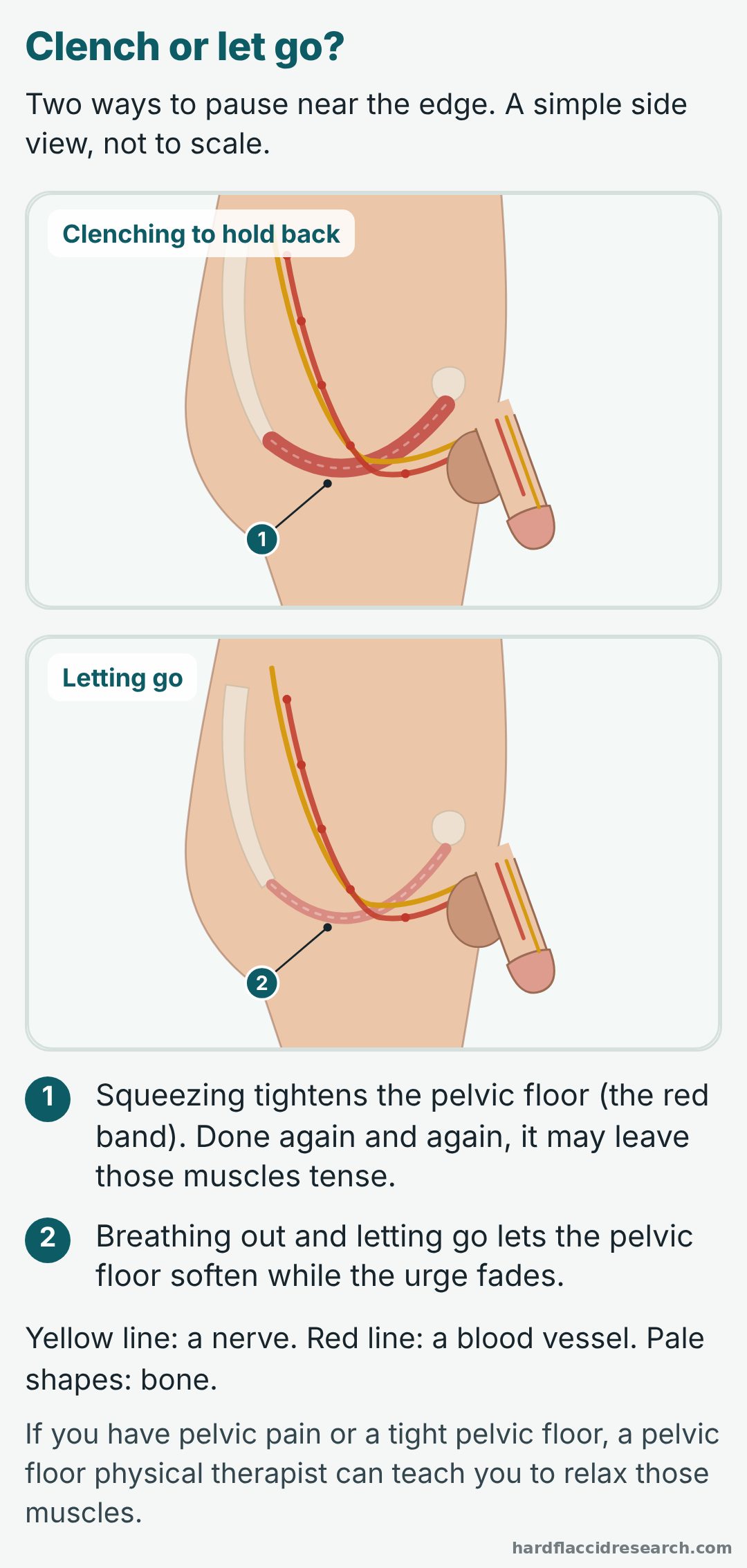
- Clenching to hold back may tire or tighten the pelvic floor, the sling of muscles between your legs.
- A dull ache in the testicles after a long session, sometimes called blue balls.
- Trouble finishing with a partner, if you get used to a very long build-up alone.
- Losing track of time, or using edging to cope with stress or boredom.
If edging leaves you sore, tense or unable to finish when you want to, try shorter, gentler sessions for a while.
Does edging help premature ejaculation?
It may help a little. Premature ejaculation means finishing sooner than you or your partner want, and feeling you can't control it. A form of edging called the stop-start technique is one of the behavioral treatments for it.
In stop-start, you stop stimulation when you feel close, wait about half a minute for the urge to fade, then carry on. A review of randomized trials found limited evidence that techniques like this help men last longer than waiting for treatment.
The same review found that combining them with medicine worked a little better than medicine alone, by about half a minute to a minute.
A US guideline on ejaculation problems says doctors should consider referring men with premature ejaculation to a mental health professional with sexual health expertise. A sex therapist can coach you through stop-start, alone or with a partner.
Can edging cause erection problems?
There's no good evidence that edging itself causes erectile dysfunction (ED), meaning trouble getting or keeping an erection. Research on masturbation, porn and erection problems is mixed.
Large surveys of men found little or no link between how often they watched porn and erection problems. The authors of one survey said heavy porn use with very frequent masturbation might still matter for some younger men.
Of the 1,130 men who mentioned edging when they reported to us, 14% also mentioned erection trouble (156 men). That's a mention, not proof that edging caused it.
Erections can change for many reasons, and a US erection guideline says changed erections can be a warning sign of heart disease. If yours have changed, see a doctor.
Can edging cause delayed ejaculation?
It might play a part for some men. Delayed ejaculation means finishing takes much longer than you want, or doesn't happen with a partner.
Doctors who study it describe masturbation habits that are very different from sex with a partner as one factor. A tight, fast grip may make a partner's touch feel like too little, and some men call this death grip. No study has looked at edging itself, but a very long build-up alone may widen that gap.
A US guideline on ejaculation problems says that changing sexual positions or practices may help. If you find it hard to finish with a partner, try a shorter, lighter routine alone for a while, and talk with your partner about what feels good.
How does edging affect the pelvic floor?
The pelvic floor muscles play a part in ejaculation. In a small study, pelvic floor training helped some men with premature ejaculation gain control.
Some men hold back orgasm by squeezing these muscles hard. No study has looked at whether doing that again and again leaves the pelvic floor tense, but it may. A tight, tender pelvic floor is linked with pelvic pain, pain after ejaculation and urinary symptoms.
When you pause, try letting go instead: breathe out slowly and let the muscles between your legs soften, as if you were starting to pee, without pushing.
Edging and hard flaccid syndrome
Hard flaccid syndrome is when the penis stays firm or shrunken at rest, often with numbness and weaker erections. Of the 6,026 men who shared their experiences of hard flaccid between December 2020 and October 2026, 72 named edging or very long sessions as how it began.
Of those 72 men, 78% described the firm flaccid state and 46% pelvic floor tension. Naming a trigger isn't proof that it caused hard flaccid. If your penis is firm, numb or sore at rest, stop edging for now, see a doctor and take our free self-check.
What are blue balls?
Blue balls is a slang term for an ache in the testicles after a long time aroused without ejaculating.
A sexual medicine society notes that the usual explanation, pressure from blood or fluid, isn't proven, and the little research on it describes a passing ache. It's never a reason to pressure a partner into sex.
A sudden, severe pain in a testicle is different: it can be twisting of the testicle (torsion), one of the emergency signs listed under When should I see a doctor?
How can I edge more safely?
If you edge, a few habits may keep it gentle:
- Use a lubricant and a light grip, and vary your touch.
- Keep sessions shorter, and stop if anything hurts or goes numb.
- Pause by letting go and breathing, not by clenching your pelvic floor.
- Don't clamp or bend the penis, or squeeze it hard, to hold back.
- With a partner, agree on a signal for when to slow down.
- If edging keeps leading you back to porn, or you're trying to cut back, skip it for a while.
If you have pelvic pain or a tight pelvic floor, a pelvic floor physical therapist can teach you to relax those muscles.
When should I see a doctor?
See a primary care provider or a urologist (a doctor for urinary and sexual health) if your erections have changed or you can't finish when you want to. See one too if you finish too soon and it bothers you, or you have pain during or after ejaculation.
If your erections have changed, ask about a blood test for blood sugar and cholesterol.
Get urgent care straight away (call 911 or go to the emergency room) if you have:
- A popping or cracking sound during sex or masturbation, followed by sudden pain, a quick loss of erection, or rapid swelling or dark bruising.
- An erection lasting more than 4 hours.
- Sudden, severe pain in the penis, testicles or pelvis.
- New numbness around your back passage, genitals or inner thighs, or new weakness in your legs.
- New trouble starting or controlling your pee, not being able to pee, or not feeling when your bladder is full.
- Loss of control of your bladder or bowel.
- A fever or chills with pelvic pain or pain when peeing.
For everything else, book a routine visit and bring our doctor visit kit, so you can explain what's going on without hunting for words.
Frequently asked questions
Is it bad to edge without finishing?
Not usually, though you might feel a dull ache in the testicles that the little research there is describes as passing. A large US study found that men who ejaculated more often had a slightly lower risk of prostate cancer, but it didn't look at edging or show cause and effect. If a testicle ache is sudden or severe, see the emergency signs above.
How long should you edge for?
There's no medical rule. Keep sessions comfortable, stop if you feel sore, numb or tense, and watch that they don't eat into sleep or plans. If they keep running long, set a time limit before you start.
Does edging make orgasms stronger?
ISSM notes that some people find a delayed orgasm feels more intense. Pleasure varies from man to man, so notice what works for you.
Is edging a relapse if I'm quitting porn?
That's up to the goals you set. If edging tends to lead you back to porn, it may be easier to set it aside for now.
Takeaway
Edging is a way to delay orgasm, and edging itself isn't known to be harmful. Long, rough sessions and clenching to hold back are the habits that may cause trouble.
Keep it gentle: pause by letting go, not squeezing, and see a doctor if you have pain, numbness or changes in erections or finishing.
This article is for general information and isn't a substitute for advice from your own doctor. Hard Flaccid Research doesn't diagnose or treat. If you have new or worsening symptoms, see a qualified clinician. In an emergency, call 911.
Free tools that can help
- Self-check: do I have hard flaccid?Compare your symptoms with what 6,026 men report.
- Doctor visit kitA one-page summary to take to your appointment.
- Habit trackerCount your days without porn or masturbation, and get through urges.
- Diaphragm breathing toolBreathe with a moving picture of your diaphragm and pelvic floor.
- Add your experienceTell us what you tried and how it went. No name needed.
- Hard Flaccid Syndrome CensusWhat men answered in 818 polls.
- Symptom trackerLog your symptoms and see what helps you.
- Ask us a questionThe questions men ask most become new articles.
The numbers behind this article
Most numbers in this article come from what 71,368 men reported to us about porn and masturbation between January and October 2026, counted once per person. A few come from what men with hard flaccid syndrome shared between December 2020 and October 2026, kept separate from the rest. These are reports from men who chose to tell us, not a clinical study, and a man counts only when he described something about himself. See how we count.
51% of men who mentioned edging also described a slip or relapse
Share of the 1,130 men who mentioned edging when they reported to us who described or mentioned each.These are reports from men who chose to tell us, not a clinical study. A mention isn't proof that edging caused anything.
Source: Hard Flaccid Research, hardflaccidresearch.com
1,130 men mentioned edging when they reported to us
Number of men who mentioned each, of the 71,368 men who reported to us about porn and masturbation between January and October 2026.These are reports from men who chose to tell us, not a clinical study.
Source: Hard Flaccid Research, hardflaccidresearch.com
Of men who named edging as how their hard flaccid began, 46% described pelvic floor tension
Of 6,026 men who shared their experiences of hard flaccid (December 2020 to October 2026), 72 named edging or very long sessions as how it began. Share of those 72 who described each.A small group of men who shared their experiences of hard flaccid, kept separate from the other numbers on this page. Naming a trigger isn't proof that it caused hard flaccid. These are reports from men who chose to tell us, not a clinical study.
Source: Hard Flaccid Research, hardflaccidresearch.com
Every number in this article, with its source
| In this article | Source |
|---|---|
| 1,130 men mentioned edging | 1,130 men who reported to us about porn and masturbation, Jan to Oct 2026 |
| 51% of them described a slip or relapse (575 of 1,130 men) | 575 of 1,130 men who reported to us about porn and masturbation, Jan to Oct 2026 |
| 49% of them described urges (554 of 1,130 men) | 554 of 1,130 men who reported to us about porn and masturbation, Jan to Oct 2026 |
| 14% of them mentioned erection trouble (156 of 1,130 men) | 156 of 1,130 men who reported to us about porn and masturbation, Jan to Oct 2026 |
| 8% of them used the term PIED (85 of 1,130 men) | 85 of 1,130 men who reported to us about porn and masturbation, Jan to Oct 2026 |
| 3% of them mentioned the pelvic floor or Kegels (31 of 1,130 men) | 31 of 1,130 men who reported to us about porn and masturbation, Jan to Oct 2026 |
| 2% of them mentioned premature ejaculation (28 of 1,130 men) | 28 of 1,130 men who reported to us about porn and masturbation, Jan to Oct 2026 |
| 238 men mentioned premature ejaculation | 238 men who reported to us about porn and masturbation, Jan to Oct 2026 |
| 168 men mentioned the pelvic floor or Kegels | 168 men who reported to us about porn and masturbation, Jan to Oct 2026 |
| 164 men described trouble finishing with a partner | 164 men who reported to us about porn and masturbation, Jan to Oct 2026 |
| 72 men named edging or long sessions as how their hard flaccid began | 72 men, counted from what men wrote, once per person |
| 6,026 men | 6,026 men, counted from what men wrote, once per person |
| Hard flaccid reports counted since December 2020 | Research data, December 2020 to October 2026 |
| 71,368 men reported to us about porn and masturbation | 71,368 men who reported to us about porn and masturbation, Jan to Oct 2026 |
| Of the men who named edging: 78% firm flaccid state, 53% weaker erections, 46% pelvic floor tension, 44% numbness, 42% shrinkage or retraction | 72 men who named edging or long sessions, counted from what men wrote, once per person |
Medical sources
What this article says about medical research, guidelines and urgent care comes from these sources.
- Baxter R. What is "edging" and why might it be employed? International Society for Sexual Medicine (ISSM). May 10, 2016. https://www.issm.info/sexual-health-qa/what-is-edging-and-why-might-it-be-employed
- Cooper K, Martyn-St James M, Kaltenthaler E, et al. Behavioral therapies for management of premature ejaculation: a systematic review. Sex Med. 2015;3(3):174-188. https://doi.org/10.1002/sm2.65
- Pastore AL, Palleschi G, Fuschi A, et al. Pelvic floor muscle rehabilitation for patients with lifelong premature ejaculation: a novel therapeutic approach. Ther Adv Urol. 2014;6(3):83-88. https://doi.org/10.1177/1756287214523329
- Shindel AW, Althof SE, Carrier S, et al. Disorders of ejaculation: an AUA/SMSNA guideline. J Urol. 2022;207(3):504-512. https://doi.org/10.1097/JU.0000000000002392
- Abdel-Hamid IA, Ali OI. Delayed ejaculation: pathophysiology, diagnosis, and treatment. World J Mens Health. 2018;36(1):22-40. https://doi.org/10.5534/wjmh.17051
- South H. What is "death grip syndrome" during male masturbation and how might it affect partnered sexual activity? International Society for Sexual Medicine (ISSM). April 9, 2025. https://www.issm.info/sexual-health-qa/what-is-death-grip-syndrome-during-male-masturbation-and-how-might-it-affect-partnered-sexual-activity
- Landripet I, Štulhofer A. Is pornography use associated with sexual difficulties and dysfunctions among younger heterosexual men? J Sex Med. 2015;12(5):1136-1139. https://doi.org/10.1111/jsm.12853
- Rowland DL, Castleman JM, Bacys KR, et al. Do pornography use and masturbation play a role in erectile dysfunction and relationship satisfaction in men? Int J Impot Res. 2023;35(6):548-557. https://doi.org/10.1038/s41443-022-00596-y
- Burnett AL, Nehra A, Breau RH, et al. Erectile dysfunction: AUA guideline. J Urol. 2018;200(3):633-641. https://doi.org/10.1016/j.juro.2018.05.004
- Baxter R. Does "blue balls" really exist? International Society for Sexual Medicine (ISSM). March 4, 2024. https://www.issm.info/sexual-health-headlines/does-blue-balls-really-exist
- Rider JR, Wilson KM, Sinnott JA, Kelly RS, Mucci LA, Giovannucci EL. Ejaculation frequency and risk of prostate cancer: updated results with an additional decade of follow-up. Eur Urol. 2016;70(6):974-982. https://doi.org/10.1016/j.eururo.2016.03.027
- Lai HH, Pontari MA, Argoff CE, et al. Male chronic pelvic pain: AUA guideline. J Urol. 2025. https://www.auanet.org/guidelines-and-quality/guidelines/male-chronic-pelvic-pain
- Hetrick DC, Ciol MA, Rothman I, Turner JA, Frest M, Berger RE. Musculoskeletal dysfunction in men with chronic pelvic pain syndrome type III: a case-control study. J Urol. 2003;170:828-831. https://doi.org/10.1097/01.ju.0000080513.13968.56
- Gul M, Towe M, Yafi FA, Serefoglu EC. Hard flaccid syndrome: initial report of four cases. Int J Impot Res. 2020;32:176-179. https://doi.org/10.1038/s41443-019-0133-z
- Abdessater M, Kanbar A, Akakpo W, Beley S. Hard flaccid syndrome: state of current knowledge. Basic Clin Androl. 2020;30:7. https://doi.org/10.1186/s12610-020-00105-5
- MedlinePlus (US National Library of Medicine). Testicular torsion. https://medlineplus.gov/ency/article/000517.htm
- Vilson F, MacDonald S, Terlecki R. Contemporary management of penile fracture: a urologist's guide. Curr Sex Health Rep. 2016;8(2):91-96. https://doi.org/10.1007/s11930-016-0069-y
- Bivalacqua TJ, Allen BK, Brock G, et al. Acute ischemic priapism: an AUA/SMSNA guideline. J Urol. 2021;206(5):1114-1121. https://doi.org/10.1097/JU.0000000000002236
How we made this article
We started from the question many men asked. Every number was checked against our data. Our editorial team edited it and Dr. Julian Reyes reviewed it medically. Read our editorial policy.
Read next
See more of us on Google
Add Hard Flaccid Research as a preferred source, and Google shows you our pages more often when you search.
Add as a preferred sourceDon't see your question? Ask us. We answer the most-asked ones in new articles.
Cite and share this article
You're welcome to quote this article. Please name Hard Flaccid Research and link to this page, so others can find the full answer and the data behind it. To cite this page, use its link.
Citation
Hard Flaccid Research. (2026). Edging: What It Is, Is It Safe, and Pelvic Floor Effects. Written by the Editorial Team, medically reviewed by Dr. Julian Reyes. https://hardflaccidresearch.com/articles/edging
Credit link for your article
Source: <a href="https://hardflaccidresearch.com/articles/edging">Hard Flaccid Research</a>
Wikipedia reference
<ref>{{cite web |url=https://hardflaccidresearch.com/articles/edging |title=Edging: What It Is, Is It Safe, and Pelvic Floor Effects |website=Hard Flaccid Research |date=2026 |access-date=28 October 2026}}</ref>
How the data was collected: our methodology. Journalists and researchers: key numbers, data and contact.