Hydrocele in Men: Causes, Symptoms and Treatment
In short
- A hydrocele is a buildup of fluid in the thin sac around a testicle, which makes one side of the scrotum swell.
- In adults it usually develops slowly, without pain, and often for no clear reason, though it can follow an injury, an infection or surgery.
- Most hydroceles are harmless and can be watched.
- A doctor should check any new swelling, and large or uncomfortable hydroceles can be removed with a small operation.
A hydrocele is a buildup of fluid in the thin sac that surrounds a testicle. The fluid makes one side of the scrotum swell, sometimes only a little and sometimes a lot. In adult men, hydroceles usually develop slowly and without pain.
Most hydroceles are harmless. Many need no treatment at all, and those that grow large or uncomfortable can be removed with a small operation. But because a swelling in the scrotum can have other causes, including a hernia or, rarely, a testicle tumor, any new swelling should be checked by a doctor. This page explains what a hydrocele is, why it happens, how it's diagnosed and treated, and when to worry.
By the numbers: of the 6,026 men who shared their experiences with hard flaccid syndrome, 2,661 described their symptoms, and 102 of them described testicle pain or a tight scrotum.

Key facts
- Each testicle sits in a thin, two-layered sac called the tunica vaginalis, which normally holds only a little fluid.
- In a hydrocele, extra fluid collects in that sac.
- In babies, hydroceles are common and often come from a small opening to the belly that hasn't closed. Many go away on their own.
- In adults, they often have no clear cause, but can follow an injury, an infection, surgery or, rarely, a tumor.
- They're usually painless, though a large one can feel heavy or uncomfortable.
- A doctor can often see light shine through a hydrocele, and an ultrasound confirms it and checks the testicle.
- Treatment is only needed if the hydrocele is large, uncomfortable or growing, or if there's an underlying cause.
What is a hydrocele?
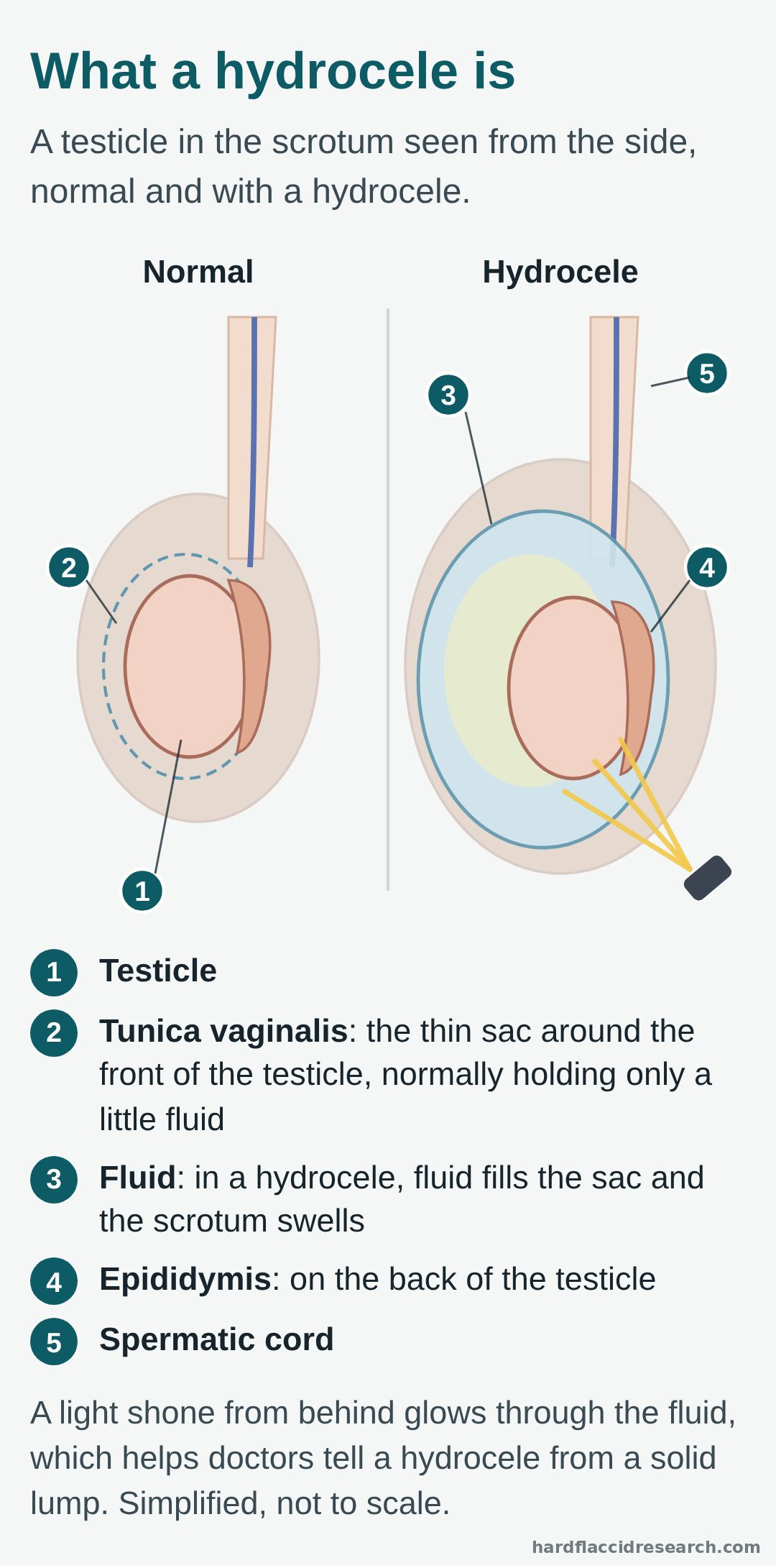
Before birth, each testicle moves down from the belly into the scrotum, taking a pouch of the belly lining with it. Most of that pouch closes off. The part that stays around the testicle becomes the tunica vaginalis, a thin sac with two layers and a tiny amount of fluid between them, which lets the testicle move smoothly.
A hydrocele forms when more fluid collects between those two layers than the body can absorb. The fluid is usually clear and pale yellow.
Related: Cremaster Muscle and Reflex: Why Testicles Pull Up »
What are the types of hydrocele?
Communicating hydrocele
The channel between the belly and the scrotum stays open, so fluid can move back and forth. The swelling often gets bigger during the day or when standing, and smaller when lying down. It's most common in babies and often comes with an inguinal hernia.
Non-communicating hydrocele
The channel is closed, and fluid builds up in the sac around the testicle. This is the usual type in adults. Its size stays about the same.
Hydrocele of the cord
Fluid collects in a pocket along the spermatic cord, above the testicle, making a smooth lump in the groin or upper scrotum.
What causes a hydrocele in adults?
- No clear cause, which is the most common situation. The lining simply makes a little more fluid than it absorbs.
- Injury to the scrotum.
- Infection or inflammation, such as epididymitis.
- After surgery in the groin or scrotum, such as hernia repair or varicocele surgery.
- Rarely, a testicle tumor, which is why an ultrasound is important.
- In some tropical regions, a parasitic infection that blocks the lymph vessels can cause very large hydroceles.
Related: Epididymis: Where It Is, What It Does and Why It Hurts »
What does a hydrocele feel like?
- A smooth, soft or tense swelling on one side of the scrotum, usually in front of the testicle.
- The testicle may be hard to feel through the fluid.
- It's usually painless.
- A large hydrocele can feel heavy, drag on the groin, or make walking or sex uncomfortable.
- Pain, redness or a fever suggest an infection or another cause, and need checking.
How is a hydrocele diagnosed?
A primary care provider or a urologist (a doctor for urinary and sexual health) will examine the scrotum while you stand and lie down. They may:
- Shine a light through the scrotum. A hydrocele usually glows, because light passes through clear fluid but not through a solid lump.
- Feel the groin and ask you to cough, to check for a hernia.
- Arrange an ultrasound scan of the scrotum, which confirms the fluid and checks the testicle underneath, especially if the testicle can't be felt clearly.
- Suggest urine or blood tests, if an infection is possible.
Our doctor visit kit helps you note when the swelling started and whether its size changes.
How is a hydrocele treated?
Watching and waiting
Small, painless hydroceles that aren't growing can simply be watched. Many cause no trouble for years.
Surgery
A hydrocelectomy is a small operation, usually done as day surgery, in which a surgeon removes or folds the sac so fluid can no longer collect. It's offered when the hydrocele is large, uncomfortable, growing or affecting daily life. Swelling after the operation can take a few weeks to settle, and the hydrocele can occasionally come back.
Draining with a needle
Draining the fluid with a needle is sometimes used, but the fluid often returns. It's usually reserved for men who can't have surgery.
Treating the cause
If the hydrocele came from an infection or another problem, treating that comes first.
Hydrocele and hard flaccid syndrome
Hard flaccid syndrome is a firm, shrunken penis at rest, often with numbness, weaker erections and pelvic pain. A hydrocele isn't part of hard flaccid and doesn't cause it. But men with hard flaccid pay close attention to changes in the genitals, and it helps to know which changes are common and harmless and which need a check.
Of the 2,661 men who described their symptoms, 27% described shrinkage or retraction (720 men) and 4% described testicle pain or a tight scrotum (102 men).
Our members' guide, Hard Flaccid and Doctors: How to Get Taken Seriously, helps you raise several genital symptoms at one appointment.
How can I tell a hydrocele from a hernia?
They can look alike, and the two sometimes happen together:
- A hydrocele is usually confined to the scrotum, and you can often feel above it, where the cord is normal.
- A hernia usually starts in the groin and may reach down into the scrotum. You often can't feel a clear top to it.
- A hernia may get bigger when you cough or strain, and may go back in when you lie down.
- A hydrocele usually glows when a light is shone through it. A hernia usually doesn't.
Only a doctor's exam, often with an ultrasound, can tell for sure.
When should I see a doctor?
See a primary care provider or a urologist about any new swelling or lump in the scrotum, a hydrocele that's growing, or one that's uncomfortable or heavy.
Get urgent care straight away (call 911 or go to the emergency room) if you have:
- Sudden, severe pain or swelling in a testicle, especially with nausea or vomiting. This can be testicular torsion.
- A painful bulge in the groin or scrotum that won't go back in, especially with vomiting.
- A fever or chills with a painful, red, swollen scrotum.
- Severe pain or swelling after an injury to the scrotum.
- Sudden, severe pain in the penis, testicles or pelvis.
Frequently asked questions
Is a hydrocele dangerous?
Usually not. Most are harmless. A doctor should check any new swelling to rule out a hernia, an infection or a tumor.
Will a hydrocele go away on its own?
In babies, many do. In adults, they usually stay, but small ones often cause no problems.
Does a hydrocele affect fertility?
Usually not. A doctor can advise, especially if the hydrocele is very large or has an underlying cause.
Can a hydrocele affect sex?
A small one doesn't. A large one can feel heavy or get in the way, which is one reason to have it treated.
What's the difference between a hydrocele and a varicocele?
A hydrocele is fluid around the testicle. A varicocele is swollen veins in the cord above it, which can feel like a bag of worms.
Can a hydrocele come back after surgery?
It can, but it's uncommon after a standard operation. Draining with a needle more often leads to the fluid coming back.
Is a hydrocele the same as a spermatocele?
No. A spermatocele is a cyst on the epididymis, above and behind the testicle. A hydrocele surrounds the front of the testicle.
Can a hydrocele be on both sides?
Yes, though it's more often on one side. Each side is checked and treated separately.
Can exercise make a hydrocele worse?
Exercise doesn't usually harm a hydrocele, but a large one can feel heavy or drag. Supportive underwear helps.
Takeaway
A hydrocele is fluid in the thin sac around a testicle. In adults it's usually painless and harmless, and small ones can simply be watched.
Any new swelling in the scrotum should be checked, and large or uncomfortable hydroceles can be removed with a small operation. Take our free self-check if you also notice changes in your penis at rest.
This article is for general information and isn't a substitute for advice from your own doctor. Hard Flaccid Research doesn't diagnose or treat. If you have new or worsening symptoms, see a qualified clinician. In an emergency, call 911.
Free tools that can help
- Self-check: do I have hard flaccid?Compare your symptoms with what 6,026 men report.
- Doctor visit kitA one-page summary to take to your appointment.
- Habit trackerCount your days without porn or masturbation, and get through urges.
- Diaphragm breathing toolBreathe with a moving picture of your diaphragm and pelvic floor.
- Add your experienceTell us what you tried and how it went. No name needed.
- Hard Flaccid Syndrome CensusWhat men answered in 818 polls.
- Symptom trackerLog your symptoms and see what helps you.
- Ask us a questionThe questions men ask most become new articles.
The numbers behind this article
Every number in this article comes from what men with hard flaccid syndrome shared between December 2020 and October 2026, counted once per person, or from their polls. These are self-selected reports, not a clinical study. See hard flaccid syndrome statistics, the Hard Flaccid Syndrome Census and how we count.
4% of men who described their symptoms described testicle pain or a tight scrotum
Share of the 2,661 men who described their symptoms. Each man is counted once.These are self-selected reports, not a clinical study.
Source: Hard Flaccid Research, hardflaccidresearch.com
Every number in this article, with its source
| In this article | Source |
|---|---|
| 4% of the men who described their symptoms described testicle pain or a tight scrotum (102 of 2,661) | 102 of 2,661 men, counted |
| 6,026 men shared their experiences, and 2,661 of them described their symptoms | 2,661 of 6,026 men, counted |
| 27% of the men who described their symptoms described shrinkage or retraction (720 of 2,661) | 720 of 2,661 men, counted |
Medical sources
What this article says about medical research, guidelines and urgent care comes from these sources.
- Hydrocele. In: StatPearls. Treasure Island (FL): StatPearls Publishing. https://www.ncbi.nlm.nih.gov/books/NBK559125/
- Anatomy, Abdomen and Pelvis: Testes. In: StatPearls. Treasure Island (FL): StatPearls Publishing. https://www.ncbi.nlm.nih.gov/books/NBK470201/
- Anatomy, Abdomen and Pelvis, Scrotum. In: StatPearls. Treasure Island (FL): StatPearls Publishing. https://www.ncbi.nlm.nih.gov/books/NBK549893/
- Adult Inguinal Hernia. In: StatPearls. Treasure Island (FL): StatPearls Publishing. https://www.ncbi.nlm.nih.gov/books/NBK537241/
- Testicular Torsion. In: StatPearls. Treasure Island (FL): StatPearls Publishing. https://www.ncbi.nlm.nih.gov/books/NBK448199/
- Leslie SW, Sajjad H, Siref LE. Varicocele. In: StatPearls. Treasure Island (FL): StatPearls Publishing. https://www.ncbi.nlm.nih.gov/books/NBK448113/
How we made this article
We started from the question many men asked. Every number was checked against our data. Our editorial team edited it and Dr. Julian Reyes reviewed it medically. Read our editorial policy.
Read next
See more of us on Google
Add Hard Flaccid Research as a preferred source, and Google shows you our pages more often when you search.
Add as a preferred sourceDon't see your question? Ask us. We answer the most-asked ones in new articles.
Cite and share this article
You're welcome to quote this article. Please name Hard Flaccid Research and link to this page, so others can find the full answer and the data behind it. To cite this page, use its link.
Citation
Hard Flaccid Research. (2026). Hydrocele in Men: Causes, Symptoms and Treatment. Written by the Editorial Team, medically reviewed by Dr. Julian Reyes. https://hardflaccidresearch.com/articles/hydrocele
Credit link for your article
Source: <a href="https://hardflaccidresearch.com/articles/hydrocele">Hard Flaccid Research</a>
Wikipedia reference
<ref>{{cite web |url=https://hardflaccidresearch.com/articles/hydrocele |title=Hydrocele in Men: Causes, Symptoms and Treatment |website=Hard Flaccid Research |date=2026 |access-date=22 November 2026}}</ref>
How the data was collected: our methodology. Journalists and researchers: key numbers, data and contact.