Spermatocele: Lump Above the Testicle, Causes and Treatment
In short
- A spermatocele is a smooth, fluid-filled cyst that grows on the epididymis, the coiled tube above and behind the testicle.
- It's harmless, isn't cancer and usually doesn't need treatment.
- Any new lump in the scrotum should still be checked by a doctor, because a lump in the testicle itself needs prompt tests.
A spermatocele (SPUR-muh-toe-seel) is a smooth, fluid-filled cyst that grows on the epididymis, the coiled tube that sits above and behind each testicle. It usually feels like a small, round lump that's separate from the testicle itself.
Spermatoceles are common and harmless. They aren't cancer, don't turn into cancer and usually don't affect fertility. Most need no treatment at all. Still, any new lump in the scrotum is worth showing a doctor, because a lump in the testicle itself needs prompt tests. This page explains how to tell the difference and what to expect.
By the numbers: of the 6,026 men who shared their experiences with hard flaccid syndrome, 2,661 described their symptoms, and 102 of them described testicle pain or a tight scrotum.

Key facts
- A spermatocele is a cyst on the epididymis, filled with clear or milky fluid that may contain sperm.
- It feels like a smooth, pea-sized or larger lump above or behind the testicle, separate from the testicle.
- It's benign. It isn't cancer and doesn't raise the risk of cancer.
- Most spermatoceles cause no symptoms and need no treatment. A large one can cause a heavy or aching feeling.
- A doctor can usually confirm it with an examination and a quick ultrasound scan.
- Surgery is only needed if a spermatocele is large, painful or bothersome.
What is a spermatocele?
Sperm are made in the testicles and then move into the epididymis, a long, tightly coiled tube on the back of each testicle, where they mature and are stored. From there, they travel up the vas deferens towards the prostate.
A spermatocele forms when part of the epididymis swells into a small sac filled with fluid. Doctors also call it a spermatic cyst or an epididymal cyst. Strictly speaking, an epididymal cyst holds clear fluid without sperm, while a spermatocele holds fluid with sperm, but they look and feel the same and are managed the same way.
Related: Epididymis: Where It Is, What It Does and Why It Hurts »
What does a spermatocele feel like?
- A smooth, round lump, usually at the top of the testicle or just behind it.
- Separate from the testicle: you can usually feel a groove between the two.
- Firm but not hard, and often slightly movable.
- Usually painless. Large ones can cause a dull ache, heaviness or a feeling of fullness.
- Often the same size for years. Some grow slowly.
Many men find a spermatocele by chance in the shower or during a self-check. A large one can look like there's a third testicle in the scrotum.
Spermatocele or something else?
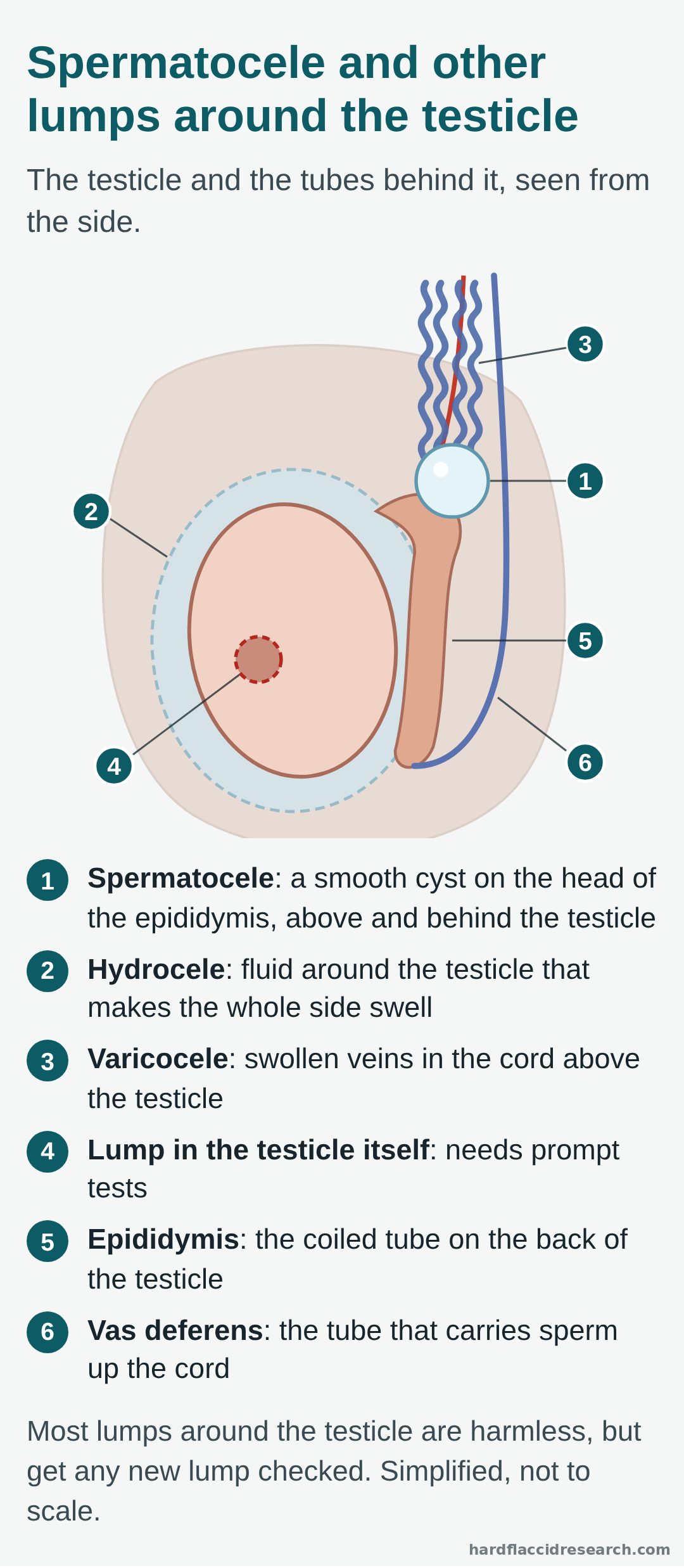
Several lumps can form in the scrotum. The drawing shows where each one usually sits:
- Hydrocele: fluid that collects around the testicle, making the whole side of the scrotum swell. It's usually painless.
- Varicocele: swollen veins in the cord above the testicle, often on the left. It can feel like a "bag of worms" and may ache after standing for a long time.
- Epididymitis: an inflamed, tender epididymis, usually from an infection, with pain and swelling that build over a day or two.
- A lump in the testicle itself: a hard lump or change in the testicle needs prompt tests, because testicular cancer usually starts this way. It's most common in young men and very treatable when found early.
A doctor can tell these apart with an examination and an ultrasound. Shining a light through the scrotum can also help, because fluid-filled lumps let light through and solid lumps don't.
What causes a spermatocele?
The exact cause usually isn't known. Doctors think a spermatocele forms when one of the tiny tubes in the epididymis becomes blocked, so fluid builds up behind the blockage. Possible triggers include:
- An earlier infection or inflammation of the epididymis.
- An injury to the scrotum.
- Previous surgery in the scrotum, such as a vasectomy.
Most often, there's no clear reason. A spermatocele isn't caused by sex, masturbation or anything you did, and it isn't a sexually transmitted infection.
Related: Gabapentin for Hard Flaccid: Worth the Side Effects? »
How is a spermatocele diagnosed?
A primary care provider or a urologist (a doctor for urinary and sexual health) will ask when you noticed the lump, whether it has changed and whether it hurts. They'll gently examine both testicles while you stand and while you lie down.
Tests may include:
- Ultrasound scan: a painless scan with gel on the scrotum. It shows whether a lump is filled with fluid or solid, and whether it's in the epididymis or the testicle. This is the key test.
- Shining a light through the scrotum: a quick bedside check. A spermatocele lets light through.
- Urine tests: if an infection is possible.
Our doctor visit kit helps you note when you found the lump and what you've noticed, so you don't forget anything in the room.
How is a spermatocele treated?
Most spermatoceles need no treatment. If yours is small and doesn't bother you, your doctor will usually suggest keeping an eye on it with regular self-checks.
Easing discomfort
- Supportive underwear or an athletic supporter.
- A cool pack wrapped in a cloth after activity.
- Pain relievers from a pharmacy for occasional aching. Ask a pharmacist which suit you.
Surgery
If a spermatocele is large, painful or getting in the way, a urologist may suggest removing it. The operation is called a spermatocelectomy. It's done through a small cut in the scrotum, usually as a day procedure. Ask about the risks, which include swelling, infection, the cyst coming back and, rarely, damage to the epididymis that can affect fertility on that side. If you might want children, mention it before surgery.
Draining a spermatocele with a needle is rarely used, because the fluid often comes back.
Spermatoceles and hard flaccid syndrome
Hard flaccid syndrome is a firm, shrunken penis at rest, often with numbness, weaker erections and pelvic pain. A spermatocele isn't part of hard flaccid and doesn't cause it.
Of the 2,661 men who described their symptoms, 4% described testicle pain or a tight scrotum (102 men) and 10% described pelvic, perineal or tailbone pain (267 men). A tight pelvic floor can pull the scrotum up and cause aching that feels like it comes from the testicles. If you have aching but no lump, that's worth mentioning to your doctor too.
Feeling brushed off can make it harder to go back to a doctor. Our members' guide, Hard Flaccid and Doctors: How to Get Taken Seriously, covers how to describe your symptoms so they're heard.
How to check your testicles
A quick monthly self-check helps you learn what's normal for you, so you notice changes early:
- Check after a warm shower, when the scrotum is relaxed.
- Hold each testicle between your thumb and fingers and roll it gently. It should feel smooth and firm, like a peeled hard-boiled egg.
- Find the epididymis at the back: a soft, rope-like ridge. This is normal, and it's where a spermatocele forms.
- Note any lump, hard spot, swelling or change in size, and see a doctor about anything new.
When should I see a doctor?
See a primary care provider or a urologist about any new lump, swelling or change in the scrotum, even if it doesn't hurt. Most lumps are harmless, but only an examination and an ultrasound can say for sure.
Get urgent care straight away (call 911 or go to the emergency room) if you have:
- Sudden, severe pain or swelling in a testicle, especially with nausea or vomiting. This can be testicular torsion, where the testicle twists and loses its blood supply. Surgery within hours can save the testicle.
- Sudden, severe pain in the penis, testicles or pelvis.
- A fever or chills with a painful, swollen scrotum.
- A hard, swollen scrotum after an injury.
Frequently asked questions
Can a spermatocele turn into cancer?
No. A spermatocele is a benign cyst and doesn't become cancer. A lump in the testicle itself is different and needs prompt tests.
Will a spermatocele go away on its own?
Some shrink as the body reabsorbs the fluid, but many stay the same size for years. That's fine if it doesn't bother you.
Does a spermatocele affect fertility?
Usually not. Surgery to remove one can, rarely, affect the epididymis on that side, so talk to your urologist if you want children.
Can ejaculation make a spermatocele bigger?
There's no good evidence that ejaculation makes a spermatocele grow.
Is a spermatocele the same as a hydrocele?
No. A spermatocele is a cyst on the epididymis. A hydrocele is fluid around the testicle itself. Both are usually harmless and both show up clearly on ultrasound.
Takeaway
A spermatocele is a smooth, harmless cyst above or behind the testicle. It isn't cancer, usually causes no symptoms, and most men never need treatment.
Still, get any new lump checked so a doctor can confirm what it is, and get urgent care for sudden, severe testicle pain. Take our free self-check if you also notice changes in your penis at rest.
This article is for general information and isn't a substitute for advice from your own doctor. Hard Flaccid Research doesn't diagnose or treat. If you have new or worsening symptoms, see a qualified clinician. In an emergency, call 911.
Free tools that can help
- Self-check: do I have hard flaccid?Compare your symptoms with what 6,026 men report.
- Doctor visit kitA one-page summary to take to your appointment.
- Habit trackerCount your days without porn or masturbation, and get through urges.
- Diaphragm breathing toolBreathe with a moving picture of your diaphragm and pelvic floor.
- Add your experienceTell us what you tried and how it went. No name needed.
- Hard Flaccid Syndrome CensusWhat men answered in 818 polls.
- Symptom trackerLog your symptoms and see what helps you.
- Ask us a questionThe questions men ask most become new articles.
The numbers behind this article
Every number in this article comes from what men with hard flaccid syndrome shared between December 2020 and October 2026, counted once per person, or from their polls. These are self-selected reports, not a clinical study. See hard flaccid syndrome statistics, the Hard Flaccid Syndrome Census and how we count.
4% of men who described their symptoms described testicle pain or a tight scrotum
Share of the 2,661 men who described their symptoms. Each man is counted once.These are self-selected reports, not a clinical study.
Source: Hard Flaccid Research, hardflaccidresearch.com
Every number in this article, with its source
| In this article | Source |
|---|---|
| 4% of the men who described their symptoms described testicle pain or a tight scrotum (102 of 2,661) | 102 of 2,661 men, counted |
| 10% of the men who described their symptoms described pelvic, perineal or tailbone pain (267 of 2,661) | 267 of 2,661 men, counted |
| 6,026 men shared their experiences, and 2,661 of them described their symptoms | 2,661 of 6,026 men, counted |
Medical sources
What this article says about medical research, guidelines and urgent care comes from these sources.
- Crawford P, Crop JA. Evaluation of scrotal masses. Am Fam Physician. 2014;89(9):723-727. https://www.aafp.org/pubs/afp/issues/2014/0501/p723.html
- Langan RC, Puente ME. Scrotal masses. Am Fam Physician. 2022;106(2):184-189. https://www.aafp.org/afp/2022/0800/scrotal-masses
- Mayo Clinic. Spermatocele: symptoms and causes. https://www.mayoclinic.org/diseases-conditions/spermatocele/symptoms-causes/syc-20377829
- Cleveland Clinic. Spermatocele. https://my.clevelandclinic.org/health/diseases/17492-spermatocele
- Anatomy, Abdomen and Pelvis: Testes. In: StatPearls. Treasure Island (FL): StatPearls Publishing. https://www.ncbi.nlm.nih.gov/books/NBK470201/
- Testicular Torsion. In: StatPearls. Treasure Island (FL): StatPearls Publishing. https://www.ncbi.nlm.nih.gov/books/NBK448199/
How we made this article
We started from the question many men asked. Every number was checked against our data. Our editorial team edited it and Dr. Julian Reyes reviewed it medically. Read our editorial policy.
Read next
See more of us on Google
Add Hard Flaccid Research as a preferred source, and Google shows you our pages more often when you search.
Add as a preferred sourceDon't see your question? Ask us. We answer the most-asked ones in new articles.
Cite and share this article
You're welcome to quote this article. Please name Hard Flaccid Research and link to this page, so others can find the full answer and the data behind it. To cite this page, use its link.
Citation
Hard Flaccid Research. (2026). Spermatocele: Lump Above the Testicle, Causes and Treatment. Written by the Editorial Team, medically reviewed by Dr. Julian Reyes. https://hardflaccidresearch.com/articles/spermatocele
Credit link for your article
Source: <a href="https://hardflaccidresearch.com/articles/spermatocele">Hard Flaccid Research</a>
Wikipedia reference
<ref>{{cite web |url=https://hardflaccidresearch.com/articles/spermatocele |title=Spermatocele: Lump Above the Testicle, Causes and Treatment |website=Hard Flaccid Research |date=2026 |access-date=22 November 2026}}</ref>
How the data was collected: our methodology. Journalists and researchers: key numbers, data and contact.