Tailbone Pain When Sitting: Causes and What Helps
In short
- Tailbone pain when sitting, called coccydynia, is pain at the very bottom of the spine that's worse when you sit, especially when leaning back, and when you stand up.
- It usually comes from a fall, long hours of sitting or strain on the small joints and muscles around the tailbone.
- Most cases settle within weeks to months with a cushion, changes to how you sit, and physical therapy.
Tailbone pain when sitting is an ache or sharp pain at the very bottom of the spine, just above the crease between the buttocks. It's usually worse when you sit, especially leaning back on a hard seat, and it often flares as you stand up. Doctors call it coccydynia (kok-sih-DIN-ee-uh).
It's common, and it usually gets better. Most cases settle within weeks to months with simple steps: a cushion, changes to how you sit, and sometimes physical therapy. This page explains why the tailbone hurts, how to sit to take the pressure off, what treatments help and when to see a doctor.
By the numbers: of the 6,026 men who shared their experiences with hard flaccid syndrome, 2,661 described their symptoms, and 267 of them described pelvic, perineal or tailbone pain.
Key facts
- The tailbone, or coccyx, is a small chain of bones at the bottom of the spine. It takes some of your weight when you sit and lean back.
- Pain is usually worse when sitting, leaning back, going from sitting to standing, and sometimes with bowel movements or sex.
- Common causes are a fall onto your bottom, long hours of sitting on hard seats, cycling, and strain from childbirth in women.
- The pelvic floor muscles attach to the tailbone, so tight pelvic floor muscles can cause or add to the pain.
- Most cases get better without surgery. Cushions, posture changes, warmth, physical therapy and sometimes injections help.
What does tailbone pain feel like?
- An ache or sharp pain right at the bottom of the spine, often in a spot you could point to with one finger.
- Worse when you sit, especially slumped or leaning back.
- A jab of pain as you stand up from sitting.
- Easier when standing, walking or lying on your side.
- Sometimes pain with bowel movements or sex.
- Sometimes tenderness when you press the tailbone.
Related: Coccygeus Muscle: Where It Is, What It Does and Pain »
What causes tailbone pain?
A fall or injury
Landing hard on your bottom, for example on ice or stairs, can bruise, sprain or, less often, break the tailbone. Pain usually starts straight away.
Sitting for long hours
Sitting a lot, especially on hard seats or slumped back, puts repeated pressure on the tailbone. Driving, office work and long gaming sessions are common triggers.
A tailbone that moves too much or too little
The small joints of the tailbone normally move slightly when you sit. If one moves too much or gets stuck, it can become painful. X-rays taken sitting and standing can show this.
Tight pelvic floor muscles
The levator ani and coccygeus muscles of the pelvic floor attach to the tailbone. When they're tight or in spasm, they can pull on it and cause pain there, often along with pain in the perineum or the back passage.
Other causes
Cycling, rowing, constipation and straining, a sudden weight change, and in women childbirth can all play a part. Rarely, a pilonidal cyst, an infection or a growth causes the pain. Sometimes no cause is found.
How to sit with tailbone pain
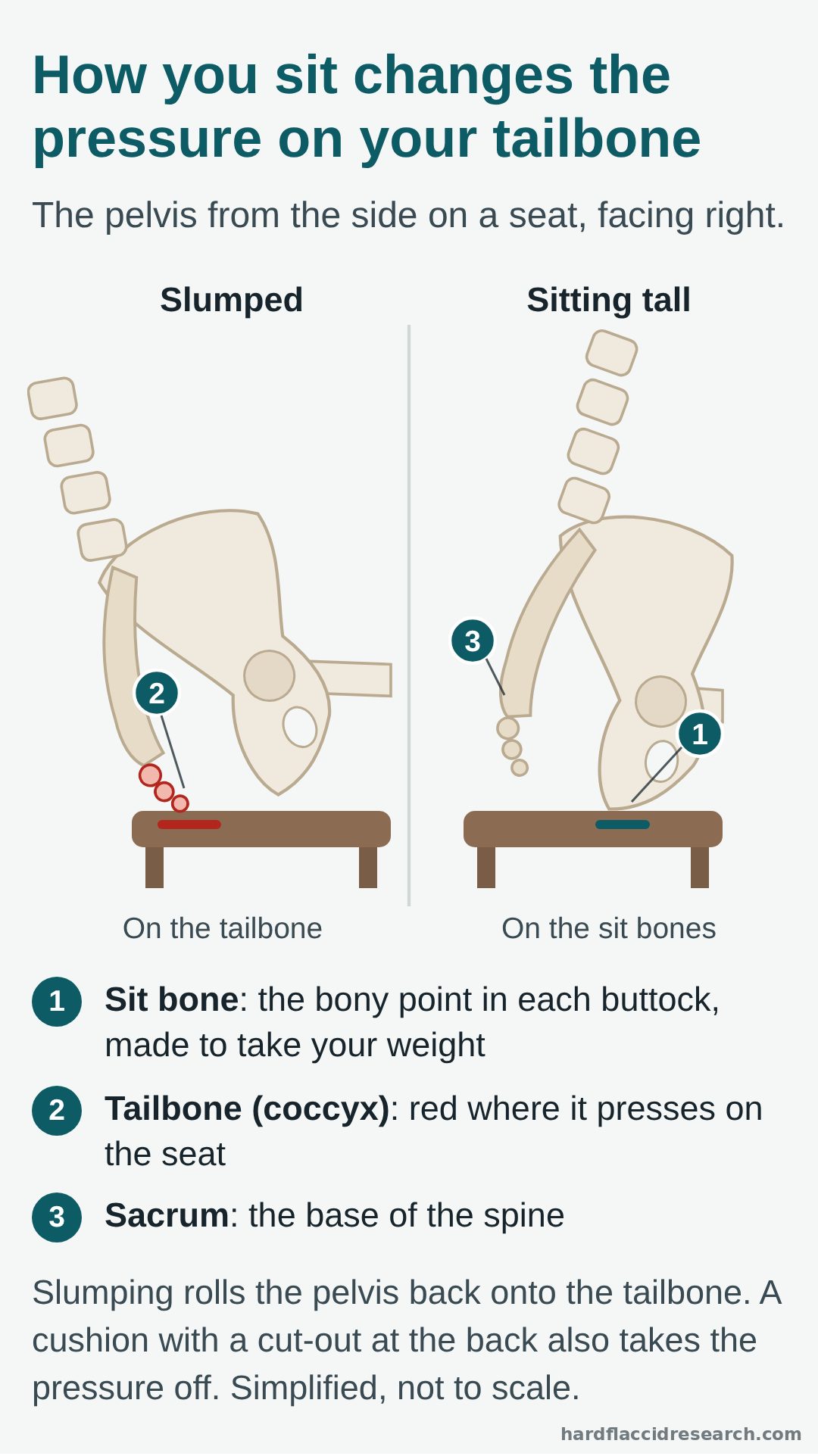
How you sit makes a big difference. When you slump, your pelvis rolls back and you sit on your tailbone. When you sit tall or lean slightly forward, your weight moves onto the two sit bones, the bony points in each buttock, and the tailbone lifts clear.
- Sit tall, or lean slightly forward, with your feet flat on the floor.
- Use a wedge cushion with a cut-out at the back, or a U-shaped cushion, so nothing presses on the tailbone. A ring-shaped cushion helps some people, but others find it presses on the wrong spot.
- Shift your weight onto one buttock, then the other, when you've been sitting a while.
- Stand up and move every half hour or so.
- When standing up, lean forward first and push up with your legs.
- Choose a softer seat, and avoid sitting on hard benches for long.
Related: Perineum Pain With Hard Flaccid: Why It Hurts, What Helps »
How is tailbone pain treated?
Most people get better with a mix of simple steps. Reviews of the treatments note that most studies are small, but cushions, physical therapy and injections all help many people.
Self-care
- A cushion and better sitting habits, as above.
- Warmth: a warm bath or a warm, not hot, pack on the area.
- Pain relievers from a pharmacy for a short time. Ask a pharmacist which suit you.
- Treating constipation, so you don't strain.
- Gentle stretches for the hips, buttocks and lower back. In separate counts, 1,288 men discussed stretching, more than any other approach.
Gentle stretches to try
Move slowly and stop if a stretch makes the tailbone pain sharper:
- Knees to chest: lie on your back and gently hug both knees towards your chest, breathing slowly into your belly.
- Child's pose: kneel, sit back towards your heels and reach your arms forward along the floor.
- Figure-four stretch: lie on your back, cross one ankle over the other knee and gently pull the lower leg towards you, feeling the stretch deep in the buttock.
- Belly breathing: as you breathe in, let your pelvic floor and the muscles around your back passage soften and drop.
Physical therapy
A physical therapist can work on the muscles around the tailbone and teach you to relax them. A pelvic floor physical therapist can also release tight pelvic floor muscles, sometimes from the inside, with your consent. Some clinicians use gentle manual techniques to move the tailbone. Our members' guide, Pelvic Floor PT for Hard Flaccid: How to Find the Right One, explains what to look for in a therapist and what a first visit involves.
Injections
If pain lasts despite these steps, a doctor may suggest a steroid injection near the tailbone, or a nerve block of a small nerve bundle in front of it (the ganglion impar). These help many people, sometimes for months.
Surgery
Removing the tailbone (coccygectomy) is a last resort for long-lasting, severe pain that hasn't responded to anything else. Ask about the risks, including infection and a long recovery.
Tailbone pain and hard flaccid syndrome
Hard flaccid syndrome is a firm, shrunken penis at rest, often with numbness, weaker erections and pelvic pain. Doctors think a tense pelvic floor may help keep it going, and the same muscles attach to the tailbone.
Of the 2,661 men who described their symptoms, 23% described pelvic floor tightness, spasm or twitching (601 men), and 10% described pelvic, perineal or tailbone pain (267 men). In separate counts, 45 men asked whether sitting makes it worse, and 24 men blamed long hours of sitting for their symptoms.
If sitting sets off both tailbone pain and hard flaccid symptoms, the steps above, especially a cut-out cushion, regular breaks and pelvic floor relaxation, may help both.
When should I see a doctor?
See a primary care provider or a physical therapist if tailbone pain lasts more than a few weeks, keeps you from sitting, or followed a fall. Our doctor visit kit helps you describe when it hurts and what makes it better or worse.
Get urgent care straight away (call 911 or go to the emergency room) if you have:
- New numbness around your back passage, genitals or inner thighs, or new weakness in your legs.
- New trouble starting or controlling your pee, not being able to pee, or not feeling when your bladder is full.
- Loss of control of your bladder or bowel.
- A fever or chills with back or pelvic pain.
- Severe pain after a serious fall or accident.
Also see a doctor soon if you have a red, swollen, painful lump near the tailbone, which can be an infected cyst, or if you're losing weight without trying.
Frequently asked questions
How long does tailbone pain last?
Most cases improve within a few weeks to a few months. Pain that lasts longer is worth a doctor's check and a referral to a physical therapist.
Is my tailbone broken?
It's possible after a hard fall, but most tailbone pain is a bruise or strain. Treatment is usually the same either way, so an X-ray isn't always needed.
Can sitting too much cause tailbone pain?
Yes. Long hours of sitting, especially slumped or on hard seats, is a common cause.
Should I use a donut cushion?
Some people find a ring cushion helps, but a wedge cushion with a cut-out at the back often takes the pressure off the tailbone better. Try what feels best for you.
Can tailbone pain cause pain elsewhere?
It can come with pain in the buttocks, the perineum or the back passage, especially when the pelvic floor muscles are tight.
Takeaway
Tailbone pain when sitting, or coccydynia, usually comes from a fall, long hours of sitting or tight pelvic floor muscles. It's worse when you slump or lean back, and easier when you sit tall on your sit bones.
A cut-out cushion, regular breaks, warmth, stretches and physical therapy help most people, and injections are an option if pain lasts. Take our free self-check if you also notice changes in your penis at rest.
This article is for general information and isn't a substitute for advice from your own doctor. Hard Flaccid Research doesn't diagnose or treat. If you have new or worsening symptoms, see a qualified clinician. In an emergency, call 911.
Free tools that can help
- Self-check: do I have hard flaccid?Compare your symptoms with what 6,026 men report.
- Doctor visit kitA one-page summary to take to your appointment.
- Habit trackerCount your days without porn or masturbation, and get through urges.
- Diaphragm breathing toolBreathe with a moving picture of your diaphragm and pelvic floor.
- Add your experienceTell us what you tried and how it went. No name needed.
- Hard Flaccid Syndrome CensusWhat men answered in 818 polls.
- Symptom trackerLog your symptoms and see what helps you.
- Ask us a questionThe questions men ask most become new articles.
The numbers behind this article
Every number in this article comes from what men with hard flaccid syndrome shared between December 2020 and October 2026, counted once per person, or from their polls. These are self-selected reports, not a clinical study. See hard flaccid syndrome statistics, the Hard Flaccid Syndrome Census and how we count.
10% of men who described their symptoms described pelvic, perineal or tailbone pain
Share of the 2,661 men who described their symptoms. Each man is counted once.These are self-selected reports, not a clinical study.
Source: Hard Flaccid Research, hardflaccidresearch.com
45 men asked whether sitting makes it worse
Men counted once each from what men wrote.Source: Hard Flaccid Research, hardflaccidresearch.com
Every number in this article, with its source
| In this article | Source |
|---|---|
| 10% of the men who described their symptoms described pelvic, perineal or tailbone pain (267 of 2,661) | 267 of 2,661 men, counted |
| 23% of the men who described their symptoms described pelvic floor tightness, spasm or twitching (601 of 2,661) | 601 of 2,661 men, counted |
| 6,026 men shared their experiences, and 2,661 of them described their symptoms | 2,661 of 6,026 men, counted |
| 24 men blamed long hours of sitting for their symptoms | 24 men who blamed long hours of sitting, counted from what men wrote |
| 45 men asked whether sitting makes it worse | 45 men asked whether sitting makes it worse, counted from what men wrote, once per person |
| 1,288 men discussed stretching | 1,288 men discussing stretching, counted from what men wrote |
Medical sources
What this article says about medical research, guidelines and urgent care comes from these sources.
- Lirette LS, Chaiban G, Tolba R, Eissa H. Coccydynia: an overview of the anatomy, etiology, and treatment of coccyx pain. Ochsner J. 2014;14(1):84-87. https://pmc.ncbi.nlm.nih.gov/articles/PMC3963058/
- Coccyx Pain. In: StatPearls. Treasure Island (FL): StatPearls Publishing. https://pubmed.ncbi.nlm.nih.gov/33085286/
- Nathan ST, Fisher BE, Roberts CS. Coccydynia: a review of pathoanatomy, aetiology, treatment and outcome. J Bone Joint Surg Br. 2010;92(12):1622-1627. https://doi.org/10.1302/0301-620X.92B12.25486
- Garg B, Ahuja K. Coccydynia: a comprehensive review on etiology, radiological features and management options. J Clin Orthop Trauma. 2021;12(1):123-129. https://doi.org/10.1016/j.jcot.2020.09.025
- Andersen GØ, Milosevic S, Jensen MM, et al. Coccydynia: the efficacy of available treatment options: a systematic review. Global Spine J. 2022;12(7):1611-1623. https://doi.org/10.1177/21925682211065389
- Howard PD, Dolan AN, Falco AN, et al. A comparison of conservative interventions and their effectiveness for coccydynia: a systematic review. J Man Manip Ther. 2013;21(4):213-219. https://doi.org/10.1179/2042618613Y.0000000040
How we made this article
We started from the question many men asked. Every number was checked against our data. Our editorial team edited it and Dr. Julian Reyes reviewed it medically. Read our editorial policy.
Read next
See more of us on Google
Add Hard Flaccid Research as a preferred source, and Google shows you our pages more often when you search.
Add as a preferred sourceDon't see your question? Ask us. We answer the most-asked ones in new articles.
Cite and share this article
You're welcome to quote this article. Please name Hard Flaccid Research and link to this page, so others can find the full answer and the data behind it. To cite this page, use its link.
Citation
Hard Flaccid Research. (2026). Tailbone Pain When Sitting: Causes and What Helps. Written by the Editorial Team, medically reviewed by Dr. Julian Reyes. https://hardflaccidresearch.com/articles/tailbone-pain-when-sitting
Credit link for your article
Source: <a href="https://hardflaccidresearch.com/articles/tailbone-pain-when-sitting">Hard Flaccid Research</a>
Wikipedia reference
<ref>{{cite web |url=https://hardflaccidresearch.com/articles/tailbone-pain-when-sitting |title=Tailbone Pain When Sitting: Causes and What Helps |website=Hard Flaccid Research |date=2026 |access-date=22 November 2026}}</ref>
How the data was collected: our methodology. Journalists and researchers: key numbers, data and contact.