Levator Ani: Anatomy, Pain and Levator Ani Syndrome
In short
- The levator ani is the main muscle of the pelvic floor, a sling that runs from the pubic bone to the tailbone and holds up the bladder, prostate and bowel.
- It helps control peeing, bowel movements and erections.
- When it stays tight or goes into spasm, it can cause a deep ache in the back passage, called levator ani syndrome, which usually improves with relaxation, warmth and pelvic floor physical therapy.
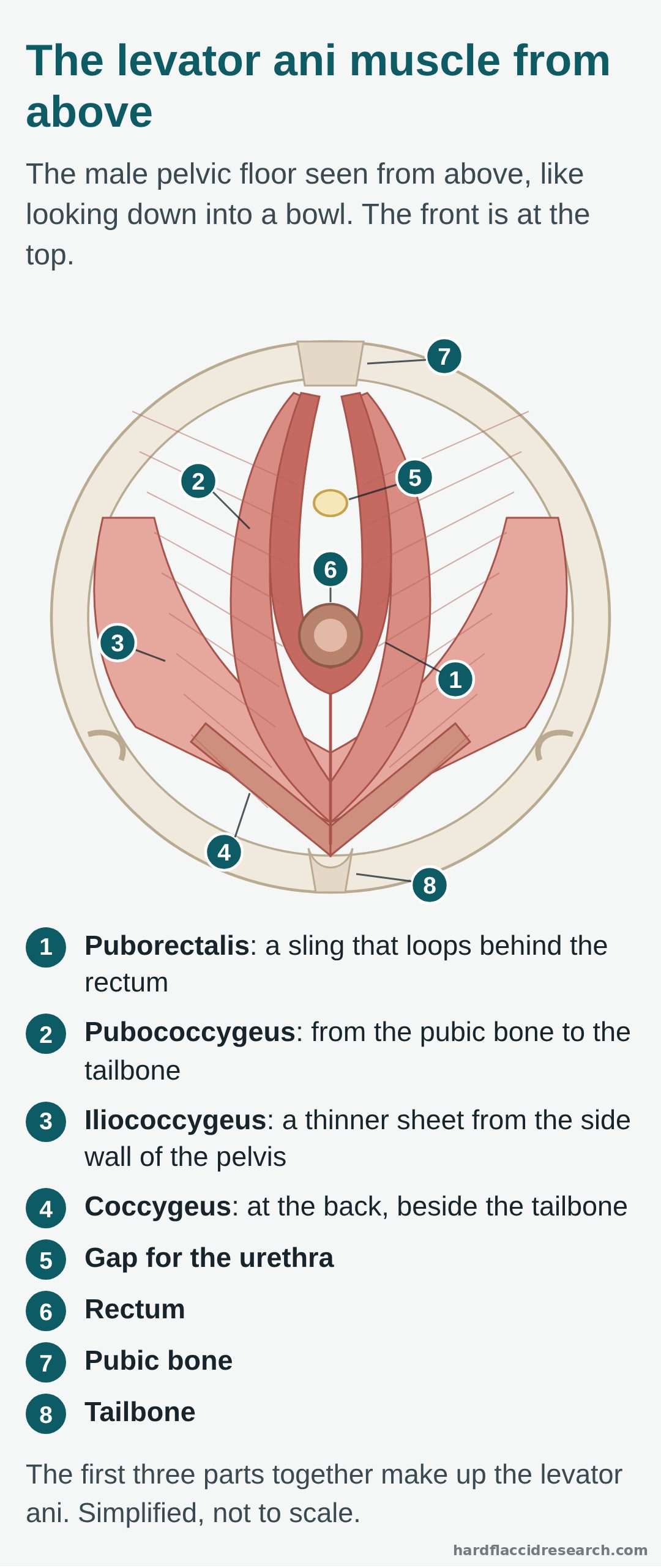
The levator ani (leh-VAY-tor AY-nye) is the main muscle of the pelvic floor. It's a broad, thin sling that stretches across the bottom of the pelvis, from the pubic bone at the front to the tailbone at the back, like the bottom of a bowl.
It holds up the bladder, the prostate and the bowel, and it helps control peeing, bowel movements and erections. When it stays tight or goes into spasm, it can cause a deep ache in the back passage or perineum. Doctors call this levator ani syndrome. This page explains the muscle's parts, what it does, what happens when it's too tight and what helps.
By the numbers: of the 6,026 men who shared their experiences with hard flaccid syndrome, 2,661 described their symptoms, and 601 of them described pelvic floor tightness, spasm or twitching.
Key facts
- The levator ani is the largest part of the pelvic floor. It has three parts: the puborectalis, the pubococcygeus and the iliococcygeus.
- It supports the pelvic organs and helps control urine, stool, gas and erections.
- It's normally a little tense all the time, tightens when you cough or lift, and relaxes when you pee or have a bowel movement.
- A levator ani that stays too tight can cause pain in the back passage, perineum or tailbone, and problems peeing or emptying the bowel.
- Levator ani syndrome is a long-lasting ache from this muscle. It's treated with relaxation, warmth, pelvic floor physical therapy and sometimes biofeedback.
What is the levator ani muscle?
The pelvic floor is a layer of muscles that closes off the bottom of the pelvis. The levator ani makes up most of it, with the smaller coccygeus muscle at the back.
Its three parts
- Puborectalis: a U-shaped sling that runs from the pubic bone, loops around the back of the rectum and returns. At rest, it pulls the end of the bowel forward into a bend, which helps hold stool in.
- Pubococcygeus: runs from the pubic bone back to the tailbone. In men, part of it supports the prostate.
- Iliococcygeus: a thinner sheet that starts from a tough band on the inner wall of the pelvis, over the obturator internus muscle, and runs back to the tailbone.
What passes through it
The urethra and the rectum pass through a gap in the front of the levator ani. Below the muscle, the pudendal nerve runs forward in a tunnel on the side wall of the pelvis, supplying the skin and muscles between the legs.
Its nerves
The levator ani is supplied by nerves from the lower spine, mainly a direct nerve to the levator ani and branches of the pudendal nerve. That's why problems in the lower back, the pudendal nerve and this muscle can all cause similar symptoms.
Related: External Anal Sphincter: What It Does, Tightness and Pain »
What does the levator ani do?
- Holds up the bladder, prostate and bowel, especially when you cough, sneeze, lift or strain.
- Keeps urine, stool and gas in by keeping the urethra and the end of the bowel closed.
- Relaxes to let you pee and have a bowel movement. The puborectalis lets go so the bowel can straighten.
- Moves with your breathing. It drops slightly as you breathe in and lifts as you breathe out.
- Helps with erections and ejaculation, working with the smaller muscles at the base of the penis.
- Helps stabilize the trunk and hips when you move.
What happens when the levator ani is too tight?
Like any muscle, the levator ani can become overactive: tight, tender or slow to relax. Doctors sometimes call this a non-relaxing or hypertonic pelvic floor. It can follow stress and anxiety, long hours of sitting, straining on the toilet, holding in urine or stool, heavy lifting, sports such as cycling, an injury, or doing lots of Kegel exercises.
A tight levator ani can cause:
- A deep ache or pressure in the back passage, often worse when sitting.
- Pain in the perineum, the area between the scrotum and the anus, or at the tailbone.
- Trouble starting to pee, a weak stream or dribbling afterwards.
- Feeling that the bowel doesn't empty, or needing to strain.
- Pain during or after ejaculation.
- Erection changes in some men.
Related: Hard Flaccid Worse After a Bowel Movement? Here's Why »
What is levator ani syndrome?
Levator ani syndrome is a long-lasting or recurring ache in the back passage thought to come from a tight levator ani. It usually lasts at least half an hour at a time, often feels like a dull pressure high in the rectum, and is often worse when sitting. Doctors diagnose it when other causes, such as hemorrhoids, a fissure or an infection, have been ruled out, and when the muscle is tender during an examination.
It's different from proctalgia fugax, which causes brief, sudden attacks of sharp pain that last seconds to minutes and then go away completely. Both are thought to involve the pelvic floor muscles.
How is a tight levator ani treated?
Pelvic floor physical therapy
A pelvic floor physical therapist can check the muscle, release tender spots by hand from the outside or the inside, with your consent, and teach you to relax it. US urology guidelines say doctors may offer this to men with chronic pelvic pain who have tight, tender pelvic floor muscles, and a small trial found physical therapy aimed at these muscles helped more men than general massage. Men with chronic pelvic pain often have tender pelvic floor muscles when they're examined.
Breathing and reverse Kegels
Slow belly breathing helps the pelvic floor drop and soften. A reverse Kegel is a gentle version of this: as you breathe in, let the muscles around the back passage and the base of the penis relax and lengthen, as if you were starting to pee. Don't push or strain.
Biofeedback
Sensors show how tight the muscle is on a screen, so you can learn to relax it. Biofeedback is used for levator ani syndrome and for trouble emptying the bowel.
Warmth and self-care
- Warm baths or a warm, not hot, pack on the perineum.
- Avoiding long hours of sitting, and using a cushion with a cut-out.
- Not straining on the toilet, and treating constipation.
- Gentle stretches for the hips and inner thighs.
Medicines and injections
For pain that doesn't settle, a doctor may suggest medicines for nerve pain or muscle spasm, or, in specialist clinics, injections into tender spots. These have side effects, so discuss them with your doctor.
The levator ani and hard flaccid syndrome
Hard flaccid syndrome is a firm, shrunken penis at rest, often with numbness, weaker erections and pelvic pain. One leading idea is that a tense pelvic floor, including the levator ani, may help keep it going. This isn't proven.
Of the 2,661 men who described their symptoms, 23% described pelvic floor tightness, spasm or twitching (601 men), 15% described bowel symptoms (391 men) and 10% described pelvic, perineal or tailbone pain (267 men). In separate counts, 704 men discussed reverse Kegels.
In a November 2022 poll, 36% of men who had seen a pelvic floor physio said it helped quite a bit or cured them (17 of 47 men). Our members' guide, Hard Flaccid Pelvic Floor Reset: Why Kegels May Backfire, explains a daily routine for helping these muscles let go.
When should I see a doctor?
See a primary care provider, a urologist (a doctor for urinary and sexual health) or a pelvic floor physical therapist if you have pelvic or rectal pain that keeps coming back, trouble peeing or emptying your bowel, or pain with sitting or ejaculation. Our doctor visit kit helps you describe your symptoms clearly.
Get urgent care straight away (call 911 or go to the emergency room) if you have:
- New numbness around your back passage, genitals or inner thighs, or new weakness in your legs.
- New trouble starting or controlling your pee, not being able to pee, or not feeling when your bladder is full.
- Loss of control of your bladder or bowel.
- Bleeding from the back passage, black stools, or a fever with pelvic pain.
- Sudden, severe pain in the penis, testicles or pelvis.
Frequently asked questions
Is the levator ani the same as the pelvic floor?
It's the biggest part of it. The pelvic floor also includes the coccygeus and the smaller muscles at the base of the penis and around the anus.
Should I do Kegels for a tight levator ani?
Usually not at first. Kegels tighten the muscle, which can make a tight pelvic floor worse. A pelvic floor physical therapist can tell you whether you need to strengthen or relax.
How do I know if my levator ani is tight?
Signs include a deep ache in the back passage, pain when sitting, trouble starting to pee or empty your bowel, and feeling that you can't fully relax down there. An examination by a pelvic floor physical therapist can confirm it.
Can stress make the levator ani tight?
Yes. Many people tense their pelvic floor when stressed, often without noticing. Breathing exercises and relaxation training can help.
How long does levator ani syndrome last?
It varies. Some people improve within weeks of starting treatment, while others need months of physical therapy and self-care.
Takeaway
The levator ani is the main muscle of the pelvic floor. It holds up the pelvic organs and helps control the bladder, the bowel and erections, and it needs to relax as well as tighten.
When it stays tight, it can cause rectal, perineal or tailbone pain and trouble peeing or emptying the bowel. Pelvic floor physical therapy, breathing, warmth and avoiding long hours of sitting help many people. Take our free self-check if you also notice changes in your penis at rest.
This article is for general information and isn't a substitute for advice from your own doctor. Hard Flaccid Research doesn't diagnose or treat. If you have new or worsening symptoms, see a qualified clinician. In an emergency, call 911.
Free tools that can help
- Self-check: do I have hard flaccid?Compare your symptoms with what 6,026 men report.
- Doctor visit kitA one-page summary to take to your appointment.
- Habit trackerCount your days without porn or masturbation, and get through urges.
- Diaphragm breathing toolBreathe with a moving picture of your diaphragm and pelvic floor.
- Add your experienceTell us what you tried and how it went. No name needed.
- Hard Flaccid Syndrome CensusWhat men answered in 818 polls.
- Symptom trackerLog your symptoms and see what helps you.
- Ask us a questionThe questions men ask most become new articles.
The numbers behind this article
Every number in this article comes from what men with hard flaccid syndrome shared between December 2020 and October 2026, counted once per person, or from their polls. These are self-selected reports, not a clinical study. See hard flaccid syndrome statistics, the Hard Flaccid Syndrome Census and how we count.
23% of men who described their symptoms described pelvic floor tightness
Share of the 2,661 men who described their symptoms. Each man is counted once.These are self-selected reports, not a clinical study.
Source: Hard Flaccid Research, hardflaccidresearch.com
36% of men who had seen a pelvic floor physio said it helped quite a bit or cured them
Of the 47 men in a November 2022 poll who had seen a pelvic floor physio.In our polls, men choose to answer. This poll didn't ask which muscle was treated.
Source: Hard Flaccid Research, hardflaccidresearch.com
Every number in this article, with its source
| In this article | Source |
|---|---|
| 23% of the men who described their symptoms described pelvic floor tightness, spasm or twitching (601 of 2,661) | 601 of 2,661 men, counted |
| 10% of the men who described their symptoms described pelvic, perineal or tailbone pain (267 of 2,661) | 267 of 2,661 men, counted |
| 15% of the men who described their symptoms described bowel symptoms (391 of 2,661) | 391 of 2,661 men, counted |
| 6,026 men shared their experiences, and 2,661 of them described their symptoms | 2,661 of 6,026 men, counted |
| 704 men discussed reverse Kegels | 704 men discussing reverse Kegels, counted from what men wrote |
| 36% of men who had seen a pelvic floor physio said it helped quite a bit or cured them (17 of 47 men) | 17 of 47 men, poll, Nov 2022 |
Medical sources
What this article says about medical research, guidelines and urgent care comes from these sources.
- Anatomy, Abdomen and Pelvis: Levator Ani Muscle. In: StatPearls. Treasure Island (FL): StatPearls Publishing. https://www.ncbi.nlm.nih.gov/books/NBK556078/
- Anatomy, Abdomen and Pelvis: Pelvic Floor. In: StatPearls. Treasure Island (FL): StatPearls Publishing. https://www.ncbi.nlm.nih.gov/books/NBK482200/
- Pelvic Floor Dysfunction. In: StatPearls. Treasure Island (FL): StatPearls Publishing. https://www.ncbi.nlm.nih.gov/books/NBK559246/
- Rao SSC, Bharucha AE, Chiarioni G, et al. Functional anorectal disorders. Gastroenterology. 2016;150(6):1430-1442. https://doi.org/10.1053/j.gastro.2016.02.009
- Hetrick DC, Ciol MA, Rothman I, Turner JA, Frest M, Berger RE. Musculoskeletal dysfunction in men with chronic pelvic pain syndrome type III: a case-control study. J Urol. 2003;170:828-831. https://doi.org/10.1097/01.ju.0000080513.13968.56
- FitzGerald MP, Anderson RU, Potts J, et al. Randomized multicenter feasibility trial of myofascial physical therapy for the treatment of urological chronic pelvic pain syndromes. J Urol. 2009;182:570-580. https://doi.org/10.1016/j.juro.2009.04.022
- Lai HH, Pontari MA, Argoff CE, et al. Male chronic pelvic pain: AUA guideline. J Urol. 2025. https://www.auanet.org/guidelines-and-quality/guidelines/male-chronic-pelvic-pain
How we made this article
We started from the question many men asked. Every number was checked against our data. Our editorial team edited it and Dr. Julian Reyes reviewed it medically. Read our editorial policy.
Read next
- External Anal Sphincter: What It Does, Tightness and PainArticle
- Hard Flaccid Worse After a Bowel Movement? Here's WhyArticle
- Pelvic Floor Biofeedback for Men: How It Works and Who It HelpsArticle
- Pelvic floor tensionSymptom
- Pelvic and perineal painSymptom
- Bowel symptomsSymptom
- Pelvic floor physioTreatment
See more of us on Google
Add Hard Flaccid Research as a preferred source, and Google shows you our pages more often when you search.
Add as a preferred sourceDon't see your question? Ask us. We answer the most-asked ones in new articles.
Cite and share this article
You're welcome to quote this article. Please name Hard Flaccid Research and link to this page, so others can find the full answer and the data behind it. To cite this page, use its link.
Citation
Hard Flaccid Research. (2026). Levator Ani: Anatomy, Pain and Levator Ani Syndrome. Written by the Editorial Team, medically reviewed by Dr. Julian Reyes. https://hardflaccidresearch.com/articles/levator-ani
Credit link for your article
Source: <a href="https://hardflaccidresearch.com/articles/levator-ani">Hard Flaccid Research</a>
Wikipedia reference
<ref>{{cite web |url=https://hardflaccidresearch.com/articles/levator-ani |title=Levator Ani: Anatomy, Pain and Levator Ani Syndrome |website=Hard Flaccid Research |date=2026 |access-date=22 November 2026}}</ref>
How the data was collected: our methodology. Journalists and researchers: key numbers, data and contact.