Urinary Hesitancy: Why It's Hard to Start Peeing and What Helps
In short
- Urinary hesitancy is difficulty getting your urine stream started, even when your bladder feels full.
- In older men it's most often caused by an enlarged prostate, while in younger men a tight pelvic floor, anxiety, prostatitis and some medicines are common causes.
- It's usually treatable, but not being able to pee at all is an emergency.
Urinary hesitancy is difficulty getting your urine stream started. You stand or sit at the toilet, your bladder feels full, but it takes a long time for anything to come, or you have to push or wait. Once the stream starts, it may also be slow, weak or stop and start.
It's very common in older men, usually because of an enlarged prostate. In younger men, a tight pelvic floor, anxiety, prostatitis and some medicines are common causes. Most causes can be treated. Not being able to pee at all, especially with a painful, swollen bladder, is an emergency. This page explains what causes hesitancy, what helps and when to see a doctor.
By the numbers: of the 6,026 men who shared their experiences with hard flaccid syndrome, 2,661 described their symptoms, and 337 of them described urinary problems.
Key facts
- Urinary hesitancy means trouble starting to pee. It often comes with a weak or stop-start stream.
- In older men, an enlarged prostate is the most common cause.
- In younger men, common causes include a tight pelvic floor, anxiety or shy bladder, prostatitis and medicines.
- Cold and allergy medicines with decongestants, some antidepressants and some other medicines can cause hesitancy or even block urine.
- Nerve problems, a narrowing of the urethra and constipation can play a part.
- Treatment depends on the cause. Relaxing the pelvic floor, reviewing medicines and treating the prostate help many men.
How does starting to pee work?
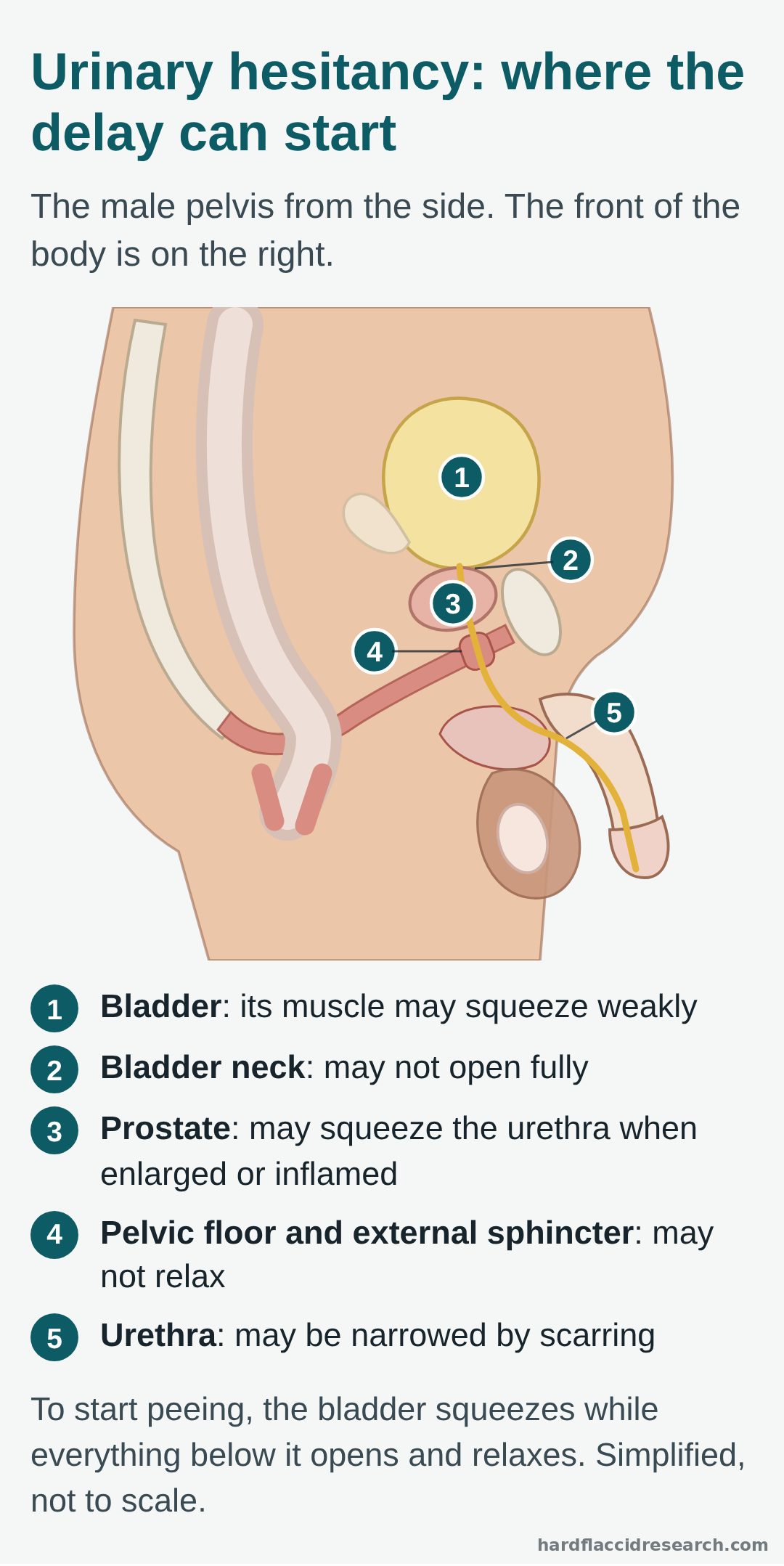
To start peeing, several things must happen together:
- The bladder muscle (the detrusor) squeezes.
- The bladder neck opens.
- The prostate lets urine pass through the urethra.
- The pelvic floor and the external sphincter relax.
- The urethra is open all the way to the tip.
A problem at any of these steps can delay or weaken the stream.
Related: Alpha Blockers for Hard Flaccid: 45% of Men Said They Help »
What causes urinary hesitancy?
An enlarged prostate
Benign prostatic hyperplasia squeezes the urethra as it passes through the prostate. It's common from middle age onward and causes hesitancy, a weak stream, dribbling, peeing often and waking at night to pee. US urology guidelines describe a range of treatments, from lifestyle changes and medicines to procedures.
A tight pelvic floor
If the pelvic floor and external sphincter don't relax fully, urine can't start easily. This is common in younger men, especially with stress, pelvic pain or chronic prostatitis.
Anxiety and shy bladder
Anxiety tightens the muscles around the urethra. Some people can't start peeing when others are nearby, which is called shy bladder or paruresis.
Prostatitis
An inflamed prostate can swell around the urethra and cause hesitancy, burning and pelvic pain.
Medicines
- Decongestants in cold and allergy medicines, such as pseudoephedrine.
- Antihistamines.
- Some antidepressants and medicines for anxiety, bladder control or Parkinson's disease.
- Opioid pain medicines.
These can tighten the bladder neck or weaken the bladder's squeeze.
Nerve problems
Diabetes, multiple sclerosis, spinal problems and pelvic surgery can affect the nerves that control the bladder.
A narrowed urethra
Scarring from an infection, injury or procedure can narrow the urethra and slow the stream.
Constipation
A full bowel can press on the bladder and urethra.
What helps urinary hesitancy?
Tips at the toilet
- Give yourself time, and don't strain or push hard.
- Sit down to pee, which can help the pelvic floor relax.
- Breathe slowly into your belly, letting your pelvic floor drop and soften as you breathe in.
- Run a tap or think of running water.
- Place a warm hand or a warm pack on your lower belly.
- After finishing, wait a moment and try again, to empty fully.
Daily habits
- Drink steadily through the day rather than in large amounts at once.
- Cut back on alcohol and caffeine, especially in the evening.
- Treat constipation.
- Check cold and allergy medicines for decongestants and antihistamines before taking them.
Medical treatment
- Pelvic floor physical therapy, if your pelvic floor is tight.
- Alpha blockers, which relax the bladder neck and prostate, often help with an enlarged prostate. They can cause dizziness and drier ejaculation.
- Medicines that shrink the prostate, for larger prostates.
- Procedures or surgery for an enlarged prostate or a narrowed urethra, if medicines don't help.
- Talk therapy and graded practice, if anxiety or shy bladder is the cause.
Related: Your Breathing May Be Keeping Your Hard Flaccid Tight »
Urinary hesitancy and hard flaccid syndrome
Hard flaccid syndrome is a firm, shrunken penis at rest, often with numbness, weaker erections and pelvic pain. Many men with hard flaccid have trouble starting to pee, which often comes from a tight pelvic floor and anxiety rather than the prostate.
Of the 2,661 men who described their symptoms, 23% described pelvic floor tightness, spasm or twitching (601 men) and 13% described urinary problems (337 men). In a separate count, 107 men asked why there are urinary problems. In an April 2023 poll, 76% said they had anxiety before hard flaccid (94 of 123 men).
Our members' guide, Bladder and Bowel Problems With Hard Flaccid: What Helps, covers relaxed peeing habits step by step.
How is urinary hesitancy diagnosed?
A primary care provider or a urologist (a doctor for urinary and sexual health) will ask about your stream, other urinary symptoms, your medicines and your health. They may suggest:
- A urine test for infection and blood.
- A check of the prostate with a gloved finger through the back passage.
- A flow test, which measures how fast you pee.
- A bladder scan after peeing, to see how much urine is left.
- Blood tests for kidney function or a PSA test, depending on age and symptoms.
- A pelvic floor assessment by a physical therapist.
Our doctor visit kit helps you describe your stream and how long the problem has lasted.
When should I see a doctor?
See a primary care provider or a urologist if hesitancy is new, getting worse, or comes with a weak stream, peeing often, waking at night to pee, pain, burning or blood in your urine.
Get urgent care straight away (call 911 or go to the emergency room) if you have:
- Not being able to pee at all, or a painful, swollen bladder.
- New trouble controlling your pee, or not feeling when your bladder is full.
- New numbness around your back passage, genitals or inner thighs, or new weakness in your legs.
- Loss of control of your bladder or bowel.
- A fever or chills with pelvic pain or pain when peeing.
Hesitancy, weak stream or retention: what's the difference?
These often happen together, but doctors look at them separately:
- Hesitancy is a delay in starting to pee.
- A weak or slow stream means urine comes out with little force once it starts.
- Stop-start peeing means the stream breaks off and restarts.
- Incomplete emptying is the feeling that your bladder isn't empty after you finish.
- Urinary retention means you can't empty your bladder. It can be sudden and painful, which is an emergency, or slow and painless, building up over months.
Telling your doctor which of these you notice, and for how long, helps them find the cause.
Frequently asked questions
Is urinary hesitancy serious?
Usually not, and most causes can be treated. It's worth a check, because it can lead to the bladder not emptying fully.
Can young men have urinary hesitancy?
Yes. In younger men, a tight pelvic floor, anxiety, prostatitis and medicines are common causes.
Can cold medicine stop you from peeing?
Decongestants and antihistamines can make it harder to pee, especially for men with an enlarged prostate, and can sometimes block urine completely.
Does sitting down to pee help?
It can. Sitting helps many men relax the pelvic floor and empty more fully.
Can anxiety cause trouble peeing?
Yes. Anxiety tightens the muscles around the urethra and can delay or stop the stream, especially around other people.
Can a tight pelvic floor cause a weak stream?
Yes. If the pelvic floor doesn't relax fully, the stream can be slow, weak or stop and start.
Does caffeine make hesitancy worse?
Caffeine and alcohol can make you need to pee more often and may irritate the bladder, which can make urinary symptoms feel worse for some men.
Can prostatitis cause trouble starting to pee?
Yes. An inflamed prostate can swell around the urethra and tighten the nearby pelvic floor, which can delay the stream.
Will urinary hesitancy go away on its own?
It depends on the cause. Hesitancy from a cold medicine or a stressful moment often settles quickly. Hesitancy from an enlarged prostate or a tight pelvic floor usually needs treatment.
Is it better to pee before bed?
Yes. Emptying your bladder before bed, and cutting back on drinks in the last couple of hours, can mean fewer night trips and less straining.
Takeaway
Urinary hesitancy is trouble starting to pee. In older men it's usually the prostate, while in younger men a tight pelvic floor, anxiety, prostatitis and medicines are common causes.
Relaxed peeing habits, a medicine review and treating the cause help most men, and not being able to pee at all is an emergency. Take our free self-check if you also notice changes in your penis at rest.
This article is for general information and isn't a substitute for advice from your own doctor. Hard Flaccid Research doesn't diagnose or treat. If you have new or worsening symptoms, see a qualified clinician. In an emergency, call 911.
Free tools that can help
- Self-check: do I have hard flaccid?Compare your symptoms with what 6,026 men report.
- Doctor visit kitA one-page summary to take to your appointment.
- Habit trackerCount your days without porn or masturbation, and get through urges.
- Diaphragm breathing toolBreathe with a moving picture of your diaphragm and pelvic floor.
- Add your experienceTell us what you tried and how it went. No name needed.
- Hard Flaccid Syndrome CensusWhat men answered in 818 polls.
- Symptom trackerLog your symptoms and see what helps you.
- Ask us a questionThe questions men ask most become new articles.
The numbers behind this article
Every number in this article comes from what men with hard flaccid syndrome shared between December 2020 and October 2026, counted once per person, or from their polls. These are self-selected reports, not a clinical study. See hard flaccid syndrome statistics, the Hard Flaccid Syndrome Census and how we count.
13% of men who described their symptoms described urinary problems
Share of the 2,661 men who described their symptoms. Each man is counted once.These are self-selected reports, not a clinical study.
Source: Hard Flaccid Research, hardflaccidresearch.com
Every number in this article, with its source
| In this article | Source |
|---|---|
| 13% of the men who described their symptoms described urinary problems (337 of 2,661) | 337 of 2,661 men, counted |
| 23% of the men who described their symptoms described pelvic floor tightness, spasm or twitching (601 of 2,661) | 601 of 2,661 men, counted |
| 6,026 men shared their experiences, and 2,661 of them described their symptoms | 2,661 of 6,026 men, counted |
| 107 men asked why there are urinary problems | 107 men asked why there are urinary problems, counted from what men wrote, once per person |
| 76% said they had anxiety before hard flaccid (94 of 123 men) | 94 of 123 men, poll, Apr 2023 |
Medical sources
What this article says about medical research, guidelines and urgent care comes from these sources.
- MedlinePlus. Urination: difficulty with flow. US National Library of Medicine. https://medlineplus.gov/ency/article/003143.htm
- Male Urinary Retention: Acute and Chronic. In: StatPearls. Treasure Island (FL): StatPearls Publishing. https://www.ncbi.nlm.nih.gov/books/NBK538499/
- Sandhu JS, Bixler BR, Dahm P, et al. Management of lower urinary tract symptoms attributed to benign prostatic hyperplasia (BPH): AUA guideline amendment 2023. J Urol. 2024;211(1):11-19. https://doi.org/10.1097/JU.0000000000003698
- Cleveland Clinic. Urinary hesitancy. https://my.clevelandclinic.org/health/symptoms/urinary-hesitancy
- Lai HH, Pontari MA, Argoff CE, et al. Male chronic pelvic pain: AUA guideline. J Urol. 2025. https://www.auanet.org/guidelines-and-quality/guidelines/male-chronic-pelvic-pain
- Kuoch KLJ, Meyer D, Austin DW, Knowles SR. A systematic review of paruresis: clinical implications and future directions. J Psychosom Res. 2017;98:122-129. https://doi.org/10.1016/j.jpsychores.2017.05.015
How we made this article
We started from the question many men asked. Every number was checked against our data. Our editorial team edited it and Dr. Julian Reyes reviewed it medically. Read our editorial policy.
Read next
See more of us on Google
Add Hard Flaccid Research as a preferred source, and Google shows you our pages more often when you search.
Add as a preferred sourceDon't see your question? Ask us. We answer the most-asked ones in new articles.
Cite and share this article
You're welcome to quote this article. Please name Hard Flaccid Research and link to this page, so others can find the full answer and the data behind it. To cite this page, use its link.
Citation
Hard Flaccid Research. (2026). Urinary Hesitancy: Why It's Hard to Start Peeing and What Helps. Written by the Editorial Team, medically reviewed by Dr. Julian Reyes. https://hardflaccidresearch.com/articles/urinary-hesitancy
Credit link for your article
Source: <a href="https://hardflaccidresearch.com/articles/urinary-hesitancy">Hard Flaccid Research</a>
Wikipedia reference
<ref>{{cite web |url=https://hardflaccidresearch.com/articles/urinary-hesitancy |title=Urinary Hesitancy: Why It's Hard to Start Peeing and What Helps |website=Hard Flaccid Research |date=2026 |access-date=22 November 2026}}</ref>
How the data was collected: our methodology. Journalists and researchers: key numbers, data and contact.