Obturator Internus: Pain, Trigger Points and Stretches
In short
- The obturator internus is a fan-shaped hip muscle that lines the inside wall of your pelvis and helps turn your thigh outward.
- Because the pelvic floor hangs from it and the pudendal nerve runs along it, a tight or tender obturator internus can cause deep buttock, sit bone, tailbone or pelvic pain that's often worse when sitting.
- Gentle stretches, heat and a pelvic floor physical therapist are the usual first steps.
The obturator internus (ob-tur-AY-tur in-TER-nus) is a fan-shaped muscle that lines the inside wall of your pelvis and helps turn your thigh outward. Because your pelvic floor hangs from it and the pudendal nerve runs along it, a tight or tender obturator internus can cause deep pain in the buttock, the sit bone, the tailbone or the pelvis.
Most men have never heard of it until it hurts. This page explains where the muscle is, what it does, what obturator internus pain feels like, and the stretches and treatments that may help.
By the numbers: of the 6,026 men who shared their experiences with hard flaccid syndrome, 2,661 described their symptoms. 601 of them described pelvic floor tightness, spasm or twitching, and 267 described pelvic, perineal or tailbone pain.
Key facts
- The obturator internus is a hip muscle that also forms the side walls of the pelvis.
- It turns your thigh outward and helps keep the ball of the hip steady in its socket.
- The levator ani, the main pelvic floor muscle, is attached to it, and the pudendal nerve runs along it in a tunnel called Alcock's canal.
- When it's tight or tender, pain is often felt deep in the buttock, around the sit bone or the tailbone, and it's often worse when sitting.
- Gentle stretches, heat and a pelvic floor physical therapist are the usual first steps. Most men don't need anything more invasive.
What is the obturator internus?
The obturator internus is one of six small muscles at the back of the hip that turn the thigh outward. What makes it different is where it starts: inside the pelvis.
It's a flat, fan-shaped muscle that covers the inner surface of each hip bone, around a large opening in the bone called the obturator foramen. The name comes from a Latin word meaning to block up, because the muscle and a tough membrane close that opening.
Where is the obturator internus?
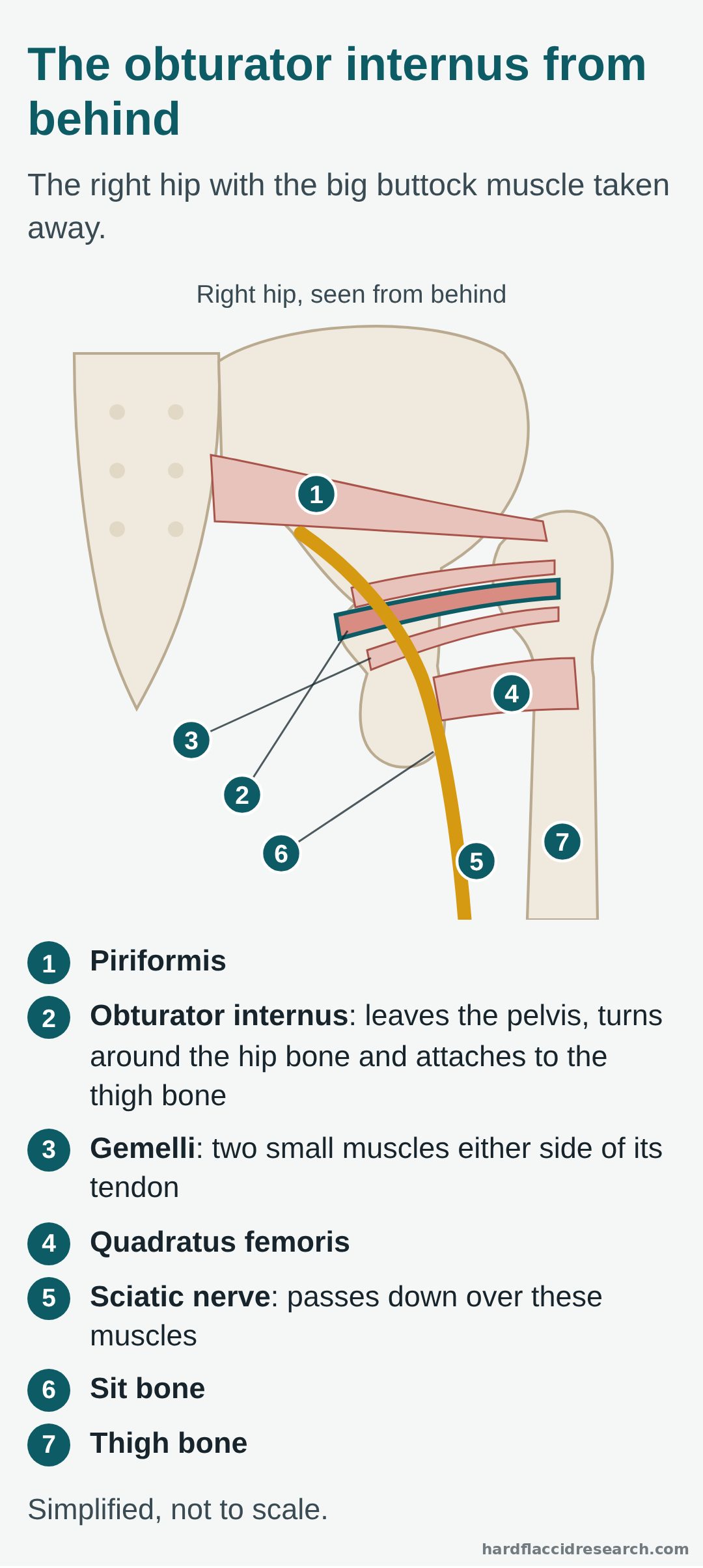
Picture the bowl of your pelvis. The obturator internus lines the lower part of each side wall of that bowl, at about the level of your hip joints. Its fibers gather into a tendon that leaves the pelvis through a small gap below the hip bone, bends around the bone like a rope over a pulley, and attaches to the top of the thigh bone.
Why it matters for the pelvic floor
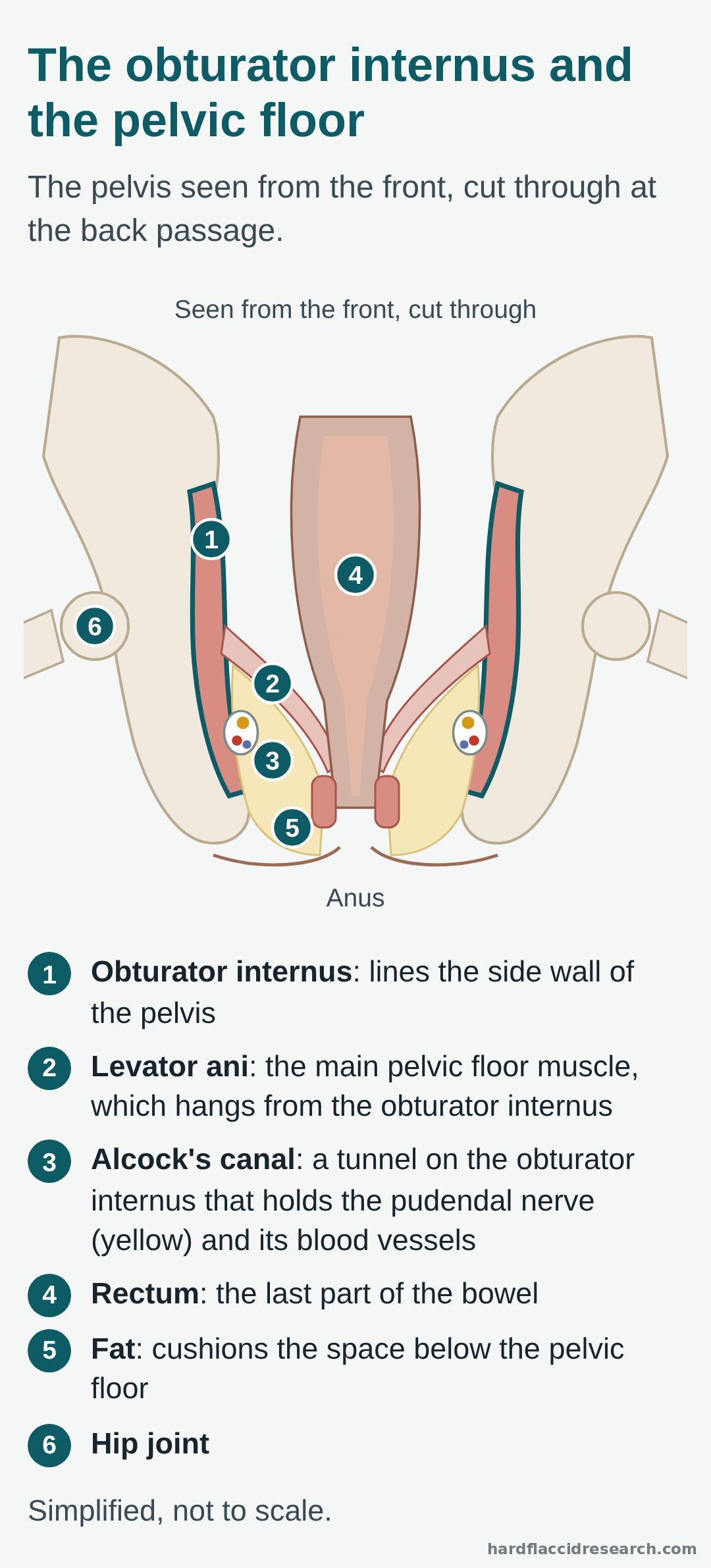
The levator ani, the largest muscle of the pelvic floor, hangs from a thick band on the inner surface of the obturator internus. So the two muscles work side by side, and tension in one can affect the other.
Just below that band, the covering of the obturator internus forms a narrow tunnel called Alcock's canal (also called the pudendal canal). The pudendal nerve, which carries feeling from the penis, the perineum (the area between the scrotum and the anus) and the anus, runs through this tunnel with its blood vessels. Doctors think a tight or swollen obturator internus may press on or irritate the nerve here, though this isn't proven.
Related: Tailbone Pain When Sitting: Causes and What Helps »
What does the obturator internus do?
The obturator internus has three main jobs:
- It turns your thigh outward (external rotation) when your hip is straight, for example when you stand and point your toes out.
- It helps move your thigh out to the side when your hip is bent, for example when you sit and let your knees fall apart.
- It holds the ball at the top of the thigh bone snugly in the hip socket, which steadies the hip when you walk, run or stand on one leg.
It works with its neighbors: the piriformis above it, the two small gemelli muscles that wrap its tendon, and the quadratus femoris below. The sciatic nerve passes down over this group.
What does obturator internus pain feel like?
Pain from the obturator internus is usually deep and hard to pin down. Men describe it in different ways:
- A deep ache in the buttock or around the sit bone, often on one side.
- Pain in the tailbone, the perineum or the back passage.
- Pain at the back of the hip that can spread down the back of the thigh.
- Pain that's worse after sitting for long periods, especially on hard seats, and eases when you stand or lie down.
- Pain when you cross your legs, climb stairs or turn your leg outward against resistance.
- A feeling of pressure or fullness in the pelvis.
Because the pudendal nerve runs along it, some men also notice burning, tingling or numbness between the legs. If numbness there is new, see the urgent signs below.
Related: Coccygeus Muscle: Where It Is, What It Does and Pain »
What causes obturator internus pain?
Often there's no single cause. Things that may play a part include:
- Long hours sitting, especially on hard chairs, in a car or on a bike saddle.
- Overuse in sport, such as running, cycling, rowing, squats, lunges or a lot of cutting and twisting.
- Clenching your pelvic floor and buttocks a lot, for example when you're stressed, or from doing too many Kegels.
- A fall onto your bottom, or an injury to the hip or pelvis.
- Hip problems, such as a hip joint that moves unevenly, or weakness in the buttock muscles that leaves the small hip muscles working harder.
- A tight pelvic floor, since the two share work and attachments.
Physical therapists call a small, tender knot in a muscle that sends pain elsewhere a trigger point. Specialists describe trigger points in the obturator internus and the levator ani as common in people with long-lasting pelvic pain.
Obturator internus and hard flaccid syndrome
Hard flaccid syndrome is a firm, shrunken penis at rest, often with numbness, weaker erections and pelvic pain. One leading idea is that a tense pelvic floor, and the muscles around it, may help keep symptoms going.
Of the 2,661 men who described their symptoms, 23% described pelvic floor tightness, spasm or twitching (601 men), 10% described pelvic, perineal or tailbone pain (267 men), and 9% described lower back, hip or hamstring tightness (233 men). A description alone can't tell which muscle is involved, but these are the same areas the obturator internus can affect.
Men also talked about the muscles around the hip. 1,288 men discussed stretching, more than any other approach, and stretching came up in 40 of the 126 recovery stories. 481 men discussed massage or trigger point release.
How is obturator internus pain diagnosed?
There's no blood test or scan that shows a tight obturator internus. A doctor or a pelvic floor physical therapist usually finds it by examining you.
What to expect
- Questions about where the pain is, what makes it worse, how you sit, your sport and your bladder, bowel and sexual health.
- A check of how your hips move and whether turning your leg outward against their hand hurts.
- Pressing on the muscle from the outside, at the back of the hip and beside the sit bone.
- An internal check, with a gloved finger in the back passage, is the most direct way to feel the muscle. It's only done if you agree. The therapist explains each step first, and you can ask for a chaperone or stop at any time.
Tests to rule other things in or out
A doctor may suggest an MRI or ultrasound scan if the pain doesn't settle, to check the hip joint, the spine and the nerves. A scan usually looks normal when the problem is a tight muscle, which is useful in itself.
Other conditions that can feel similar include piriformis syndrome, hip joint problems, a pinched nerve in the lower back, pudendal nerve entrapment and prostatitis. Bring our doctor visit kit so you can describe exactly where it hurts and when.
Obturator internus stretches you can try
Stretching should feel like a gentle pull, never sharp pain. Breathe slowly into your belly as you hold each one, and let your pelvic floor relax, the way you would for reverse Kegels. Hold each stretch for twenty to thirty seconds, and repeat two or three times on each side, once or twice a day. Stop if it makes pain between the legs worse.
1. Knees falling in
Lie on your back with your knees bent and your feet wider than your hips. Let both knees fall slowly inward toward each other, until you feel a stretch at the back of the hips. This turns the hip inward, the opposite of what the obturator internus does.
2. Knee to the opposite shoulder
Lie on your back with your legs straight. Bend one knee and hold it with both hands. Gently pull it up and across toward the opposite shoulder until you feel a stretch deep in the buttock.
3. Figure-four stretch
Lie on your back with both knees bent. Cross one ankle over the other knee. Hold the back of the lower thigh and draw it toward your chest. You should feel the stretch deep in the buttock on the side of the crossed leg.
4. Seated hip turn
Sit tall on a firm chair with your feet flat. Keep one knee pointing forward and let the other foot slide out to the side, so the thigh turns inward. Lean forward a little from the hips to deepen the stretch.
Other self-care
- Warm baths or a warm, not hot, heat pack on the back of the hip may help the muscle relax.
- Take a break from sitting every half hour or so. A cushion with a cut-out at the back, or sitting with your weight on the backs of your thighs, may take pressure off the sit bones.
- A soft massage ball against the back of the hip, while you lean on a wall, can ease the outer part of the muscle. Keep it away from the sit bone and the area between the legs.
- Ease off the activity that set it off, then return slowly.
- Diaphragmatic breathing, slow and deep into the belly, may help a tense pelvic floor let go.
Our members' guide, Hard Flaccid Pain and Flare-Ups: How to Calm Them, goes through a full plan for bad days step by step.
Treatment from a physical therapist or doctor
If the pain hasn't settled after a few weeks of self-care, see a doctor or a pelvic floor physical therapist.
Pelvic floor physical therapy
A pelvic floor physical therapist can find tight or tender spots in the obturator internus and the pelvic floor and release them by hand, from the outside or the inside, with your consent. They also teach relaxation and breathing, and give you stretches and strengthening for the hips. US urology guidelines say doctors may offer hands-on physical therapy to men with chronic pelvic pain who have tight, tender pelvic floor muscles.
In a November 2022 poll, 36% of men who had seen a pelvic floor physio said it helped quite a bit or cured them (17 of 47 men).
Trigger point release and relaxation training
In a study of men with chronic pelvic pain, trigger point release combined with relaxation training eased symptoms for many of them. A small trial found that physical therapy aimed at tight pelvic muscles helped more people than general massage.
Dry needling and injections
Some clinics offer dry needling, where a fine needle is put into a trigger point. Injections into the muscle, such as local anesthetic or Botox, are sometimes used by pain specialists. The evidence for these is limited, and US urology guidelines don't recommend Botox or nerve blocks for pelvic pain in men. Ask about the risks, such as soreness, bruising, infection and numbness, before you agree.
If a nerve is involved
If your doctor thinks the pudendal nerve is pressed or irritated, they may refer you to a pain specialist. Surgery to free the nerve is rarely needed and only considered after other treatments.
When should I see a doctor?
See a primary care provider, a sports medicine doctor or a urologist (a doctor for urinary and sexual health) if pelvic or buttock pain lasts more than a few weeks, keeps you from sitting, or comes with pain when you pee or ejaculate. A pelvic floor physical therapist can also assess you.
Get urgent care straight away (call 911 or go to the emergency room) if you have:
- Sudden, severe pain in the penis, testicles or pelvis.
- New numbness around your back passage, genitals or inner thighs, or new weakness in your legs.
- New trouble starting or controlling your pee, not being able to pee, or not feeling when your bladder is full.
- Loss of control of your bladder or bowel.
- A fever or chills with pelvic pain or pain when peeing.
Frequently asked questions
Can a tight obturator internus cause pudendal nerve pain?
It may. The pudendal nerve runs along the obturator internus in Alcock's canal, so doctors think a tight or swollen muscle may irritate it. This isn't proven, and other things can affect the nerve too.
Is obturator internus pain the same as piriformis syndrome?
No, but they're neighbors and can feel alike. The piriformis sits just above the obturator internus at the back of the hip, and both can cause deep buttock pain and irritate the sciatic nerve.
How long does obturator internus pain take to go away?
It varies. Some men feel better within weeks of stretching and sitting less. Pain that has lasted a long time often takes longer and may need a physical therapist's help.
Should I do Kegels for obturator internus pain?
Not if your pelvic floor feels tight. Kegels squeeze the pelvic floor, which may add to the tension. Ask a pelvic floor physical therapist first, and if you do them, let go fully between squeezes.
Can I massage my own obturator internus?
You can ease the outer part, at the back of the hip, with a soft ball. The inner part can only be reached internally, which is best left to a trained therapist.
Takeaway
The obturator internus is a hip muscle that lines the side walls of your pelvis. The pelvic floor hangs from it and the pudendal nerve runs along it, so when it's tight it can cause deep buttock, tailbone or pelvic pain.
Gentle stretches, heat, sitting less and slow breathing help many people. If the pain lasts, a pelvic floor physical therapist can find and release the tight spots. Take our free self-check if you also notice changes in your penis at rest.
This article is for general information and isn't a substitute for advice from your own doctor. Hard Flaccid Research doesn't diagnose or treat. If you have new or worsening symptoms, see a qualified clinician. In an emergency, call 911.
Free tools that can help
- Self-check: do I have hard flaccid?Compare your symptoms with what 6,026 men report.
- Doctor visit kitA one-page summary to take to your appointment.
- Habit trackerCount your days without porn or masturbation, and get through urges.
- Diaphragm breathing toolBreathe with a moving picture of your diaphragm and pelvic floor.
- Add your experienceTell us what you tried and how it went. No name needed.
- Hard Flaccid Syndrome CensusWhat men answered in 818 polls.
- Symptom trackerLog your symptoms and see what helps you.
- Ask us a questionThe questions men ask most become new articles.
The numbers behind this article
Every number in this article comes from what men with hard flaccid syndrome shared between December 2020 and October 2026, counted once per person, or from their polls. These are self-selected reports, not a clinical study. See hard flaccid syndrome statistics, the Hard Flaccid Syndrome Census and how we count.
23% of men who described their symptoms described pelvic floor tightness
Share of the 2,661 men who described their symptoms. Each man is counted once.These are self-selected reports, not a clinical study. A muscle can't be named from a description alone.
Source: Hard Flaccid Research, hardflaccidresearch.com
Stretching was the approach men discussed most
How many men discussed each approach. Each man is counted once per approach. Discussing something isn't the same as trying it.These are self-selected reports, not a clinical study.
Source: Hard Flaccid Research, hardflaccidresearch.com
36% of men who had seen a pelvic floor physio said it helped quite a bit or cured them
Of the 47 men in a November 2022 poll who had seen a pelvic floor physio.In our polls, men choose to answer. This poll didn't ask which muscle was treated.
Source: Hard Flaccid Research, hardflaccidresearch.com
Every number in this article, with its source
| In this article | Source |
|---|---|
| 23% of the men who described their symptoms described pelvic floor tightness, spasm or twitching (601 of 2,661) | 601 of 2,661 men, counted |
| 10% of the men who described their symptoms described pelvic, perineal or tailbone pain (267 of 2,661) | 267 of 2,661 men, counted |
| 9% of the men who described their symptoms described lower back, hip or hamstring tightness (233 of 2,661) | 233 of 2,661 men, counted |
| 6,026 men shared their experiences, and 2,661 of them described their symptoms | 2,661 of 6,026 men, counted |
| 1,288 men discussed stretching | 1,288 men discussing stretching, counted from what men wrote |
| 656 men discussed pelvic floor physio | 656 men discussing pelvic floor physio, counted from what men wrote |
| 481 men discussed massage or trigger point release | 481 men discussing massage or trigger point release, counted from what men wrote |
| Stretching came up in 40 of the 126 recovery stories | 40 of 126 recovery stories |
| 36% of men who had seen a pelvic floor physio said it helped quite a bit or cured them (17 of 47 men) | 17 of 47 men, poll, Nov 2022 |
Medical sources
What this article says about medical research, guidelines and urgent care comes from these sources.
- Anatomy, abdomen and pelvis, obturator muscles. In: StatPearls. Treasure Island (FL): StatPearls Publishing; updated January 2023. https://pubmed.ncbi.nlm.nih.gov/36943954/
- Anatomy, bony pelvis and lower limb, gemelli muscles. In: StatPearls. Treasure Island (FL): StatPearls Publishing; updated August 2023. https://pubmed.ncbi.nlm.nih.gov/32491352/
- Myofascial pelvic pain and related disorders (review). Phys Med Rehabil Clin N Am. 2017. https://pubmed.ncbi.nlm.nih.gov/28676361/
- Lai HH, Pontari MA, Argoff CE, et al. Male chronic pelvic pain: AUA guideline. J Urol. 2025. https://www.auanet.org/guidelines-and-quality/guidelines/male-chronic-pelvic-pain
- FitzGerald MP, Anderson RU, Potts J, et al. Randomized multicenter feasibility trial of myofascial physical therapy for the treatment of urological chronic pelvic pain syndromes. J Urol. 2009;182:570-580. https://doi.org/10.1016/j.juro.2009.04.022
- Anderson RU, Wise D, Sawyer T, Chan C. Integration of myofascial trigger point release and paradoxical relaxation training treatment of chronic pelvic pain in men. J Urol. 2005;174:155-160. https://doi.org/10.1097/01.ju.0000161609.31185.d5
- Labat JJ, Riant T, Robert R, Amarenco G, Lefaucheur JP, Rigaud J. Diagnostic criteria for pudendal neuralgia by pudendal nerve entrapment (Nantes criteria). Neurourol Urodyn. 2008;27:306-310. https://pubmed.ncbi.nlm.nih.gov/17828787/
How we made this article
We started from the question many men asked. Every number was checked against our data. Our editorial team edited it and Dr. Julian Reyes reviewed it medically. Read our editorial policy.
Read next
See more of us on Google
Add Hard Flaccid Research as a preferred source, and Google shows you our pages more often when you search.
Add as a preferred sourceDon't see your question? Ask us. We answer the most-asked ones in new articles.
Cite and share this article
You're welcome to quote this article. Please name Hard Flaccid Research and link to this page, so others can find the full answer and the data behind it. To cite this page, use its link.
Citation
Hard Flaccid Research. (2026). Obturator Internus: Pain, Trigger Points and Stretches. Written by the Editorial Team, medically reviewed by Dr. Julian Reyes. https://hardflaccidresearch.com/articles/obturator-internus
Credit link for your article
Source: <a href="https://hardflaccidresearch.com/articles/obturator-internus">Hard Flaccid Research</a>
Wikipedia reference
<ref>{{cite web |url=https://hardflaccidresearch.com/articles/obturator-internus |title=Obturator Internus: Pain, Trigger Points and Stretches |website=Hard Flaccid Research |date=2026 |access-date=22 November 2026}}</ref>
How the data was collected: our methodology. Journalists and researchers: key numbers, data and contact.