Epididymis: Where It Is, What It Does and Why It Hurts
In short
- The epididymis is a tightly coiled tube on the back of each testicle where sperm mature and are stored.
- It has a head, a body and a tail, and its tail joins the vas deferens.
- The most common problem is epididymitis, a painful swelling usually caused by infection.
- Cysts and long-lasting pain can also happen.
The epididymis is a tightly coiled tube that lies along the back of each testicle. Sperm made in the testicle pass into it, mature there and are stored in it until ejaculation. Its tail joins the vas deferens, the tube that carries sperm up into the pelvis.
You can usually feel it yourself as a soft, slightly lumpy ridge at the back of each testicle. Many men feel it for the first time, worry that it's a lump, and are relieved to learn it's normal. This page explains the parts of the epididymis, what it does, why it can hurt and when to see a doctor.
By the numbers: of the 6,026 men who shared their experiences with hard flaccid syndrome, 2,661 described their symptoms, and 102 of them described testicle pain or a tight scrotum.

Key facts
- There's one epididymis on the back of each testicle.
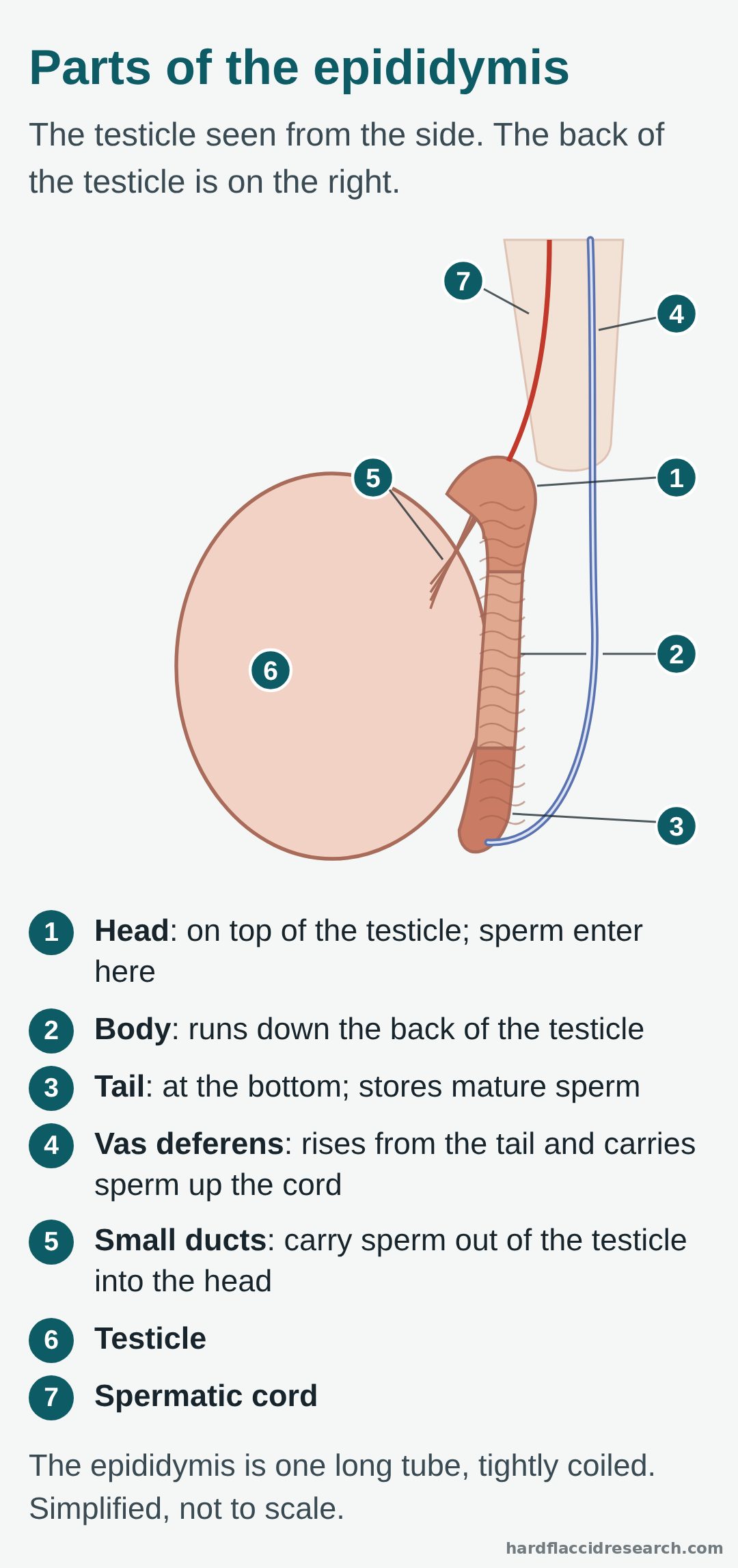
- It has three parts: a head at the top, a body down the back and a tail at the bottom.
- It's a single tube, coiled so tightly that it would stretch several yards if it were straightened out.
- Sperm mature as they move through it. They learn to swim forward and become able to fertilize an egg.
- Its tail stores sperm and joins the vas deferens.
- The most common problem is epididymitis, a painful swelling usually caused by infection.
- Sudden, severe pain in the scrotum can be testicular torsion, which is an emergency.
What are the parts of the epididymis?
The head
The head sits on top of the testicle. Small ducts carry sperm from the testicle into it.
The body
The body runs down the back of the testicle. Here sperm continue to mature as they move slowly along the coiled tube.
The tail
The tail sits at the bottom of the testicle. It stores mature sperm and turns upward to become the vas deferens.
Related: Gabapentin for Hard Flaccid: Worth the Side Effects? »
What does the epididymis do?
Sperm that leave the testicle aren't ready yet. They can't swim forward properly or fertilize an egg. As they travel through the long, coiled tube of the epididymis, over a period of days, the lining of the tube changes them so that they become able to do both.
The epididymis also absorbs some of the fluid that comes out of the testicle, concentrating the sperm, and stores them in its tail until ejaculation. During ejaculation, muscle in the wall of the tail and the vas deferens contracts and pushes sperm up into the pelvis.
What does a normal epididymis feel like?
When you check your testicles, you'll feel a soft, slightly bumpy, comma-shaped ridge along the back and top of each one. That's the epididymis. It may feel a little tender if you press it firmly. Knowing what's normal for you makes it easier to notice a change, such as new swelling, a hard spot or a separate lump.
Related: Perineum Pain With Hard Flaccid: Why It Hurts, What Helps »
Why does the epididymis hurt?
Epididymitis
Epididymitis is inflammation of the epididymis. It usually develops over a day or two, with pain and swelling at the back of the testicle that can spread to the whole testicle. The scrotum may be red and warm, and you may have a fever, burning when you pee or a discharge from the penis.
- In younger, sexually active men, it's most often caused by a sexually transmitted infection such as chlamydia or gonorrhea.
- In older men, and in men who have anal sex, it's often caused by bacteria from the urinary tract.
- Sometimes there's no infection, for example after heavy straining, an injury or with certain medicines.
Epididymitis caused by infection needs antibiotics. If it was sexually transmitted, your partner needs testing and treatment too. Rest, supportive underwear, cold packs wrapped in a cloth and anti-inflammatory medicines a doctor or pharmacist suggests can ease the pain.
Long-lasting epididymis pain
Some men have pain in the epididymis that lasts for months, with or without an earlier infection. It can come from ongoing inflammation, pressure after a vasectomy, nerve irritation or a tight pelvic floor. A urologist can look for the cause and discuss treatment.
Cysts
Epididymal cysts and spermatoceles are smooth, fluid-filled lumps on the epididymis, usually on its head. They're common and harmless, and usually need treatment only if they're large or painful.
After a vasectomy
After a vasectomy, sperm still made by the testicle can't get out, and pressure can build in the epididymis. A small number of men have ongoing aching, sometimes worse after ejaculation.
Testicular torsion
Torsion is a twist of the spermatic cord that cuts off the blood supply to the testicle. It causes sudden, severe pain, often with nausea and vomiting. It's an emergency, because surgery within hours can save the testicle.
How is epididymis pain diagnosed?
A primary care provider or a urologist (a doctor for urinary and sexual health) will ask how the pain started and examine both testicles. They may suggest:
- A urine test and tests for sexually transmitted infections.
- An ultrasound scan of the scrotum, which can show swelling, a cyst or blood flow problems.
- Blood tests, if you have a fever.
Our doctor visit kit helps you describe when the pain started and what makes it better or worse.
Epididymis and hard flaccid syndrome
Hard flaccid syndrome is a firm, shrunken penis at rest, often with numbness, weaker erections and pelvic pain. There's no evidence that the epididymis causes hard flaccid. But aching in the scrotum is common in men with pelvic pain, and a tense pelvic floor can refer pain to the testicles and the area behind them.
Of the 2,661 men who described their symptoms, 10% described pelvic, perineal or tailbone pain (267 men) and 4% described testicle pain or a tight scrotum (102 men).
Our members' guide, Hard Flaccid Pain and Flare-Ups: How to Calm Them, has a step-by-step plan for days when pain flares.
How do I check my testicles and epididymis?
A quick check once a month, after a warm bath or shower when the scrotum is relaxed, helps you learn what's normal for you:
- Hold each testicle gently between your thumb and fingers and roll it slowly.
- Feel for the soft ridge of the epididymis along the back and top. That's normal.
- Feel the cord above it, where you can usually find the firm vas deferens.
- Note any new swelling, a hard area, a separate lump or a change in size or weight.
One testicle often hangs a little lower or is a little bigger than the other, and that's normal too.
When should I see a doctor?
See a primary care provider or a urologist if you have pain or swelling at the back of a testicle, a new lump, burning when you pee or a discharge from the penis, or pain that keeps coming back.
Get urgent care straight away (call 911 or go to the emergency room) if you have:
- Sudden, severe pain or swelling in a testicle, especially with nausea or vomiting. This can be testicular torsion. Surgery within hours can save the testicle.
- A testicle that suddenly sits higher than usual or lies sideways, with pain.
- A fever or chills with a painful, swollen scrotum.
- Sudden, severe pain in the penis, testicles or pelvis.
Frequently asked questions
Is it normal to feel a lump on the back of my testicle?
Yes. The soft, bumpy ridge along the back of each testicle is the epididymis. A separate, firm lump, or a lump in the testicle itself, should be checked.
How long does epididymitis take to heal?
Pain often improves within a few days of starting antibiotics, but swelling can take weeks to settle. Finish the full course of medicine.
Can epididymitis cause infertility?
It can if it's severe or keeps coming back, especially on both sides. Prompt treatment lowers the risk.
Can you get epididymitis without an STI?
Yes. It can come from urinary bacteria, straining, an injury or certain medicines.
How can I tell epididymitis from torsion?
Epididymitis usually builds over a day or two. Torsion usually starts suddenly and is severe. You can't always tell them apart at home, so get sudden, severe pain checked straight away.
Can a tight pelvic floor cause pain near the epididymis?
It can contribute. Tight pelvic floor muscles can refer aching to the testicles and scrotum. It's still important to rule out infection first.
Can I have sex with epididymitis?
It's best to wait until you and your partner have finished treatment and your symptoms have gone, especially if the cause was a sexually transmitted infection.
Does the epididymis grow back after a vasectomy?
A vasectomy doesn't remove the epididymis. It stays in place and keeps working, though sperm can no longer leave it through the vas deferens.
Takeaway
The epididymis is the coiled tube on the back of each testicle where sperm mature and are stored. Feeling it is normal.
Pain and swelling there are most often from epididymitis, which usually needs antibiotics, while sudden, severe pain is an emergency. Take our free self-check if you also notice changes in your penis at rest.
This article is for general information and isn't a substitute for advice from your own doctor. Hard Flaccid Research doesn't diagnose or treat. If you have new or worsening symptoms, see a qualified clinician. In an emergency, call 911.
Free tools that can help
- Self-check: do I have hard flaccid?Compare your symptoms with what 6,026 men report.
- Doctor visit kitA one-page summary to take to your appointment.
- Habit trackerCount your days without porn or masturbation, and get through urges.
- Diaphragm breathing toolBreathe with a moving picture of your diaphragm and pelvic floor.
- Add your experienceTell us what you tried and how it went. No name needed.
- Hard Flaccid Syndrome CensusWhat men answered in 818 polls.
- Symptom trackerLog your symptoms and see what helps you.
- Ask us a questionThe questions men ask most become new articles.
The numbers behind this article
Every number in this article comes from what men with hard flaccid syndrome shared between December 2020 and October 2026, counted once per person, or from their polls. These are self-selected reports, not a clinical study. See hard flaccid syndrome statistics, the Hard Flaccid Syndrome Census and how we count.
4% of men who described their symptoms described testicle pain or a tight scrotum
Share of the 2,661 men who described their symptoms. Each man is counted once.These are self-selected reports, not a clinical study.
Source: Hard Flaccid Research, hardflaccidresearch.com
Every number in this article, with its source
| In this article | Source |
|---|---|
| 4% of the men who described their symptoms described testicle pain or a tight scrotum (102 of 2,661) | 102 of 2,661 men, counted |
| 10% of the men who described their symptoms described pelvic, perineal or tailbone pain (267 of 2,661) | 267 of 2,661 men, counted |
| 6,026 men shared their experiences, and 2,661 of them described their symptoms | 2,661 of 6,026 men, counted |
Medical sources
What this article says about medical research, guidelines and urgent care comes from these sources.
- Anatomy, Abdomen and Pelvis: Testes. In: StatPearls. Treasure Island (FL): StatPearls Publishing. https://www.ncbi.nlm.nih.gov/books/NBK470201/
- Epididymitis. In: StatPearls. Treasure Island (FL): StatPearls Publishing. https://www.ncbi.nlm.nih.gov/books/NBK430814/
- Epididymitis: an overview. Am Fam Physician. 2016;94(9):723-726. https://pubmed.ncbi.nlm.nih.gov/27929243/
- MedlinePlus. Epididymitis. US National Library of Medicine. https://medlineplus.gov/ency/article/001279.htm
- Ziegelmann MJ, Farrell MR, Levine LA. Evaluation and management of chronic scrotal content pain: a common yet poorly understood condition. Rev Urol. 2019;21(2-3):74-84. https://pmc.ncbi.nlm.nih.gov/articles/PMC6864917/
- Testicular Torsion. In: StatPearls. Treasure Island (FL): StatPearls Publishing. https://www.ncbi.nlm.nih.gov/books/NBK448199/
How we made this article
We started from the question many men asked. Every number was checked against our data. Our editorial team edited it and Dr. Julian Reyes reviewed it medically. Read our editorial policy.
Read next
See more of us on Google
Add Hard Flaccid Research as a preferred source, and Google shows you our pages more often when you search.
Add as a preferred sourceDon't see your question? Ask us. We answer the most-asked ones in new articles.
Cite and share this article
You're welcome to quote this article. Please name Hard Flaccid Research and link to this page, so others can find the full answer and the data behind it. To cite this page, use its link.
Citation
Hard Flaccid Research. (2026). Epididymis: Where It Is, What It Does and Why It Hurts. Written by the Editorial Team, medically reviewed by Dr. Julian Reyes. https://hardflaccidresearch.com/articles/epididymis
Credit link for your article
Source: <a href="https://hardflaccidresearch.com/articles/epididymis">Hard Flaccid Research</a>
Wikipedia reference
<ref>{{cite web |url=https://hardflaccidresearch.com/articles/epididymis |title=Epididymis: Where It Is, What It Does and Why It Hurts |website=Hard Flaccid Research |date=2026 |access-date=22 November 2026}}</ref>
How the data was collected: our methodology. Journalists and researchers: key numbers, data and contact.