Ilioinguinal Nerve: Path, What It Does and Groin Pain
In short
- The ilioinguinal nerve comes from the lower spine and runs around the side of the belly, through the groin alongside the spermatic cord.
- It gives feeling to the skin of the groin, the upper inner thigh, the root of the penis and the front of the scrotum.
- When it's irritated or trapped, often after hernia surgery, it can cause burning or sharp groin pain, ilioinguinal neuralgia, that may spread to the scrotum and thigh.
The ilioinguinal nerve is a small nerve that gives feeling to the groin. It starts from the lower spine, runs around the inside of the belly wall near the hip bone, and passes through the groin alongside the spermatic cord. It carries feeling from the skin of the groin, the upper inner thigh, the root of the penis and the front of the scrotum.
Most men never notice it. But when it's irritated or trapped, most often after surgery for an inguinal hernia, it can cause burning, sharp or electric pain in the groin that spreads to the scrotum or the inner thigh. Doctors call this ilioinguinal neuralgia. This page explains the path of the nerve, the skin it supplies, the causes of ilioinguinal pain and the treatments that help.
By the numbers: of the 6,026 men who shared their experiences with hard flaccid syndrome, 2,661 described their symptoms, and 914 of them described numbness or reduced sensation.
Key facts
- The ilioinguinal nerve comes mainly from the first lumbar nerve root, in the lower back.
- It runs around the inside of the belly wall, pierces the belly muscles near the front of the hip bone and travels through the inguinal canal with the spermatic cord.
- It gives feeling to the skin over the groin, the upper inner thigh, the root of the penis and the front of the scrotum.
- It also helps supply some of the lower belly wall muscles.
- Ilioinguinal neuralgia is a common cause of long-lasting groin pain, especially after hernia repair.
- The genitofemoral nerve, a close neighbor, supplies nearby skin and the cremaster muscle, and can cause similar pain.
- Treatment ranges from medicines and physical therapy to nerve blocks and, for some, surgery.
What is the path of the ilioinguinal nerve?
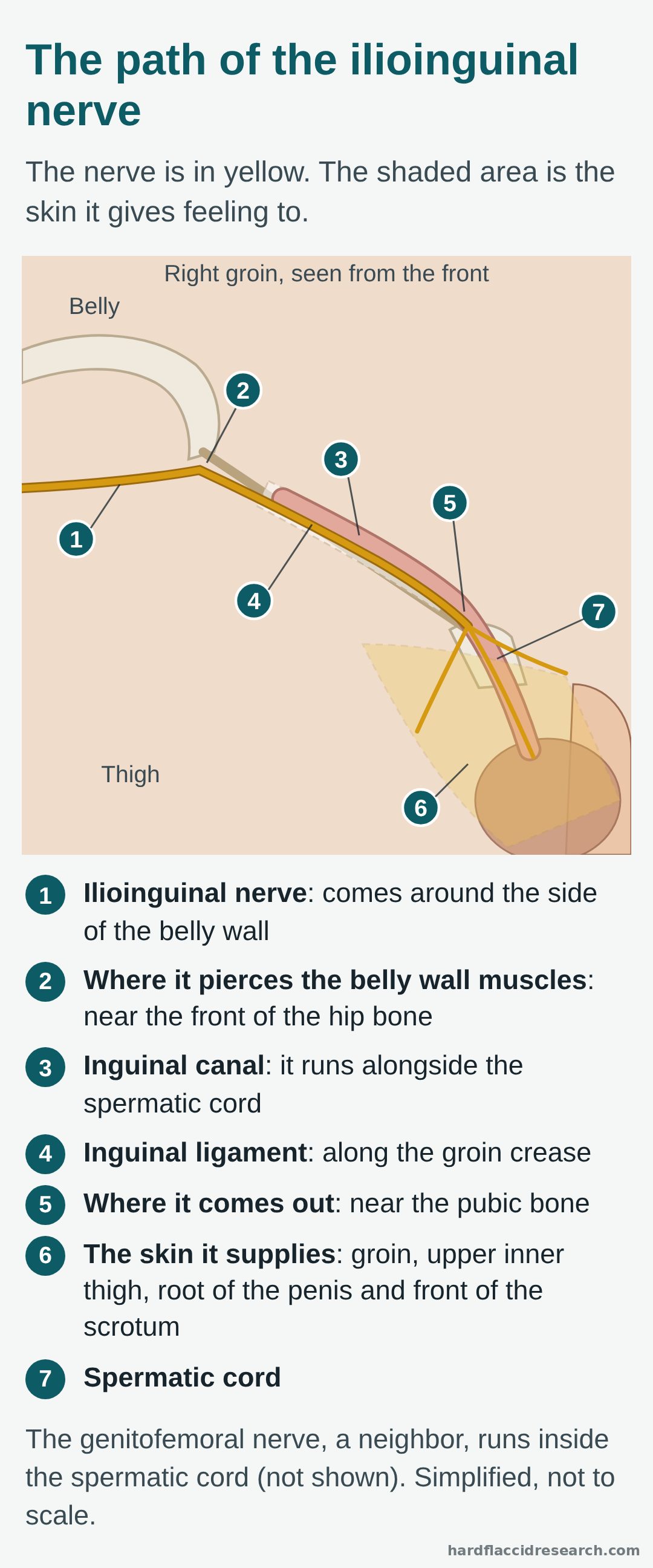
- It starts from the lumbar plexus, a network of nerves in the lower back.
- It runs around the inside of the back and side of the belly wall, toward the front of the hip bone.
- Near the bony point at the front of the hip, it pierces the deep muscles of the belly wall.
- It enters the inguinal canal, the short tunnel in the groin, and runs alongside the spermatic cord.
- It comes out of the canal near the pubic bone, at the superficial inguinal ring.
- Its branches spread to the skin of the groin, the upper inner thigh, the root of the penis and the front of the scrotum.
Related: Gabapentin for Hard Flaccid: Worth the Side Effects? »
What does the ilioinguinal nerve do?
It carries feeling
It carries touch, temperature and pain from the skin it supplies. That's why irritation of the nerve causes pain, tingling or numbness in that area.
It helps the belly wall
It sends small branches to the lower parts of the internal oblique and transversus abdominis, two deep muscles of the belly wall that help protect the groin.
What causes ilioinguinal nerve pain?
Hernia surgery
The nerve runs right through the area repaired in inguinal hernia surgery. It can be stretched, cut, caught in a stitch or irritated by scar tissue or mesh. International hernia guidelines describe long-lasting pain after groin hernia repair as one of the most frequent problems after the operation.
Other surgery
Operations on the lower belly, such as appendix removal, cesarean sections in women and some urological procedures, can also affect it.
Entrapment and strain
Tight belly wall muscles, a direct blow, or repeated strain in sports can irritate the nerve where it passes through the muscles.
Tight clothing and posture
Tight belts or waistbands pressing on the front of the hip can irritate the nerve in some people.
Related: Epididymis: Where It Is, What It Does and Why It Hurts »
What does ilioinguinal neuralgia feel like?
- Burning, stabbing or electric pain in the groin.
- Pain that spreads to the upper inner thigh, the root of the penis or the scrotum.
- Numbness, tingling or extra sensitivity of the skin in that area.
- Pain that's worse with walking, standing up straight, bending back or straining, and better when lying with the hip bent.
- Tenderness near the front of the hip bone.
How is it diagnosed?
A doctor will ask about past operations and examine the groin, the hip and the skin, testing for numbness or extra sensitivity. They may suggest:
- An examination for a hernia.
- An ultrasound scan of the groin.
- A nerve block, an injection of local anesthetic near the nerve. If the pain eases, the nerve is likely involved.
- Nerve studies, in some cases.
Groin pain has many causes, including muscle strains, hernias and hip problems, so a careful examination is important. Our doctor visit kit helps you describe the pain and any past surgery.
How is it treated?
- Medicines for nerve pain, such as certain anticonvulsants or antidepressants, from your doctor.
- Physical therapy, including myofascial release and gentle stretching of the belly wall and hip.
- Avoiding tight belts and waistbands.
- Nerve blocks with local anesthetic, sometimes with a steroid, which can ease pain for a while and help confirm the diagnosis.
- Other procedures from a pain specialist, such as radiofrequency treatment.
- Surgery to remove the irritated nerve or release it from scar tissue or mesh, for severe pain that doesn't improve.
Ilioinguinal nerve and hard flaccid syndrome
Hard flaccid syndrome is a firm, shrunken penis at rest, often with numbness, weaker erections and pelvic pain. The ilioinguinal nerve gives feeling to the root of the penis and front of the scrotum, but most feeling in the penis comes from the pudendal nerve. There's no evidence that the ilioinguinal nerve causes hard flaccid. Some men with hard flaccid do have groin aching or changes in skin sensation, and it helps to know which nerve covers which area.
Of the 2,661 men who described their symptoms, 34% described numbness or reduced sensation (914 men), 10% described pelvic, perineal or tailbone pain (267 men) and 4% described testicle pain or a tight scrotum (102 men). In a separate count, 246 men discussed nerve blocks.
Our members' guide, Hard Flaccid Pain and Flare-Ups: How to Calm Them, has a plan for days when pain spreads to the groin and thighs.
When should I see a doctor?
See a primary care provider if you have groin pain that lasts more than a few weeks, keeps coming back, follows a hernia operation, or comes with numbness or burning in the groin, thigh or scrotum.
Get urgent care straight away (call 911 or go to the emergency room) if you have:
- A painful bulge in the groin or scrotum that won't go back in, especially with vomiting.
- Sudden, severe pain or swelling in a testicle, especially with nausea or vomiting.
- A fever or chills with groin pain, or a hot, red, swollen wound after surgery.
- New numbness around your back passage, genitals or inner thighs, or new weakness in your legs.
- Sudden, severe pain in the penis, testicles or pelvis.
Frequently asked questions
Where does the ilioinguinal nerve give feeling?
To the skin over the groin, the upper inner thigh, the root of the penis and the front of the scrotum.
Can the ilioinguinal nerve cause testicle pain?
It can cause pain in the front of the scrotum and the groin, which may feel like testicle pain. A doctor should rule out other causes.
How common is nerve pain after hernia surgery?
Long-lasting pain is one of the most frequent problems after groin hernia repair, though most men recover well. Severe nerve pain is much less common.
What's the difference between the ilioinguinal and genitofemoral nerves?
Both supply the groin and scrotum. The genitofemoral nerve's genital branch runs inside the spermatic cord and also controls the cremaster muscle.
Can a tight belt cause groin nerve pain?
It can contribute in some people, by pressing on the nerve near the front of the hip bone.
Does ilioinguinal neuralgia go away?
It often improves with time and treatment. Persistent cases can be treated by a pain specialist or surgeon.
Can physical therapy help groin nerve pain?
It can. Releasing tight belly wall and hip muscles and improving how you move may ease pressure on the nerve.
Where exactly is the ilioinguinal nerve?
It runs through the groin just above the crease between the belly and the thigh, alongside the spermatic cord, and comes out near the pubic bone.
Can sitting or exercise make it worse?
Standing up straight, walking and bending back often make ilioinguinal pain worse, while sitting or lying with the hip bent may ease it.
Is ilioinguinal pain the same as a groin strain?
No. A strain affects muscles or tendons and hurts with movement. Nerve pain is often burning or electric and comes with numbness or extra sensitive skin.
Takeaway
The ilioinguinal nerve runs through the groin with the spermatic cord and gives feeling to the groin, inner thigh, root of the penis and front of the scrotum.
When it's irritated, often after hernia surgery, it causes burning groin pain that can be treated with medicines, physical therapy, nerve blocks or surgery. Take our free self-check if you also notice changes in your penis at rest.
This article is for general information and isn't a substitute for advice from your own doctor. Hard Flaccid Research doesn't diagnose or treat. If you have new or worsening symptoms, see a qualified clinician. In an emergency, call 911.
Free tools that can help
- Self-check: do I have hard flaccid?Compare your symptoms with what 6,026 men report.
- Doctor visit kitA one-page summary to take to your appointment.
- Habit trackerCount your days without porn or masturbation, and get through urges.
- Diaphragm breathing toolBreathe with a moving picture of your diaphragm and pelvic floor.
- Add your experienceTell us what you tried and how it went. No name needed.
- Hard Flaccid Syndrome CensusWhat men answered in 818 polls.
- Symptom trackerLog your symptoms and see what helps you.
- Ask us a questionThe questions men ask most become new articles.
The numbers behind this article
Every number in this article comes from what men with hard flaccid syndrome shared between December 2020 and October 2026, counted once per person, or from their polls. These are self-selected reports, not a clinical study. See hard flaccid syndrome statistics, the Hard Flaccid Syndrome Census and how we count.
34% of men who described their symptoms described numbness or reduced sensation
Share of the 2,661 men who described their symptoms. Each man is counted once.These are self-selected reports, not a clinical study.
Source: Hard Flaccid Research, hardflaccidresearch.com
Every number in this article, with its source
| In this article | Source |
|---|---|
| 10% of the men who described their symptoms described pelvic, perineal or tailbone pain (267 of 2,661) | 267 of 2,661 men, counted |
| 34% of the men who described their symptoms described numbness or reduced sensation (914 of 2,661) | 914 of 2,661 men, counted |
| 4% of the men who described their symptoms described testicle pain or a tight scrotum (102 of 2,661) | 102 of 2,661 men, counted |
| 6,026 men shared their experiences, and 2,661 of them described their symptoms | 2,661 of 6,026 men, counted |
| 246 men discussed nerve blocks | 246 men discussing nerve blocks, counted from what men wrote, once per person |
Medical sources
What this article says about medical research, guidelines and urgent care comes from these sources.
- Ilioinguinal Neuralgia. In: StatPearls. Treasure Island (FL): StatPearls Publishing. https://pubmed.ncbi.nlm.nih.gov/30855844/
- Anatomy, Abdomen and Pelvis: Inguinal Region (Inguinal Canal). In: StatPearls. Treasure Island (FL): StatPearls Publishing. https://www.ncbi.nlm.nih.gov/books/NBK470204/
- Anatomy, Abdomen and Pelvis: Genitofemoral Nerve. In: StatPearls. Treasure Island (FL): StatPearls Publishing. https://www.ncbi.nlm.nih.gov/books/NBK430733/
- Genitofemoral Neuralgia. In: StatPearls. Treasure Island (FL): StatPearls Publishing. https://pubmed.ncbi.nlm.nih.gov/39163445/
- HerniaSurge Group. International guidelines for groin hernia management. Hernia. 2018;22(1):1-165. https://doi.org/10.1007/s10029-017-1668-x
- Maloy W, Merrigan B, Hulsopple CD. Groin pain and injuries: evaluation and management. Am Fam Physician. 2025;111(4):337-343. https://pubmed.ncbi.nlm.nih.gov/40238976/
How we made this article
We started from the question many men asked. Every number was checked against our data. Our editorial team edited it and Dr. Julian Reyes reviewed it medically. Read our editorial policy.
Read next
See more of us on Google
Add Hard Flaccid Research as a preferred source, and Google shows you our pages more often when you search.
Add as a preferred sourceDon't see your question? Ask us. We answer the most-asked ones in new articles.
Cite and share this article
You're welcome to quote this article. Please name Hard Flaccid Research and link to this page, so others can find the full answer and the data behind it. To cite this page, use its link.
Citation
Hard Flaccid Research. (2026). Ilioinguinal Nerve: Path, What It Does and Groin Pain. Written by the Editorial Team, medically reviewed by Dr. Julian Reyes. https://hardflaccidresearch.com/articles/ilioinguinal-nerve
Credit link for your article
Source: <a href="https://hardflaccidresearch.com/articles/ilioinguinal-nerve">Hard Flaccid Research</a>
Wikipedia reference
<ref>{{cite web |url=https://hardflaccidresearch.com/articles/ilioinguinal-nerve |title=Ilioinguinal Nerve: Path, What It Does and Groin Pain |website=Hard Flaccid Research |date=2026 |access-date=22 November 2026}}</ref>
How the data was collected: our methodology. Journalists and researchers: key numbers, data and contact.