Osteitis Pubis: Pubic Bone Pain in Men, Causes and Relief
In short
- Osteitis pubis is painful inflammation of the pubic symphysis, the joint at the front of the pelvis where the two pubic bones meet, and the bone and tissue around it.
- It's most common in athletes who kick, sprint or change direction, but it can also follow pelvic or urological surgery.
- It causes pain over the pubic bone that can spread to the groin, inner thighs, lower belly or scrotum.
- Most cases improve with rest, physical therapy and time.
Osteitis pubis is painful inflammation of the pubic symphysis, the joint at the very front of the pelvis where the two pubic bones meet, along with the bone and tissue around it. It causes pain right over the pubic bone, just above the base of the penis, that can spread into the groin, the inner thighs, the lower belly or the scrotum.
It's best known in athletes, especially in sports with kicking, sprinting and sudden changes of direction, such as soccer, hockey and running. It can also follow surgery on the bladder, prostate or other pelvic organs. It's usually not serious, but it can be stubborn. Most men improve with rest, physical therapy and time. This page explains the causes, symptoms, diagnosis and treatment, and when pubic bone pain needs urgent care.
By the numbers: of the 6,026 men who shared their experiences with hard flaccid syndrome, 2,661 described their symptoms, and 267 of them described pelvic, perineal or tailbone pain.
Key facts
- The pubic symphysis is a firm joint, padded with a disc of cartilage, that joins the two pubic bones at the front of the pelvis.
- Osteitis pubis is inflammation and stress of this joint and the bone next to it.
- Its exact cause isn't fully understood. Repeated pulling from the belly muscles above and the inner thigh muscles below is thought to play a big part.
- It's more common in men than women, and most common in athletes.
- Stiff hips and some pelvic surgeries can also lead to it.
- It causes pain over the pubic bone that may spread to the groin, inner thighs, lower belly or scrotum.
- Most cases improve with rest from aggravating activities and a gradual rehab program.
Where is the pubic symphysis?
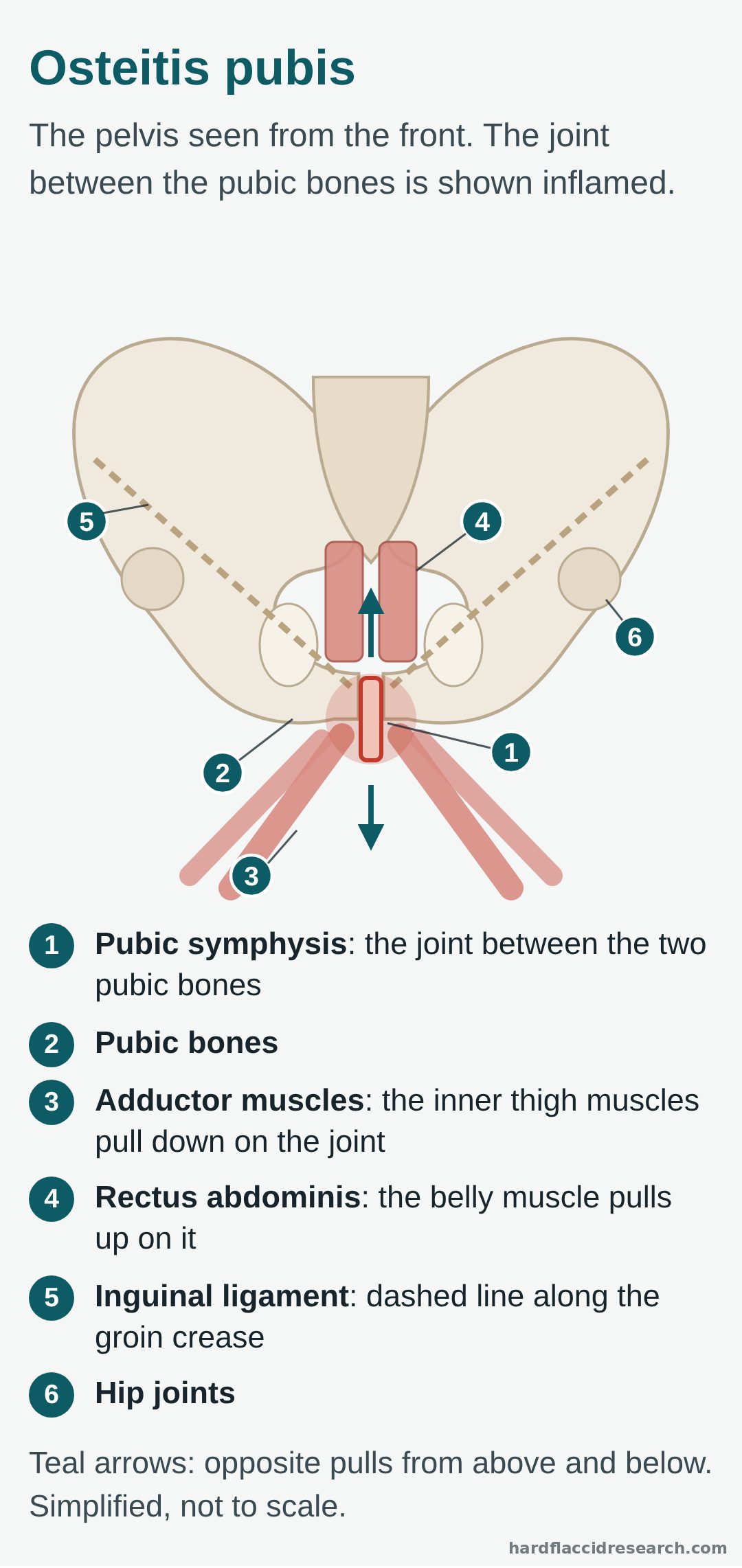
Feel the bony ridge in the middle of your lower belly, just above the base of the penis. That's the front of the pelvis, where the two pubic bones meet. The joint between them is the pubic symphysis. It moves only a tiny amount, absorbing shock and keeping the two sides of the pelvis steady.
Several strong muscles attach near it:
- The rectus abdominis, the long belly muscle, pulls up on it from above.
- The adductors, the inner thigh muscles, pull down on it from below.
- The inguinal ligament, along the groin crease, attaches nearby at the pubic tubercle.
Related: Sit Bone Pain: Causes of Ischial Tuberosity Pain and Relief »
What causes osteitis pubis?
Sport
Running, kicking, sprinting, cutting and twisting cause the belly muscles and the inner thigh muscles to pull on the joint in opposite directions, again and again. Over time, this can stress the joint and the bone, causing inflammation and pain.
Stiff hips
When the hip joints don't move freely, for example with femoroacetabular impingement, more movement and strain may pass through the pubic symphysis.
Surgery and procedures
Osteitis pubis is a known, uncommon complication of surgery on the bladder, prostate and other pelvic organs.
Other causes
Injury, inflammatory arthritis and, rarely, infection can affect the joint. Infection of the joint, called osteomyelitis pubis, is serious and needs different treatment.
What does osteitis pubis feel like?
- Aching or sharp pain over the pubic bone, in the middle of the lower belly.
- Pain that spreads to one or both groins, the inner thighs, the lower belly or the scrotum.
- Pain with running, kicking, climbing stairs, getting out of a car, sit-ups or standing on one leg.
- Tenderness when the pubic bone is pressed.
- Sometimes a clicking feeling at the front of the pelvis.
- Pain that builds gradually over weeks.
Related: Perineum Pain With Hard Flaccid: Why It Hurts, What Helps »
How is osteitis pubis diagnosed?
A primary care provider, a sports medicine doctor or a physical therapist will ask about your activities and examine the groin, pressing on the pubic bone and testing the hips, belly muscles and inner thigh muscles. They may suggest:
- X-rays, which may show changes at the joint, though early on they can look normal.
- An MRI scan, which can show swelling in the bone and other causes of groin pain.
- An examination and ultrasound for a hernia, a common cause of groin pain.
- Blood tests, if an infection is possible.
Groin pain has many causes, including adductor strains, hernias, hip problems and nerve irritation, and they often happen together. Our doctor visit kit helps you describe your symptoms clearly.
How is osteitis pubis treated?
Relative rest
Stop or cut back on activities that cause pain, such as running and kicking. Low-impact exercise, like cycling or swimming, may be allowed if it doesn't hurt.
Physical therapy
Doctors who treat groin pain recommend active, supervised physical therapy as the first treatment. A program usually includes:
- Gentle stretching of the hips and inner thighs.
- Strengthening of the inner thigh muscles, the deep belly muscles and the hips.
- Work on core control and balance.
- A gradual return to running and sport over weeks to months.
Pain relief
Ice and pain relief a doctor or pharmacist suggests can ease pain. Injections into the joint are sometimes used for stubborn pain.
Surgery
Surgery is rarely needed and is reserved for long-lasting pain that doesn't improve with other treatment.
How long does osteitis pubis take to heal?
It varies. Mild cases can settle in weeks, while more severe ones can take several months. Returning to sport too soon is a common reason pain comes back, so a gradual, guided return matters.
Osteitis pubis and hard flaccid syndrome
Hard flaccid syndrome is a firm, shrunken penis at rest, often with numbness, weaker erections and pelvic pain. Osteitis pubis isn't part of hard flaccid and doesn't cause it. But it causes pain just above the base of the penis and in the groin, which can be confused with other pelvic pain conditions. Telling them apart helps you get the right treatment.
Of the 2,661 men who described their symptoms, 10% described pelvic, perineal or tailbone pain (267 men) and 9% described lower back, hip or hamstring tightness (233 men).
Our members' guide, Hard Flaccid Pain and Flare-Ups: How to Calm Them, has a calm-down plan for days when pelvic pain flares.
When should I see a doctor?
See a primary care provider or a sports medicine doctor if you have pain over the pubic bone or in the groin that lasts more than a few weeks, keeps coming back or stops you being active.
Get urgent care straight away (call 911 or go to the emergency room) if you have:
- A fever or chills with pain over the pubic bone, especially after surgery.
- Severe pain after a fall or injury, or you can't put weight on your leg.
- A painful bulge in the groin that won't go back in, especially with vomiting.
- Sudden, severe pain or swelling in a testicle.
- Sudden, severe pain in the penis, testicles or pelvis.
Frequently asked questions
Is osteitis pubis the same as a sports hernia?
No, though they can happen together. A sports hernia, or athletic pubalgia, involves the muscles and tendons of the lower belly wall and groin. Osteitis pubis involves the joint and bone.
Can osteitis pubis cause pain in the testicles?
It can cause pain that spreads to the groin and scrotum. Pain in the testicle itself should be checked for other causes.
Can I keep training with osteitis pubis?
Usually only activities that don't cause pain. A physical therapist can help plan a safe program.
What exercises help osteitis pubis?
Gentle hip and inner thigh stretches, and gradual strengthening of the inner thighs, deep belly muscles and hips, guided by a physical therapist.
Is osteitis pubis an infection?
Usually not. It's inflammation and stress of the joint. Infection of the joint is a different, rarer condition.
Can osteitis pubis come back?
It can, especially if you return to sport too quickly. A gradual return and ongoing strengthening help prevent it.
Is osteitis pubis common?
It isn't common in the general population, but it's a well-known cause of groin pain in athletes, especially in kicking and running sports.
Can osteitis pubis cause pain during sex?
It can, if movement puts pressure on the front of the pelvis. Positions that avoid pressure on the pubic bone may help while it heals.
Does osteitis pubis show on an X-ray?
Sometimes, but early on X-rays can look normal. An MRI scan is better at showing swelling in the bone.
Can I cycle with osteitis pubis?
Often yes, if it doesn't hurt. Cycling is gentler on the joint than running, but stop if pain increases.
Takeaway
Osteitis pubis is painful inflammation of the joint at the front of the pelvis, most often from repeated strain in sport or after pelvic surgery. It causes pain over the pubic bone that can spread to the groin, thighs and scrotum.
Relative rest and a gradual physical therapy program help most men, and fever or severe pain needs prompt care. Take our free self-check if you also notice changes in your penis at rest.
This article is for general information and isn't a substitute for advice from your own doctor. Hard Flaccid Research doesn't diagnose or treat. If you have new or worsening symptoms, see a qualified clinician. In an emergency, call 911.
Free tools that can help
- Self-check: do I have hard flaccid?Compare your symptoms with what 6,026 men report.
- Doctor visit kitA one-page summary to take to your appointment.
- Habit trackerCount your days without porn or masturbation, and get through urges.
- Diaphragm breathing toolBreathe with a moving picture of your diaphragm and pelvic floor.
- Add your experienceTell us what you tried and how it went. No name needed.
- Hard Flaccid Syndrome CensusWhat men answered in 818 polls.
- Symptom trackerLog your symptoms and see what helps you.
- Ask us a questionThe questions men ask most become new articles.
The numbers behind this article
Every number in this article comes from what men with hard flaccid syndrome shared between December 2020 and October 2026, counted once per person, or from their polls. These are self-selected reports, not a clinical study. See hard flaccid syndrome statistics, the Hard Flaccid Syndrome Census and how we count.
10% of men who described their symptoms described pelvic, perineal or tailbone pain
Share of the 2,661 men who described their symptoms. Each man is counted once.These are self-selected reports, not a clinical study.
Source: Hard Flaccid Research, hardflaccidresearch.com
Every number in this article, with its source
| In this article | Source |
|---|---|
| 10% of the men who described their symptoms described pelvic, perineal or tailbone pain (267 of 2,661) | 267 of 2,661 men, counted |
| 9% of the men who described their symptoms described lower back, hip or hamstring tightness (233 of 2,661) | 233 of 2,661 men, counted |
| 6,026 men shared their experiences, and 2,661 of them described their symptoms | 2,661 of 6,026 men, counted |
Medical sources
What this article says about medical research, guidelines and urgent care comes from these sources.
- Osteitis Pubis. In: StatPearls. Treasure Island (FL): StatPearls Publishing. https://www.ncbi.nlm.nih.gov/books/NBK556168/
- Maloy W, Merrigan B, Hulsopple CD. Groin pain and injuries: evaluation and management. Am Fam Physician. 2025;111(4):337-343. https://pubmed.ncbi.nlm.nih.gov/40238976/
- Lentz SS. Osteitis pubis: a review. Obstet Gynecol Surv. 1995;50(4):310-315. https://doi.org/10.1097/00006254-199504000-00026
- Adult Inguinal Hernia. In: StatPearls. Treasure Island (FL): StatPearls Publishing. https://www.ncbi.nlm.nih.gov/books/NBK537241/
- Anatomy, Abdomen and Pelvis: Inguinal Region (Inguinal Canal). In: StatPearls. Treasure Island (FL): StatPearls Publishing. https://www.ncbi.nlm.nih.gov/books/NBK470204/
How we made this article
We started from the question many men asked. Every number was checked against our data. Our editorial team edited it and Dr. Julian Reyes reviewed it medically. Read our editorial policy.
Read next
See more of us on Google
Add Hard Flaccid Research as a preferred source, and Google shows you our pages more often when you search.
Add as a preferred sourceDon't see your question? Ask us. We answer the most-asked ones in new articles.
Cite and share this article
You're welcome to quote this article. Please name Hard Flaccid Research and link to this page, so others can find the full answer and the data behind it. To cite this page, use its link.
Citation
Hard Flaccid Research. (2026). Osteitis Pubis: Pubic Bone Pain in Men, Causes and Relief. Written by the Editorial Team, medically reviewed by Dr. Julian Reyes. https://hardflaccidresearch.com/articles/osteitis-pubis
Credit link for your article
Source: <a href="https://hardflaccidresearch.com/articles/osteitis-pubis">Hard Flaccid Research</a>
Wikipedia reference
<ref>{{cite web |url=https://hardflaccidresearch.com/articles/osteitis-pubis |title=Osteitis Pubis: Pubic Bone Pain in Men, Causes and Relief |website=Hard Flaccid Research |date=2026 |access-date=22 November 2026}}</ref>
How the data was collected: our methodology. Journalists and researchers: key numbers, data and contact.