Pelvic Floor & Hip Flexor Stretches for Men
In short
- Pelvic floor and hip flexor stretches are gentle stretches for the muscles around the pelvis, plus positions that let the pelvic floor soften as you breathe, and physios often use them for a tight pelvic floor. 1,288 men with hard flaccid syndrome mentioned stretching, and it came up in 40 of 126 recovery stories, though it isn't proven to treat hard flaccid syndrome.
- Go gently, little and often, never into pain, and see a doctor first if your symptoms haven't been checked.
216 men with hard flaccid asked this question.
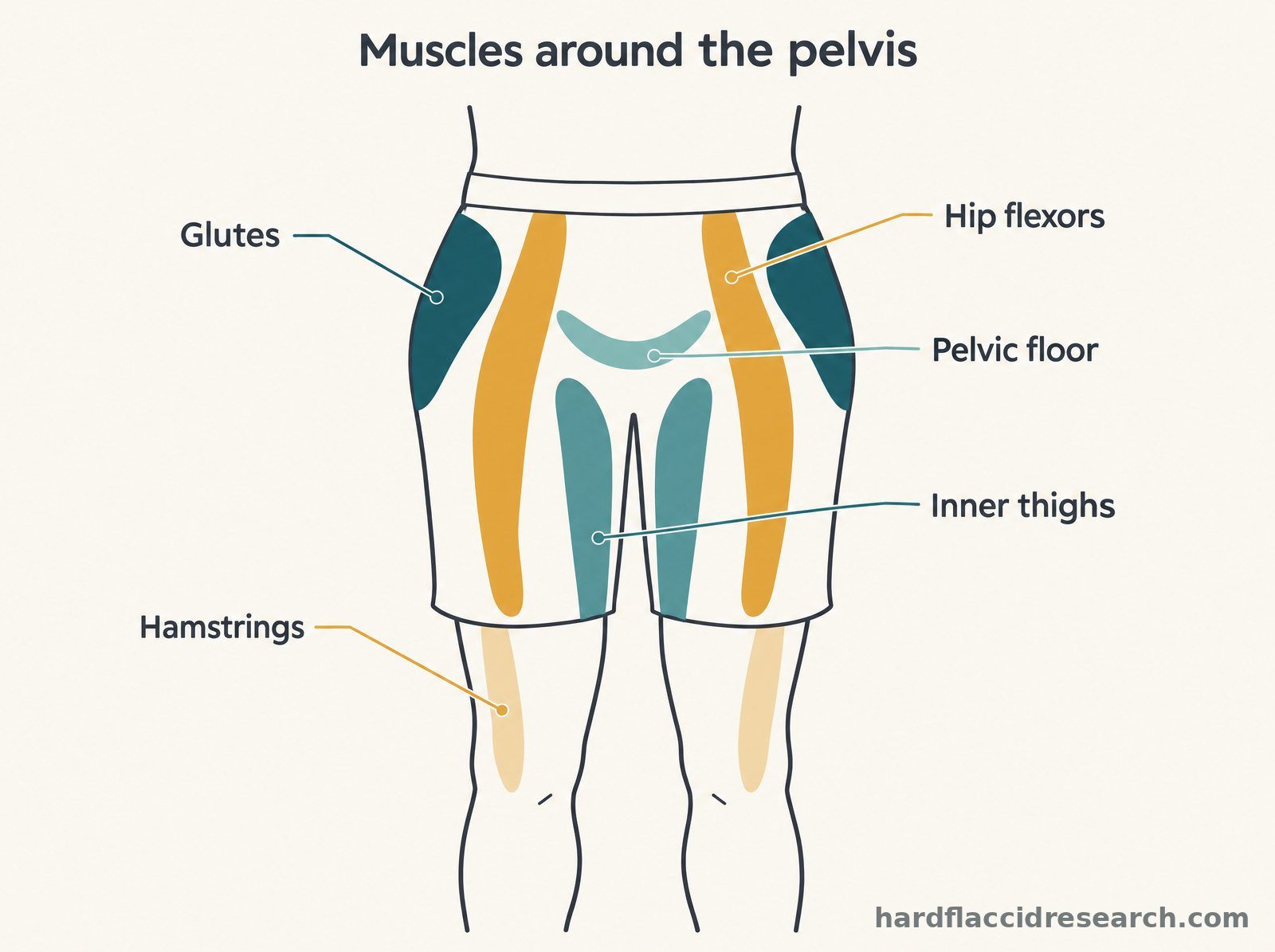
Pelvic floor and hip flexor stretches are gentle stretches for the muscles around your pelvis: the hip flexors at the front, the inner thighs, the glutes and the hamstrings, along with positions that let the pelvic floor soften as you breathe. Physios who treat pelvic pain often use them for a tight pelvic floor. 1,288 men with hard flaccid syndrome, where the penis stays firm or rubbery when it should be soft, mentioned stretching, and it came up in 40 of 126 recovery stories, though a story mentioning something is not proof that it worked.
No stretch is proven to treat hard flaccid, and being mentioned is not the same as working. But stretching is low risk when done gently. This page explains why stretching the hips and pelvic floor may help, the signs of tightness, the stretches physios often suggest, how to stretch safely, a simple daily routine and the other exercises men mention. 216 men asked which stretches or exercises help.
By the numbers: between December 2020 and October 2026, 2,661 of the 6,026 men who shared their experiences described their symptoms: 601 described pelvic floor tightness, spasm or twitching, and 233 tight hips, hamstrings or lower back. 1,288 men mentioned stretching.
Why stretch the pelvic floor and hips?
The pelvic floor doesn't work alone. The pelvic floor is the sling of muscles between your legs that supports your bladder and bowel and helps control erections. It sits inside a ring of muscles: the hip flexors at the front (including the psoas, which runs from your lower back to your thigh), the inner thigh muscles, the glutes and deep hip muscles at the back, and the hamstrings behind your thighs. These are the ideas physios discuss most. None is proven for hard flaccid syndrome.
- Tight neighbours. When the muscles around the hips are tight, the pelvic floor may tighten with them, as part of the same guarding. When the pelvic floor stays tight, the resting penis may feel firmer or more pulled in.
- Sitting. Long hours of sitting may keep the hip flexors short and press on the area between your legs.
- Stress. Doctors think stress makes many people brace their hips, belly and pelvic floor without noticing.
- Letting go. Slow stretching with slow breathing may help the body switch out of a braced, on-guard state.
233 men with hard flaccid described tight hips, hamstrings or lower back, and 67% of them mentioned stretching. Among the 601 men who described pelvic floor tightness, spasm or twitching, 64% mentioned stretching, and among the 1,553 men who described the firm flaccid state, 45% did.
Hard Flaccid Explorerby Hard Flaccid Research
Stretches for the pelvic floor and hips
A 7-minute animated explainer of this article. Press play, or skip between chapters. The first minute is free for everyone.
A picture to explain, not a diagnosis. No stretch is proven to treat hard flaccid syndrome.
Signs of tight hip flexors and a tight pelvic floor
Tight hip flexors may show up as:
- A tight or pulling feeling at the front of the hip, especially after sitting.
- An ache in the lower back when you stand for a while.
- Finding it hard to straighten your hip fully, for example in a lunge or a long stride.
- A pelvis that tips forward, with a bigger curve in the lower back, though posture varies a lot from man to man.
Each of these can have other causes too, such as a back or hip joint problem. Back pain with numbness or tingling down a leg, or weakness in a leg, needs a doctor rather than stretches.
Signs your pelvic floor may be too tight include pain between your legs or around your tailbone, a slow stream, straining on the toilet, and pain during or after ejaculation. For men with hard flaccid syndrome, a firm or pulled-in resting penis is often linked to a tight pelvic floor, though this isn't proven. Each of these can have other causes, so see a doctor or a pelvic health physio to check. New trouble starting your pee, or not being able to pee, needs urgent care (see the list below).
Of the 2,661 men who described their symptoms, 23% described pelvic floor tightness, spasm or twitching (601 of 2,661) and 9% tight hips, hamstrings or lower back (233 of 2,661).
Related: Anterior Pelvic Tilt and Hard Flaccid: Is Posture to Blame? »
Hip flexor stretches
The hip flexors, including the psoas, run from your lower back and pelvis to the top of your thigh. Hold each stretch gently for about half a minute, breathe slowly into your belly, and never push into pain.
- Kneeling hip flexor stretch, also called a psoas stretch: kneel on one knee on a cushion, the other foot flat in front. Tuck your tailbone under, keep your back tall without arching it, and shift gently forward until you feel the front of the hip of the kneeling leg. Swap sides.
- Standing hip flexor stretch: stand in a short lunge holding a chair or wall, back heel off the floor. Tuck your tailbone under and ease forward. A good choice if kneeling hurts your knees.
- Couch stretch: a stronger version. Kneel with your back knee on a cushion close to a wall or sofa, the shin and top of the foot resting up against it, and the other foot flat in front. Tuck your tailbone under and keep your back tall. It can be intense, so ease into it, and skip it if it hurts your knee or hip.
Pelvic floor stretches
The pelvic floor can't be stretched like a hamstring. But some positions let it lengthen and soften as you breathe in, which physios often pair with reverse Kegels:
- Happy baby: lie on your back, bring your knees up towards your armpits, hold the outsides of your feet with the soles facing the ceiling, and let your knees drop wide. If you can't reach your feet, hold behind your thighs. Many physios use it to help the pelvic floor soften.
- Child's pose: kneel, sit back towards your heels with your knees wide, and rest your forehead on the floor or a cushion. Breathe into your lower back and let the area between your legs soften. Skip it if it hurts your knees.
- Supported deep squat: hold onto a counter and sink down as far as is comfortable, letting your pelvic floor soften. Skip it if it hurts your knees.
- Breathing into the pelvic floor: lying on your back with your knees bent, breathe slowly into your belly and feel the area between your legs gently drop, then let it rise back on its own as you breathe out, without squeezing. It is a letting go, never a push.
Related: Yoga for Hard Flaccid: The Poses That Help vs Hurt »
Inner thigh, glute and hamstring stretches
- Butterfly stretch: sit with the soles of your feet together and let your knees fall out to stretch the inner thighs. Don't press your knees down.
- Frog stretch: on hands and knees, slide your knees wide apart with your ankles in line with your knees, and ease your hips back until you feel the inner thighs. It is a deep stretch, so go gently, pad your knees, and skip it if it hurts your knees, hips or groin.
- Figure-four stretch, also called a piriformis or glute stretch: lying on your back, cross one ankle over the other knee and draw both legs towards you, for the glutes and deep hip muscles. Swap sides.
- Hamstring stretch: lie on your back with one knee bent and that foot flat. Loop a towel or strap around the other foot and slowly raise that leg, knee slightly bent, until you feel a gentle stretch at the back of the thigh. Swap sides.
Our members' guide, The Hard Flaccid Stretch Plan, has illustrated steps for eight stretches, with a built-in timer, how long to hold each one and what to skip.
How to stretch without making things worse
- Go gently. Stretch to mild tension, never to pain, and don't bounce.
- Breathe slowly into your belly, and let your pelvic floor gently drop and soften each time you breathe in.
- Little and often: many physios suggest a few minutes once or twice a day rather than long, hard sessions.
- Stop any stretch that brings on burning, sharp pain, tingling or numbness. If it doesn't settle soon after you stop, see a doctor or physio, and if numbness around your back passage, genitals or inner thighs is new, get urgent care (see the list below).
- Break up sitting. Walking breaks every half hour or so may stop the hip flexors staying short all day.
- Go easy on heavy bracing and breath-holding while your pelvic floor feels tight. If your pelvic floor feels tight, ask a pelvic health physio before doing Kegels, and let go fully between squeezes.
- If you have a hip, knee or back problem, or you've had surgery, ask a physio which stretches suit you.
A simple daily stretching routine
If you're not sure where to start, many physios suggest something short every day rather than a long session now and then. For example, once or twice a day:
- A minute or two of slow belly breathing, lying on your back with your knees bent.
- A kneeling hip flexor stretch, each side.
- A figure-four stretch, each side.
- Happy baby or child's pose, breathing slowly.
- A short walk, and short walking breaks when you sit for long spells.
It takes about ten minutes. Notice how you feel over the next day, and drop anything that makes your symptoms worse.
Other exercises men with hard flaccid syndrome mention
- Reverse Kegels: 704 men mentioned reverse Kegels or pelvic floor relaxation, and they came up in 20 of 126 recovery stories. A reverse Kegel is a gentle letting go of the pelvic floor, the opposite of a squeeze.
- Breathing exercises: 425 men, and 16 of 126 recovery stories. Slow belly breathing may help the pelvic floor move and soften.
- Core, glute and posture strengthening: 361 men, and 15 of 126 recovery stories. Avoid holding your breath and bracing hard, which may also tighten the pelvic floor.
- Walking and cardio: 483 men, and 12 of 126 recovery stories. Walking is low risk and breaks up long spells of sitting.
- Yoga or Pilates: 202 men, and 11 of 126 recovery stories. Slow, relaxing poses may suit a tight pelvic floor better than classes built around clenching your core.
- Kegels: 846 men, and 19 of 126 recovery stories. Kegels squeeze the pelvic floor, so if yours feels tight, ask a pelvic health physio before doing them, and let go fully between squeezes.
Being mentioned is not the same as working. We count what men say they did while they got better, not what caused the improvement. These are self-selected reports, not a clinical study.
What the research says about stretching
No study has tested stretching on its own for hard flaccid syndrome. In men with chronic pelvic pain, a condition with a lot of overlap, a small randomised trial found that regular aerobic exercise helped more than stretching. Each treatment page on this site has a plain-English summary of the published studies, under What the research says.
So stretching is low risk and may ease tight muscles, but it isn't a proven treatment for hard flaccid.
Common questions about pelvic floor and hip stretches
How long should I hold a stretch? Many physios suggest about half a minute, gently, while you breathe slowly. There's no need to hold longer or push harder.
How often should I stretch? Many physios suggest little and often, such as a few minutes once or twice a day, rather than one long session.
What is the best stretch for a tight pelvic floor? There's no single best stretch. Many physios start with breathing, happy baby or child's pose and a hip flexor stretch, and a pelvic health physio can tell you which suit you.
Can stretching make hard flaccid worse? It may, if you push too hard, bounce or hold your breath, which may make the muscles guard more. Stop any stretch that brings on pain, burning, tingling or numbness, and if numbness between your legs is new, get urgent care (see the list below).
Is yoga good for a tight pelvic floor? Slow, relaxing yoga may suit a tight pelvic floor, but classes built around clenching your core or holding hard poses may not.
Do I need a physio? Many men start gentle stretches on their own. But if your symptoms haven't been checked, see a doctor first, because they can have other causes. A pelvic health physio can check whether your pelvic floor is tight, weak or both, and which stretches suit you.
When to see a doctor
See a doctor or a pelvic health physio if you have pain, numbness or changes in your penis, bladder or bowel that haven't settled, or if stretching makes your symptoms worse. A physio can check whether your pelvic floor is tight and show you which stretches suit you.
Get urgent care straight away if you have:
- Sudden, severe pain in the penis, testicles or pelvis.
- New numbness around your back passage, genitals or inner thighs, or new weakness in your legs.
- New trouble starting or controlling your pee, not being able to pee, or not feeling when your bladder is full.
- Loss of control of your bladder or bowel.
- A fever or chills with pelvic pain or pain when peeing.
If you are feeling hopeless or having thoughts of ending your life, please visit our Support page now. It lists crisis lines you can call or text.
What to do next
- If your symptoms haven't been checked, see a doctor first, because they can have other causes.
- Pick two or three of the stretches above and do them every day for a few weeks.
- Add a short walk and a few minutes of slow belly breathing.
- Use the symptom tracker to see what helps you.
- Take our self-check, and make a doctor visit kit before your appointment.
If you're worried about how a visit will go, many men feel the same: in a November 2022 poll of men who had seen a urologist, 95% called their visits bad and unhelpful (63 of 66 men). That's a reason to prepare well with the doctor visit kit, not to skip the visit.
Free tools that can help
- Self-check: do I have hard flaccid?Compare your symptoms with what 6,026 men report.
- Doctor visit kitA one-page summary to take to your appointment.
- Habit trackerCount your days without porn or masturbation, and get through urges.
- Diaphragm breathing toolBreathe with a moving picture of your diaphragm and pelvic floor.
- Add your experienceTell us what you tried and how it went. No name needed.
- Hard Flaccid Syndrome CensusWhat men answered in 818 polls.
- Symptom trackerLog your symptoms and see what helps you.
- Ask us a questionThe questions men ask most become new articles.
The numbers behind this article
Every number in this article comes from what men with hard flaccid syndrome shared between December 2020 and October 2026, counted once per person, or from their polls. These are self-selected reports, not a clinical study. See hard flaccid syndrome statistics, the Hard Flaccid Syndrome Census and how we count.
In what men wrote, stretching came up more than any other approach
Number of men who mentioned each approach, counted once per person.Mentioned is not the same as worked.
Source: Hard Flaccid Research, hardflaccidresearch.com
Exercises that came up in recovery stories
Share of the 126 recovery stories that mention each. Mentioned is not the same as worked.These are self-selected reports, not a clinical study. A story mentioning something is not proof that it worked.
Source: Hard Flaccid Research, hardflaccidresearch.com
Tightness men described
Share of the 2,661 men who described their symptoms. Each man is counted once.These count men who raised it on their own, so they may undercount.
Source: Hard Flaccid Research, hardflaccidresearch.com
How many men in each group mentioned stretching
Share of the men in each group who mentioned stretching, counted once per person. The groups overlap.Men in smaller symptom groups mention more approaches of every kind, so the gaps may partly reflect how much men wrote. Mentioned is not the same as worked.
Source: Hard Flaccid Research, hardflaccidresearch.com
Other exercises men mention
Number of men who mentioned each, counted once per person.Source: Hard Flaccid Research, hardflaccidresearch.com
How men rated their urologist visits
How 66 men with hard flaccid syndrome who had seen a urologist answered a November 2022 poll.These are self-selected reports, not a clinical study.
Source: Hard Flaccid Research, hardflaccidresearch.com
Every number in this article, with its source
| In this article | Source |
|---|---|
| 1,288 men mentioned stretching | 1,288 men, counted from what men wrote, once per person |
| Stretching came up in 40 of 126 recovery stories | 40 of 126 recovery stories |
| 126 recovery stories | 126 men, counted from what men wrote, once per person |
| 216 men asked which stretches or exercises help | Question group, 216 men, research data |
| Of 233 men with tight hips, hamstrings or back, 67% mentioned stretching | 233 men with tight hips, hamstrings or back, counted from what men wrote, once per person |
| Of 601 men who described pelvic floor tightness, spasm or twitching, 64% mentioned stretching | 601 men with a tight pelvic floor, counted from what men wrote, once per person |
| Of 1,553 men with the firm flaccid state, 45% mentioned stretching | 1,553 men with the firm flaccid state, counted from what men wrote, once per person |
| 704 men mentioned reverse Kegels or pelvic floor relaxation | 704 men, counted from what men wrote, once per person |
| Reverse Kegels came up in 20 of 126 recovery stories | 20 of 126 recovery stories |
| 425 men mentioned breathing exercises | 425 men, counted from what men wrote, once per person |
| Breathing exercises came up in 16 of 126 recovery stories | 16 of 126 recovery stories |
| 361 men mentioned core, glute and posture strengthening | 361 men, counted from what men wrote, once per person |
| Core, glute and posture strengthening came up in 15 of 126 recovery stories | 15 of 126 recovery stories |
| 483 men mentioned walking or cardio | 483 men, counted from what men wrote, once per person |
| Walking or cardio came up in 12 of 126 recovery stories | 12 of 126 recovery stories |
| 202 men mentioned yoga or Pilates | 202 men, counted from what men wrote, once per person |
| Yoga or Pilates came up in 11 of 126 recovery stories | 11 of 126 recovery stories |
| 846 men mentioned Kegels | 846 men, counted from what men wrote, once per person |
| Kegels came up in 19 of 126 recovery stories | 19 of 126 recovery stories |
| 969 men mentioned tadalafil | 969 men, counted from what men wrote, once per person |
| 779 men mentioned rest or abstinence | 779 men, counted from what men wrote, once per person |
| 656 men mentioned pelvic floor physio | 656 men, counted from what men wrote, once per person |
| 95% called urologist visits bad and unhelpful (63 of 66 men) | 63 of 66 men, poll, Nov 2022 |
| Counting since December 2020 | Research data, December 2020 to October 2026 |
| 23% (601 of 2,661) described pelvic floor tightness, spasm or twitching | 601 of 2,661 men, counted from what men wrote, once per person |
| 9% (233 of 2,661) described tight hips, hamstrings or lower back | 233 of 2,661 men, counted from what men wrote, once per person |
| 2,661 of the 6,026 men who shared their experiences described their symptoms | Research data, December 2020 to October 2026 |
How we made this article
We started from the question 216 men asked. Every number was checked against our data. Our editorial team edited it and Dr. Julian Reyes reviewed it medically. Read our editorial policy.
Read next
See more of us on Google
Add Hard Flaccid Research as a preferred source, and Google shows you our pages more often when you search.
Add as a preferred sourceDon't see your question? Ask us. We answer the most-asked ones in new articles.
Cite and share this article
You're welcome to quote this article. Please name Hard Flaccid Research and link to this page, so others can find the full answer and the data behind it. To cite this page, use its link.
Citation
Hard Flaccid Research. (2026). Pelvic Floor & Hip Flexor Stretches for Men. Written by the Editorial Team, medically reviewed by Dr. Julian Reyes. https://hardflaccidresearch.com/articles/hard-flaccid-stretches-exercises
Credit link for your article
Source: <a href="https://hardflaccidresearch.com/articles/hard-flaccid-stretches-exercises">Hard Flaccid Research</a>
Wikipedia reference
<ref>{{cite web |url=https://hardflaccidresearch.com/articles/hard-flaccid-stretches-exercises |title=Pelvic Floor & Hip Flexor Stretches for Men |website=Hard Flaccid Research |date=2026 |access-date=28 October 2026}}</ref>
How the data was collected: our methodology. Journalists and researchers: key numbers, data and contact.