Pelvic Floor Biofeedback for Men: How It Works and Who It Helps
In short
- Pelvic floor biofeedback uses small sensors to show the activity of your pelvic floor muscles on a screen, so you can see when they tighten and when they relax.
- A physical therapist uses it to help you learn to relax a tight pelvic floor or strengthen a weak one.
- It's a standard treatment for straining during bowel movements, and it's also used for pelvic pain, urinary problems and leakage after prostate surgery.
Pelvic floor biofeedback is a way of seeing what your pelvic floor muscles are doing. Small sensors, usually stickers on the skin near the anus or a small probe, pick up the activity of the muscles and show it on a screen as a line or a graph. When you squeeze, the line rises. When you let go, it falls.
Because the pelvic floor is hidden and hard to feel, many men don't know whether theirs is tight, weak or working well. Biofeedback makes it visible, so a physical therapist can teach you to relax a tight pelvic floor or strengthen a weak one. It's a standard treatment for straining during bowel movements and is also used for pelvic pain, urinary problems and leakage after prostate surgery. This page explains how it works, what a session is like and who it helps.
By the numbers: of the 6,026 men who shared their experiences with hard flaccid syndrome, 2,661 described their symptoms, and 601 of them described pelvic floor tightness, spasm or twitching.

Key facts
- Biofeedback uses sensors to show pelvic floor muscle activity on a screen in real time.
- It helps you learn to relax, squeeze and coordinate muscles you can't easily feel.
- A pelvic floor physical therapist usually guides the sessions.
- Specialists in bowel disorders describe biofeedback as the main treatment for dyssynergic defecation, when the pelvic floor tightens instead of relaxing during a bowel movement.
- It's used for men with chronic pelvic pain and tight pelvic floor muscles, alongside other physical therapy.
- A trial of pelvic floor exercises with biofeedback found they helped some men with erection problems.
- For leakage after prostate surgery, a large review found the evidence for exercises with or without biofeedback is uncertain.
How does pelvic floor biofeedback work?
The sensors
The most common type, called EMG biofeedback, uses small sticky sensors placed on the skin near the anus or perineum. Some therapists use a small probe placed just inside the back passage, which can give a clearer signal. Some use a balloon or pressure sensor instead.
The screen
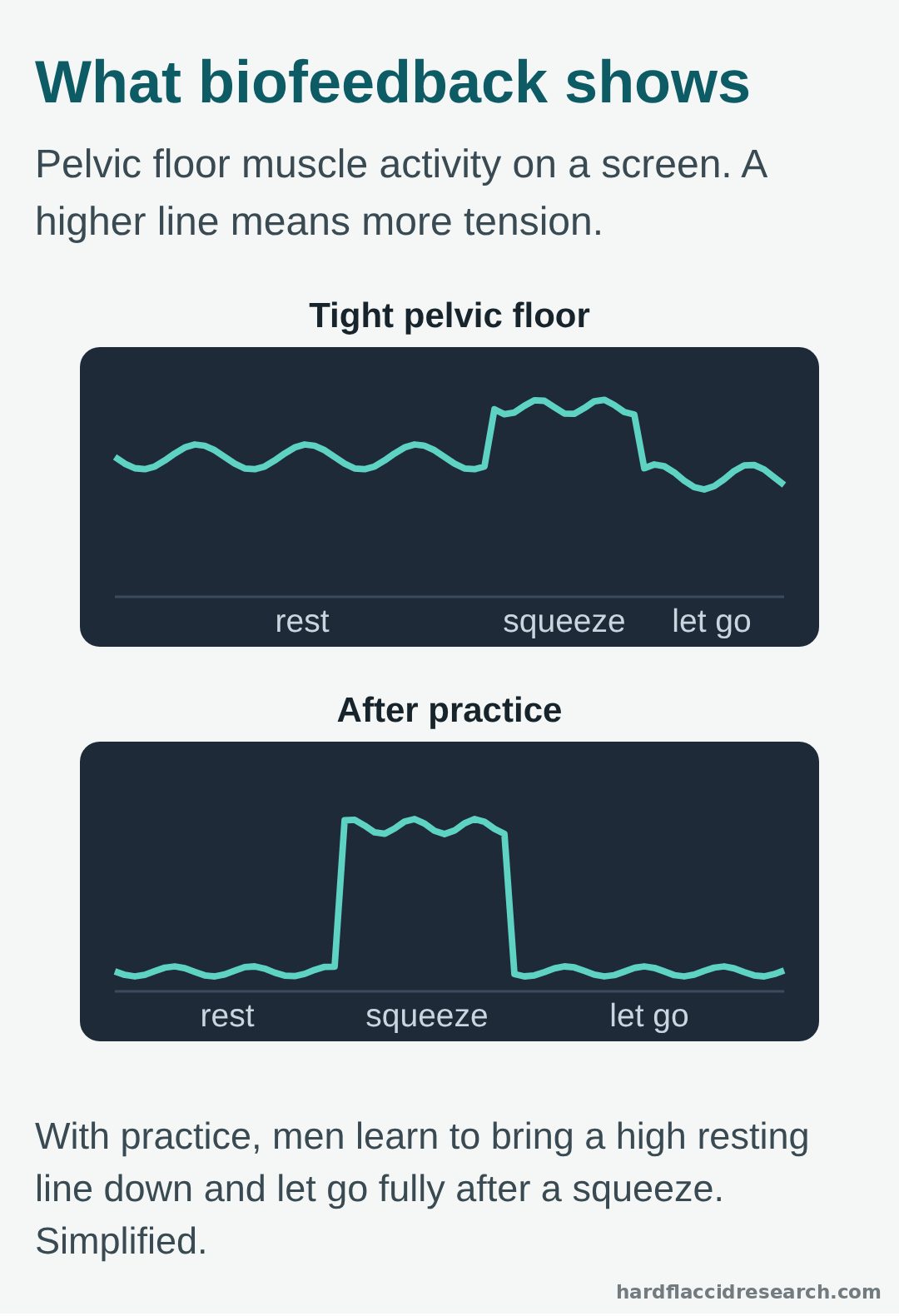
The sensors measure the tiny electrical signals your muscles make. The computer turns them into a line on the screen. A higher line means more muscle activity. You watch the line as you breathe, squeeze and relax, and learn what each action feels like.
Learning to relax
For a tight pelvic floor, the goal is to bring the line down and keep it low at rest. Many men are surprised to see how high their resting line is and how hard it is to let go at first.
Learning to squeeze and coordinate
For a weak pelvic floor, the goal is a strong, quick rise when you squeeze and a full drop when you let go. For bowel problems, you practice relaxing the pelvic floor while gently pushing, the way the body should work during a bowel movement.
Related: Hard Flaccid Worse After a Bowel Movement? Here's Why »
What is a session like?
- You talk with the therapist about your symptoms, and they explain the equipment.
- Sensors go on, and you sit or lie comfortably, usually with your clothes adjusted.
- You watch the screen while the therapist guides you through breathing, relaxing, squeezing and letting go.
- You practice exercises to do at home, sometimes with a home device or app.
- Sessions typically take less than an hour and are repeated over several weeks.
It shouldn't hurt. You can ask questions or stop at any time.
What can pelvic floor biofeedback help?
Straining and constipation
In dyssynergic defecation, the pelvic floor and anal sphincter tighten instead of relaxing when you try to go. Biofeedback teaches them to relax at the right time. Specialists in functional bowel disorders describe it as the main treatment.
Pelvic pain and a tight pelvic floor
For men with chronic pelvic pain and tight, tender pelvic floor muscles, biofeedback can help them learn to relax, usually as part of physical therapy with hands-on release, breathing and stretching. US urology guidelines support pelvic floor physical therapy for men with these findings, and a small trial found physical therapy aimed at these muscles helped more men than general massage.
Urinary problems
Biofeedback can help men who strain to pee, have a stop-start stream from a tight pelvic floor, or have urgency.
Leakage after prostate surgery
Pelvic floor exercises, with or without biofeedback, are often offered after prostate surgery. A large review found the evidence on how much they help is uncertain, and many men improve over time anyway.
Erection problems
A small trial of pelvic floor exercises with biofeedback and lifestyle advice found they helped some men with erectile dysfunction compared with lifestyle advice alone. These exercises strengthen the muscles at the base of the penis.
Related: Kegel Exercises for Men: How to Do Them, Benefits & When to Stop »
Is biofeedback right for a tight pelvic floor?
If your pelvic floor is tight, the aim is relaxation, not strengthening. Biofeedback can be especially useful here, because many men with a tight pelvic floor think they're relaxing when they're not. Seeing the line helps them learn the feeling of letting go. Kegels, which strengthen the pelvic floor, usually aren't the first step for a tight pelvic floor.
Pelvic floor biofeedback and hard flaccid syndrome
Hard flaccid syndrome is a firm, shrunken penis at rest, often with numbness, weaker erections and pelvic pain. Doctors think a tense pelvic floor may help keep it going. This isn't proven. Pelvic floor physical therapy is one of the approaches men with hard flaccid most often discuss, and biofeedback is one of the tools a therapist may use to teach relaxation. It hasn't been studied in hard flaccid specifically.
Of the 2,661 men who described their symptoms, 23% described pelvic floor tightness, spasm or twitching (601 men). In a separate count, 656 men discussed pelvic floor physio. In a November 2022 poll, 36% of men who had seen a pelvic floor physio said it helped quite a bit or cured them (17 of 47 men).
Our members' guide, Pelvic Floor PT for Hard Flaccid: How to Find the Right One, lists questions to ask, including whether a therapist uses biofeedback.
How do I find pelvic floor biofeedback?
- Ask your primary care provider, a urologist or a gastroenterologist for a referral to a pelvic floor physical therapist.
- Look for a therapist who treats men and has experience with pelvic pain or bowel problems.
- Ask whether they use biofeedback, and whether a home device is available.
- Check your insurance, which may cover it with a referral.
When should I see a doctor?
See a primary care provider if you have ongoing straining, constipation, pelvic pain, urinary symptoms or leakage, so they can check for other causes before starting biofeedback.
Get urgent care straight away (call 911 or go to the emergency room) if you have:
- Not being able to pee at all, or a painful, swollen bladder.
- Heavy bleeding from the back passage, or black stools.
- New loss of control of your bladder or bowel, or new numbness around your back passage, genitals or inner thighs.
- Sudden, severe pain in the penis, testicles or pelvis.
Frequently asked questions
Does pelvic floor biofeedback hurt?
No. The sensors are stickers or a small probe. It may feel a little awkward at first, but it shouldn't hurt.
How many sessions do I need?
It varies, but most programs involve several sessions over a number of weeks, plus practice at home.
Can I do biofeedback at home?
Some home devices and apps are available, often after learning with a therapist first.
Is biofeedback the same as Kegels?
No. Biofeedback is a way of seeing the muscles. It can be used to learn relaxation or strengthening, depending on what you need.
Does insurance cover biofeedback?
Often, with a referral, though coverage varies. Check with your insurer.
Can biofeedback help pelvic pain in men?
It can help men learn to relax a tight pelvic floor, usually as part of a wider physical therapy plan.
What does a tight pelvic floor look like on the screen?
Usually a line that stays high when you're trying to rest, and drops only a little when you try to let go.
Can biofeedback help after prostate surgery?
It's often used as part of pelvic floor training after prostate surgery, though the evidence on how much it adds is uncertain.
Can biofeedback make symptoms worse?
It's generally safe. Some men feel a little sore or more aware of tension at first, which usually settles as they learn to relax.
Do I need a referral for biofeedback?
Often, especially for insurance. Your primary care provider or a specialist can refer you to a pelvic floor physical therapist.
Takeaway
Pelvic floor biofeedback shows your pelvic floor muscles on a screen, so you can learn to relax them, strengthen them or coordinate them.
It's a standard treatment for straining and constipation and a useful tool for pelvic pain and urinary problems, guided by a pelvic floor physical therapist. Take our free self-check if you also notice changes in your penis at rest.
This article is for general information and isn't a substitute for advice from your own doctor. Hard Flaccid Research doesn't diagnose or treat. If you have new or worsening symptoms, see a qualified clinician. In an emergency, call 911.
Free tools that can help
- Self-check: do I have hard flaccid?Compare your symptoms with what 6,026 men report.
- Doctor visit kitA one-page summary to take to your appointment.
- Habit trackerCount your days without porn or masturbation, and get through urges.
- Diaphragm breathing toolBreathe with a moving picture of your diaphragm and pelvic floor.
- Add your experienceTell us what you tried and how it went. No name needed.
- Hard Flaccid Syndrome CensusWhat men answered in 818 polls.
- Symptom trackerLog your symptoms and see what helps you.
- Ask us a questionThe questions men ask most become new articles.
The numbers behind this article
Every number in this article comes from what men with hard flaccid syndrome shared between December 2020 and October 2026, counted once per person, or from their polls. These are self-selected reports, not a clinical study. See hard flaccid syndrome statistics, the Hard Flaccid Syndrome Census and how we count.
36% of men who had seen a pelvic floor physio said it helped quite a bit or cured them
Of the 47 men in a November 2022 poll who had seen a pelvic floor physio.In our polls, men choose to answer. This poll didn't ask whether biofeedback was used.
Source: Hard Flaccid Research, hardflaccidresearch.com
Every number in this article, with its source
| In this article | Source |
|---|---|
| 23% of the men who described their symptoms described pelvic floor tightness, spasm or twitching (601 of 2,661) | 601 of 2,661 men, counted |
| 6,026 men shared their experiences, and 2,661 of them described their symptoms | 2,661 of 6,026 men, counted |
| 656 men discussed pelvic floor physio | 656 men discussing pelvic floor physio, counted from what men wrote |
| 36% of men who had seen a pelvic floor physio said it helped quite a bit or cured them (17 of 47 men) | 17 of 47 men, poll, Nov 2022 |
Medical sources
What this article says about medical research, guidelines and urgent care comes from these sources.
- Rao SSC, Bharucha AE, Chiarioni G, et al. Functional anorectal disorders. Gastroenterology. 2016;150(6):1430-1442. https://doi.org/10.1053/j.gastro.2016.02.009
- Pelvic Floor Dysfunction. In: StatPearls. Treasure Island (FL): StatPearls Publishing. https://www.ncbi.nlm.nih.gov/books/NBK559246/
- Johnson EE, Mamoulakis C, Stoniute A, Omar MI, Sinha S. Conservative interventions for managing urinary incontinence after prostate surgery. Cochrane Database Syst Rev. 2023;4:CD014799. https://doi.org/10.1002/14651858.CD014799.pub2
- Dorey G, Speakman MJ, Feneley RCL, Swinkels A, Dunn CDR. Pelvic floor exercises for erectile dysfunction. BJU Int. 2005;96:595-597. https://doi.org/10.1111/j.1464-410X.2005.05690.x
- Lai HH, Pontari MA, Argoff CE, et al. Male chronic pelvic pain: AUA guideline. J Urol. 2025. https://www.auanet.org/guidelines-and-quality/guidelines/male-chronic-pelvic-pain
- FitzGerald MP, Anderson RU, Potts J, et al. Randomized multicenter feasibility trial of myofascial physical therapy for the treatment of urological chronic pelvic pain syndromes. J Urol. 2009;182:570-580. https://doi.org/10.1016/j.juro.2009.04.022
How we made this article
We started from the question many men asked. Every number was checked against our data. Our editorial team edited it and Dr. Julian Reyes reviewed it medically. Read our editorial policy.
Read next
See more of us on Google
Add Hard Flaccid Research as a preferred source, and Google shows you our pages more often when you search.
Add as a preferred sourceDon't see your question? Ask us. We answer the most-asked ones in new articles.
Cite and share this article
You're welcome to quote this article. Please name Hard Flaccid Research and link to this page, so others can find the full answer and the data behind it. To cite this page, use its link.
Citation
Hard Flaccid Research. (2026). Pelvic Floor Biofeedback for Men: How It Works and Who It Helps. Written by the Editorial Team, medically reviewed by Dr. Julian Reyes. https://hardflaccidresearch.com/articles/pelvic-floor-biofeedback
Credit link for your article
Source: <a href="https://hardflaccidresearch.com/articles/pelvic-floor-biofeedback">Hard Flaccid Research</a>
Wikipedia reference
<ref>{{cite web |url=https://hardflaccidresearch.com/articles/pelvic-floor-biofeedback |title=Pelvic Floor Biofeedback for Men: How It Works and Who It Helps |website=Hard Flaccid Research |date=2026 |access-date=22 November 2026}}</ref>
How the data was collected: our methodology. Journalists and researchers: key numbers, data and contact.