Prostate Anatomy: Where It Is, Its Zones and What It Does
In short
- The prostate is a walnut-sized gland that sits just below the bladder and wraps around the start of the urethra, in front of the rectum.
- It makes a fluid that forms part of semen and helps sperm survive.
- Doctors divide it into zones: enlargement usually starts in the inner transition zone, which can squeeze the urethra, while most prostate cancers start in the outer peripheral zone.
The prostate is a small gland, about the size of a walnut in young men, that sits deep in the pelvis just below the bladder and in front of the rectum. It wraps around the first part of the urethra, the tube that carries urine and semen out through the penis.
Its main job is to make a thin, milky fluid that forms part of semen and helps sperm survive and swim. Because it surrounds the urethra, changes in the prostate often affect peeing. This page explains where the prostate is, its zones and lobes, what passes through it, what it does and the most common prostate problems.
By the numbers: of the 6,026 men who shared their experiences with hard flaccid syndrome, 2,661 described their symptoms, and 337 of them described urinary problems.
Key facts
- The prostate sits below the bladder, in front of the rectum and behind the pubic bone.
- It wraps around the urethra, and the two ejaculatory ducts pass through it.
- It makes part of the fluid in semen, and its muscle helps push semen out during ejaculation.
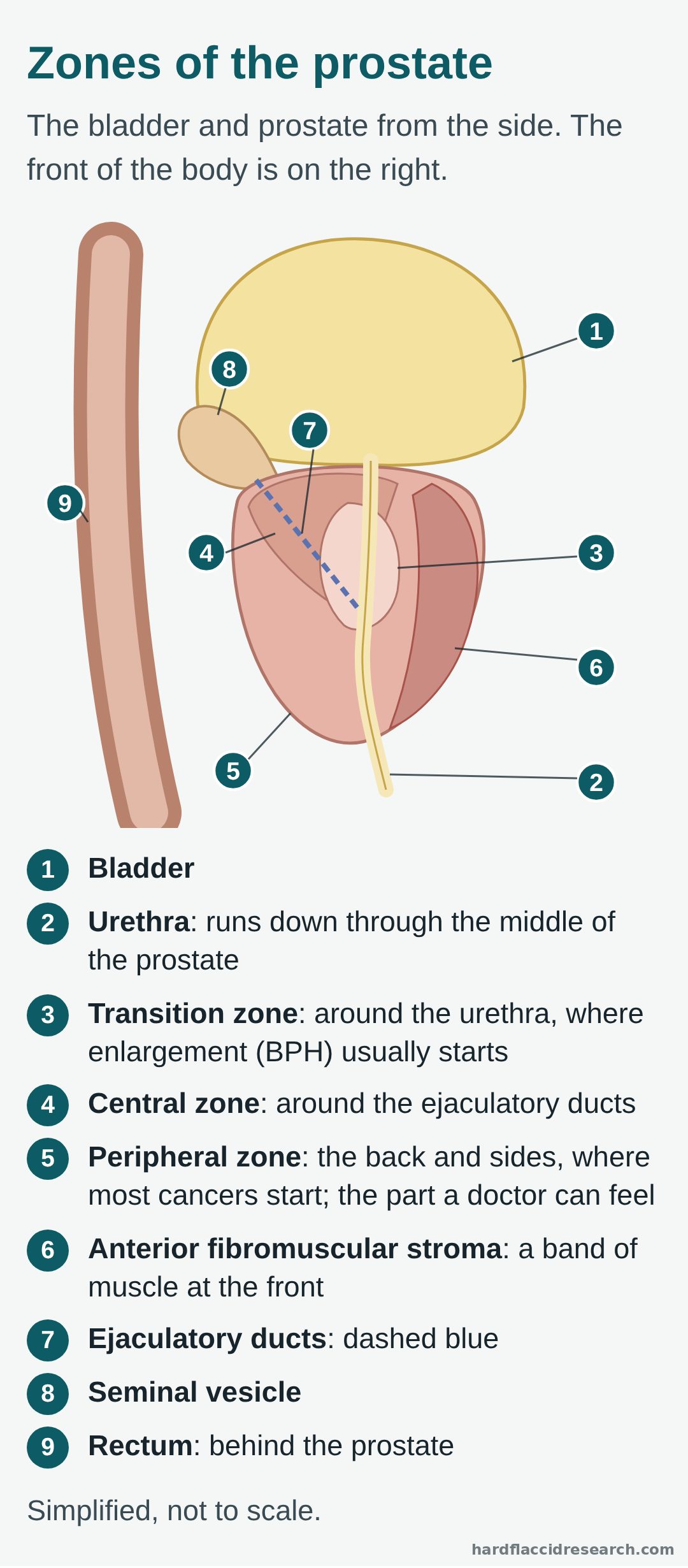
- Doctors divide it into zones: the transition zone, the central zone, the peripheral zone and a band of muscle at the front.
- Enlargement (benign prostatic hyperplasia, or BPH) usually starts in the transition zone, around the urethra.
- Most prostate cancers start in the peripheral zone, at the back, which is the part a doctor can feel through the rectum.
Where is the prostate?
The prostate sits:
- Just below the bladder, with its wider base against the bladder neck.
- Above the pelvic floor muscles, with its narrow tip (the apex) resting just above them.
- In front of the rectum, which is why a doctor can feel its back surface with a gloved finger.
- Behind the pubic bone.
The seminal vesicles, two small glands that make much of the fluid in semen, sit behind the bladder just above the prostate. Bundles of nerves and blood vessels that control erections run along the back and sides of the prostate, which matters in prostate surgery.
Related: Prostatitis or Hard Flaccid? Symptoms, Types and Treatment »
What passes through the prostate?
- The urethra: the part inside the prostate is called the prostatic urethra. It runs from the bladder neck straight down through the gland.
- The ejaculatory ducts: each vas deferens joins the duct of a seminal vesicle to form an ejaculatory duct, which runs through the prostate and opens into the urethra on a small mound called the verumontanum.
- Tiny prostate ducts that empty prostate fluid into the urethra.
What are the zones of the prostate?
Doctors used to describe the prostate in lobes: two side lobes and a middle lobe. Today, they usually describe zones, because each zone tends to have different problems:
- Transition zone: a small area wrapped around the urethra. With age, it often grows, which is benign prostatic hyperplasia. Because it hugs the urethra, even a little growth can squeeze it.
- Central zone: around the ejaculatory ducts, at the base of the prostate.
- Peripheral zone: the largest zone in young men, forming the back and sides of the gland. Most prostate cancers start here, and it's the part a doctor feels in a rectal examination.
- Anterior fibromuscular stroma: a band of muscle and fibrous tissue at the front, with little gland tissue.
The whole prostate is wrapped in a thin capsule.
Related: Alpha Blockers for Hard Flaccid: 45% of Men Said They Help »
What does the prostate do?
Making part of semen
The prostate makes a thin, slightly milky fluid that forms part of semen. It contains enzymes, including prostate-specific antigen (PSA), which helps thin the semen after ejaculation so sperm can swim, as well as zinc and other substances that help sperm survive.
Helping ejaculation
The prostate has smooth muscle that squeezes its fluid into the urethra during ejaculation. At the same time, the bladder neck at its top closes, so semen goes forward and not back into the bladder.
Controlling urine flow
Smooth muscle in the prostate and at the bladder neck helps control the flow of urine. That's why alpha blockers, which relax this muscle, make peeing easier for men with an enlarged prostate.
Hormones
The prostate needs male hormones to grow and work. In the prostate, testosterone is converted into a stronger form, dihydrotestosterone (DHT), which drives its growth. Medicines that block this conversion, such as finasteride, shrink an enlarged prostate.
What can go wrong with the prostate?
Benign prostatic hyperplasia
Non-cancerous growth of the transition zone becomes common as men get older. It can cause a weak stream, trouble starting, dribbling, peeing often and waking at night to pee. US urology guidelines describe a range of treatments, from lifestyle changes and medicines to procedures.
Prostatitis and chronic pelvic pain syndrome
Prostatitis means an inflamed or irritated prostate. A bacterial infection can cause fever and pain. Much more common, especially in younger men, is chronic prostatitis or chronic pelvic pain syndrome, where there's pelvic, perineal or ejaculation pain without an infection. Tight pelvic floor muscles often play a part.
Prostate cancer
Prostate cancer is common in older men and usually grows slowly. Early prostate cancer often causes no symptoms. Screening decisions, including a PSA blood test, are best made with a doctor.
How does the prostate change with age?
The prostate grows during puberty under the influence of testosterone, reaching its adult size in early adulthood. From middle age, the transition zone often starts to grow again. This slow growth is why benign prostatic hyperplasia becomes more common with each decade.
Not every enlarged prostate causes symptoms, and the size of the prostate doesn't always match how much it affects peeing. A small prostate can cause a lot of trouble if it squeezes the urethra tightly, and a large one can cause very little. PSA levels also tend to rise slowly with age and prostate size, which is one reason doctors interpret the test carefully.
The prostate and hard flaccid syndrome
Hard flaccid syndrome is a firm, shrunken penis at rest, often with numbness, weaker erections and pelvic pain. Many men with hard flaccid also have symptoms that overlap with chronic prostatitis or chronic pelvic pain syndrome.
Of the 2,661 men who described their symptoms, 13% described urinary problems (337 men), 10% described pelvic, perineal or tailbone pain (267 men) and 8% described a weak or painful orgasm or ejaculation problems (202 men). In separate counts, 378 men discussed alpha blockers.
Our members' guide, Bladder and Bowel Problems With Hard Flaccid: What Helps, covers peeing habits that ease these symptoms.
How do doctors check the prostate?
- A digital rectal examination: a doctor gently feels the back of the prostate through the rectum with a gloved finger. You can ask for a chaperone or stop at any time.
- A PSA blood test, after discussing the pros and cons.
- A urine test, a flow test and a scan after peeing to see how well the bladder empties.
- An ultrasound scan of the prostate from inside the rectum, or an MRI scan.
Our doctor visit kit helps you list your symptoms before you go.
When should I see a doctor?
See a primary care provider or a urologist (a doctor for urinary and sexual health) if you have a weak stream, trouble starting, peeing often, waking at night to pee, pain in the pelvis or perineum, pain with ejaculation, or blood in your urine or semen.
Get urgent care straight away (call 911 or go to the emergency room) if you have:
- Not being able to pee at all, or a painful, swollen bladder.
- A fever or chills with pelvic pain or pain when peeing.
- New numbness around your back passage, genitals or inner thighs, or new weakness in your legs.
- Loss of control of your bladder or bowel.
- Sudden, severe pain in the penis, testicles or pelvis.
Frequently asked questions
How big is the prostate?
In young men, it's about the size of a walnut. It often grows larger with age.
Can you feel your own prostate?
Not from the outside. A doctor can feel its back surface through the rectum during an examination.
Does the prostate affect erections?
The prostate itself doesn't make erections, but the nerves for erections run right beside it, which is why prostate surgery and radiation can affect them.
What is the prostate's fluid for?
It forms part of semen, helps thin it after ejaculation and helps sperm survive.
Can young men have prostate problems?
Yes. Prostatitis and chronic pelvic pain syndrome are common in younger men. Enlargement and cancer are much more common in older men.
Takeaway
The prostate is a walnut-sized gland below the bladder that wraps around the urethra and makes part of semen. Its zones have different problems: enlargement starts around the urethra, while most cancers start at the back.
If you have trouble peeing, pelvic pain or pain with ejaculation, a doctor can check the prostate and the pelvic floor. Take our free self-check if you also notice changes in your penis at rest.
This article is for general information and isn't a substitute for advice from your own doctor. Hard Flaccid Research doesn't diagnose or treat. If you have new or worsening symptoms, see a qualified clinician. In an emergency, call 911.
Free tools that can help
- Self-check: do I have hard flaccid?Compare your symptoms with what 6,026 men report.
- Doctor visit kitA one-page summary to take to your appointment.
- Habit trackerCount your days without porn or masturbation, and get through urges.
- Diaphragm breathing toolBreathe with a moving picture of your diaphragm and pelvic floor.
- Add your experienceTell us what you tried and how it went. No name needed.
- Hard Flaccid Syndrome CensusWhat men answered in 818 polls.
- Symptom trackerLog your symptoms and see what helps you.
- Ask us a questionThe questions men ask most become new articles.
The numbers behind this article
Every number in this article comes from what men with hard flaccid syndrome shared between December 2020 and October 2026, counted once per person, or from their polls. These are self-selected reports, not a clinical study. See hard flaccid syndrome statistics, the Hard Flaccid Syndrome Census and how we count.
13% of men who described their symptoms described urinary problems
Share of the 2,661 men who described their symptoms. Each man is counted once.These are self-selected reports, not a clinical study.
Source: Hard Flaccid Research, hardflaccidresearch.com
Every number in this article, with its source
| In this article | Source |
|---|---|
| 13% of the men who described their symptoms described urinary problems (337 of 2,661) | 337 of 2,661 men, counted |
| 10% of the men who described their symptoms described pelvic, perineal or tailbone pain (267 of 2,661) | 267 of 2,661 men, counted |
| 8% of the men who described their symptoms described a weak or painful orgasm or ejaculation problems (202 of 2,661) | 202 of 2,661 men, counted |
| 6,026 men shared their experiences, and 2,661 of them described their symptoms | 2,661 of 6,026 men, counted |
| 378 men discussed alpha blockers | 378 men discussing alpha blockers, counted from what men wrote, once per person |
Medical sources
What this article says about medical research, guidelines and urgent care comes from these sources.
- Anatomy, Abdomen and Pelvis, Prostate. In: StatPearls. Treasure Island (FL): StatPearls Publishing. https://www.ncbi.nlm.nih.gov/books/NBK540987/
- Aaron L, Franco OE, Hayward SW. Review of prostate anatomy and embryology and the etiology of benign prostatic hyperplasia. Urol Clin North Am. 2016;43(3):279-288. https://doi.org/10.1016/j.ucl.2016.04.012
- Sandhu JS, Bixler BR, Dahm P, et al. Management of lower urinary tract symptoms attributed to benign prostatic hyperplasia (BPH): AUA guideline amendment 2023. J Urol. 2024;211(1):11-19. https://doi.org/10.1097/JU.0000000000003698
- National Cancer Institute. SEER Training Modules: Zones of the prostate. https://www.training.seer.cancer.gov/prostate/anatomy/zones.html
- Lai HH, Pontari MA, Argoff CE, et al. Male chronic pelvic pain: AUA guideline. J Urol. 2025. https://www.auanet.org/guidelines-and-quality/guidelines/male-chronic-pelvic-pain
- Parnham A, Serefoglu EC. Retrograde ejaculation, painful ejaculation and hematospermia. Transl Androl Urol. 2016;5(4):592-601. https://doi.org/10.21037/tau.2016.06.05
How we made this article
We started from the question many men asked. Every number was checked against our data. Our editorial team edited it and Dr. Julian Reyes reviewed it medically. Read our editorial policy.
Read next
- Prostatitis or Hard Flaccid? Symptoms, Types and TreatmentArticle
- Alpha Blockers for Hard Flaccid: 45% of Men Said They HelpArticle
- Blood in Semen (Hematospermia): Causes and When to WorryArticle
- Urinary problemsSymptom
- Pelvic and perineal painSymptom
- Orgasm and ejaculation problemsSymptom
- Alpha blockersTreatment
See more of us on Google
Add Hard Flaccid Research as a preferred source, and Google shows you our pages more often when you search.
Add as a preferred sourceDon't see your question? Ask us. We answer the most-asked ones in new articles.
Cite and share this article
You're welcome to quote this article. Please name Hard Flaccid Research and link to this page, so others can find the full answer and the data behind it. To cite this page, use its link.
Citation
Hard Flaccid Research. (2026). Prostate Anatomy: Where It Is, Its Zones and What It Does. Written by the Editorial Team, medically reviewed by Dr. Julian Reyes. https://hardflaccidresearch.com/articles/prostate-anatomy
Credit link for your article
Source: <a href="https://hardflaccidresearch.com/articles/prostate-anatomy">Hard Flaccid Research</a>
Wikipedia reference
<ref>{{cite web |url=https://hardflaccidresearch.com/articles/prostate-anatomy |title=Prostate Anatomy: Where It Is, Its Zones and What It Does |website=Hard Flaccid Research |date=2026 |access-date=22 November 2026}}</ref>
How the data was collected: our methodology. Journalists and researchers: key numbers, data and contact.