Scrotum Anatomy: Layers, the Dartos Muscle and What's Normal
In short
- The scrotum is the pouch of skin and muscle that holds the testicles outside the body, where they stay a little cooler.
- It's divided into two compartments by a central wall, and each testicle sits under several layers: the skin, the dartos muscle, three layers of tissue from the belly wall including the cremaster muscle, and a thin sac called the tunica vaginalis.
- The scrotum tightens and relaxes to keep the testicles at the right temperature.
The scrotum is the pouch of skin and muscle below the penis that holds the testicles. It keeps them outside the body, where they stay a little cooler than the inside of the belly, which is what sperm production needs. A wall down the middle, called the septum, divides it into two compartments, one for each testicle.
The scrotum is more than skin. Each testicle sits under several thin layers, including two muscles that move the scrotum and testicles: the dartos, which wrinkles and tightens the skin, and the cremaster, which lifts the testicle. This page explains the layers of the scrotum, how it controls temperature, what's normal and what needs a doctor's check.
By the numbers: of the 6,026 men who shared their experiences with hard flaccid syndrome, 2,661 described their symptoms, and 102 of them described testicle pain or a tight scrotum.
Key facts
- The scrotum holds the testicles outside the body to keep them slightly cooler, which helps sperm production.
- A central wall, the septum, divides it into two compartments. The line on the skin down the middle, called the raphe, marks where the two halves joined before birth.
- The dartos muscle, a thin layer of smooth muscle just under the skin, wrinkles and tightens the scrotum.
- The cremaster muscle, deeper down, lifts the testicles toward the body.
- In the cold, with arousal and with stress, the scrotum tightens and the testicles rise. In the warmth, it relaxes and they hang lower.
- One testicle, often the left, usually hangs a little lower than the other. That's normal.
- Any new lump, swelling or lasting pain in the scrotum is worth a check.
What are the layers of the scrotum?
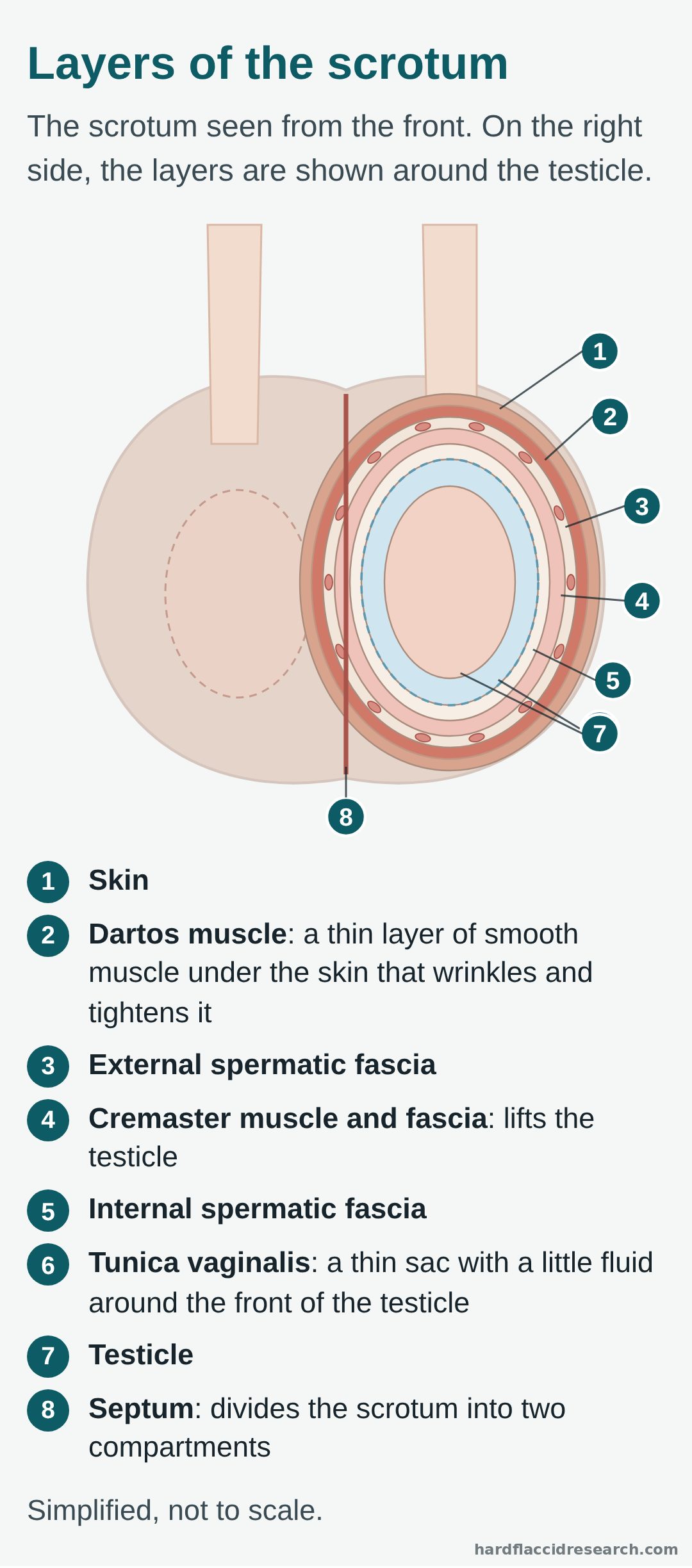
From the outside in, each testicle is covered by:
Skin
Thin, stretchy, darker skin with hair, sweat glands and oil glands. It has no fat layer, which helps heat escape.
The dartos muscle
A thin sheet of smooth muscle fused to the underside of the skin. When it contracts, the skin wrinkles and tightens, the scrotum shrinks, and less heat is lost. The dartos also forms the septum between the two sides.
The external spermatic fascia
A thin layer of tissue that comes from the outer muscle of the belly wall.
The cremaster muscle and fascia
Loops of muscle that come from the inner muscle of the belly wall. When they contract, they pull the testicle up toward the body. This is what happens in the cremasteric reflex, when the inner thigh is stroked.
The internal spermatic fascia
A thin layer that comes from the deepest layer of the belly wall.
The tunica vaginalis
A thin, two-layered sac around the front and sides of the testicle, with a tiny amount of fluid to let it move smoothly. Extra fluid here is a hydrocele.
These layers come from the belly wall because, before birth, each testicle moves down from the belly into the scrotum through the groin, pulling layers of the belly wall with it.
Related: Cremaster Muscle and Reflex: Why Testicles Pull Up »
How does the scrotum control temperature?
Sperm production works best a little below normal body temperature. The scrotum keeps the testicles there in several ways:
- In the cold, the dartos tightens the skin and the cremaster lifts the testicles closer to the body to keep them warm.
- In the warmth, both muscles relax, so the scrotum hangs loose and has more surface for heat to escape.
- The thin skin, lack of fat and many sweat glands help release heat.
- The network of veins in the spermatic cord cools blood flowing down to the testicles.
What does a normal scrotum look like?
- Wrinkled when cold, smooth and loose when warm.
- One side, often the left, hanging a little lower.
- A visible line, the raphe, down the middle.
- Small, painless bumps on the skin, often harmless oil glands or hair follicles.
- The testicles moving up and down with temperature, arousal and stress.
Related: Why Is My Penis Shrinking? Causes of Penis Shrinkage and What Helps »
What can go wrong with the scrotum?
- A hydrocele, fluid around the testicle that makes one side swell.
- A varicocele, swollen veins above the testicle that feel like a bag of worms.
- An inguinal hernia that reaches into the scrotum.
- Epididymitis, a painful swelling behind the testicle, usually from infection.
- Skin problems, such as fungal infections, rashes, cysts or ingrown hairs.
- Testicular torsion, a twist of the cord that causes sudden, severe pain. It's an emergency.
- Rarely, a lump in the testicle itself, which needs prompt tests.
Scrotum anatomy and hard flaccid syndrome
Hard flaccid syndrome is a firm, shrunken penis at rest, often with numbness, weaker erections and pelvic pain. Many men with hard flaccid describe a scrotum that feels tight or pulled up, or testicles that retract more than before. Stress and a tense pelvic floor may tighten the cremaster and dartos, though this hasn't been studied in hard flaccid.
Of the 2,661 men who described their symptoms, 27% described shrinkage or retraction (720 men) and 4% described testicle pain or a tight scrotum (102 men). In an April 2023 poll, 76% said they had anxiety before hard flaccid (94 of 123 men). That doesn't show anxiety causes hard flaccid.
Our members' guide, Hard Flaccid Blood Tests: Testosterone, Sugar and Hormones, explains which tests to ask about if your testicles or sex drive have changed.
How do I check my scrotum and testicles?
A quick monthly check helps you learn what's normal for you:
- Check after a warm bath or shower, when the scrotum is relaxed.
- Hold each testicle gently and roll it between your thumb and fingers.
- Feel for the soft ridge of the epididymis on the back, which is normal.
- Feel the cord above each testicle, with the firm vas deferens inside.
- Look and feel for any new lump, swelling, hardness or change in size.
How is the scrotum examined?
A primary care provider or a urologist (a doctor for urinary and sexual health) will look at and feel the scrotum, testicles and cords, while you stand and lie down. They may shine a light through any swelling and arrange an ultrasound scan, which shows the testicles, the fluid around them and the blood flow.
Our doctor visit kit helps you describe what you've noticed and when it started.
When should I see a doctor?
See a primary care provider or a urologist if you notice a new lump or swelling, a change in the size or feel of a testicle, an ache or heaviness that keeps coming back, or a rash that doesn't settle.
Get urgent care straight away (call 911 or go to the emergency room) if you have:
- Sudden, severe pain or swelling in a testicle, especially with nausea or vomiting. This can be testicular torsion.
- A testicle that suddenly sits higher than usual or lies sideways, with pain.
- A fever or chills with a painful, red, swollen scrotum.
- A painful bulge in the groin or scrotum that won't go back in.
- Sudden, severe pain in the penis, testicles or pelvis.
Frequently asked questions
Why does my scrotum tighten and loosen?
The dartos and cremaster muscles tighten it in the cold, with arousal and with stress, and relax it in the warmth, to keep the testicles at the right temperature.
Is it normal for one testicle to hang lower?
Yes. One, often the left, usually hangs a little lower.
What is the line down the middle of the scrotum?
It's the raphe, a natural seam where the two halves joined before birth.
What is the dartos muscle?
A thin layer of smooth muscle just under the skin of the scrotum that wrinkles and tightens it.
Why does my scrotum feel tight all the time?
Cold, stress, anxiety and a tense pelvic floor can all keep the dartos and cremaster tighter. If it's new, painful or comes with other changes, get it checked.
Can the scrotum shrink?
It shrinks temporarily in the cold or with stress. A lasting change in the size of a testicle should be checked.
Why does my scrotum sweat?
The scrotum has many sweat glands to help release heat and keep the testicles cool. Breathable underwear can help.
Do the testicles move during sex?
Yes. During arousal the scrotum tightens and the testicles rise closer to the body, and they relax again afterwards.
What is the septum of the scrotum?
A wall of tissue down the middle that keeps the two testicles in separate compartments.
Can tight underwear affect the scrotum?
Very tight underwear can keep the testicles warmer. Looser, breathable underwear lets the scrotum regulate temperature more easily.
Takeaway
The scrotum is a pouch of skin and muscle with several thin layers around each testicle. The dartos tightens the skin and the cremaster lifts the testicles to keep them at the right temperature.
Changes with cold, arousal and stress are normal, but a new lump, swelling or sudden pain needs a doctor's check. Take our free self-check if you also notice changes in your penis at rest.
This article is for general information and isn't a substitute for advice from your own doctor. Hard Flaccid Research doesn't diagnose or treat. If you have new or worsening symptoms, see a qualified clinician. In an emergency, call 911.
Free tools that can help
- Self-check: do I have hard flaccid?Compare your symptoms with what 6,026 men report.
- Doctor visit kitA one-page summary to take to your appointment.
- Habit trackerCount your days without porn or masturbation, and get through urges.
- Diaphragm breathing toolBreathe with a moving picture of your diaphragm and pelvic floor.
- Add your experienceTell us what you tried and how it went. No name needed.
- Hard Flaccid Syndrome CensusWhat men answered in 818 polls.
- Symptom trackerLog your symptoms and see what helps you.
- Ask us a questionThe questions men ask most become new articles.
The numbers behind this article
Every number in this article comes from what men with hard flaccid syndrome shared between December 2020 and October 2026, counted once per person, or from their polls. These are self-selected reports, not a clinical study. See hard flaccid syndrome statistics, the Hard Flaccid Syndrome Census and how we count.
27% of men who described their symptoms described shrinkage or retraction
Share of the 2,661 men who described their symptoms. Each man is counted once.These are self-selected reports, not a clinical study.
Source: Hard Flaccid Research, hardflaccidresearch.com
Every number in this article, with its source
| In this article | Source |
|---|---|
| 27% of the men who described their symptoms described shrinkage or retraction (720 of 2,661) | 720 of 2,661 men, counted |
| 4% of the men who described their symptoms described testicle pain or a tight scrotum (102 of 2,661) | 102 of 2,661 men, counted |
| 6,026 men shared their experiences, and 2,661 of them described their symptoms | 2,661 of 6,026 men, counted |
| 76% said they had anxiety before hard flaccid (94 of 123 men) | 94 of 123 men, poll, Apr 2023 |
Medical sources
What this article says about medical research, guidelines and urgent care comes from these sources.
- Anatomy, Abdomen and Pelvis, Scrotum. In: StatPearls. Treasure Island (FL): StatPearls Publishing. https://www.ncbi.nlm.nih.gov/books/NBK549893/
- Anatomy, Abdomen and Pelvis: Testes. In: StatPearls. Treasure Island (FL): StatPearls Publishing. https://www.ncbi.nlm.nih.gov/books/NBK470201/
- Mellick LB, Mowery ML, Al-Dhahir MA. Cremasteric Reflex. In: StatPearls. Treasure Island (FL): StatPearls Publishing. https://www.ncbi.nlm.nih.gov/books/NBK513348/
- Hydrocele. In: StatPearls. Treasure Island (FL): StatPearls Publishing. https://www.ncbi.nlm.nih.gov/books/NBK559125/
- Leslie SW, Sajjad H, Siref LE. Varicocele. In: StatPearls. Treasure Island (FL): StatPearls Publishing. https://www.ncbi.nlm.nih.gov/books/NBK448113/
- Testicular Torsion. In: StatPearls. Treasure Island (FL): StatPearls Publishing. https://www.ncbi.nlm.nih.gov/books/NBK448199/
How we made this article
We started from the question many men asked. Every number was checked against our data. Our editorial team edited it and Dr. Julian Reyes reviewed it medically. Read our editorial policy.
Read next
See more of us on Google
Add Hard Flaccid Research as a preferred source, and Google shows you our pages more often when you search.
Add as a preferred sourceDon't see your question? Ask us. We answer the most-asked ones in new articles.
Cite and share this article
You're welcome to quote this article. Please name Hard Flaccid Research and link to this page, so others can find the full answer and the data behind it. To cite this page, use its link.
Citation
Hard Flaccid Research. (2026). Scrotum Anatomy: Layers, the Dartos Muscle and What's Normal. Written by the Editorial Team, medically reviewed by Dr. Julian Reyes. https://hardflaccidresearch.com/articles/scrotum-anatomy
Credit link for your article
Source: <a href="https://hardflaccidresearch.com/articles/scrotum-anatomy">Hard Flaccid Research</a>
Wikipedia reference
<ref>{{cite web |url=https://hardflaccidresearch.com/articles/scrotum-anatomy |title=Scrotum Anatomy: Layers, the Dartos Muscle and What's Normal |website=Hard Flaccid Research |date=2026 |access-date=22 November 2026}}</ref>
How the data was collected: our methodology. Journalists and researchers: key numbers, data and contact.