Sensate Focus: The Touch Exercises for Erection Anxiety
In short
- Sensate focus is a set of structured touch exercises developed by the sex researchers Masters and Johnson.
- Partners take turns touching each other, at first without touching the genitals and without aiming for sex or orgasm, and simply notice sensations.
- Taking the pressure off helps with performance anxiety, erection problems and low desire, and it's widely used by sex therapists.
Sensate focus is a set of structured touch exercises for couples, developed by the sex researchers William Masters and Virginia Johnson. Partners take turns touching each other, at first without touching the genitals and without any goal of sex or orgasm, and simply pay attention to what they feel.
The idea is to take the pressure off. When sex feels like a test, anxiety can block arousal and erections, and the fear of it happening again makes things worse. Sensate focus breaks that cycle by removing the goal for a while. It's one of the most widely used tools in sex therapy, for erection problems, performance anxiety, low desire and orgasm problems. This page explains how it works, its stages and how to start.
By the numbers: of the 6,026 men who shared their experiences with hard flaccid syndrome, 2,661 described their symptoms, and 926 of them described weaker or lost erections.
Key facts
- Sensate focus is a series of touch exercises done at home, often with guidance from a sex therapist.
- Partners take turns touching for their own interest and noticing sensations, not to arouse or please.
- Sex and orgasm are off the table in the early stages, which removes performance pressure.
- It moves step by step from non-genital touch to genital touch and, eventually, to sex without pressure.
- It's used for erection problems, performance anxiety, low desire, painful sex and orgasm problems.
- Reviews of the research describe it as a core sex therapy technique, though most studies are older or small.
How does sensate focus work?
Erections depend on the nervous system being in a relaxed, "rest" state. Anxiety switches on the stress response, which tightens blood vessels and the pelvic floor and pulls attention away from sensations. Many men start "spectating": watching themselves during sex, checking their erection, worrying it will fade. That makes it more likely to fade.
Sensate focus helps by:
- Removing the goal, so there's nothing to fail at.
- Training attention onto touch, temperature and texture, instead of worried thoughts.
- Letting arousal come back on its own, without being forced.
- Helping partners talk openly and rebuild closeness.
What are the stages of sensate focus?
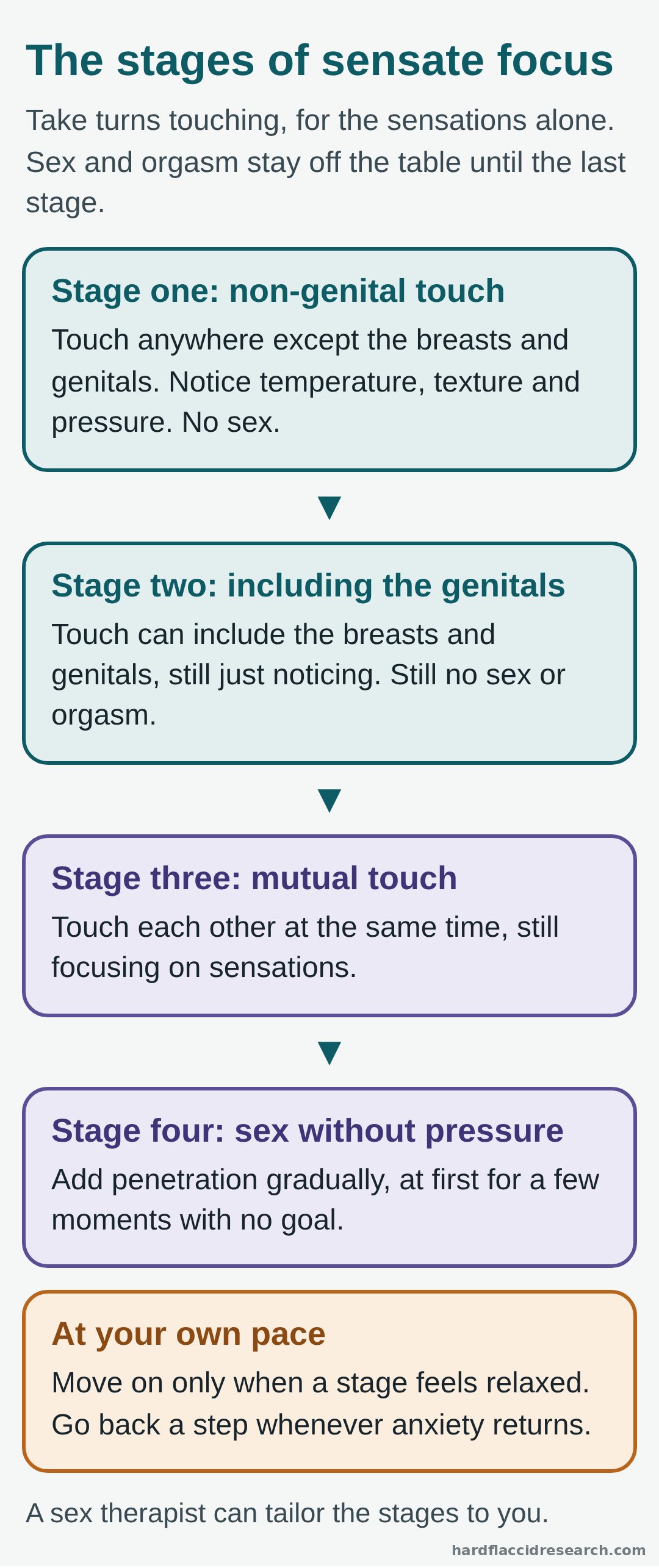
Sex therapists describe the stages slightly differently, but they usually follow this order. Each stage is repeated over several sessions until it feels relaxed.
Stage one: non-genital touch
Partners take turns. One touches, the other receives, then you swap. You can touch anywhere except the breasts and genitals. The person touching does it for their own interest and curiosity, noticing temperature, texture and pressure. The receiver simply notices sensations and says if anything is uncomfortable. No sex, no orgasm, even if you're aroused.
Stage two: including the genitals
Touch can now include the breasts and genitals, still with the same aim: noticing, not arousing. Erections may come and go, and that's fine. Sex and orgasm are still off the table.
Stage three: mutual touch
Partners touch each other at the same time, still focusing on sensations rather than a goal.
Stage four: sex without pressure
Penetration is added gradually, often at first for just a few moments with no movement and no aim, then more as it feels comfortable. The focus stays on sensations, not on performance.
If anxiety returns at any point, go back a step. Moving slowly is part of the method.
How to start sensate focus at home
- Talk first. Agree that sex and orgasm are off the table for now, so neither of you feels pressure.
- Set aside time when you're both relaxed and won't be interrupted, in a warm, private space.
- Agree on how long each turn lasts, and on how to say "stop" or "that's uncomfortable" without needing to explain.
- Start with stage one. Take turns, and notice sensations rather than trying to arouse each other.
- If your mind wanders to worries, gently bring your attention back to the sensation of touch.
- Talk afterward about what you noticed, in a curious, kind way.
- Plan a few sessions a week, and stay at each stage until it feels easy.
Many couples find it easier with a sex therapist, who can adapt the exercises and help with any feelings that come up.
Related: What Does a Sex Therapist Do? When Men Should See One »
Common mistakes with sensate focus
- Rushing through the stages. Moving on before a stage feels relaxed can bring the pressure back.
- Turning it into foreplay. The touching is for noticing, not for arousing your partner or yourself.
- Breaking the "no sex" agreement. Even if things go well, sticking to it builds trust and keeps the pressure off.
- Judging how it went. There's no right way to feel, and some sessions will feel awkward or flat.
- Doing it when tired, rushed or after an argument. Pick calm times.
- Not talking. A short, kind conversation afterward helps you both feel safe.
Sensate focus and hard flaccid syndrome
Hard flaccid syndrome is a firm, shrunken penis at rest, often with numbness, weaker erections and pelvic pain. Worry about erections is common with hard flaccid, and fear of failing can make sex feel impossible.
Of the 2,661 men who described their symptoms, 35% described weaker or lost erections (926 men). In a July 2023 poll, 42% said they hadn't had sex since hard flaccid began (67 of 159 men). In an April 2023 poll, 76% said they had anxiety before hard flaccid (94 of 123 men).
Sensate focus isn't a treatment for hard flaccid itself, but it can help with the anxiety and pressure around sex. Our members' guide, Weak Erections With Hard Flaccid: The Gentle Way Back to Sex, walks through a gradual return to intimacy.
Can you do sensate focus without a partner?
The classic exercises are for couples, but the same ideas can help on your own: slow, curious self-touch focused on sensation rather than reaching orgasm, with no porn and no time pressure. A sex therapist can suggest solo exercises.
Does sensate focus work with other treatments?
Yes. US urology guidelines recommend that men with erectile dysfunction be offered a range of options, and that the psychological side be addressed alongside medical treatment. Sensate focus can be combined with:
- Medicines such as tadalafil or sildenafil, prescribed by a doctor. These must never be taken with nitrate medicines for chest pain or with poppers.
- Counseling or sex therapy for anxiety, relationship issues or past experiences.
- Pelvic floor physical therapy, if you have a tight pelvic floor.
- Treatment of any health problems found by a doctor.
When should I see a doctor?
See a primary care provider or a urologist (a doctor for urinary and sexual health) if you have erection problems that last more than a few weeks, keep coming back or worry you. Erection problems can be an early sign of heart and blood vessel disease, so a check-up is worth it at any age. Our doctor visit kit helps you explain what's happening.
A sex therapist can help with sensate focus, anxiety and relationship worries. Look for one with recognized training in sex therapy.
Get urgent care straight away (call 911 or go to the emergency room) if you have:
- An erection lasting more than 4 hours.
- Chest pain, especially during or after sex.
- Sudden, severe pain in the penis, testicles or pelvis.
Frequently asked questions
How long does sensate focus take?
It varies. Many couples spend a few weeks on the early stages. Going slowly is part of how it works.
What if I get an erection during the early stages?
Enjoy it, but don't act on it. The point is to notice sensations without a goal, and erections often come and go.
What if I lose my erection?
That's fine and expected. It shows that erections can return on their own when the pressure is off.
Is sensate focus only for erection problems?
No. It's also used for low desire, painful sex, orgasm problems and couples who want more closeness.
Do I need a sex therapist?
Not always, but a therapist can tailor the exercises, keep you on track and help with feelings that come up.
What if my partner isn't interested?
Talk about why you'd like to try it, and that it's about closeness rather than performance. A sex therapist can help couples talk about this, and some exercises can be adapted for one person.
Can sensate focus help with premature ejaculation?
It can help some men by lowering anxiety and building awareness of arousal. It's often combined with other techniques taught by a sex therapist.
Takeaway
Sensate focus is a set of step-by-step touch exercises that take the pressure off sex. By focusing on sensations instead of performance, it helps with erection anxiety, low desire and closeness.
Start slowly, keep sex off the table at first, and consider a sex therapist and a doctor's check alongside it. Take our free self-check if you also notice changes in your penis at rest.
This article is for general information and isn't a substitute for advice from your own doctor. Hard Flaccid Research doesn't diagnose or treat. If you have new or worsening symptoms, see a qualified clinician. In an emergency, call 911.
Free tools that can help
- Self-check: do I have hard flaccid?Compare your symptoms with what 6,026 men report.
- Doctor visit kitA one-page summary to take to your appointment.
- Habit trackerCount your days without porn or masturbation, and get through urges.
- Diaphragm breathing toolBreathe with a moving picture of your diaphragm and pelvic floor.
- Add your experienceTell us what you tried and how it went. No name needed.
- Hard Flaccid Syndrome CensusWhat men answered in 818 polls.
- Symptom trackerLog your symptoms and see what helps you.
- Ask us a questionThe questions men ask most become new articles.
The numbers behind this article
Every number in this article comes from what men with hard flaccid syndrome shared between December 2020 and October 2026, counted once per person, or from their polls. These are self-selected reports, not a clinical study. See hard flaccid syndrome statistics, the Hard Flaccid Syndrome Census and how we count.
42% said they hadn't had sex since hard flaccid began
How 159 men answered a July 2023 poll.In our polls, men choose to answer.
Source: Hard Flaccid Research, hardflaccidresearch.com
76% said they had anxiety before hard flaccid
How 123 men answered an April 2023 poll.In our polls, men choose to answer. This doesn't show that anxiety causes hard flaccid.
Source: Hard Flaccid Research, hardflaccidresearch.com
Every number in this article, with its source
| In this article | Source |
|---|---|
| 35% of the men who described their symptoms described weaker or lost erections (926 of 2,661) | 926 of 2,661 men, counted |
| 6,026 men shared their experiences, and 2,661 of them described their symptoms | 2,661 of 6,026 men, counted |
| 42% said they hadn't had sex since hard flaccid began (67 of 159 men) | 67 of 159 men, poll, Jul 2023 |
| 76% said they had anxiety before hard flaccid (94 of 123 men) | 94 of 123 men, poll, Apr 2023 |
Medical sources
What this article says about medical research, guidelines and urgent care comes from these sources.
- Avery-Clark C, Weiner L, Adams-Clark AA. Sensate focus for sexual concerns: an updated, critical literature review. Curr Sex Health Rep. 2019;11(2):84-94. https://doi.org/10.1007/s11930-019-00197-9
- Linschoten M, Weiner L, Avery-Clark C. Sensate focus: a critical literature review. Sex Relatsh Ther. 2016;31(2):230-247. https://doi.org/10.1080/14681994.2015.1127909
- Burnett AL, Nehra A, Breau RH, et al. Erectile dysfunction: AUA guideline. J Urol. 2018;200(3):633-641. https://doi.org/10.1016/j.juro.2018.05.004
- Shindel AW, Althof SE, Carrier S, et al. Disorders of ejaculation: an AUA/SMSNA guideline. J Urol. 2022;207(3):504-512. https://doi.org/10.1097/JU.0000000000002392
- Melnik T, Soares B, Nasello AG. Psychosocial interventions for erectile dysfunction. Cochrane Database Syst Rev. 2007;(3):CD004825. https://doi.org/10.1002/14651858.CD004825.pub2
How we made this article
We started from the question many men asked. Every number was checked against our data. Our editorial team edited it and Dr. Julian Reyes reviewed it medically. Read our editorial policy.
Read next
See more of us on Google
Add Hard Flaccid Research as a preferred source, and Google shows you our pages more often when you search.
Add as a preferred sourceDon't see your question? Ask us. We answer the most-asked ones in new articles.
Cite and share this article
You're welcome to quote this article. Please name Hard Flaccid Research and link to this page, so others can find the full answer and the data behind it. To cite this page, use its link.
Citation
Hard Flaccid Research. (2026). Sensate Focus: The Touch Exercises for Erection Anxiety. Written by the Editorial Team, medically reviewed by Dr. Julian Reyes. https://hardflaccidresearch.com/articles/sensate-focus
Credit link for your article
Source: <a href="https://hardflaccidresearch.com/articles/sensate-focus">Hard Flaccid Research</a>
Wikipedia reference
<ref>{{cite web |url=https://hardflaccidresearch.com/articles/sensate-focus |title=Sensate Focus: The Touch Exercises for Erection Anxiety |website=Hard Flaccid Research |date=2026 |access-date=22 November 2026}}</ref>
How the data was collected: our methodology. Journalists and researchers: key numbers, data and contact.