Bulbourethral Glands (Cowper's Glands): What They Do
In short
- The bulbourethral glands, also called Cowper's glands, are two pea-sized glands just below the prostate.
- During arousal they release a clear, slippery fluid, known as pre-ejaculate or pre-cum, that lubricates the urethra and neutralizes traces of urine.
- Problems are rare.
- The main one is a widening of their ducts called a syringocele.
The bulbourethral glands, better known as Cowper's glands, are two small glands, each about the size of a pea, that sit just below the prostate on either side of the urethra. During sexual arousal they release a clear, slippery fluid that appears at the tip of the penis before ejaculation. This fluid is called pre-ejaculate or, informally, pre-cum.
Many men only learn these glands exist when they notice this fluid and wonder whether it's normal. It is. The fluid lubricates the urethra and neutralizes traces of acidic urine, and the amount varies a lot from man to man. This page explains where Cowper's glands are, what they do, whether pre-cum can carry sperm, and the rare problems that can affect them.
By the numbers: of the 6,026 men who shared their experiences with hard flaccid syndrome, 2,661 described their symptoms, and 601 of them described pelvic floor tightness, spasm or twitching.

Key facts
- There are two bulbourethral glands, one on each side of the urethra, just below the prostate.
- They're named after William Cowper, an English surgeon who described them in detail.
- They sit inside the pelvic floor, embedded in the muscle that controls the flow of urine.
- During arousal they release a clear, slippery, alkaline fluid: pre-ejaculate.
- The fluid lubricates the urethra and neutralizes acidic traces of urine before semen passes through.
- Pre-ejaculate doesn't come from the testicles, but a small study found sperm in the pre-ejaculate of some men.
- Problems are rare. The best known is a syringocele, a widening of the gland's duct.
Where are the bulbourethral glands?
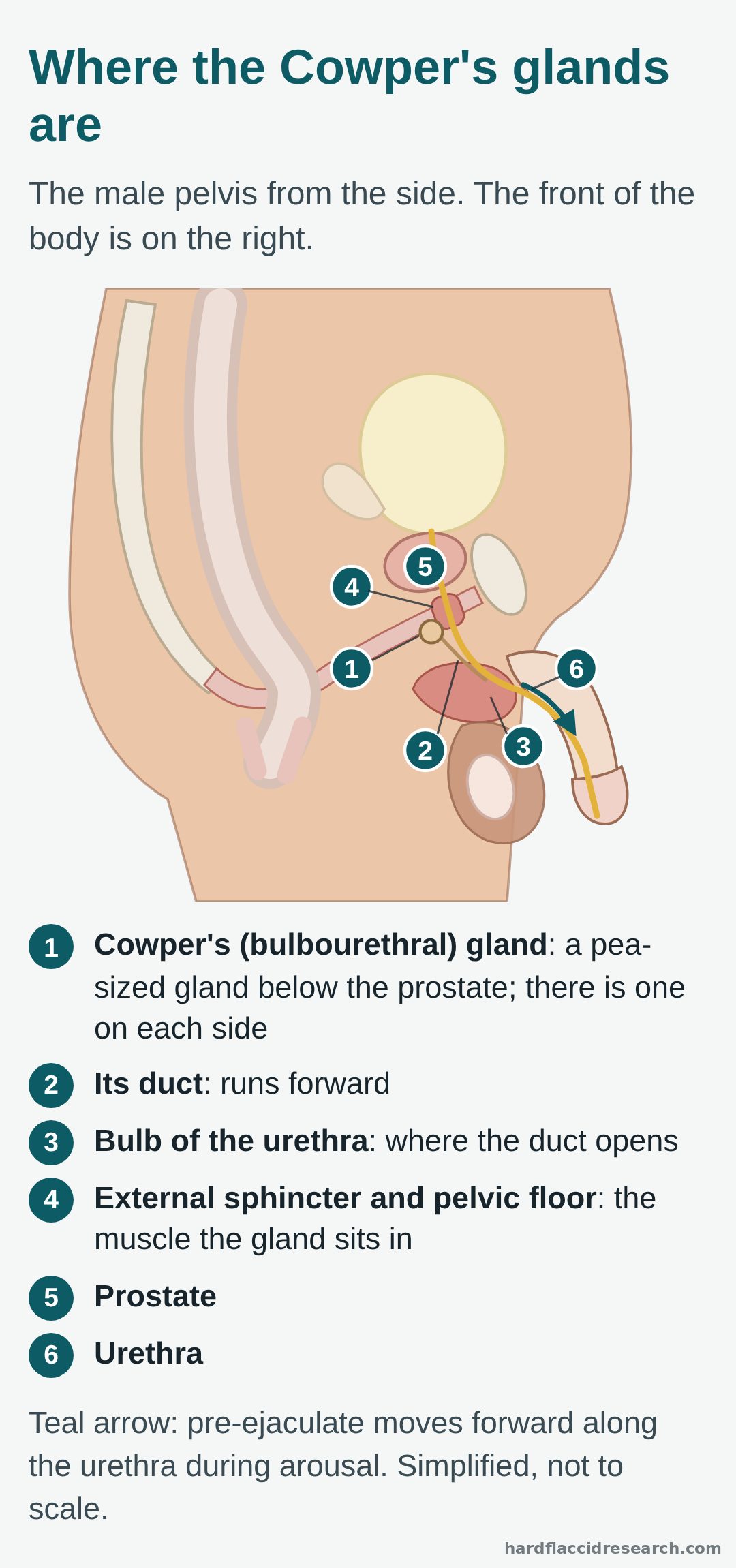
The bulbourethral glands lie in a layer of the pelvic floor called the deep perineal space, just below the prostate. They sit on either side of the short part of the urethra that passes through the pelvic floor, called the membranous urethra.
Each gland has a thin duct that runs forward and opens into the urethra inside the bulb of the penis, the wider part at the root of the penis, behind the scrotum. A study of the anatomy of these glands found that they're surrounded by both pelvic floor muscle and smooth muscle, which seem to work together to squeeze the fluid out.
Related: Alpha Blockers for Hard Flaccid: 45% of Men Said They Help »
What do the bulbourethral glands do?
They lubricate the urethra
During arousal, the glands release a clear, stretchy fluid into the urethra. It coats the lining and can appear at the tip of the penis as a drop or two, sometimes more.
They neutralize traces of urine
Urine is slightly acidic, and acid harms sperm. The fluid from Cowper's glands is alkaline, so it helps neutralize traces of urine left in the urethra before semen passes through.
They may help with ejaculation
A small amount of fluid from these glands also becomes part of semen. Because the glands sit within the pelvic floor, the same muscles that contract during orgasm help squeeze them.
Is pre-ejaculate normal?
Yes. Pre-ejaculate is a normal part of arousal. The amount varies widely: some men notice a lot, some notice only a little, and some notice almost none. It can also vary from day to day with how long and how strongly you're aroused. A lot or a little is usually normal.
Pre-ejaculate is clear and slippery. If you notice a cloudy, yellow or green discharge, a discharge when you're not aroused, burning when you pee or a bad smell, that's not pre-ejaculate, and it may be an infection that needs checking.
Related: Bulbospongiosus Muscle: Erections, Ejaculation and Dribbling »
Can pre-ejaculate contain sperm?
The glands themselves don't make sperm. But a small study of pre-ejaculate samples found sperm in the pre-ejaculate of some of the men, and in most of those cases some of the sperm could swim. The same men tended to have sperm in every sample, or none.
This means pre-ejaculate can sometimes lead to pregnancy, which is one reason withdrawal isn't a reliable form of birth control. The study's authors advise putting on a condom before any genital contact, which also protects against infections.
What can go wrong with the bulbourethral glands?
Syringocele
A syringocele is a widening of the duct of a Cowper's gland, which can fill with fluid like a small cyst. It's found most often in children, but specialists now recognize it in adult men more often than was once thought. In adults it can cause:
- Dribbling after peeing.
- A weak or slow urine stream.
- Urinary infections or blood in the urine.
- Pain or swelling in the perineum.
Small syringoceles that cause no symptoms can be left alone. Larger ones that cause symptoms can be opened or removed by a urologist, usually through a camera passed into the urethra.
Infection and stones
Infection of the glands, or small stones in them, are very rare. They can cause pain in the perineum and pain with ejaculation.
Bulbourethral glands and hard flaccid syndrome
Hard flaccid syndrome is a firm, shrunken penis at rest, often with numbness, weaker erections and pelvic pain. There's no evidence that Cowper's glands cause hard flaccid. But they sit inside the pelvic floor, and doctors think a tense pelvic floor may help keep hard flaccid going. Men with hard flaccid sometimes notice changes in arousal, pre-ejaculate or urination and wonder how these fit together.
Of the 2,661 men who described their symptoms, 23% described pelvic floor tightness, spasm or twitching (601 men), 13% described urinary problems (337 men) and 8% described a weak or painful orgasm or ejaculation problems (202 men).
If arousal and sex feel different since your symptoms started, our members' guide, Weak Erections With Hard Flaccid: The Gentle Way Back to Sex, takes it step by step.
How are problems checked?
A primary care provider or a urologist (a doctor for urinary and sexual health) will ask about your symptoms and may suggest:
- A urine test and tests for sexually transmitted infections, if you have a discharge.
- A flow test and a bladder scan after peeing, if your stream is weak.
- A camera look into the urethra or an MRI scan, if a syringocele is possible.
Our doctor visit kit helps you describe your symptoms clearly.
What's the difference between pre-ejaculate and semen?
- Pre-ejaculate appears during arousal, before orgasm. It's clear, slippery and usually only a small amount.
- Semen comes at orgasm. It's white or grey, thicker, and much larger in volume.
- Pre-ejaculate comes mainly from Cowper's glands. Semen comes mostly from the seminal vesicles and prostate, with sperm from the testicles.
- You can't control pre-ejaculate. It's a reflex that comes with arousal.
When should I see a doctor?
See a primary care provider or a urologist if you notice a cloudy or colored discharge, burning when you pee, dribbling after peeing, a weak stream, blood in your urine or semen, or pain or swelling in the perineum.
Get urgent care straight away (call 911 or go to the emergency room) if you have:
- Not being able to pee at all, or a painful, swollen bladder.
- A fever or chills with pelvic pain or pain when peeing.
- New numbness around your back passage, genitals or inner thighs, or new weakness in your legs.
- Sudden, severe pain in the penis, testicles or pelvis.
Frequently asked questions
Is pre-cum the same as semen?
No. Pre-ejaculate is a small amount of clear fluid, mostly from Cowper's glands. Semen comes at ejaculation and is mostly fluid from the seminal vesicles and prostate, with sperm.
Can you get pregnant from pre-cum?
It's possible. A small study found sperm in the pre-ejaculate of some men. Use a condom from the start of genital contact if you want to avoid pregnancy.
Why do I leak clear fluid when I'm aroused?
That's pre-ejaculate from Cowper's glands. It's normal and can appear even without a full erection.
Is it normal to have no pre-cum?
Yes. Some men release very little or none, and that's usually normal.
Can I feel my Cowper's glands?
No. They're small and sit deep in the pelvic floor.
Can Cowper's glands cause pain?
Rarely. A syringocele, an infection or a stone can cause pain in the perineum. Pain in this area more often comes from the pelvic floor or prostate.
Does pre-cum mean I'm close to ejaculating?
Not necessarily. Pre-ejaculate can appear early in arousal, long before orgasm, and doesn't mean ejaculation is near.
Can a syringocele come back after treatment?
It can, though it's uncommon. A urologist will usually check your symptoms and urine flow after treatment.
Is pre-ejaculate the same as urine?
No. It comes from glands, not the bladder. It's clear and slippery, while urine is watery and yellowish.
Takeaway
Cowper's glands are two pea-sized glands below the prostate that release pre-ejaculate during arousal. The fluid lubricates the urethra and neutralizes traces of urine, and the amount varies widely from man to man.
Pre-ejaculate can sometimes carry sperm, and problems with the glands themselves are rare. Take our free self-check if you also notice changes in your penis at rest.
This article is for general information and isn't a substitute for advice from your own doctor. Hard Flaccid Research doesn't diagnose or treat. If you have new or worsening symptoms, see a qualified clinician. In an emergency, call 911.
Free tools that can help
- Self-check: do I have hard flaccid?Compare your symptoms with what 6,026 men report.
- Doctor visit kitA one-page summary to take to your appointment.
- Habit trackerCount your days without porn or masturbation, and get through urges.
- Diaphragm breathing toolBreathe with a moving picture of your diaphragm and pelvic floor.
- Add your experienceTell us what you tried and how it went. No name needed.
- Hard Flaccid Syndrome CensusWhat men answered in 818 polls.
- Symptom trackerLog your symptoms and see what helps you.
- Ask us a questionThe questions men ask most become new articles.
The numbers behind this article
Every number in this article comes from what men with hard flaccid syndrome shared between December 2020 and October 2026, counted once per person, or from their polls. These are self-selected reports, not a clinical study. See hard flaccid syndrome statistics, the Hard Flaccid Syndrome Census and how we count.
23% of men who described their symptoms described pelvic floor tightness
Share of the 2,661 men who described their symptoms. Each man is counted once.These are self-selected reports, not a clinical study.
Source: Hard Flaccid Research, hardflaccidresearch.com
Every number in this article, with its source
| In this article | Source |
|---|---|
| 23% of the men who described their symptoms described pelvic floor tightness, spasm or twitching (601 of 2,661) | 601 of 2,661 men, counted |
| 13% of the men who described their symptoms described urinary problems (337 of 2,661) | 337 of 2,661 men, counted |
| 8% of the men who described their symptoms described a weak or painful orgasm or ejaculation problems (202 of 2,661) | 202 of 2,661 men, counted |
| 6,026 men shared their experiences, and 2,661 of them described their symptoms | 2,661 of 6,026 men, counted |
Medical sources
What this article says about medical research, guidelines and urgent care comes from these sources.
- Anatomy, Abdomen and Pelvis: Deep Perineal Space. In: StatPearls. Treasure Island (FL): StatPearls Publishing. https://www.ncbi.nlm.nih.gov/books/NBK538272/
- Muro S, Suriyut J, Akita K. Anatomy of Cowper's gland in humans suggesting a secretion and emission mechanism facilitated by cooperation of striated and smooth muscles. Sci Rep. 2021;11:16705. https://doi.org/10.1038/s41598-021-96130-z
- Killick SR, Leary C, Trussell J, Guthrie KA. Sperm content of pre-ejaculatory fluid. Hum Fertil (Camb). 2011;14(1):48-52. https://doi.org/10.3109/14647273.2010.520798
- Javed S, Shahid MH, Omar I, Gupta S, Khan AZ, Kaiser A. Cowper's syringocele: a literature review. Cureus. 2022;14(12):e32583. https://doi.org/10.7759/cureus.32583
- Bugeja S, Frost A, Ivaz S, Dragova M, Andrich DE, Mundy AR. Syringoceles of Cowper's ducts and glands in adult men. Asian J Androl. 2020;22(2):129-133. https://doi.org/10.4103/aja.aja_59_19
- Anatomy, Abdomen and Pelvis, Penis. In: StatPearls. Treasure Island (FL): StatPearls Publishing. https://www.ncbi.nlm.nih.gov/books/NBK482236/
How we made this article
We started from the question many men asked. Every number was checked against our data. Our editorial team edited it and Dr. Julian Reyes reviewed it medically. Read our editorial policy.
Read next
See more of us on Google
Add Hard Flaccid Research as a preferred source, and Google shows you our pages more often when you search.
Add as a preferred sourceDon't see your question? Ask us. We answer the most-asked ones in new articles.
Cite and share this article
You're welcome to quote this article. Please name Hard Flaccid Research and link to this page, so others can find the full answer and the data behind it. To cite this page, use its link.
Citation
Hard Flaccid Research. (2026). Bulbourethral Glands (Cowper's Glands): What They Do. Written by the Editorial Team, medically reviewed by Dr. Julian Reyes. https://hardflaccidresearch.com/articles/bulbourethral-gland
Credit link for your article
Source: <a href="https://hardflaccidresearch.com/articles/bulbourethral-gland">Hard Flaccid Research</a>
Wikipedia reference
<ref>{{cite web |url=https://hardflaccidresearch.com/articles/bulbourethral-gland |title=Bulbourethral Glands (Cowper's Glands): What They Do |website=Hard Flaccid Research |date=2026 |access-date=22 November 2026}}</ref>
How the data was collected: our methodology. Journalists and researchers: key numbers, data and contact.