Hard Flaccid for 5+ Years? 38 of 150 Men Are Still Fighting
In short
- Hard flaccid syndrome can still get better after five years or more.
- In 8 of the 15 recovery stories that said how long, the man had had it for three years or more, and in one for seven years.
- In a February 2023 poll on how long men had had hard flaccid, 25% said five years or more (38 of 150 men).
- A fresh check, a pelvic floor assessment, gentle daily steps given a fair trial and a life not put on hold can all help.
Hard flaccid syndrome is when the penis stays firm, rubbery or shrunken at rest, often with numbness and weaker erections. If you've had it for five years or more, there is still hope: men report getting better after years.
You're far from alone, too. In a February 2023 poll that asked men how long they had had hard flaccid, 25% said five years or more (38 of 150 men).
By the numbers: 6,026 men shared their experiences between December 2020 and October 2026. Of them, 126 shared stories of getting better, and 15 of those stories said how long the man had had hard flaccid first. What men wrote and what they answered in our polls are self-selected reports, not a clinical study.
Key facts
- Men report getting better after years: in 8 of the 15 recovery stories that said how long, the man had had hard flaccid syndrome for three years or more.
- In a June 2023 poll, 42% said they were at least half better (56 of 132 men); men who recover may stop answering polls, so this may undercount recovery.
- Many men have never seen a pelvic floor physical therapist: 59% hadn't in a February 2023 poll (91 of 155 men).
- A fresh check, gentle daily steps given a fair trial, and a life not put on hold can all help.
Hard Flaccid Explorerby Hard Flaccid Research
Hard flaccid for five years or more
A 7-minute animated explainer of this article. Press play, or skip between chapters. The first minute is free for everyone.
A picture to explain, not a diagnosis. No one can say how hard flaccid will go for any one man.
Is there still hope after five years of hard flaccid?
Yes. Of the 126 recovery stories, 15 said how long the man had had hard flaccid syndrome before he got better. In 8 of the 15 it was three years or more, and in 1 of the 15 it was seven years.
In a June 2023 poll that asked men whether they had healed, 42% said they were at least half better (56 of 132 men). That includes 11% who were about 90% better or fully healed (14 of 132), though the poll didn't ask how long they'd had it.
Nothing is proven to make hard flaccid go away yet, but doctors think the tight muscles and overactive nerve signals that may keep it going can settle. And 428 men wrote about something that gave them hope.
The February 2023 poll counted men who had hard flaccid when they answered, so it can't show how long it lasts. Our article on hard flaccid recovery time looks at how long getting better took. This week, pick one step from the plan below.
Related: Is Hard Flaccid Permanent? What 126 Recovery Stories Show »
Why has nothing worked so far?
It isn't that you failed. Hard flaccid syndrome was first described in a medical journal in 2020, no treatment has been tested in a proper trial yet, and in a published survey men rated most treatments poorly. These gaps are worth checking:
- No proper pelvic floor check. The pelvic floor is the sling of muscles between your legs, and a video can't show how yours tightens and lets go.
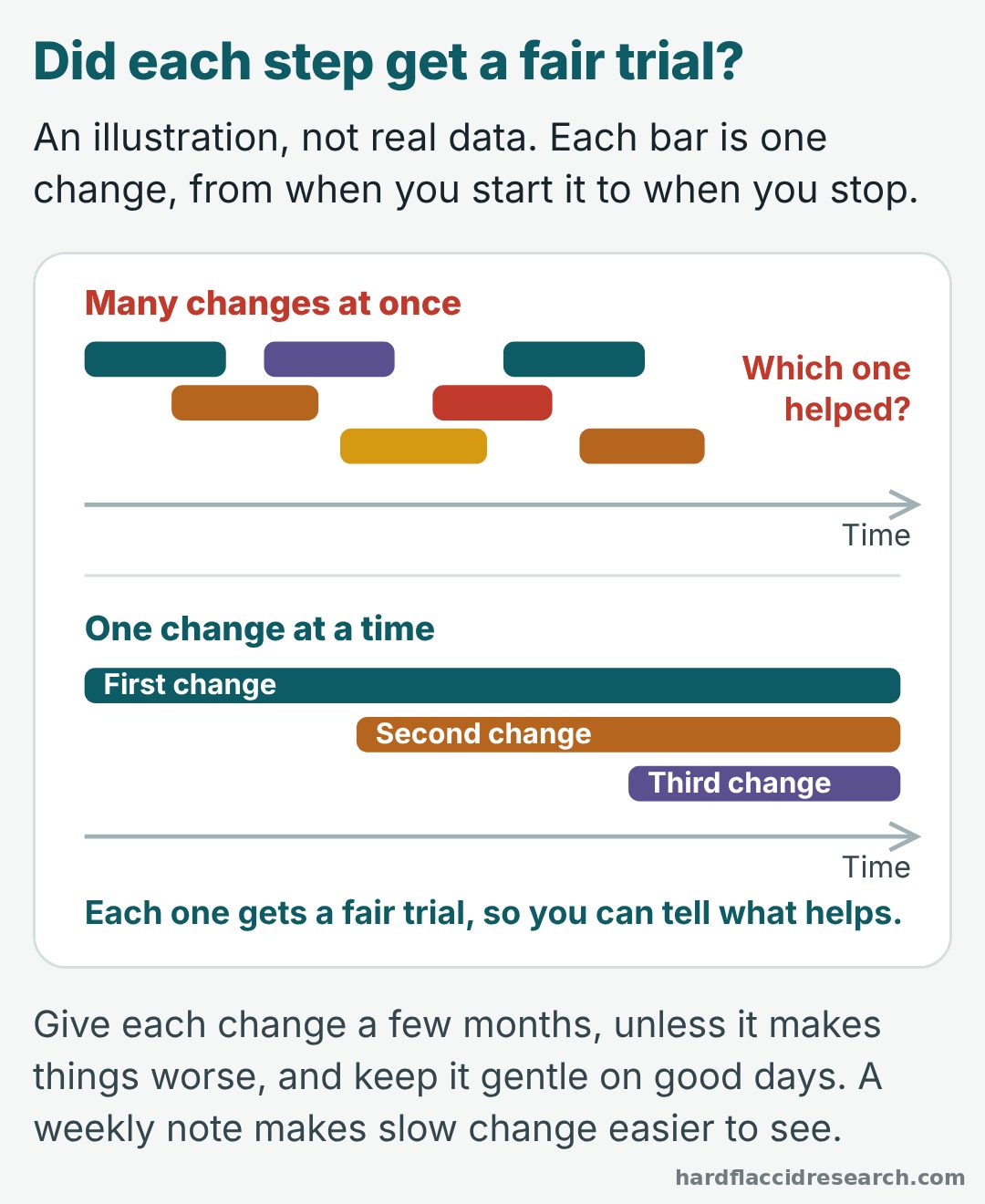
- Changing many things at once, or stopping too soon, so you can't tell what helped.
- Pushing too hard. Many men say forceful stretching, frequent erection checks or hard workouts set off flare-ups, and a flare can hide slow progress.
- A trigger that hasn't stopped, such as an enlargement method, rough masturbation, straining on the toilet or long hours sitting.
- Another cause that was never checked, or a new one (see the next section).
- Low mood or worry that hasn't been treated.
Write down what you've tried, for how long and what happened. Our members' guide, Hard Flaccid for Years? What to Try When Nothing Has Worked, walks you through it.
What should a fresh check-up look for?
It should look at what has changed since your last check, and at causes that were never checked. Tests check for other causes, and normal results make some of them less likely. Ask about the ones that fit you:
- Weaker erections: blood tests for blood sugar (HbA1c) and cholesterol, because erection problems can be a sign of diabetes or heart disease.
- Low sex drive: a testosterone blood test.
- Pain or numbness that's worse when you sit, or long-lasting numbness: a nerve check, including the pudendal nerve (pyoo-DEN-dul), the main nerve between the legs.
- A new curve or bend: an early check, because Peyronie's disease (pay-roe-NEEZ), scar tissue that bends the penis, responds best to early care.
- Pain when peeing or a weaker stream: a urine test, and a doctor may look at chronic prostatitis, a long-term pelvic pain condition.
- Your pelvic floor: a pelvic floor physical therapist checks how the muscles tighten and let go. Every US state lets you see one without a referral, with some limits.
- Medicines: list everything you take, since some, including some antidepressants, can affect erections. Never stop one on your own.
A penile Doppler ultrasound, a blood flow scan, is worth having only if a urologist (a urinary and sexual health specialist) thinks it would change your care. In a study at one US clinic, presented at a medical meeting, blood flow into the penis was normal in all the men scanned. The scans looked only at blood flow.
Any exam should be explained. The doctor or therapist should ask before touching, you can ask for a chaperone, and an internal check happens only if you agree.
This week, book a primary care visit and take your doctor visit kit.
Related: Hard Flaccid Syndrome Medical Evidence Diagnosis Symptoms Treatment Urology »
How do I stop putting my life on hold after years of hard flaccid?
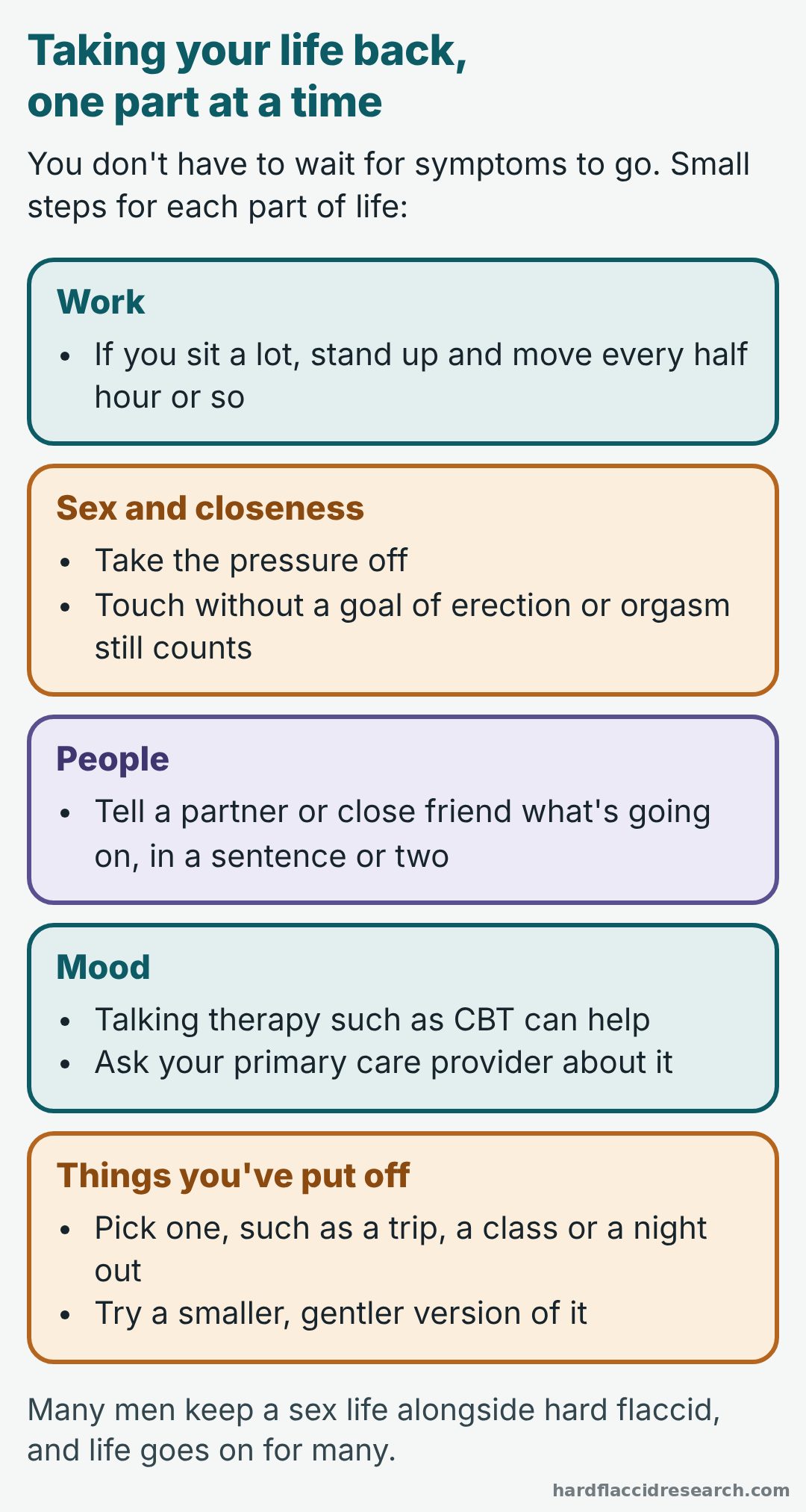
Take back one part of your life at a time, rather than waiting for symptoms to go. Many men keep a sex life: in a July 2023 poll, 58% had had sex since hard flaccid syndrome began, regularly or not (92 of 159 men).
In a January 2023 poll, 67% said hard flaccid affects their life dramatically (83 of 124 men), but 29% said it does and life goes on (36 of 124).
- Work: if you sit a lot, stand up and move every half hour or so.
- Sex and closeness: take the pressure off. Touch without a goal of erection or orgasm still counts, and our article on sex life and relationships has more.
- People: tell a partner or close friend what's going on, in a sentence or two. 97 men wrote about feeling isolated, so you're not the only one.
- Mood: 550 men wrote about low mood or depression, and 916 about anxiety. Talking therapy such as CBT (cognitive behavioral therapy) can help, and US guidelines on pelvic pain in men say doctors may offer it (a conditional recommendation).
If you're feeling hopeless or thinking about suicide, call or text 988, or visit our Support page for more crisis lines. If you can't keep yourself safe, call 911.
This month, pick one thing you've put off, such as a trip, a class or a night out, and try a smaller, gentler version of it.
How do I restart after years of trying?
Build a simple plan from what men who got better credited. Hip and leg stretching came up in 40 of the 126 recovery stories, more than anything else, then a break from masturbation and porn (28 of 126). One way to restart:
- Take stock: list what you've tried, and keep a weekly note in our symptom tracker.
- Get checked: have the fresh check-up above and see a pelvic floor physical therapist. In a November 2022 poll of men who had seen one, 36% said it helped quite a bit or cured them (17 of 47 men).
- Pick two or three gentle daily basics: hip stretches, reverse Kegels or pelvic floor relaxation (20 of 126 stories) and breathing exercises (16 of 126). A reverse Kegel is a gentle letting go, never a push.
- Go easy on Kegels, the squeezing exercises (19 of 126 stories). If your pelvic floor feels tight, ask a physical therapist first, and let go fully between squeezes.
- Ask about medicines: a doctor may suggest tadalafil (Cialis), a prescription medicine for erections (20 of 126 stories). In a June 2023 poll, 76% said Cialis had helped them (34 of 45 men).
Talk to a doctor first: tadalafil can cause headaches, flushing, indigestion or back pain, which usually ease within a day or two. Never take it with nitrate medicines for chest pain or with poppers, because together they can drop your blood pressure dangerously. If you get chest pain, tell the ambulance crew or doctor that you've taken tadalafil, and when: nitrate medicines must not be given within 48 hours of a dose.
- Pace yourself: change one thing at a time, keep it gentle on good days, and stop anything that hurts.
Be wary of clinics promising a quick fix. Ask about the evidence, the risks and the total cost first. Our article on what men who got better did covers each step.
This week, write your list, book the check-up and start one daily basic.
When should I see a doctor?
See a primary care provider if you haven't been checked in a long time, or if your symptoms have changed or something new has started.
Get urgent care straight away (call 911 or go to the emergency room) if you have:
- A plan to end your life, or feeling you can't keep yourself safe.
- An erection lasting more than 4 hours.
- Sudden, severe pain in the penis, testicles or pelvis.
- New numbness around your back passage, genitals or inner thighs, or new weakness in your legs.
- New trouble starting or controlling your pee, not being able to pee, or not feeling when your bladder is full.
- Loss of control of your bladder or bowel.
- A fever or chills with pelvic pain or pain when peeing.
If it isn't urgent but you're worried, ask your primary care provider's office to see you soon.
Frequently asked questions
Is it too late to see a pelvic floor physical therapist?
No: a therapist can check whether muscles that may have been tight for years can let go, and teach you to relax them. In a February 2023 poll of men who had seen one, 38% said it dramatically helped (24 of 64 men). US guidelines on pelvic pain in men say doctors may offer this hands-on therapy (a conditional recommendation).
Is it worth retrying something that didn't help before?
Sometimes. It may deserve another go if it was stopped too soon, pushed too hard or the wrong kind, such as strengthening for a tight pelvic floor. Ask a doctor or physical therapist, and change one thing at a time.
What if a fresh check finds nothing new?
That's still useful: it makes some other causes less likely, and it doesn't mean nothing will help. Put your energy into the plan above, starting with a pelvic floor physical therapist.
Takeaway
Five years or more of hard flaccid is a long time, but men report getting better after years. A fresh check, a pelvic floor assessment and a few gentle steps, given time, can still change things.
This week, list what you've tried and book a check-up. Try our free self-check, and add your experience to help the next man.
This article is for general information and isn't a substitute for advice from your own doctor. Hard Flaccid Research doesn't diagnose or treat. If you have new or worsening symptoms, see a qualified clinician. In an emergency, call 911.
Free tools that can help
- Self-check: do I have hard flaccid?Compare your symptoms with what 6,026 men report.
- Doctor visit kitA one-page summary to take to your appointment.
- Habit trackerCount your days without porn or masturbation, and get through urges.
- Diaphragm breathing toolBreathe with a moving picture of your diaphragm and pelvic floor.
- Add your experienceTell us what you tried and how it went. No name needed.
- Hard Flaccid Syndrome CensusWhat men answered in 818 polls.
- Symptom trackerLog your symptoms and see what helps you.
- Ask us a questionThe questions men ask most become new articles.
The numbers behind this article
Every number in this article comes from what men with hard flaccid syndrome shared between December 2020 and October 2026, counted once per person, or from their polls. These are self-selected reports, not a clinical study. See hard flaccid syndrome statistics, the Hard Flaccid Syndrome Census and how we count.
In a February 2023 poll, 25% had had hard flaccid syndrome for five years or more, 48% for two to four years and 27% for less than two
How 150 men answered: how long have you had hard flaccid syndrome? The poll's answers 'less than a year' and 'one year' are shown together, and so are 'two', 'three' and 'four years'.A snapshot of how long men had had it on the day they answered. It can't show how long hard flaccid lasts or whether it gets better. These figures come from voluntary polls. They describe the men who answered, not everyone with hard flaccid syndrome, and aren't clinical findings.
Source: Hard Flaccid Research, hardflaccidresearch.com
Getting better after years: 8 of 15 stories came after three years or more and 1 after seven; in a June 2023 poll, 42% were at least half better and 11% about 90% better or fully healed
The first two bars are the 15 recovery stories that said how long the man had had hard flaccid before he got better. The last two are from a June 2023 poll that asked men whether they had healed.Only 15 stories said how long. The poll didn't ask how long men had had hard flaccid.
Source: Hard Flaccid Research, hardflaccidresearch.com
Pelvic floor physical therapy: in February 2023, 59% had never seen a therapist and 38% of those who had said it dramatically helped; in November 2022, 36% of those who had seen one said it helped quite a bit or cured them
Two polls, each with its own date and number of men. The second and third bars count only men who had seen a therapist.Polls are self-selected, and they don't say what kind of therapy men had or for how long.
Source: Hard Flaccid Research, hardflaccidresearch.com
In a January 2023 poll, 67% said hard flaccid syndrome affects their life dramatically and 29% that it does but life goes on; in a July 2023 poll, 58% had had sex since it began
Each bar is from its own poll, with its own date and number of men.Polls are self-selected.
Source: Hard Flaccid Research, hardflaccidresearch.com
916 men wrote about anxiety, 550 about low mood or depression, 428 about something that gave them hope and 97 about feeling isolated
Number of men who wrote about each, counted once per person.The groups overlap: one man can write about more than one.
Source: Hard Flaccid Research, hardflaccidresearch.com
What men who got better credited, of 126 recovery stories: hip and leg stretching 40, a break 28, reverse Kegels 20, tadalafil 20, Kegels 19, breathing 16, and physical therapy, talking therapy and core work 15 each
What men who got better say helped them: the share of the 126 recovery stories that credited each, most-credited first. One story can credit several things.A story mentioning something is what the man credited, not proof it worked. Polls are self-selected.
Source: Hard Flaccid Research, hardflaccidresearch.com
In a June 2023 poll, 76% said Cialis had helped them, 20% a lot
How 45 men answered: has Cialis helped your hard flaccid syndrome? The second bar is the men who said a lot.A poll answer is what the man felt. Talk to a doctor before taking any medicine.
Source: Hard Flaccid Research, hardflaccidresearch.com
Every number in this article, with its source
| In this article | Source |
|---|---|
| 6,026 men | 6,026 men, counted from what men wrote, once per person |
| 126 recovery stories | 126 men, counted from what men wrote, once per person |
| 15 of 126 recovery stories said how long | 15 of 126 recovery stories said how long |
| 8 of 15 had had hard flaccid syndrome for three years or more | 8 of 15 recovery stories that said how long, 3 years or more |
| 1 of 15 had had hard flaccid for five years or more (seven years) | 1 of 15 recovery stories that said how long, 5 years or more |
| The longest was 7 years (84 months) | Range of 15 recovery stories that said how long, 2 to 84 months |
| 42% said they were at least half better (56 of 132 men) | 56 of 132 men, poll, Jun 2023 |
| 11% said they were about 90% better or fully healed (14 of 132 men) | 14 of 132 men, poll, Jun 2023 |
| 428 men wrote about something that gave them hope | 428 men who wrote about hope, research data |
| 25% had had hard flaccid for five years or more (38 of 150 men) | 38 of 150 men, poll, Feb 2023 |
| 48% had had hard flaccid for two to four years (72 of 150 men) | 72 of 150 men, poll, Feb 2023 |
| 27% had had hard flaccid for less than two years (40 of 150 men) | 40 of 150 men, poll, Feb 2023 |
| 59% had never seen a pelvic floor physical therapist (91 of 155 men) | 91 of 155 men, poll, Feb 2023 |
| Of men who had seen a pelvic floor physical therapist, 38% said it dramatically helped (24 of 64 men) | 24 of 64 men, poll, Feb 2023 |
| Of men who had seen a pelvic floor physical therapist, 36% said it helped quite a bit or cured them (17 of 47 men) | 17 of 47 men, poll, Nov 2022 |
| 67% said hard flaccid affects their life dramatically (83 of 124 men) | 83 of 124 men, poll, Jan 2023 |
| 29% said it affects their life but life goes on (36 of 124 men) | 36 of 124 men, poll, Jan 2023 |
| 58% said they had had sex since hard flaccid began, regularly or not (92 of 159 men) | 92 of 159 men, poll, Jul 2023 |
| 916 men wrote about anxiety | 916 men who wrote about anxiety, research data |
| 550 men wrote about low mood or depression | 550 men who wrote about low mood or depression, research data |
| 97 men wrote about feeling isolated | 97 men who wrote about isolation, research data |
| Hip and leg stretching came up in 40 of 126 recovery stories | 40 of 126 recovery stories |
| A break from masturbation and porn came up in 28 of 126 recovery stories | 28 of 126 recovery stories |
| Reverse Kegels or pelvic floor relaxation came up in 20 of 126 recovery stories | 20 of 126 recovery stories |
| Tadalafil came up in 20 of 126 recovery stories | 20 of 126 recovery stories |
| Kegels came up in 19 of 126 recovery stories | 19 of 126 recovery stories |
| Breathing exercises came up in 16 of 126 recovery stories | 16 of 126 recovery stories |
| Pelvic floor physical therapy came up in 15 of 126 recovery stories | 15 of 126 recovery stories |
| Talking therapy, CBT, mindfulness or meditation came up in 15 of 126 recovery stories | 15 of 126 recovery stories |
| Core and glute strengthening came up in 15 of 126 recovery stories | 15 of 126 recovery stories |
| 76% said Cialis had helped them (34 of 45 men) | 34 of 45 men, poll, Jun 2023 |
| 20% said Cialis helped a lot (9 of 45 men) | 9 of 45 men, poll, Jun 2023 |
| Counting since December 2020 | Research data, December 2020 to October 2026 |
Medical sources
What this article says about medical research, guidelines and urgent care comes from these sources.
- Gul M, Towe M, Yafi FA, Serefoglu EC. Hard flaccid syndrome: initial report of four cases. Int J Impot Res. 2020;32:176-179. https://doi.org/10.1038/s41443-019-0133-z
- Pang KH, Feng J, Zhang Y. Hard-flaccid syndrome: a systematic review of aetiopathophysiology, clinical presentation and management. Int J Impot Res. 2026;38:393-403. https://doi.org/10.1038/s41443-025-01118-2
- Niedenfuehr J, Stevens DM. Hard flaccid syndrome symptoms, comorbidities, and self-reported efficacy and satisfaction of treatments: a cross-sectional survey. Int J Impot Res. 2025;37:458-464. https://doi.org/10.1038/s41443-024-00853-2
- Abdessater M, Kanbar A, Akakpo W, Beley S. Hard flaccid syndrome: state of current knowledge. Basic Clin Androl. 2020;30:7. https://doi.org/10.1186/s12610-020-00105-5
- Sullivan J, Salter C, Flores J, Ghuring P, Parker M, Mulhall J. Exploring erectile hemodynamics in men complaining of hard-flaccid syndrome (meeting abstract). J Sex Med. 2023;20(Suppl 1):i124-i125. https://doi.org/10.1093/jsxmed/qdad060.194
- Lai HH, Pontari MA, Argoff CE, et al. Male chronic pelvic pain: AUA guideline. J Urol. 2025. https://www.auanet.org/guidelines-and-quality/guidelines/male-chronic-pelvic-pain
- Hetrick DC, Ciol MA, Rothman I, Turner JA, Frest M, Berger RE. Musculoskeletal dysfunction in men with chronic pelvic pain syndrome type III: a case-control study. J Urol. 2003;170:828-831. https://doi.org/10.1097/01.ju.0000080513.13968.56
- Labat JJ, Riant T, Robert R, Amarenco G, Lefaucheur JP, Rigaud J. Diagnostic criteria for pudendal neuralgia by pudendal nerve entrapment (Nantes criteria). Neurourol Urodyn. 2008;27:306-310. https://pubmed.ncbi.nlm.nih.gov/17828787/
- MedlinePlus (US National Library of Medicine). Erection problems. https://medlineplus.gov/ency/article/007617.htm
- MedlinePlus (US National Library of Medicine). Hemoglobin A1C (HbA1c) test. https://medlineplus.gov/lab-tests/hemoglobin-a1c-hba1c-test/
- National Institute of Diabetes and Digestive and Kidney Diseases. Symptoms and causes of erectile dysfunction. https://www.niddk.nih.gov/health-information/urologic-diseases/erectile-dysfunction/symptoms-causes
- National Institute of Diabetes and Digestive and Kidney Diseases. Penile curvature (Peyronie's disease). https://www.niddk.nih.gov/health-information/urologic-diseases/penile-curvature-peyronies-disease
- American Physical Therapy Association. Direct access advocacy. https://www.apta.org/advocacy/issues/direct-access-advocacy
- American Medical Association. Code of Medical Ethics Opinion 1.2.4: Use of chaperones. https://code-medical-ethics.ama-assn.org/ethics-opinions/use-chaperones
- National Institute of Mental Health. Psychotherapies. https://www.nimh.nih.gov/health/topics/psychotherapies
- Eli Lilly and Company. CIALIS (tadalafil) tablets: prescribing information. DailyMed, US National Library of Medicine, revised March 2026. https://dailymed.nlm.nih.gov/dailymed/drugInfo.cfm?setid=bcd8f8ab-81a2-4891-83db-24a0b0e25895
- Bivalacqua TJ, Allen BK, Brock G, et al. Acute ischemic priapism: an AUA/SMSNA guideline. J Urol. 2021;206(5):1114-1121. https://doi.org/10.1097/JU.0000000000002236
- Substance Abuse and Mental Health Services Administration. 988 Suicide and Crisis Lifeline. https://988lifeline.org/
How we made this article
We started from the question many men asked. Every number was checked against our data. Our editorial team edited it and Dr. Julian Reyes reviewed it medically. Read our editorial policy.
Read next
- Is Hard Flaccid Permanent? What 126 Recovery Stories ShowArticle
- Hard Flaccid Syndrome Medical Evidence Diagnosis Symptoms Treatment UrologyArticle
- How Long Does Hard Flaccid Last? 15 Men's Recovery TimesArticle
- Firm flaccid stateSymptom
- Pelvic floor physioTreatment
- Therapy and mindfulnessTreatment
- StretchingTreatment
See more of us on Google
Add Hard Flaccid Research as a preferred source, and Google shows you our pages more often when you search.
Add as a preferred sourceDon't see your question? Ask us. We answer the most-asked ones in new articles.
Cite and share this article
You're welcome to quote this article. Please name Hard Flaccid Research and link to this page, so others can find the full answer and the data behind it. To cite this page, use its link.
Citation
Hard Flaccid Research. (2026). Hard Flaccid for 5+ Years? 38 of 150 Men Are Still Fighting. Written by the Editorial Team, medically reviewed by Dr. Julian Reyes. https://hardflaccidresearch.com/articles/hard-flaccid-5-years
Credit link for your article
Source: <a href="https://hardflaccidresearch.com/articles/hard-flaccid-5-years">Hard Flaccid Research</a>
Wikipedia reference
<ref>{{cite web |url=https://hardflaccidresearch.com/articles/hard-flaccid-5-years |title=Hard Flaccid for 5+ Years? 38 of 150 Men Are Still Fighting |website=Hard Flaccid Research |date=2026 |access-date=28 October 2026}}</ref>
How the data was collected: our methodology. Journalists and researchers: key numbers, data and contact.