No Morning Wood? Causes, What It Means & When to Worry
In short
- Morning wood comes from erections that happen naturally during dream sleep, so losing it for a while points more towards a physical cause, such as sleep, blood flow, nerves, hormones or a medicine, than stress alone.
- Missing it now and then is normal.
- Losing it is common in hard flaccid syndrome: in a January 2023 poll, only 9% of men with hard flaccid syndrome said they get one every day (12 of 128 men).
- If it has faded for weeks, a check-up is worth it.
Missing morning wood now and then is normal. Morning wood is the erection many men wake up with, and it comes from erections that happen naturally during dream sleep. If it fades for weeks, a physical cause such as poor sleep, blood flow, nerves, hormones or a medicine is more likely than stress alone. Fewer or weaker morning erections are common in hard flaccid syndrome: in a January 2023 poll, only 9% of men with hard flaccid said they get one every day (12 of 128 men).
147 men described fewer or no morning erections, and they describe the other main symptoms more often too. This page explains what morning erections are, whether it's normal not to have them, what causes them to fade, what they mean in hard flaccid, how men try to get them back, and when to worry.
By the numbers: between December 2020 and October 2026, 2,661 of the 6,026 men who shared their experiences described their symptoms, and 147 of them mentioned fewer or no morning erections. In a January 2023 poll, 128 men with hard flaccid answered whether they get morning erections.
What is morning wood?
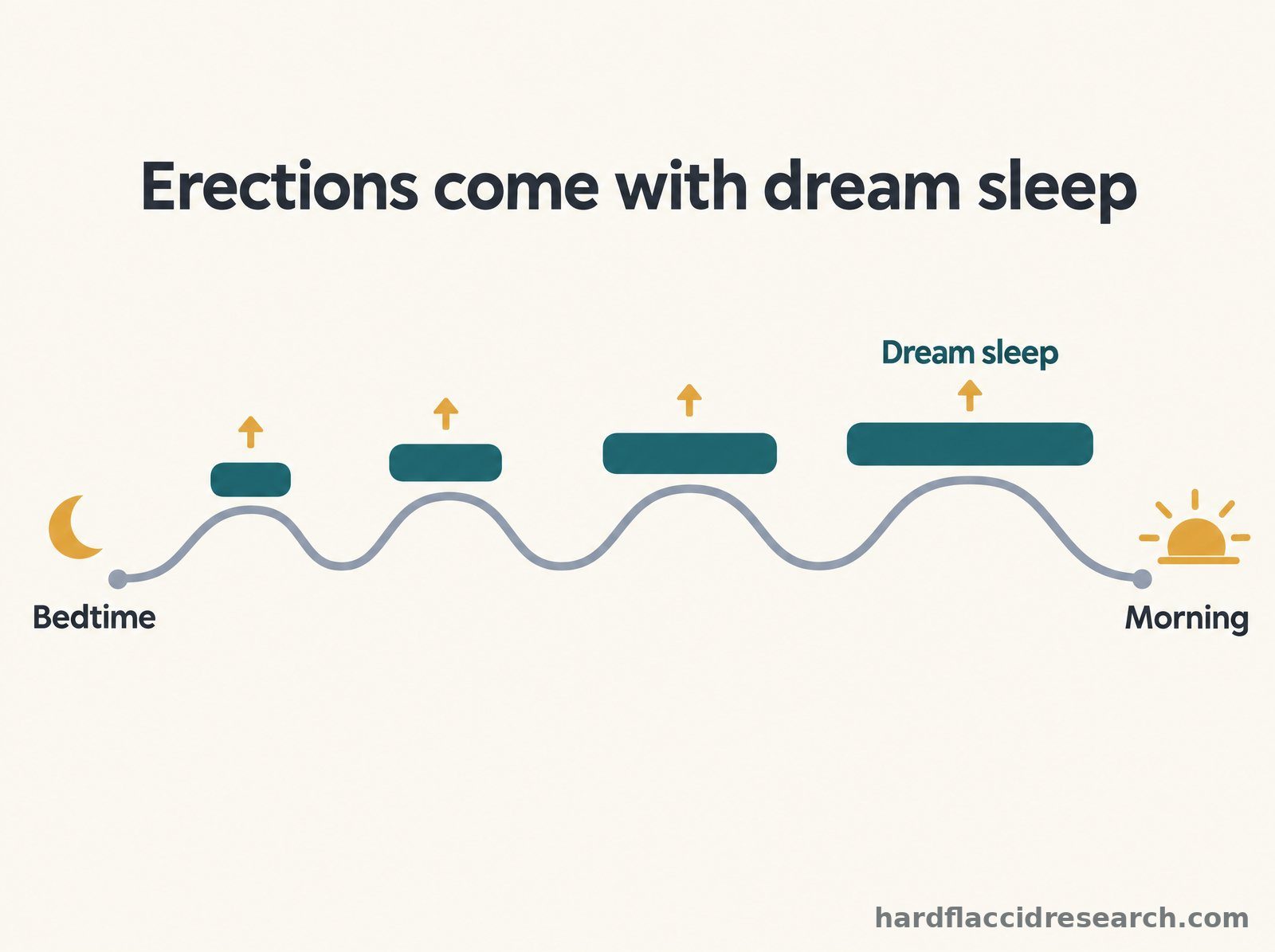
Morning wood is the common name for an erection you wake up with. Doctors call erections during sleep nocturnal penile tumescence. They happen mostly during REM sleep, the dreaming stage, which comes in cycles through the night. The longest dream periods tend to come towards morning, so you often wake up during or just after one.
They don't need sexual thoughts or a full bladder. During dream sleep, the brain switches erections on by itself, and doctors think this may help keep the tissue in the penis healthy by bringing in fresh, oxygen-rich blood.
Hard Flaccid Explorerby Hard Flaccid Research
Morning wood, step by step
A 7-minute animated explainer of this article. Press play, or skip between chapters. The first minute is free for everyone.
A picture to explain, not a diagnosis. Nobody knows for sure yet why hard flaccid syndrome affects morning erections.
Is it normal not to have morning wood?
Not waking up with one every day is normal. You only notice one if you wake at the right moment, and they become less frequent and less firm as men get older.
Healthy men have several erections a night in dream sleep, at any age. Missing them after a late night, alcohol, or a stressful week is common.
A change that lasts for weeks, or that comes with weaker erections during sex, is worth checking. So is a sudden change in a young man, because it is less often down to age.
Related: Weak Erections With Hard Flaccid: Will They Come Back? »
Why doctors ask about morning erections
Morning erections are a useful clue. If you still wake up with firm erections but struggle during sex, the nerves and blood vessels are probably working, and stress, anxiety or the situation may be playing a big part. If they have faded or stopped, a physical cause is more likely, such as a problem with blood flow, nerves or hormones.
It's not a perfect test. Poor sleep, alcohol and some medicines can stop morning erections even when everything else is fine. Some clinics can measure erections overnight with a small device worn in bed, but most doctors simply ask.
What causes no morning wood?
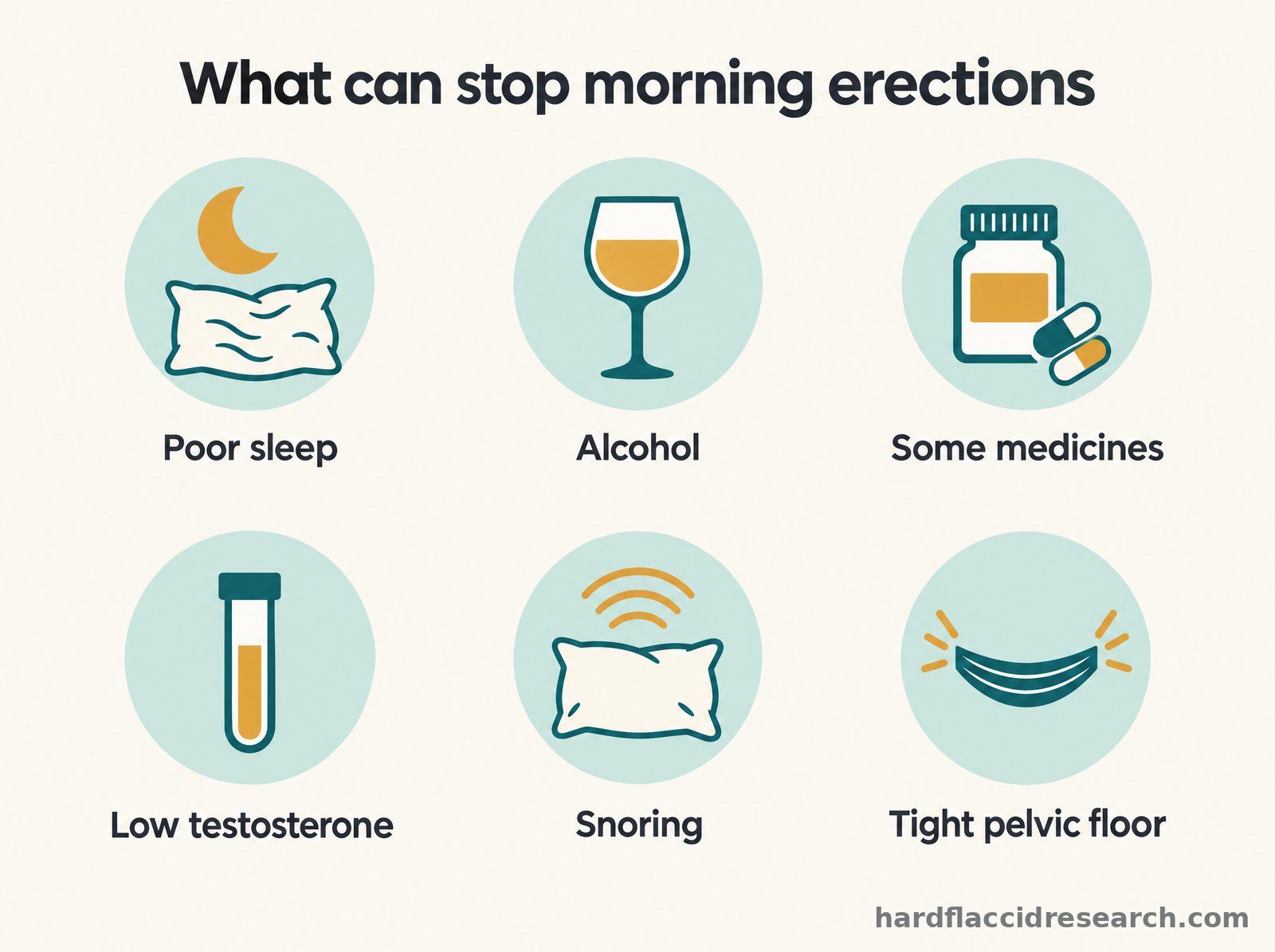
Fewer morning erections have many possible causes, and hard flaccid syndrome is only one of them. Common ones include:
- Short or broken sleep, for example from shift work, a new baby or a busy mind.
- Sleep apnoea, where breathing stops and starts during sleep. Loud snoring and feeling tired in the day are signs.
- Alcohol close to bedtime, which disrupts dream sleep.
- Some medicines, including some antidepressants, some blood pressure medicines and finasteride for hair loss. Don't stop or change a medicine on your own: talk to your doctor.
- Low testosterone, which often lowers sex drive too. Testosterone helps keep sleep erections going, so low levels can mean fewer of them.
- Diabetes, high blood pressure, high cholesterol, smoking and heart disease, which can all affect blood flow.
- Depression, and getting older.
- Stress and worry, which doctors think act mainly by breaking sleep up.
- Less often, a tight pelvic floor or a condition such as hard flaccid, which may play a part, though this isn't proven (covered below).
Low sex drive is common in hard flaccid as well. 230 men described low libido, and in an April 2023 poll, 83% said their libido was lower or gone since hard flaccid began (71 of 86 men).
Related: Hard Flaccid Syndrome Medical Evidence Diagnosis Symptoms Treatment Urology »
Morning erections in hard flaccid syndrome
In a January 2023 poll, 128 men with hard flaccid syndrome answered whether they get morning erections. Only 9% said every day (12 of 128 men). 45% said some days (57 of 128), 28% said yes, but not very strong (36 of 128), and 18% said never (23 of 128).
Put another way, 46% said they never get one or only weak ones (59 of 128 men).
Of the 2,661 men who described their symptoms, 147 mentioned fewer or no morning erections. Most of them describe other symptoms too: 70% the firm flaccid state, 63% weaker erections, 56% numbness, 53% shrinkage and 38% pelvic floor tightness.
That is more than among men with hard flaccid as a whole, where 58% describe the firm flaccid state (1,553 of 2,661), 35% weaker erections (926 of 2,661), 34% numbness (914 of 2,661), 27% shrinkage (720 of 2,661) and 23% pelvic floor tightness (601 of 2,661). These are self-selected reports, not a clinical study.
Erections matter a lot to men with hard flaccid. In a May 2023 poll asking which one symptom men would fix, erection problems came first: 43% chose them (45 of 104 men).
Why might hard flaccid syndrome affect morning erections?
Nobody knows for sure yet. An erection during sleep works like any other erection, except that dream sleep, not arousal, starts it. First, dream sleep has to come: it is when the brain switches erections on. Then the signal travels down nerves to the penis. Finally, smooth muscle in the arteries and chambers relaxes, blood rushes in, and the chambers squeeze their small veins shut so it stays in. When you're awake, arousal sends the signal instead.
- Nerves send the signal
Arousal travels down nerves, including the pudendal nerve, to the penis. Irritated nerves are one idea for hard flaccid syndrome.
- Muscles relax and arteries open
Smooth muscle in the arteries and chambers relaxes, and blood rushes in. Tight pelvic floor muscles may press on these vessels.
- The chambers fill and the veins close
The spongy chambers swell and squeeze their small veins shut, so the blood stays in until the erection ends.
Each idea doctors and physios discuss for hard flaccid touches one of these steps:
- A tight pelvic floor. The pelvic floor is the sling of muscles between your legs that supports your bladder and bowel and helps control erections. If these muscles stay clenched, they may press on the nerves and blood vessels an erection depends on, even during sleep.
- Irritated nerves. The pudendal nerve carries feeling from the penis and powers the muscles that make an erection rigid. If it is irritated or squeezed, erections may be weaker.
- Poor sleep. Short or broken sleep means less dream sleep, and fewer chances for a morning erection. Many men with hard flaccid say they sleep badly because of worry, pain or needing to pee at night.
- Blood flow. Some men wonder about veins or blood flow. Our article on venous leak explains how doctors test for it.
Is it all stress? Missing morning erections suggest it isn't only stress, and many men feel the same: in a January 2023 poll, 84% said the cause of hard flaccid is not psychological (88 of 105 men). Anxiety is common too: in an April 2023 poll, 76% said they had anxiety before hard flaccid (94 of 123 men), though that doesn't show that anxiety caused it. Stress mostly falls away in sleep, but it can break sleep up, and when you're awake, it can hold an erection back.
How to get morning wood back
There is no guaranteed way, and what helps depends on the cause. Things that may help:
- Enough sleep at regular times. The longest dream periods come late in the night, so cutting sleep short cuts them.
- Keeping alcohol away from bedtime.
- Moving more, keeping a healthy weight and, if you smoke, stopping, which all help your blood vessels. US urology guidelines say that for men whose health problems affect their erections, more physical activity and a better diet may improve erections.
- Getting loud snoring or daytime tiredness checked. Treating sleep apnoea may help some men.
- Going through your medicines with a doctor or pharmacist. Don't stop or change a medicine on your own.
- Blood tests for testosterone, blood sugar and cholesterol, so a doctor can look for causes that can be treated.
- For men with hard flaccid syndrome: if your pelvic floor feels tight, a pelvic health physio may help it relax. Our article on how to do reverse Kegels explains the basics.
What men with hard flaccid syndrome mentioned
Among the 147 men who mentioned fewer or no morning erections, the treatments mentioned most were stretching (55%), rest or abstinence (49%), tadalafil (49%), Kegels (46%), reverse Kegels (36%) and supplements (35%). Being mentioned is not the same as working, and many men mentioned several things.
Kegels strengthen the pelvic floor, which may not help if it is already too tight and may make it worse. Reverse Kegels and pelvic floor physio focus on relaxing it instead. Pelvic floor physio means working with a physiotherapist trained in the pelvic floor muscles. If your pelvic floor feels tight, ask a pelvic health physio before doing Kegels, and let go fully between squeezes.
Tadalafil (sold as Cialis) is a medicine doctors prescribe for erection problems. It helps the muscles relax and the arteries open, but it needs a nerve signal to work on, and it doesn't relax the pelvic floor or fix poor sleep. It lasts longer than similar medicines, so a doctor may suggest taking it daily rather than before sex. Never take it with nitrate medicines for chest pain or with poppers. In a June 2023 poll of men who had tried it, 76% said it helped their hard flaccid syndrome at least a bit (34 of 45 men). That is a small, self-selected group, so it isn't proof that it works.
Talk to a doctor first. In most countries tadalafil and similar medicines, such as sildenafil, need a prescription, and they are not safe for everyone with heart or blood pressure problems. Never take them with nitrate medicines for chest pain or with poppers, because together they can drop your blood pressure dangerously. If you get chest pain, tell the ambulance crew or doctor which medicine you've taken, and when: nitrate medicines must not be given within 24 hours of a sildenafil dose, or within 48 hours of a tadalafil dose. Taken with an alpha blocker, a medicine for peeing problems or high blood pressure, they can drop your blood pressure too far. Side effects such as headache, flushing, a blocked nose or indigestion usually ease within a day or two. Rarely, they cause sudden loss of sight or hearing, or an erection that won't go down, and all of these need urgent care. Never start, stop or change a medicine on your own, and don't buy medicines online without a prescription.
Will morning erections come back?
We don't have numbers on morning erections coming back by themselves yet. In a June 2023 poll about hard flaccid syndrome overall, not morning erections, 42% of men said they were at least half better than when they started (56 of 132 men), and 126 men shared a story of getting better.
Because morning erections depend less on your mood than erections when you're awake, they are also a gentle way to track change. Some men note them in a diary, alongside sleep, stress and flare-ups. Our symptom tracker can help.
Common questions about morning wood
Does no morning wood mean erectile dysfunction? Not on its own. If you still get firm erections when you're aroused, the nerves and blood flow are probably working. If morning erections and erections during sex have both faded, see a doctor.
Is no morning wood a sign of low testosterone? It can be, especially with low sex drive and tiredness, but many other things cause it too. A blood test, usually taken in the morning, can check.
Can stress or anxiety stop morning wood? Stress mostly falls away in sleep, but it can break sleep up and cut dream sleep, so it can mean fewer morning erections.
Does a full bladder cause morning wood? Not on its own. Morning wood comes mainly from dream sleep. A full bladder may add to it, and it may wake you while one is happening.
Is it normal to lose morning wood in your twenties or thirties? Missing it for a few days is normal at any age. A change that lasts for weeks in a young man is worth checking.
When to worry about no morning wood
Get fewer morning erections checked sooner if:
- They have faded or stopped for more than a few weeks.
- Erections during sex are weaker too, or your sex drive has dropped.
- The change came on suddenly, or after starting a new medicine. Don't stop or change it on your own.
- You snore loudly, stop breathing in your sleep, or feel very tired in the day.
- You have diabetes, high blood pressure, high cholesterol or heart disease, or you smoke.
- You have other symptoms, such as a firm resting penis, numbness you've had for a while, or pelvic pain. New numbness between your legs needs urgent care (see below).
See a doctor if your morning erections have faded or stopped for more than a few weeks, especially if erections with a partner are weaker too. Erection problems can be an early sign of heart disease or diabetes, so a check-up is worth it even if you think hard flaccid syndrome is the cause. Ask about a blood pressure check and blood tests for blood sugar, cholesterol and testosterone, which is usually tested in the morning, when levels are highest. If you snore or wake up tired, a doctor may suggest a sleep test.
Get urgent care straight away if you have:
- An erection lasting more than 4 hours.
- Chest pain or shortness of breath, especially during sex.
- Blood in your urine that you can see.
- Sudden, severe pain in the penis, testicles or pelvis.
- New numbness around your back passage, genitals or inner thighs, or new weakness in your legs.
- New trouble starting or controlling your pee, not being able to pee, or not feeling when your bladder is full.
- Loss of control of your bladder or bowel.
- A fever or chills with pelvic pain or pain when peeing.
If you are feeling hopeless or having thoughts of ending your life, please visit our Support page now. It lists crisis lines you can call or text.
What to do next
Many men find it hard to be taken seriously. In a November 2022 poll of men who had seen a urologist, 95% called their visits bad and unhelpful (63 of 66 men). That's a reason to prepare well, not to skip the visit.
- Keep a note of your morning erections for a few weeks, with how you slept, alcohol and stress.
- Book a check-up and ask for blood pressure, blood sugar, cholesterol and morning testosterone tests.
- Go through your medicines with a doctor or pharmacist. Don't stop or change a medicine on your own.
- If your pelvic floor feels tight, ask about a pelvic health physiotherapist.
- Use our doctor visit kit to take a clear summary to your appointment.
Our members' guide, Weak Erections With Hard Flaccid: The Gentle Way Back to Sex, explains what may be behind weaker erections and morning erections, and has a step-by-step plan for coming back to sex gently.
Free tools that can help
- Self-check: do I have hard flaccid?Compare your symptoms with what 6,026 men report.
- Doctor visit kitA one-page summary to take to your appointment.
- Habit trackerCount your days without porn or masturbation, and get through urges.
- Diaphragm breathing toolBreathe with a moving picture of your diaphragm and pelvic floor.
- Add your experienceTell us what you tried and how it went. No name needed.
- Hard Flaccid Syndrome CensusWhat men answered in 818 polls.
- Symptom trackerLog your symptoms and see what helps you.
- Ask us a questionThe questions men ask most become new articles.
The numbers behind this article
Every number in this article comes from what men with hard flaccid syndrome shared between December 2020 and October 2026, counted once per person, or from their polls. These are self-selected reports, not a clinical study. See hard flaccid syndrome statistics, the Hard Flaccid Syndrome Census and how we count.
Only a few men with hard flaccid syndrome get a morning erection every day
How 128 men with hard flaccid syndrome answered a January 2023 poll.These are self-selected reports, not a clinical study.
Source: Hard Flaccid Research, hardflaccidresearch.com
Men who lose morning erections describe the main symptoms more often
Each pair compares the 147 men who mentioned fewer or no morning erections with all 2,661 men who described their symptoms.Source: Hard Flaccid Research, hardflaccidresearch.com
More men described weaker erections than low libido or fewer morning erections
Number of the 2,661 men who described their symptoms who described each one, counted once per person.Source: Hard Flaccid Research, hardflaccidresearch.com
What men with fewer morning erections mentioned
Share of the 147 men who mentioned fewer or no morning erections who mentioned each treatment.Being mentioned is not the same as working. Other approaches came up too.
Source: Hard Flaccid Research, hardflaccidresearch.com
In one poll, most men said the cause of hard flaccid syndrome is not psychological
Each bar comes from a separate poll of men with hard flaccid syndrome, with its own number of men.These are self-selected reports, not a clinical study. Having anxiety before hard flaccid syndrome doesn't show that anxiety caused it.
Source: Hard Flaccid Research, hardflaccidresearch.com
Erections, libido, tadalafil and recovery
Each bar comes from a separate poll of men with hard flaccid syndrome, with its own number of men.These are self-selected reports, not a clinical study.
Source: Hard Flaccid Research, hardflaccidresearch.com
Every number in this article, with its source
| In this article | Source |
|---|---|
| 9% get morning erections every day (12 of 128 men) | 12 of 128 men, poll, Jan 2023 |
| 45% some days (57 of 128 men) | 57 of 128 men, poll, Jan 2023 |
| 28% yes, but not very strong (36 of 128 men) | 36 of 128 men, poll, Jan 2023 |
| 18% never (23 of 128 men) | 23 of 128 men, poll, Jan 2023 |
| 46% never or only weak ones (59 of 128 men) | 59 of 128 men, poll, Jan 2023 |
| 147 men mentioned fewer or no morning erections | 147 of 2,661 men, counted from what men wrote, once per person |
| Of men with fewer or no morning erections: 70% firm flaccid state, 63% weaker erections, 56% numbness, 53% shrinkage, 38% pelvic floor tightness | 147 men mentioning fewer or no morning erections, counted from what men wrote, once per person |
| Treatments mentioned by men with fewer or no morning erections: stretching 55%, rest or abstinence 49%, tadalafil 49%, Kegels 46%, reverse Kegels 36%, supplements 35% | 147 men mentioning fewer or no morning erections, counted from what men wrote, once per person |
| 58% (1,553 of 2,661) describe the firm, semi-rigid flaccid state | 1,553 of 2,661 men, counted from what men wrote, once per person |
| 35% (926 of 2,661) mentioned weak or lost erections | 926 of 2,661 men, counted from what men wrote, once per person |
| 34% (914 of 2,661) describe numbness or loss of feeling | 914 of 2,661 men, counted from what men wrote, once per person |
| 27% (720 of 2,661) describe shrinkage or retraction | 720 of 2,661 men, counted from what men wrote, once per person |
| 23% (601 of 2,661) describe pelvic floor tightness, spasm or twitching | 601 of 2,661 men, counted from what men wrote, once per person |
| 43% would fix erection problems first (45 of 104 men) | 45 of 104 men, poll, May 2023 |
| 84% said the cause is not psychological (88 of 105 men) | 88 of 105 men, poll, Jan 2023 |
| 76% had anxiety before hard flaccid syndrome (94 of 123 men) | 94 of 123 men, poll, Apr 2023 |
| 230 men described low libido | 230 men, counted from what men wrote, once per person |
| 83% lower or no libido (71 of 86 men) | 71 of 86 men, poll, Apr 2023 |
| 76% said tadalafil helped at least a bit (34 of 45 men) | 34 of 45 men, poll, Jun 2023 |
| 42% at least half better (56 of 132 men) | 56 of 132 men, poll, Jun 2023 |
| 126 recovery stories | 126 men, counted from what men wrote, once per person |
| 95% called urologist visits bad and unhelpful (63 of 66 men) | 63 of 66 men, poll, Nov 2022 |
| Counting since December 2020 | Research data, December 2020 to October 2026 |
| 6,026 men shared their experiences | Research data, December 2020 to October 2026 |
How we made this article
We started from the question many men asked. Every number was checked against our data. Our editorial team edited it and Dr. Julian Reyes reviewed it medically. Read our editorial policy.
Read next
See more of us on Google
Add Hard Flaccid Research as a preferred source, and Google shows you our pages more often when you search.
Add as a preferred sourceDon't see your question? Ask us. We answer the most-asked ones in new articles.
Cite and share this article
You're welcome to quote this article. Please name Hard Flaccid Research and link to this page, so others can find the full answer and the data behind it. To cite this page, use its link.
Citation
Hard Flaccid Research. (2026). No Morning Wood? Causes, What It Means & When to Worry. Written by the Editorial Team, medically reviewed by Dr. Julian Reyes. https://hardflaccidresearch.com/articles/no-morning-wood
Credit link for your article
Source: <a href="https://hardflaccidresearch.com/articles/no-morning-wood">Hard Flaccid Research</a>
Wikipedia reference
<ref>{{cite web |url=https://hardflaccidresearch.com/articles/no-morning-wood |title=No Morning Wood? Causes, What It Means & When to Worry |website=Hard Flaccid Research |date=2026 |access-date=28 October 2026}}</ref>
How the data was collected: our methodology. Journalists and researchers: key numbers, data and contact.