Post-Finasteride Syndrome and Hard Flaccid: The Overlap
In short
- Post-finasteride syndrome (PFS) is the name for sexual, physical and mental symptoms that some men report carrying on after they stop finasteride, a tablet for hair loss and an enlarged prostate.
- How often it happens, and why, isn't known, but medicines regulators now warn that sexual side effects can last after stopping, and that finasteride can cause low mood and, rarely, thoughts of suicide.
- PFS overlaps with hard flaccid syndrome, though few men with hard flaccid syndrome link hard flaccid to these medicines: 4% in one March 2023 poll (6 of 164 men).
- If you take finasteride and your mood drops, get medical advice straight away, and get urgent help for any thoughts of harming yourself.
Post-finasteride syndrome (PFS) is the name for sexual, physical and mental symptoms that some men report carrying on after they stop finasteride, a tablet for hair loss and an enlarged prostate. Some overlap with hard flaccid syndrome, where the penis stays firm, rubbery or shrunken when it should be soft. How often PFS happens, and why, isn't known, but regulators now warn that sexual side effects can last after stopping, and that finasteride can cause low mood and, rarely, thoughts of suicide.
If you take finasteride and notice low mood, get medical advice straight away; any thoughts of harming yourself need urgent help now (see below).
By the numbers: of the 6,026 men with hard flaccid who shared their experiences between December 2020 and October 2026, 2,661 described their symptoms, and 38 named a medication or supplement as how their hard flaccid began, not all of them finasteride. These are self-selected reports, not a clinical study.
What is finasteride?
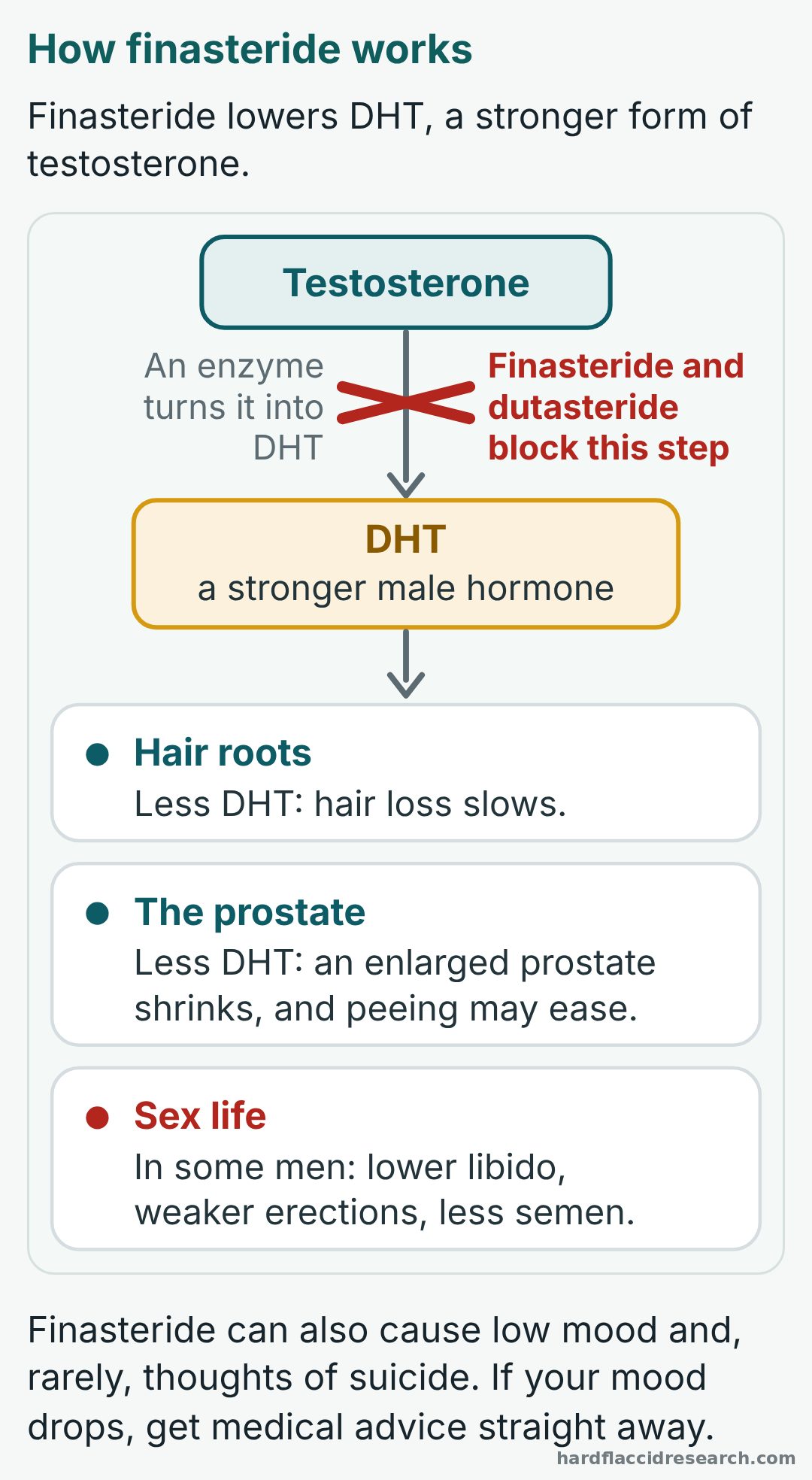
Finasteride blocks an enzyme called 5-alpha reductase, which turns the main male hormone into DHT (dihydrotestosterone), a stronger form that acts on hair roots, the prostate and the genitals. Lowering DHT slows male pattern hair loss and shrinks an enlarged prostate, which can ease peeing problems. It comes as a low-dose tablet for hair loss (Propecia and others) and a higher-dose tablet for an enlarged prostate (Proscar and others).
For hair loss it takes months to work, and the hair loss usually comes back after stopping. A skin spray is approved in some countries, but not in the US.
- Dutasteride blocks the same enzyme, and a second form of it, and is mainly used for an enlarged prostate. It can cause similar sexual side effects and breast changes, and because it works like finasteride, European regulators added a mood warning to it as a precaution.
- Saw palmetto is a supplement some men take for the same reasons. It may act a little like these medicines, though studies haven't shown that it helps prostate symptoms; it usually causes only mild side effects, but may raise the risk of bleeding with a blood thinner.
Hard Flaccid Explorerby Hard Flaccid Research
Finasteride, PFS and hard flaccid
A 7-minute animated explainer of this article. Press play, or skip between chapters. The first minute is free for everyone.
A picture to explain, not a diagnosis. Hormones aren't drawn, and mood shows only as stress signals: the picture shows the prostate, the pelvic floor, a nerve, blood flow and the penis.
Finasteride side effects
Most men who take finasteride don't notice side effects. The ones listed most often are sexual:
- Lower interest in sex (libido).
- Erection problems.
- Less semen, problems ejaculating, or a weaker orgasm.
Less common or rare side effects include:
- Breast tenderness or swelling (gynecomastia). Lumps, pain or swelling in your chest, or discharge from a nipple, need a doctor straight away, because they can be a sign of breast cancer, which has rarely been reported in men taking finasteride.
- Low mood (depression) and, rarely, thoughts of suicide. The European Medicines Agency has confirmed thoughts of suicide as a side effect of finasteride tablets; how often it happens isn't known.
- Testicle pain, lower sperm quality, which can affect fertility, a rash, and, rarely, a serious allergic reaction with swelling of the lips, face or throat.
For most men, sexual side effects settle while they keep taking it or after they stop, but regulators now warn that in some men they carried on after stopping. Finasteride also lowers PSA results, so tell your doctor before a PSA test. Women who are or may be pregnant shouldn't handle crushed or broken tablets, and if your partner is or may be pregnant, the prostate tablet's leaflet advises a condom.
Related: Low Libido and Hard Flaccid: Why 83% Say Their Drive Dropped »
What is post-finasteride syndrome?
Post-finasteride syndrome is the name for symptoms that some men report carrying on for months or years after stopping finasteride, or that start after they stop. Men describe three groups of symptoms:
- Sexual: low or no libido, weaker erections, less feeling in the penis, a weaker orgasm, less semen, and changes in size, shape or curve.
- Physical: tiredness, muscle or joint aches, dry skin, testicle pain and breast changes.
- Mental: low mood, anxiety, feeling flat, poor sleep and brain fog; some men describe thoughts of suicide.
The symptoms men describe are real and can be very hard to live with. What doctors still debate is how often finasteride causes them, and why: most studies have been small, and their results conflict. Regulators take it seriously: US finasteride labels mention sexual problems that carried on after stopping and thoughts of suicide, the UK has added a patient alert card to packs, and the European Medicines Agency has confirmed thoughts of suicide as a side effect.
Nobody knows why it might happen. Ideas include lasting changes in the brain's steroid chemistry and in how tissues respond to male hormones; worry and expectation (the nocebo effect) haven't been ruled out either. None is proven, and men with lasting symptoms often have normal testosterone levels, so a normal result doesn't mean the symptoms aren't real.
How common is post-finasteride syndrome? It isn't known. Sexual side effects while taking finasteride affect a minority of men, and lasting symptoms after stopping seem rarer, but there are no reliable figures on how often they happen.
A skin spray puts less finasteride into the blood, but side effects have still been reported (see below). Some men report similar lasting symptoms after dutasteride.
PFS or hard flaccid?
Few men with hard flaccid syndrome link it to these medicines. In one March 2023 poll asking how men got hard flaccid, 4% named DHT blockers such as finasteride, dutasteride or saw palmetto (6 of 164 men), and 41% masturbation, including excessive Kegels (68 of 164 men); the chart shows the rest. Naming a cause in a poll isn't proof of what caused it.
In what men with hard flaccid wrote, 38 named a medication or supplement as how their hard flaccid began, and 82% of them described the firm flaccid state. Not all of them named finasteride, naming a cause isn't proof, and men who wrote about a cause tended to describe more symptoms of every kind.
Many men with hard flaccid describe PFS-like symptoms, whatever the cause: of the 2,661 men who described their symptoms, 35% described weaker erections (926 men), 34% numbness (914) and 9% low libido (230). Counts from what men wrote run lower than poll answers.
In one April 2023 poll of men with hard flaccid, 83% said their libido had been lower or gone since hard flaccid began (71 of 86 men); like the other polls in the chart, it asked nothing about finasteride.
The main differences:
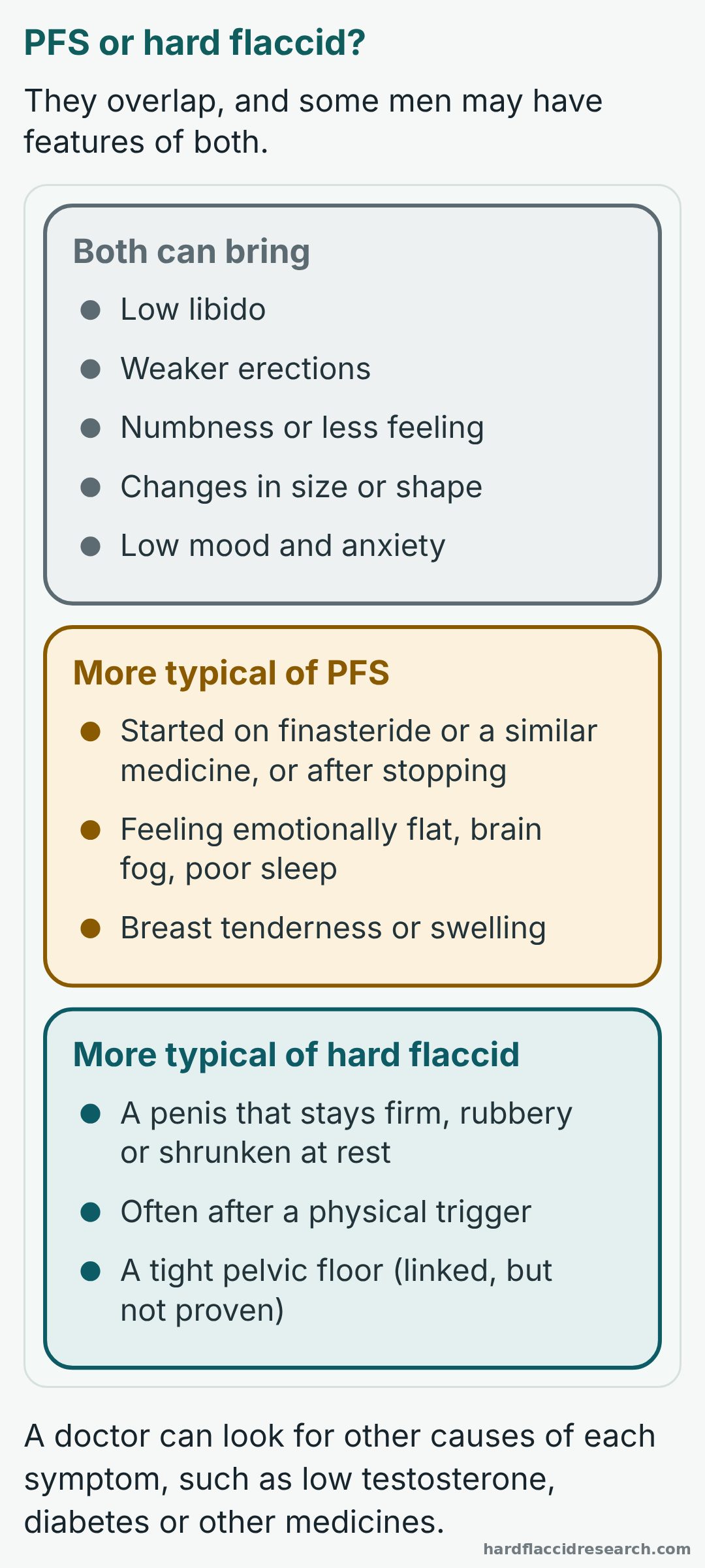
- When it started: PFS starts on or after finasteride or a similar medicine; hard flaccid often follows a physical trigger, such as an enlargement method, rough masturbation or an injury.
- The penis at rest: hard flaccid is named for a firm, rubbery or shrunken penis at rest, which isn't a usual PFS symptom, though size and shape changes are.
- Mood and thinking: low mood, anxiety, feeling flat and brain fog are central to many descriptions of PFS, and many men with hard flaccid write about low mood and anxiety too.
- The pelvic floor: a tight pelvic floor is often linked to hard flaccid, though this isn't proven, and isn't typical of PFS; men can have both.
Because they overlap, some men may have features of both, and a doctor can look for other causes, such as low testosterone, diabetes, thyroid problems or other medicines.
Related: Antidepressants and Hard Flaccid: Help or Hidden Problem? »
If you're taking finasteride now
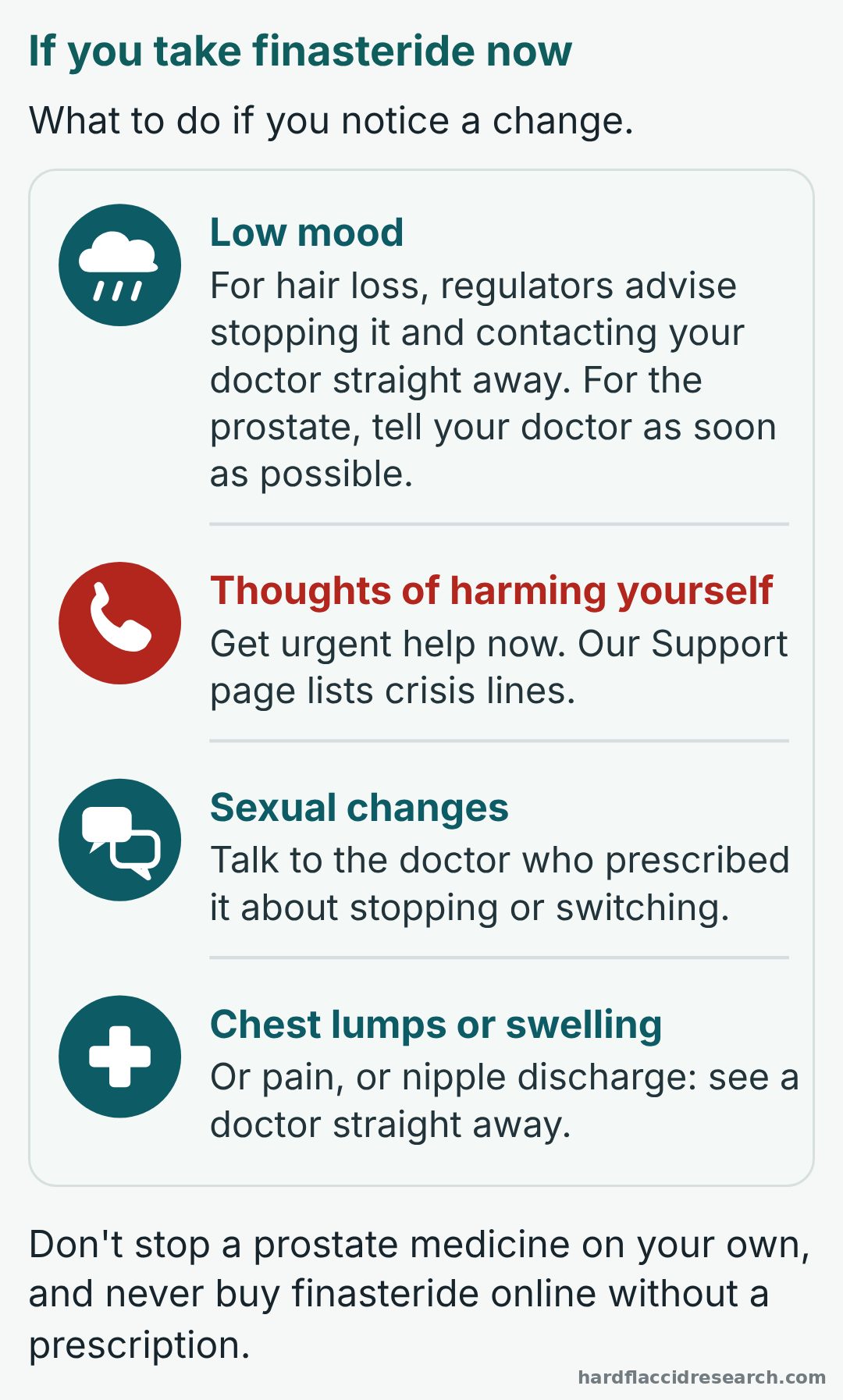
- If you take it for hair loss and notice low mood, or lose interest in things you used to enjoy, UK and European regulators advise stopping it straight away and contacting your doctor. If you take it for an enlarged prostate, tell your doctor as soon as possible rather than stopping on your own.
- If you have any thoughts of harming yourself or ending your life, get urgent help now (see below). If you take finasteride for hair loss, regulators advise stopping it straight away too.
- Tell family or friends that finasteride can affect mood, so they can tell you if they notice a change.
- If you notice sexual changes, talk to the doctor who prescribed it about stopping or switching. Don't stop a prostate medicine on your own.
- Lumps, pain or swelling in your chest, or discharge from a nipple, need a doctor straight away.
- If you'd rather avoid finasteride for hair loss, ask about other options, such as minoxidil, which can irritate the scalp and, as tablets used off-label, cause dizziness, a fast heartbeat and swollen ankles.
- Don't buy finasteride, dutasteride or minoxidil tablets online without a prescription.
Post-finasteride syndrome treatment
There is no proven treatment for post-finasteride syndrome, and none for hard flaccid syndrome yet. Doctors usually treat each symptom on its own, after checking for other causes. Ways that may help:
- See a doctor first. Tell them when your symptoms started, and when you took and stopped finasteride or any similar medicine or supplement.
- Blood tests: a doctor may check testosterone and other hormones, blood sugar and thyroid. Testosterone treatment only helps if tests show a low level, and it can switch off your own sperm production, thicken the blood and raise blood pressure.
- Mood: talking therapy, such as CBT, may help with low mood and anxiety. A doctor may suggest an antidepressant; sexual side effects are common with them and can carry on after stopping, some people feel worse when they first start one, and stopping suddenly can cause withdrawal.
- Erections: a doctor may discuss an erection medicine such as tadalafil or sildenafil, after checking your heart and other medicines. Never take one with nitrate medicines for chest pain, riociguat or poppers, because together they can drop your blood pressure dangerously.
- A tight pelvic floor: if this is part of the picture, a pelvic health physio can check the muscles and teach them to relax, rather than strengthening them.
- Sex and relationships: a sex therapist can help you, and a partner, take the pressure off sex.
Separately, men with hard flaccid discussed many approaches, from pelvic floor physio (656 men) and supplements (624) to talking therapy, CBT, mindfulness or meditation (603); the chart shows more. These are for hard flaccid in general, not finasteride, and discussing something is not the same as it working.
Be wary of hormones, peptides or supplements sold online as fixes for PFS: none is proven, and prescription hormones bought without a prescription can be unsafe.
Talk to a doctor first. Finasteride and dutasteride are prescription medicines. They can cause sexual side effects, breast changes and low mood, and finasteride, rarely, thoughts of suicide; in some men sexual side effects have carried on after stopping. If you take finasteride for hair loss and your mood drops, UK and European regulators advise stopping it and contacting your doctor straight away; if you take finasteride or dutasteride for an enlarged prostate, tell your doctor as soon as possible rather than stopping on your own. Thoughts of harming yourself need urgent help. Both lower PSA results, and women who are or may be pregnant shouldn't handle broken finasteride tablets or leaking dutasteride capsules. Saw palmetto may act a little like them and may raise the risk of bleeding with a blood thinner. Minoxidil can irritate the scalp, and its tablets can cause dizziness, a fast heartbeat and swollen ankles. Testosterone only helps if blood tests show a low level, and it can switch off your own sperm production, thicken the blood and raise blood pressure. Antidepressants commonly cause sexual side effects; some people feel worse or have thoughts of harming themselves when they first start one, so get help straight away if that happens, and stopping one suddenly can cause withdrawal. Erection medicines such as tadalafil and sildenafil need a heart and blood pressure check first; never take one with nitrate medicines for chest pain, riociguat or poppers, because together they can drop your blood pressure dangerously. If you get chest pain, tell the ambulance crew which medicine you've taken and when: nitrates must not be given within 24 hours of sildenafil or 48 hours of tadalafil. Get urgent care for an erection lasting more than 4 hours, or sudden loss of sight or hearing. Tell your doctor or pharmacist about every medicine and supplement you take, and never buy any of these online without a prescription. Otherwise, never start, stop or change a medicine on your own.
Looking after your mood
Low mood is a real part of these conditions, not a weakness. In one January 2023 poll, 67% of men with hard flaccid syndrome said hard flaccid affects their life dramatically (83 of 124 men); it asked nothing about finasteride.
Talk to someone you trust, and tell your doctor how you're feeling. Separately, 142 men with hard flaccid wrote about thoughts of ending their life. If that's you, you are not alone, and those thoughts can pass with the right help.
If you are feeling hopeless or having thoughts of ending your life, please visit our Support page now. It lists crisis lines you can call or text today.
Common questions about post-finasteride syndrome
Is post-finasteride syndrome real? The symptoms are real; how often finasteride causes them, and why, isn't settled.
Do finasteride side effects go away? For most men who get them, yes: they settle while taking it or after stopping. For some they carry on. Some men report slow improvement over time, but there are no good figures on how many recover.
Does finasteride cause erectile dysfunction? It can in some men; erection problems are a listed side effect, though they have many other causes too, so a doctor can check.
Can finasteride cause hard flaccid? No study has shown that it does, and hard flaccid syndrome itself is little studied. Few men with hard flaccid link it to DHT blockers, but if your symptoms started while taking finasteride or after stopping it, tell your doctor.
Is topical finasteride safer? It isn't known: less gets into the blood, but side effects have still been reported. Europe's review found no evidence linking the spray to thoughts of suicide; in the US no topical form is approved, and the FDA has warned about side effects with compounded sprays.
What are the side effects of dutasteride? Much like finasteride's: lower libido, erection and ejaculation problems, breast changes and a lower PSA, plus a mood warning as a precaution. It is mainly for an enlarged prostate, so don't stop it on your own.
When to see a doctor
See a doctor about sexual, physical or mood symptoms while taking finasteride, dutasteride or saw palmetto, or after stopping. Ask about hormone blood tests, other causes and support for your mood. If you've had numbness between your legs for a while, or pain worse when sitting, ask a doctor to check the nerves; new numbness there needs urgent care (see the list below).
A new bend or change in shape is worth checking early, in case of another condition (Peyronie's disease). If your erections have changed, ask about a blood test for blood sugar (HbA1c) and cholesterol. Our doctor visit kit helps you take your symptoms, dates and questions with you.
Get urgent care straight away if you have:
- Thoughts of ending your life, or of harming yourself.
- Swelling of your lips, face, tongue or throat, or trouble breathing.
- An erection lasting more than 4 hours.
- Chest pain, a fast or pounding heartbeat, fainting, or sudden loss of sight or hearing, after taking an erection medicine.
- Sudden, severe pain in the penis, testicles or pelvis.
- New numbness around your back passage, genitals or inner thighs, or new weakness in your legs.
- New trouble starting or controlling your pee, not being able to pee, or not feeling when your bladder is full.
- Loss of control of your bladder or bowel.
- A fever or chills with pelvic pain or pain when peeing.
What to do next
- If your symptoms haven't been checked, see a doctor first, because they can have other causes.
- If you take finasteride now and your mood has dropped, contact your doctor straight away; thoughts of harming yourself need urgent help.
- Write down when your symptoms started, and when you started and stopped any medicine or supplement.
- Use our self-check to see how your symptoms compare.
- Add your experience, so the next man has better numbers than we do.
Our members' guide, Weak Erections With Hard Flaccid: The Gentle Way Back to Sex, explains what may be behind weaker erections and low libido, and has a step-by-step plan for coming back to sex gently.
Free tools that can help
- Self-check: do I have hard flaccid?Compare your symptoms with what 6,026 men report.
- Doctor visit kitA one-page summary to take to your appointment.
- Habit trackerCount your days without porn or masturbation, and get through urges.
- Diaphragm breathing toolBreathe with a moving picture of your diaphragm and pelvic floor.
- Add your experienceTell us what you tried and how it went. No name needed.
- Hard Flaccid Syndrome CensusWhat men answered in 818 polls.
- Symptom trackerLog your symptoms and see what helps you.
- Ask us a questionThe questions men ask most become new articles.
The numbers behind this article
Every number in this article comes from what men with hard flaccid syndrome shared between December 2020 and October 2026, counted once per person, or from their polls. These are self-selected reports, not a clinical study. See hard flaccid syndrome statistics, the Hard Flaccid Syndrome Census and how we count.
In one poll, 4% of men with hard flaccid syndrome named DHT blockers such as finasteride as how they got hard flaccid syndrome (6 of 164 men)
How 164 men with hard flaccid syndrome answered a March 2023 poll: "How did you get hard flaccid?"Naming a cause isn't proof of it. Finasteride can cause low mood and, rarely, thoughts of suicide; never start, stop or change a medicine on your own.
Source: Hard Flaccid Research, hardflaccidresearch.com
Of the 38 men with hard flaccid syndrome who named a medication or supplement as how it began, 82% described the firm flaccid state
Of the 38 men with hard flaccid syndrome who named a medication or supplement as how it began, the share who described each symptom. Each man is counted once in each bar.Not all of them named finasteride. Naming a cause isn't proof of it, and men who wrote about a cause tended to describe more symptoms of every kind.
Source: Hard Flaccid Research, hardflaccidresearch.com
In what men with hard flaccid syndrome wrote, 35% described weaker erections and 9% low libido
Share of the 2,661 men with hard flaccid syndrome who described their symptoms. Each man is counted once in each bar.These are men with hard flaccid syndrome from any cause, not men with PFS. Counts from what men wrote run lower than poll answers, because men weren't asked.
Source: Hard Flaccid Research, hardflaccidresearch.com
In one poll, 83% of men with hard flaccid syndrome said their libido had been lower or gone since hard flaccid syndrome began (71 of 86 men)
Each bar is a different poll of men with hard flaccid syndrome, with its own number of men.None of these polls asked about finasteride. These are self-selected reports, not a clinical study.
Source: Hard Flaccid Research, hardflaccidresearch.com
916 men with hard flaccid syndrome wrote about anxiety, and 550 about low mood or depression
Number of men with hard flaccid syndrome who wrote about each, counted once per person.These are men with hard flaccid syndrome from any cause. If you are having thoughts of ending your life, please visit our Support page now.
Source: Hard Flaccid Research, hardflaccidresearch.com
Men with hard flaccid syndrome discussed many approaches; discussing one isn't proof it works
Number of men with hard flaccid syndrome who discussed each, counted once per person. These are for hard flaccid syndrome in general, not finasteride.These are for hard flaccid syndrome in general, not finasteride. Other approaches came up too, and discussing something is not the same as it working. Never take erection medicines with nitrates, riociguat or poppers; antidepressants can cause sexual side effects; anti-anxiety medicines can cause drowsiness, and some are habit-forming; testosterone can switch off sperm production; never start, stop or change a medicine on your own.
Source: Hard Flaccid Research, hardflaccidresearch.com
343 men with hard flaccid syndrome asked why their erections are weaker and whether they will recover
Number of men with hard flaccid syndrome who asked each question, counted once per person.The groups overlap: one man can ask more than one question.
Source: Hard Flaccid Research, hardflaccidresearch.com
Every number in this article, with its source
| In this article | Source |
|---|---|
| 2,661 of the 6,026 men who shared their experiences described their symptoms | Research data, December 2020 to October 2026 |
| 38 men named a medication or supplement as how their hard flaccid syndrome began | 38 men, counted from what men wrote, once per person |
| Of the 38 men who named a medication or supplement: 82% firm flaccid state, 47% weaker erections, 45% numbness, 37% hourglass shape or dents, 32% shrinkage, 29% bowel symptoms | 38 men who named a medication or supplement, counted from what men wrote, once per person |
| 4% named DHT blockers (6 of 164 men) | 6 of 164 men, poll, Mar 2023 |
| 41% named masturbation, including excessive Kegels (68 of 164 men) | 68 of 164 men, poll, Mar 2023 |
| 16% named enlargement methods (26 of 164 men) | 26 of 164 men, poll, Mar 2023 |
| 7% named a fall or body injury (11 of 164 men) | 11 of 164 men, poll, Mar 2023 |
| 4% named recreational drugs (6 of 164 men) | 6 of 164 men, poll, Mar 2023 |
| 29% didn't know or named something else (47 of 164 men) | 47 of 164 men, poll, Mar 2023 |
| 35% described weaker erections (926 of 2,661) | 926 of 2,661 men, counted from what men wrote, once per person |
| 34% described numbness (914 of 2,661) | 914 of 2,661 men, counted from what men wrote, once per person |
| 27% described shrinkage (720 of 2,661) | 720 of 2,661 men, counted from what men wrote, once per person |
| 9% described low libido (230 of 2,661) | 230 of 2,661 men, counted from what men wrote, once per person |
| 8% described a weak or painful orgasm or ejaculation problems (202 of 2,661) | 202 of 2,661 men, counted from what men wrote, once per person |
| 6% described fewer or no morning erections (147 of 2,661) | 147 of 2,661 men, counted from what men wrote, once per person |
| 5% described a loss of length or girth (131 of 2,661) | 131 of 2,661 men, counted from what men wrote, once per person |
| 83% said their libido was lower or gone since hard flaccid began (71 of 86 men) | 71 of 86 men, poll, Apr 2023 |
| 79% lost some sensation (85 of 108 men) | 85 of 108 men, poll, Apr 2023 |
| 46% never or only weak morning erections (59 of 128 men) | 59 of 128 men, poll, Jan 2023 |
| 916 men wrote about anxiety | 916 men who wrote about anxiety, research data |
| 550 men wrote about low mood or depression | 550 men who wrote about low mood or depression, research data |
| 186 men wrote about shame or embarrassment | 186 men who wrote about shame or embarrassment, research data |
| 97 men wrote about feeling isolated | 97 men who wrote about feeling isolated, research data |
| 142 men wrote about thoughts of ending their life | 142 men who wrote about suicidal thoughts, research data |
| 67% said hard flaccid affects their life dramatically (83 of 124 men) | 83 of 124 men, poll, Jan 2023 |
| 54% cut down on socialising heavily or no longer leave the house (67 of 125 men) | 67 of 125 men, poll, May 2023 |
| 969 men discussed tadalafil | 969 men, counted from what men wrote, once per person |
| 656 men discussed pelvic floor physio | 656 men, counted from what men wrote, once per person |
| 624 men discussed supplements | 624 men, counted from what men wrote, once per person |
| 603 men discussed talking therapy, CBT, mindfulness or meditation | 603 men, counted from what men wrote, once per person |
| 381 men discussed sildenafil and other PDE5 inhibitors | 381 men, counted from what men wrote, once per person |
| 236 men discussed antidepressants or anti-anxiety medicines | 236 men, counted from what men wrote, once per person |
| 99 men discussed testosterone or hormone treatment | 99 men, counted from what men wrote, once per person |
| 42% at least half better (56 of 132 men) | 56 of 132 men, poll, Jun 2023 |
| 343 men asked why their erections are weaker and whether they will recover | Question group, 343 men, research data |
| 82 men asked how to cope mentally | Question group, 82 men, research data |
| 69 men asked what causes hard flaccid | Question group, 69 men, research data |
| 45 men asked why their libido is low | Question group, 45 men, research data |
| 40 men asked whether supplements help | Question group, 40 men, research data |
| 26 men asked which doctor to see and what tests | Question group, 26 men, research data |
| 22 men asked whether lost size will come back | Question group, 22 men, research data |
| 17 men asked whether sensation will come back | Question group, 17 men, research data |
How we made this article
We started from the question many men asked. Every number was checked against our data. Our editorial team edited it and Dr. Julian Reyes reviewed it medically. Read our editorial policy.
Read next
See more of us on Google
Add Hard Flaccid Research as a preferred source, and Google shows you our pages more often when you search.
Add as a preferred sourceDon't see your question? Ask us. We answer the most-asked ones in new articles.
Cite and share this article
You're welcome to quote this article. Please name Hard Flaccid Research and link to this page, so others can find the full answer and the data behind it. To cite this page, use its link.
Citation
Hard Flaccid Research. (2026). Post-Finasteride Syndrome and Hard Flaccid: The Overlap. Written by the Editorial Team, medically reviewed by Dr. Julian Reyes. https://hardflaccidresearch.com/articles/post-finasteride-syndrome-hard-flaccid
Credit link for your article
Source: <a href="https://hardflaccidresearch.com/articles/post-finasteride-syndrome-hard-flaccid">Hard Flaccid Research</a>
Wikipedia reference
<ref>{{cite web |url=https://hardflaccidresearch.com/articles/post-finasteride-syndrome-hard-flaccid |title=Post-Finasteride Syndrome and Hard Flaccid: The Overlap |website=Hard Flaccid Research |date=2026 |access-date=28 October 2026}}</ref>
How the data was collected: our methodology. Journalists and researchers: key numbers, data and contact.