Sit Bone Pain: Causes of Ischial Tuberosity Pain and Relief
In short
- Sit bone pain is an ache or sharp pain in the bony points at the bottom of the buttocks, called the ischial tuberosities, that you sit on.
- Common causes include irritation of the hamstring tendons that attach there, an inflamed bursa, long hours on hard seats, and tight pelvic floor or hip muscles.
- Nerve irritation can also cause pain in this area, especially when sitting.
- Most causes improve with changes to sitting, targeted exercise and time.
Sit bone pain is an ache, soreness or sharp pain in the bony points at the bottom of the buttocks that take your weight when you sit. Doctors call these bones the ischial tuberosities, and pain there is often called ischial tuberosity pain. It's usually worse when sitting, especially on hard seats, and may spread down the back of the thigh.
The most common causes are irritation of the hamstring tendons that attach to the sit bone and an inflamed bursa, a small cushion of fluid over the bone. Tight hip and pelvic floor muscles and irritated nerves can also cause pain in this area. Most causes improve with changes to how you sit, the right exercises and time. This page explains the causes, what helps and when to see a doctor.
By the numbers: of the 6,026 men who shared their experiences with hard flaccid syndrome, 2,661 described their symptoms, and 233 of them described lower back, hip or hamstring tightness.
Key facts
- The sit bones are the two rounded bony points at the bottom of the pelvis that you sit on.
- The hamstring muscles at the back of the thigh attach to them by strong tendons.
- Proximal hamstring tendinopathy, irritation of these tendons, is a common cause of deep pain at the sit bone, often worse with sitting, running, lunging and squatting.
- Ischial bursitis, inflammation of the cushion over the bone, can follow long hours on hard seats.
- Irritation of the pudendal or sciatic nerves can cause pain in this area that's worse when sitting.
- Tight pelvic floor and deep hip muscles can add to the pain.
- Most cases improve with a cushion, breaks from sitting and a gradual exercise plan.
Where are the sit bones?
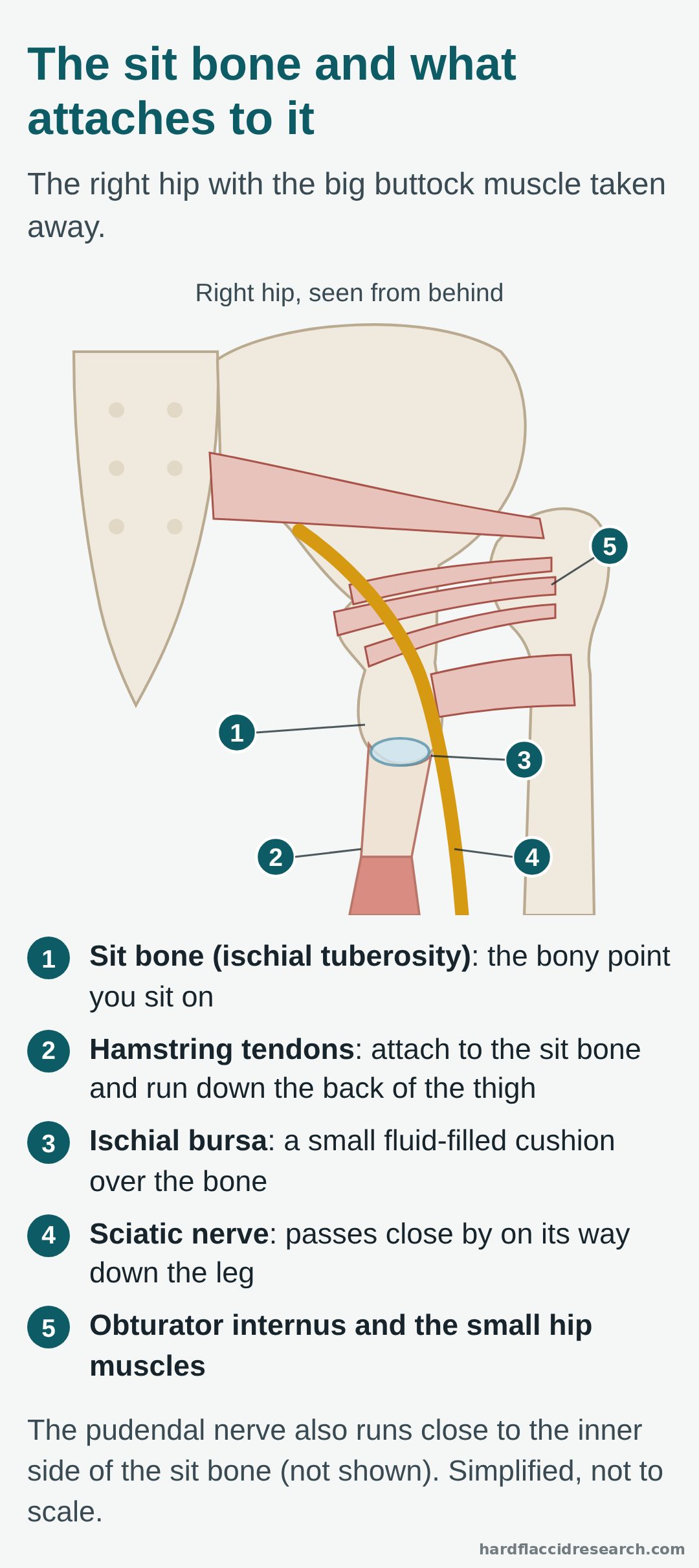
Sit down on a firm chair and slide your hands under your buttocks. The two hard knobs you feel are your sit bones. They're part of the ischium, the lower back part of each hip bone.
When you stand, the big buttock muscle covers them. When you sit or bend forward at the hips, that muscle slides up, and the bones take your weight directly, cushioned mainly by a small bursa and fat. That's why sitting on hard surfaces can make them sore.
Several structures attach to or pass near each sit bone:
- The hamstring tendons, which run down the back of the thigh.
- The sacrotuberous ligament, a strong band to the sacrum and tailbone.
- The sciatic nerve, which passes close by on its way down the leg.
- The pudendal nerve, which runs nearby along the inner side of the bone toward the perineum.
Related: Perineum Pain With Hard Flaccid: Why It Hurts, What Helps »
What causes sit bone pain?
Proximal hamstring tendinopathy
This is irritation and thickening of the hamstring tendons where they attach to the sit bone. It causes deep, aching pain right at the sit bone that's often worse when sitting, especially on hard seats or when driving, and with running, lunging, squatting or stretching the hamstrings. It's common in runners but also happens in people who don't play sports.
Ischial bursitis
The ischial bursa is a small fluid-filled sac that cushions the bone. Long periods of sitting on hard surfaces, or repeated rubbing, can inflame it. It causes pain and tenderness over the sit bone, sometimes spreading down the back of the thigh.
Nerve irritation
- The pudendal nerve runs close to the sit bone. When it's irritated, it can cause burning or aching pain in the perineum, genitals or around the sit bones that's worse when sitting and better when standing or lying down, or when sitting on a toilet seat.
- The sciatic nerve can be irritated near the sit bone, causing pain that shoots down the back of the leg.
Tight muscles
Tight pelvic floor muscles, the obturator internus and the other deep hip muscles near the sit bone can cause deep buttock pain that's hard to pinpoint.
Injury
A fall onto the buttocks can bruise the bone. A sudden, forceful stretch, for example during sprinting or a slip into the splits, can tear the hamstring tendon from the bone, causing sudden pain, often with a pop and bruising.
Referred pain
Problems in the lower back, the sacroiliac joint or the hip can send pain to the buttock and the sit bone area.
What helps sit bone pain?
Change how you sit
- Use a cushion that takes weight off the sit bones, such as a foam cushion with a cut-out at the back or a soft gel cushion.
- Sit on softer surfaces, and avoid very low, deep seats that bend the hips sharply.
- Get up and move often during long periods of sitting.
- Try a standing desk for part of the day.
Exercise and physical therapy
For hamstring tendinopathy, a physical therapist usually starts with exercises that load the tendon gently without bending the hip far, then builds strength step by step. A review of treatments found that research is limited, and exercise-based care is the usual first approach. Deep hamstring stretches can press on the irritated tendon and may make this kind of pain worse.
Pelvic floor and hip muscle work
If tight pelvic floor or deep hip muscles play a part, a pelvic floor physical therapist can help them relax with hands-on release, breathing and relaxation training.
Other treatments
- Ice or warmth, whichever feels better.
- Pain relief a doctor or pharmacist suggests.
- Injections near the bursa or tendon, for pain that doesn't improve.
- Treatment for nerve pain, if a nerve is involved.
Related: Hard Flaccid Worse When Standing? 86% of Men Noticed It »
Sit bone pain and hard flaccid syndrome
Hard flaccid syndrome is a firm, shrunken penis at rest, often with numbness, weaker erections and pelvic pain. Many men with hard flaccid say sitting makes their symptoms worse. Doctors think a tense pelvic floor may help keep hard flaccid going, and the pudendal nerve, which carries feeling from the penis, passes close to the sit bone. This isn't proven.
Of the 2,661 men who described their symptoms, 10% described pelvic, perineal or tailbone pain (267 men) and 9% described lower back, hip or hamstring tightness (233 men). In separate counts, 45 men asked whether sitting makes it worse and 24 men blamed long hours of sitting for their symptoms.
Our members' guide, Hard Flaccid Pain and Flare-Ups: How to Calm Them, includes a sitting plan for long workdays.
How is sit bone pain diagnosed?
A primary care provider, a sports medicine doctor or a physical therapist will ask when the pain started, what makes it worse and whether it spreads, and will press on the sit bone and test the hamstrings. They may suggest:
- An ultrasound or MRI scan, to look at the tendons and bursa.
- An X-ray, after a fall.
- A referral to a pain specialist, neurologist or pelvic floor physical therapist, if a nerve problem or pelvic floor tension is possible.
Our doctor visit kit helps you describe the pain clearly.
When should I see a doctor?
See a primary care provider if sit bone pain lasts more than a few weeks, keeps coming back, spreads down the leg, or comes with numbness or burning in the genitals or perineum.
Get urgent care straight away (call 911 or go to the emergency room) if you have:
- A sudden pop and severe pain at the back of the thigh with bruising, after an injury.
- New numbness around your back passage, genitals or inner thighs, or new weakness in your legs.
- New trouble controlling your bladder or bowel, or not being able to pee.
- A fever or chills with severe buttock or back pain.
- Sudden, severe pain in the penis, testicles or pelvis.
Frequently asked questions
Why do my sit bones hurt when I sit?
When you sit, your weight rests directly on the sit bones, pressing on the hamstring tendons, the bursa and nearby nerves. If any of these are irritated, sitting hurts.
Should I stretch my hamstrings for sit bone pain?
Gentle movement is fine, but hard hamstring stretching often worsens tendon pain at the sit bone. A physical therapist can guide you.
What is the best cushion for sit bone pain?
A cushion with a cut-out at the back, or a soft gel or foam cushion, takes pressure off the sit bones. Try a few to see which feels best.
Can sit bone pain come from the pelvic floor?
Yes. Tight pelvic floor and deep hip muscles near the sit bone can cause deep buttock pain.
How long does sit bone pain take to heal?
Bursitis often settles over weeks with less pressure. Tendon pain can take months of gradual exercise.
Is sit bone pain the same as tailbone pain?
No. The tailbone is in the middle, at the base of the spine. The sit bones are the two bony points on either side, lower down.
Takeaway
Sit bone pain usually comes from irritated hamstring tendons, an inflamed bursa, tight muscles or irritated nerves, and it's usually worse when sitting.
A good cushion, regular breaks, the right exercises and time help most people, and nerve symptoms or sudden injuries need a doctor's check. Take our free self-check if you also notice changes in your penis at rest.
This article is for general information and isn't a substitute for advice from your own doctor. Hard Flaccid Research doesn't diagnose or treat. If you have new or worsening symptoms, see a qualified clinician. In an emergency, call 911.
Free tools that can help
- Self-check: do I have hard flaccid?Compare your symptoms with what 6,026 men report.
- Doctor visit kitA one-page summary to take to your appointment.
- Habit trackerCount your days without porn or masturbation, and get through urges.
- Diaphragm breathing toolBreathe with a moving picture of your diaphragm and pelvic floor.
- Add your experienceTell us what you tried and how it went. No name needed.
- Hard Flaccid Syndrome CensusWhat men answered in 818 polls.
- Symptom trackerLog your symptoms and see what helps you.
- Ask us a questionThe questions men ask most become new articles.
The numbers behind this article
Every number in this article comes from what men with hard flaccid syndrome shared between December 2020 and October 2026, counted once per person, or from their polls. These are self-selected reports, not a clinical study. See hard flaccid syndrome statistics, the Hard Flaccid Syndrome Census and how we count.
10% of men who described their symptoms described pelvic, perineal or tailbone pain
Share of the 2,661 men who described their symptoms. Each man is counted once.These are self-selected reports, not a clinical study.
Source: Hard Flaccid Research, hardflaccidresearch.com
Every number in this article, with its source
| In this article | Source |
|---|---|
| 9% of the men who described their symptoms described lower back, hip or hamstring tightness (233 of 2,661) | 233 of 2,661 men, counted |
| 10% of the men who described their symptoms described pelvic, perineal or tailbone pain (267 of 2,661) | 267 of 2,661 men, counted |
| 6,026 men shared their experiences, and 2,661 of them described their symptoms | 2,661 of 6,026 men, counted |
| 45 men asked whether sitting makes it worse | 45 men asked whether sitting makes it worse, counted from what men wrote, once per person |
| 24 men blamed long hours of sitting for their symptoms | 24 men who blamed long hours of sitting, counted from what men wrote |
Medical sources
What this article says about medical research, guidelines and urgent care comes from these sources.
- Johnson DB, Varacallo M. Ischial Bursitis. In: StatPearls. Treasure Island (FL): StatPearls Publishing. https://www.ncbi.nlm.nih.gov/books/NBK482285/
- Nasser AM, Vicenzino B, Grimaldi A, et al. Proximal hamstring tendinopathy: a systematic review of interventions. Int J Sports Phys Ther. 2021;16(2). https://doi.org/10.26603/001c.21250
- Pudendal Neuralgia. In: StatPearls. Treasure Island (FL): StatPearls Publishing. https://www.ncbi.nlm.nih.gov/books/NBK562246/
- Coccyx Pain. In: StatPearls. Treasure Island (FL): StatPearls Publishing. https://www.ncbi.nlm.nih.gov/books/NBK563139/
- Labat JJ, Riant T, Robert R, Amarenco G, Lefaucheur JP, Rigaud J. Diagnostic criteria for pudendal neuralgia by pudendal nerve entrapment (Nantes criteria). Neurourol Urodyn. 2008;27:306-310. https://pubmed.ncbi.nlm.nih.gov/17828787/
- Lai HH, Pontari MA, Argoff CE, et al. Male chronic pelvic pain: AUA guideline. J Urol. 2025. https://www.auanet.org/guidelines-and-quality/guidelines/male-chronic-pelvic-pain
How we made this article
We started from the question many men asked. Every number was checked against our data. Our editorial team edited it and Dr. Julian Reyes reviewed it medically. Read our editorial policy.
Read next
- Perineum Pain With Hard Flaccid: Why It Hurts, What HelpsArticle
- Hard Flaccid Worse When Standing? 86% of Men Noticed ItArticle
- Osteitis Pubis: Pubic Bone Pain in Men, Causes and ReliefArticle
- Tight hips, back and hamstringsSymptom
- Pelvic and perineal painSymptom
- Long hours sittingCause
- StretchingTreatment
See more of us on Google
Add Hard Flaccid Research as a preferred source, and Google shows you our pages more often when you search.
Add as a preferred sourceDon't see your question? Ask us. We answer the most-asked ones in new articles.
Cite and share this article
You're welcome to quote this article. Please name Hard Flaccid Research and link to this page, so others can find the full answer and the data behind it. To cite this page, use its link.
Citation
Hard Flaccid Research. (2026). Sit Bone Pain: Causes of Ischial Tuberosity Pain and Relief. Written by the Editorial Team, medically reviewed by Dr. Julian Reyes. https://hardflaccidresearch.com/articles/sit-bone-pain
Credit link for your article
Source: <a href="https://hardflaccidresearch.com/articles/sit-bone-pain">Hard Flaccid Research</a>
Wikipedia reference
<ref>{{cite web |url=https://hardflaccidresearch.com/articles/sit-bone-pain |title=Sit Bone Pain: Causes of Ischial Tuberosity Pain and Relief |website=Hard Flaccid Research |date=2026 |access-date=22 November 2026}}</ref>
How the data was collected: our methodology. Journalists and researchers: key numbers, data and contact.